987 résultats
6915London 1783-1816: George Eyre and Andrew Strahan Printers. Hard Cover. Folio 12" X 18 ½". The first four volumes are as follows; Vol. #1-382 leaves Vol. #2-450pp.Vol. #3- 570pp. index vol. Vol. #4-635pp. supplement vol. All are handsomely bound in 19th century ¾ calf over marbled boards raised bands with contrasting red morocco labels gilt. Joints of two volumes expertly repaired; an exceptionally nice set and quite scarce as such. There are 26 blank leaves in volume one with a few leaves containing portions of text or text on the verso. It would appear that these leaves were left blank for illustrations which evidently never took place perhaps because of the cost and manpower it would take to make it possible. The projected cost and labor is noted in volume 3. It does contain the later inserted title pages and contents leaves and the four facsimile leaves are present in the last volume the supplement two displaying hand coloring. The first two volumes are printed on hand-made laid paper watermarked "J. Whatman" and coat-of-arms with the King's Initials "GR". The last two volumes printed on hand-made wove paper by Balston & C. all uncut and wide margined. The last page cvii of the general introduction of the third volume states: "It was not however till after 1770 that the work was actually commenced. It was completed early in 1783 having been ten years in passing through the press. The type with which it was executed was destroyed in the fire which consumed Mr. Nichols' printing-office in the month of February 1808." The book itself was proposed by Mr. John Nichols and executed by Mr. Joseph Jackson and printed by George Eyre and Andrew Strahan. While title pages were added later and dated 1816 printed on the last page of volume three is the printers' names and date1811 and volume four is dated 1816. The Domesday Book was commissioned in December 1085 by William the Conqueror who invaded England in 1066. The Domesday Book project was a major undertaking employing many transcribers of the manuscripts and type makers to design the special type used. It is one of the most ancient records of England and represents an amazing accomplishment. It is the Register from which judgment was to be given upon the value tenure and services of the land. Another point on which the Domesday Survey throws considerable light is the history of the ancient Castles which William erected everywhere. By the completion of this survey the King acquired an exact knowledge of the possessions of the crown. It afforded him names of the land holders and the means of ascertaining the military strength of the country. It also pointed out the possibility of increasing the revenue in some cases and of lessening the demands of the tax collectors in others. The Domesday Book also left exact records behind which give historians today much data about Norman English life and the first appearance of English names. At the end of the introduction to volume four pertaining to the "Bolden Book" is a section considered to be the most important work of the supplement; it is from the Laud MSS. 542. Contained herein is a manuscript note stating; "This account of the 'Bolden Book' was written by me; I also transcribed MS. Laud collated it with the others & prepared the whole for the press as it appeared in that volume. signed Adam Clarke. Adam Clarke was a noted commentator and theological writer who lived in London after 1805. He wrote English translations and new editions of other men's books a bibliographical dictionary in six volumes and many other very important works during his lifetime. He was also a member of the Society of Antiquaries of London. Our only reasoning for this note is the fact that while Clarke transcribed the Laud MS. his name was not acknowledged as the transcriber and does not appear within the text. Only those either of high office or directly involved in its publication had their names included. see DNB Vol iv p. 413 Provenance: Hudson Gurney of Keswick 1775-1864 his book with his signature on the front free endpaper of the first volume. <br/><br/> George Eyre and Andrew Strahan, Printers hardcover books
600008"Abraham Lincoln" in black ink Washington February 10 1862. Folio. Partially printed document on vellum accomplished in a secretarial hand. Blue wafer seal intact. Lincoln's signature is dark. Appointment of Ethan Allen Hitchcock to the rank of Major General of Volunteers. Boldly co-signed by Edwin Stanton Secretary of War and Adjutant General L. Thomas a few small holes at the folds else fine fresh and dark. Lincoln 1809-65 16th President of the United States 1861-65 and one of the most important figures in American history. Hitchcock 1798-1870 Graduated West Point in 1817; served in Florida war; later with Winfield Scott in Mexico. He was commissioned Major-General of Volunteers as per this document in 1862 and rendered many valuable services to Lincoln's administration and the Union Army see Basler's Lincoln for numerous references to him. Signed by Authors. F. Soft cover. hardcover books
1795M3955Jena:: Fiedlerianis 1795. 1795. 232 x 197 mm. Small 4to. iv iv 46 ix pp. Foxed. Self wraps; last few gatherings loose. Ex library rubber stamp on title. Very good. Albers' dissertation on dropsy of the belly. Johann Abraham Albers studied under J. C. von Loder and Chistoph Wilhelm Hufeland 1762-1836. Hirsch I pp. 80. Not in RLIN. Fiedlerianis, 1795. paperback books
1930M14059New York:: Paul B. Hoeber 1930. 1930. 8vo. x 318 pp. 50 illustrations index. Original maroon blind and gilt-stamped cloth; extremities a bit frayed. Endleaves with several rubber stamps of previous owner: Dr. Robert V. Day Los Angeles. Very good. First edition. Edwin Beer 1876 – 1938 American surgeon took his medical degree at College of Physicians and Surgeons of New York. He pioneered the endoscopic treatment of papillary bladder tumors. Beer is recognized as the founder of electrosurgery of the bladder. / "The authors base their work on twenty years' experience with diseases of the genito-urinary tract in children. The preliminary chapter is devoted to the symptomatology of genitourinary disease in young life. The technic of cystoscopy and pyelo-ureterography is discussed in some detail. Intravenous pyelography by the use of sodium-2-oxo-5-iodo-pyridine-n-acetate is described and its advantages and indications are pointed out. The use of the Bucky diaphragm is not advised. Edwin Beer writes on enuresis in childhood. He emphasizes the need for a thorough examination in order to determine the etiologic factor. Hyman writes the important chapter on infections of the urinary tract cystitis pyelitis pyelonephritis. He presents the most recent contributions to bacteriologic experimental surgical cystoscopic and roentgenographic progress. He appropriately avers that "pyelitis" is a misnomer which covers a number of conditions and that "pyuria" is more applicable until the true nature of the underlying lesion is understood . . . This monograph presents the essential clinical and special urologic data in a clear practical manner." – JAMA. 1930;9517:1286. See: G. W. Kaplan "Edwin Beer--a patriarch of pediatric urology." Urology 1999 Jan;531:236-8. Kiefer 634. Paul B. Hoeber, 1930. hardcover books
186536081Philadelphia: Jas. B. Rodgers Printer 52 & 54 North Sixth Street 1865. 1st printing Monaghan 757. Limited to 750 cc. INSCRIBED by the author at the top of the front wrapper. Printed grey paper wrappers. Age-toning to wrappers. A VG copy. 19 1 blank. 9-1/16" x 5-7/8" <br/><br/> Jas. B. Rodgers, Printer, 52 & 54 North Sixth Street unknown books
6726Engraved frontis.; eight engraved vignettes and head- & tailpieces 19 finely engraved plates most folding & some engravings in the text. 18 p.l. 254 36 pp. of index & errata. Thick 8vo 160 x 105 mm. late 18th-cent. marbled boards extremities a little rubbed & worn. Dresden: C. G. Nitzsche 1765. An important German edition of Bosse's Traité des manières de graver en Taille douce 1st ed. in French: 1645 considerably augmented for the German audience. This work was translated and published by Carl Gottlieb Nitzsche from the 1745 Cochin edition. The Cochin edition was the first to promote etching with hard etching-ground vernis dur instead of the soft etching-ground vernis mol to imitate line engraving. It also featured long sections on Le Blon's color printing and the refining of mezzotint illustration. In the present book we find four illustrations of the rolling press which Cochin had updated to account for several design upgrades. There are also several diagrams and cross-sections of printing presses. This book is richly illustrated with plates and vignettes executed by Carl Gottfried Nestler 1730-80 that depict various techniques equipment and the interiors of print shops. Nestler reworked the engraved title-page from the 1645 first edition for this book's frontispiece. A very good copy internally fresh. Unidentified engraved bookplates with the initials "G. F." on front and rear paste-downs. ❧ Benezit Dictionary of Artists Vol. 10 p. 258 Nestler. hardcover books
1927M2591Berlin:: Julius Springer 1927. 1927. 243 x 165 mm. 8vo. iv 285 pp. Index. Original printed wrappers. Very good. FIRST GERMAN EDITION of Flexner's comparative study of medical education. Flexner wrote the first systematic and thorough comparisons of the major systems of medical education with his medical education in Europe New York 1912. Here he continues and expands his work. Garrison and Morton 1766.504 English ed. New York 1925. Julius Springer, 1927. unknown books
1995201413New York: New York University Press 1995. Hardcover. xxxix 242p. foreword introductions author's foreword very good first printing of this new edition with added materials quarter-cloth over decorated boards. The Cutting Edge: Lesbian Life and Literature series editor: Karla Jay. New York University Press hardcover books
1995201414New York: New York University Press 1995. Paperback. xxxix 242p. foreword by Karla Jay signed introductions author's foreword very good first printing of this new edition with added materials trade paperback in pictorial wraps. The Cutting Edge: Lesbian Life and Literature series editor: Karla Jay. New York University Press paperback books
1927264123New York: Arbayter-Ring for the Neye Gezelshaft and Ferer Senter Branche 1927. 371p. hardcover mild shelfwear very good. Text in Yiddish. Arbayter-Ring for the Neye Gezelshaft and Ferer Senter Branche unknown books
1920263519New York: Cloak Operators' Union Local no. 1 1920. xiii 251 pages very good hardcover text in Yiddish. Cloak Operators' Union, Local no. 1 unknown books
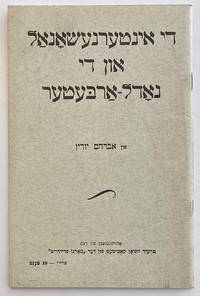
1965263459New York: Morgen Freiheit Trade Union Committee 1965. 32p. staplebound pamphlet very good. Text in Yiddish except for English title on verso of cover: I.L.G.W.U. and the needle trade workers. The Morgen Freiheit was the main Communist Party-affiliate Yiddish paper in New York. Morgen Freiheit Trade Union Committee unknown books
1925262954New York: Natzionaler Ekzekutiw Komite fun Arbeiter Ring 1925. Two hardcover volumes minor shelfwear top of spine panels rubbed. On the history of the Workers Circle formerly Workmen's Circle. Natzionaler Ekzekutiw Komite fun Arbeiter Ring unknown books
1987255469Lagrasse France: Éditions Verdier 1987. 334p. french-fold wraps 5.5 x 8.5 inches pages lightly toned pen notation on front blank old price sticker on rear wrap else very good condition. Text in French. Collection "Les Dix Paroles Éditions Verdier unknown books
18841562Various places in South Africa Botswana 1884. Overall very good. 295pp. plus five additional letters totaling 60pp. altogether more than 38000 words. Composed mostly on small octavo sheets. Some wear to edges of initial and final few leaves slightly affecting text. Light even tanning. Written in a consistent legible script. An extensive and outstanding manuscript account of travel and exploration in southern Africa during late 1883 and early 1884 by Abraham Anscher a Polish Jewish immigrant to Chicago. The manuscript is composed in the form of a letter addressed to Edith Delia Rogalski but really comprises a travelogue or diary with entries written from September 1883 to mid-January 1884. Five additional letters accompany this account addressed to Edith's later husband Israel Jackson Roe; her parents Samuel and Sarah Rogalski; and her brother Benny. <br/><br/>Anscher's descriptions of his experiences in Africa cover a wide variety of topics including big game hunting; interactions with local indigenous peoples and their rulers; encounters with white missionaries traders and other hunters; ethnographic botanical geological and zoological observations and much more. His account is by turns dramatic and amusing interspersed with personal recollections of family and home cultural and religious notes his addressee was also a Polish-speaking Jewish immigrant to Chicago and reminiscences of earlier adventures in Colorado Utah the California gold fields and elsewhere.<br/><br/>Little can be readily discerned of the details of Anscher's biography beyond the pages of this manuscript. He was born in Mariampol then a part of Poland and today in Lithuania but clearly came to the United States at an early age and was well-educated. He was an adventurer at heart and spent several years in the West perhaps in the U.S. Army for part of this time and partly as a solo fortune seeker. At some point during the mid- to late-1870s he decided to take his adventuring talents to South Africa in order to satisfy his own wanderlust and to create a business of organizing guided African exploration and hunting. The stakes of his chosen profession are mentioned several times throughout his narrative such as when a party member dies of an unspecified illness "My lot is a very hard one just now and my position as promoter and chief adventurer is anything but enviable". From the additional letters present it is apparent that the young Ms. Rogalski was a former love interest of Anscher who spurned his affections and became engaged to a mutual friend. Indeed a letter here addressed to the fiancé offers an apology for presumption of writing to Edith in such a lengthy and cordial manner; at one time all of the individuals addressed by Anscher were a part of the same immigrant community in Chicago.<br/><br/>This absorbing account follows a lengthy excursion organized and led by Anscher across the Transvaal through Bechuanaland Matabeleland and beyond to a settlement he calls Tatti probably Francistown on the Tati River traveling through parts of modern-day South Africa and Botswana. They contain many details of great interest and his vignettes are well-written and dramatically delivered. An immense boa constrictor drops out of the treetops strangling a springbok before his eyes. He finds a five-year-old girl with a broken leg the only survivor of a village massacre; he sets her leg nurses her for a month and eventually conveys her to a missionary station. A young zebra joins the traveling party incurring the jealousy of the team's dogs. A large lizard is trained to sleep in a tent but only after his teeth are removed for safety. <br/><br/>His missive begins in medias res with his party already underway in South Africa near the Orange River in what he calls the "Tarka bush" during mid-September 1883. Anscher decides having missed his last opportunity to send mail "Now to put myself on guard against mischance and not be like the traditional foolish virgins who did not keep their lamps properly trimmed.to have a so-called running letter always open and ready" for his recipient. The group first traveled northeast near and along the Orange allowing Anscher to wax discursive concerning the river's wildlife:<br/><br/>"The wanderings of the river sometimes flowed through immense chasms over hung with stupendous precipices and then like a translucent lake with beautiful towering mimosas and willows reflected from its bosom and a rich variety of fine plumage though without a song; wild geese ducks snipes flamingoes in perfect security feeding on the banks beneath the green shade or basking in the sun's rays on the verdant islands far from the fowler's snare. The swallows also mounting aloft or skimming the surface of the mirror of the stream; while the ravens with their hoarse note might be seen seeking their daily food among the watery tribe or cawing on the bending tops of the weeping willows."<br/><br/>The party leaves the river and skirts the southern edge of the Kalahari to reach Lattakoo modern-day Dithakong a traditional departure point for excursions deeper into the interior of Africa during the 19th century. Thence they headed north again stopping often to hunt for food and sport:<br/><br/>"When on the Kama plains I went one night accompanied by Tytler and Winsloe and one native to a pool of water about two miles from camp. We did not wait more than about half an hour when we heard loud lapping at the water. The natives told me 'Ronimala ' be silent 'There is a lion.' Our next visitors were two buffaloes but we did not fire lest we attract the attention of the lions. Next came three giraffes and one we knocked over on the spot and wounded another but who got away. I have seen plenty of game in my time. I saw and hunted antelope and elk on the Laramie plains and in the Meek Mountains in America before the Union Pacific RR was built. I saw quite enough of buffalo in the Smokey Hills and Montana as well as south of the Green Horn Mountains between California and Arizona but such a variety of game big game and in such number as I saw some years ago in the Transvaal & Swaziland and hereabouts now I never saw anywhere."<br/><br/>As the excursion proceeds further into the interior their encounters with native tribes increases and Anscher observes them keenly and reports with a detailed if somewhat jaded 19th-century eye:<br/><br/>"The town of Kalabeg is already in the Matabele country. Of course they have no religion of any kind for there is no such thing as natural religion. Men acquire knowledge good or bad from instruction of men with more fertile brains. This holds good all the world over. The rainmakers here hold the position of prophets and divines of the so-called civilized countries. These rainmakers who are also the doctors and sextons have great influence over the minds of the people and are held in great estimation by them superior to that of their king who is likewise compelled to yield to the dictates of this personage the rainmaker. Nothing can exceed the freaks of fancy and the adroitness with which the rainmaker can awe the public mind and lead thousands captive at his will. Each tribe has one or more of them and they generally come from other countries for a prophet is seldom honored in his own country."<br/><br/>Arriving in Shoshong in what is now central Botswana Anscher meets some missionaries and witnesses a tribal gathering which leads him to remember the religious theories of a familial acquaintance back home:<br/><br/>"Was present at a Pitsoh or native congress this forenoon held by the natives about some tribe affairs. About 12000 natives present and wound up the proceedings with a war dance. As these tribes are considered by some religious enthusiasts to be of the lost tribes of Israel not your own but ours and as your uncle once spoke to me about them while at Chicago I would therefore request you to kindly tell him to disabuse his mind on this point and that the only peg whereon the so-called lost tribe maniacs hang their argument in favor of their hobby is that the natives practice a certain custom which history attributes to our father Abraham. But this ceremony takes place instead of at the age of 7 days old when they are about fourteen years old and even when older. But they have no tradition as to why it is done. If this simple custom entitles them to be call Jews why for my part they are quite welcome to the honor. But this is about all there is to build the theory on." <br/><br/>Despite his occasionally sarcastic and somewhat disparaging demeanor toward the natives he encounters Anchser seems overall to have a decent connection with them at a personal level and to understand a basic sense of shared humanity. In one particularly poignant episode Anscher meets a mother and father who have walked 300 miles to ransom their two teenaged sons enslaved by a local chief: <br/><br/>"Neither the man's looks nor ornaments excited the smallest emotion in the bosom of the chief and when he was solicited by one who felt something of a father's love to pity the old man who had walked so far and brought his all to purchase his own children he at last replied with a sneer that one of the boys died last year and for the other he wants an ox at least. 'But I have not even a goat' pleaded the old man 'the Matabele have taken all I had and destroyed my hut.' A sigh it was a heavy sigh burst from his bosom one dead and the other not permitted to see anymore. The chief walked off while the man sat leaning his head on the palm of his hand and his eye fixed on the ground apparently lost to everything but his grief. On taking up his trinkets to retire I told him to keep up a good heart that I would try to get him his boy. He started at the sound of my voice kneeled before me and laid down his trinket saying 'take all this but get me back my boy.' I got him his boy for a colored blanket and 1 lb. of tobacco."<br/><br/>When sad and homesick Anscher recalls his time in Chicago and in the West but it is often insufficient comfort. After departing Shoshong for Tatti Anscher must leave his group to "pioneer" a trail to the settlement:<br/><br/>"On the evening of my first day's journey I had to off-saddle a term used here on a waterless plain picketed my horse and went to bed minus my supper or dinner. I awoke suddenly by something touching me on my forehead like the cold nose of a dog but I could see nothing in the dark except my horse who was laying down poor fellow. After this occurrence I could sleep no longer. My head was hot my lips parched and had no taste even for a cigarette. I daresay some of you have experienced waiting for a train early in the morning in some out of the way small RR station where moments appear like days. Well waiting there is not a patch to lying in the dark in Africa's solitude waiting for daylight to come. I tried to divert my mind and think of anything but water but I could not do it! I tried to cool myself by thinking of Chicago in the month of Feb. but that only led me to snow and from snow to water. One may as well try Ovid's 'Remedia Amoris' to cure him from hankering after the girl he loves as to try Chicago in my case as a remedy when thirsty." <br/><br/>The difficulties of obtaining food and water establishing safe camp and finding routes through minimally charted territory evident in this final passage are an ever-present theme of the expedition but Anscher eventually guided his group to their destination where they intended to stay for a month or two before heading further north to Victoria Falls on the Zambezi River. The final entries describe life at the settlement and how a Portuguese colonial explorer and administrator Alexandre de Serpo Pinto whom they met in camp would be entrusted with the present manuscript as he traveled to Namaqualand on the west coast of Africa in the hopes that it would eventually find its way aboard a ship bound for America. Pinto was a fascinating figure in his own right -- he explored the interior of Africa for Portugal in the 1860s and 1870s and after this meeting with our author became the Portuguese Consul in Zanzibar.<br/><br/>Anscher's trail goes somewhat cold after January 1884 when he relinquished control of this massive "running letter." An additional fragment of a later letter to Edith Rogalski included here forwarded via a mining acquaintance in Kimberly contains a few tantalizing details of his onward expedition including an attack on their party near Victoria Falls by a group of slavers led by "an American Negro." He was also working on a journal and taking photographs which are mentioned several times throughout this account but the survival of this other material as well as the ultimate conclusion of this expedition are not known. A wonderful unpublished account of African exploration by a seemingly unlikely and apparently otherwise unknown American character. A complete transcription of the manuscript is available upon request. unknown books
18843195451884. 295pp. plus five additional letters totaling 60pp. altogether more than 38000 words. Composed mostly on small octavo sheets. Some wear to edges of initial and final few leaves slightly affecting text. Light even tanning. Written in a consistent legible script. Overall very good. 295pp. plus five additional letters totaling 60pp. altogether more than 38000 words. Composed mostly on small octavo sheets. An extensive and outstanding manuscript account of travel and exploration in southern Africa during late 1883 and early 1884 by Abraham Anscher a Polish Jewish immigrant to Chicago. The manuscript is composed in the form of a letter addressed to Edith Delia Rogalski but really comprises a travelogue or diary with entries written from September 1883 to mid-January 1884. Five additional letters accompany this account addressed to Edith's later husband Israel Jackson Roe; her parents Samuel and Sarah Rogalski; and her brother Benny. <br/> <br/>Anscher's descriptions of his experiences in Africa cover a wide variety of topics including big game hunting; interactions with local indigenous peoples and their rulers; encounters with white missionaries traders and other hunters; ethnographic botanical geological and zoological observations and much more. His account is by turns dramatic and amusing interspersed with personal recollections of family and home cultural and religious notes his addressee was also a Polish-speaking Jewish immigrant to Chicago and reminiscences of earlier adventures in Colorado Utah the California gold fields and elsewhere.<br/> <br/>Little can be readily discerned of the details of Anscher's biography beyond the pages of this manuscript. He was born in Mariampol then a part of Poland and today in Lithuania but clearly came to the United States at an early age and was well-educated. He was an adventurer at heart and spent several years in the West perhaps in the U.S. Army for part of this time and partly as a solo fortune seeker. At some point during the mid- to late-1870s he decided to take his adventuring talents to South Africa in order to satisfy his own wanderlust and to create a business of organizing guided African exploration and hunting. The stakes of his chosen profession are mentioned several times throughout his narrative such as when a party member dies of an unspecified illness "My lot is a very hard one just now and my position as promoter and chief adventurer is anything but enviable". From the additional letters present it is apparent that the young Ms. Rogalski was a former love interest of Anscher who spurned his affections and became engaged to a mutual friend. Indeed a letter here addressed to the fiancé offers an apology for the presumption of writing to Edith in such a lengthy and cordial manner; at one time all of the individuals addressed by Anscher were a part of the same immigrant community in Chicago.<br/> <br/>This absorbing account follows a lengthy excursion organized and led by Anscher across the Transvaal through Bechuanaland Matabeleland and beyond to a settlement he calls Tatti probably Francistown on the Tati River traveling through parts of modern-day South Africa and Botswana. They contain many details of great interest and his vignettes are well-written and dramatically delivered. An immense boa constrictor drops out of the treetops strangling a springbok before his eyes. He finds a five-year-old girl with a broken leg the only survivor of a village massacre; he sets her leg nurses her for a month and eventually conveys her to a missionary station. A young zebra joins the traveling party incurring the jealousy of the team's dogs. A large lizard is trained to sleep in a tent but only after his teeth are removed for safety. <br/> <br/>His missive begins in medias res with his party already underway in South Africa near the Orange River in what he calls the "Tarka bush" during mid-September 1883. Anscher decides having missed his last opportunity to send mail "Now to put myself on guard against mischance and not be like the traditional foolish virgins who did not keep their lamps properly trimmed.to have a so-called running letter always open and ready" for his recipient. The group first traveled northeast near and along the Orange allowing Anscher to wax discursive concerning the river's wildlife:<br/> <br/>"The wanderings of the river sometimes flowed through immense chasms over hung with stupendous precipices and then like a translucent lake with beautiful towering mimosas and willows reflected from its bosom and a rich variety of fine plumage though without a song; wild geese ducks snipes flamingoes in perfect security feeding on the banks beneath the green shade or basking in the sun's rays on the verdant islands far from the fowler's snare. The swallows also mounting aloft or skimming the surface of the mirror of the stream; while the ravens with their hoarse note might be seen seeking their daily food among the watery tribe or cawing on the bending tops of the weeping willows."<br/> <br/>The party leaves the river and skirts the southern edge of the Kalahari to reach Lattakoo modern-day Dithakong a traditional departure point for excursions deeper into the interior of Africa during the 19th century. Thence they headed north again stopping often to hunt for food and sport:<br/> <br/>"When on the Kama plains I went one night accompanied by Tytler and Winsloe and one native to a pool of water about two miles from camp. We did not wait more than about half an hour when we heard loud lapping at the water. The natives told me 'Ronimala ' be silent 'There is a lion." Our next visitors were two buffaloes but we did not fire lest we attract the attention of the lions. Next came three giraffes and one we knocked over on the spot and wounded another but who got away. I have seen plenty of game in my time. I saw and hunted antelope and elk on the Laramie plains and in the Meek Mountains in America before the Union Pacific RR was built. I saw quite enough of buffalo in the Smokey Hills and Montana as well as south of the Green Horn Mountains between California and Arizona but such a variety of game big game and in such number as I saw some years ago in the Transvaal & Swaziland and hereabouts now I never saw anywhere."<br/> <br/>As the excursion proceeds further into the interior their encounters with native tribes increases and Anscher observes them keenly and reports with a detailed if somewhat jaded 19th-century eye:<br/> <br/>"The town of Kalabeg is already in the Matabele country. Of course they have no religion of any kind for there is no such thing as natural religion. Men acquire knowledge good or bad from instruction of men with more fertile brains. This holds good all the world over. The rainmakers here hold the position of prophets and divines of the so-called civilized countries. These rainmakers who are also the doctors and sextons have great influence over the minds of the people and are held in great estimation by them superior to that of their king who is likewise compelled to yield to the dictates of this personage the rainmaker. Nothing can exceed the freaks of fancy and the adroitness with which the rainmaker can awe the public mind and lead thousands captive at his will. Each tribe has one or more of them and they generally come from other countries for a prophet is seldom honored in his own country."<br/> <br/>Arriving in Shoshong in what is now central Botswana Anscher meets some missionaries and witnesses a tribal gathering which leads him to remember the religious theories of a familial acquaintance back home:<br/> <br/>"Was present at a Pitsoh or native congress this forenoon held by the natives about some tribe affairs. About 12000 natives present and wound up the proceedings with a war dance. As these tribes are considered by some religious enthusiasts to be of the lost tribes of Israel not your own but ours and as your uncle once spoke to me about them while at Chicago I would therefore request you to kindly tell him to disabuse his mind on this point and that the only peg whereon the so-called lost tribe maniacs hang their argument in favor of their hobby is that the natives practice a certain custom which history attributes to our father Abraham. But this ceremony takes place instead of at the age of 7 days old when they are about fourteen years old and even when older. But they have no tradition as to why it is done. If this simple custom entitles them to be call Jews why for my part they are quite welcome to the honor. But this is about all there is to build the theory on." <br/> <br/>Despite his occasionally sarcastic and somewhat disparaging demeanor toward the natives he encounters Anchser seems overall to have a decent connection with them at a personal level and to understand a basic sense of shared humanity. In one particularly poignant episode Anscher meets a mother and father who have walked 300 miles to ransom their two teenaged sons enslaved by a local chief: <br/> <br/>"Neither the man's looks nor ornaments excited the smallest emotion in the bosom of the chief and when he was solicited by one who felt something of a father's love to pity the old man who had walked so far and brought his all to purchase his own children he at last replied with a sneer that one of the boys died last year and for the other he wants an ox at least. 'But I have not even a goat' pleaded the old man 'the Matabele have taken all I had and destroyed my hut.' A sigh it was a heavy sigh burst from his bosom one dead and the other not permitted to see anymore. The chief walked off while the man sat leaning his head on the palm of his hand and his eye fixed on the ground apparently lost to everything but his grief. On taking up his trinkets to retire I told him to keep up a good heart that I would try to get him his boy. He started at the sound of my voice kneeled before me and laid down his trinket saying 'take all this but get me back my boy.' I got him his boy for a colored blanket and 1 lb. of tobacco."<br/> <br/>When sad and homesick Anscher recalls his time in Chicago and in the West but it is often insufficient comfort. After departing Shoshong for Tatti Anscher must leave his group to "pioneer" a trail to the settlement:<br/> <br/>"On the evening of my first day's journey I had to off-saddle a term used here on a waterless plain picketed my horse and went to bed minus my supper or dinner. I awoke suddenly by something touching me on my forehead like the cold nose of a dog but I could see nothing in the dark except my horse who was laying down poor fellow. After this occurrence I could sleep no longer. My head was hot my lips parched and had no taste even for a cigarette. I daresay some of you have experienced waiting for a train early in the morning in some out of the way small RR station where moments appear like days. Well waiting there is not a patch to lying in the dark in Africa's solitude waiting for daylight to come. I tried to divert my mind and think of anything but water but I could not do it! I tried to cool myself by thinking of Chicago in the month of Feb. but that only led me to snow and from snow to water. One may as well try Ovid's 'Remedia Amoris' to cure him from hankering after the girl he loves as to try Chicago in my case as a remedy when thirsty." <br/> <br/>The difficulties of obtaining food and water establishing safe camp and finding routes through minimally charted territory evident in this final passage are an ever-present theme of the expedition but Anscher eventually guided his group to their destination where they intended to stay for a month or two before heading further north to Victoria Falls on the Zambezi River. The final entries describe life at the settlement and how a Portuguese colonial explorer and administrator Alexandre de Serpo Pinto whom they met in camp would be entrusted with the present manuscript as he traveled to Namaqualand on the west coast of Africa in the hopes that it would eventually find its way aboard a ship bound for America. Pinto was a fascinating figure in his own right -- he explored the interior of Africa for Portugal in the 1860s and 1870s and after this meeting with our author became the Portuguese Consul in Zanzibar.<br/> <br/>Anscher's trail goes somewhat cold after January 1884 when he relinquished control of this massive "running letter." An additional fragment of a later letter to Edith Rogalski included here forwarded via a mining acquaintance in Kimberly contains a few tantalizing details of his onward expedition including an attack on their party near Victoria Falls by a group of slavers led by "an American Negro." He was also working on a journal and taking photographs which are mentioned several times throughout this account but the survival of this other material as well as the ultimate conclusion of this expedition are not known. A wonderful unpublished account of African exploration by a seemingly unlikely and apparently otherwise unknown American character. unknown books
WELLER9780997457810New. New book. unknown books
1669D6035Paris: Frederic Leonard 1669. First Edition. Hardcover. Very Good. 4to 242 x 185 mm. 120pp. Printers woodcut device on title depicting the winged lion of Evangelist Mark and motto Virtute invidiam vince Virtue overcometh envy and the legend Pax tibi marce Evangelista meus. 5 engraved folding plates 4 by Sebastien Le Clerc and one by Abraham Bosse depicting a chameleon on a branch and a plate with chameleons skeleton and organs in the upper part on a trompe-loeil sheet; and the same anatomical analysis for the beaver the camel the bear and the gazelle decorative woodcut head- and tail-pieces. Contemporary mottled calf spine gilt in compartments plates with some tears along folds repaired on verso some light darkening minor marginal worming at end; light edgewear. From the collection of Charles Philippe Robin 1821-1885 French doctor anatomist and politician bibliographical note at foot of title. Other early inscriptions to title referring to the engraver M. LeClerc and on rear pastedown to the state of the engravings. <br/><br/>First Edition and second publication dealing with the comparative anatomy of the animals the chameleon the beaver the camel the bear and the gazelle. Perrault scientist and naturalist was the leader of a team of comparative anatomists called the Parisians that included Guichard-Joseph Duverney Jean Pecquet Moyse Charas and Philippe de la Hire. Their investigations began in June 1667 with a thresher shark and lion from the royal academy and went on to encompass forty-nine vertebrate species. The detailed reports and exact descriptions on these dissections were the first of a long series of anatomical descriptions which ultimately included those of twenty-five species of mammals seventeen birds five reptiles one amphibian and one fish. Perrault and the team of Parisians prided themselves on several discoveries and in the process debunked many popular myths attached to certain species such as the legend that salamanders live in fire or that chameleons subsist on air. The scientists also recorded how they obtained their results providing a glimpse of how such anatomical research was conducted in the seventeenth century. The work is illustrated beautifully with five large folding plates by the expert painter engraver and writer Sebastian Leclerc 1637-1714 four of which were engraved by Leclerc and one by the watercolor painter writer and printmaker Abraham Bosse c. 1604-1676. Very fine work; the large folding plates remain fresh and intact. No such detailed and exact descriptions and illustrations had been published before. It is hard to measure another such important addition to the anatomical study of animals. Frederic Leonard hardcover books
195279016Meriden 1952. Hardcover. Very Good. photos unpaginated. 28cm. No Jacket. <br/><br/> hardcover books
1866238120Washington D.C.: John H. Littlefield; Wm. Terry Printer 1866. Photograph by John Goldin of Littlefield's painting on printed mount. 1 vols. Image 11 1/2 x 18 3/4 in.; mounted to 19 x 24 in. Soiling to image vertical crease large chips to bottom of mount not affecting image or legend; good. Photograph by John Goldin of Littlefield's painting on printed mount. 1 vols. Image 11 1/2 x 18 3/4 in.; mounted to 19 x 24 in. A published photograph of Littlefield's hyper-realistic Lincoln death-bed painting each figure meticulously rendered from photographs. Littlefield studied law under Lincoln in 1858 stumped for him in his Presidential bid and was rewarded with a position in the Treasury Department. After Lincoln's death Littlefield invented this tableau of twenty-five people ranged around the death-bed including Vice-President Johnson Surgeon Chalres Leale and Mrs. Lincoln. "The artist used photographs as models for the twenty-five people gathered in the death room but his profile of the dying Lincoln shows a first-hand acquaintance" Ostendorf LINCOLN'S PHOTOGRAPHS p. 279. Provenance: Harper Family John H. Littlefield; Wm. Terry, Printer unknown books
1866238011Washington D.C.: John H. Littlefield; Wm. Terry Printer 1866. Photograph by John Goldin of Littlefield's painting on printed mount. Image 8 1/2 x 13 3/4 in.; mounted to 13 x 17 in. Faint toning to mount; fine. Photograph by John Goldin of Littlefield's painting on printed mount. Image 8 1/2 x 13 3/4 in.; mounted to 13 x 17 in. A published photograph of Littlefield's hyper-realistic Lincoln death-bed painting each figure meticulously rendered from photographs. <br/>Littlefield studied law under Lincoln in 1858 stumped for him in his Presidential bid and was rewarded with a position in the Treasury Department. After Lincoln's death Littlefield invented this tableau of twenty-five people ranged around the death-bed including Vice-President Johnson Surgeon Charles Leale and Mrs. Lincoln.<br/>"The artist used photographs as models for the twenty-five people gathered in the death room but his profile of the dying Lincoln shows a first-hand acquaintance" Ostendorf LINCOLN'S PHOTOGRAPHS p. 279. John H. Littlefield; Wm. Terry, Printer unknown books
1994118120Valparaiso IN: Sandlin's Books and Bindery 1994. leather spine and front cover gilt-stamped. Miniature Book. oblong miniature book 5.3 x 5.8 cm. leather spine and front cover gilt-stamped. viii 41 3 pages. Limited to 200 numbered copies Bradbury Sandlin's Books and Bindery 3. Frontispiece. A letter from President Lincoln to a bereaved young friend. Foldout facsimile of letter. Introduction and notes by Robert Geoffrey Newman. Sandlin's Books and Bindery unknown books
1271716th president of the United States who held the country together during civil war and abolished slavery. Newspaper "The Independent" New York May 4 1865. 1 page 18" x 25". Front Page Including a poem entitled "President Lincoln Dead" and a central headline "The Last Word and Deed of Abraham Lincoln. Some spotting some tearing around edges and at the creases not affecting the text and a small amount of paper loss from the top right hand corner of the banner. unknown books
194247853New York: Hillman Periodicals Inc 1942. Reprint. Octavo 19cm; blue pictorial paper wrappers; 128pp. Wrappers creased and lightly soiled with rubbing about the extremities; stray pencil mark on front. Textblock edged and preliminaries foxed; date penciled on title page January 12 1942; mild reading wear else Very Good overall very scarce. The third entry in Hillman's "Detective Novel Classics" series this humorously lurid mystery pulp tells the tale of an "electrical wizard" who is found dead in his personal electrocuting chamber every house needs one. Our range of suspects include the usual dames and dodgy guys all to be investigated by our chain-smoking detective Marty Cohen.<br/><br/>Published under a joint pen name used by ecclectic writer and filmmaker Abraham Polonsky who was blacklisted by the HUAC in 1951; this story is actually a reissue of his 1940 The Goose is Cooked written in alternating chapters with novelist Mitchell A. Wilson. Don't miss the hilarious "dead giveaway" on page 89 with the two real authors referring to themselves by name. Hillman Periodicals, Inc unknown books
1657012951Nurnberg: Zufinden bey Paulus Fursten Kuntsthandler 1657. Book. Very good condition. Hardcover. First Edition. Oblong 16mo. Engraved title page 20 leaves of introductory text followed by 71 leaves of text followed by four leaves of black and white copper-engraved plates numbered I-IIII followed by 226 leaves of black and white copper-engraved plates numbered 1-226. Each engraved leaf is engraved on one side only. Original full leather binding is moderately worn on the exterior hinges and extremities with minor warping of front board. Front endpapers are lacking. Minor staining to the fore-edge of the majority of pages affecting the margins only. Minor foxing scattered throughout in several instances affecting the plates. Previous owner's stamp circa 1900 on title page and half title page and bookplate on front pastedown endpaper: Henry von Wackerbarth Chicago. The final two leaves of plates are creased on the edge not affecting the engravings and the rear endpapers are heavily creased. A very attractive first edition of this work. No author is stated on the title page but Sibmacher is mentioned in the text. "gedruckt bey Christoff Gerhard zufinden bey Paulus Fursten." Title continues "aussgebildet zuersehen. Erste-Theil.". Zufinden bey Paulus Fursten Kuntsthandler Hardcover books