37 325 résultats
2021Adhya-9780702075247ELSEVIER MEDICAL 2021. Hardcover. New. ELSEVIER MEDICAL hardcover
2016DBS-9781781546901Auris Press 2016. 1St. Hardcover. New. Auris Press hardcover
2016DBS-9781781546901Auris Press 2016. 1St. Hardcover. New. Auris Press hardcover
2016DBS-9781785690730Koros 2016. 1St. Hardcover. New. Koros hardcover
2016DBS-9781785690730Koros 2016. 1St. Hardcover. New. Koros hardcover
GOR001612254Paperback. Very Good. paperback
179651283London A. Strahan and T. Cadell and W. Davies 1796. Hardcover. In a 20th century binding quarter morocco over marbled boards with gold-on-black spine labels. Bound without half titles. Three different circular embossed stamps blind stamps are noted each about 1.5 inches in diameter. The first reading "LIBRARY OF ARTHUR BEISS" on the circumference and "ABJ" in the center appears on an early blank in each volume. The second is essentially the same but reads "LIBRARY OF JUDITH BEISS" on the circumference and "JBA" in the center and is found on a rear blank in each volume. A third circular embossed stamp of the same size is not entirely legible. It reads "THE illegible LIBRARY ASSOCIATION" on the circumference with two smaller illegible lines and a year probably 1885 in the center. It is found on page 5 of each volume and also on page 345 of volume 2 and page 327 of volume 3. The volumes contain no other ownership markings or annotations or markings of any kind. The pages are mildly foxed but without tears or other damage. . Three volumes separately paged. London, A. Strahan and T. Cadell and W. Davies hardcover
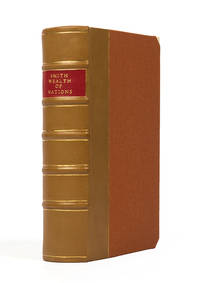
43414Printed at the University Press for Peter Brown and Thomas Nelson. Edinburgh. 1827. 8vo. 22cm xxx404xxvp. index printed in double columns thin paper bound in contemporary half tan calf gilt ruled raised bands gilt title on crushed black morocco label in double gilt border marbled boards a fine copy rare issue. fine. WorldCat indicates one printed copy at National Library of Scotland. HUB locates only 2 copies one in 1883 and one being a catalogue from Francis Edwards Ltd. in 1964. <br /> An Inquiry into the Nature and Causes of the Wealth of Nations commonly known as The Wealth of Nations is a seminal work by Adam Smith published on March 9 1776. The book explores the fundamental principles that contribute to a nation's wealth focusing on aspects such as labor productivity the division of labor and the roles of government and commerce in economic development. Smith's analysis includes discussions on market pricing capital accumulation and the importance of free trade and limited government intervention in fostering economic growth. This work laid the foundation for modern economics and remains influential in economic thought today. Printed at the University Press, for Peter Brown and Thomas Nelson. Edinburgh. 1827 unknown
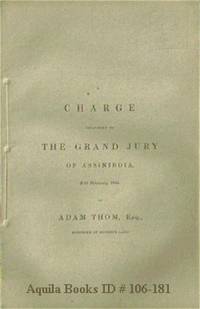
1848106181London: Printed by E. Couchman 1848. Softcover. very good. 1st Edition. 44pp. Octavo in original printed tan wrappers. Rare. very good TPL 7986; Peel 3 - 228 locates in the Glenbow collection. Not in Casey Gagnon Lande Sabin Amtmann Eberstadt Soliday or Streeter. In his charge to the jury at the commencement of the trial of an Indian for murder Thom incorrectly declared that the rights of the Hudson's Bay Company by its charter extended to judicial authority over the aborigines. Thom was here exceeding his authority as the case should have been tried in Upper Canada. 1848 Printed by E. Couchman paperback
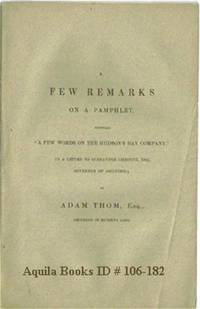
1848106182London: Printed by E. Couchman 1848. Softcover. fine. 1st thus. 21pp. Octavo in original tan printed wrappers. Fine. fine Peel 3 - 259. Not in TPL Casey Gagnon Lande Sabin Amtmann Eberstadt Soliday or Streeter. Rare! Having emigrated in 1832 to Montreal Thom was known for his anti-French Canadian views which he continued to publish after becoming the Montreal Herald's editor in 1835. He traveled to Red River in 1838 after being offered the job of recorder in Rupert's land where he was unpopular with the Metis population due to his francophobia and repressive fur trade measures suggested to the governor Assiniboia. Several petitions by the Metis including Louis Riel Sr. were made for his resignation and in 1851 he was relieved of his duties. 1848 Printed by E. Couchman paperback
18704651London: Ward Lock and Co Limited c 1870. First edition thus. Hardcover. Good. Bookplates for gift to the Reverend W Curzon-Siggers Vicar of St Mathews Dunedin 1901. Some faint pencil marks seen. Rear cover loose. 831 pages . 3 volumes from 1812 reprinted into one volume. Blue and brown buckram cloth with gilt title tofront and spine. Deckle cut pages are nice and white - no foxing to pages gilt stamped World Library of Standard Books logo to spine. Circa 1870 <br/><br/> Ward Lock and Co Limited hardcover
18711100London: Alex Murray& Son 1871. Later printing. Hardcover. Good. Bookplates for Sir Robert Stout donating his library in 1926 and Victoria University College book plate in front. Some faint pencil marks seen. Rear cover loose. 781 pages plus 16 pages of adverts. 3 volumes from 1812 reprinted into one volume. Carmine coloured cloth with gilt title to spine. Pages are nice and white - slight foxing to pages edges and dusty looking to top edges <br/><br/> Alex Murray& Son hardcover
1865100069Folio original cloth with leather spine and corners gilt title on front cover 55 colo maps.Extremities quite worn some general fading hinges repaired and rear free endpaper glued down maps with scattered narrow dampstain to bottom margin some splitting at centerfolds and a few scattered spots and toning or offsetting title with some offsetting; still a pretty sturdy atlas that has very good content overall. Colorful general atlas with double page maps of Australia various countries in Europe South America and Africa.There are two double page maps of the United States; the Eastern United States and the Western United States. Washington Dacotah Idaho and Utah are shown larger than they are today. Adam and Charles Black,
179327911London: A. Strahan and T. Cadell. Very Good with no dust jacket. 1793. Seventh Edition. Hardcover. All three volumes professionally rebacked keeping the original speckled leather boards. Not xlib. Owner's sticker inside the front c overs Bloomfield Jervis Beach 1820-1894. A very nice clean attractive set. ; 8vo 8" - 9" tall . A. Strahan and T. Cadell hardcover
1810012551Breslau und Leipzig: Wilhelm Gottlieb Korn 1810. Book. Very Good. Half-Leather. Third Edition. 8vo. Pappbände der Zeit. Band 1: XII/412 seiten. Band 2: VIII/631 seiten. Band 3: VIII/422 seiten. Aus dem Englischen der vierten Ausgabe neu übersetzt. Dritte mit Stewarts Nachricht von dem Leben und den Schriften des Autors unveräderte Ausgabe. Six panels on spine; title panel in red with gilt lettering. Brown leather and brown boards. Chips to crown and foot of spine Band 1; chip to crown Band 3; joints torn at crown of spine Band 2. Adam Smith`s "Inquiry into the Nature and Causes of the Wealth of Nations." 3 volumes - German Language Some shelfwear to covers and corners rubbed to boards. Text blocks fresh and clean. Bindings solid. Wilhelm Gottlieb Korn Hardcover
169861339Amsterdam George Gallet 1698 Amsterdam Lorme 1699. 8vo. In a nice contemporary Cambridge-style mirror binding with five raised bands and richly gilt spine. Small paper-label pasted on to top of spine. Lower part of front board with small hole in leather showing the wooden boards underneath. With a few occassional brownspots. Line of imprint trimmed off in the second work and small tear to the map 'Relation du voyage de Mr Evert Isbrand' otherwise a nice and clean copy. 6 164 4 pp. frontispiece and 8 engraved plates; 4 249 1 pp. folded map. Wanting the frontispiece. <br/><br/><em>First French translation of Adam Brand’s ‘Relation du voyage’ an 18-month journey to Beijing where he served as the embassy’s secretary. In 1692 Tsar Peter the Great commissioned Eberhard Isbrand Ides to lead a mission to the Kangxi Emperor of China with Adam Brand functioning as the embassy's secretary. The delegation comprising over 250 individuals including noblemen advisors merchants and soldiers arrived in Beijing after an 18-month journey in 1693. The embassy's primary accomplishment was securing permission for Russians to conduct business in Beijing with a caravan of up to 200 members every three years. The present work became extremely popular in Western Europe and it was quickly translated into various European languages including English 1698 and 1707 French 1699 Dutch 1699 and Spanish 1701. Withbound is Prideaux' "La Vie de Mahomet". </em> hardcover
#[42511]42491 pag. Full leather spine broken library stamp on title page. Illustrated with a frontispice and a folding map of Russia after Nic. Witsen map repaired. On pp. 193-249: lettre de monsieur xxx =Witsen sur l'etat present de la Moscovie. hardcover
2015Atlantic-97814666860382015. Hardcover. New. hardcover
2015Atlantic-97814666860382015. Hardcover. New. hardcover
1802018053Paris: Agasse An X 1802. Cinque volumi in 8° di 4-CXXVII-368pp; 4-493pp; 4-564pp; 4-556pp; 4-588pp. Ritratto di Smith inciso da Prevost al primo volume. Legatura coeva in mezza pelle dorsi lisci dorati. Tagli gialli. Bella copia. Prima edizione di questa traduzione e del classico commento del Garnier. La stessa edizione esiste anche con fogli di errata a ogni volume. Ma questa sembra essere più rara: All editions usually having at the end of each volume an errata-leaf. Here; however all the errors have been corrected and the errata-leaf is not present. Is the improved version of the first edition of this classic translation scrive il Catalogo 53 di Gerits che lo valuta appunto più degli esemplari con errata. Vanderblue p. 25; K.E. Carpenter The Dissemination of the Wealth of Nations in French and in France p. 175; Kress B.4604; Goldsmiths 18412; Einaudi 5340. Agasse unknown
1822037619Paris: Mme Veuve Agasse Imprimeur-Libraire 1822. 2nd Edition . Meia de Pele / Half Leather. Bom / Good / Bon. In-8º217x137. 6 volumes de CLVI-368 / 6-493 / 4-564 / 2-556 / 670 / 572 pp. Gravura com retrato do autor. Encadernaçdos em meia inglesa de pele. <br/> <br/> Mme Veuve Agasse, Imprimeur-Libraire hardcover
120099Edinburgh Printed for Adam and Charles Black and William Tait 1839. . 'A new edition corrected throughout and greatly enlarged'; 8vo 23 x 15 cm; two engraved plates including portrait frontispiece slightly soiled contemporary female ownership inscription in pen to half-title text slightly browned; modern calf backed russet cloth boards vellum tips contrasting red morocco lettering-piece to spine fore-edge uncut very good; 8 lxiii 1 648pp.<br /> An early single-volume critical edition of Smith's masterpiece. The editor J.R. McCulloch achieved note as the first professor of political economy at University College London and for his works on statistical analysis. The work opens with a short biography of Smith and an 'Introductory Discourse' giving a history of the study of political economy.<br /><br />A cornerstone text in the development of modern economic theory and political philosophy the Wealth of Nations 'begins with the thought that labour is the source from which a nation derives what is necessary to it. The improvement of the division of labour is the measure of productivity and in it lies the human propensity to barter and exchange. The Wealth of Nations ends with a history of economic development a definitive onslaught on the mercantile system and some prophetic speculations on the limits of economic control' PMM.<br /> Tribe 151. Edinburgh, Printed for Adam and Charles Black, and William Tait, 1839. hardcover
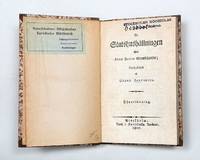
1800152848Stockholm: Tryckt i Kumblinska Tryckeriet 1800. First translation in Swedish of Georg Sartorius's abbreviated edition of the Wealth of Nations first published in German in 1796 aimed as a university textbook. "Sartorius' indisputable contribution to economic science consists in the fact that he was one of the first German professors to grasp the significance of Adam Smith's system. At a time when German academic and political life was still dominated by the cameralist tradition he enthusiastically undertook the propagation of the Smithian doctrine using the lecture hall as his principal forum. His selections from the Wealth of Nations published as early as 1796 'for use in academic lectures' revealed a capacity to present the principles and implications of laissez faire in a manner suited to the tastes and needs of German students" ESS. This abridged version intended as a textbook marked a radical reduction of the work - at around 40000 words it is a tenth the size of the original. The Swedish translation by the jurist Johan Holmbergsson 1764-1840 was important in introducing Smith's ideas to Sweden. Prior to this publication only excepts of Smith's work had been available in Swedish in the journal Läsning i blandade ämnen 1799. The section on income tax is omitted possibly for political reasons since it suggested that there were some forms of taxation that should be applied to all. The preface is an abbreviated and revised version of Sartorius's original introduction. Octavo 163 x 106 mm. Late 19th-century purple quarter cloth spine lettered in gilt marbled sides blue speckled edges. Library label of Stockholms Högskolas Juridiska Bibliotek to front pastedown and their stamp to title pp. 17 and 236. Inner hinges a little weak. A very good copy. Tribe 73. Kress B.4270; not in Goldsmiths' or Vanderblue. hardcover
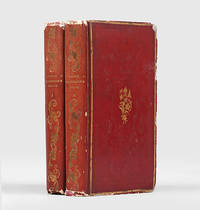
1830129378Paris: Chez Barrois l'Ainé 1830. Second edition first published in 1798 of Sophie de Grouchy's translation the "the best available in her language" Ross p. 365 which brought Smith's work to a much broader French audience following two ineffectual translations and which remains the standard French text. The edition includes de Grouchy's Lettres sur la sympathie her notable contribution to moral philosophy. The translation was preceded in French editions by Marc-Antoine Eidous's translation of 1764 roundly criticized for its low quality and held by Smith to be responsible for the poor reception of his work on the continent and Jean-Louis Blavet's translation of 1774-5 which was poorly disseminated. A manuscript translation by Louis Alexandre Duc de la Rochefoucauld 1774 was abandoned and unpublished. In contrast de Grouchy's translation was praised from the start and commended for its faithfulness to the original text. "Smith was no longer alive by the time Grouchy published her own translation 1798; he died in 1790 but it is safe to say that he would have been happier with hers as she followed the text as precisely as she could attempting to capture the tone and rhythm as well as the multilayered meanings of his sentences" Bergès and Schliesser p. 9. The edition also includes a translation of Smith's Dissertation on the Origin of Language first published in The Philological Miscellany and thereafter appended to the third and subsequent editions of the Theory of Moral Sentiments. The translation was reprinted again in 1860; Tribe mentions a printing of 1820 p. 239 but does not list it in his catalogue and it cannot be traced presumably an error. De Grouchy was a prominent salon hostess during the French Revolution and under Napoleon. The Lettres sur la Sympathie appended to the translation form a response to Smith's Moral Sentiments but also offer an original and important contribution to moral philosophy. The text written from around 1791 to 1793 takes the form of eight letters addressed to C sometimes surmised as to her husband the philosopher Condorcet more probably her brother-in-law the physiologist and philosopher Pierre Jean Georges Cabanis. De Grouchy in the first letter sets out her project to find the origins of sympathy and over the following letters sustains her argument that they are physiological based in experienced or imagined pain and pleasure. The Lettres have long been recognized in French scholarship - Jean-Paul de Lagrave's French edition of 1994 lists at least 15 works in French dealing with her from 1887 to 1987. In English scholarship her work has been recognized only more recently. English translations were published - independent from Smith's Theory - in 2008 edited and translated by Karin Brown and James E. McClellan III and 2019 edited and translated by Sandrine Bergès and Eric Schliesser both containing lengthy introductory monographs confirming the originality and importance of the Lettres. Karin Brown in 2008 bemoaned de Grouchy's then invisibility in English scholarship - "the Lettres are certainly a notable if overlooked Enlightenment text. But more specifically there is significant recent interest in sympathy and sensibility in the literature of the eighteenth century and Sophie de Grouchy is the one contemporary woman philosopher who thought and wrote critically about sympathy. This otherwise informed and eye-opening scholarly reinterpretation of the role of sentiment in late-eighteenth century thought is unaware of Sophie de Grouchy or her contributions" Brown and McClellan p. xvi. 2 vols octavo 203 x 117 mm. Contemporary red paper-covered boards spine and covers lettered and tooled in gilt covers additionally ornately panelled in blind marbled edges. Contemporary school presentation bookplate. Wear around extremities spines a little sunned foxed yet overall an attractive copy. Tribe 141; Vanderblue p. 41. Sandrine Bergès and Eric Schliesser introduction to Sophie de Grouchy's Letters on Sympathy Oxford University Press 2019; Karin Brown and James E. McClellan Sophie de Grouchy: Letters on Sympathy 1798 a Critical Edition 2008; Ian Simpson Ross Life of Adam Smith 1995. hardcover
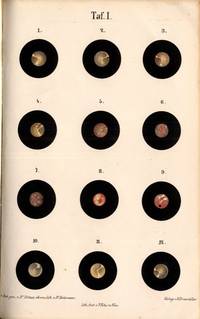
1865442551865. Wien W. Braumüller 1865 8° VI 1 Blatt Druckfehler 143. 1 pp. 13 Holzschnitte 2 farblith. Tafeln mit 24 von Politzer gezeichneten Abbildungen Halbledereinband der Zeit; Rücken erneuert; feines Exemplar. First Edition of the first OTOSCOPY ATLAS! "In 1865 Adam Politzer 1835-1920 published his first work on otoscopy or rather his first great work as an artist. He was the first to think of publishing a book on this subject. The 143-page atlas showing methods of examining the ear included 37 drawings of the tympanic membrane by Politzer entitled "Die Beleuchtungsbilder des Trommelfells im gesunden und kranken Zustande". There were 13 drawings in black and white distributed through the text and 24 drawings in color reproduced as two separate plates using chromolithography by Carl I Heitzmann at the Köke lithography workshops in Vienna. Scientific images began to be used in medical circles as they could be an excellent aid to understanding a phenomenon and teaching it. The images represented true or real facts i.e. they allowed reality to be studied more or less directly and analyzed according to perception and interpretation. Recognizing a certain feature did not mean understanding the message of the image itself in which the feature could have a particular meaning. It was necessary to know how to interpret the images before recognizing the features taking into account that the images were only two-dimensional. Interpreting them was the major problem. The objectives of their analysis were clearly defined and these were essential for determining the means of interpretation. The atlas was the first real one of observations made during direct visual examination of the ear based on the diagnostic approach and examination of the tympanic membrane with different images of healthy and diseased ears described in relation to the color transparency position healthiness cicatrization and mobility of the tympanic membrane. Politzer introduced color for the first time. Apparently simple to use in fact it was not at all. Color is affected as much by light as by darkness so it was connected closely to light and revealed to the eye therefore through observation. Politzer had to perfect a technique for keeping the light constant during examination of the ear so he could finalize the colors he saw while studying pathologies of the tympanic membrane. His atlas was soon considered essential to the study of otology. In the introduction Politzer clearly explained the importance of examining the tympanic membrane correctly because if it was done well many diseases of the ear could be identified without further examination: . Politzer showed that the color of the tympanic membrane depended on the combination of three factors: its own color the color of the promontory806 seen against the light and the effect of the light source. Revolutionary at that time the importance of the otoscopie image in diagnosis is still today the key point in examining a patient with ear problems. In more than 90% of cases the otoscop¬ie image is sufficient for making a correct diagnosis. This new method with its three main stages followed almost exactly that used by art critics to study a work: description of the object observed using the appropriate vocabulary understand¬ing after studying it how the image is composed and analysis of the meaning of the image or rather of the pathology found. More simply studying an image means asking questions in this instance looking for anomalies from which to make a diagnosis. Because it is transient the image has to be reproduced so it can be used again. It then becomes a transposition of the real thing or a reality in itself and can be used for training in observation. That was without doubt Politzer's aim when he published the otoscopy atlas." Albert Mudry: Adam Politzer 2010 pp.174-178 Garrison-Morton No.3378 unknown