Smith Janet AdamABAA
1 033 résultats
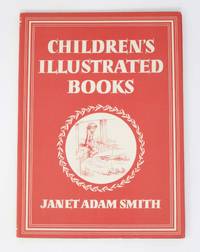
194844815London: Collins 1948. Pink paper-wrapped boards. Dust wrapper. VG newspaper offset to half-title & last page/VG sp sunned. 50 pp. Illustrated including 4 color plates. 8vo. <br/><br/> Collins hardcover books
194824401London: Collins 1948. First edition 8vo pp. 49 1; color frontispiece 3 plates in color illustrations in b&w throughout; but for a slightly faded spine panel a fine copy in the original orange and white pictorial paper-covered boards and dust jacket. <br/><br/> Collins hardcover books
1965USMIJOH00LAWLittle Brown & Co 1965. Very Good. Smith Janet Adam. John Buchan: A Biography. Boston MA: Little Brown & Co 1965. 524pp. Indexed. Illustrated. 8vo. Black cloth with gilt lettering on backstrip. Book condition: Very good with subtly bumped corners tiny stain on fore edge and very edges of spine ends slightly faded. Dust Jacket Condition: Good with corners slightly chipped and two short closed tears in edges of front panel. Spine slightly sunned and light soiling on spine and rear panel. Little, Brown & Co hardcover books
1965016922London: Ruper Hart-Davis 1965. 2d Impression. 524p. b/w front. port. b/w illus. dj. Biography of this member of Parliament and Governor-General of Canada. Ruper Hart-Davis unknown books
194622806London: Collins 1946. First Edition. 8vo pp. 48. Series: Britain in pictures Illustrated with 8 plates in colour and 25 in B&W. VG in litttle yellowed and worn dj. A brief history and description of Scotland. Collins unknown books
194627918London: Dent 1946. First edition. Cloth very good in dust jacket. <br/><br/> Dent hardcover books
1891WRCLIT70830Chicago: Slason Thompson & Co. 1891. 393pp. Typographically decorated wrappers. Hint of trivial dust soiling to wrappers otherwise near fine. First edition of this libretto by the popular lyricist book collector and briefly bookseller. The opera was notable as Leila Marie Koerber's a.k.a. Marie Dressler first role on Broadway. Uncommon - OCLC locates but two copies at Brown and at the HRC. OCLC: 10239329. Slason, Thompson & Co. unknown books
1929USMIJER00MELHarper & Brothers 1929. Good. Smith George Adam. Jeremiah: Being the Baird Lecture for 1922. New York: Harper & Brothers 1929. Fourth edition revised and enlarged. 410pp. 8vo. Navy cloth. Book condition: Good with bumped edges faint soiling spine slightly askew front hinge cracked and former owner' neat underlining marginalia and highlighting throughout in different color inks. Harper & Brothers hardcover books
1919016161New York: George H. Doran Company 1919. xi 256p. original burgundy cloth. George H. Doran Company unknown books
9006327New York: Harper & Brothers <br /> n.d. Revised. Hardcover. Very good condition in very good condition dust jackets. With an introduction and sketch of prophecy in early Israel. <br/><br/> Harper & Brothers, <br /> hardcover books
2000185272Osprey Publishing 2000-04-01. Paperback. Very Good. Clean has a good binding no marks or notations. Light wear. Osprey Publishing paperback books
17971329312Paris: H. Agasse 1797. First French Edition. Hardcover. Octavo 316 283 pages; VG; bound in period quarter calf green marbled boards gilt titling and tooling to spine; mild wear and rubbing marbled paper slightly damaged in four places; speckled text block; interior clean with no names or markings; two parts bound together lacking frontispiece portrait as usual only bound into some copies; both half-titles and title pages present; JL consignment; shelved case 3. Essays on Philosophical Subjects is a posthumously published history of astronomy until Smith's own era plus some thoughts on ancient physics and metaphysics; This French translation published two years after the first English was translated by Pierre Prévost a Swiss philosopher and physicist who he demonstrated in 1791 that all bodies cold or hot emit heat by radiation. 1329312. Shelved Dupont Bookstore. H. Agasse hardcover books
17641334674Paris: Briasson 1764. First French Edition. Hardcover. Octavos 2 volumes; VG; bound in contemporary acid-washed calf spines with two burgundy morocco labels each gilt titling and tooling; marbled endpapers; text block red; 1 leaf ad in volume 2 rear; JL consignment; shelved case 3. The first French edition was unauthorized the first authorized French translation would not appear until 1774. The 1774 translation was done by Blavet who published a letter from Smith in which Smith called Eidous's translation 'mortifying' a reaction which prompted Blavet to pursue his own attempt.;<br /> <br><br /> <br><br /> First appearing in 1759 The Theory of Moral Sentiments lays the ethical and philosophical groundwork for Smith's later economic work.;. 1334674. Shelved Dupont Bookstore. Briasson hardcover books
2009Embry 183053Harriman House 2009. Two tiny marks to upper edges else fine in fine dust jacket in mylar cover. Introduction and Notes by Jonathan B. Wight. Harriman House, 2009. unknown books
110826Dublin: Printed for Messrs. Whitestone Chamberlaine Watson et al. 1776. 3 vols. 8vo viii 1-391; viii- 1-524 3 ads; iv 1-412 pp. Diced calf with gilt rules recently rebacked. Lady Davy’s bookplate and inscription in each vol. purple ink signature of a later owner upon each bookplate occasional marginal staining closed tear to p.259 of vol. 3. Preserved in an archival clamshell box. § The Adam Smith-John Playfair-Humphry Davy copy an incomparable association. First Dublin edition the only edition printed in the same year as the first London 1776. Lady Davy’s copy with her bookplate and ink inscription in each volume stating the books were given by Adam Smith to John Playfair. As a tangible record of the connections between these three influential Enlightenment figures this book is intriguing. Adam Smith 1723-1790 who established the foundations of modern economics with this book and John Playfair 1748-1819 the mathematician and geologist were friends in later life. They both belonged to the Oyster Club in Edinburgh and each owned copies of the other's books. Smith’s library catalogue lists a presentation copy from Playfair and the sale catalogue 1820 of Playfair’s library includes books by Smith but not this one. Jane Davy formerly Apreece 1780-1855 was a well-known and widely-travelled literary hostess. As a young wealthy widow she rejected a proposal of marriage from John Playfair in favour of Humphry Davy 1778-1829 whom she married in 1812 a few days after he had received his knighthood. The binding style with wove paper endpapers and diced calf boards postdates Smith’s death in 1790. The first volume has the binders ticket ‘Lycett Nelson Street City Road’ and records show that the firm was declared bankrupt in 1829 making it possible that Jane Davy received the book perhaps as a gift from Playfair during their courtship or on his death. Both Playfair and Davy visited London and could have commissioned the binding.This copy is the only evidence we have that Smith owned a copy of this Dublin edition which appeared in the same year as the first and is the only other edition printed in that year but surely Lady Davy's attestation suffices. The copy has a small ink correction to page 368 in vol. 3. This correction was not made to the printed text until the 4th edition. Smith was known to make authorial marginal notes in books; though the hand that made this correction cannot be known it is unlikely that anyone else would have felt emboldened to emend the great man's text. More about the relationships between Adam Smith and John Playfair and John Playfair and Jane Davy remains to be discovered stimulated by the discovery of this extraordinary association copy. A fascinating copy of a great Enlightenment text. PMM 221. Printed for Messrs. Whitestone hardcover books
110446London: W. Strahan and T. Cadell 1776. 2 vols. 4to 12 x 9.25 inches or 305 x 240 mm large-paper top edge just trimmed other edges untrimmed; 12 510 pp.; 4 587 588 ads pp. Volume I: A4 a2 B-Z Aa-Zz 3A-3S4 T4 -3T4 blank as usual; Volume II: A2 B-Z Aa-Zz Aaa-Zzz 4A-4E4 4F2. With the usual cancels: M3 Q1 U3 2Z3 3A4 and 3O4 in volume I cancels D1 & 3Z4 in volume II. In vol. 2 p. 288 is misprinted as 289. Old speckled calf recently rebacked edges untrimmed and substantially larger than 2 copies recently sold as in “original boardsâ€. Copious annotations in ink in a neat early hand. Some soiling to a few leaves in the press and occasional spotting or foxing as usual. § First edition the issue without the Edinburgh imprint of W. Creech as copies with his imprint have cancel titles those lacking the Edinburgh imprint such as this probably have priority of "the first and greatest classic of modern economic thought. Where the political aspects of human rights had taken two centuries to explore Smith's achievement was to bring the study of economic aspects to the same point in a single work" PMM. The records of copies at auction and through the trade in the last several years all show copies measuring at least an inch shorter and narrower than this copy -- the Schiff copy alone was almost as tall the Bradley Martin copy an inch shorter. The annotations are “memory aids†clearly written by an attentive reader who wanted to be able to refer back quickly to the key points of interest to him or her; they are not attempts to dispute or correct the text or even comment on it and one might surmise the reader to have been a high-level student or more likely a teacher. The two suggested errata have both been corrected by a different hand. ESTC T96668; Goldsmith 11392; Kress 7621; PMM 221; Rothschild 1897. W. Strahan hardcover books
1962M11662Edinburgh:: Royal College of Surgeons of Edinburgh 1962. 1962. 8vo. xiv 237 pp. Frontis. illustrated figs. tables indexes. Blue cloth gilt-stamped cover emblem and spine title dust-jacket. Previous owner's inked signature on f.f.e.p. and dust-jacket. Very good. Royal College of Surgeons of Edinburgh, 1962. hardcover books
1981112445New York: Summit Books 1981. First edition of this modern classic. Octavo original half cloth. Presentation copy inscribed and dated by the author on the half-title page in the year of publication "Fr Shecters-san! Thanks for all with best wishes Jerry 'Adam Smith' 2/2/81." Very good in a very good dust jacket. Jacket design by Robert Anthony. George Jerome Goodman was an American author and economics broadcast commentator best known by his pseudonym Adam Smith which was assigned by Clay Felker at New York magazine in order to keep his published articles about Wall Street anonymous. "Like the painter Mondrian Adam Smith makes it look simple." Summit Books hardcover books
198120005New York: Summit Books 1981. First edition of this modern classic. Octavo original half cloth. Inscribed and dated by the author on the half-title page. Near fine in a near fine with a few closed tears. George Jerome Goodman was an American author and economics broadcast commentator best known by his pseudonym Adam Smith which was assigned by Clay Felker at New York magazine in order to keep his published articles about Wall Street anonymous. "Like the painter Mondrian Adam Smith makes it look simple." Summit Books hardcover books
179234586London: A. Strahan T. Cadell and others 1792. 2 volumes 8vo. iii-xv 1 488; iii-viii 462pp. Lacks half-titles. Expertly bound to style in half russia and period marbled paper covered boards.<br/> <br/>Eighteenth century edition of Adam Smith's first published work.<br/> <br/>Adam Smith's first published work first printed in 1759 would lay the basis for The Wealth of Nations and establish his reputation as a philosopher of note.<br/> <br/>ESTC T121726; Alston III.829; Goldsmiths 15514. A. Strahan, T. Cadell [and others] unknown books
19611326973Madrid: Aguilar 1961. Segunda edición. Hardcover. Octavo; Fair/no DJ; Hardcover w/out DJ; Spine grey with gold print; Boards in grey cloth with gold print wear to corners and spine caps stain on rear and small stain on spine shelfwear; Text block has cracked front hinge owner label on front flyleaf significant amount of notes and underlining in ink and pencil throughout; Text in Spanish; xx 893 pages. 1326973. FP New Rockville Stock. Aguilar hardcover books
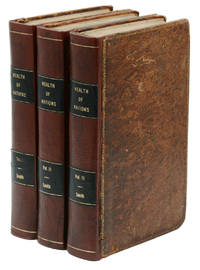
17862442London: A. Strahan and T. Cadell 1786. Fourth edition. Contemporary calf. Very Good. HANDSOME EIGHTEENTH-CENTURY EDITION OF THE "GREATEST CLASSIC OF MODERN ECONOMIC THOUGHT.". This classic work of the Scottish Enlightenment - originally published in the same year as the Declaration of Independence and Gibbon's History of the Decline and Fall of the Roman Empire - is a magisterial study of the sources of national wealth and of the political and institutional arrangements that foster or suppress it. Based on a 2016 analysis of data from Google Scholar The Wealth of Nations is the second only to Marx's Das Kapital as the most-frequently cited among books in the social sciences published before 1950. And while Smith recognized the economic benefits that flow from voluntary transactions between individuals and is as a result sometimes thought of as the apostle of laissez faire capitalism he supported several forms of government intervention in the economy either to create and maintain the necessary conditions for economic growth or to ameliorate the incidental harms that such conditions could create.<br /> <br /> The Wealth of Nations proposed that "no society can surely be flourishing and happy of which the far greater part of the members are poor and miserable. It is but equity besides that they who feed cloath and lodge the whole body of the people should have such a share of the produce of their own labour as to be themselves tolerably well fed cloathed and lodged." WN this edition vol. 1 page 119. Smith believed that this condition of society could be achieved only through the higher productivity that is made possible by the division of labor. As an example of the division of labor Smith offered the example of the "trade of the pin-maker" which he apparently learned about from Diderot and d'Alembert's Encyclopédie in which "one man draws out the wire another straights it a third cuts it a fourth points it a fifth grinds it at the top for receiving the head ." and so forth. WN this edition vol. 1 pages 7-8.<br /> <br /> In a famous passage Smith explains that such arrangements arise naturally from voluntary transactions between individuals based on their common recognition of the benefits that division of labor creates:<br /> <br /> This division of labour from which so many advantages are derived is not originally the effect of any human wisdom which foresees and intends that general opulence to which it gives occasion. It is the necessary though very slow and gradual consequence of a certain propensity in human nature which has in view no such extensive utility; the propensity to truck barter and exchange one thing for another.<br /> <br /> . Man has almost constant occasion for the help of his brethren and it is in vain for him to expect it from their benevolence only. He will be more likely to prevail if he can interest their self-love in his favour and shew them that it is for their own advantage to do for him what he requires of them. Whoever offers to another a bargain of any kind proposes to do this. Give me that which I want and you shall have this which you want is the meaning of every such offer; and it is in this manner that we obtain from one another the far greater part of those good offices which we stand in need of. It is not from the benevolence of the butcher the brewer or the baker that we expect our dinner but from their regard to their own interest. We address ourselves not to their humanity but to their self-love and never talk to them of our own necessities but of their advantages. WN this edition vol. 1 pages 19-21.<br /> <br /> "Throughout the book Smith's 'system of natural liberty and justice' . plays a pervasive role as explanatory model and regulatory ideal though the famous image of an 'invisible hand' appears late and only once in the whole work . It appears at volume 3 page 181 of this edition. A quasi-Newtonian treatment is given to those forces which act like gravity when market price departs from natural price and it always carries with it a normative implication that policies or practices that prevent these forces from acting are detrimental to the public interest. Monopolies special privileges informal combinations by merchants or employers to raise prices and keep down wages import duties export bounties as well as institutions such as apprenticeships and restrictions on labour mobility . are all condemned from this perspective." Dictionary of National Biography.<br /> <br /> Smith was not unmindful of possible deleterious consequences of the division of labor: "The man whose whole life is spent in performing a few simple operations of which the effects too are perhaps always the same or very nearly the same has no occasion to exert his understanding or to exercise his invention in finding out expedients for removing difficulties which never occur. He naturally loses therefore the habit of such exertion and generally becomes as stupid and ignorant as it is possible for a human creature to become." WN this edition vol. 3 pages 182-83. Smith believed that public elementary education would compensate for this tendency.<br /> <br /> Edition: This copy of The Wealth of Nations is the fourth edition 1786 issued ten years after the first. It was the penultimate edition published during Smith's lifetime the last being the fifth edition of 1789. It carried forward the significant changes made in the third edition of 1784 without making any material additional changes of its own as Smith specifically admitted in the prefatory Advertisement to this edition. A detailed collation of the first five editions is provided in Edwin Cannan's 1904 edition of Smith's work.<br /> <br /> Provenance: With the armorial bookplate of Thomas Howitt bearing the motto "Aquila Non Capit Muscas" "Eagles do not catch flies" on the front pastedown of each volume. Howitt may have been the Lancaster physician of that name 1785-1832; see archives of the Royal College of Surgeons of England ref no. GB 0114 MS0092 the entry for Howitt's son also named Thomas Howitt. It is possible that Howitt's son Thomas Jr. 1830-1922 was responsible for the additions to these volumes described below.<br /> <br /> Volume 2 is bound with additional pages at the end on which a prior owner has pasted articles on the California gold rush of 1849 citing a discussion on page 354 of the volume in which Smith argues that "of all those expensive and uncertain projects however which bring bankruptcy upon the greater part of the people who engage in them there is none perhaps more perfectly ruinous than the search after new silver and gold mines." Another extract pasted at the beginning of volume 1 from an unknown source recommends the reduction of taxes.<br /> <br /> London: A. Strahan and T. Cadell 1786. Octavo contemporary full calf with elaborately gilt-decorated spines; vol 1 rebacked with original spine laid-down. Bound without half-titles. Vol 1 spine darker more toned than the other two. Light flaking to spines a little chipping to leather at extremities. Some foxing to title and first few leaves of each volume; otherwise text clean. A lovely early set of Smith's masterpiece. A. Strahan and T. Cadell unknown books
1799124769London: A. Strahan and T. Cadell 1799. Rare 18th century edition of Adam Smith's magnum opus and cornerstone of economic thought. Octavo 3 volumes. Bound in full contemporary tree calf gilt titles to the spine morocco spine labels. In very good condition. A very nice set of this classic work. Adam Smith's masterpiece first published in 1776 is the foundation of modern economic thought and remains the single most important account of the rise of and the principles behind modern capitalism. "The history of economic theory up to the end of the nineteenth century consists of two parts: the mercantilist phase which was based not so much on a doctrine as on a system of practice which grew out of social conditions; and the second phase which saw the development of the theory that the individual had the right to be unimpeded in the exercise of economic activity. While it cannot be said that Smith invented the latter theory.his work is the first major expression of it. He begins with the thought that labour is the source from which a nation derives what is necessary to it. The improvement of the division of labour is the measure of productivity and in it lies the human propensity to barter and exchange.Labour represents the three essential elements-wages profit and rent-and these three also constitute income. From the working of the economy Smith passes to its matter -'stock'- which encompasses all that man owns either for his own consumption or for the return which it brings him. The Wealth of Nations ends with a history of economic development a definitive onslaught on the mercantile system and some prophetic speculations on the limits of economic control.The Wealth of Nations is not a system but as a provisional analysis it is complete convincing. The certainty of its criticism and its grasp of human nature have made it the first and greatest classic of modern economic thought" PMM. A. Strahan and T. Cadell unknown books
1793124986London: A. Strahan and T. Cadell 1793. Rare 18th century edition of Adam Smith's magnum opus and cornerstone of economic thought. Octavo 3 volumes bound in half calf over marbled boards gilt titles to the spine morocco spine labels. In near fine condition. A very nice set of this classic work. Adam Smith's masterpiece first published in 1776 is the foundation of modern economic thought and remains the single most important account of the rise of and the principles behind modern capitalism. "The history of economic theory up to the end of the nineteenth century consists of two parts: the mercantilist phase which was based not so much on a doctrine as on a system of practice which grew out of social conditions; and the second phase which saw the development of the theory that the individual had the right to be unimpeded in the exercise of economic activity. While it cannot be said that Smith invented the latter theory.his work is the first major expression of it. He begins with the thought that labour is the source from which a nation derives what is necessary to it. The improvement of the division of labour is the measure of productivity and in it lies the human propensity to barter and exchange.Labour represents the three essential elements-wages profit and rent-and these three also constitute income. From the working of the economy Smith passes to its matter -'stock'- which encompasses all that man owns either for his own consumption or for the return which it brings him. The Wealth of Nations ends with a history of economic development a definitive onslaught on the mercantile system and some prophetic speculations on the limits of economic control.The Wealth of Nations is not a system but as a provisional analysis it is complete convincing. The certainty of its criticism and its grasp of human nature have made it the first and greatest classic of modern economic thought" PMM. A. Strahan and T. Cadell hardcover books
1791140941390London: Printed for A. Strahan; and T. Caddell 1791. Sixth Edition. Very Good. The Sixth Edition. Complete in three volumes In contemporary full tree calf rebacked with new spines. Bindings worn former owner bookplate to pastedowns. Old tidemarks to preliminary pages and faintly to textblock edge light foxing and browning to pages light and sporadic pencil marks in text. Printed for A. Strahan; and T. Caddell unknown books