Voll, AdamBiblio.com
872 résultats
1890565761890. Verh. physik. med. Ges. NF 23. - Würzburg Verlag & Druck der Stahl'schen K. Hof- & Univ.-Buch- & Kunsthandlung 1890 8° 4 315 pp. 8 lith. Taf. Halbleinenband d.Zt.; St.a.Tit.; feines Expl. Erstdruck! unknown
1869325261869. Wien. med. Wschr. 19/32. - Wien L.W. Seidel 1869 4° Sp.533-548 Broschur. Erstdruck! unknown
1863148211863. Wien. med. Wschr. 13/ 6-810. - Wien L.W. Seidel & Sohn 1863 4° Sp.81-128 145-160 feine Broschur. First Edition! Adam Politzer's 1835-1920 method of effecting permeability of the Eustachian tube. Garrison & Morton No.3377 unknown
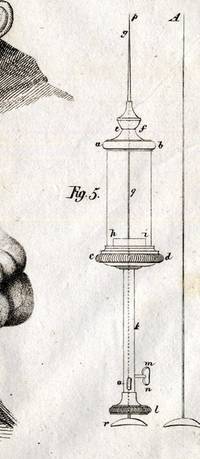
1827253941827. Journ. Chir. Augenh. 10/3. - Hrsg.v. Graefe & Walther. - Berlin im Verlag von G. Reimer 1827 8° pp.363-520 1 lith. Tafl. feiner Pappand. DIE ERSTE INJEKTIONSSPRITZE. 1827 - Erste Ausgabe! "Schon vor Pravaz einem Arzt in Dijon nach dem häufig Injektionsspritzen benannt werden hatte der Darmstädter Arzt A.Neuner eine Spritze mit feiner Kanüle konstruiert durch die ein Stilett zur Wegbahnung vorgeschoben wurde". Proskauer C. Bildgeschichte der Zahnheilkunde Abb. 159 p.207 Diese von dem Grossherzogl. Hessischen Oberarzte Adam Neuner 1788-1869 in Darmstadt verfasste experimentelle Arbeit über die künstliche Erzeugung von "Cataracten in todten Augen" enthält wohl die erste bekannte Injektionsspritze die sogar dem sehr belesenen Verfasser der "Hypodermastischen Injection der Arzneitmittel" Albert Eulenburg entgangen ist. Dies mag vielleicht daran liegen dass hier kein Arzneimittel sondern künstlich Krankheit und insbesondere ins Auge appliziert werden sollte. Neuner führt aus "welches Unglück durch den weniger kundigen weniger an Leichen gut eingeübten angehenden Operateur um so leichter veranlasst werden kann als bei den in Rede stehenden Operationen die Spitze des Instrumentes oft seinen Blicken ganz entzogen ist und alles von einer richtig angewöhnten Mechanik der Hand abhängt" und so stellte sich ihm die Frage "wie kann man zu dem genannten Zwecke in dem todten Auge eine Trübung Undurchsichtigkeit und größere Consistenz des Krystallköpers d.i. eine Cataracta künstlich erzeugen" und stellte dann weiter fest dass "nehmlich Consolidirung und Undurchsichtigkeit der Linse durch Coagulation ihrer Albumine d.i. eine künstlich erzeugte Cataracta auch in der natürlichen Contiguität innerhalb des todten Auges befindlichen Linse herbeigeführt werden könne . wenn man eine subtile Weise blos in die weiche Substanz der Linse durch ein geeignetes Instrument einführen und absetzen könnte" und erfand somit die erste Injektionsspritze. Einer der besten aller medizinischen Historiographen Julius Hirschberg hat leider diese Schrift von Neuner übersehen; er beschreibt in seiner Geschichte der Augenheilkunde wie Michele Troja 1780 "den künstlichen Star zur Uebung für Anfänger erzeugt indem er eine Mischung von Lt. Wasser und eine Drachme Salpetersäure Augen von Leichen oder ganze Köpfe einlegt". Ferner erwähnt er nur noch die Arbeit von Ritterich aus dem Jahre 1859: "den Künstlichen Star an Leichen-Augen zur Uebung erzeugt man auch durch Sublimat Einspritzungen in die Linse nach Lederhaut Stich". unknown
1873325381873. Wien. med. Wschr. 23/ 9-11. - Wien L.W. Seidel & Sohn 1873 4° Sp.193-264 Broschur. Erstdruck! unknown
1862326511862. Wien. med. Wschr. 12/1314. - Wien L.W. Seidel & Sohn 29. März und 5. April 1862 4° Sp.193-224 feine Broschur. Erstdruck! unknown
18198583BB1819. 2 Teile in 1 Band. Bamberg Kunz'sche Buchhandlung 1819-1820. XX 362 S. 1 Bl. - XVI 332 S. 1 Bl. Pappband der Zeit mit Rückenschilld und Rotschnitt etwas berieben Ecken leicht bestoßen. Vorsatz mit Eckausriss. Altersbedingt leicht gebräunt bzw. braunfleckig sonst innen sehr sauber und gut erhalten. unknown
1872325361872. Wien. med. Wschr. 22/ 6. - Wien L.W. Seidel & Sohn 10. Februar 1872 4° Sp.121-144 feine Broschur. Erstdruck! unknown
1892104367Chicago: Craig Press. Good. No Jacket 15 pages Bound with tassle string in a card cover no apparent tears. Card . Card. 1892. Craig Press unknown
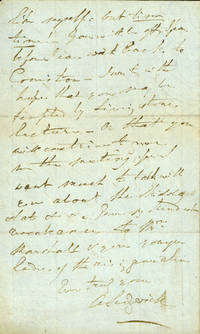
1857408581857. <p>Sedgwick Adam 1785-1873. Two autograph letters signed to James Marshall. Dent Yorkshire Oct. 7 1857; Trinity College Cambridge Oct. 31 1857. 8pp. total. 186 x 113 mm. Light soiling along folds but very good.</p> <p>Letters with excellent scientific content from one of the founders of modern geology. Sedgwick was responsible for defining the Devonian and Cambrian ages in the geological time scale and his immensely popular lecture courses on geology delivered annually at Cambridge between 1819 and 1870 had an enormous influence on succeeding generations of English geologists. One of his students was Charles Darwin who began attending Sedgwick's lectures in January 1831 and accompanied Sedgwick on a geological field tour of Wales the following summer. The two men remained friends until Sedgwick's death even though Sedgwick was never able to accept Darwin's theory of evolution by natural selection.</p> <p>IIn his Oct. 7 letter to Marshall Sedgwick discusses the geological researches he was then undertaking in England's Lake District:</p> <p>"I mean D.V. to work my way to Ulverston; & on Saturday or possibly Monday to transfer my head quarters to Broughton. I want to connect our work in all quarries on the east side of the road with the great open quarries in the Ireleth country; which we failed to do. The beds in the great open quarries strike very differently from those you & I saw; yet the strike of the cleavage is unchanged in direction & from end to end almost perpendicular--I think it highly probable that the bed between the Ireleth slate & the Ulverston estuary are nearly all from the flag or flag & grit--And I suspect that some hard gritty ridges I remember to have seen in a part of Cartmell Fell are but a repetition by enormous fault of the Comiston grits. . . ." </p> <p>Sedgwick also notes his intention to "hear Dr. Livingstone's evening lecture"; this is a reference to David Livingstone 1813-73 famous for his exploration of Africa. Sedgwick later provided a preface to Dr. Livingstone's Cambridge Lectures 1858.</p> <p>In his Oct. 31 letter Sedgwick touches on his precarious health--"On Monday I ought to have begun my course of lectures but on that day I had a severe relapse of vertigo & was obliged to put off my lectures until Friday yesterday"--and continues his discussion of his work:</p> <p>"All the rocks from the Ireleth country to the Comiston Ulverston sands are Comiston flag--But in our final traverse we found the hard Comiston grits in the hills S. W. of Penny Bridge--just where they ought to be--I think there is an enormous break down the valley meeting the complicated faults which come down from the hill a little North of Seathwaite at an angle.--In short the country from Ireleth Moor inclusive to the Sand of Ulverston has had a shove southwards of about five miles!"</p> <p>The recipient of these letters James Marshall was an amateur geologist and Fellow of the Geological Society. A friend of both Sedgwick and John Herschel Marshall was "a keen advocate of scientific education" Briggs Victorian Cities 1993 p. 161. Olroyd Earth Water Ice and Fire 2002 p. 20. Dictionary of Scientific Biography. </p> . unknown
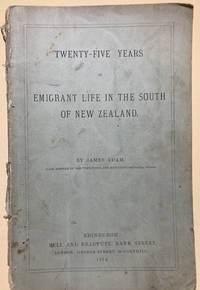
187401AIR1847.<p>Original covers lightly soiled edges chipped and creased with small pieces missing but no loss of print. Pieces of backstrip missing lower cover and final two pages loose but binding otherwise holding though loose. Some corners creased some foxing mainly in page margins a few light marginal stains but most of text-block clean. No ownership marks or other inscriptions. Frontispiece map has 5cm. tear along one fold otherwise good with a few minor spots of foxing. Four full-page duo-tone illustrations collated all present. Includes advertising at rear. Follows: <strong>Hocken 288:</strong> <em>'Fascinating account of early days full of absorbing interest and adventure; brought down to date. The writer was an energetic Tokomairiro settler and died in March 1908.' </em><strong>Bagnall Vol. 1 1: 39</strong>: <em>'A blend of recollection and factual information for intending settlers.'</em> A wide ranging and very readable but scarce publication that rarely comes up for sale. Suitable candidate for re-backing.</p> Bell and Bradfute.
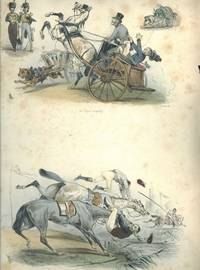
186030420Paris: Hautecoeur Freres; lithographed by Godard 1860. No stated edition. Unbound sheets. Good many plates foxed but the coloring is bright. Adam Albert. Dozens of humorous equestrian escapades are shown in color lithographs on 12 of 16 original leaves. Each leaf contains two sets of scenes for a total of 24 of 32 scenes. Lacks title page and covers if any. Ca. 9 x 13 inches. In French. In these lithographs all kinds of hapless riders and drivers in town and country come to grief in many imaginative ways. The scenes are numbered 1 through 22 and 29-30. This is item 361 in the magnificent Dejager collection Great Books on Horsemanship. The Dejager set is lacking plate 4 scenes 7 and 8 which we believe is present in our set. Very scarce; WorldCat cites a handful of locations in great libraries. Albert Adam 1832/33-1900 was well known for his illustrations of mid-19th-century French equestrian life especially the portfolio Ecole Imperiale de Cavalerie Saumur. Shipping/handling will be extra; please keep this in mind when ordering. Sold as a group as is. Hautecoeur Freres; lithographed by Godard unknown
189837899Paris A. Breger Freres 1898. Softcover. Covers lightly foxed; backstrip sun-darkened; corners of pages lightly bumped; light foxing on a few pages; outside margin of some pages lightly frayed; otherwise very good condition. Inscribed by author on preliminary blank. . 178p. Illus. Frontispiece with tissue guard. Paris, A. Breger Freres paperback
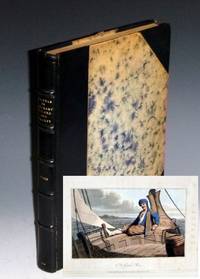
181821197931818. London Longman Hurst Rees Orme and Brown 1818. 4to. Contemporary Irish diced calf rebacked boards ornamented in gilt and with central coat-of-arms of Waterford School inner dentelles gilt marbled endpapers; pp. xiii 295 15 handcoloured aquatints on 11 leaves after drawing byu the author; one preliminary leaf and a few plates misbound initial three leaves with marginal restorations title-page with partlyu obliterated small stamp evcen toning to plates a good copy with the 1818-printed announcement for the examinations at Waterford School now De La Salle College Waterford pasted onto front fly-leaf.First edition. The Scottish army physician and writer Adam Neale travelled through Germany Poland Moldavia and the Ottoman Empire to Constantinople to take up his position as physician to the British embassy. He encountered Europe suffering from the Napoleonic Wars. Neale travelled an almost straight line from Essex to Heligoland and Husum on the main land and then over Berlin Dresden Prague Vienna down the Danube to the Dniester and further on to Istanbul. Abbey 19; Atabey 859; Blackmer 1186. hardcover
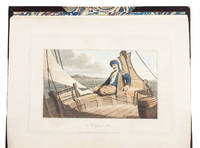
1818023937London: Longman Hurst Rees Orme and Brown 1818. Quarto. Hand-colored frontispiece 295pp. 10 other hand color plates. With the errata sheet on the verso of the directions to the binder which shows where the following items all present are to be placed: The Greek Reis to face the title page Dresden Koenigstein on the Elbe Meissen the Margravite 2 views Prague Wissegorod of Prague and Brunn 2 views; Halietz on the Dniester and Greek palace at Terapia 2 views Jassy Capitol of Moldavia; and on the Black Sea Agatopoli the Promentory of Eneada and finally The Turkish boatmen and barber. In all there are 15 aquatints on the 11 plates Dr. Adam Neale's travels covered several neglected areas especially in Moldavia and the Ottoman Empire. His travels commenced in July 1805 until March 1806. His vivid English text details observations and descriptons of the regions especially those suffering as a result of the Napoleonic wars. The battle of Austerlitz had just taken place in December 1805. In addition he provides statistical data on population rulers and related points of interest. This is one of the best accounts on Romania at the time as well as the Balkan region. Bound in a later 3/4 black morocco over marbled paper covered boards with matching endpapers raised bands lettering within three compartments gilt top edge gilt light off-setting to plates and a few text pages. A very handsome copy. see Abbey Travel 19; Tooley 1954 No. 344; Cat. Russica No. N261. Longman, Hurst, Rees, Orme and Brown unknown
181883GC2FWCCH2ULondon 1818. 4to. back of title-page: printed by A. Straham 19th-century half morocco ROOT bookbinders London richly gold-tooled spine with author and short-title marbled boards marbled endpapers. With 15 hand-coloured aquatints on 11 plates by I. Clark after drawings by author. XIII 295 pp. First and only edition of a vividly written account of a voyage through Germany Poland Moldavia and the Ottoman Empire beautifully illustrated with fifteen coloured aquatints after the designs of the author. Adam Neale ca. 1780-1832 of Scottish descent was an army physician and writer. His first work Letters from Portugal and Spain 1809 was a description of the events he experienced with the British forces under Sir John Moore and Sir Arthur Wellesley during the terrible campaigns of Napoleon in Spain and Portugal. Neale subsequently visited Germany Poland Moldavia and the Ottoman Empire ending up in Constantinople to take up his position as physician to the British embassy. The present work contains his autobiographical account of these travels from July 1805 to March 1806 partly through regions which had suffered and were still suffering the horrors and barbarism of the Napoleonic wars. The battle of Austerlitz had just taken place in December 1805. Neale added also many statistical data on the population number of inhabitants rulers etc.Binding re-backed with the original backstrip laid down. Some faint water stains but overall in very good condition.l Abbey Travel 19; Atabey 859; Blackmer 1186; Tooley Coloured plates 344; cf. DNB XL pp. 137-140. hardcover
18283123508Madrid.: Imprenta de Miguel de Burgos. 1828. Hardcover. Cubierta deslucida. Good. 15 cm. 406 p. Encuadernación en tapa dura artesanal en plena piel con tejuelo. "Reducido a lo mas útil para la inteligencia de los autores clásicos latinos y del derecho civil" . Cubierta deslucida. Historia.93 93 Imprenta de Miguel de Burgos. hardcover
18849999_01433Paris Octave Doin 1884. Hardcover. . ~ ~ NOTE: THE PRICE OF THIS BOOK IS CURRENTLY REDUCED! ~ ~ . Royal octavo. Pp. xxvii 761. With 258 illustrations. HARDCOVER bound in handsome contemporary quarter calf and marbled boards spine with raised bands between compartments with gilt fleurons gilt lettering marbled endpapers. Interior is not so bright with large dampmark at the beginning diminishing in size and much foxing; some tiny ink spot on one page. All the same good complete tight copy in nice binding. ~ First French edition. Translated from the German by Antonin Joly. Rare first translation into French of this influential work of the great otologist. E-2 <br/> <br/> Paris, Octave Doin hardcover
186820503Paris: J. B. Balliere et Fils 1868. Hardcover. Very good overall. 8vo xxiv 631pp 3 folding plates two of which are chromolithographic diagrams. The folding table showing fist age of menstruation in different regions of the world. Three quarter leather and blue marbled boards; gilt title at spine with 4 gilt compartments & raised bands. Rubbed at edges. Internally very good and clean. J. B. Balliere et Fils hardcover
184119670Kbh. 1841-42. 8 samt. ensartede hldrbd. af ræd kalv m. rig rygforgyldn. Her og der lidt rifter i bindene. Indvendig indimellem lidt brunplettet. <br/><br/><em>Den første samlede udgave af Oeh.s Tragedier. </em> unknown