Chrysostome, Jean (Johannes Chrysostomus), Bernard de Montfaucon (Ed.) und Christian Friedrich Matthäi (Ed.)Antiquariat.de

11 résultats
17922104389Misenae, impensis C. F. G. Erbsteinii (Meißen: Erbstein) 1792. XXVIII, 123, (1), (2), 161, (1) Seiten. 8° (20,5 x 12,5 cm). Schlichter Priv.-Leinenband mit Titelschild auf dem Rücken und rotgefärbtem Schnitt. [Hardcover / fest gebunden].
1800R77636Malines, P.J. Hanicq [1800] 16pp., 23cm., br.muette d'époque, bon état, R77636
179512917Rom, [ohne Drucker], um 1795. Kupferstich. Blattgröße: 12,3 x 18 cm, Druckspiegel: 8,2 x 12 cm.
17632108300413xbvkNo place or Publisher, M.DCC.LXIII.(1763). VI, 191 (1) / 194 (1) pages. - Richly gilt french leather binding of the period over 65 raised band with orig. gilt spinelabel, all edges red, marbled endpapers and green marker-ribbon; 8vo.(ca. 18 x 10 x 2,5 cm).
17811601300210xbvkRoma, per Benedetto Francesi, 1781. Titlepage with large copperengraved coat-of-arms; XII, 300; [4, incl. titlep. with woodcut-decoration], 264 pages; few illustrated architectural initials and woodcut head- and endpieces. - Modern lightblue-and-black-on-yellow-ground marbled hardcover bindings with gilt-titled green leather-spinelabels, all edges sparkled in red; 8vo.(ca. 18,5 x 11 x 4 cm).
1776R51930Amstelaedami [Amsterdam], apud Gerardum Tielenburg 1776 167pp., text in latin, 20cm., blind cart.cover (bit used), interior VG
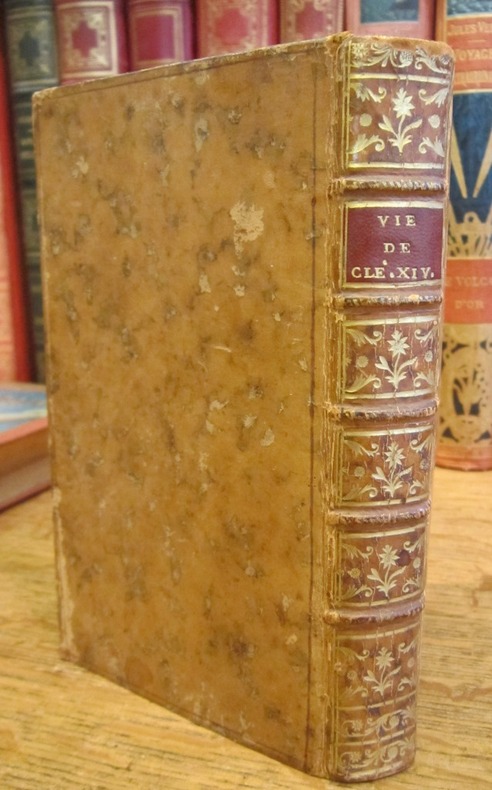
177648985Chez la veuve Desaint, Libraire 1776 In-16 10 x 17 cm. Reliure de l’époque plein veau marbré havane, filet à froid sur les plats, bordures ornées, dos lisse ornés de fleurons dorés, pièce de titre en maroquin rouge, tranches rouges, VII + 207 pp. Traces de mouillures sur les gardes. Bon exemplaire. L’auteur, Louis-Antoine Caraccioli 1719-1803, est un écrivain français polygraphe, auteur d’ouvrages littéraires, historiques, politiques, théologiques, etc. Giovanni Vincenzo Antonio en religion Lorenzo Ganganelli Santarcangelo di Romagna, près de Rimini, 1705 - Rome, 1774, élu pape le 19mai1769 sous le nom de Clément XIV est particulièrement connu pour avoir supprimé la Compagnie de Jésus le 21juillet1773.
1776002871Paris, Veuve Desaint, 1776
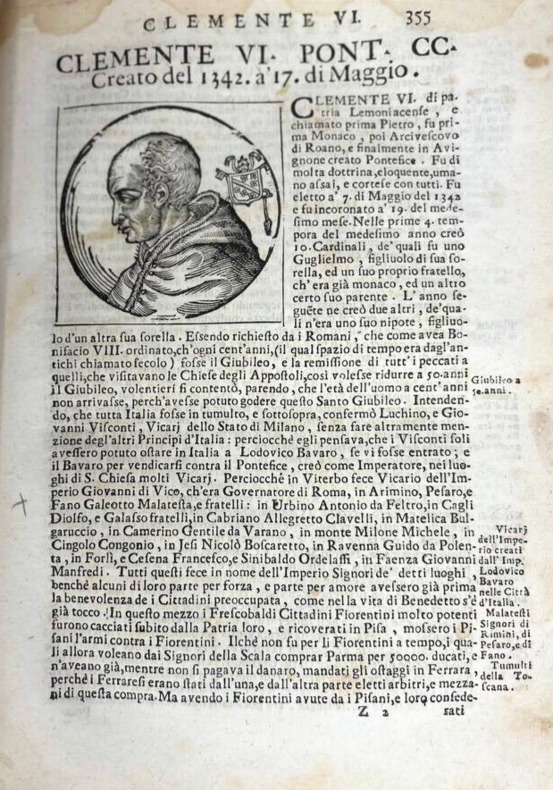
17300081Venise, Girolamo Savioni, 1730. En italien. Un fort volume in-8 de 240 x 175 mm pour 80 mm d'épaisseur. Catalogue des Papes et des cardinaux non paginé (env. 200 pages), vie de l'ensemble des souverains pontifes (912 pages) et "chronologie ecclésiastique" (271 pages). Relié plein vélin, dos à 5 nerfs + coutures en coiffe et queue, partie du titre et année manuscrites au dos. Ex-libris à la plume sur garde blanche, bout de papier collé en page de faux-titre avec liste rédigée à la plume. Lettrines, cul-de-lampe, biographies et gravures sur bois de 257 papes. Attention : 20 portraits ont été découpés et enlevés du livre, le texte situé derrière les portraits manquant également. À part ce retrait, le livre est complet. Véritable encyclopédie des papes, ce livre contient une biographie de chaque jusqu'à Benoît XIII (1649-1730) annotée par le père Onofrio Panvinio, avec sa chronologie ecclésiastique améliorée par Bartolomeo Dionigi, Lauro Testa, Francesco Tomasuccio et d'autres jusqu'en 1703. ***** Venice, Girolamo Savioni, 1730. In Italian. A thick octavo volume, 240 x 175 mm and 80 mm thick. It contains an unpaginated catalogue of Popes and Cardinals (approx. 200 pp.), biographies of all the pontiffs (912 pp.), and an "ecclesiastical chronology" (271 pp.). Bound in full vellum, spine with five raised bands and stitching at the head and tail, part of the title and year handwritten on the spine. A bookplate in pen on a white endpaper, a small piece of paper pasted onto the half-title page with a list written in pen. Initials, tailpieces, biographies, and wood engravings of 257 popes. Note: 20 portraits have been cut out and removed from the book, and the text behind the portraits is also missing. Apart from this, the book is complete. A true encyclopedia of popes, this book contains a biography of each one up to Benedict XIII (1649-1730) annotated by Father Onofrio Panvinio, with its ecclesiastical chronology improved by Bartolomeo Dionigi, Lauro Testa, Francesco Tomasuccio and others up to 1703.
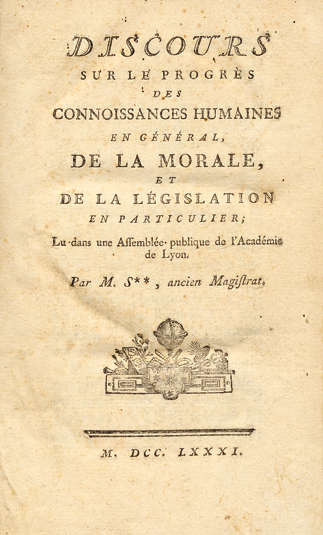
178115905S.l., s.n., 1781 ; in-8, broché ; VIII, 159 pp.
17923602Rome:: Presso Lazzarini 1792. FIRST EDITION. Octavo:. 15.5 x 10.8 cm. 4 216 pp. Collation: 2 a-m8 n12 the first leaf 1 is a blank and is present Printed on blue paper. In contemporary mottled calf the spine and boards tooled in gold. A very fine copy of the very rare first catalogue of the Museo Pio-Clementino - founded by Pope Clement XIV in 1771 and greatly expanded his successor by Pius VI- written for the use of visitors by the keeper of the museum Pasquale Massi of Cesena. Rare. The Museo Pio-Clementino was the first major curatorial museum within what are known today collectively as the Vatican Museums. In 1771 Pope Clement XIV had Michelangelo Simonetti adapt the Belvedere Pavilion to accommodate the papal collection of ancient art. When Clement’s successor the avid art collector Pius VI was elevated to the pontificate in 1775 the pace of acquisition increased dramatically and very soon the collections outgrew the rooms arranged for them by Simonetti. In 1776 Pius VI called for a radical restructuring of the existing museum and the construction of new grand spaces to house the ever-expanding collection. Massi’s catalogue a room-by-room guide of the museum with descriptions of all of the artifacts and artworks housed therein is an invaluable record of how the greatly expanded museum of antiquities looked in the late 18th century with its newly constructed series of rooms and the recently installed masterpieces of ancient sculpture -the fruits of some of the most important excavations in Italy including the excavation of Hadrian’s villa at Tivoli. In addition to providing a record of the arrangement of the exhibits Massi’s catalogue in which he provides details of provenance acquisition and attribution of each artwork described serves as a history of the museum’s formation and preserves valuable information about the art trade and the function of archaeology in the late 18th century. Massi has used a system of numbers and letters to indicate which works were added to the museums by Julius II and his various successors above all Clement XIV and the then-current pope Pius VI. In his introduction Massi tells us that he has designed his guide for portability and easy reference by tourists by arranging the descriptions of the objects in each room in the form of a walking itinerary. Since it is necessary at two points to retrace one’s steps Massi’s guide leads us along one side of each room as we proceed through the galleries. When it is time to reverse our course he leads us along the opposite side of the rooms already traversed thus keeping us engaged and entertained as we retrace our steps through the vast complex. Our tour begins at the new entrance to the museum in the corridor of Cleopatra also known as the corridor of the inscriptions just within the new entrance to the museum. We then pass through two vestibules. The first one is square with frescoes by Giovanni da Udine in the vault. In it we encounter the tomb of the Scipios and the Belvedere Torso. The second vestibule is round and in its center is a large bowl made of pavonazzetto. From here we proceed through a corridor into the porticoed octagonal courtyard of the Belvedere the site of Julius II’s first installation of ancient sculpture transformed by Simonetti in the 1770’s. Massi then leads us through the hall of the animals the gallery of statues the gallery of busts and the “loggia scoperta†the room of masks. We make our way back through these galleries to arrive at the series of rooms created by Simonetti in the 1780’s. The first of these is the hall of the muses. We then enter the breathtaking Sala Rotonda with its immense newly installed ancient porphyry basin from the Domus Aurea through which we make our way to the Sala of the Greek Cross where we find the newly installed ancient porphyry sarcophagus of Constantine’s daughter Constantia. From here Massi takes us via Simonetti’s new staircase up past the unfinished hall of the biga to Bramante’s vast gallery of the candelabra which is itself divided into numerous rooms with vases statuary and jewelry. Exiting by the stairs we visit the library and trace our way back through the new wing and via the Belvedere courtyard where we marvel at the Laocoön and the Belvedere Apollo to the cortile the great open court of he complex where our tour ends. Cicognara 3408. I have located 6 copies in the U.S.: Getty UC Riverside USC Cleveland NW Chicago Presso Lazzarini, unknown books