Mauduit IsraelABAA
86 résultats
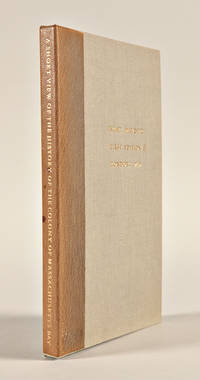
1769WRCAM44566London 1769. 271pp. Lacks the half title. Modern boards printed paper label. Modern bookplate on front pastedown. Internally clean. Very good plus. In a half morocco and cloth folder. First edition. Mauduit who was a Loyalist once the Revolution came firmly believed in the right of the British government to dictate to the colonies in general and Massachusetts in particular. "Strives to prove that this colony's charter was not exempt from Parliamentary authority" - Howes. Mauduit is perhaps best known for his REMARKS UPON GEN. HOWE'S ACCOUNT OF HIS PROCEEDINGS ON LONG-ISLAND IN THE EXTRAORDINARY GAZETTE OF OCTOBER 10 1776 London 1778. Only a handful of copies in ESTC. HOWES M431. AMERICAN CONTROVERSY 68-21a. SABIN 46921. ESTC T100618. hardcover books
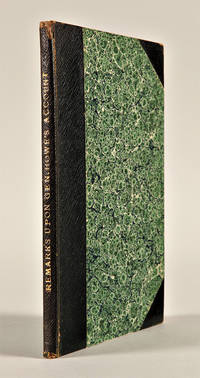
1778WRCAM11173London 1778. 454pp. Lacks the half title. 20th-century three-quarter green morocco and marbled boards spine gilt. Head of spine worn extremities rubbed. Minor foxing. Very good. Criticism of Howe's conduct in the Battle of Long Island wherein he refused to allow the entrenchments at Brooklyn to be attacked because of the element of risk. Mauduit gives a detailed analysis of the battle including the deposition of troops involved. AMERICAN CONTROVERSY 78-69a. HOWES M430 "aa." SABIN 46919. hardcover books
178910730Strasburg, Akademische Buchhandlung, 1789. 2 in 1 Bd. 244, III, 187, II S. 1 Bl. (Druckfehler). 8°. HLdr. der Zeit mit Rückenschild (restauriert).
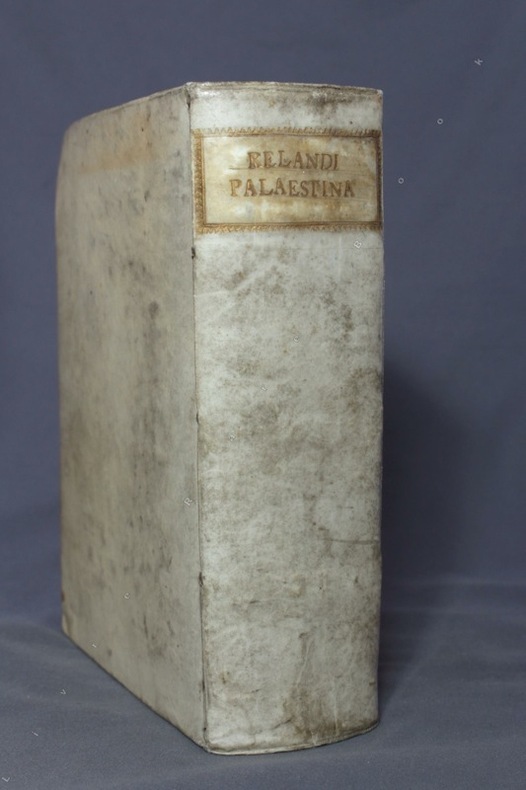
1714X119435Trajecti Batavorum [Utrecht], Ex libraria Guilielmi Broedelet 1714 Complete in 3 parts in one physical volume, part I: pp. [10],391,[1], Part II: pp. [4],396-511, Part III: pp. [4],516-1068,[94], with an additional engraved title, illustrated with engraved vignettes and with 15 engraved plates out of text (of which 13 folding) among which 9 maps and a large folding portrait of the author as well as a large folding genealogical table, 1st edition, text in Latin, 20x17cm., first title in red and black, text is clean and bright, small reference number on first title page, manuscript ex-dono on blanco endpaper (prize book of the School of Zwolle), contemporary brown full-leather binding (intact but with some wear at ends and joints, gilt decorations on boards and spine, gilt title on red label at spine, missing ties), a good copy of this work by the Dutch orientalist Reland (1676-1718) who made the first geographically accurate maps of Palestine and surroundings based upon his own study during his travel to Palestine, weight: 1.5kg., [Content: Part I: "In quo de Palaestinae nominibus, situ, terminis, partitione, aquis, montibus, et campis agitur", II: "in quo agitur de intervallis locorum Palaestinae", III: "in quo de urbibus et vicis Palaestinae agitur" which is in fact a topographical dictionary], X119435
17168475Norimbergae [Nuremberg], Petrum Conradum Monathum, 1716. Gros in-8 de [18]-787-[83]-[2bl.] pages, plein vélin ivoire du temps, dos lisse, titre doré au dos dans une cartouche de roulette dorée, tranches mouchetées. Hormis une pâle auréole d'humidité en marge supérieure de quelques feuillets, bel exemplaire.
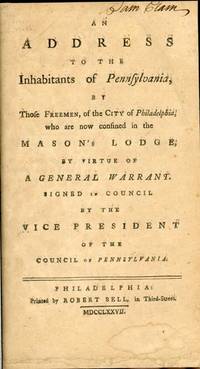
177754250Philadelphia: Printed by Robert Bell. 1777. 1777. PENNSYLVANIA. First edition. 8vo. Binder 4 52 pp. This is a paper of great significance in the struggle for civil liberty and religious freedom. On religious grounds Pemberton and other Quakers refused to swear allegiance to the Commonwealth of Pennsylvania. "These Quakers were imprisoned for security reasons by the Revolutionary Council of Pennsylvania." Howes P101. "These freemen principally Quakers were imprisoned in consequence of their refusal 'not to depart from their dwelling-houses and engage to refrain from doing anything injurious to the United States by speaking writing or otherwise." Sabin 59610. Pemberton offers a passionate denunciation of their arrests: no warrants charging a specific crime no opportunity to be heard. The documents and letters are printed here and Pemberton reviews them in detail. Inked name of former owner Sam Elam at top of front page minor light foxing throughout else a solid very good clean and tight copy. Housed in a quarter cloth and boards binder with titles stamped in silver on the front cover Printed by Robert Bell. 1777. hardcover
1778788401778. MAUDUIT Israel. Remarks upon Gen. Howe's Account of His Proceedings on Long-Island in the Extraordinary Gazette of October 10 1776. London: Printed for Fielding and Walker 1778. 454pp. Lacks the half title. 20th-century 3/4 green morocco and marbled boards spine gilt. Head of spine worn extremities rubbed. Minor foxing. Very good. HOWES M-430 "aa." American Controversy 78-69a. Sabin 46919. Criticism of Howe's conduct in the Battle of Long Island wherein he refused to allow the entrenchments at Brooklyn to be attacked because of the element of risk. Mauduit gives a detailed analysis of the battle including the deposition of troops involved. unknown
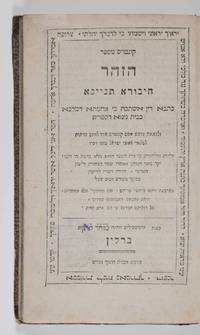
178248885Berlin and Dessau: Hevrat Hinukh Ne‘arim Berlin Freischule/n.p. 1782. First editions 2 of 4. Hardcover. Nearly Fine. Sammelband of four opuscules published between 1782 and 1819 octavo. Contemporary half calf top inch perished over pastepaper boards; spine lettered and tooled in gilt. Edges speckled blue. Covers lightly worn else fine clean copies the fourth work lightly foxed throughout. The first three works issued from the Hevrat Hinukh Ne'arim Berlin Freischule under the supervision of Isaac Satanow 1732-1804 the most prolific Hebrew writer of the Berlin Haskalah. As director of the publishing house Satanow was assigned the task of reissuing old Hebrew classics by the Marpeh ha-Nefesh a philanthropic group headed by the banker Daniel Itzig his son-in-law David Friedländer and the famous physican and philosopher Marcus Herz. A number of these editions however were in fact original works by Satanow which he presented as the work of earlier writers. The first item in the sammelband is an outstanding example of this latter type.<br /> <br /> I. Kuntres mi-Sefer ha-Zohar Hibura Tinyana Berlin: Hevrat Hinukh Ne‘arim 1783. aleph-gimel8 dalet1; 25ff. Vinograd Berlin 313. First edition of this polemic styled in imitation of the Zohar as a response to the Mitpahat Sefarim 1768 of Jacob Emden 1697-1776 in which the latter calls into question the antiquity and textual integrity of that chief work of the Jewish mystical tradition. Emden's critique may be understood as an attempt to undermine the doctrinal foundation of the Frankists who based their beliefs on the Zohar. "Emden had suspected the authenticity of the Zohar for a long time and he hoped some time 'to reveal the strange things found in the book.' But these intentions were secretly nursed within him for many years until the time was propitious for his exposé" Cohen. Perhaps surprisingly for a maskil Satanow held a very different view: "While advocating secular knowledge and the study of science Satanow also expressed great admiration for Kabbalah. In contrast to Emden he claims that the whole Zohar was written by Bar Yohai and Moses De Leon had nothing to do with its writing. He also rejects Emden's claim that in the Zohar there are words against the Talmud and promises to 'consult the Zohar and prove that all its words are right and truthful none of them is crooked Kuntres mi-Sefer ha-Zohar pp. 25 26" N. Rezler-Bersohn. Born in the Polish now Ukrainian town of Satanov Isaac Satanow settled in Berlin around 1771. "Among the most prolific of the early Haskalah writers. Satanow demonstrated a wealth of knowledge of the Hebrew language ranking as a model stylest throughout the Haskalah period" EJ 14: 905-906. As a leading representive of the eighteenth-century Jewish Enlightement Satanow boldly displayed a "conglomeration of contrasts" Jewish Enc. XI: 71: “Though Orthodox in his beliefs he nevertheless favored Reform in practice. He was one of the greatest authorities on Jewish tradition and lore yet he was one of the most free-thinking of philosophers.†For a more detailed discussion of this and other works by Satanow see N. Rezler-Bersohn "Isaac Satanow - An Epitome of an Era" in: Year Book XXV Leo Baeck Institute 1980. For Emden in the present context see M. L. Cohen Jacob Emden A Man of Controversy Philadelphia: The Dropsie College 1937 pp. 254ff.<br /> <br /> II. Sefer Igeret ha-Kodesh Berlin 553 1793. 7ff. Vinograd Berlin 415. Later edition of this well-known work. The celebrated talmudist and exegete Nachmanides the Ramban Moses ben Nachman ca. 1195-ca. 1270 acted as a conciliator between the parties in the early 13th-century controversies surrounding the philosophical and secular direction of Maimonides' growing influence. "After having given the earlier part of his life to his Talmudical works Moses Nachmanides devoted himself to writing of a homiletic-exegetic and devotional character. To these belong the "Iggeret ha-Kodesh" and the "Torat ha-Adam." In the former which deals with the holiness and significance of marriage Moses criticizes Maimonides for stigmatizing as a disgrace to man certain of the desires implanted in the human body. In Moses' opinion the body with all its functions being the work of God none of its impulses can be regarded as intrinsically objectionable" Jewish Enc. IX:88. The rare editio princeps appeared at Rome in 1546; the editor of the present edition Isaac Satanow notes at the title that the letter was “printed in Basel in the year 5340†referring to the 1580 edition of Ambrosius Froben Prijs 127.<br /> <br /> III. Nevu’at ha-Yeled Berlin: Hevrat Hinukh Ne‘arim 549 1789. asterisk8 2asterisk2. 10 unnumbered leaves. Vinograd Berlin 384. Later edition of a medieval Hebrew short story with commentary first printed at the end of Jacob Zemah's Sefer Nagid u-Metzaveh Constantinople 1726. "The body of the tale is followed by a number of occult prophecies in Aramaic. it was known already as early as the end of the 15th century and the beginning of the 16th when some kabbalists among them R. Abraham b. Eliezer ha-Levi wrote commentaries on the prophecies. The story tells of a wonder child Nahman born in the fifth century to a kabbalist; the child died very young but immediately upon birth began to tell his mother secrets of the heavenly worlds. His father cautioned him not to reveal mysteries forbidden to man and from then the child spoke only obscurely and enigmatically. Modern scholars have attempted to date the story and the prophecies therein by tracing known historical events hinted at and relating them to the text. The obscurity of the text makes this very difficult but it seems probable that historical events in the 15th century especially in the East are referred to in the prophecies. However the purpose of the story and its prophecies was to anticipate the coming of the Messiah and to describe the major political and historical events and catastrophes bringing about his final revelation. The kabbalists interpreted the prophecies as hinting at the coming of the Messiah in the early 16th century" JE XII:1020. Here the commentary on the Aramaic "prophecies" is likely attributable to Satanow.<br /> <br /> IV. Herev Nokemet Nekam Berit Dessau 5579 1819. 16pp. Vinograd Dessau 77. First edition of this famous polemical letter. A leader of the Reform movement Meyer Israel Bresselau d. 1839 together with I. S. Fraenkel edited and adapted in 1818 a prayer book for the Hamburg Reform Temple under the title Seder ha-Avodah. He anonymously published the present work in response to Eleh Divrei ha-Berit Altona 1819 "a pamphlet which collated the views of the greatest Orthodox rabbis of Western Europe against Reform Judaism and its innovations." A rhymed work written in a satirical biblical style Herev Nokemet is "remarkable in its witty take-off on the Orthodox rabbis who opposed the reforms in the Hamburg Reform synagogue. It ranks among the best Hebrew polemic literature written at the time of the Haskalah" EJ 4:1358 In response Meir Leib Reinitz published his Lahat ha-Herev ha-Mithappekhet in 1820. Bresselau's polemic was reprinted as an appendix to Bernfelds's Toledot ha-Reformazyon ha-Datit be-Yisrael in 1900. ×§×•× ×˜×¨×¡ מספר הזהר ×—×™×‘×•×¨× ×ª× ×™×™× ×<br /> ספר ×גרת הקדש<br /> × ×‘×•×ת הילד<br /> חרב × ×§×ž×ª × ×§× ×‘×¨×™×ª. Hevrat Hinukh Ne‘arim (Berlin Freischule)/[n.p.] hardcover
1759CREskACR66Stockholm: Harber & Hesselberg 1759. 1759. small 4to. pp. 10 p.l. 533 ie. 503 1. woodcut ornaments. 19th century morocco gilt back inside dentelles gilt edges lightly browned throughout spine dull later inscriptions in Swedish on old flyleaves; a good copy with wide margins. First Edition of "the most trustworthy contemporary authority on Swedish settlements on the Delaware." Howes The author was Provost over the Swedish congregation in America and pastor of the Church at Christina Wilmington Delaware from 1749 to 1756. Besides the Swedish historians Campanius Swedberg Biorck and others Acrelius made extensive use of various manuscripts and documents in the Royal Archives at Stockholm and the Archives at New York including a valuable unpublished manuscript by the Rev. Anders Rudman pastor of the Swedish Lutheran congregation at Wicacoa from 1697 to 1701. Acrelius' account contains a history of the colonies under Swedish Dutch and English government with a general description of the land natural resources major towns &c. an ecclesiastical history from 1655 to 1697 with a list of the names of all the Swedish inhabitants of Pennsylvania in 1693 and an ecclesiastical history of the congregations at Wicacoa Christina Racoon and Pensneck. "This important work is hardly less scarce than that of Campanius.especially when in good condition; it has besides the merit of being much more extensive and of reproducing a large number of documents partly unpublished." Muller A complete English translation was not published until 1874. Bell A55. Howes A-34. JCB I 1202. Muller 1134. Rich I 132. Sabin 133. Winsor IV 494-95. 1st Edition. Hardcover. Very Good. Stockholm: Harber & Hesselberg, 1759. Hardcover
1710DIV012in 8 ( 18x 12 cm) 201 Fol / pages 5470 (H) 1710 (c) frontispice gravé ,papier en bel état ,tranches dorés reliure sur haies de bois ,fermoirs métalliques présent . Un plat parfaitement séparé du volume En portugais Very rare 2nd second edition of the only treatise on Hebrew laws and customs written in Portuguese language and printed for the Portuguese Sephardic communities in Northern Europe. Treasure of Jewish Laws that the people of Israel must know and observe composed by Rabbi Hacham Menasseh ben Israel in Amsterdam, 1st edition 1647; and this 2nd edition in 1710. In 8. º (18x12 cm) (v) -201 - (iv) folium. Binding (worn out at edges) contemporary full calf gilt at spine. Engraved frontispiece. Contains title page to Third Part (Of feasts and fasts throughout the year, the people of Israel must know and observe) and the Last part (in which contains all the precepts, rites and ceremonies concerning to a perfect economy dedicated to the very noble and magnificent lords Abraham and Ishak Israel Pereyra). MENASSEH BEN ISRAEL was born in Lisbon in 1604. Very young of age he went to Amsterdam with his father, Joseph ben Israel, and became a disciple of Haham Yshac Uziel. In 1622 he was appointed professor of the Portuguese Jewish community in Amsterdam and, four years later, he founded the first Hebraic typography in Amsterdam; printing small books in Portuguese, Spanish and Hebrew languages. Menasseh had a decisive contribution in reopening England to the Jewish people, closed since the time of King Edward Ist. He went personally to London and had talks with Cromwell who gave him an honorific pension he never profit of. Menasseh died in 1658 after returning from London. He was portrait by Rembrant. Inocêncio VI, 211. 'In a book dealer which trade was new and old books, I found a complete copy of the Treasure. I've never seen another. '
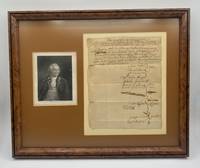
1766020388Pomfret CT: no publisher stated 1766. Handwritten. Very good condition. Unbound. Signed by Authors. First Edition. Octavo 8vo. One page document being an Annual Nomination to keep license Publick Houses of Entertainment of James Ingalls Ebenezer Grosvenor Abigail Waldo Samuel Cotton Joseph Abbott. Signed by Justices: William Osgood 1697-1791; Thomas Williams; John Grosvenor 1711-1804 who served with Putnam in French-Indian Wars; Stephen Keyes 1717-1788 who was a Lieutenant in the CT militia during American Revolution. Signed by Selectmen: Joseph Scarborough; Israel Putnam 1718-1790; Daniel Trowbridge. Signed by Constable Sam Lyon. Signed by Grand Jurors George Sumner; Daniel Holt Jr. Israel Putnam served as a Major in the Connecticut Militia in the French and Indian War and as a Major General in the Continental Army in the Revolutionary War fighting at Bunker Hill. In Colonial times a Publick House of Entertainment was a tavern offering food drink and lodging and served as community centers where one heard news and debate as well as held political meetings and they were essential stops for travelers. . no publisher stated Paperback