-MareMagnum
- Hirsh Nurit -Livre Rare Book
Partition de la chanson : O'se shalom he will make peace
197230122Or-Tav 1972 approx.

Le Temps des Chansons · Paris, France8,00 €
16 073 résultats
Mit zahlreichen Abbildungen.
Reichlich illustriert mit Farbfotografien von Itzhak Amit.
With 3 illustrations & 1 b/w Photo.
197230122Or-Tav 1972 approx.
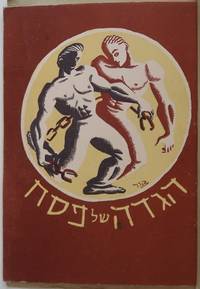
195043267Be'eri Beeri: Hotsa'at Be'eri 1950. 1st edition. Original illustrated color paper wrappers with outer protective cover added 8vo 31 pages. All pages are illustrated with illustrations created specifically for this hagadah. 24 cm. In Hebrew. 1st edition of the Hagadah produced by the Kibbutz where Hamas killed 100 Israelis on October 7 2023. Apparently several editions were produced between 1950-1981. <br> The cover depicts two muscle-bound shirtless men ripping their shackles off a classic passover depiction using Zionist "New Jew" imagry showing the strength of the young Jewish state emerging from the Holocaust. <br> The front cover as well as the inside illustrated pages are identical to the later 1953 UToronto copy whose pages can be seen at https://archive.org/details/druck00148/page/n35/mode/2up though our copy retains the original text which theirs has replaced on pages 15-16 and lacks their the tipped in colophon. The rear cover has also changed with their 1953 edition compare our illustration to theirs. <br> Be'eri is a kibbutz in southern Israel. Located in the north-western Negev desert near the eastern border with the Gaza Strip. During.the 2023 Hamas attack on Israel 100 people were killed." Jerry Seinfeld famously visited in December following the attack to show support. <br> “Kibbutz Be'eri was established on 6 October 1946 as one of the 11 points in the Negev. It was located near Wadi Nahabir a few kilometres south of Be'erot Yitzhak. Its founders were members of the HaNoar HaOved VeHaLomed movement who had been preparing in Maoz Haim as well as some Hebrew scouts. It was named after Berl Katznelson as Be'eri Beeri a biblical name was his pen name.<br> In 1947 Be'eri had a population of over 150. The early settlers engaged in land reclamation and tree planting. The group was enlarged by young Jews from Iraq who arrived by desert trek. The Jewish National Fund reported that for months the kibbutz was completely isolated 'but the settlers held their ground until the liberation of the Negev in October 1948.'<br> After Israeli independence the kibbutz moved three kilometres southeast to its present location. It is considered one of Israel's wealthiest kibbutzim" Wikipedia. <br> Commemorating members of Kibbutz Be’eri who were killed in the second intifadah Miriam Holtzman reflected on the kibbutz and it’s hagadah:<br> “In 1950 the members and members of Kibbutz Be’eri produced the Hagadah for Passover. Less than two years after the end of the War of Independence in which they paid a terrible price for the fulfillment of their life's vision - the establishment of a Jewish state in the Land of Israel the members of the kibbutz designed holiday content relevant to their values and lifestyles. In those years the kibbutz Hagadot fulfilled the mitzvah ‘A person must see himself as if he had come out of Egypt’ by incorporating the history of the nation of Israel at that time. <br> The Hagadah told the story of exile immigration pioneers fighting and settlement in the areas of the book as a direct continuation of the struggle of the Israelites for freedom and as part of their journey back to the Land of Israel .In contrast to the traditional Hagadah the Kibbutz Hagadahs put a deep emphasis not only on leaving the slavery of Egypt but also on arriving in the Promised Land and settling in it.<br> In those days of the beginning of the state the kibbutz Seder night also included content that today we incorporate into the Holocaust Day Remembrance Day and Independence Day ceremonies. The Kibbutz Hagadah combined the local and national story with passages from the traditional Hagadah verses from the Bible passages of Zionist thought and self-creation - both in painting and writing. The War of Independence became in Be’eri's Hagadah another chapter in the story of the Exodus from Egypt….<br> In the chapter ‘We will remember' the victims of the Holocaust and the refugees who fell on their way to Israel are mentioned alongside those who fell in the War of Liberation. The message is one of remembrance but also of mission:<br> 'And let us not forget because it was only because of them and because of the whole multitude of the House of Israel that we have come to this day and because it was for their sake and for the sake of the rest of Israel that we are at peace now….Prepare yourselves for the enemies of all generations - for a great evil.'<br> The emphasis in remembrance is on finding meaning and belief in the righteousness of the path in the face of the paralyzing pain. A topical reading of Be’eri's passages of the Hagadah places the reality we face in a historical context - not a single point but a long and continuous line of our existence in this land.<br> The Hagadah ends with the return of Zion and includes verses such as 'Keep your voice from weeping and your eyes from tears there is a reward for your work and return from the land of the enemy' as well as 'while your son is built and built virgin of Israel there is hope for your future and sons return to their borders'.<br> The Hagadah ends with a description of Ari's who was killed in the 2nd Intifadah life in that year. It is impossible not to hear the call carried to us from the main day:<br> 'Come out and see our work in the first year of our sabbath at Beri Hadasha….Let us plow and sow and let the blessings of God visit our fields. We planted fruit trees and vines and increased the herds of cattle and more priests and priests were added to our dwelling and we are only at the beginning of the journey. There is still a lot of need and a lot of longing to improve our home from the inside.<br> Indeed today is a joyous holiday for us. . The silence and the peace are with us and now because we have yet to stand the test and we have yet to be girdled we have vowed to stand on the soul of our work. . And with anxious anticipation we wait for the day when we will give our hands to the effort of the great liberation here at our rejected point we will rush to the redemption of the people and the world.'†www.chagim.org.il<br> "No group… has taken the reinterpretation of the traditional Haggadah more seriously than the kibbutz movement which over the years has produced an estimated 1000 different versions. Taken together these Haggadot offer a fascinating perspective on the still evolving social movement. Of all Jewish texts the Haggadah had special significance for the early kibbutz pioneers because it dealt with concepts important to their ideology: national freedom and socialist ideals… The staggering number of kibbutz Haggadot can be attributed to the fact that few were actually printed; most were simply stenciled in small numbers to be used in a particular year by a particular kibbutz. It was only later that official kibbutz federations published a standard version" Carol Novis in The Forward. <br> SUBJECTS: Kibbutz haggadot. Haggadot -- Texts. Passover -- Liturgy -- Texts. Haggadah Non-traditional Secular haggadot. Paque -- Liturgie -- Textes. OCLC: 1030800415. OCLC lists only 2 institutions with holdings for any of editions NLI holding several editions and Stanford holding the 2nd edition of 1951 as well as UToronto 4th edition of 1953. Very Good Condition. Rare and powerful. BK5 HAG-26-4K-VV. Be'eri [Beeri]: Hotsa'at Be'eri unknown
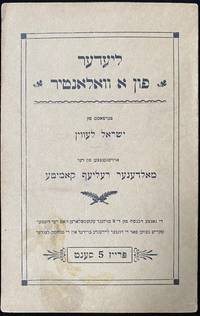
191942896No Place Malden MA: Maldener Relief Komite 1919. No Date 1919. 1st Edition. Original printed paper wrappers 8vo 14 pages. 21 cm. In Yiddish. Title translates as “Verses of a Volunteer.†No city or date listed but clearly published during or immediately after WW I with the Leksikon suggesting Malden MA 1919 OCLC suggests Boston the location of the printer and a clearly incorrect date of 1900 perhaps intending "1900s". Malden the poet’s home town just outside of Boston and clearly the home of the "Maldener Relief Komite" makes much more sense making this is the first documented yiddish publication in Malden MA north of Boston.<br> "The poet dedicated the entire income of 5 thousand copies to the brothers suffering from hunger in the countries at war†Translated from the front cover. Includes 4 poems: Der Volontir; Ikh Zukh a Vort; Nach der Milhome; Hazkharot Neshimot. The final poem is “in memory of the fallen Jewish heroes in all the war-torn lands.â€<br> Israel Levine 1878-1970 “was born in a village in Minsk district Byelorussia. In 1895 he arrived in the United States lived in various cities worked as a teacher in Talmud Torahs and was secretary for Mizrachi in the town in which he lived Malden Massachusetts. <br> He debuted in print in 1904 in Fraye arbeter-shtime Free voice of labor in New York with a poem entitled ‘Funken shpritsn’ Sparks fly and from that point he went on to contribute poetry and translations from Tanakh and from ethical books to: Yidishes tageblat Jewish daily newspaper Forverts Forward Dos yudishe folk The Jewish people Di varheyt The truth and Idisher kemfer Jewish fighter—in New York; Idishe shtime Jewish voice in Boston; and more. He published in book form: Lider fun a volontir Poems of a volunteer Malden 1919 16 pp.; Sefer naim zemirot tehilim Naim Zemirot on Psalms translated into a poetic form with short prefaces by Dr. Meir Vaksman and Aharon Kaminska Jerusalem 1934 19 pp†Khayim Leyb Fuks in Leksikon Fun Der Nayer Yidisher Literatur<br> OCLC: 19307496. OCLC lists 4 copies worldwide YIVO Brandeis Harvard NYBC none outside the northeast. A few stains & discoloring Very Good Condition an excellent copy. Scarce. B YID-45-9XX-LE-’. No Place [Malden, MA]: Maldener Relief Komite unknown
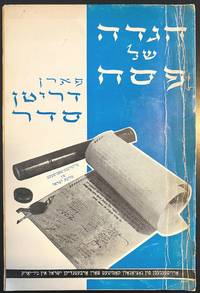
195443290Nyu-York New York: Aroysgegebn fun Natsyonaln komitet farn arbetndikn Yisroel 1954. 2nd edition 1st was 1953 the year prior. Original Color photographic paper wrappers designed by Pinchas Schuldenrein showing the Israeli declaration of independence a cover design used on other 1950s-60s editions as well. 8vo 3 25 3 pages. In Yiddish and occasional Hebrew with 1-page introduction in English and 3 pages with song lyrics in transliterated Hebrew. Text primarily in Yiddish typescript i.e. Yiddish typewriter. <br> Title translates as “Hagadah for Passover for the Third Seder from the Histadrut Campaign.†With a few photos illustrations and calligraphic headings. <br> Date and edition based on the introduction which explains the third seder as if it were a new concept to the audience. It continues “The ‘Hagadah for the Third Seder’ was written under the impact of the great event in jewish history which took place six years ago in 1948– the creation of the State of Israel….The National Committee for Labor Israel in its thirtieth anniversary year proudly presents the ‘Hagadah for the Third Seder’ to all its friends in the United States and Canada.â€<br> <br> Opens with Chaim’s Weitzmann’s 1941 Speech to the Histadruth in America during the Holocaust where he tells the labor organization:<br> <br> I do not want to deny to you that perhaps many of our troubles and difficulties stem from the fact that our work in the Land of Israel is so successful. If she had been less careful perhaps people would not have looked at what the Jews had done in the Land of Israel with such green eyes with the eyes of envy. Yesterday…<br> The former High Commissioner of the Land of Israel said to England that after the war the groups in the Land of Israel would be considered as a model for the construction of the world. There he pointed out forms of life were formed which after all the crisis and search that Europe is going through it has not yet been achieved through the sacrifices of the Histadrut and the people who understood the role that the Histadrut played in the construction of Israel….<br> My few words are enough as a greeting in the difficult and unfortunate time we are living through. Right here in this country which is perhaps not yet as connected personally through people with the Land of Israel as you would like it to be.<br> Your very own want and as I would want it and as the Histadrut would want it just in this country America which is led with such great and spirited people…many of the Jewish workers have well understood where their debt lies.<br> These days I met with an unseen labor leader. I told him that now everyone has to work together for the Land of Israel he replied that all Jewish workers in America are already working together and that the leftist leftists are all for the Land of Israel….<br> To the work and sacrifices for Jewish establishment. I know we will still have bitter times. the world unfortunately it did not understand that while the dark forces attacked the Jews they attacked the Ten Commandments without which a civilized society cannot exist. But the new dark Egypt will also end.<br> The sun will begin to shine again and it will shine for us too. But until the sun appears again we will still have to go through a difficult long and dark night. At Passover a count is taken. Today if I don't move any error is the foundation of grace in salvationâ€<br> <br> The Histadrut Third Seder was a public communal event organized by the American Histadrut the Israel labor federation that took place annually in the United States particularly in New York City for several decades. It was a secular Yiddish cultural alternative to traditional Passover seders using the Seder structure to commemorate events in Jewish history often focusing on the 20th-century return of Jews to Israel and the founding of Histadrut itself. <br> <br> The Third Seder was an American secular and politically motivated interpretation of the Passover Seder tradition particularly associated with the Labor Zionist movement and institutions like Farband. Evolved from earlier educational models these public events combined Passover's themes of freedom and social justice with socialist ideals and support for Histadrut in Eretz Israel. They featured speakers Zionist and Yiddish songs and fundraising for labor projects creating a unique cultural and political Passover ritual for immigrant communities.<br> For an interesting history of the third seder see Jenna Weissman Joselit’s A Passover Do-Over: The third Seder was once an American tradition with a sense of community and politics that set it apart from the first two in Tablet April 5 2017 https://www.tabletmag.com/sections/belief/articles/a-passover-do-over<br> T he National Committee for Labor Israel NCLI founded in 1923 as the National Committee for Labor Palestine was an American fundraising organization that supported the Histadrut Israel's labor federation. The organization closely linked to the Labor Zionist movement solicited funds from American labor unions and Jewish communities to finance the Histadrut's educational health and social programs. NCLI also aimed to strengthen ties between American and Israeli labor sectors and promote public support for Labor Israel. The committee eventually faced financial difficulties and dissolved. <br> “NCLI was headquartered in New York City and oversaw regional fundraising offices in other cities such as Boston Chicago Cleveland Detroit Los Angeles Miami and Philadelphia…. <br> In spite of their close association the relationship between NCLI and the Histadrut was complicated….The labor involved in cataloging and assigning thousands of sponsorship opportunities transmitting monies between countries producing evidence of ongoing projects and attaching the correct names and acknowledgments to finished projects was considerable—especially in light of the fact that the organizations operated in different languages in a mostly pre-computer workplace. The two periodically accused each other of mishandling funds and disagreed about which of them had the authority to resolve their disputes….operations were ceased in 2006†Center for Jewish History. <br> <br> OCLC: 713758489 & 1284891527. OCLC locates only 2 copies of this edition worldwide NLI Ben Gurion U none outside Israel.<br> Crease to cover at staples at spine as expected. Otherwise very good condition. Scarce. B Hag-26-12-LG. Nyu-York [New York]: Aroysgegebn fun Natsyonaln komitet farn arbetndikn Yisroel unknown
1015496326.Ghardcover. Good. Access codes and supplements are not guaranteed with used items. May be an ex-library book. hardcover
1015500943.Gpaperback. Good. Access codes and supplements are not guaranteed with used items. May be an ex-library book. paperback
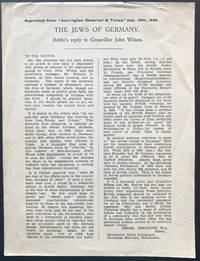
193640010Manchester Accrington Observer And Times 1936. Single sheet of paper. 1st separate edition. 8vo. 1 page. Offprint from Accrington Observer and Times Sept. 19 1936. <br> “Chief Rabbi Prof. Israel Abrahams of The Great Synagogue Cape Town South Africa was the Chief Rabbi of the United Council of Orthodox Hebrew Congregations Cape Province and South West Africa and also Northern Rhodesia from 1937 to 1968 after which he and his wife made Aliyah to Israel. He was the head of the department of Jewish Studies at The University of Cape Town. He was one of the founders of Herzlia School. In South Africa he wrote several books of sermons including ‘Pathways in Judaism’ ‘Living Waters’ and ‘The Birth of a Community’ - a history of Western Province Jewry from its earliest times to the end of the South African War 1902. He translated the scholarly works of Prof Umberto Cassuto from Hebrew to English both while in South Africa and later in Jerusalem. <br> In Israel he went on to translate works by Prof Urbach and others until his death after a short illness in October 1973. Chief Rabbi Prof Abrahams was born in Vilna and came to London as a small child where he later received his Rabbinic Ordination from Jews College. He received his degrees at University of London. He came to Cape Town after serving as the Rabbi of the Great Synagogue in Manchester. †telfed.org <br> Abrahams was responding to an article in which he claimed that some “facts†from Coun. John Wilson and Mr. Barnes were inaccurate and anti-Semitic. He refutes that claims that “In the post-war ie post WW I years Germany was over-run by Jews from Russia and Poland †and that “some 90 per cent of the official posts in the country were occupied by Jews. †<br> He does not take an attacking tone rather stating that “It is a thousand pities that Councillor Wilson and Mr. Barnes did not take the trouble to verify all their facts before giving their impressions Press publicity. British sympathy should be extended to the Jew who is the helpless victim in Germany and the convenient scapegoat for all its tribulations not to Hitler the aggressor who has shown neither Christian charity nor a sense of ordinary justice and humanity in his persecution of a community that has not only lived in Germany since earliest times but has performed yeoman service in its country’s behalf.†The US Holocaust Museum houses their copy in their Rare Book Collection. <br> SUBJECTS: Jews -- Germany -- History -- 20th century. -- Politics and government -- Juifs -- Politique et gouvernement -- 20e sie`cle. OCLC: 1088420602. OCLC lists only 1 copy worldwide USHMM. Very Good Condition. Very Rare. BK5 HOLO2-140-24. Manchester, Accrington Observer And Times unknown
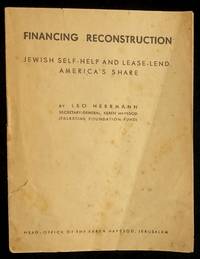
194240029Tel-Aviv: No Publisher 1942. Paperback. 1st separate edition. Original wrappers 12mo 15 pages 15 cm.<br> Holocaust-era plea for continued support for the war in Europe from both the US government as well as from the Yishuv and world Jewry in general. Reprinted from: Palestine and Middle East October 1942.<br> The author Leo Herrmann was Secretary-General of Keren Hayesod Palestine Foundation Fund. He writes “The historical foundation of our demands the moral basis which we must establish by our way of life in the country the unparalleled needs of Jewry today particularly suffering Continental Jewry-all these are absolutely fundamental elements in the call we must make for the world’s aid. This is the point that we reach by careful and systematic consideration of our position. We need self-help; we need the Keren Hayesod. Things cannot and will not remain as they are. We shall maintain our claim for inclusion in the great measures of aid for the whole world which have begun in the Lease and Lend policy that first step towards the world of freedom and democracy in which alone the Jewish People and Eretz Israel have a future.†<br> SUBJECTS : World War 1939-1945 -- Civilian relief -- Palestine. Lend-lease Keren Hayesod. Middle East -- Palestine. OCLC: 13175680 OCLC lists 3 copies worldwide YIVO HUC NLI.<br> Pages are toned some staining on cover small rip on spine side edge that goes through all pages else Good Condition. Scarce. BK5HOLO2-141-8. Tel-Aviv: No Publisher paperback
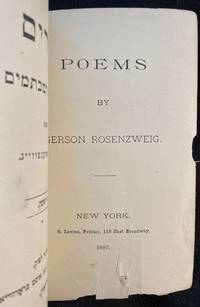
189342357New York: S. Levine 1893. 1st edition. Later Paper Wrappers 70 4 pages 18 x 12 cm Singerman 4588. <br> Gerson Rosenzweig 1861-1914 was born in Lithuania he taught Hebrew in Bialystok and in 1888 he emigrated to the United States. Rosenzweig edited several Hebrew periodicals - Ha-Ivri 1891-1902 Kadimah 1899-1902 Ha-Devorah 1911-12 - they were short-lived and earned him neither fame nor a livelihood. He also edited Hebrew columns in the Yiddish press. <br> Though he was a versifier rather than a poet he had a genuine flair for satire and he was known to his contemporaries as the "sweet satirist of Israel" and as a parodist he earned an honorable place in Hebrew literature. His Talmud Yanka'i "Yankee Talmud " 1907 1909 poured a stream of ill-humored sarcasm on the peddler the teacher the rabbi. The pages of that collection of satires resembled the pages of the Talmud: the text in large letters wreathed by commentary in Rashi script is divided into six tractates instead of the talmudic six orders. <br> Rosenzweig also denounced the vulgarisms of the country the worship of money the religion of success. Epigrammatic neatness was his forte. Example: "What is the difference between a convert and an anarchist A convert denies what he believes an anarchist believes what he denies. " Using a biblical phrase he quipped sardonically about his impending death by cancer of the tongue: "Life and death are at the mercy of the tongue" Prov. 18: 21. <br> He published two books of epigrams: Shirim Meshalim u-Mikhtamim 1893 and Hamishah ve-Elef Mikhtamim 1903; reprinted in Russia. Silberschlag in EJ. Subjects: 19th Century Poetry. OCLC: 18293289. Lacking original paper wrapper probably identical to title page touch of edgewear and toning to title page Good Condition B AMR-36-25AXX-LBD-'ex. New York: S. Levine unknown
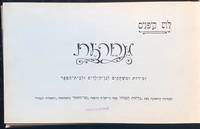
192343438Frankfurt am Main: Verlag "Omonuth" Omonut Omanut Omanuth 1923. 1st German-printed Edition. Original boards horizontal 8vo 1 score xv 177 pages. 13 x 21 cm. In Hebrew. Title translates as "Rhyme: Songs and Games for Kindergarten and School."<br> Book of songs for children written by Levin Kipnis. Includes musical settings unaccompanied for the poems by various composers. Hebrew text of each entire poem printed on page corresponding to strophic melody. Originally issued in Jerusalem and republished in this edition in Germany by the publishing house Omonuth.<br> "Kipnis was born in Ushomyr Volhynia.In 1913 he moved to Palestine to study at the Bezalel Academy of Art and Design. He later studied pedagogy for two years in Germany and thereafter became a teacher in Levinsky's Teacher's College in Tel Aviv 1923-1952. He debuted in print in 1911 with a poem in the children's magazine Heperaim The flowers and from that point published over one hundred Hebrew books for children and edited children's newspapers textbooks and the like. He is considered the founder of Hebrew-language children's literature in Israel. Leksikon fun der Nayer Yidisher Literatur<br> "A year after opening and before a single book had even been published Omanut closed its doors in Moscow and moved to Odessa a bustling port on the Black Sea located in the Ukraine and as yet untouched by the Revolution. Odessa was already a flourishing center of Jewish culture home to such luminaries of Modern Hebrew literature as Mendele Mocher Sforim and Chaim Nachman Bialik. But the events of 1917 sent even more Jewish writers and artists pouring in. With such a stable of local talent from which to draw Odessa was to prove fertile ground indeed for Omanut.<br> As the Bolsheviks advanced on the Ukraine Olamenu's female founder Shoshana Persitz relocated again this time to Frankfurt-am-Main in Germany. There she republished the beautiful picture books illustrated by the young art students in Odessa and also began publishing the polished Hebrew translations of world literature for children by which the press was to become famous. In 1925 Omanut left Europe altogether establishing itself once and for all in Tel-Aviv." LOC <br> SUBJECTS: Children's songs Hebrew. Singing games. Children's songs Hebrew. Singing games. OCLC: 18897325.<br> "Printed in Germany" stamp on title page. Some wear to spine and discoloration of cloth binding. Good Condition. GER-61-5-XX-'elggxcc. Frankfurt am Main: Verlag "Omonuth" [Omonut, Omanut, Omanuth] unknown
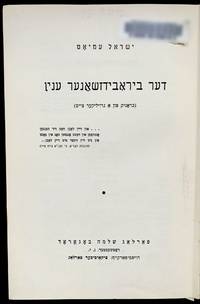
196043104Rochester N.Y.: Sol Bogorad 1960. First edition. Original boards 8vo 191 pages. 24 cm. In Yiddish. Title also appears in English as “The Birobidjan Case.â€<br> Inscribed by the author. Memoir of the author's time as a journalist in Birobidzhan and his stint in a Soviet labor camp in Siberia. Later issued in English as "The Birobidzhan Affair."<br> “Emiot was born in 1909 in Ostrow Mazowiecka then part of Congress Poland within the Russian Empire…Emiot published his first writing in 1926 and brought out four books of poetry during the 1930s.<br> When Germany invaded Poland in 1939 Emiot and his wife and children fled east to the Soviet Union; his mother remained and was killed during the war. In 1944 he was sent to work as a journalist in Birobidzhan the autonomous region set up for Jews in Siberia. Within a few years as the climate for Jewish writers in the Soviet Union worsened he was convicted of trumped-up crimes and sentenced to ten years of hard labor which he served at a camp near Taishet.<br> After his release he returned to Poland and soon after emigrated to the United States where his wife and children were living in Rochester. He spent his last decade and a half as writer-in-residence at Rochester's Jewish Community Center.†Wikipedia <br> SUBJECTS: Political prisoners -- Russia Federation -- Biography. Authors Yiddish -- Biography. Jews -- Russia Federation -- Birobidzhan. Ethnic relations. Imprisonment.Jews. Political prisoners. OCLC: 11234764<br> Ex-library with usual markings. Good Condition. YID-46-34-. Rochester, N.Y.: Sol Bogorad unknown
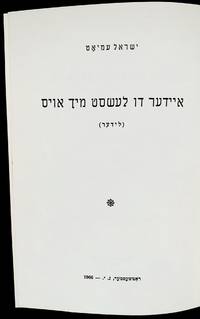
196643105Rotshester Rochester: Israel Goldwasser Emiot 1966. First edition. Original illustrated printed boards 8vo 64 pages. 23 cm. In Yiddish. Title appears in English as “Before I Am Extinguished.â€<br> Collection of Yiddish poems by Israel Emiot written while he was a writer-in-residence at the Jewish Community Center in Rochester New York.<br> “Emiot was born in 1909 in Ostrow Mazowiecka then part of Congress Poland within the Russian Empire…Emiot published his first writing in 1926 and brought out four books of poetry during the 1930s.<br> When Germany invaded Poland in 1939 Emiot and his wife and children fled east to the Soviet Union; his mother remained and was killed during the war. In 1944 he was sent to work as a journalist in Birobidzhan the autonomous region set up for Jews in Siberia. Within a few years as the climate for Jewish writers in the Soviet Union worsened he was convicted of trumped-up crimes and sentenced to ten years of hard labor which he served at a camp near Taishet.<br> After his release he returned to Poland and soon after emigrated to the United States where his wife and children were living in Rochester. He spent his last decade and a half as writer-in-residence at Rochester's Jewish Community Center.†Wikipedia<br> SUBJECTS: Yiddish poetry. OCLC: 10983110.<br> Contains marking in pen but otherwise excellent. Very Good Condition. YID-46-33-. Rotshester [Rochester]: Israel Goldwasser (Emiot) unknown
1905122287Stuttgart, Württ. Bibelanstalt, (1905). Kl.-4to. Mit 5 Kartenseiten u. 64 farbigen Abbildungen nach Fotografien. 70 S. Or.-Leder mit dreiseitigem Goldschnitt; Kapitale u. Ecken etw. beschabt, unt. Kapital mit Abschabung. [4 Warenabbildungen]