17 résultats
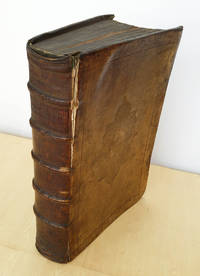
1583000119Laugingen (d. i. Lauingen), Leonhart Reinmichel für Georg Willers, 1583. 8 Blatt, 487 S., 27 Blatt, 1 unbedrucktes Blatt. Alter Pergamentband mit umgeschlagenen Vorderkanten. 4 Teile in einem Band. Mit 2 Titelvignetten in Holzschnitt und 42 ganzseitigen Pflanzenholzschnitten. Deutschsprachige Beschreibung von Rauwolfs Reise ins Heilige Land und den Vorderen Orient mit zahlreichen authentischen und zuverlässigen Beobachtungen. Graesse VI, 39; Brunet IV, 1122f.; Pritzel 7430; VD16: R 431; Short-Title Catalogue of German Books in the British Museum, p. 727. Die hier vorliegende zweite Auflage enthält erstmals den wichtigen vierten Teil mit den Pflanzenholzschnitten zuvor teils unbekannter orientalischer Gewächse (Nissen: Die botanische Buchillustration, Nr. 1587). Dem Autor zu Ehren wurde später die Gattung "Rauvolfia" der Pflanzenfamilie der Hundsgiftgewächse (Apocynaceae) benannt. "Mit besonderer Vorliebe hat Rauwolf alle medicinischen Dinge, Krankheiten, Heilmittel, Bäder, Speisen und Getränke und alle Industrien besprochen, nicht ohne daß durch Leichtgläubigkeit, wie sie der Zeit gegenüber den Erzählungen von fremden Ländern eigen war, auch manches Fabelhafte (s. die Schilderung des Greifes im 8. Capitel des 2. Buches) mit unterläuft. Rauwolf muß ein genaues Tagebuch geführt haben, er würde sonst nicht im Stande gewesen sein, eine solche Fülle einzelner genauer Angaben zu bieten" (F. Ratzel in ADB 27). In der Schilderung seiner dramatisch verlaufenen Reise gibt der Autor außerdem die erste Beschreibung des Kaffees und eines Kaffeehauses: "Under andern habens ein gut getränck / welliches sie hoch halten / Chaube von jnen genennet / das ist gar nahe wie Dinten so schwartz / vnnd in gebresten / sonderlich des Magens / gar dienstlich. Dises pflegens am Morgen frü / auch an offnen orten / vor jedermenigklich one alles abscheuen zutrincken / auß jrdinen vnnd Porcellanischen tieffen Schälein / so warm / alß sies können erleiden." (S. 102f.). Zwischen die 4 Teile des Textes hat der Buchbinder jeweils mehrere unbedruckte Leerseiten eingebunden. Der Vorderdeckel innen und das Titelblatt am oberen Rand mit handschriftlichen Vermerken von alter Hand zur Bedeutung des Buches. Der Rücken nachgedunkelt und der Vorderdeckel etwas fleckig, insgesamt handelt es sich jedoch um ein ordentliches, breitrandiges und weitgehend fleckenfreies Exemplar.
1587910995CGWittenberg:, Ambrosius Kirchner, 1587. Holzschnitt 27 x 17 cm, Blattgröße 30,5 x 20 cm.
1587910996CGWittenberg:, Ambrosius Kirchner, 1587. Holzschnitt 26 x 36,5 cm, Blattgröße 31 x 39 cm. [2 Warenabbildungen]
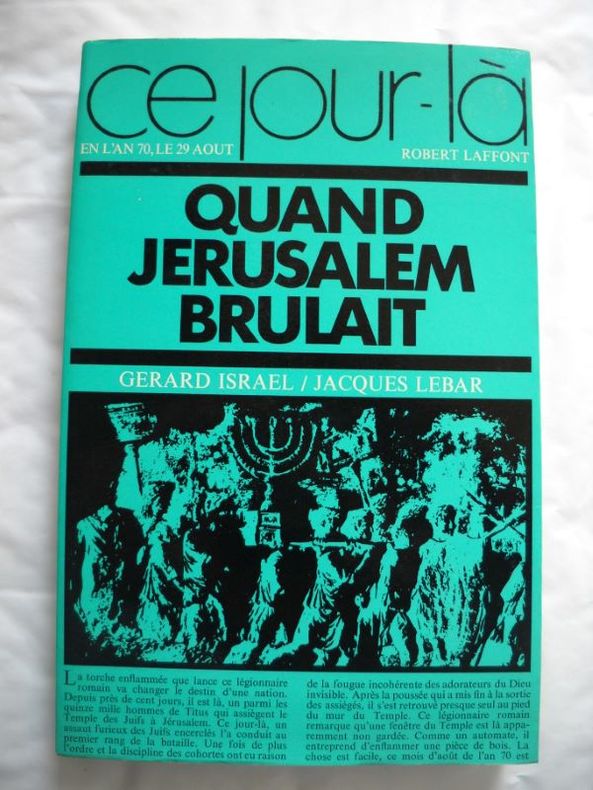
1552184101552 Broché avec jaquette - 15,5 x 24 - 276 pp année 1970 - Editions Robert Laffont
1510317598Berlin, R. Friedländer & Sohn - Gedruckt bei L. Schumacher 1881. Neudruck der Ausgabe Nürnberg, Höltzel, 1510. 21,3:16,7 cm. Halblederband der Zeit mit Lederecken. Kanten und Ecken etwas berieben. 4 Blatt: Titelblatt (Stark gebräunt), 4 Seiten Text und letztes Blatt mit Druckvermerk. Sauber und wohlerhalten. Gutes Exemplar. [5 Warenabbildungen]
1526Khe02355Frankfurt (Suhrkamp Verlag) 1989 (= edition suhrkamp 1526, Erste Ausgabe). 8°, Originalbroschur (Paperback ) 303 s., ISBN 351811526x 1
1587910998CGWittenberg:, Ambrosius Kirchner, 1587. Holzschnitt, 27,5 x 38 cm, Blattgröße 30,5 x 39,5 cm. [2 Warenabbildungen]
1597108004Argentinae Strasbourg: Sumptibus Lazari Zetzneri 1597. Third edition. Leather bound. Good . 33 cm. Full vellum. Varying pagination. All pages present. Title vignette. Anatomical illustrations including babies in the womb and gynaecological instruments. 6 impressive illustrations near the beginning of the book show full midsection of a body opened to reveal reproductive organs. Crack in top right edge of spine but binding still holding well. Owner's signature. Bookseller's label W.F. Watson Edinburgh. Dampstain to bottom third of title page continuing through preliminaries. Some notations in margins pages browned minor spots a few small holes. <br/><br/>Bookplate of James Young Simpson 1811-1870 Scottish doctor and discoverer of the anaesthetic uses of chloroform in medical work. Includes signed note by Simpson dated 1860 a note of introduction for another doctor Dr. Elisha Kinney touring Europe. Text in Latin and Greek. GM 6013. Israel Spach 1560-1610 studied medicine under Jean Riolan the Elder and later at the University of Tubingen. After receiving his doctorate he practised medicine before taking a professorship at the Strasbourg Academy. This book is one of Spach's many scholarly works. In this text he has compiled as editor a great collection of gynaecological writings. It is in effect the third edition of the collection previously issued by Wolff No. 6011 and Bauhin No. 6012. Sumptibus Lazari Zetzneri hardcover
159619353Würzburg, Fleischmann, 1596. 20 n.n. Bll. Schöne Holzschnitt-Titelbordüre, einige Vignetten und Holzschnitt-Initialen. 8°, späterer, schlichter Papierumschlag.
1587910997CGWittenberg:, Ambrosius Kirchner, 1587. Holzschnitt, 27 x 36,5 cm, Blattgröße 30,5 x 39 cm. [2 Warenabbildungen]
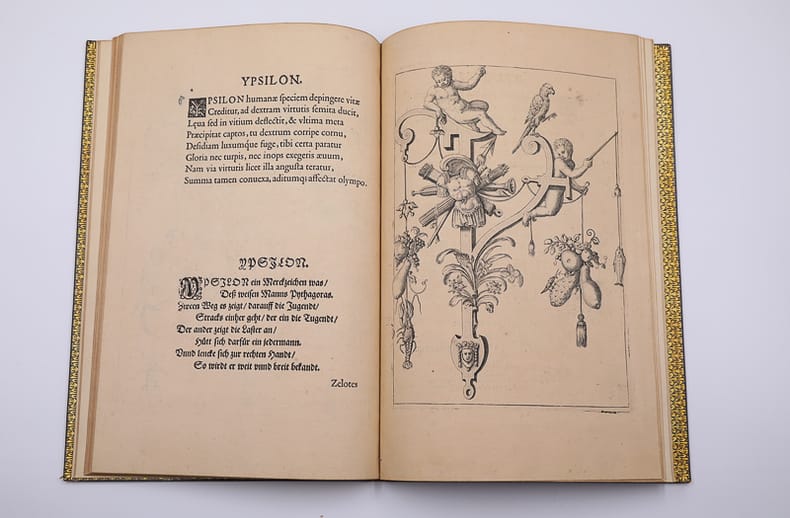
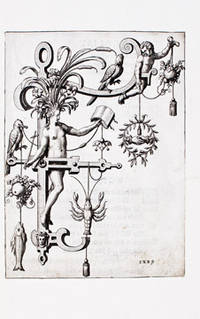
15751483181575. DE BRY Johann Theodor and J. I. DE BRY. Nova Alphati Effictio histories ad singulas literas correspondentibus et toreumate Bryanaeo artificiose in aes incises illustrate . Engraved title-page 24 elaborately engraved plates of letters all with grotesque Mannerist ornamentation. 4to. 325 x 212 mm bound by Rivière in full crushed brown morocco triple gilt fillet on covers floral gilt ornaments in corners spine with intricate floral tooling in compartments a.e.g. Frankfurt: De Bry 1595. First Edition of this celebrated and rare Renaissance Alphabet Book. "Elles représentent un grand Alphabet majuscule dont les lettres sont formées par découpures mouvementées ornées de figures de trophées d'oiseaux de fleurs et de fruits" Guilmard Les Maîtres Ornemanistes p. 368. The letters appear in uppercase and are embedded within elaborate ornamentation consisting of Biblical figures nymphs fauns musical instruments cherubs lovers insects fruits birds trophies fish lobsters flowers splendid entrelacs and luxurious arabesques. These extravagant illustrations are characterized by a disintegration of reality in which the forms have been redistributed in accordance with the fantasy of the De Bry brothers. The mixture of grotesque classical and symbolic imagery executed with supreme artistic bravado elevates this work to the pinnacle of published ornamental alphabet books. Each engraving is accompanied by a letterpress text in German and Latin on the verso where the subject matter is identified. The engravings are individually "signed" with "J.T.B. fe." A second edition of the work appeared at Cologne in 1613. The rarity of this first edition is attested by the recent facsimile of it Ravensburg 1997. No copies sold at auction as listed by ABPC; OCLC lists 7 copies in America at Houghton Morgan Library NYPL Walters Art Gallery RISD Newberry and the University of Virginia. There are also 7 copies listed in European institutions. This copy had the engravings cut out and mounted during the nineteenth century on large papier Hollande in a folio format. However the size of the cut-out sheets 195 x 150 mm remains fully intact; the folio sheets measure 325 x 212 mm. Some insignificant spots to interleaved sheets binding with minor rubbing to extremities. This copy lacks the two dedication leaves which includes the text to the letter A on the verso of the second leaf. A desirable copy nonetheless. PROVENANCE: Sir John Stirling Maxwell 1818-1878 with his private ex-libris his sale Christie's London 1958 Lot 59 and with the Nether Pollok "Arts of Design" ex-libris. Berlin Katalog 5281. Guimard Les Maîtres Ornemanistes p. 368 No. 38. Bonacini 292 "estremamente rara". Brunet I 1309. BMC German 161. See: Becker The Practice of Letters The Hofer Collection of Writing Manuals 1514-1800 for the 1596 German edition of Alphabeten. unknown
1595bf5572Fr. ad Moe Relié 1595 EDITION ORIGINALE DES PLUS RECHERCHEES. Nova alphati effictio historiis ad singulas literas correspondentibus, et toreumate Bryanæo artificiose in æs incisis illustrata : Versibus insuper Latinis et Rithmis Germanicis non omnino inconditis. Nejw kunstliches Alphabet, gezirt mit schonen Figurn deren jede sich auff seinen Buchstaben acconmodirt ; artlich in kupffergestochen, durch die Bryen, Auch mit Lateineschen Versen und teutschen Reimen lustig beschrieben. Fr. ad Moe. [Francfort-sur-le-Main]. 1595. In-4 (28 x 19 cm). Titre-frontispice, (2) ff. [Dédicace et préface], (24) planches gravées avec le texte latin et allemand imprimé sur la page en regard : plein maroquin havane janséniste, dos à six nerfs, dentelle intérieure et tranches dorées. (Trautz-Bauzonnet). Édition originale, des plus recherchées, du somptueux alphabet des frères de Bry. Jean Théodore (Strasbourg 1561-1623 Francfort), graveur, dessinateur et éditeur, travailla, en association avec son frère, Jean Israël (1565-1609), dans l’imprimerie familiale de Strasbourg fondée par leur père, Théodore de Bry (Liège 1528-1598 Francfort), dessinateur, graveur et éditeur protestant. Remarquable suite de vingt-quatre planches, finement gravées sur cuivre, figurant vingt-quatre lettres richement ornées inspirées de la Bible : Adam, Caïn, David, Goliath, Holopherne, Judith, Luc, Moïse, Noé, Pierre, Roboam, Salomon, Thomas, Vrias, Xhristus, etc. Les personnages représentant l’occurrence sont agrémentés de fruits, animaux, objets et angelots. En regard, le texte en latin et allemand avec lettrines ornées. Seconde émission avec le texte en allemand. Merveilleux recueil et bel exemplaire dans une élégante reliure en plein maroquin de Trautz-Bauzonnet, conçue vers 1860, avec quelques très minimes frottements d’usage. Provenances : Bibliothèque d’Edmond Foulc (1826-1916), avec son ex-libris, remarquable collectionneur d’art et de recueils d’estampes d’architecture et d’ornements. Un second ex-libris, sous forme de carré magique, révèle le nom de Jules Riollot, ingénieur spécialiste de l’étude de ces carrés. Livraison a domicile (La Poste) ou en Mondial Relay sur simple demande.
15751483181575. DE BRY Johann Theodor and J. I. DE BRY. Nova Alphati Effictio histories ad singulas literas correspondentibus et toreumate Bryanaeo artificiose in aes incises illustrate . Engraved title-page 24 elaborately engraved plates of letters all with grotesque Mannerist ornamentation. 4to. 325 x 212 mm bound by Rivière in full crushed brown morocco triple gilt fillet on covers floral gilt ornaments in corners spine with intricate floral tooling in compartments a.e.g. Frankfurt: De Bry 1595. First Edition of this celebrated and rare Renaissance Alphabet Book. "Elles représentent un grand Alphabet majuscule dont les lettres sont formées par découpures mouvementées ornées de figures de trophées d'oiseaux de fleurs et de fruits" Guilmard Les Maîtres Ornemanistes p. 368. The letters appear in uppercase and are embedded within elaborate ornamentation consisting of Biblical figures nymphs fauns musical instruments cherubs lovers insects fruits birds trophies fish lobsters flowers splendid entrelacs and luxurious arabesques. These extravagant illustrations are characterized by a disintegration of reality in which the forms have been redistributed in accordance with the fantasy of the De Bry brothers. The mixture of grotesque classical and symbolic imagery executed with supreme artistic bravado elevates this work to the pinnacle of published ornamental alphabet books. Each engraving is accompanied by a letterpress text in German and Latin on the verso where the subject matter is identified. The engravings are individually "signed" with "J.T.B. fe." A second edition of the work appeared at Cologne in 1613. The rarity of this first edition is attested by the recent facsimile of it Ravensburg 1997. No copies sold at auction as listed by ABPC; OCLC lists 7 copies in America at Houghton Morgan Library NYPL Walters Art Gallery RISD Newberry and the University of Virginia. There are also 7 copies listed in European institutions. This copy had the engravings cut out and mounted during the nineteenth century on large papier Hollande in a folio format. However the size of the cut-out sheets 195 x 150 mm remains fully intact; the folio sheets measure 325 x 212 mm. Some insignificant spots to interleaved sheets binding with minor rubbing to extremities. This copy lacks the two dedication leaves which includes the text to the letter A on the verso of the second leaf. A desirable copy nonetheless. PROVENANCE: Sir John Stirling Maxwell 1818-1878 with his private ex-libris his sale Christie's London 1958 Lot 59 and with the Nether Pollok "Arts of Design" ex-libris. Berlin Katalog 5281. Guimard Les Maîtres Ornemanistes p. 368 No. 38. Bonacini 292 "estremamente rara". Brunet I 1309. BMC German 161. See: Becker The Practice of Letters The Hofer Collection of Writing Manuals 1514-1800 for the 1596 German edition of Alphabeten. unknown books
1587910999CGWittenberg:, Ambrosius Kirchner, 1587. Holzschnitt, 26 x 36 cm, Blattgröße 30,5 x 39 cm. [2 Warenabbildungen]
1587910994CGWittenberg:, Ambroisius Kirchner, 1587. Holzschnitt, 27 x 19,5 cm, Blattgröße 30,5 x 20 cm. [3 Warenabbildungen]
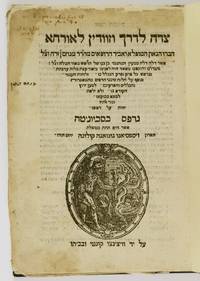
156753370Sabbioneta: Vincenzo Conti 1567. Second edition. Hardcover. Good. Small quarto. 261 1ff. Signatures: 1-65 alef - sameḥ-heh4 chi2 = 262 leaves. Woodcut illustration leaf 90. Final two leaves are folding broadsheets with letterpress charts the first leaf 261 with the final page of text at the verso. Printer's device Hercules slaying the Hydra at title. Modern black polished calf. A few skilfull paper repairs at top margin in early leaves. Clean marginal tear leaf 181. Light worm tracing with some text loss in final ten leaves; along with a small group of 4 to 6 very tiny worm holes in the final 30 leaves. Light mostly marginal dampstain at final 30 leaves. Both charts with old corrections and annotations and some loss of text due to worming each mounted on fine laid paper. A good copy with generally crisp clean text notably complete with the final two folding almanac charts.<br /> <br /> Second edition of this compendium of Jewish law composed in honor of Don Samuel Abravanel of Seville. It was intended principally for the use of persons in the upper social classes many of whom occupied positions in government and found it inconvenient to observe all the legal and ritual regulations or lacked the time to refer to the halakhic sources. First published at Ferrara in 1554 and arranged in five articles Heb. = ma'amarot "the work has an added importance on account of the introduction which contains valuable historical material including important details of the method of study in the yeshivot of France and Germany as well as contemporary incidents in the history of the Jews in Spain. Menahem writes reprovingly of those Jews who because of the demands of the times began to disregard the observance of the precepts. Although he shows great erudition in his knowledge of the Talmud and codes and was acquainted with the teachings of the earlier Spanish French and German scholars he relies mainly for his halakhic rulings on those of Asher b. Jehiel" EJ. This preference likely reflects the influence of Asher's son Judah who was one of Menahem's principal teachers at the yeshiva in Toledo.<br /> <br /> Among the very last Hebrew works published at Sabbioneta the title highlights the approval of Vespasiono Gonzaga the reigning prince. Previously in 1553 "the proprietors of this press attempted the hazardous work of republishing the Talmud and one Treatise saw the light; but the papal decree of that year made the further publication of the Talmud in Italy an impossibility. The end of this press came in the year 1559 due as De Rossi intimates to anti-Christian statements in some of their publications which finally brought down upon them the wrath of the church" Amram. When Vincenzo Conti briefly re-established the press at Sabbioneta to print the present work and two or three others he would have been keen to indicate his obedience to the temporal and ecclesiastical authorities.<br /> <br /> The verso of the last numbered leaf and the following unnumbered leaf both are broadsheets comprise a calendar or almanac entitled "Beʼur ha-luḥot" for the years 5025-6000. The first part is designated "Ha-Luaḥ ha-Rishon" and the second "Ha-Luaḥ ha-Sheni." Many copies appear to lack one or both of the broadsheets.<br /> <br /> Annotations: Old Hebrew entries in two hands at the margins of the title-page; some scattered marginal notes in Hebrew. Title in Hebrew: â€×¦×“×” לדרך וזוודין ל××•×¨×—× :†â€×•×”×’×“×œ× ×• ×•×”×•×¡×¤× ×• . בי×ור קצת מילות ערביות . ולוחות העבור . ×•× ×•×¡×£ על הלוח ×¡×™×ž× ×™ ×”×“×¤×™× ×ž×”×ž×מרות ×•×”×›×œ×œ×™× ×•×”×¤×¨×§×™× â€<br /> <br /> References: D. Amram The Makers of Hebrew Books in Italy pp. 292-3; Cowley 132; Enc. Jud. 11:1303-04; Goldstein 105; Roest Rosenthaliana p. 788 noting two tables; Steinschneider 6368.2 and 3617 Luah; Vinograd Sabbioneta 55; USTC 1791691; Zedner p.527. Vincenzo Conti hardcover
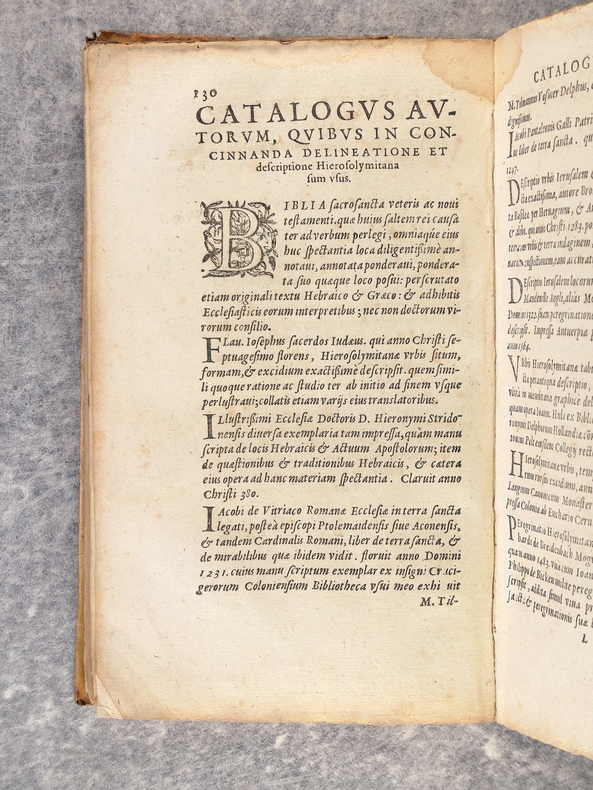
15922176COLONIAE AGRIPPINAE. IN OFFICINA BIRCKMANNICA, SUMPTIBUS ARNOLDI MYLII. 1592. PETIT IN-8 (10,5 X 19 CENTIMETRES ENVIRON) DE (32, DONT 3 BLANCHES) + 136 + (24, DONT 4 BLANCHES)PAGES, RELIURE D'EPOQUE PLEIN VELIN IVOIRE. VIGNETTE DE TITRE AUX ARMES DE JERUSALEM GRAVEE SUR BOIS. LE PLAN DE JERUSALEM N'EST PAS PRESENT ICI, COMME DANS LA PLUPART DES EXEMPLAIRES CONNUS DE CET OUVRAGE. LES PAGES 130 A 136 CONTIENNENT UN CATALOGUE DES LIVRES PARUS SUR JERUSALEM. PETITS DEFAUTS EXTERIEURS, PETIT MANQUE DE PAPIER SANS ATTEINTE AU TEXTE SUR LE FEUILLET DE TITRE, SINON BON EXEMPLAIRE.