528 résultats
1820ZB1283966St. Petersburg: Russian Orthodox Church ca. 1820. 1204 pp. contemporary full leather binding now very dry worn and lacking the leather spine covering; masonic book plate to the front paste down old inked ownership markings to the front free endpaper the title page and the following blank else internally clean and tight. - If you are reading this this item is actually physically in our stock and ready for shipment once ordered. We are not bookjackers. Buyer is responsible for any additional duties taxes or fees required by recipient's country. Photos available upon request. St. Petersburg: Russian Orthodox Church hardcover
1772000254London: W. Owen in Fleet-Street; J. Dodsley in Pall-Mall; J. Rivington in St. Paul's Church-Yard; and T. Becket and P.A. DeHondt 1772. First Edition. . Hardcover. See Description. 4to. pp 6 xix 5 477. With 12 copper engraved plates and a fold-out frontispiece illustration of the Devitza Monastary near St. Petersburg - all by P. Mazell. The title page contains a vignette depicting the medal of Catherine II. Pages are generally clean with occasional mild specks of marginal foxing; faint library stamp placed in upper margin of title page. Bound in Modern half dark brown morocco with marbled boards and end papers. J.G. King 1731-1787 was Chaplain to the English Factory at St. Petersburg. He spent much time studying and observing Russian Orthodox practices. His work offers detailed descriptions and select translations of the various rituals services and liturgies belonging to the Russian Orthodox Church. ESTC T95407; Lewine p.262; Brunet III 661; Graesse IV p.18; Lowndes p.1274 <br/> <br/> W. Owen, in Fleet-Street; J. Dodsley, in Pall-Mall; J. Rivington, in St. Paul's Church-Yard; and T. Becket and P.A. DeHondt hardcover
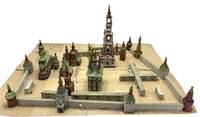
18601753Sergiyev Posad. c.1860-1900. A set of 40 hand-carved and painted wooden buildings forming a toy model of the Trinity Lavra of St. Sergius the tallest piece measuring 26cm in height with the original block-printed guide sheet showing how the pieces should be laid out also showing walkways 63.5 x 48.5cm. The set is apparently lacking four wall sections and several smaller pieces however the numbering system is somewhat hard to discern with the ink numbers on the bases of the pieces often obscured and the numbering on the guide sheet being slightly erratic/mismatched to the pieces so it is difficult to be certain. It is however also possible to arrange the set in a slightly more compact manner in order to complete the walls as the example sold at Christies mentioned below was presented which also appeared to lack a couple of wall sections and other pieces and where the pieces were fixed in place to a board with the guide sheet lacking. There are some small losses and repairs to several of the pieces but broadly the set is in good condition; the guide sheet is very fragile and has several holes two affecting the printed plan and some splitting along the folds but remains a remarkable survival. A very charming vibrantly hand-painted late nineteenth-century toy model of the Trinity Monastery of St. Sergii the most important monastery in Russia and the spiritual centre of the Russian Orthodox Church.</p><p>The monastery was founded in 1337 by Sergius of Radonezh later one of the most venerated Russian saints and a spiritual patron of the nation. Its first stone cathedral was built in 1422 by a group of refugee Serbian monks which decorated with frescoes painted by the greatest icon painters of medieval Russia Andrei Rublev and Daniil Chyorny came to serve as the place of baptism for Muscovite royals. In 1476 Ivan III commissioned the church of the Holy Spirit now one of the few remaining examples of a Russian church topped with a belltower and in 1559 Ivan the Terrible ordered the construction of the six-pillared Assumption Cathedral ultimately completed after twenty-six years. During the sixteenth century the monastery grew into one of the wealthiest landowners in Russia. It was also a notable centre of chronicle-writing and icon painting and housed an eminent library of manuscripts and books. Its stone walls were constructed in the 1550s helping it to withstand the famous sixteen-month Polish-Lithuanian siege of 1608-1610. Throughout the seventeenth century during which Peter the Great twice took refuge in the monastery numerous buildings were added including the Church of John the Baptist's Nativity commissioned by the Stroganovs. In 1744 Empress Elizabeth conferred on the cloister the dignity of a Lavra and also oversaw the construction of a further church as well as the belltower the tallest building in the present set.</p><p>The monastery is situated in the town of Sergiyev Posad which itself grew alongside the monastery just over 40 miles northeast of Moscow. From the eighteenth century Sergiyev Posad developed into a centre of toy-making and by the following century the town was home to hundreds of independent artisans and workshops making all manner of wooden toys including the famous nesting dolls. Toy models of the Trinity Lavra of St. Sergius such as the present example were produced by local craftspeople from around the 1860s with the Sergiyev Posad Toy Museum holding another similar model in its collections.</p><p>A near-identical model from the collection of Alexandra Tolstoy was also sold at Christies in 2020 25th November lot 90. [Sergiyev Posad]. unknown