Photius / Photios, David HœschelLivre Rare Book

917 résultats
16010400Augsbourg, Augustae Vindelicorum Ad Insigne Pinus, 1601. Édition princeps de l’œuvre de Photios Ier de Constantinople par l'humaniste allemand David Hœschel, portant mention de primus edidit sur la page de titre. Fort volume (338 x 234 mm pour 105 mm d'épaisseur) en sexternions, (xi) 985 pp. Relié plein vélin, plats muets, dos lisse, mention calligraphiée "Photius Bibliotheca" en partie effacée près de la coiffe, cinq coutures apparentes aux charnières en plus des coutures de tête et de queue. Toutes tranches teintes en rouge. Un signet bicolore en tissu épais est fourni. Mention à la plume sur la première garde blanche datée de 1777. Page de titre, dédicace en latin à Marco Velsero, une page en grec, liste "Eruditorum Aliquot de Photio" en latin, élégie en vers latins à Janus Gruter ("Ianus Gruteri"), page dédiée à Isaac Casaubon ("Isaacus Casaubonus"), l'ensemble formant 11 pages non paginées. Commence ensuite le texte grec de l’œuvre de Photius, bien paginé, avec de nombreuses notes aux marges. Page de note en latin de David Hœschel à la p. 919, la suite étant consacrée aux notes de bas de page en grec jusqu'au colophon, en latin, qui clôt le livre p. 985. Gravures sur bois à la page de titre et au colophon. Nombreux bandeaux, lettrines et culs-de-lampe à travers l'ouvrage. "La Bibliothèque (Βιβλιοθήκη) ou Myriobiblos (Μυριόβιβλος), œuvre de Photios, patriarche de Constantinople de 858 à 886, est une collection de 280 notices (appelées traditionnellement « codex », parfois au pluriel « codices ») sur des textes littéraires de genres variés lus par le recenseur. L'ouvrage fut commencé vers 843. Les « codices », de longueur très variable, vont de la simple mention d'un nom d'auteur avec un titre à une analyse de plusieurs dizaines de pages. Ils traitent des auteurs, du contenu des textes, du jugement porté par Photios sur eux, et comprennent souvent des citations plus ou moins longues. Selon Karl Krumbacher (Die griechische Lit., 1905, p. 274.), il s'agit du « plus important ouvrage d'histoire littéraire du Moyen Âge »" (Wikipédia) Si Hœschel publia de nombreux textes de Pères de l'église en grec et latin, dont plusieurs furent des éditions princeps, le Myriobiblios reste considéré comme sa plus importante contribution à la philologie. Il fit l'objet d'une traduction en latin, publiée par le jésuite André Schott également à Augsbourg en 1606, ainsi que de plusieurs rééditions du vivant même d'Hœschel. Ouvrage rarissime et d'une grande valeur historique. Taches et frottements aux plats, légères craquelures en certains points du dos juste avant les charnières, coin inférieur avant frotté et émoussé, coiffes baillant légèrement avec débuts de craquelure au milieu, extrémités haute et basse des charnières avant craquelées. Trous de mite importants sur la marge intérieure des 9 premières et des 16 dernières pages, avec très légers manques au milieu de la colonne gauche de la p.969 au colophon p.985, quelques petits trous épars, rousseurs éparses surtout marginales sans perte. ************************************************** Augsburg, Augustae Vindelicorum Ad Insigne Pinus, 1601. Editio Princeps of the work of Photius I of Constantinople by the German humanist David Hœschel, with mention of primus edidit on the title page. Large volume (338 x 234 mm for 105 mm thickness) in sexternions, (xi) 985 pp. Bound in full vellum, blank covers, flat spine, calligraphic mention "Photius Bibliotheca" partly erased at the top of the spine, five visible stitches at the hinges in addition to the head and tail stitches. All edges dyed red. A two-tone bookmark in thick cloth is provided. Pen note on the first white guard dated 1777. Title page, dedication in Latin to Marco Velsero, one page in Greek, list "Eruditorum Aliquot de Photio" in Latin, elegy in Latin verse to Janus Gruter ("Ianus Gruteri"), page dedicated to Isaac Casaubon ("Isaacus Casaubonus"), this being 11 unpaginated pages. Then begins the (paginated) Greek text of Photius' work, with numerous notes in the margins. Page of note in Latin by David Hœschel on p. 919, the rest being devoted to footnotes in Greek until the colophon, in Latin, which closes the book on p. 985. Woodcuts on the title page and colophon. Numerous headpieces, initials and tailpieces throughout. "The Bibliotheca (Βιβλιοθήκη) or Myriobiblos (Μυριόβιβλος), the work of Photios, patriarch of Constantinople from 858 to 886, is a collection of 280 notices (traditionally called "codex", sometimes in the plural "codices") on literary texts of various genres read by the census taker. The work was begun around 843. The "codices", of very variable length, range from the simple mention of an author's name with a title to an analysis of several dozen pages. They deal with the authors, the content of the texts, the judgment made by Photios on them, and often include more or less long quotations. According to Karl Krumbacher (Die griechische Lit., 1905, p. 274.), it is the "most important work of literary history of the Middle Ages"." (Wikipedia) While Hoeschel published many texts by the Fathers of the Church in Greek and Latin, several of which were first editions, the Myriobiblios remains considered his most important contribution to philology. It was translated into Latin, published by the Jesuit André Schott also in Augsburg in 1606, as well as several reissues during Hoeschel's own lifetime. A very rare work of great historical value. Stains and rubbing on the covers, slight cracking in some places on the spine just before the hinges, lower front corner rubbed with a slight defect, spine extremities slightly gaping with the beginnings of cracking in the middle. Upper and lower ends of the front hinges crackled. Significant moth holes on the inside margin of the first 9 and last 16 pages, with very slight losses in the middle of the left column from p.969 to the colophon p.985), some small scattered holes, scattered foxing mainly marginal without loss.
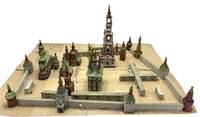
18601753Sergiyev Posad. c.1860-1900. A set of 40 hand-carved and painted wooden buildings forming a toy model of the Trinity Lavra of St. Sergius the tallest piece measuring 26cm in height with the original block-printed guide sheet showing how the pieces should be laid out also showing walkways 63.5 x 48.5cm. The set is apparently lacking four wall sections and several smaller pieces however the numbering system is somewhat hard to discern with the ink numbers on the bases of the pieces often obscured and the numbering on the guide sheet being slightly erratic/mismatched to the pieces so it is difficult to be certain. It is however also possible to arrange the set in a slightly more compact manner in order to complete the walls as the example sold at Christies mentioned below was presented which also appeared to lack a couple of wall sections and other pieces and where the pieces were fixed in place to a board with the guide sheet lacking. There are some small losses and repairs to several of the pieces but broadly the set is in good condition; the guide sheet is very fragile and has several holes two affecting the printed plan and some splitting along the folds but remains a remarkable survival. A very charming vibrantly hand-painted late nineteenth-century toy model of the Trinity Monastery of St. Sergii the most important monastery in Russia and the spiritual centre of the Russian Orthodox Church.</p><p>The monastery was founded in 1337 by Sergius of Radonezh later one of the most venerated Russian saints and a spiritual patron of the nation. Its first stone cathedral was built in 1422 by a group of refugee Serbian monks which decorated with frescoes painted by the greatest icon painters of medieval Russia Andrei Rublev and Daniil Chyorny came to serve as the place of baptism for Muscovite royals. In 1476 Ivan III commissioned the church of the Holy Spirit now one of the few remaining examples of a Russian church topped with a belltower and in 1559 Ivan the Terrible ordered the construction of the six-pillared Assumption Cathedral ultimately completed after twenty-six years. During the sixteenth century the monastery grew into one of the wealthiest landowners in Russia. It was also a notable centre of chronicle-writing and icon painting and housed an eminent library of manuscripts and books. Its stone walls were constructed in the 1550s helping it to withstand the famous sixteen-month Polish-Lithuanian siege of 1608-1610. Throughout the seventeenth century during which Peter the Great twice took refuge in the monastery numerous buildings were added including the Church of John the Baptist's Nativity commissioned by the Stroganovs. In 1744 Empress Elizabeth conferred on the cloister the dignity of a Lavra and also oversaw the construction of a further church as well as the belltower the tallest building in the present set.</p><p>The monastery is situated in the town of Sergiyev Posad which itself grew alongside the monastery just over 40 miles northeast of Moscow. From the eighteenth century Sergiyev Posad developed into a centre of toy-making and by the following century the town was home to hundreds of independent artisans and workshops making all manner of wooden toys including the famous nesting dolls. Toy models of the Trinity Lavra of St. Sergius such as the present example were produced by local craftspeople from around the 1860s with the Sergiyev Posad Toy Museum holding another similar model in its collections.</p><p>A near-identical model from the collection of Alexandra Tolstoy was also sold at Christies in 2020 25th November lot 90. [Sergiyev Posad]. unknown
492-Eo.J. Bleistift, auf grautonigem Papier, rechts unten monogrammiert und datiert ?825 GF (ligiert)?, unter der Darstellung bezeichnet ?Entwurf zum ersten Altarbild für einen Grafen Erdödi in Ungarn?. 22,8:18 cm. Literatur: Thieme/Becker, Bd. XII, S. 77. In dem eigenhändigen Werkverzeichnis wird das Altarbild ?St. Georg? an erster Stelle aufgeführt.
2008207906Meitingen, Kyrios-Verlag 1954-2008. 8°, sauber und fachmännisch eingebunden in Bibliotheks-Leinen / -Halbleinen,
63194, Brepols, 2023 Hardback, 2 vols, xxxvi + 1593 pages, Size:155 x 245 mm, Language(s):Syriac, English, Arabic.*new ISBN 9782503545059.
417 pages. Index. Appendices. Footnotes. List of sixty black and white illustrations. A rare surviving copy of this important reference, made all the more engaging by today's environment of competing fiat currency devaluations. "Hitherto Numismatists when stydying the Origines of Coinage had confined themselves to the materials presented to them in the earliest money of Lydia, Greece and Italy, and on the other hand the Metrologists had almost completely limited their range of observation to the systems of Babylon, Egypt, Greece and Rome. As the Comparative Method has yielded such excellent results in the study of other human institutions, I have endeavoured by its aid to get some new principles which may throw some fresh light on the first beginnings of monetary and weight systems." - from Preface. Attractive gilt decoration upon green front board. Legible gilt lettering upon backstrip. Average external soiling and wear. Several chips from and lengthy openings along backstrip which has become brittle with age. Narrow opening along most of front hinge. Back hinge open. Bookplate discretely removed inside front board. Unmarked. A tender but worthy copy. Book
1772000254London: W. Owen in Fleet-Street; J. Dodsley in Pall-Mall; J. Rivington in St. Paul's Church-Yard; and T. Becket and P.A. DeHondt 1772. First Edition. . Hardcover. See Description. 4to. pp 6 xix 5 477. With 12 copper engraved plates and a fold-out frontispiece illustration of the Devitza Monastary near St. Petersburg - all by P. Mazell. The title page contains a vignette depicting the medal of Catherine II. Pages are generally clean with occasional mild specks of marginal foxing; faint library stamp placed in upper margin of title page. Bound in Modern half dark brown morocco with marbled boards and end papers. J.G. King 1731-1787 was Chaplain to the English Factory at St. Petersburg. He spent much time studying and observing Russian Orthodox practices. His work offers detailed descriptions and select translations of the various rituals services and liturgies belonging to the Russian Orthodox Church. ESTC T95407; Lewine p.262; Brunet III 661; Graesse IV p.18; Lowndes p.1274 <br/> <br/> W. Owen, in Fleet-Street; J. Dodsley, in Pall-Mall; J. Rivington, in St. Paul's Church-Yard; and T. Becket and P.A. DeHondt hardcover
1820ZB1283966St. Petersburg: Russian Orthodox Church ca. 1820. 1204 pp. contemporary full leather binding now very dry worn and lacking the leather spine covering; masonic book plate to the front paste down old inked ownership markings to the front free endpaper the title page and the following blank else internally clean and tight. - If you are reading this this item is actually physically in our stock and ready for shipment once ordered. We are not bookjackers. Buyer is responsible for any additional duties taxes or fees required by recipient's country. Photos available upon request. St. Petersburg: Russian Orthodox Church hardcover
Very Good Croatian First Edition of this very early and rare translation into Croatian (in any European language) of 'Sokollu' by Ahmed Refik Altinay, (1881-1937) including Sokollu Mehmed Pasha's first biography in any language, the Ottoman grand vizier (1565-1579) who served under three successive sultans including Süleyman the Magnificent. Signed and inscribed in Ottoman Turkish by translator Delitch, to Tahir Alangu, (1915-1973), who was a Turkish folklorist. Sokollu (Serbo-Croatian and Bosnian: Sokolovic), is a prominent Bosnian family of Serbian ethnic origin. Notable members of the family were high state officials in the Ottoman Empire during the 16th century. Prominent members include Sokollu Mehmed Pasha, Ferhad Pasha Sokolovic, Makarije Sokolovic, and Savatije Sokolovic. This book is the first book which is dealing with this family in depth. Ahmet Refik Altinay was a Turkish historian, academic, writer and poet, who gave history lectures at Darülfünun after the First World War. Delic was an eminent Belgrade historian of the Ottoman era, who translated from Turkish the biography of Mehmed Sokolovic by Ahmed Refik, written with as much science as love. Original cloth bdg. Blind tooled to board. Title and author gilt on spine. Cr. 8vo. (20 x 14 cm). In Croatian. [2], 262 p., 15 unnumbered b/w plates and portraits. OCLC 456508581.
Good Turkish Missing covers with original end-papers. Slight tears on end-papers. Overall a good copy. Roy. 8vo. (24 x 16 cm). In Gagauz Turkish. 40, 4 p., b/w ills. First edition of this extremely rare translation in book form, which is the first comprehensive book on the Bessarabian Gagauz people, translated from the magazine "Viata Bessarabiei" in 1933... Ciachir worked for the Romanian magazine titled "Viata Basarabiei" [i.e. The life of Bessarabia] between 1933-34. Mihail Ciachir (or Çakir) was a Protoiereus and educator in the Gagauz language, and the first publisher of Gagauz books in the erstwhile Russian Empire and in the Soviet Union. Ciachir was born in the Bessarabian village of Ceadîr-Lunga, in a Gagauz deacon's family. Bessarabia is a historical region in Eastern Europe, bounded by the Dniester river on the east and the Prut river on the west. About two-thirds of Bessarabia lies within modern-day Moldova, with the Ukrainian Budjak region covering the southern coastal region and part of the Ukrainian Chernivtsi Oblast covering a small area in the north. In the aftermath of the Russo-Turkish War (1806-1812), and the ensuing Peace of Bucharest, the eastern parts of the Principality of Moldavia, an Ottoman vassal, along with some areas formerly under direct Ottoman rule, were ceded to Imperial Russia. The acquisition was among the Empire's last territorial acquisitions in Europe. The newly acquired territories were organized as the Bessarabia Governorate of the Russian Empire, adopting a name previously used for the southern plains between the Dniester and the Danube rivers. Following the Crimean War, in 1856, the southern areas of Bessarabia were returned to Moldavian rule; Russian rule was restored over the whole of the region in 1878, when Romania, the result of Moldavia's union with Wallachia, was pressured into exchanging those territories for the Dobruja. In 1917, in the wake of the Russian Revolution, the area constituted itself as the Moldavian Democratic Republic, an autonomous republic part of a proposed federative Russian state. Bolshevik agitation in late 1917 and early 1918 resulted in the intervention of the Romanian Army, ostensibly to pacify the region. Soon after, the parliamentary assembly declared independence, and then union with the Kingdom of Romania. However, the legality of these acts was disputed, most prominently by the Soviet Union, which regarded the area as a territory occupied by Romania. The Gagauz people is living mostly in southern Moldova (Gagauzia, Taraclia District, Basarabeasca District) and southwestern Ukraine (Budjak). Gagauz is mostly Eastern Orthodox Christians. The term Gagauz is also often used as a collective naming of Turkic people living in the Balkans, speaking Balkan Gagauz Turkish. The origin of the Gagauz is obscure. At the beginning of the 20th century, a Bulgarian historian counted 19 different theories about their origin. A few decades later the Gagauz ethnologist M. N. Guboglo increases the number to 21. In some of those theories, the Gagauz people are presented as descendants of the Pechenegs, Cumans-Kipchaks, or a clan of Seljuk Turks, or a mix of all. The fact that their confession is Eastern Orthodox Christianity may suggest that their ancestors already lived in the Balkans prior to the Ottoman conquest in the late 14th century. (Wikipedia). Not in OCLC.
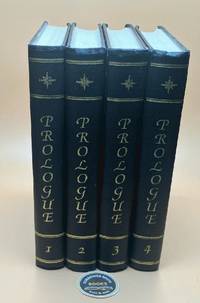
1986251029001Lazarica Press 1986. First THUS. hardcover. Very Good. 6x8x1. Velimirovic Bishop Nikolai : Prologue from Ochrid: Lives of the Saints and Homilies for every day in the year. Birmingham UK : Lazarica Press 1986. Translation by Mother Maria. Four volume set ISBN 0948298030. Each volume shows no additional printings listed - first THUS. Each volume octavo 8vo 8.5"/22cm h. Bound in publisher's black leather gilt lettering to spine; red to front board gilt ornamentation to both. Plain white endpapers. Volume I contains the Preface to the First 1928 Edition and the translator's preface as well as an alphabetical index for the entire year all four volumes contain the same index to the end; each daily entry contains summary of a few saints remembered this day along with a "For Consideration" passage another "To Ponder" and a short Homily. Each month begins with a summary calendar. Number of pages varies from 398 to 440. Condition notes: These are high quality bindings and remain solid. Corners are bumped and spine ends rolled. Moderate wear and rubbing to boards with excellent color retention. Interior shows former owner's name to head ffep of first three volumes else unmarked. An occasional smudge or folded page. An incomparable resource of the Orthodox Church. Please note: this is a large heavy set which will likely require additional postage over standard. Please inquire prior to placing your order.We personally inspect every book we offer. Lazarica Press hardcover
Good Greek, Modern (post 1453) Original booklet. Cr. 8vo. (20 x 14 cm). In Greek (Modern). 8 p. Heavily stains on pages, tear on lower spine and lower right cover, staple rusted. Fair copy. Extremely rare pamphlet of the regulations of "the Maronite Brotherhood, or Enosis" which consists of 27 articles in modern Greek. The Maronites constitute a Christian group whose members adhere to the Syriac Maronite Church with the largest population around Mount Lebanon in Lebanon. The Maronite Church is an Eastern Catholic sui iuris particular church which is in full communion with the Pope and the Catholic Church, with the right of self-governance under the Code of Canons of the Eastern Churches, one of more than a dozen individual churches which are in full communion with the Holy See. The Maronites derive their name from the Syriac Christian Saint Maron, some of whose followers migrated to the area of Mount Lebanon from their previous place of residence which was located around the area of Antioch, and established the nucleus for the Syriac Maronite Church. Saint Maron sent Saint Abraham, often referred to as the Apostle of Lebanon, to convert the non-Christian native population to Maronite Christianity. The name of the Adonis River was changed to Abraham's river by the inhabitants after Saint Abraham preached there. Mass emigration to the Americas at the outset of the 20th century, due to famine mainly resulting from Ottoman blockades and confiscations during World War I, which killed an estimated one third to one half of the population during the Lebanese Civil War between 1975-1990 and the low fertility rate greatly decreased their numbers in the Levant. Maronites today form more than one-quarter of the total population in the Republic of Lebanon. All Lebanese presidents have been Maronites as part of a tradition that persists as part of the National Pact, by which the Prime Minister has historically been a Sunni Muslim and the Speaker of the National Assembly has historically been a Shi'i Muslim. Enosis is the movement of various Greek communities that live outside Greece, for incorporation of the regions they inhabit into the Greek state. Widely known is the case of the Greek-Cypriots for the union of Cyprus into Greece. The idea of enosis is related to the Megali Idea, an irredentist concept of a Greek state which dominated Greek politics following the creation of the modern Greek state in 1830. The Megali Idea was a project which called for the annexation of all ethnic Greek lands, parts of which had participated in the Greek War of Independence in the 1820s but were unsuccessful and remained under foreign rule. In 1821, several parts of Western Thrace rebelled against Ottoman rule, participating in the Greek War of Independence. During the Balkan Wars, Western Thrace was occupied by Bulgarian troops and in 1913 Bulgaria gained Western Thrace under the terms of the Treaty of Bucharest. Following World War I, Western Thrace was withdrawn from Bulgaria under the terms of the 1919 Treaty of Neuilly and put temporarily under Allied management before being given to Greece at the San Remo conference in 1920. Following the conclusion of World War I, Greece began the occupation of Smyrna and surrounding areas of Western Anatolia in 1919 at the invitation of the victorious Allies of World War I, particularly David Lloyd George the British Prime Minister. The occupation was given official status in the 1920 Treaty of Sèvres, with Greece being awarded most of Eastern Thrace and a mandate to govern Smyrna and its hinterland. Smyrna was declared a protectorate in 1922. However, the attempted Enosis failed when the new Turkish Republic prevailed in the resulting Greco-Turkish War of 1919-1922, after which most Anatolian Christians who had not already fled during the war were forced to relocate to Greece in the 1923 population exchange treaty executed between Greece and Turkey. Not located in OCLC.
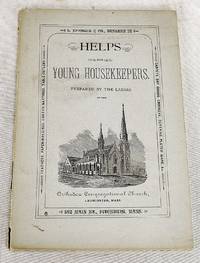
18822209140063Fitchburg Mass.: Orthodox Congregational Church 1882 . First Edition. Paperback. Good. Early American Cookbook Bound in publisher's printed wraps. Softcover. Spine frayed. Clean unmarked pages. 80 pages 4 blank lined leaves. Contemporary advertisements. Fitchburg, Mass.: Orthodox Congregational Church paperback
200270165<p><strong>TO BIBΛIO TOY IΩB</strong></p><p>Luxurious collectible edition; numbered copies signed by the Archbishop of Sinai and Raitho. Leatherbound 25x35 cm 492 pp. ill.; shipping weight 6 kg. List price EUR 660.00 // 55% discount !</p><p>The set includes:</p><p><strong>Description:</strong><em> Codex Sinaiticus graecus 3 is considered as one of the best Greek manuscripts; it consists of 246 folios written on ex</em><em>cellent quality parchment; its condition is very good with minimal losses; contains the "Book of Job" with commentaries and protheoria of Olympiodorus Deacon of Alexandria end of 5th ce. A.D. Olympiodorus interprets the text allegorically following the Origenic tradition. Although 14 Greek manuscripts have survived with the "Book of Job" only the Sinai codex represents the drama in a quasi-cinematic manner employing dense illustration. The high quality of the miniatures the delicate use of colour that approaches the technique of pastel the gold both on clothing and frames recall works created in the famous Monastery of Studios at Constantinople. This facsimile is printed on excellent quality paper 170 gr.</em></p><p>The accompanying volume contains the introductory texts.</p><p>Limited availability.</p><p>.</p><p>.</p><p><strong>IMPORTANT: The shipping cost is an important parameter of this order; it is NOT included in the price and depends on the actual weight and destination; you will have to approve it after the confirmation of the order. You may ask for an estimate before placing the order at: dem.siatras@gmail.com</strong></p> Graphida hardcover
Good Turkish, Ottoman (1500-1928) Original wrappers. Tear on the upper left side of front cover, chippings on extremities. A good copy. Roy. 8vo. (24 x 17 cm). In Bulgarian. 107 p. First and only edition of this scarce early book in Bulgarian, printed in Constantinople (Macedonian Printing House) on the history of the Archbishopric of Ohrid, also known as the Bulgarian Archbishopric of Ohrid, which was an autocephalous Eastern Orthodox Church established following the Byzantine conquest of Bulgaria in 1018 by lowering the rank of the autocephalous Bulgarian Patriarchate due to its subjugation to the Byzantines. In 1767, the Archbishopric's autocephaly was abolished, and the Archbishopric was placed under the tutelage of the Patriarchate of Constantinople. 13 copies in OCLC: 793578483, 48911077.
New English Original bdg. HC. In publisher's special slip-case. Folio. (40 x 30 cm). In English, French, Turkish, and Arabic. 80 p., full page color ills. Reprint of the 1852 Edition. St. Sofia converted by Mehmed the Conqueror into a mosque after the conquest of Istanbul often has been restored. There was again needed a major restoration in the era Sultan Abdulmecid. Sultan was appointed architect Gaspard Fossati for this restoration. For this restoration, about 800 workers worked and all the building has been almost completely repaired. Fossati has produced 25 drawings showing the interior and exterior of Hagia Sophia and he suppressed these drawings as a album in 1852 in French. The Fossati brothers, Gaspare and Giuseppe (1822-1891), were Swiss architects. They completed more than 50 projects in Turkey during the Tanzimat Era. They belonged to the Morcote branch of the Fossati, a prominent Ticinese family with mentions in the historical record going back to the 14th century. This Edition is a reprint and translated edition which is almost identical to original. A very heavy volume. 1000 copies were printed.
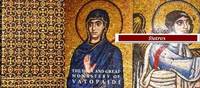
1998120509EN<p>Two huge volumes in slip case. In English. Hard cover 25X35 cm 750 pp. rich colour illustration throughout; shipping weight 7 kg.</p><p><br /></p><p><br /></p><p><b>IMPORTANT: The shipping cost is an important parameter of this order; it is NOT included in the price and depends on the actual weight and destination; you will have to approve it after the confirmation of the order. You may ask for an estimate before placing the order at: dem.siatras@gmail.com<br /></b></p> Vatopedi Monastery hardcover
181594228Broxbourne, Societatis ob Biblia Sacra, 1815. [2] Bl., 519 S. 27 x 22,5 cm. Ganzleder der Zeit mit Blindprägung u. Vollfarbschnitt.
1928055999Istanbul: Manuscript 6 February 1928 1928. No Binding. Very Good. Atlas Folio - over 23 - 25" tall. A 10-line autograph letter entirely written in Ottoman Turkish in elegant handwriting with a signature in Greek. 37x23 cm.Vertical and horizontal fold marks slight chippings on extremities repaired contemporarily by tape. Otherwise a very good document. A rare letter in Ottoman Turkish written in elegant handwriting and sent to Muammer Rasid Sevig 1885-1973 a prominent jurist and politician who served as a judge at the Permanent Court of International Justice in The Hague and as Rector of Istanbul University during the period when he was practicing as a lawyer specializing in international law. The letter was written by a Greek Orthodox Rum citizen of Istanbul stating that his house had been assigned by the state without his consent to a Thessaloniki immigrant within the context of the ongoing Population Exchange. It also includes details regarding the legal fees associated with the matter. "Avukat Muammer Rasid Sevig Beyefendiye Beyoglu'nda Pangalti'da Sehid Muhtar Bey Caddesi'nde 107-81 numerolu hanemi Istanbul Iskân Müdüriyeti Selânik muhacirlerinden Osman Fehmi Bey'e bilâsebeb Kanûn-i Takrîz edilmek üzere mezkûr hanemi bittahkîk mümaileyhi iskân ettirmis oldugundan muhakeme-i iadesine müracaa ile haleldar olan hukukumu müdafaa ve hukuk-i tasarrufiyyemi temîn etmek üzere lâzim gelen muamele-yi kanûniyyenin ecrâmi için zât-i âlîlerini bir kit'a vekâletnâme ile tevkîl eylemis oldugumdan icraât-i vekâlet olarak maktûen bin lira iadesini tehir eylerim. Isbu bin liradan üçyüz lirasini. Fî 16 Subat sene 1928." English translation: To Lawyer Muammer Rasid Sevig Bey As the Istanbul Resettlement Directorate Iskân Müdüriyeti has without any legitimate reason assigned my residence located in Beyoglu Pangalti on Sehid Muhtar Bey Street No. 107-81 to Osman Fehmi Bey one of the immigrants from Thessaloniki with the aim of formalizing it under the relevant law Kanûn-i Takriz and as my property has been unlawfully occupied in this manner. I have applied for a retrial muhakeme-i iade and in order to defend my compromised rights and secure my rights of ownership hukuk-i tasarrufiyye I have authorized Your Excellency by means of a power of attorney vekâletnâme to carry out the necessary legal procedures muamele-i kanuniyye. For these legal services to be carried out on my behalf I request that the fixed sum of one thousand liras be paid. From this amount three hundred liras are to be. Dated: 16 February 1928". On January 30 1923 the Convention and Protocol Concerning the Exchange of Greek and Turkish Populations was signed and entered into force. According to Article 1 of the agreement a compulsory population exchange was to be carried out between Muslims residing in Greek territory and Greek Orthodox Christians settled in Turkish territory beginning on May 1 1923 Oran. The primary rationale behind this exchange was the desire of both countries to create ethnically homogeneous societies within their respective borders. Article 2 of the agreement stipulated that Greeks residing in Istanbul and Muslims residing in Western Thrace were excluded from the exchange and considered established residents établis. However the different interpretations of this article by the two countries led to significant disagreements Metintas. These disagreements persisted for a long time and when no resolution could be reached the matter was brought before the League of Nations. Still no solution emerged and the case was eventually referred to the Permanent Court of International Justice which issued a non-binding advisory opinion. Yet the issue remained unresolved Firat. Bilateral negotiations continued for years and finally led to the signing of the Ankara Agreement between the two governments on June 10 1930. According to Articles 10 and 14 of the agreement Greek Orthodox residents of Istanbul and Turks of Western Thrace who had settled in these regions before October 30 1918 <br/> <br/> Manuscript, 6 February 1928 unknown
346 pages. Index. Black and white illustrations throughout. Published on the occasion of Saskatchewan't 75th Anniversary in 1980. "Written in order to inform our present and future generations of the life and achievements of their ancestors who laid the foundations for a rich life in this community." - from Dedication page. "Provides the family histories of the settlers of the Fosston district from the time of 1905 until 1980. The numerous photographs tell their own story depicting types of homes, modes of transportation, farming procedures, sports enjoyed and growth in community life. Since schools were great focal points of interest in the life of the residents we have a selection devoted to the school districts of Fosston Rural, Hopeful, Mallard, Hoosehorn #2, Orpington, Ponass Lake and Fosston Hamlet. The spiritual life of the early setters is very evident as we note the faiths which made it possible to erect the churches of Bethel Lutheran, Bobulynci, Evangelical Free, St. Mary's Roman Catholic, Ukrainian Orthodox, and the St. John's Greek Catholic Church." - from Foreward. Bright gilt lettering and illustration upon front board and spine. Clean and unmarked but for ink stamp and 2"x3" application of liquid paper upon front free endpaper. Binding tight. Quality copy. Book
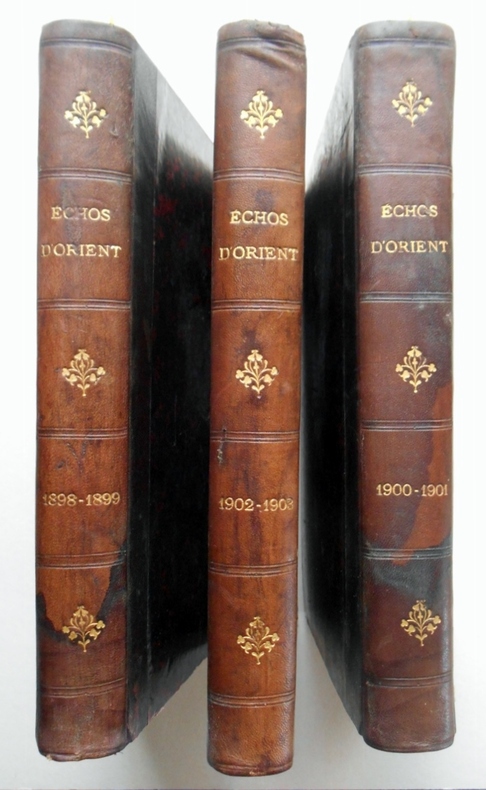
M13066Sl , 3 vols in4° 1/2 chagrin marron , 384 - 380 - 112 , 384 - 384 -128 , 416 - 416 pp Rare revue d' érudition imprimée sur 2 colonnes , plans , gravures.Trace d' humidité sans atteinte ni à la reliure , ni au texte sur 2 dos.
194948317Jordanville Holy Trinity Russian Orthodox Seminary 1949. Hardcover. Two volumes bound in green buckram with remaining volume bound in black. Covers scuffed and discolored with corners slightly bumped; pages in two volumes edge-browned and only a few pages in remaining volumes are toned; otherwise very good condition. . Three bound volumes each containing 24 issues of the Russian Orthodox newspaper/magazine. Jordanville, Holy Trinity Russian Orthodox Seminary hardcover
1988600061<p>In English. Hard coverjacket 29 cm 362 pp. ill. 170 B/W and colour plates with manuscripts net weight 1490 gr.</p><p>.</p><p>.</p> Hellenic Association for Slavic Studies hardcover
20056203<p>Georgian title: "Cels AÄ¡moÄÊ»enil KÊ»artÊ»ul XelnacertÊ»a AÄ¡ceriloba". Multilingual: Greek - English - Georgian. Soft cover 29 cm 664 pp. numerous color plates of the codices; net weight 2320 gr. Read the contents at the attached images.</p><p>Sinis MtÊ»aze Cm. Ekaterines MonasterÅ¡i 1975. Cels AÄ¡moÄÊ»enil KÊ»artÊ»ul XelnacertÊ»a AÄ¡ceriloba. GamocÊ»ema. AtÊ»eni: Sinis MtÊ»aze Cm. Ekaterines MonasterÅ¡i - SaberżnetÊ»is kulturis saministro - Sinuri kvlevis pÊ»ondi 1975.</p><p><strong><em><strong>IMPORTANT: The shipping cost is an important parameter of this order; it is NOT included in the price and depends on the actual weight and destination; you will have to approve it after the confirmation of the order. You may ask for an estimate before placing the order at: dem.siatras@gmail.com</strong></em></strong></p><p><strong><em><strong>IMPORTANT 2: From time to time we also have second hand copies of this book in good condition at a cheaper price; ask for details at dem.siatras@gmail.com</strong></em></strong></p> St. Catherine's Monastery - Patriarchate of Georgia - Georgian Academy of Sciences paperback
Very Good Turkish, Ottoman (1500-1928) Original newspaper. Folio. (49 x 33 cm). In Ottoman script (Old Turkish with Arabic letters) and imprint details in bilingual in Russian and Turkish. 4 p. An early issue of this extremely rare newspaper published in Tbilisi by Mehemmedaga Sahtahtli between 1903 and 1905 as 392 issues in total, published for all Turks and Islamic groups in Russia, which had a significant position in the modernization history of Azerbaijani and Russian Turks and the political and social changes at the end of the 19th and the early 20th centuries for Islamic minorities in Russia. The articles were included in this issue as follows: Tiflis-Musahabe by Mehemmed Bey Kasimbekov, pp. 1-2 (about the Girls' Schools in the Caucasus.; Türkistan'a Seyahat by Tacir Arif, pp. 2-3 [Voyage into Turkestan], Öz Muhbirlerimizden-Uralsk'dan-Men Garra' Gurra'-Tercüman ve Muharriri, pp. 3 [an article criticizing "Sark-i Rus"' publishing policy]; Kirim, Öz Muhbirlerimizden-Kirim'dan-Akmescid'de Darü'l-Muallimîn, pp. 3-4 [about the school for theachers, which was opened in Akmescit (Simferopol) in 1870 and provides education in Russian, the number of students and the education program and the inadequacy of the Muslim education of the same school]; Öz Muhbirlerimizden-Bakû'dan, pp. 4 [about the Muslims of Baku losing their influence from the commercial life of the city]; etc. The first Turkish newspapers titled "Ziya", "Ziya-yi Kafkasiye" and "Keshkul" published in Tbilisi in the 19th century were closed by the Russian authorities. The newspaper "Sark-i Rus", published in 1891, long after the closure of Keskul, became the first Turkish newspaper published in the Caucasus at the beginning of the 20th century. Mehemmedaga Sahtahtli, or Mammad agha Shahtakhtinski (1846-1931), was an Azerbaijani linguist and public figure. In 1902, Shahtakhtinski returned to Caucasus and settled in Tiflis. Here in March 1903, he founded the Azeri-language newspaper Sharg-i Rus ("The Russian Orient") dedicated to the academic enlightenment of the Muslims of the Caucasus. His articles propagated the necessity of Europeanisation, which he saw as the only possible way to a stable and developed future. He sharply criticised Islamic fanaticism, which in his opinion was a major obstacle in the development of Azeri culture and was incompatible with the idea of progress. He also dismissed Pan-Turkism, a popular theory among Turkic-speaking scholars and political activists of the time, and propagated the use of folk Azeri as a literary language, as opposed to the common practice of using Ottoman Turkish. He was among the peacemakers during the bloody Armenian-Tatar massacres of 1905-1907. In 1907, he was elected to the State Duma of the Russian Empire (second convocation). After dissolution of the duma, he worked for Petersburg-based newspaper "Russia", then edited by Pyotr Stolypin. Between 1908 and 1918, Shahtakhtinski lived in various parts of the Middle East, including Anatolia, Iraq and Persia, meanwhile writing articles for "Turkestan Times" (Russian: Turkestanskie Vedomosti). During this time abroad, he worked at the Russian embassy to the Ottoman Empire as translator between 1909 and 1912. In 1919, he returned to then-independent Azerbaijan to give lectures at the newly established Azerbaijan State University. Shahtakhtinski was among the numerous scholars who had followed Mirza Fatali Akhundov in proposing an alphabet reform for Azeri, suggesting to reform the existing Perso-Arabic script. The unsuitability of the Arabic alphabet to Turkic languages in general was in his opinion a major obstacle to the spread of literacy among Azeris. Between 1879 and 1903, Shahtakhtinski designed several model alphabets for Azeri, some of them Roman-based, however none of them was implemented in practice. He attended Congress of the Peoples of the East, acting as an interpreter for Turkish, French, German, Persian and Arabic in 1920. In 1923, Shahtakhtinski as member of a special four-mem