[QUAKERS]Biblio.com

263 résultats
171521197London 1715. Broadsheet. 1p. plus printed docket title on verso. Dbd. Early folds and early stab holes in left margin. Moderate toning and foxing. Very good. Quakers seek relief on affirmation.<br/> <br/> In 1696 after experiencing decades of exclusion and imprisonment for conscientiously refusing to take loyalty and court oaths Quakers were granted the right by Parliament to take a "solemn affirmation" in legal situations in place of an actual oath. Over the next two decades numerous Quakers objected to the invocation of God's name in the official affirmation and refused it as they had the oath. In 1715 a bill was under consideration in Parliament to renew indefinitely the Quakers' right to the affirmation. The Quaker authors of the present petition support the bill but ask that it be amended with a revised affirmation that does not include the name of God. ESTC lists copies at four institutions: the British Library the Library of the Religious Society of Friends the National Library of Scotland and Oxford.<br/> <br/> Smith A Descriptive Catalogue of Friends' Books Vol. II p.265 listing its imprint at "about 1721". unknown
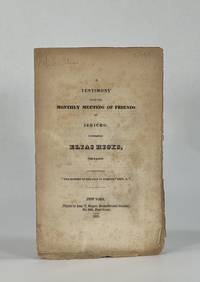
18308959New York: Isaac T. Hopper 1830. Unbound. Very Good binding. Octavo. 8 pp. Folded sheet never bound; untrimmed. Separation at the folds of the outer two leaves; toning and soiling; pencil notations. A laudatory biography of Elias Hicks who had led a umber of Quakers into schism. Sabin 31718; American Imprints 1510. Isaac T. Hopper unknown
17808847London: James Philips 1780. Original Wrappers. Good binding. Octavo. 32 pp. In original plain wrappers; original stitching perished now renewed. Generally edgeworn and soiled with six-digit number rubber-stamped on the front wrapper; some dog-earing shallow closed tears and chipping. <br /> <br /> Originally issued in 1666 this is an important publication by the 17th century Quaker who at the time was urging member to follow the central tenets of the Quaker faith and not put trust wholly in the clergy of whom he was suspicious. The preface of this copy points to the insecurity around the American Revolution. It states: "The ensuing Tract is re-published at the Request of several Friends who thought it might be of Service to settle the the sic Minds of many in these unstable Times and incline them to look Home to that Rock which has been is and will be the only Safety for the Righteous in all Storms and Trials of every Kind which may attend them in this Life: and it thought necessary to reprint it for the general Service at this Time wherein there are such Commotions Wars and Rumours of Wars in the Earth" p. 3. An import tract reissued in an important time. ESTC N9235. Oxford Dictionary of National Biography. James Philips unknown
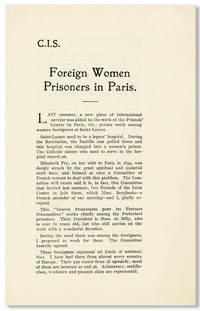
192526813London: Friends' Council for International Service 1925. Offprint. Octavo 20.5cm.; bifolium. Fine. <br /> <br /> "The efforts for pressing reforms in the women's prisons of Paris to which Garda Kappenburg has devoted all her time have at last been crowned with success. A committee has been formed of which the Dean of The Faculty of Law Monsieur Barthelemy is Honorary President and Mr. Donnedieu de Vabre Professor of Criminology actual President. A well known lawyer and a woman barrister are secretaries. The scheme of reform worked out at the instance of Garda Kappenburg and afterwards in the course of several personal interviews submitted to the Minister for Justice Pierre Laval seems to have met with complete success." 1925 Annual Report of The American Friends Service Committee. Article first published in the World Outlook Section of The Friend March 1925. Gerda Kappenburg De Hass's dedication to prison reform and the reduction of criminal behaviour through attacking root causes like poverty and lack of social mobility clearly knew no bounds and her unique determination achieved considerable results. Currently there is only a single institutional holding in a US institution NYPL. Friends' Council for International Service unknown
186135341Philadelphia: William W. Moore 1861. Hardcover. Fair. Quarto. 1 viii 832 pages. Marbled paper covered boards with leather corners. Leather spine with title. The boards are very worn. Most of the paper on the back cover is missing. Leather spine is rotted dried and cracked. Light toning and scattered foxing to the contents. Last few pages are damp stained and soiled. Fair only. <br /> <br /> Contents include 52 issues covering parts of 1860 and 1861. Article headings include Africans in Key West recaptured from the Slavers; Cotton Spinning; The Slave Trade; A Journal of the Life of John Gratton; Thoughts on Emigration; Origin and Introduction of Railroads Into America; Slave Statistics; and much more. William W. Moore hardcover
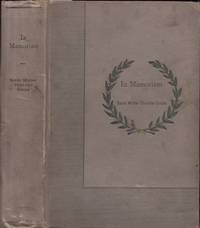
189936486Kansas City: Hudson-Kimberly 1899. Hardcover. Fair. Octavo. 191 pages. Illustrated with photographs. Gray cloth hardcover with title and illustrated wreath on the front cover. Title on the spine. Some shelf wear and light soil to the binding. Both hinges were broken and glued. Text block is secure untrimmed and not shaken. Interior contents are clean. Fair only. <br /> <br /> Inscribed by the editor on the right front flyleaf "For Mr. and Mrs. Larsney With Kind regards. Laura Coates Reed. John Lindley Coates. Arthur Chandler Coates. May 1899 all names written in same hand." Underneath the inscription is a pencil bame of Mitchell Behen. Located ihe upper left corner of the front paste down is a small label "Library of Mitchell Behen." Folling the title page is a tipped card "Compls. of Mr. Homer Reed."<br /> <br /> Contents include moving from Pennsylvania the Civil War a trip out west and more. From find a grave:<br /> <br /> Social Reformer. Headed a local Woman’s Suffrage Club for several years and was a personal friend of Susan B. Anthony. She served on many boards and helped found a group that became the Missouri Federation of Women’s Clubs. She was born in Pennsylvania. Her husband Kersey Coates was also born in Pennsylvania and practiced law there. He moved to the area that became Kansas City Missouri about 1854 where he was a director of a railroad partner in a bank and a real estate investor. He developed the bluffs on the west side the area that became known as "Quality Hill". During the civil war he was with a Pennsylvania unit of the Union Army. Union troops in Kansas City stabled their horses in what was the foundation of the coming Coates House Hotel that had been boarded over. His hotel opened about 1868. In January 1978 there was a large fire in the building killing 16 people. It was very cold at the time and the water being used accumulated on a hook and ladder truck causing the frame to break from the weight. The building was restored and still stands today at the corner of 10th & Broadway in downtown Kansas City Missouri. Hudson-Kimberly hardcover
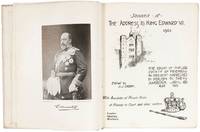
190120890291901. London: Headley Brothers. 1901. 8vo. Original decoratively gilt-stamped white cloth the upper board somewhat marked top edge gilt; pp. 90 2 portrait photo frontis and 8 other b/w photo plates; inscribed in pencil to the recto of the ffep 'Barrow Cadbury Birmingham'; endpapers lightly embrowned else a bright copy.First edition. One of a limited edition of 250 numbered copies. This copy numbered in pencil 175. A collection of addresses made to the Sovereign between 1654 up to the address made to King Edward VII in 1902 by the Deputation of the Society of Friends The Quakers.Barrow Cadbury 1862-1958 was the head of the chocolate factory and founder of the Barrow Cadbury Trust. The Cadburys were a leading Quaker family and George Cadbury Barrow's uncle was one of the Friends that formed the deputation to Edward VII. hardcover
18472345<p>Boston: Printed by S.N. Dickinson & Co. 1847.</p><p>A full-throated cry against slavery. The Quakers who had long opposed slavery wonder how a supposedly Christian nation could allow such evil to exist. "From the border slave states to the far south and southwest the vessels of the slave-trader regularly ply laden with youthful victims reared like cattle for the market" page 4. <br /><br />This pamphlet is scarce to the market.</p><p>PHYSICAL DETAILS: 12mo 7 1/4 x 4 5/8 inches; 183 x 119 mm 12 pages in original printed wrappers softcover.</p><p><br />CONDITION: Slight soiling and creasing to wrappers horizontal fold probably for mailing. Very Good or better.</p> Printed by S.N. Dickinson & Co. paperback
193736016New York: Liveright Publishing Corporation 1937. First Edition. Hardcover. Fair. Octavo. xxx 1 Burgundy cloth hardcover with gilt title on the front cover and spine. Frontispiece photograph of the two sisters. Illustrated. Map illustrated front end papers. Genealogical chart for "Arnoll Buffum m. Rebecca Gould." on the rear papers. Light shelf and edge wear to the hardcover. Interior contents clean. <br /> <br /> Inscribed by the author on the half title page: "To Winthrop W. Aldrich With my very sincere regards Malcom Read Lovell 1937. Contents include anti slavery reminiscences by Elizabeth Buffum Chace pages 110-183. Liveright Publishing Corporation hardcover
53519P., Fischbacher, 1924, in 12 broché, 130 pages ; couverture et dos effrangés.
202570London Luke Hinde 1760. 372pp. 8vo. Full leather slightly rubbed and edgeworn. Ink inscription to ffe. Some scattered foxing. A very good copy. London, Luke Hinde, 1760. hardcover
18211015808vo leather spine label gilt lines on spine 184 pp. Top hinge cracked some minor wear to extremities volume slightly bent small hole through pages 7 and 8 some slight foxing but internally generally bright and clean. This is a collection of short biographies of notable Quakers who passed away between 1783 and 1820.While much of the text appears to talk about the personal challenges these people faced some comments are directed at their works with others including native Americans. Solomon W. Conrad,
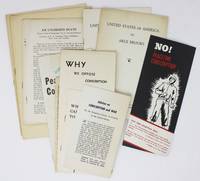
19544307Philadelphia 1954. About very good. Thirty-five printed and typescript items approximately 150pp. total. Some staples old folds. Scattered contemporary ink stamps. Light toning and minor wear heavier in places. Scattered chipping and occasional short edge tears. A fascinating and scarce group of newsletters pamphlets and ephemera published by the American Friends Service Committee during and after World War II comprising thirty-five printed and typescript items. The Committee administered roughly one third of the camps in the Civilian Public Service system which was established to provide a means of non-military service to religious conscientious objectors during the war and also played a significant role in the anti-draft anti-conscription movement. The first group of material present here includes seven issues of the Civilian Public Service Friends Newsletter. These provide a detailed contemporary account of the overall state of the camps including camp populations incoming "campers" camp openings and closures and the financial situation. The newsletters also include news relating to the administration of the camps and developments regarding their operation and the activities of the interned objectors. Included as well are a promotional report issued on the two-year anniversary of the Service's inception and an elaborate four-page solicitation for donations to the CPS both also issued by the American Friends Service Committee. The issues of the newsletters present are: No. 5 October 30th 1942; No. 6 December 21 1942; No. 8 February 25 1943; No. 9 March 15 1943; No. 10 April 21 1943; No. 12 July 12 1943; No. 13 August 23 1943. A substantial run of a scarce and short-lived newsletter. We locate individually catalogued groups of these reports only at Bethel College and the University of Oregon and not in the Swarthmore Peace Collection.<br /> <br /> A second group of newsletters contains three issues of a weekly periodical Information and eleven issues of its monthly offshoot Information Digest dating December 1943 to July 1945 with two issues from later in 1946. These issues document the administration process of the CPS camps and contain reports on various facets of their operation including finances fundraising working and social conditions religious life and legal issues. Amongst these are reports on internal efforts and negotiations to fund the camps both within the Society of Friends and in partnership with other pacifist religious sects such as the Mennonites who were involved in camp operations. The December 2 1943 issue of Information for example contains a detailed narrative of the negotiation to fund the camps in 1944. The newsletters also contain a wealth of information on developments initiatives and daily life at the camps which include some particularly interesting reports on mental health among internees and on civil rights as the issue related to conscientious objectors but also to racial equality in the United States during the war era. OCLC locates holdings of this periodical at just a small handful of institutions.<br /> <br /> The third group of material comprises four scarce typed reports prepared and distributed by the AFSC during the war regarding the rights of conscientious objectors and their status. Three of the reports address the Selective Service Act and continued amendments thereto concentrating on the portions of the law that applied to religious objectors to military service and changes that affected objectors during the early years of the war. The first these issued in March 1942 first outlines the changes made to the draft law during December 1941 in the wake of the attack on Pearl Harbor and the declaration of war on the Axis powers and then provides an extensive step-by-step procedure for the application process to become a conscientious objector. Two further lengthy "memoranda" explain the rights of conscientious objectors as of December 1942 and March 1943 when each report was produced and gives advice for completing the objector application as well as for preparing supplementary documents and written statements. The other report in this group dated September 1941 gives an outline of the finances and disposition of the Civilian Public Service the system of labor camps for conscientious objectors on the eve of the war including lists of camps already in operation their capacities and statistical charts of objectors already registered and camp populations and assignments. These reports are quite striking as first-hand evidence of the role played by the Society of Friends administration in counseling their members to become conscientious objectors.<br /> <br /> Finally there is an interesting group of Quaker anti-conscription ephemera from World War II consisting of nine pamphlets that outline the pacifist views of the Society of Friends and the reasons behind them. The works go on to detail how these beliefs necessitate the Quakers' refusal to be conscripted into the American armed forces and defend this stance. Two pamphlets deal specifically with the opposition to peacetime conscription which became a political issue towards the end of the war. The individual titles are as follows:<br /> <br /> 1 "Why They Cannot Go to War." Philadelphia: American Friends Service Committee 1940.<br /> 2 "Why We Oppose Conscription." Philadelphia: American Friends Service Committee 1941.<br /> 3 "United States of America vs. Arle Brooks." Philadelphia: American Friends Service Committee 1941. Two copies.<br /> 4 Royden A. Maude. "An Unarmed State." Philadelphia: American Friends Service Committee N.d.<br /> 5 Muste A.J. "Conscription and Conscience." Philadelphia: American Friends Service Committee 1944. Two copies.<br /> 6 "Peace Time Conscription.A Problem for Americans." Philadelphia: American Friends Service Committee 1944.<br /> 7 "Permanent Conscription." Philadelphia: American Friends Service Committee 1945.<br /> 8 "No! To Peacetime Conscription." Philadelphia: American Friends Service Committee 1945.<br /> 9 "Advices on Conscription and War." Philadelphia: American Friends Service Committee 1954. unknown
178735617Philadelphia: Printed by Joseph Crukshank 1787. Leather bound. Fair. Octavo. 439 pages. Brown calf leather binding with leather title label on the spine. Front board is detached. Leather is rubbed and pitted on the covers. Leather chipped head of the spine with a small remnant of black tape at the top. A small piece of black linen tape at the bottom of the spine. All preliminary and end sheets are removed. Title page is torn on the edge with a small amount of missing print. Text starts on the title page and ends on page 439. The last leave is partially glued to the rear paste down. Several pencil names written in the margins throughout the text including American Presidents on the early pages. Name of Richard Hopkins written in old ink on the title page. Other Hopkins family members names on the rear paste down. Small paper bookplate of Richard K. Betts on the front paste down. Persistent toning to the contents. A fair copy only. <br /> <br /> Evans 20377; Sabin 14377. Printed by Joseph Crukshank unknown
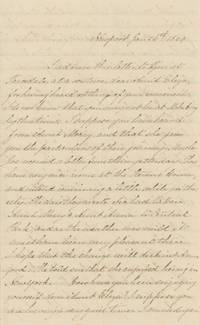
1871List3241Rhode Island Massachusetts and New York 1871. Thirty-two letters two apparently missing final pages; with fifteen pages of incomplete letter material. Excellent to Near Fine. Letters from some of the young ladies of the Hazard family primarily Gertrude Minturn 1843–1877 Anna Peace 1845–1868 and Esther Robinson 1848–d. Hazard with some from other family and friends. The family was descended from Thomas Hazard one of the founding settlers of Newport Rhode Island.1<br /> <br /> The girls were educated and often write from school; Anna and Esther attend the ‘Friends School’ in Providence which is probably the Moses Brown School and Gertrude attends Dr. Dio Lewis’s School for Young Ladies in Lexington Massachusetts. Founded by Diocletian Lewis a temperance and physical culture advocate the school incorporated his exercise system developed to condition weaker individuals. Gertrude describes a regimen of thirty minutes of walking plus an hour and a half of exercise and discusses Dr. Lewis:<br /> <br /> “Dr Lewis gives familiar lectures on any subject which the scholars propose. He is a very pleasant genial man and takes part in the games & dancing with the greatest spirit. There are about 20 scholars. Some of them board in the village but are subject to the rules of the school. This building is very large and is mostly occupied by the patients of Dr Lewis’ ‘Movement Cures’ to whom most of his time is devoted. The scholars and patients associate together. Indeed we are under very little constraint the teachers leaving our actions to be regulated by our own sense of propriety; and they seldom find occasion to reprove the scholars for misdemeanors.†November 23 1864<br /> <br /> Meanwhile Anna and Esther’s education is more on the religious side; Esther writes:<br /> <br /> “We have not been to meeting very often since we returned from our lovely visit to Newport but the first Sunday morning I did think all the time of it as I said I was going to. We were edified this morning by a sermon from Elizabeth Meader or rather a torrent of noise so that I am nearly deafened now. I don’t think I ever heard a more horrible combination of sounds from the mouth of any human being.†January 8 1865<br /> <br /> Though speaking in tongues is most strongly associated with Pentecostalism it is not unheard of in Quakerism. In his book of genealogy and reflections the girls’ father Thomas Hazard 1797–1886 connects the family’s “strong religious tendencies†to his own interest in spiritualism.2 This interest in mediumship comes up several times in the letters first in 1864 when one of the girls reports that “Pa writes us that at a circle which he attended a few days ago a clairvoyant medium described our house at Vaucluse perfectly†February 24 1864 and later when one of the girls attends a circle with their father in Philadelphia:<br /> <br /> “Yesterday morning Pa & I had a sitting with a Mrs. Robinson a trance speaking medium. The communication from mother was the most beautiful I ever heard. She spoke to us just as she used to on earth using the same expressions. It seemed as if I could almost see her – we are going again on Monday.†February 8 1867<br /> <br /> That is the pair spoke to Frances Minturn Hazard who had died in 1854.<br /> <br /> Of interest to researchers of the Hazard family and Rhode Island Quakers.<br /> <br /> 1 Caroline Elizabeth Robinson The Hazard Family of Rhode Island 1635–1894 Printed for the Author 1896.<br /> 2 Thomas R. Hazard Recollections of Olden Times Sanborn 1879 228. unknown
1953LFA01068N° 17 de la revue "Saint Cyr" : 180 pages, format 240 x 310 mm, illustrée, brochée couverture couleurs, publié en 1953
180976436New Bedford:: Abraham Shearman Jun. 1809. First edition. old full sheep. . Light discoloration to the text throughout the paper is not at all brittle; light rubbing to the leather; tight and sound. . 8vo. Printed by Direction of the Meeting. Annotated in an old hand at the top of the title page: "This Book belongs to Rhode Island Monthly Meeting of Friends." A note at the close of the Introduction refers to additions on three pages approx. 200 words; regarding those "out of unity with friends" inspecting testimonies and the receipt of military pensions of persons who subsequently became members. These manuscript additions are dated 1822 1811 and 1818.l Abraham Shearman, Jun., hardcover
First edition, ii,238pp., cont. calf, rebacked, rubbed. The first Quaker bibliography. "Hereby may be seen, not only what Books have been Printed of the Sufferings which many of the said People underwent, but also the many Warnings to the Governments and Rulers, &c. Concerned..." ? Advertisement of verso of title.
New revised edition, 4to (195 x 154 mm), 484, [8]pp., cont. calf, rubbed, hinges cracked, head and foot of spine chipped. An important source on the Quakers which includes, as well, much on the Irish society, local history and genealogy. Provenance: Early ownership ink signature to title page "John Humphreys, City new, Sarum [Salisbury], L/N."
18525992Genève, Paris Émile Beroud, Grassart 1852 In-8 576 pp, Extraite des mémoires publiés par ses deux filles et enrichie de matéraiaux inédits par l'auteur des biographies d'Albert de Haller, Jean-Gaspard Lavater, etc. Orné d'un portrait gravé. 2è édition revue et augmentée. Toutes tranches marbrées, mouillure d'angle sur l'ensemble du volume, rousseurs. dos orné de caissons et filets dorés
1390660311.Gpaperback. Good. Access codes and supplements are not guaranteed with used items. May be an ex-library book. paperback
First Edition, xii, 556, 12pp., portrait, ownership inscription of on upper blank margin of title, original brown blind-stamped cloth, lettered in gilt on spine, a nice copy. "In 1827 Walker joined the Society of Friends, his diaries contain extracts of his remarkable journeys with James Backhouse, visiting the convict settlements in Van Dieman's Land, South Wales (including, at that time, Moreton Bay), and Norfolk Island. His wife was a member of Lady Franklin's committee to visit the female prisoners. In 1843 he was appointed to a board of inquiry into conditions at the Female Factory, built by Lieutenant-Governor Arthur in 1827 in accord with Elizabeth Fry's recommendations. Worried over the growing number of prostitutes, he formed a committee to 'suppress vice' by finding employment for destitute women. In 1848 Lieutenant-Governor Denison asked him to share in the task of providing an asylum for these women, and noted in his journal: 'the very personification of a mild, benevolent, and excellent Quaker' A respected founder with Backhouse of the Society of Friends in Hobart, Walker was always ready to plead for any convict under punishment by solitary confinement or treadmill for refusing in Quaker custom to remove his hat in respect to authority, to explain to judges the Quaker aversion to oaths, or to reason against state aid to religion. Although unable to repeat his missionary journeys, he managed to visit Friends around the island and encouraged others to travel 'in the ministry' to help new Meetings on the mainland". - Australian Dictionary of Biography. Ferguson, 6473.
20041648<p>VG/FINE Softback Volume a new edition of the 1973 volume collecting a multitude of Quaker sources together to illustrate the relationship of early Friends with God. 622pp with index ~ 71.50 ~ George Fox Quakers Society Of Friends Pendle Hill Swarthmoor Margaret Fell ~ Religion</p> Pendle Hill Publications paperback
1973106438Eerdmans 1973 In-8 cartonné 23,4 cm sur 15,7. Pas de jaquette. Couverture légèrement passée, coins émoussés, intérieur propre. 622 pages. Bon état d’occasion.
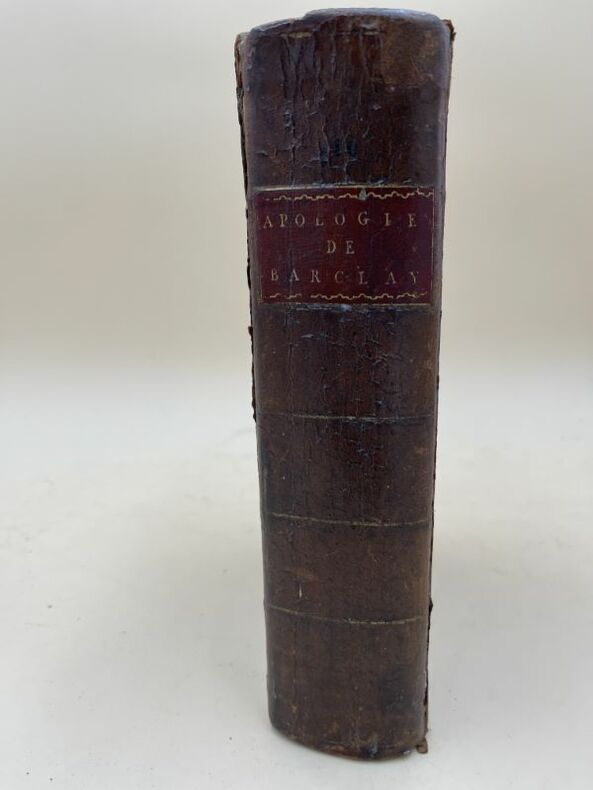
17979994545Imprimerie Jaques Phillips Londres, Imprimerie Jaques Phillips et Fils, 1797. Fort In-8 relié pleine basane de l'époque, dos lisse, filets dorés, pièce de titre rouge. XXXII + 652 pages. Index des textes de l'Ecriture cités dans l'ouvrage, table des auteurs cités et table des choses principales. Quelques rousseurs et brunissures, reliure légèrement usagée sans gravité, mors fragile. Bon exemplaire malgré les défauts signalés. Ex-dono du temps "Témoignage d'amitié de Stéphane GRELLET, de NEW YORK dans la NOUVELLE ANGLETERRE". Un ouvrage essentiel sur le sujet qui eut un grand retentissement en son temps. Ecrit à l'origine en Latin et en Anglais, l'ouvrage fut traduit en Allemand, Hollandais, Espagnol et cette présente édition française traduite par E. P.BRIDEL...pour l'instruction des étrangers.