263 résultats
174277443London:: T. Sowle Raylton 1742. Second edition. later old half morocco and marbled sides. Neat marginal repairs to the fore-edge of the last four leaves; extremities of the binding rubbed with the start 2" of a split at the top of one joint. . 12mo. T. Sowle Raylton, unknown
183402723Philadelphia: Elijah Weaver 1834. First edition. Octavo. Contemporary 3/4 paper over cloth boards; viii 279 pp. Lacking paper spine label; paper to board edges chipped; heavy foxing throughout which is typical for this title. A Good but complete and tight copy. Famous legal case of internecine Quaker squabbling. Elijah Weaver hardcover
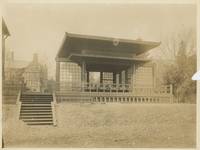
1910List2847Bryn Mawr Pennsylvania; and others 1910. Eleven photographs approximately 7 x 9 ½ inch and smaller. With stamps for Brown Brothers Illustrations Bureau and E.J. Reily verso; most with captions verso. Most with chipping and wear at edges; overall good. Open-air schools became popular in the United States in the early 20th century in response to public health crises including tuberculosis.1 Conducting lessons in open-air classrooms reduced the transmission of diseases which allowed many children to attend school despite their often chronic illnesses. Offered here are eleven photographs of open-air schools three of which are identified as the Phebe Anna Thorne Model School at Bryn Mawr.<br /> <br /> The Phebe Anna Thorne Model School opened in 1913 under the direction of the College’s president Carey Thomas using funds donated by Samuel Thorne in memory of his sister Phebe Anna.2 The Thornes were an affluent New York Quaker family; Phebe Anna 1828–1909 was the only daughter to survive to adulthood and was a philanthropist and supporter of progressive social causes.3 <br /> <br /> The school was part of Bryn Mawr’s Department of Education which trained its students in teaching younger pupils rather than those of highschool or college age – the students in most of these photos are probably in about 4th or 5th grade.3 It also allowed testing of more cutting-edge pedagogical practices: the structure of the school was quite experimental including open-air classrooms outdoor naptime a flexible curriculum and less formal assessment. <br /> <br /> Of interest to scholars of the history of education especially experimental pedagogy.<br /> <br /> 1 Sherman C. Kingsley & F.B. Dresslar “Open-Air Schools†Department of the Interior Bureau of Education Bulletin 23 1916.<br /> 2 Cornelia Meigs What Makes a College A History of Bryn Mawr The MacMillan Company 1956.<br /> 3 Olive Floyd Phebe Anna Thorne: Quakeress Privately Printed in Rye New York 1958. unknown
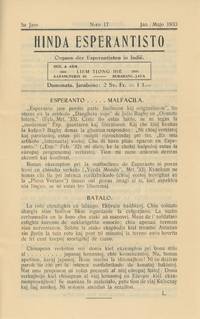
1947List2844Austria; Java Indonesia; London England; and Los Angeles California 1947. Sixteen pieces: two “Friends’ Esperanto Society†bulletins 8 x 12 ½ inch each; two letters 8 ½ x 11 inch each; seven “Hinda Esperantisto†pamphlets 5 ½ x 8 inch four pages each; two “Declaration†forms 4 x 6 inches; one BES pamphlet 4 ½ x 6 inches eight pages; one set of tickets for membership information 2 x 5 inches missing one tear-off ticket and one “Universala Ligo†membership card for 1947 3 x 4 ½ inches. Folded; some chipping and tearing at edges. Overall excellent to near fine. Esperanto is an artificial language created by Polish physician Ludwik Zamenhof 1859–1917 in 1887. Zamenhof intended Esperanto to be a universal second language; his experiences growing up Jewish in the Russian Empire among Russian Polish German and Yiddish speakers—all of whom regarded each other at best with suspicion—led him to believe that an easily-learned neutral second language could by contrast inspire unity between all people. Offered here is a small collection of materials related to various Esperanto societies: the “BES†a Czech group the Universal Esperanto Association the Friends’ Esperanto Society the Esperanto Club of Los Angeles and Hinda Esperantisto – “Indian Esperantist†based in Java Indonesia.<br /> <br /> These materials written largely in Esperanto note that most quotes herein are translated are mostly typical club bulletins advertising events announcing members’ news and reminding the reader of upcoming fees. The BES pamphlet besides advertising its Adresaro member directory solicits donations for a “living monument to Esperantoâ€â€”a headquarters—to be built in PotÅ¡tejn in Czechia<br /> <br /> “in the shape of a five-pointed star which would become a real home for all those who love goodness beauty health truth and progress. The stone-like majestic white building will shine brightly in a beautiful circle from a moderate slope and the fragrant forest behind it will form a charming background.†1932<br /> <br /> This utopian vision was likely prevented at least in part by the Nazi occupation of the country. Esperanto speakers including Zamenhof’s family in particular were among their many targets. The effort to purge the universal language from Europe was clearly not successful; a postwar letter from a language teacher in Austria to a gentleman in California included in this collection notes that the Californian’s address had been printed “in the magazine ‘Die Weltsprache’†– that is “The World Language†February 14 1947.<br /> <br /> Esperanto’s egalitarian and pacifist aims form a large part of its appeal to Quakers. It is unclear whether the Friends’ Esperanto Society which authored two of the items in this collection is the same as the Kvakera Esperanto-Societo which was founded in 1921 and is still active. The March 1935 bulletin announces the F.E.S.’s annual meeting at Friends House in London the headquarters of the Religious Society of Friends in Britain. An obituary for Wilson Henry Sturge the Society’s Vice President remarks on “his desire for international friendship and understanding through Esperanto†March 1935. The January 1936 bulletin calls members to petition their local Registrar of Education for Esperanto to be taught in high schools a request echoed by the Universala Esperanto-Asocio’s declaration form calling on the United Nations to “help to spread the use of this language in every possible way†including supporting its teaching in schools in order “to facilitate communication between the peoples of the world and to promote social progress.â€<br /> <br /> George R. Thompson’s letter to the Los Angeles Esperanto Club as its President strikes a similarly idealistic tone. He gives Club members his “Decalogue†finishing with an exhortation to: “10. Fix our eyes directly on our dear goal the universal brotherhood of humanity and global peace – through linguistic mutual understanding†August 1 1933.<br /> <br /> “Hinda Esperantisto†written by Liem Tjong Hie is somewhat more polemical. Its announcements include news from the Manchurian Federation of Esperantists who proposed to make Esperanto the region’s official language and “to abolish the English language†Jan-May 1933. It criticizes “the European progressive writers†especially the Hungarian Esperantist Kálmán Kalocsay for making the language more difficult for learners. Liem also writes mysteriously:<br /> <br /> “The world does not know that the Belgian Esperanto Institute dir. Frans Schoofs Antwerp is a physically rotting company. The shamelessness of the leaders is shown by the fact that they are so heroic in victimizing distant people knowing that they cannot do anything against them. A black mark to the apparent reputation of the leaders!â€<br /> <br /> These pamphlets also include side-by-side Indonesian and Esperanto blurbs including a review of a new book for Malaysian Esperanto learners – Esperanto caught on quickly in Asia where it still enjoys widespread popularity. <br /> <br /> Of interest to Esperantistoj and historians of Esperanto. unknown
181863305Catskill & Newburgh NY: J.S. Lewis and Co. U.C. Lewis Printer 1818.` 12mo. xii 13-144 pp. Contemporary mottled calf gilt ruling on spine wear scuffing to spine fore-edges some at joints light uniform interior toning w/o flyleaves front & back still VG- copy w/ ownership of Elias W. Price Elizabethtown NY w/ note on rear pastedown to “bring this home when you get done the piece you are writing.†Second American edition with 20 additional pages of material of this combination teacher’s edition and instructional volume following up his very popular “English Reader†and “English Grammar†originally written in the 1790’s for a local Friends’ School for Girls in York England. Before the Revolutionary War Murray 1745-1826 maintained a successful legal practice and although having grown up amongst Quaker communities in Pennsylvania North Carolina and New York his grammars and readers proved wildly popular in both Great Britain and the United States although this Catskill NY imprint is quite uncommon. Worldcat locates only microfilm and computer file online copies of this American edition. J.S. Lewis, and Co., U.C. Lewis, Printer, unknown
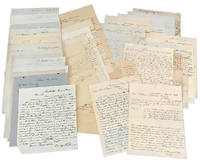
143728<p>Philadelphia and from Various Places. 1837–1845. Approximately 145 manuscript items viz. 38 handwritten letters and 109 manuscript receipts. All in very good condition. Housed in an archival box.</p> <p>William P. Cresson Co. of Philadelphia was actively engaged in the hardware commission business in the 1830’s and 1840’s. </p> <p>The company offered a variety of products with a strong focus on metal ware household building materials and household furnishings. </p> <p>In the late 1840’s the firm began selling cooking stoves and became stove manufacturers and likely hollow ware manufacturers as well. During the late 1840’s and 1850’s a number of stove patents were applied for in the firm’s name.</p> <p>William P. Cresson manufacturer and philanthropist 1814–1892 was the son of Caleb Cresson 1775–1821. Caleb Cresson was himself a prominent and wealthy Philadelphia Quaker merchant and the husband of Sarah Emlen 1787–1870. </p> <p>W.P. Cresson’s family clearly enjoyed a prosperous and affluent style of living that would have been consistent with the successful endeavors of William’s father.</p> <p>This archive can be described as follows:</p> <p>I. William P. Cresson Co. Incoming Business Correspondence. <br /> 20 letters all written in 1842; 18 letters all written in 1845. </p> <p>Cresson had a sizeable business and this incoming correspondence records a variety of New England firms that were involved with this mid-Atlantic firm. An example of the correspondence in part:</p> <p>John D. Johnson writes an interesting letter to Cresson regarding brass makers and brass agents concerning manufacturing prices and the intricacies of dealing with the brass makers May 4 1842. Johnson later writes of other concerns selling brass at cheaper prices of the instability in the brass market and of a future hope:</p> <p>"On the whole I think that the manufacturers are beginning to have some confidence in each other and I believe the time is not very far distant when we shall all be willing to come under prescribed rules and regulations but until this can be achieved we must be somewhat irregular.†Johnson then writes briefly of “making an article for paper makers…"</p> <p>A one page ALS from Joel Bartlett of Harmony Maine concerns a discussion of the Cresson firm selling shank handles made by Bartlett on commission. Bartlett informs that the shank handles he is manufacturing are of high quality and is willing to send along samples. May 10 1842 On Bartlett ref. Folsom Fifty Years in the Northwest 1888 pp185–186.</p> <p>J. Danforth & Co. asks Cresson to sell bottles and Brittania ware and coffee pots May 12 1842. Later Danforth sent by steam boat from Middleton Connecticut “tea setts†tea pots sugars and creamers and soup bowls. In exchange Danforth asks Cresson to send along some blind fastenings saw “stretchers†and windows springs. </p> <p>Josiah Hayden of Haydensville wants to send Cresson cheap pens. A number of merchants ask plead for payments for goods sold or goods hoped to have been sold. Others ask for advice concerning the reduction of their manufacturing output and future trade prospects in wire and gauge metals. From Pine Plains Dutchess County New York Cresson purchased cradles scythes from Silas Harris May 29 1842.</p> <p>From Dotterer & Taylor of Reading Pennsylvania comes a letter of exact specifications for a proposed “15 horse engine†with three boilers June 5 1842. This is followed by an excellent letter from another steam engine manufacturer a John H. Gage in Nashua N.H. who writes to Cresson of a steam engine order and what he can offer the company at the present time June 10 1845. </p> <p>Another firm writes requesting Cresson to send by rail a large quantity of “cram paper†that will be suitable for packing sad irons January 24 1842. A New York entity asks Cresson to provide prices and quantity available for a large order for tea kettles coffee mills hatchets shoe blacking mill saws cow hides Eagle and New England wood screws and shank augers June 30 1845. </p> <p>Various other letters are devoted to outstanding debts and bills paid or not paid or agents traveling to and from delayed by various inconveniences of pre-1850 American transportation.</p> <p>II. William P. Cresson Family and Business Receipts 1837–1845. <br /> 109 manuscript receipts a blend of business and private household expenses. </p> <p>These receipts range from 1837-1845 the majority are from the late 1830’s. Among the more interesting receipts in part:</p> <p>Two receipts one for gold fillings “replacing part of a plug†etc. are from noted dentist Samuel Sheldon Fitch 1801–1876. S.S. Fitch was a Jefferson graduate and a pioneer in dentistry. Fitch’s A System of Dental Surgery 1829 was a standard work in its day and from its successful proceeds Fitch devoted his efforts as a publisher and patent medicine manufacturer. See Atwater I: 321–325 </p> <p> Receipts to benevolent societies: The Female Society of Philadelphia for the Relief and Employment of the Poor “for one large comfortable†and the Magdalen Society of Philadelphia. </p> <p>A receipt to Dennis Rearson for marble post stones for Laurel Hill cemetery to be cut and engraved.</p> <p>Jappaning 175 feet of iron chain; repairing stoves and ovens; one black Russian hat a receipt for a passage from Pittsburgh to Louisville; shovel and tong stands; “altering pew cushions†a receipt for blankets a valice trunk “to hanging 4 Looking Glasses†expenses for resetting curb stone; “2 sett dishes Brittania Wareâ€; etc.</p> <p>A receipt for US almanacs bought of Watson & Reynolds by Cresson for what appears to be H. Peale. This is possibly Henrietta Peale 1806–1892 daughter of artist Rembrandt Peale 1778–1860. </p> <p>Twenty-five receipts specific to purchases by Mrs. William P. Cresson record a wide variety of Philadelphia merchants and providers of household and domestic services in part:</p> <p>Foodstuffs purchased: Peaches raisins prunes almonds wines hams soda & water crackers sherry mustard rice etc.</p> <p>Household wares: gold plates moulded dishes linens gold pencils sweeping brush cut lamps cone pitcher cone boats etc.</p> <p>Services rendered: glazing English glass paying Sarah Binns dressmaker capes and corsets made merino shirts made etc. A receipt is also seen for altering front chamber nursery dining room parlors stair and entry carpet; fixing stair rods and fitting oil “cloathsâ€; putting up parlor bed and window curtains payable to a Rachael Fletcher etc.</p> <p>Of mention a portrait of W.P. Cresson is located at the Smithsonian and this description includes a facsimile of a daguerreotype portrait of W.P. Cresson from an online source.</p> unknown
22684Philadelphia: Printed by John Richards No. 130 North Third Street. 1839. The full title is: 'An Address to the Quarterly Monthly and Preparative Meetings and the Members thereof composing the Yearly Meeting of Friends held in Philadelphia By the Committee appointed at the late Yearly Meeting to have charge of the Subject of Slavery.' 12pp 12mo. Pamphlet in original plain brown wraps. In good condition lightly aged and worn. Begins with two pages of extracts from the minutes 17 May 1839 regarding the setting up of the committee on 'the deeply interesting subject of Slavery' with reference to 'Benjamin Price Jr. Clerk' and 'Deborah F. Wharton Clerk.' The address itself 'Signed by direction and on behalf of the Committee by John Jackson Clerk' is eight pages long. Towards the beginning it notes that 'Many of our forefathers were slave-holders and the unrighteous practice of holding our fellow-creatures in bondage was not then forbidden by our discipline.' The change of policy is described with reference to 'Anthony Benezet and John Woolman'. Later the address notes: 'The advancement of this righteous concern and the increase of light upon the subject of human rights are causing this system of iniquity to totter to its base. Hence under the influence of fearful excitement many are putting forth their strength to impede the progress of principles which if ultimately triumphant will break the fetters of the slave. A part of the trading interests at the North is evidently involved with those of the South and an influence is in this way exerted against the onward course of Emancipation; thus light and darkness antagonize each other.' And later still: 'Within a few years great events hae occurred in relation to Slavery and much light has been spread on the subject. The experience derived from Emancipation in the British West Indies has opened a new era. . while we have painful evidence that a great body of slave-holders are influenced by injustice and cruelty . There are many whose consciences are burdened by a system which they derived from their ancestors . the money of the slave-trader is temptingly held up before them; . they cannot separate the tender ties of family connexion among their slaves; they dare not receive the price of blood. . We believe they are fervently desiring the deliverance of master and slave from the bondage to which both are subjected. Their hearts have bounded with joy at the success of Emancipation in the British West Indies; it has opened a door of hope thaty they also may be legally permitted to prove the advantage of requited labour over that which is extorted by the lash of the oppressor. .'. The entries on OCLC WorldCat are not clear but the item is uncommon. Philadelphia: Printed by John Richards, No. 130 North Third Street. 1839. paperback
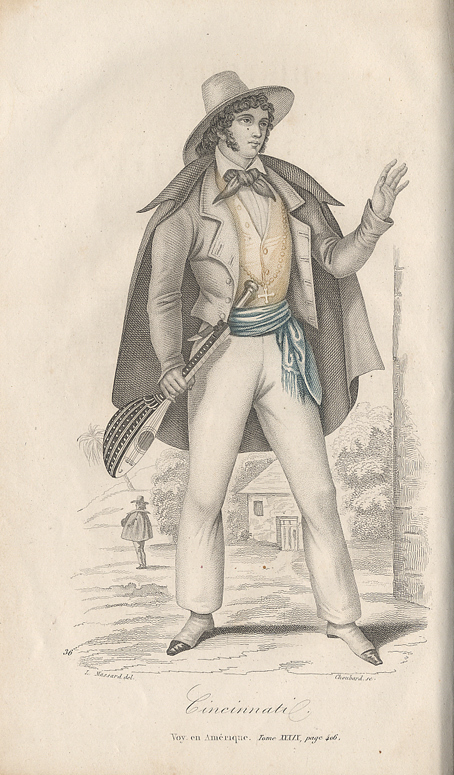
187012108Paris, Armand-Aubrée, sans date (circa 1870) ; in-8, demi-veau glacé havane, dos lisse, faux nerfs dorés, fleurons décoratifs, titre doré ; (2), 451, (1) pp., 1 gravure aquarellée en frontispice.
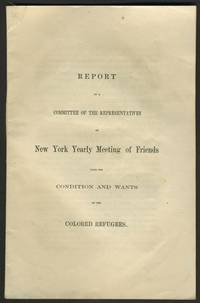
186227695New York: The Religious Society of Friends 1862. First printing. Pamphlet. Very good condition. Three reports from the Quakers during the Civil War on their ministry amongst the "Colored Refugees" of Virginia & Washington DC reporting on the conditions and needs at Fort Monroe Camp Barker Craney Island Alexandria Hampton Norfolk etc. Conditions are tough in the refugee camps but none wish to return to where they have fled from. "Slaves have been abandoned and we must help. Don't we owe them for our prosperity--- enjoying indirectly from the unrequited labor of these people." <br /> <br /> Encyclopedia Virginia writes on their website- "In this report dated May 1864 the Committee on Colored Refugees who were representatives of the New York Yearly Meeting of Friends gives its assessment of the needs of the formerly enslaved people escaping behind Union lines and how Quaker charity efforts were meeting them in contraband camps across Virginia including Alexandria. One of their agents Harriet Jacobs wrote her own letter documenting what she saw in Alexandria and Washington D.C. For Quakers the abolition of slavery was a moral and religious imperative."<br /> <br /> Title continues: Address of the Representatives of New-York Yearly Meeting of Friends to Its Members.; Third Report of Committee of the Representatives of New York Yearly Meeting of Friends upon the Condition and Wants of the Colored Refugees<br /> <br /> 1862 Report OCLC: 21308787 8vo 30pp black title on cream paper wraps saddle stitched. Clean throughout. 1862 Address OCLC: 25519700 8vo 10pp. October 24th 1862. 1864 Third Report OCLC: 25113848 cites 9 copies; 8vo 23pp May 1864 slt. marked wrapper. <br /> <br /> All in their original self wrappers overall in very good condition. The Religious Society of Friends unknown
184420220422London: Edward Marsh 1844. First Edition. Hardcover. Fine. Octavo; 4 247 pages publisher's embossed black cloth newly rebacked in leather <br /> <br/><br/>An excellent precis of the history of the treatment of the Indian tribes east of the Mississippi River. The 2 fine maps are the frontispiece 16x11 cm. of the territories several Indian nations occupied previously to the settlement of the English colonies in America. The large folding map 46x43 cm also in color shows the territory NOW occupied by the natives In addition to the areas east of the Mississippi River this volume republished the report of two Quakers John Lang & Samuel Taylor who traveled in 1842 west of the Mississippi visiting the Winnebago Shawnees Kickapoos Delawares Kansas Osages Cherokees and Choctaws. Sabin 86572; Phillips Maps of America p.604; see also Howes L72; not in Field; Graff 2386 2387; Hubach p. 95; Jones 1073; Rader 2199; Wagner-Camp-Becker 96; Streeter 1807; Eberstadt 137:332; Not in Siebert Catalogues . The map of North America depicts an independent Texas extending north nearly to the Oregon border and northwest to Russian America. Edward Marsh hardcover
pp. (6), (1)-112. Foxed. Some signatures browned but not brittle. Early manuscript ownership of the Thirdhaven Preparative Meeting (Easton, MD). 24mo. 140 mm. Disbound. Fair. S&S/AI 15075. SCARCE. PAIMP 25
0975157906.Ghardcover. Good. Access codes and supplements are not guaranteed with used items. May be an ex-library book. hardcover
180619256New York: Published by Samuel Stansbury Southwick and Hardcastle Printers 1806. First American edition. Frontispiece Oval portrait by P. Maverick. 1 vols. 8vo. Contemporary American mottled sheep red morocco labels. Some scuffing and rubbing of binding head of spines slightly chipped some browning spotting and offsetting of text but not offensive. A very nice copy of this interesting text. First American edition. Frontispiece Oval portrait by P. Maverick. 1 vols. 8vo. Sabin 13492 Published by Samuel Stansbury, Southwick and Hardcastle Printers unknown
180830732Philadelphia: Printed by Joseph Crukshank 1808. First published in London in 1795 it was first printed in America in 1799. 70pp. 1 vols. 8vo. Later grey plain wrappers. Some light discoloration and light wear else very good. First published in London in 1795 it was first printed in America in 1799. 70pp. 1 vols. 8vo. S & S 16230. S & S 16230 <br/><br/> Printed by Joseph Crukshank unknown
178324871London printed: Philadelphia: Re-Printed: and sold by Joseph Cruikshank 1783. First American edition. 4 206 pp missing 207-209. 1 vols. 8vo. Contemporary sheep. Signed on half-title "Rachael Peason Solebury Pa.". First American edition. 4 206 pp missing 207-209. 1 vols. 8vo. <br/><br/> and sold by Joseph Cruikshank unknown
178316713London: Printed Philadelphia: Reprinted and sold by Joseph Crukshank 1783. First American edition. 209 pp. 1 vols. 8vo. Contemporary sheep. Quite rubbed surface worming on covers front free endpapers and blanks removed pencilled duplicate notation on endpaper text browned some soiling. First American edition. 209 pp. 1 vols. 8vo. First published in in London in 1773. This tract as were most of Phipps works written in defence of the Quakers and in response to Samuel Newton of Norwich. Shipton and Mooney 18139 Reprinted and sold by Joseph Crukshank unknown
a67156Philadelphia 1773 Printed by Joseph Crukshank. Two volumes bound as one. 12mo. 8 147pp. 3 64pp. Crukshank book catalogue at end original leather boards with later paper spine. Good boards worn. . hardcover
176024872London: Printed and Sold by Luke Hinde in George-Yard Lombard-Street 1760. First edition. 12 372 pp. 1 vols. 8vo. Contemporary blind pannelled calf missing front free-endpaper. First edition. 12 372 pp. 1 vols. 8vo. Printed and Sold by Luke Hinde, in George-Yard, Lombard-Street unknown
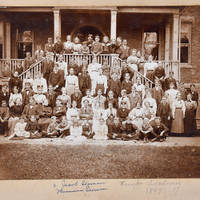
189728309Locust Valley 1897. 1 vols. 8 3/4 x 6 3/4 inches photo image. Original photograph on a larger board. Section of board broken off but present affecting upper corner of photograph some spotting and light soiling of board else very good with pencilled and pen identificatory notations. 1 vols. 8 3/4 x 6 3/4 inches photo image. The Friends' Adademy was founded by Gideon Frost and located near Locust Valley L. I. This was it's twentieth year. <br /> From the collection of the Seaman family of Glen Cove Long Island who were longtime members of the Society of Friends and several of the Seaman children are students at the time of this catalogue Edith Jacob T. Mary W. Mary E. Frederick W Samuel J. and R. Frank T. Samuel J. Seaman became a trustee several years later. Jacob and Marianne Seaman are marked on the photographs with small ink mark. unknown
189828311Locust Valley 1898. 1 vols. 7 7/8 x 5 7/8 inches image size. Original photograph on a slightly larger board. Some fading of image soiling of board and photograph inked identification under photo else very good. 1 vols. 7 7/8 x 5 7/8 inches image size. From the collection of the Seaman family of Glen Cove Long Island who were longtime members of the Society of Friends with the inscription on the verso reading "Presented by Laura F. Craft Ninth Mo. 10 1898 Marianne Seaman. " Laura F. Craft had attended Friends' Academy at the same time as the Seamans. <br/><br/> unknown
191028312New York 1910. 1 vols. 4to. Grey printed board string for hanging at top. Some soiling and wear to corners else very good 2. 1 vols. 4to. From the collection of the Seaman family of Glen Cove and Westbury Long Island and Woodbury Falls NY who were longtime members of the Society of Friends. ¶ Accompanied by an illustration showing the FRIENDS' MEETING HOUSE IN NEW YORK & Seminary ca. 1910 some spotting and light soiling.¶ Also accompanied by two issues of the "FRIENDS' INTELLIGENCER" dated 28 March 1903 and 30 March 1921. <br/><br/> unknown
189528317Philadelphia: Published for the Yearly Meeting 1895. 127 pp. 1 vols. 8vo. Original printed wrappers stapled postmark on upper cover. Some light soiling and wear to wrappers and edges else very good. 127 pp. 1 vols. 8vo. From the collection of the Seaman family of Glen Cove and Westbury Long Island and Woodbury Falls New York who were longtime members of the Society of Friends. <br/><br/> Published for the Yearly Meeting unknown
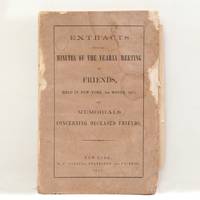
185728319New York: B. F. Corlies Stationer and Printer 1857. 31 pp. 1 vols. 8vo. Original printed wrappers. Spine and fore-edge damaged some gatherings loose marginal tear on p. 15 affecting only a letter or so some soiling and staining of wrappers and text generally light else very good. 31 pp. 1 vols. 8vo. From the collection of the Seaman family of Glen Cove and Westbury Long Island and Woodbury Falls New York who were longtime members of the Society of Friends. <br/><br/> B. F. Corlies, Stationer and Printer unknown
185228314New York: R. Craighead Printer 1852. 26 pp. 1 vols. 8vo. Original green printed wrappers. Some soiling and staining of wrappers light spotting and marginal staining of text some gnawing of edges else very good. 26 pp. 1 vols. 8vo. From the collection of the Seaman family of Glen Cove and Westbury Long Island and Woodbury Falls New York who were longtime members of the Society of Friends. <br/><br/> R. Craighead Printer unknown
184310911Philadelphia: Joseph and William Kite 1843. Hardcover. Very Good. Hardcover. 12mo. 359pp. plus index. This copy has gift inscription to Sarah B. Cope Nordhoff Mother of author Charles Nordhoff with the Walter and Sarah C.W. Nordhoff blindstamp on title page. Plain brown pebble leather binding spine stamped in gold. Endpapers and first and last few blanks browned page edges also. Nice tight copy from 1843. <br/><br/> Joseph and William Kite hardcover