263 résultats
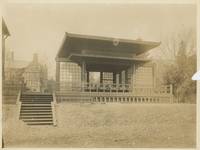
191028312New York 1910. 1 vols. 4to. Grey printed board string for hanging at top. Some soiling and wear to corners else very good 2. 1 vols. 4to. From the collection of the Seaman family of Glen Cove and Westbury Long Island and Woodbury Falls NY who were longtime members of the Society of Friends. ¶ Accompanied by an illustration showing the FRIENDS' MEETING HOUSE IN NEW YORK & Seminary ca. 1910 some spotting and light soiling.¶ Also accompanied by two issues of the "FRIENDS' INTELLIGENCER" dated 28 March 1903 and 30 March 1921. <br/><br/> unknown
30 pages. Features: The Burlington Glass Site; Pennsylvanian German Folk Art; Canadian Furniture; Starting a Book Collection, by L.S. Loomer; The Children of Peace - a sect of the Quakers founded by David Willson and went on to build their first church in the village of Sharon, Ontario in 1819 - with illustrations; Horse Brasses - article with black and white photos; Guide to Canadian Woods - Part 2 - Softwoods and Imported Decorative Woods, by Michael Harmes; The Built-in English Rooms at the Royal Ontario Museum; Glossary of Pottery and Porcelain Terms. Average wear. Unmarked. A sound copy. Magazine
207p. Original publisher's cloth binding. DJ. Novel about Indiana Quakers for young people.
pp. (6), (1)-112. Foxed. Some signatures browned but not brittle. Early manuscript ownership of the Thirdhaven Preparative Meeting (Easton, MD). 24mo. 140 mm. Disbound. Fair. S&S/AI 15075. SCARCE. PAIMP 25
1938759341938 Paris, Société Religieuse des Amis Quakers, 1938, in 8° broché, 316 pages ; petit défaut de papier au dos.
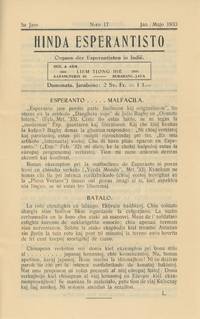
1947List2844Austria; Java Indonesia; London England; and Los Angeles California 1947. Sixteen pieces: two “Friends’ Esperanto Society†bulletins 8 x 12 ½ inch each; two letters 8 ½ x 11 inch each; seven “Hinda Esperantisto†pamphlets 5 ½ x 8 inch four pages each; two “Declaration†forms 4 x 6 inches; one BES pamphlet 4 ½ x 6 inches eight pages; one set of tickets for membership information 2 x 5 inches missing one tear-off ticket and one “Universala Ligo†membership card for 1947 3 x 4 ½ inches. Folded; some chipping and tearing at edges. Overall excellent to near fine. Esperanto is an artificial language created by Polish physician Ludwik Zamenhof 1859–1917 in 1887. Zamenhof intended Esperanto to be a universal second language; his experiences growing up Jewish in the Russian Empire among Russian Polish German and Yiddish speakers—all of whom regarded each other at best with suspicion—led him to believe that an easily-learned neutral second language could by contrast inspire unity between all people. Offered here is a small collection of materials related to various Esperanto societies: the “BES†a Czech group the Universal Esperanto Association the Friends’ Esperanto Society the Esperanto Club of Los Angeles and Hinda Esperantisto – “Indian Esperantist†based in Java Indonesia.<br /> <br /> These materials written largely in Esperanto note that most quotes herein are translated are mostly typical club bulletins advertising events announcing members’ news and reminding the reader of upcoming fees. The BES pamphlet besides advertising its Adresaro member directory solicits donations for a “living monument to Esperantoâ€â€”a headquarters—to be built in PotÅ¡tejn in Czechia<br /> <br /> “in the shape of a five-pointed star which would become a real home for all those who love goodness beauty health truth and progress. The stone-like majestic white building will shine brightly in a beautiful circle from a moderate slope and the fragrant forest behind it will form a charming background.†1932<br /> <br /> This utopian vision was likely prevented at least in part by the Nazi occupation of the country. Esperanto speakers including Zamenhof’s family in particular were among their many targets. The effort to purge the universal language from Europe was clearly not successful; a postwar letter from a language teacher in Austria to a gentleman in California included in this collection notes that the Californian’s address had been printed “in the magazine ‘Die Weltsprache’†– that is “The World Language†February 14 1947.<br /> <br /> Esperanto’s egalitarian and pacifist aims form a large part of its appeal to Quakers. It is unclear whether the Friends’ Esperanto Society which authored two of the items in this collection is the same as the Kvakera Esperanto-Societo which was founded in 1921 and is still active. The March 1935 bulletin announces the F.E.S.’s annual meeting at Friends House in London the headquarters of the Religious Society of Friends in Britain. An obituary for Wilson Henry Sturge the Society’s Vice President remarks on “his desire for international friendship and understanding through Esperanto†March 1935. The January 1936 bulletin calls members to petition their local Registrar of Education for Esperanto to be taught in high schools a request echoed by the Universala Esperanto-Asocio’s declaration form calling on the United Nations to “help to spread the use of this language in every possible way†including supporting its teaching in schools in order “to facilitate communication between the peoples of the world and to promote social progress.â€<br /> <br /> George R. Thompson’s letter to the Los Angeles Esperanto Club as its President strikes a similarly idealistic tone. He gives Club members his “Decalogue†finishing with an exhortation to: “10. Fix our eyes directly on our dear goal the universal brotherhood of humanity and global peace – through linguistic mutual understanding†August 1 1933.<br /> <br /> “Hinda Esperantisto†written by Liem Tjong Hie is somewhat more polemical. Its announcements include news from the Manchurian Federation of Esperantists who proposed to make Esperanto the region’s official language and “to abolish the English language†Jan-May 1933. It criticizes “the European progressive writers†especially the Hungarian Esperantist Kálmán Kalocsay for making the language more difficult for learners. Liem also writes mysteriously:<br /> <br /> “The world does not know that the Belgian Esperanto Institute dir. Frans Schoofs Antwerp is a physically rotting company. The shamelessness of the leaders is shown by the fact that they are so heroic in victimizing distant people knowing that they cannot do anything against them. A black mark to the apparent reputation of the leaders!â€<br /> <br /> These pamphlets also include side-by-side Indonesian and Esperanto blurbs including a review of a new book for Malaysian Esperanto learners – Esperanto caught on quickly in Asia where it still enjoys widespread popularity. <br /> <br /> Of interest to Esperantistoj and historians of Esperanto. unknown
Detailed description of the Lake District. In three parts: Westmoreland, Cumberland, Lancashire. With sixteen plates and a map, 245 pages. Index. Red cloth covers. Book has some light foxing to page edges.
pp. vi, 160, (1). 12mo. 17 cm. Foxed. Early full leather binding. Manuscript ownership of: Mary Wiley, 1802. Manuscript presentation (1822) from John S. Pearson to Sarah Ann Wright. Includes some little contemporary printed slips, with valentine sentiments (that were perhaps used as book marks). Evans 19001. **PRICE JUST REDUCED! PA 60 Rt Stk
194611596Bad Pyrmont, Leonhard Friedrich, 1946-48. "8° (18,5-22,5 cm). (64); (128); (144); (164); (192); (223); (256) SS." Illustr. OBroschur
83pp., 22cm., text in German, Doctoral Dissertation (Inaugural-Dissertation zur Erlangung des Doktorgrades der Philosophischen Fakultät der Martin Luther-Universität zu Halle an der Saale), stamp at verso of title page, text is clean and bright, G113224
1939G113224Halle, 1939 83pp., 22cm., text in German, Doctoral Dissertation (Inaugural-Dissertation zur Erlangung des Doktorgrades der Philosophischen Fakultät der Martin Luther-Universität zu Halle an der Saale), stamp at verso of title page, text is clean and bright, G113224
pp. xv, 5, 266 (of 270?). 12mo. Preliminary leaf (a2) with loss. May lack two leaves at end. Lacks fly leaves. Disbound, though some of the original full leather binding remains. Early manuscript ownerships of Samuel Chamberlain. Evans 47349. PA L Stk
1871000472London Eng: F. Bowyer Kitto 1871. First Edition. Very Good -. London: F. Bowyer Kitto; Carlisle: Chas. Thurnam and Sons. vii 3 208 p.; 20 cm. Reddish-brown pebble-grain cloth with gilt-stamped spine title and black-stamped decoration of both boards. Pale yellow endpapers. Binder's label on back fixed endpaper for Westleys & Co. London. Front free endpaper bears the names of two former owners: Thomas Drewry 1871 and Jesse Darbyshire 1901. A third name was erased at the head of that endpaper. The author states that about one third of these biographical sketches of early English Quakers first appeared in the Carlisle Journal. This is the first edition in book form. The appendix contains relevant excerpts from Besse's Sufferings. In Very Good- Condition: spine sunned; somewhat cocked; cover is slightly soiled; edges lightly rubbed; pp. 1-16 partially detached; pp. 154-55 have a shadow in the gutter from former newspaper bookmark; a few pencilled marginialia and occasional soiling in the margins. F. Bowyer Kitto unknown
20041648<p>VG/FINE Softback Volume a new edition of the 1973 volume collecting a multitude of Quaker sources together to illustrate the relationship of early Friends with God. 622pp with index ~ 71.50 ~ George Fox Quakers Society Of Friends Pendle Hill Swarthmoor Margaret Fell ~ Religion</p> Pendle Hill Publications paperback
1973106438Eerdmans 1973 In-8 cartonné 23,4 cm sur 15,7. Pas de jaquette. Couverture légèrement passée, coins émoussés, intérieur propre. 622 pages. Bon état d’occasion.
1910List2847Bryn Mawr Pennsylvania; and others 1910. Eleven photographs approximately 7 x 9 ½ inch and smaller. With stamps for Brown Brothers Illustrations Bureau and E.J. Reily verso; most with captions verso. Most with chipping and wear at edges; overall good. Open-air schools became popular in the United States in the early 20th century in response to public health crises including tuberculosis.1 Conducting lessons in open-air classrooms reduced the transmission of diseases which allowed many children to attend school despite their often chronic illnesses. Offered here are eleven photographs of open-air schools three of which are identified as the Phebe Anna Thorne Model School at Bryn Mawr.<br /> <br /> The Phebe Anna Thorne Model School opened in 1913 under the direction of the College’s president Carey Thomas using funds donated by Samuel Thorne in memory of his sister Phebe Anna.2 The Thornes were an affluent New York Quaker family; Phebe Anna 1828–1909 was the only daughter to survive to adulthood and was a philanthropist and supporter of progressive social causes.3 <br /> <br /> The school was part of Bryn Mawr’s Department of Education which trained its students in teaching younger pupils rather than those of highschool or college age – the students in most of these photos are probably in about 4th or 5th grade.3 It also allowed testing of more cutting-edge pedagogical practices: the structure of the school was quite experimental including open-air classrooms outdoor naptime a flexible curriculum and less formal assessment. <br /> <br /> Of interest to scholars of the history of education especially experimental pedagogy.<br /> <br /> 1 Sherman C. Kingsley & F.B. Dresslar “Open-Air Schools†Department of the Interior Bureau of Education Bulletin 23 1916.<br /> 2 Cornelia Meigs What Makes a College A History of Bryn Mawr The MacMillan Company 1956.<br /> 3 Olive Floyd Phebe Anna Thorne: Quakeress Privately Printed in Rye New York 1958. unknown
189528317Philadelphia: Published for the Yearly Meeting 1895. 127 pp. 1 vols. 8vo. Original printed wrappers stapled postmark on upper cover. Some light soiling and wear to wrappers and edges else very good. 127 pp. 1 vols. 8vo. From the collection of the Seaman family of Glen Cove and Westbury Long Island and Woodbury Falls New York who were longtime members of the Society of Friends. <br/><br/> Published for the Yearly Meeting unknown
185728319New York: B. F. Corlies Stationer and Printer 1857. 31 pp. 1 vols. 8vo. Original printed wrappers. Spine and fore-edge damaged some gatherings loose marginal tear on p. 15 affecting only a letter or so some soiling and staining of wrappers and text generally light else very good. 31 pp. 1 vols. 8vo. From the collection of the Seaman family of Glen Cove and Westbury Long Island and Woodbury Falls New York who were longtime members of the Society of Friends. <br/><br/> B. F. Corlies, Stationer and Printer unknown
1808WRCAM49717Philadelphia 1808. 31pp. Folio on a folded sheet. Old fold lines minor soiling and wear. Very good. Extracts from the yearly meeting of the Religious Society of Friends commonly known as the Quakers containing highlights of the meeting. These include reports on the education of Quaker youth and a mention of the Committee in charge of the conversion of Native Americans. SHAW & SHOEMAKER 15076. unknown books
2009044728Philadelphia PA: Quaker Pr of Friends General 2009. First Edition First Printing . Hardcover. Near Fine/Very Good. 8vo - over 7¾ - 9¾" tall. 8vo. 548 pages indexed. Hardcover in blue dust jacket. Light wear to the jacket. The text is clean. Contains some illustrations. <br/> <br/> Quaker Pr of Friends General hardcover
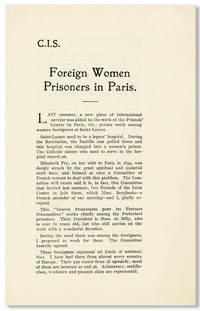
192526813London: Friends' Council for International Service 1925. Offprint. Octavo 20.5cm.; bifolium. Fine. <br /> <br /> "The efforts for pressing reforms in the women's prisons of Paris to which Garda Kappenburg has devoted all her time have at last been crowned with success. A committee has been formed of which the Dean of The Faculty of Law Monsieur Barthelemy is Honorary President and Mr. Donnedieu de Vabre Professor of Criminology actual President. A well known lawyer and a woman barrister are secretaries. The scheme of reform worked out at the instance of Garda Kappenburg and afterwards in the course of several personal interviews submitted to the Minister for Justice Pierre Laval seems to have met with complete success." 1925 Annual Report of The American Friends Service Committee. Article first published in the World Outlook Section of The Friend March 1925. Gerda Kappenburg De Hass's dedication to prison reform and the reduction of criminal behaviour through attacking root causes like poverty and lack of social mobility clearly knew no bounds and her unique determination achieved considerable results. Currently there is only a single institutional holding in a US institution NYPL. Friends' Council for International Service unknown
186135341Philadelphia: William W. Moore 1861. Hardcover. Fair. Quarto. 1 viii 832 pages. Marbled paper covered boards with leather corners. Leather spine with title. The boards are very worn. Most of the paper on the back cover is missing. Leather spine is rotted dried and cracked. Light toning and scattered foxing to the contents. Last few pages are damp stained and soiled. Fair only. <br /> <br /> Contents include 52 issues covering parts of 1860 and 1861. Article headings include Africans in Key West recaptured from the Slavers; Cotton Spinning; The Slave Trade; A Journal of the Life of John Gratton; Thoughts on Emigration; Origin and Introduction of Railroads Into America; Slave Statistics; and much more. William W. Moore hardcover
1390660311.Gpaperback. Good. Access codes and supplements are not guaranteed with used items. May be an ex-library book. paperback
1956101841956 broché (paperback) in-octavo, dos très légèrement défraîchi (spine lightly faded), première de couverture illustrée (front cover illustrated), abondamment illustré (plentifully illustrated), 192 pages, 1956 à Paris Aux Editions du Seuil,
1956135319Couverture souple. Broché. 192 pages. Format de poche.