(KORAN, Herbert C)Biblio.com
737 résultats
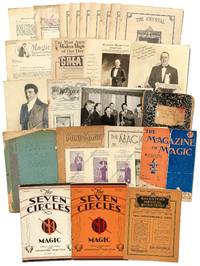
19305907921930. Unbound. Very Good. A small archive of magic related ephemera magazines and photographs. Included is a composition book repurposed as a scrapbook containing just over 70 business cards and 15 letterheads of various magician illusionists and ventriloquist; 18 magazine and magic catalogs published in the United States and England during the 1920-1940s; and four photographs of performers. Overall about very good with the rear cover and several pages of the composition book detached; moderate chipping and wear to the various magazines and photos with some edgewear.<br /> <br /> The notebook was compiled by Herbert. C. Koran a ventriloquist from Long Island New York. While not much could be found about him he appears to have been active during the 1930s and 1940s. He tipped-in the business cards and letterheads of fellow performer of the day largely from the New York-New Jersey area but with examples of half a dozen from as far away as Texas Illinois Ohio Wisconsin West Virginia and Winnipeg Manitoba in Canada. Among the performers of note are Bill Frazee James L. Holmes Ted Collins Eddie Clever Joseph Ovette Allan Lambie Roba Collins Eugene Pronk Ned Fraile Don and Thelma Greenwood Larry Shean and Gerald Heaney who has Inscribed his card to Koran. A number of the performer appear to have been members of The Conjurers Club of Trenton New Jersey an included 10†x 8†photograph of someone demonstrating a trick to a small group of men appears to be of this group. Additional material includes various American and British magazines/catalog including two copies The Seven Circles which was published by William Gibson and Harry Blackston; two copies of The Magician Monthly from A.W. Gamage an English game and sports good store; seven issues of The Crystal a newsletter issued by the aforementioned Conjurers Club and a photo and illustrated folding card of Swivello a.k.a. magician Harry W. Swivel. <br /> <br /> A nice collection of Depression-era magic-related of the New York-New Jersey area. unknown
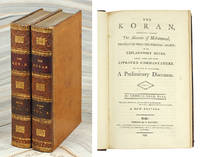
17951227232 vols. Bath: Printed by S. Hazard for J. Johnson etc. 1795. 2 vols. 8vo xii 2 248 Preliminary Discourse 266; viii 519 12 indexpp. Engraved fold-out map of Arabia three genealogical tables two folding and a plate illustrating "The Temple of Mecca" all from the 1735 first edition. Old calf rebacked a good copy tears in folding map repaired. § Fourth edition the first thus of the first translation of the Koran into English. Peter Harrington notes: "George Sale c.1696-1736 although a solicitor by profession was also a leading orientalist having acted as corrector to the SPCK's Arabic translation of the New Testament 1727. His translation is prefixed by a long "preliminary discourse" a compendium of all that was known about the religion of Islam itself separately translated into and published in several languages. In 1921 Edward Denison Ross claimed that Sale's version had not yet been superseded and more than fifty years later Sale's objectivity still guarded him from criticism in Edward Said's Orientalism 1978." Printed by S. Hazard for J. Johnson [etc.] unknown books
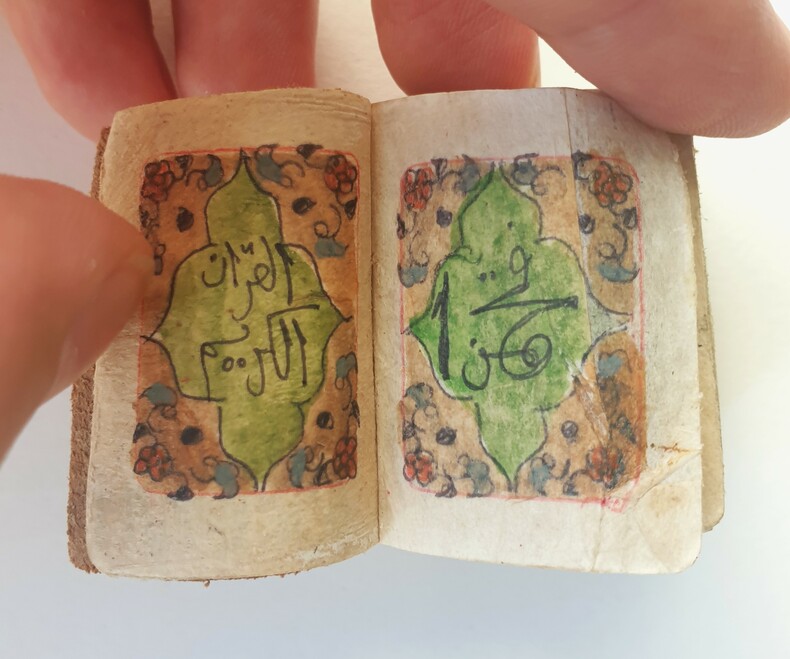
18005557[circa 1800] 1800 1 vol. minuscule (40 x 30 mm) de: [117] ff. manuscrites. Plein veau.
1837170051Leipzig, Tauchnitz, 1837. Editio stereotypa. VIII, 534 S. Mit einigen ornamentalen Verzierungen und Einfassungen in Rot. 8°, Ldr. d. Z. mit Flügelklappe und Rundumgoldschnitt.
177563787CBHalle, Verlag J. H. Gebauers Witwe und Joh. Jac. Gebauer, 1775. 8°. 22 x 14 cm. 42 [recte 40], 678 Seiten. Frontispiz. Brauner Handleinband in Ganzleder auf 5 Bünden, mit Streicheisenlinien und floralen Blindprägungen sowie Lederriemenschließen mit dekorativen bronzenen Hakenverschlüssen und Rundum-Rotschnitt. [9 Warenabbildungen]
2023CC131Edition Orientica, 2023. In-8° de 608 pp.,
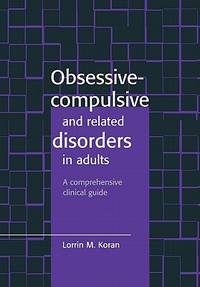
199930959West Nyack New York U.S.A.: Cambridge Univ Pr. New. 1999. Paperback. 0521559758 . FREE UPGRADE to Courier/Priority Shipping Upon Request - IN STOCK AND IMMEDIATELY AVAILABLE FOR SHIPMENT - BRAND NEW FLAWLESS COPY NEVER OPENED -- 370 pages. "Written for clinicians this book presents in detail the diagnosis clinical picture pharmacotherapeutic and psychotherapeutic treatments for obsessive-compulsive disorder and disorders traditionally included in an obsessive-compulsive spectrum. The book draws on the author's extensive experience as well as reviewing the published evidence including controlled trials case series and case reports. Each chapter ends with treatment planning guidelines summarizing appropriate evaluation and treatment strategies. An extended chapter details the use of all medications that have been reported effective for these disorders and the management of common and uncommon drug interactions and side effects. The book's appendices contain useful symptom rating scales provide access to mental health organizations and to printed and Internet materials for patient education and list international proprietary names for the drugs discussed. This is an essential resource and practical guide to treatment planning for psychiatrists and other mental health professionals whether they favor pharmacological or cognitive-behavioral approaches." -- with a bonus offer-- . Cambridge Univ Pr paperback
199933803West Nyack New York U.S.A.: Cambridge Univ Pr. New. 1999. Paperback. 0521559758 . FREE UPGRADE to Courier/Priority Shipping Upon Request - IN STOCK AND IMMEDIATELY AVAILABLE FOR SHIPMENT - 370 pages -- -- CHOOSE US FOR THE INFORMATION YOU NEED -- TABLE OF CONTENTS: Pt. I The clinical perspective 1 Introduction 3 2 Approach to the patient and treatment of comorbid conditions 7 Pt. II Obsessive - compulsive disorder and its treatment 3 Obsessive - compulsive disorder 35 4 Managing the side effects of serotonergic drugs 81 5 Obsessive - compulsive symptoms in schizophrenic disorders 115 6 Medical conditions associated with obsessive and compulsive symptoms 119 Pt. III Obsessive - compulsive spectrum disorders 7 Tourette's disorder 135 8 Body dysmorphic disorder 151 9 Hypochondriasis 163 10 Pathological jealousy 178 11 Trichotillomania 185 12 Skin picking 202 13 Nail biting 208 14 Compulsive buying 213 15 Kleptomania 219 16 Pathological gambling 227 17 Nonparaphilic sexual disorders 238 18 Obsessive - compulsive personality disorder 248 App. 1 Accessing patient education materials 256 App. 2 Rating scales for clinical use 275 App. 3 Trademark drug names: an international list 303 Bibliography 314 Index -- REVIEWS: "Lorrin Koran M. D. has written a thorough practical and well-organized book on OCD and related conditions that is aimed squarely at the clinician.I highly recommend Obsessive-Compulsive and Related Disorders in Adults to the clinician in search of practical approaches to OCD and its kindred conditions." Psychiatric Times "Koran has accomplished a phenomenal state-of-the-art compilation of current knowledge in OCD and related disorders. The author clearly and concisely presents a master's view of diagnosis psychotherapy and psychopharmocology for a set of common but difficult pathologies. The tone and utility reminds me of the more general spiral-bound volumes by Schatzberg and Cole that are a benchmark for clinical psychopharmacology. Koran's monograph at least matches and in many ways surpasses their work especially in practical discussions of therapy issues. This is very high praise.Finally! A really frank open guide to managing treatment! No complexity is evaded bringing out crystalline diagnostic and treatment pearls." Journal of Clinical Psychiatry "Lorrin Koran M. D. has written a thorough practical and well-organized book on OCD and related conditions that is aimed squarely at the clinician.I highly recommend Obsessive-Compulsive and Related Disorders in Adults to the clinician in search of practical approaches to OCD and its kindred conditions." Psychiatric Times -- PUBLISHER DESCRIPTION: Written for clinicians this book presents in detail the diagnosis clinical picture and pharmacotherapeutic and psychotherapeutic treatments both for obsessive - compulsive disorder and for disorders traditionally included in an obsessive - compulsive spectrum. The book draws on the author's extensive experience as well as reviewing the published evidence including controlled trials case series and case reports. "This is an essential resource and practical guide to treatment planning for psychiatrists and other mental health professionals whether they favor pharmacological or cognitive - behavioural approaches. For professionals in training this book brings together a wealth of information not otherwise available in a single source. -- with a bonus offer-- . Cambridge Univ Pr paperback
169816446CBPatavii, (Padova), Typographia Seminaria, 1698. Folio Title page [1 nn. page], 45 pages, [2 nn. pages], 46 pages, [1 nn. page] 81 pages., [3 nn. pages], 94 pages, [5 nn. leaves], 126 pages., [1nn. page Appendix and 8 nn. pages INDEX] Contemporary vellum. Die Versandkosten für Kunstwerke und mehrbändige Werke können von den Standard-Versandkosten abweichen. The complete first volume of II volumes. 2 nd. edition. Good condition.
New Arabic Original cloth bdg. 592 p. In Arabic. Elephant folio. (49 x 35 cm). First Edition. Illuminated. Reprinted from the original manuscript of Topkapi Palace Museum dated 1584-87. The Koran known as Ahmed Karahisarî's Mushaf-i Serif is leading among the most important works created by artists, who are experts of letters of the Ottoman Palace dealing with the art of books. The work is registered at number 5 among the Hirka-i Saadet books of the Library of Topkapi Palace Museum. Its binding with golden gilded ornament, angle and border has miklep and is made of black leather and was repaired in time. Being the Koran with the largest size written in the Ottoman world, is sized 61.5x42.5 cm and consists of 300 sheets. The place of the work where the name of the calligrapher and the date of transcription would have been written, i.e. the colophon is left empty. The reason for attributing it to Ahmed Karahisarî, the famous calligrapher of the period of Kanunî Sultan Suleyman, is based on a foundation record at its beginning: in this foundation record on page 1b, it is briefly stated that the work is the Mushaf-i Serîf of Karahisarî, was kept in the sultan's treasure until then and was devoted to the Hirka-i Serîf Chamber (Private Chamber) for being recited in 1107 (1696) by Sultan Mustafa II. The beginnings of Fâtiha and Bakara chapters of the Koran, every page of which is gilded carefully, are written with celî muhakkak (large cursive style) and reyhanî calligraphy. Two opposed pages following the epigraph demonstrate a different arrangement. Here, one line each of celî calligraphy at the bottom and top and reyhanî calligraphy in a round medallion at the middle are used. In the opposed pages following this, the same arrangement is used without the medallion. Following this diversity at the beginning, the Koran is written according to a classical arrangement known as Yakut style, consisting of one line of celi muhakkak, five lines of nesih (roundish writing), one line of celî sulus (large style), again five lines of nesih and celî muhakkak calligraphy at the bottom. Ahmed Karahisarî is the most famous artist writing in this style among 16th century Ottoman calligraphers. However, it is quite surprising that the signature of Ahmed Karahisarî, who had great reputation in his time, is not seen at the end of the work. This can be explained by the failure to complete the Koran of the artist due to his death or his old age. It is possible to determine the period in which the work, accepted to be written by Ahmed Karahisarî, famous calligrapher of the time of Kanunî Sultan Suleyman, and incorporating the richest examples of Ottoman palace gilding art was completed with its main lines in the light of some documents.It is understood that 220 pages of the Koran known as Ahmed Karahisarî Mushaf-i Serif and which is one of the most valuable works of Topkapi Palace Museum were written by Karahisarî at the time of Kanunî Sultan Suleyman between 1545-55 and was left unfinished upon the death of the artist. It is also understood that the remaining 80 pages completing the Koran were possibly written by Hasan Celebi, his adoptive son, under the patronage of Sultan Murad III between 1584-87. Conjunction, drawing of rulers, gilding of every page and binding and final completion of the work was performed between 1584-1596. Murad III, who died in 1595, could not see the result of this study that he assumed the patronage of for long years.
Very Good Burmese Original dark brown leather with embossing on the front board with an initial-like symbol. The black script in ink with several pencil annotations on rectangular pieces of thick hand-made mulberry paper. Closed size: 38x12,5 cm. Open size: 550x38 cm. Text in Pali, written in Burmese "round" script, richly illustrated in red, black, white, and yellow from the most influential Buddhist and astrological texts of the region. Well-preserved and in very good condition. Extremely rare example of one of the longest and a richly illustrated parabaik from Burma, "reflecting an old system of Theravardan magical beliefs pertaining to Burma / Myanmar over 100 years ago". A highly collectible item from the pre-colonial period of the Konbaung dynasty, formerly known as the Alompra dynasty, the Third Burmese Empire, the last dynasty that ruled Burma/Myanmar from 1752 to 1885, Buddhist Myanmar. With its open size, it is extremely rare in length with 44 folds; "The longest one would have 64 folds" (Harvard online). The scenes might show episodes from the Buddhist folk tales popular in Burma towards the end of the 19th century including many ancient tables and ca. 40 specific depictions of Buddha's life, Buddhist practices, some historical scenes, and religious practices like sky burial scenes, etc, as well as astrological and astronomical chapters. Folding-book manuscripts (Parabaiks in Burmese) are a type of writing material historically used in Mainland Southeast Asia, particularly in the areas of present-day Myanmar, Thailand, Laos, and Cambodia. The manuscripts are made of thick paper, usually of the Siamese rough bush (Khoi in Thai and Lao) tree or the paper mulberry, glued into a very long sheet and folded in a concertina fashion, with the front and back lacquered to form protective covers or attached to decorative wood covers. The unbound books are made in either white or black varieties, with the paper being undyed in the former and blackened with soot or lacquer in the latter. Along with paper made from bamboo and palm leaves, parabaik were the main medium for writing and drawing in early modern Burma/Myanmar.
biblio1<p>the very first first edition Koran in Chinese 3 volumes published in 1875 in Yun Nan Province. Yun Nan is a minority border province of southwestern China where Islam first arrived at China. binding in the oriental way. Some wear and rebounded in 3 volumes by former owner.Very Scarce no record at OCLC and at any library.</p>