331 résultats
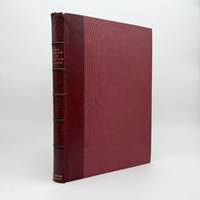
1767WRCAM45554New York: James Parker 1767. 447991431pp. Antique-style three-quarter calf and marbled boards leather label. Titlepage neatly repaired at bottom not affecting text. Two contemporary signatures on titlepage. Light tanning and scattered foxing. A very good copy. The first book of music printed from type in America. "This is the First Edition in English of the Prayer-Book of the Reformed Dutch Church of New York. It is a translation of the old Holland liturgy. The translation of the book from the Dutch was made by the Rev. John Livingston D.D. The Psalms were rendered into English verse by Francis Hopkinson one of the signers of the Declaration of Independence. There are one hundred fifty Psalms in metre accompanied on every page by the printed music. The type for the music notes was ordered from Daniel Cromelin of Amsterdam in 1764. The Ten Commandments are also versified and supplied with music. These are followed by the Songs of Zacharias the Virgin Mary and Simeon. The same musical treatment is given to the Creed and the Lord's Prayer" - Church. EVANS 10561. ESTC W6234. CHURCH 1067. AMERICAN SACRED MUSIC IMPRINTS 398. James Parker hardcover books
1518371799Cologne: Johann Soter 1518. Title within woodcut borders. Text in double columns in Latin Amharic not Chaldaean Greek and Hebrew types across double page spreads. Collation: a-y6 ç6 &6 ¶4 -&6 blank. 147 ff. 1 vols. 4to. Twentieth century red morocco and cloth. Some traces of rubbing to joints. GTS bookplate stamps on first and last leaves. Very good plus. Title within woodcut borders. Text in double columns in Latin Amharic not Chaldaean Greek and Hebrew types across double page spreads. Collation: a-y6 ç6 &6 ¶4 -&6 blank. 147 ff. 1 vols. 4to. The third polyglot Psalter edited by Johannes Potken who had edited an Ethiopic Psalter in 1513. The work is preceded only by the Genoa Psalter 1516 and the Complutensian Bible printed 1514-1517 but not published until 1522. The Introductiunculae in tres linguas externas: Hebraeam Graecam Chaldaeam sic introduction to three languages Greek Hebrew and Chaldaean i.e. Ethiopic is bound after the main text.<br /> <br /> Preserving an early binder's blank marked Duplum Bibliothecae Regiae Monacensis with ink inscription beneath The General Seminary of the Protestant Episcopal Church in the U States new York 10 December 1826 gift of John Pintard. This marks it as one of the earliest books donated to the newly established library.<br /> <br /> Pintard 1759-1844 was a prominent New Yorker of Huguenot origin patron of education and one of the earliest and staunchest advocates for the preservation and study of the history of New York and the United States. Pintard began to work towards the establishment of a historical society in the city in early 1804 and he was the leader in the organization of the New-York Historical Society in November 1804. He was also a patron of the old French Huguenot Church of St. Esprit and the General Theological Seminary.<br /> <br /> Important and early work. Darlow & Moule 1413; VD16 B 3101; Adams B-1371; Vinograd Cologne 1; D.S. Berkowitz In Remembrance of Creation 1968 no. 175; Fumagalli G. Bibliografia etiopica 1243 [Johann Soter] unknown
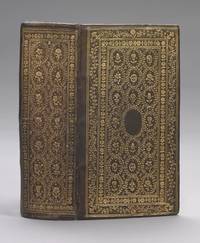
158608537Paris: A. L'Angelier 1586. CONTEMPORARY RICHLY GILT CALF DECORATED IN THE DUODO-STYLE WITH NINETEEN DIFFERENT TOOLS. The outer borders have three double-rules with olive branches trefoils curved rules and a floral roll between. Sewn with S fermés quatrefoils and open circles the central field has twenty ovals each with one of six small tools in it. A single compartment the flat spine presents the same decor but with additional tools its base and crown ruled on the bias; board edges ruled one slightly defective all edges gilt. THICK PAPER COPY. The binding by Clovis Ève adopts the design favored by the Venetian ambassador to Paris Pietro Duodo 1554-1611. The chic S fermé symbolizes love sage seul secret soucieux. Fresh inside and out one lower corner neatly restored.<br /> ¶Balsamo & Simonin A. L’Angelier 163; Delaveau & Hillard Bibles imprimées du XVe au XVIIIe siècle 3417; BnF Enrichissements 1961-1973 1974 1051; Brun Le Livre français illustré 130 & 278 “gravés très délicatementâ€.  For similar Duodo-style decor see Nixon’s Sixteenth-Century Gold-Tooled Bookbindings 59 and Esmerian’s Bibliothèque I 6.VI.1972 59-61 and Hobson & Culot’s Italian and French 16th-Century Bookbindings 68-9. A. L'Angelier unknown
1480254000Ulm: Johann Zainer 1480. 293 of 296 leaves; lacking first 2 leaves of the Calendar and final blank. •6 ••8 a-x8 y12 z8 A-L8 M3. 1 vols. 8vo; 111 x 90 mm. Bound in 18th-century paper boards with remnant of morocco spine label edges stained red. Spine defective and covers rubbed but binding is sound; several leaves bear stubs at outer edge from former index tabs; first leaf of Psalter extended at inner margin; final two leaves slightly waterstained; some browning and occasional stains; text block seriously trimmed but never into text. Notes on front endpapers and a presentation inscription in 1826 from a member of the German Methodist Episcopal Church U.S. In a custom half-morocco slipcase and chemise. 293 of 296 leaves; lacking first 2 leaves of the Calendar and final blank. •6 ••8 a-x8 y12 z8 A-L8 M3. 1 vols. 8vo; 111 x 90 mm. Johann Zainer the Elder fl. 1472-93 established the first printing press at Ulm where his first book is dated 1473. This pocket psalter by Zainer is undated; the colophon gives only the printer's name and the city in which it was printed. ISTC gives a conjectural date of around 1480. <br /> <br /> The book's handy but fragile format a thick octavo that would have been easily portable for late fifteenth-century users doubtless guaranteed a low survival rate. Indeed the few copies which have survived are often incomplete fragments or in poor condition.<br /> <br /> ISTC gives the following locations: France: Strasbourg BNU imperfect wanting Commune sanctorum; Germany: Bamberg SB; Berlin SB; Fulda HLB; Leipzig DB/Buch fragment missing; München BSB 2 imperfect; Stuttgart WLB 3; U.S.A: Washington DC Washington Cathedral Library this copy<br /> <br /> The present copy - the only copy in America - is complete save for the first two leaves of the Calendar and the blank leaf at the end. Goff Suppl. P1041a; H 13475; C 4927; GW M36206; ISTC No.: ip01041500 Johann Zainer unknown
1480254000Ulm: Johann Zainer 1480. 293 of 296 leaves; lacking first 2 leaves of the Calendar and final blank. •6 ••8 a-x8 y12 z8 A-L8 M3. 1 vols. 8vo; 111 x 90 mm. Bound in 18th-century paper boards with remnant of morocco spine label edges stained red. Spine defective and covers rubbed but binding is sound; several leaves bear stubs at outer edge from former index tabs; first leaf of Psalter extended at inner margin; final two leaves slightly waterstained; some browning and occasional stains; text block seriously trimmed but never into text. Notes on front endpapers and a presentation inscription in 1826 from a member of the German Methodist Episcopal Church U.S. In a custom half-morocco slipcase and chemise. 293 of 296 leaves; lacking first 2 leaves of the Calendar and final blank. •6 ••8 a-x8 y12 z8 A-L8 M3. 1 vols. 8vo; 111 x 90 mm. An Incunable of the Utmost Rarity. Johann Zainer the Elder fl. 1472-93 established the first printing press at Ulm where his first book is dated 1473. This pocket psalter by Zainer is undated; the colophon gives only the printer's name and the city in which it was printed. ISTC gives a conjectural date of around 1480. <br/><br/>The book's handy but fragile format a thick octavo that would have been easily portable for late fifteenth-century users doubtless guaranteed a low survival rate. Indeed the few copies which have survived are often incomplete fragments or in poor condition.<br/><br/>ISTC gives the following locations: France: Strasbourg BNU imperfect wanting Commune sanctorum; Germany: Bamberg SB; Berlin SB; Fulda HLB; Leipzig DB/Buch fragment missing; München BSB 2 imperfect; Stuttgart WLB 3; U.S.A: Washington DC Washington Cathedral Library this copy<br/><br/>The present copy - the only copy in America - is complete save for the first two leaves of the Calendar and the blank leaf at the end. Goff Suppl. P1041a; H 13475; C 4927; GW M36206; ISTC No.: ip01041500 Johann Zainer unknown books
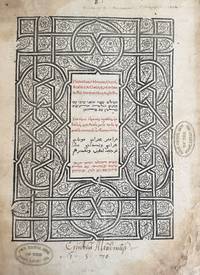
1516371021Genoa: Petrus Paulus Porrus 1516. Title printed in red and black within woodcut arabesque border printer's device on final leaf. Parallel text in Hebrew Latin Greek Arabic and Chaldaean Aramaic 4 columns to a page 41 lines. 13 woodcut floriated initials. A10 B-Z8 &8 con6; 200 leaves complete. Folio 13-1/8 x 9-3/8 inches. Contemporary blind tooled pigskin over bevelled wooden boards boards with repeated roll of hound hunter and stag spine with floral tools. Clasps perished early repairs with vellum at lower corners; spine darkened with chip at foot joint starting wormholes to the covers. Toning throughout worm holes throughout but heavier to the preliminary and terminal leaves paper loss not affecting text at the lower outer corners of the first 3 leaves minor dampstaining at the lower corners of most leaves and extending from the top inner margin. Scattered early marginalia. Title printed in red and black within woodcut arabesque border printer's device on final leaf. Parallel text in Hebrew Latin Greek Arabic and Chaldaean Aramaic 4 columns to a page 41 lines. 13 woodcut floriated initials. A10 B-Z8 &8 con6; 200 leaves complete. Folio 13-1/8 x 9-3/8 inches. The Genoa Psalter also known as the Octaplum or Quadruplex Psalter was the first polyglot psalter to be published and the first polyglot edition of any part of the Bible. Financed by the Oriental language scholar Bishop Agostino Giustiniani and printed in Genoa in 1516 it presents the psalms laid out in eight columns i.e. four per page on double-page spreads: in Hebrew a Latin paraphrase the Vulgate Latin the Septuagint Greek Arabic Chaldean Aramaic a Latin paraphrase and the editor's notes. "A monument of Renaissance typography this Psalter was linguistically the most ambitious work attempted to date and the first Polyglot work ever published. It provides the Psalms in five languages as well as a marginal scholarship based largely on rabbinic sources. The Arabic text is one of the first two texts and the first biblical text ever printed in this language. The Hebrew types used in this book were apparently never used again" B. Sabin Hill Hebraica from the Valmadonna Trust The Piermont Morgan Library 1989 no. 18.<br /> <br /> Notably within a lengthy editor's note to Psalm XIX is what is considered the first printed biography of Christopher Columbus along with a very early description of his voyage. A native son of Genoa Giustiniani presents the discovery of the new world as a fulfilment of Biblical prophecy appropriately glossing verse four of Psalm XIX to include his biography of Columbus: "Their sound is gone out through all the earth and their words to the end of the world." <br /> <br /> The text of the biography of Columbus written a decade after his death includes a brief account of his childhood and continues at length on his discovery of America. Translated from the Latin it begins: "And so their words have reached unto the ends of the earth at least in our own times in which by the marvelous daring of Christopher Columbus of Genoa almost another world was discovered and joined to the community of Christians. And since Columbus often declared that he was chosen by God so that through him this prophecy would be fulfilled I did not consider it unsuitable to include his life here. Therefore Christopher surnamed Columbus a Genoese by birth . lived in our age and through his own efforts explored more lands and seas in a few months than almost all other mortals had done throughout all previous ages . More swiftly than the Portuguese had done he approached new lands and new peoples and at last penetrated regions unknown before now. The news of this matter quickly reached the King who - both out of rivalry with the Portuguese kings and a desire for such new marvels and glory that might accrue to him and his descendants - after long discussions with Columbus finally ordered two ships to be outfitted. With these Columbus set sail from the Fortunate Islands directing his course slightly off the western line . After many days of sailing they had covered great distances. While the others having lost all hope urged a change in course Columbus persisted asserting by reason and conjecture that continuing but a little longer might lead them to discover continents or islands. Nor was he wrong. On the following dawn they sighted land. From this event immense confidence arose in human minds. Later it was learned that these were islands and observations were made of certain peoples there uncultivated and prone to raids on their neighbors even devouring human flesh like wolves. There were violent encounters yet eventually some of these islanders were brought safely to Spain astonishing and delighting all who saw them because they were at first timid unfamiliar with approach easy to persuade and marveling at everything as new."<br /> <br /> An important and desirable work from a liturgical linguistic and historical perspective. Adams B1370; BM STC Italian p. 97; Darlow & Moule 1411; Sabin 66468; European Americana 516/4; Harrisse BAV 88; JCB 3 I:64; Smitskamp 236; Roper Early Arabic Printing in Europe in Sprachen des Nahen Ostens und die Druckrevolution p. 132; Vinograd Genoa 1. Provenance: Cenobii Alois 1570 inscription below title; Bibliotheca Regia Monacensi pencil inscription on the inside front board identifying it as a duplicate; General Theological Seminary ink and blindstamps and other markings Petrus Paulus Porrus unknown