253 résultats
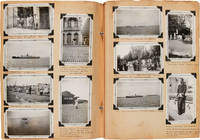
1938WRCAM55556Various locations in Latin America 1938. 100pp. containing 230 photographs as well as postcards maps dozens of menus greeting cards and other travel ephemera. Thick folio. Contemporary brown paper-covered cloth string-tied. Boards lightly scuffed and worn. Some leaves loose moderate edge wear and chipping. Photographs clean and nice annotations highly legible. Good plus. An illuminating and entertaining illustrated scrapbook documenting the travels of six friends on a trip to Mexico Panama and various points in South America including Colombia Peru Chile Argentina and Brazil in 1938. One of the opening leaves has four photographs of the travellers comprised of two elderly couples and two single women captioned "Rogues to the Pampas!" Throughout the album there are numerous photographs both vernacular and professional a great many capturing locals in native dress as well as images of scenery and the city streets. The photographs are accompanied by colorful descriptive annotations. <br> <br> The voyage began January 20 1938 aboard the Japanese NYK Liner S.S. Bokuyo Maru. There are numerous menus and other ephemera from the ship as well as a photograph of the Japanese crew signed by the ship's officers. The first photographs depict Manzanillo Mexico a week later with captions such as "Worst city we ever saw says the man from Capetown South Africa who has been around the world" and "Sid Thompson says 'I bet if these Mexicans had a good hot bath they'd find a suit of underwear they didn't know they had!" They picture a "peddler of hats and drink" and a "man carrying load on his head" in the streets of Manzanillo. They then take a train to Colima Mexico on which a passenger is noted to say "Jesus Christ you'd think they never saw an American before" and where they eat papaya for the first time. In Panama on February 3 they see "a native with an iguana in each hand - we also saw our first sloth and a land crab" and they witnessed "a negro funeral." <br> <br> On February 5 the travellers stop at Buenaventura Colombia where they experienced an earthquake and their first sight of the Andes along with a "strong acrid wet odor that pervades atmosphere everywhere." There are several photographs of the city and the locals including one of "natives" fishing accompanied by significant commentary on the locals: <br> <br> "The natives have plenty of fish which they catch in nets thrown by hand - plenty of bananas and fruits and cocoanuts and will not work enough to buy anything but a little clothing rice and coffee. There are no public schools in Colombia - a few religious schools inland. All education for boys and girls of better class is in U.S. or Europe. U.S. buys 85% of Colombia's coffee. Population 80% negroes on coast. Government is unstable foreign capital will not make very much of an investment here but Standard Oil Co. has a $52000000 pipeline in Colombia. Malaria is the greatest plague here though typhoid is also guarded against in fruits and vegetables. Buenaventura is wholly tropical." <br> <br> The group then proceeds to Lime Peru where they arrive "in a dense fog - worst in 10 years." They take numerous snapshots of various cultural sights around the city images of "guano birds" along the shoreline and a "Typical Peruvian Indian of the High Andean Plateaus." They stayed three nights at the Hotel Bolivar before proceeding to Cuzco Tacua and Mollendo which they describe as "a dirty town." Still they took several photographs here including "Descendants of the Incas at Cuzco" an "Indian woman riding Burro - typical scene" in Tacua and other street scenes. <br> <br> Chile was next for the group. They were in Santiago by February 23 and shot several images at a street market such as a soap dealer the flower market a corn stand and other scenes. Shortly thereafter they traveled to Valparaiso Puerto Varas Puerto Montt and other Chilean locations. They captured the port of Valparaiso the Three Brothers at Chilean Lakes scenes in the Chilean mountains Lake Llanquihue and include in the album a professional real photo postcard captioned "Typical Araucanian Indian Hut" among other images. <br> <br> The travellers then moved on to Argentina. They describe Buenos Aires as "the most beautiful city in South America so far as the city itself is concerned." Their time in the city is illustrated exclusively with postcards but they include a plethora of descriptive text for numerous monuments landmarks harbor scenes gardens and other sites. <br> <br> During their time in Brazil the travellers document coffee production cattle and other agricultural settings as well as cities and architectural features. These include numerous images of Rio de Janeiro which "no picture however beautiful can portray with any accuracy the beauty of Rio." On March 30 the group heads "from Buenos Aires down the muddy Rio de la Plata" towards the Amazon River. Here they include real photo postcards of "Typical Indians of the Amazon" an "Amazon Indian Hut" and "More Indians - These are some of the most primitive people living." Among the images taken on the streets of Brazil is one showing a black woman walking with a bundle on her head which is captioned "N asterisks ours mammy in pink dress and head load - and was she furious when I took her picture! If looks could kill I'd be buried in Brazil." <br> <br> The group rejoined their cruise in Brazil boarding the Rio de Janeiro Maru and finished their journey at the end of April. A detailed revealing and lengthy travel account extensively illustrated and annotated by a group of judgmental American tourists. hardcover books
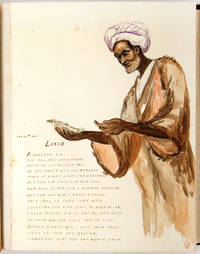
21433Hardcover. Very good. Black leather album containing 54 tissue-guarded leaves of watercolor paper of which 43 have been used. 10 x 12 inches stamped in gilt on the front "Sketches on the Nile / Alan Hinch / 1938." Leather scuffed cloth tape reinforcement to inner hinges all else very good. Alan Hinch was born in England c. 1881 but was living in the United States by 1920 when the federal census documents him working in Miami as pilot of a private yacht owned by socialite James Deering an executive in International Harvester Company. He apparently embarked on this Nile cruise as companion to his next employer Richard Flint Howe 1863-1943 another International Harvester executive who had married James Deering's sister Abby. Passenger manifests show Hinch as traveling in the company of a "Mr. R. Howe" and the census of 1940 lists him as butler on Howe's estate. He was clearly more than a simple servant however as this charming and humorous album reveals. The album documents the journey from departure on the Italian Line passenger ship Conte de Savoia on January 15 1938 to arrival home at Banksia Howe's custom-built mansion in Aiken South Carolina on March 26 1938. Each page includes an original watercolor most measuring about 4.5 x 8 inches but some larger with a related original doggerel poem. Hinch's paintings are skillful. His poetry is markedly less so but it is clever observant and skillfully captures the traveler's experiences. On a visit to Asyut Hinch writes: Assuit the place they said would be warm/ Was 42 degrees at early morn/ If the like keeps on we will have to don /Earlaps coonskins as at a football game./ Rode through the quarters where the natives were/ Couldn't say lived for it looked so bare/ They called out for bakscheesh/ Both old and young/ They thought we came only to give to them./ Oh what a place to be born and live./ Then through the bazaar narrow and crowded/ Maybe bargains galore/ But we passed through as quick as we could./ Oddments and rubbish in hovels so poor./ Then to the tombs too high to climb/ And round the modern town we drove/ Back on board the "Memnon" to dine. A visit to the ancient cemetery at Beni Hasan is described from the perspective of the donkeys who labor under the weight of well-fed tourists. Other subjects include the ocean liners and streamers they traveled in local people they encountered a dragoman a water carrier a little girl in a red scarf boats on the Nile camels and water buffalo the Pyramids Sphinx Panopolis El-Balyyana Abydos Karnak Kom Ombo Wadi Haifa Abu Simbel and Luxor. There are also several views of the Mediterranean coast and one of Banksia in South Carolina. In all a charming and lovely representation of the places and time. hardcover books
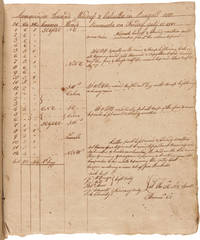
1796WRCAM54712Mostly at sea from New York with stops in Calcutta Saint Helena Ascension Island and Cornwall England 1796. 246pp. Square folio. Original crude burlap covers stab-sewn with thick string. A bit toned and foxed occasional ink or tobacco burns. Very good. A remarkable artifact of early American naval commerce containing the sailing directions and shipboard activities of the "Ship Washington of Philadelphia" which sailed from New York to Calcutta rounding the southern tip of Africa and visiting Saint Helena and Ascension Island before crashing on the rocks at Cornwall England on the way to Hamburg Germany. The log contains a navigational ledger with locations headings wind and weather remarks along with occasional sick lists names of men "unfit for duty" those put on light duty temperatures and other information. The remarks are quite detailed and specific regarding shipboard work and activity. <br> <br> The captain of this final voyage of the ship WASHINGTON was Samuel Hubbart but the identity of the sailor who kept this log is unknown. The ship departed New York on July 4 1795 and reached Calcutta on August 31. Without the need for recording navigational data while in port the log's author switches from the ledger-style format and writes longer more-detailed daily entries describing the crew's activities. The crewmen mentioned include pilots boatswains carpenters coopers caulkers sailmakers and others. Most of the entries pertain to the maintenance of the ship while anchored in the bay. Numerous mentions are made of crew on board fixing various equipment including types and amounts of supplies. A few entries note the employment of Indian "Cooleys" on board the ship making various repairs. An interesting incident of September 17 bears relating: <br> <br> "Hearing a noise upon the main Deck Mr. Naylor went to see what was the matter - upon engaging found Abraham Moor had struck Thomas Williams the Cook as Moor said for wanting to trouble a girl which Moor had on board - Mr. Naylor told him he should not ill use that man for he had every reason to believe it to be false what he alledged against the Cook. Moor said he did not come here to be jawd by a black Man.S." <br> <br> After swearing he would "never go home" on the WASHINGTON Moor literally jumped ship just after this confrontation and hid on another ship before being found and brought back to the WASHINGTON "in irons." <br> <br> In early November a few entries mention the ship receiving a supply of sugar taking on "Three Burr Load of Sugar" on November 7 and two more "Burr Load" two days later. Subsequent entries detail the loading of several "Burr Load of Bales" and "one hundred bags of ginger." <br> <br> Over the course of the ship's time at Calcutta the author mentions encounters with at least four other American ships: the GANGES the HAMILTON the MAJOR PINKNEY of Charleston and the "American Ship Camilla of New York arriv'd here from London." <br> <br> By early February the WASHINGTON left Calcutta for the voyage to Hamburg spelled variously here as "Hamborough" and "Hamburgh" though the ship would never make it to Germany. On March 15 and again on April 6 the recordist notes an inventory of the ship's water supply. By March 23 the ship reaches a point "prependicular on Cape Lagulas Bank" the southernmost point of Africa. About a week later the punishment of a drunken sailor is reported: <br> <br> "Joseph Gonrabbysp who has for some time past been addicted to Drunkeness and no person on board having given him any liquor he was discovered this morning to have taken from the Ships stores about half a Gallon of rum and from his being frequently very drunk there is no doubt of his having been Guilty of the same offence before for which Capt. Hubbart is necessitated to order his Boatswain to flog him. Accordingly mustered all hands aft and give him one and a half dozen lashes." <br> <br> On April 16 the WASHINGTON arrived at the remote island of Saint Helena in the South Atlantic Ocean sending "the Boat on shore with an Officer to the Governor for permission to Anchor." Here the WASHINGTON restocked supplies including water potatoes & other vegetables rice and bread before embarking for Ascension Island which they reached on April 25. The author remarks on the "number of remarkable rocks like pyramids" and "a low point of black Rocks with a fine white sandy beach back of it" witnessed at Ascension Island. The WASHINGTON spent one night at Ascension where a group of men went ashore in order to "spend the Night in Catching Turtle in the different Bays." The crewmen caught twelve turtles and brought them aboard ship before continuing their journey. <br> <br> While heading north to Europe the WASHINGTON was boarded on May 17 by the "Quebec British Frigate Cap J Cook in Company with the Carnatic 74 Rear Admr Powel with a convoy of 21 sail of Transports & Gun boats with 10000 Troops on board bound for Martinico Martinique." On June 7 they again encounter another ship "a Spaniard from some port in South America bound for Cadiz out 3 months & 10 days - we cannot understand rightly what port she was from." <br> <br> Then on June 18 disaster struck the WASHINGTON as it ran aground at the Lizard Rocks off Cornwall England. The log book records the ship's demise: <br> <br> "The weather still very thick and hazy. At 9PM hearing the Surf break on shore took in all the studding sails Braced the Yards sharp and hauled to the Southward finding ourselves in amongst the Rocks off the Lizard have all aback and endeavored to get her out from among them but the Flood tide making very strong drove the Ship so hard upon the Rocks that with every endeavour we found it impracticable to get her off she having settled on them & the strength of the tide Thumping her very hard upon the Rocks sounded the Pump and found she made water very fast. Fired several Guns as a signal of Distress which brought several boats off from the Shore to our assistance." <br> <br> For the next couple of weeks the crew of the WASHINGTON participated in "discharging the cargo" from the ship so that it is not "plundered by the natives" sending everything to Falmouth "where the Goods are deposited under the protection of a Custom house Yaught." The log book mentions one crewman of the WASHINGTON "threatening revenge on Captain Hubbart." Another crewman is put "under a Guard of Soldiers" after selling off some of the muslin stored in the bales rescued from the wreck. Here the ship's log ends along with the career of the Ship WASHINGTON. <br> <br> A unique record of the last voyage of an early American trading vessel with insight into late 18th-century navigational methods and the commercial interests of Federal-era America. unknown books