SOUZE (Auguste) ; DUBOIS (Mme E.)Livre Rare Book

39 469 résultats
386Paris ; Rouen : s. n. : Mégard, vers 1859 ; 1859. UNE IMPORTANTE ET RARISSIME PLAQUE À DORER DU MAÎTRE GRAVEUR AUGUSTE SOUZE
2349101810 - 1811 5 pièces in-4, en feuilles, cousues.
569Service animation du patrimoine de la ville de Boulogne-sur-Mer, 2000. In-4, broché sous couverture illustrée en couleurs, 192 pp. Préface de M. Guy Lemagne, député-maire de Boulogne-sur-Mer - Sommaire - Première Période : 1900 - 1914 - Boulogne-sur-Mer vers 1900. - L'architecture des loisirs... - L'Hôtel des poste. - Les nouvelles rues. - Architecture privée... - Georges Dufétel - ...
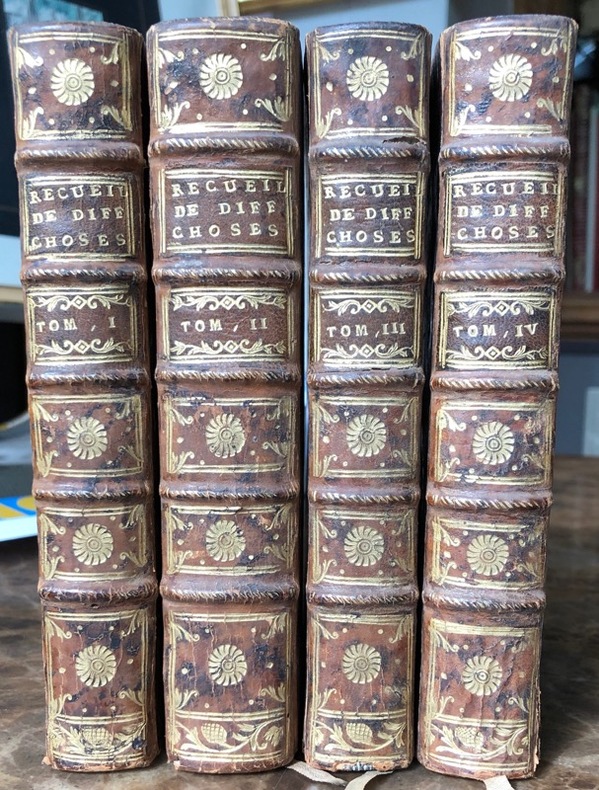
175616100A Lausanne, chez Marc-Michel Bousquet, 1756. 4 vol. petit in-8 de (4)-XI-(1)-412 pp. ; (4)-533 pp. ; (4)-429 pp. ; (4)-491 pp., veau porphyre, dos orné à nerfs, pièce de titre et de tomaison en maroquin brun, tranches marbrées (reliure de l'époque).
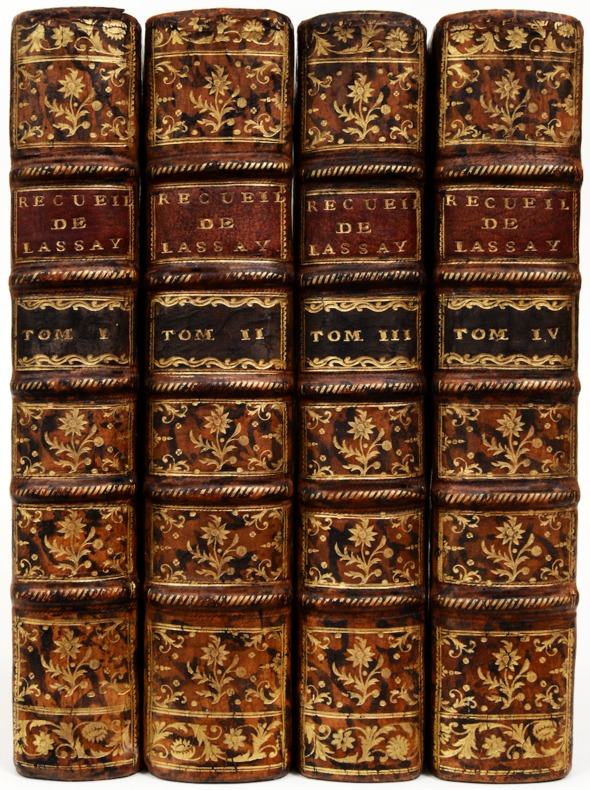
175616201A Lausanne, chez Marc-Michel Bousquet, 1756. 4 vol. in-4 de (4)-XI-412 pp. ; (4)-533 pp. ; (4)-429 pp. ; (4)-491 pp., veau marbré, dos orné à nerfs, pièces de titre en maroquin rouge et de tomaison en maroquin noir, tranches rouges (reliure de l'époque).
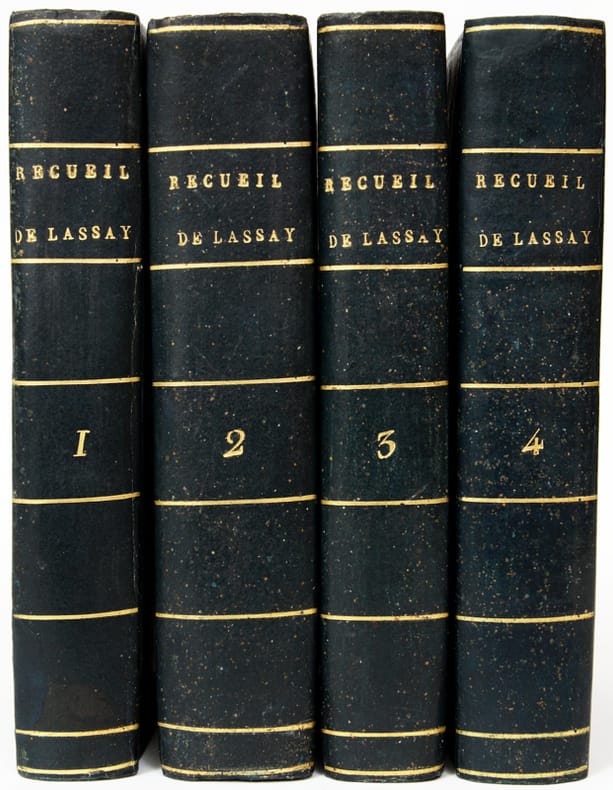
175613668A Lausanne, chez Marc-Michel Bousquet, 1756. 4 vol. in-12 de (4)-XI-412 pp. ; (4)-533 pp. ; (4)-429 pp. ; (4)-491 pp., cartonnage papier bleu, dos lisse orné de filets dorés, entièrement non rogné (relié vers 1810).
182590618Librairie de l'Industrie Renard | Paris 1825 | 13.5 x 21.5 cm | Broché
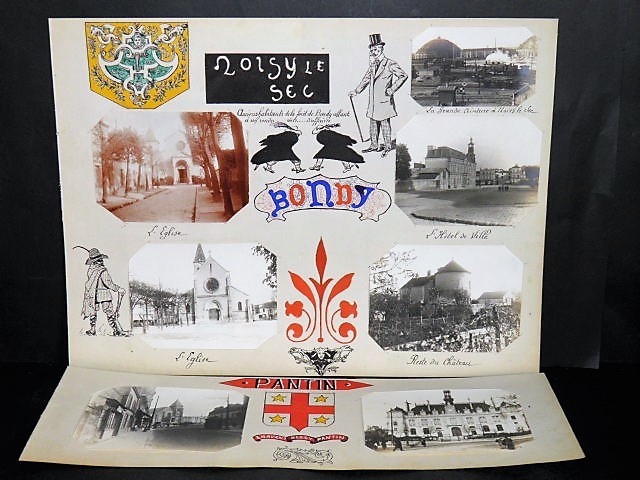
19001909Sans lieu, circa 1900. 35 X 26 cm et 35 X 11,5 cm (planches), environ 6 x 8 cm, 7,5 x 8,5 cm, 8 x 11 cm, (photos). 2 planches. Ensemble de 7 photographies originales sur papier, réparties sur 2 planches, légendées et illustrées à la main, à l'encre et à la gouache. Les photographies retracent un parcours touristique passant par Noisy-le-Sec, Bondy et Pantin (Hôtel de ville, reste du château, Eglises, etc). Les armoiries de Pantin à l'encre et la gouache ornent également les planches. Très intéressant ensemble, qui reflète une certaine diffusion sociale de la pratique photographique - au sein de l'élite bourgeoise - à la fin du XIXe siècle, en lien avec l'évolution des techniques, à la fois en ce qui concerne la prise de vue et les procédés de tirage. Equipés d'appareils d'utilisation de plus en plus aisée, de nombreux amateurs immortalisent alors les petits et grands moments de la vie de tous les jours, constituant albums de souvenirs et collections privées qui consacrent le rôle désormais essentiel de l'image dans la culture de la Belle Epoque. L'auteur de ces clichés, qui ne manquait ni d'humour ni de talent, a par ailleurs enrichi son travail artisanal d'autres éléments esthétiques : décors et ornements graphiques issus de l'univers du livre (imitant fleurons,bandeaux, culs-de-lampe, séparations de chapitres...), dessins "classiques" (paysages, portraits), inspirés du mouvement Art Nouveau ou influencés par la presse et l'affiche (typographie fantaisiste, caricatures,...).
Oblong Imperial folio (35 x 48.5 cm). A series of 24 numbered engraved views (plate size 27 x 43 cm; image size 24 x 41 cm) of the conquests of the Qianlong Emperor of China in what became Xinjiang province in western China, advancing to the area around the modern Chinese-Kazakhstan border, and the celebrations that followed in Beijing and elsewhere. With reproductions of the engraved explanation of the views, both in the earlier state covering views 1-16 and the later state covering views 1-24. Loose prints in folders in a modern archival box. A fine complete series of 24 large and meticulously engraved views of the western conquests by the Qianlong Emperor (1711-1799), the favourite grandson of the Kangxi Emperor in the Manchu Qing dynasty, who ruled China officially from 1735 to 1796. In the latter year he took the title of Emperor Emeritus, though in fact he held the reins of power to his death in 1799. The first series of 16 views illustrates events from 1754 to 1760, the first and most important of what the Chinese termed Qianlong's ten great military campaigns. From his base in Beijing, he took the Chinese army across the Gobi desert and into the Dzungar Khanate, where he decimated the Zunghars, a nomadic western Mongol people, and made the region into Xinjiang province, establishing the western border of China as we now know it. Hundreds of thousands of Zunghars were killed and most of the few that survived fled to what is now Kazakhstan. The campaign also greatly increased Chinese influence over Mongolia and Tibet. It largely established Chinese control of the highly influential Dalai Lama and set the stage for the suppression of the Turkic-speaking Islamic peoples in the southern part of the province, also covered in the present series. The views give very detailed images of the battles, with large numbers of foot soldiers and cavalry, often with the Chinese troops using Western long guns (as well as cannons) against the Zunghars' bows and arrows. It shows the troops, clothing, arms, camps and fortifications of both sides, and the use of camels and other beasts of burden, all in the spectacular mountainous landscapes of the region. The last three plates of the original sixteen show the presentation of Islamic prisoners to the Emperor, and celebrations of the victory. - The Qianlong Emperor had close relations with Europe and brought several missionaries into his court, mostly Jesuits. In 1765 he ordered the production of a series of 16 European copperplate prints commemorating the campaign against the Zunghars, drawn by the leading European artists in China: the Milanese Jesuit Giuseppe Castiglione (1688-1766), then the most famous European painter in China, the Roman Augustinian Jean Damascène (Sallusti), the Roman Jesuit Jean Denis Attiret (1702-1768) and the Bohemian Jesuit Ignaz Sichelbart (1708- 1780). The first edition was engraved on enormous plates under the direction of Charles-Nicolas Cochin in Paris in the years 1769 to 1774, but few of his prints ever reached China and it was decided to have the present new edition of the same views produced at a more practical scale. It was engraved in Paris from 1783 to 1785 by Isidore Stanislas Helman, who published it together with Nicolas Ponce. This edition was a great success. While the original series comprised 16 views, Helman added two supplementary series to his edition, each with four views, resulting in a total of 24. The first supplement (1786) shows the ceremonial breaking of new ground with an ox-drawn plough and three views that could be assembled to form one panoramic view of the Emperor's procession through Beijing. The second supplement (1788) shows the Emperor's various celebrations, mostly in honour of his ancestors. - An engraved plate of text was produced to accompany Cochin's first edition of the first 16 views, giving a brief explanation of each view. Helman appears to have acquired the plate and added descriptions of the 8 supplemental plates, though those for the original 16 were not updated, so that they still give the names of the earlier engravers, even though the imprint at the foot of the description for the panoramic view (plates 18-20) names Helman and Ponce. This plate of text is present here in a later printing on wove paper without a watermark. Most of the views are on a laid paper stock watermarked: dovecote = "T DUPVY F|AUVERGNE 1742", that in views 1-16 similar to Heawood 1234 (London, 1784). - In fine condition. A rare and remarkable series of views made for the Qianlong Emperor, mostly showing his conquests in western China.
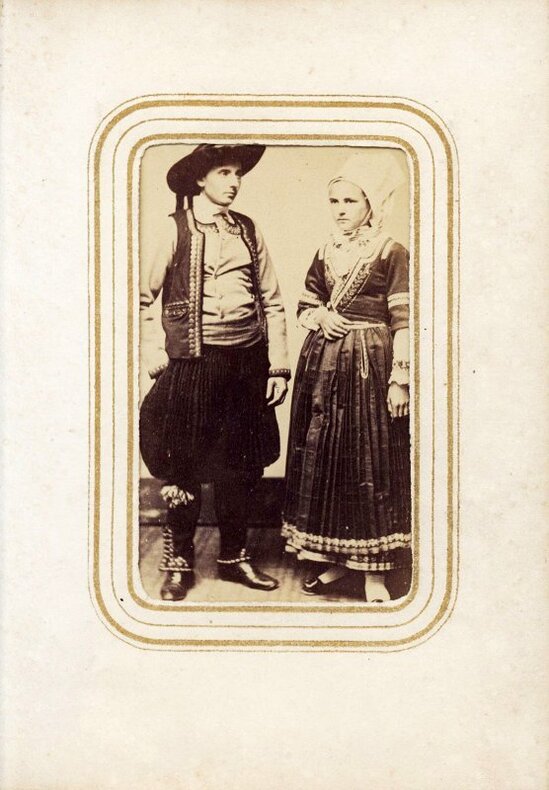
1488s. d. (vers 1865-1870). 11 PHOTOGRAPHIES DE VUES ET COSTUMES BRETONS
Folio. Bound in 9 uniform magnificent late 19th century full green morocco bindings with gilt centrepieces, gilt lines to edges of boards and gilt line-frames to inside of boards. All edges gilt and all volumes signed W. Pratt. A lovely set, exquisitely and uniformly bound, magnificently restored in the most gentle and respectful of manners, of the entire original run of De Bry's "Great American Voyages" (supplied by extra variant copies of volumes IV and VIII), the magnificent work that is responsible for shaping the European image of the New World, inventing it in the minds of the masses. Presenting a broad view of European conquests in America and the first contact with the American Indians, De Bry's Great American Voyages represents the first attempt to introduce in Europe - and on a large scale - a pictorial image of the New World as a whole. With it, the first iconography of the American Indian had been created, and most Europeans glimpsed for the first time the wonders of the New World in the illustrations present here. For more than a century, the European view of the New World was dominated by the present work. Theodor de Bry himself published the first six parts (in German and Latin simultaneously), and after his death, his widow and his two sons issued the three following parts. "It appears that they intended to stop there" (Sabin III, 20). However, 17 years later, Johann Theodor decided to publish another three volumes (1619-24). These are not present here. The present set is a mix of the German and Latin volumes (which appeared simultaneously), and as always in a mix of editions and issues. Due to the great scarcity as well as the complex bibliographical nature of "The Great American Voyages", no sets of this great work are said to be alike. They are always made up of different languages, editions, and issues, and there is said to be no such thing as a "complete set". Copies of sets are almost always in very poor condition. - With the book plate of John Jay Paul (dated 1913 and 1914) to each volume, and each volume with a tipped-in manuscript note describing issue points and/or the main restoration work (one dated 1919). - Gentle washing, pressing, and a few restorations; some maps neatly mounted, 2 maps supplied in facsimile (being the map in both copies of vol. VIII, which is not always present and thus technically not lacking), and a few leaves supposedly supplied from other copies. Occasional slight cropping. All in all a very handsome and well preserved copy.
Very Good Turkish Original 7 b/w photos including 7 original photographs of Istanbul walls. 6,5x9 cm. [THE WALLS OF CONSTANTINOPLE] [A collection including seven original photographs of Istanbul walls on the Bosphorus].
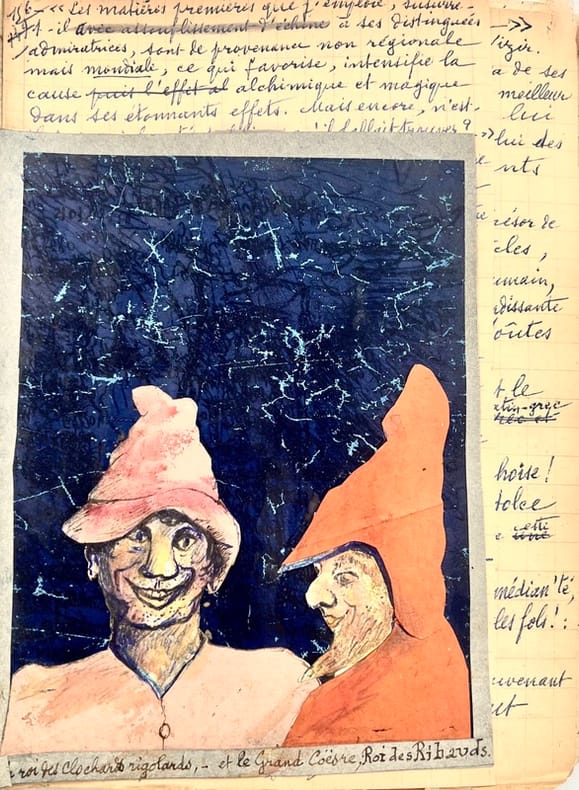
193543630, , vers 1935. Cahier manuscrit de (3)-258 pp. nombreux becquets, demi-toile verte et couverture bleue anonymes.
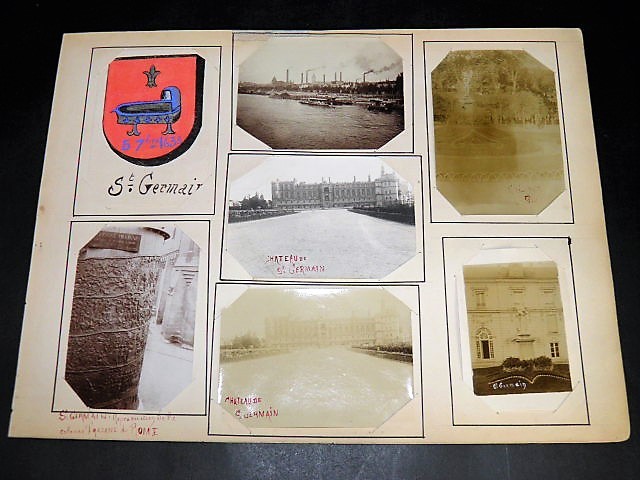
19001908Sans lieu, circa 1900. 35 X 26 cm (planches), environ 6 x 8 cm, 7,5 x 8,5 cm, 8 x 11 cm, (photos). 2 planches. Ensemble de 13 photographies originales sur papier, réparties sur 2 planches, légendées et illustrées à la main, à l'encre et à la gouache. Les photographies retracent un parcours touristique passant par Saint-Germain-En-Laye (le Château, la Reproduction de la colonne Trajane de Rome, le Parc), Le Pecq (La Seine, une vue des chemins de fer) et Versailles (Statue de Bayard, Hôtel de Ville). Les armoiries de Saint-Germain-en-Laye à l'encre et la gouache ornent également les planches. Très intéressant ensemble, qui reflète une certaine diffusion sociale de la pratique photographique - au sein de l'élite bourgeoise - à la fin du XIXe siècle, en lien avec l'évolution des techniques, à la fois en ce qui concerne la prise de vue et les procédés de tirage. Equipés d'appareils d'utilisation de plus en plus aisée, de nombreux amateurs immortalisent alors les petits et grands moments de la vie de tous les jours, constituant albums de souvenirs et collections privées qui consacrent le rôle désormais essentiel de l'image dans la culture de la Belle Epoque. L'auteur de ces clichés, qui ne manquait ni d'humour ni de talent, a par ailleurs enrichi son travail artisanal d'autres éléments esthétiques : décors et ornements graphiques issus de l'univers du livre (imitant fleurons,bandeaux, culs-de-lampe, séparations de chapitres...), dessins "classiques" (paysages, portraits), inspirés du mouvement Art Nouveau ou influencés par la presse et l'affiche (typographie fantaisiste, caricatures,...).
In 8° grande br. sov. fig. col. ( di Cisari ) 86 ill.ni b/n f/t, 11 disegni, un grafico, 4 carte e il facsimile di un autgrafo di G. D'annunzio. Pref. di Italo Balbo, intonso e ben tenuto
This is a very good hardcover copy in pale blue cloth covers titles and devices in gilt to the front cover and spine. Light sunning to the covers and a few tiny marks to the cover edges. Completely clean inside. Text in English and Portuguese. Illustrated lavishly in color and black & white. A monumental work on Mozambiquan art from the earliest historical times to the present. Written by a scholar from the Instituto Superior in Lisbon. Sections on native art with many illustrations of masks and other sculptures and folk arts. The architectural works of Mozambique also well illustrated. 14" high X 10" wide, 559 pages. This book will be securely wrapped and packed in a sturdy box and shipped with tracking.
français In-12 de 104 pp.; broché à rabats. Edition établie, présentée et annotée par Jean-François Nivet. Infime tâche au second plat.
1998040786Mansfield Centre CT: Martino Fine Books 1998. Reprint. Hardcover. Fine. Two volumes bound as one. pp: 338 62; 486 28 21 indices and supplements. Bound in green cloth red spine block with gilt lettering. 8.5" x 5.25" "This Reprint is Strictly Limited to 150 Copies" statement on verso title-page. Martino Fine Books hardcover
8vo [24 x 16 cm]; xxvii, 635 pp, index. original cloth, gilt spine title lettering, fine, clean and unmarked. A picture of this book is available upon request by email. A standard reference covering over 10,000 items and preceded by an extensive introduction providing a good historical perspective.
8vo [23.5 x 15.5 cm]; xi, 273 pp, author index, title index. original boards (hardcover) with title lettering on spine and cover, fine and clean, unmarked. A picture of this book is available upon request by email. Citing over 3,500 books in English, the work is arranged by subject including philosophy and religion, social sciences, language, science, fine arts and archeology, literature, geography and travel, history, etc, and with excellent indexes.
4to [28.5 x 22 cm]; xii, 328 pp, pictorial endpapers, detailed index. original blue cloth, gilt spine title lettering, pictorial gilt crest, cover very slightly used but a fine, clean and unmarked copy. A picture of this book is available upon request by email. A detailed description of over 2,000 publications, including explorations, travellers, native peoples, etc. A valuable reference.
4to [28 x 21.5 cm]; iii, 20 pp, full-page map. original pictorial heavy paper wraps, with printed title lettering, small ink stamp on cover, else near fine copy, clean throughout. A picture of this book is available upon request by email. A useful work consisting of an introduction by authors, a detailed bibliography, mostly with annotated descriptions and a list of general reference works.
4to., Best Edition, on laid paper, with a portrait frontispiece (short closed tear), 14 plates and numerous full-page facsimiles in the text, partially unopened, one or two leaves poorly opened; strongly bound in contemporary maroon half roan gilt, maroon buckram boards, back gilt with five raised bands, leather label gilt, gilt top, marbled endpapers, uncut, covers lightly age-scuffed else a very good, bright, clean copy. Handsomely bound copy of the substantially rewritten and enlarged issue of the original edition of 1886. Lists around 330 works with discursive bibliographical notes. Scarce in this condition. Howard-Hill, 4484.
8vo [25 x 17 cm]; xxviii, 780 pp, bibliography, detailed indexes by subject, title, author. original cloth, title lettering on cover and spine, edges slightly rubbed, fine, clean and unmarked. A picture of this book is available upon request by email. A standard reference with 4408 items listed, each with description, dates, etc. The author index includes biography of each author. This edition includes the 1963 supplement and is a major expansion of the earlier edition.
4to [26 x 18.5 cm]; xxxi, 441 pp, abbreviations, key to journals, index. original blue cloth, clean and fine condition. A picture of this book is available upon request by email. A basic reference covering each country in Central & South America and Mexico with sections on each historical period.