911 résultats
Hopkins, Nicholas S., edIn Pristine Condition. unknown
Jørgensen, MogensIn Pristine Condition. unknown
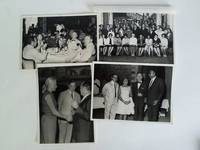
1J85921971. Maße: ca. 18 cm x 13 cm rückseitig mit Stempel/1 Foto mit Transparentpapier zur Namenszuordnung an den oberen Rand montiert. - 1 Aufnahem zeigt Präsident Sadat / Anbei: 2 Fotos von 1967 - unknown
1995275980PN. New. 1995. Soft Cover. Date is original print. This is a reprint edition . PN paperback
1995275981PN. New. 1995. Soft Cover. Date is original print. This is a reprint edition . PN paperback
1995275979PN. New. 1995. Soft Cover. Date is original print. This is a reprint edition . PN paperback
1984BN257949Mainz am Rhein : von Zabern 1984. 1984. 1000 Tausend Jahre Kairo : die Geschichte einer verzaubernden Stadt. <br/><br/>1000 Tausend Jahre Kairo : die Geschichte einer verzaubernden Stadt. Kairo / Ägypten / Stadtgeschichte / Stadtbeschreibung / Städtebilder / Stadtansicht / Städte - Volkoff Oleg V. Mainz am Rhein : von Zabern unknown
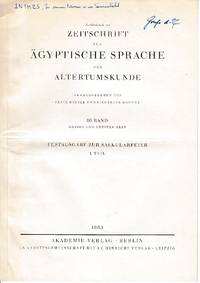
19639999_00412Berlin Akademie-Verlag 1963. 1st Edition . Offprint. . Quarto. Pp. 10. Original printed wrappers; small inscription. In a very good condition. ~ FIRST EDITION thus. Sonderdruck aus Zeitschrift für ägyptische Sprache und Altertumskunde 1963. Rudolf Anthes 1896-1985. AEB 63027. ~Librarium of The Hague offers the largest and finest collection of Egyptological offprint monographs in the rare book market. With the acquisition in recent years of multiple Egyptological libraries those of Prof. Herman te Velde; Prof. Mathieu Heerma van Voss Prof. Baudouin van de Walle; Prof. Michel Malaise; Prof. Herman De Meulenaere; Egyptologist Jacobus Visser and former Trustee of the Egypt Exploration Society Stewart Dale White we now hold several thousands of rare offprint monographs which were collected over many years by these scholars. Very limited in number when originally issued and fragile by nature most are by now practically extinct and the scarce survivors are much sought after. We took upon ourselves to collate catalogue and identify each item in accordance with Beinlich-Seeber or Annual Egyptological Bibliography in the hope that this collection will prove useful for scholars and collectors alike. Your queries are most welcome OFP-01 <br/> <br/> Berlin, Akademie-Verlag unknown
2014046173Athens: Ekdoseis Ethnos 2014 Book. New Book from Greece. Decorative Hardcover. Reissue. Re-issue with an introduction by Nikos Mathaioudakis Essays on various places Italy EgyptSinai JerusalemCyprus that Kazantzakis travelled to in 1926 & 1927. 336p. see English language editions under the title "Journeying : Travels in ItalyEgyptSinaiJerusalem and Cyprus". Ekdoseis Ethnos hardcover
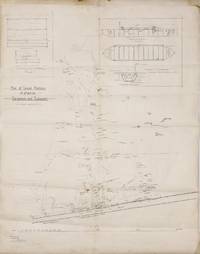
114959A detailed map of the battleground of the failed attempt by Turkish troops to invade Egypt on 3 February 1915. At the head of the map are large sketches of 'Frame of Kerosene Tin Raft in Turkish Attack' and 'Sketch of Turkish Pontoons captured at Toussoum-Serapeum 4.2.1915'. The Australian War Memorial has one of the 24 pontoons used by the 4th Turkish Army in their attempt to cross the Suez Canal in its collection. In fact the AWM records that 'The action in which it was captured was the first in which a unit of the AIF 3 Field Company Australian Engineers was engaged and as such this trophy was the first captured by the army in the First World War. by May 1918 the Australian War Records Section was lobbying for an example to be brought back to Australia noting that while Australian involvement by 3 Field Company Engineers was small it was important'. <p>Both Charles Bean 'The Official History of Australia in the War of 1914-18' Volume 1 Chapter VIII: 'The Turkish Expedition against Egypt' pages 140-165 and the AWM have much to say on this attack. After Turkey entered the war on 31 October 1914 one of the first objectives of both the Germans and Turks was to strike a blow against Britain in Egypt. By January 1915 a 'Turkish force of an estimated 10000 had travelled from Jerusalem to Kantara on the Suez Canal a distance of 200 miles. The force was composed of 5 percent Germans 10 percent Turks and 85 percent Bedouins and was aimed at raising anti-British feeling within the protectorate of Egypt inciting a Jihad and denying use of the canal to Allied forces. This potential threat forced the British to base up to 70000 troops in Egypt 30000 of them defending the Canal. Initially the Turks had three options: to attack from the Jordan-Mediterranean coast to Kantara through the Sinai from Beersheeba to Ismalia or from the south to Suez. Thus the British were obliged to keep options open defending all three zones along the 159 km of canal until it became obvious the Turks were marching south-west from Beersheeba heading for the central zone at Ismalia straight across the Sinai Desert. Despite being initially unconvinced that the Turks could actually organise such a crossing the British were aware of the intent; they decided to base their forces on the West Bank of the Suez using the canal as part of the defence bolstered by Royal Navy ships. This essentially meant giving up the Sinai. The force opposing the Turks mainly comprised of the 10th and 11th Divisions Indian Army. The New Zealand Wellington and Otago Battalions however assisted in the defence. The 3rd Field Company Engineers AIF were detached to operate searchlights and the Ismalia powerhouse but no other Australians were involved directly in the defence. The majority of defenders were hidden by high spoil banks thrown up on the west bank during construction of the Suez Canal. Small parties of Turks were spotted by a French seaplane on 15 January - but they missed most of the force heading out of Beersheeba and across the Sinai. This move was unexpected as most armies had moved along the coast. The Turks sent smaller parties to the southern & northern routes as a diversion and to keep the British guessing. The central party physically dragged their pontoons on wagons and artillery across the desert. Early on the morning of 3 February about 3:30 am movements and sounds were noticed by the defenders on the eastern bank and the Indian sentries started shooting. After dying down more sounds were noted a kilometre south. A Turkish pontoon landed on the west bank loaded with 25 Turks. This was charged by Punjabis and all the occupants were killed; a second crossed under fire but landed with only 10 survivors - four were captured in the morning. Pontoons were raked with shrapnel and machine gun fire killing all aboard. Many more were targeted on the east bank as their crews attempted to launch them with heavy casualties. Witnesses noted ten or eleven damaged pontoons drifting full of dead. Survivors tried to hide behind pontoons and make a dash for safety - many of these killed as well. Orders were given for Torpedo Boat 43 to blow up remaining intact pontoons. At the same time unaware of the disaster and hearing that some pontoons had already crossed the Turkish commander sent up thousands of reinforcements. The British Territorial artillery spotted them and started shooting as did the guns of the French battleship "Requin". An Indian counter-attack across the Canal took 250 prisoners and the attack ceased. The British had lost just on 160 men - the Turkish toll was ten times higher. The Turks retreated back across the desert. The Turkish performance at the Canal may have coloured Australian British and Indian attitudes to Turkish fighting ability which they brought to Gallipoli to their cost' AWM. <p>Bean provides more and pertinent details: 'Early in January the 3rd Field Company of Australian Engineers . had been sent down to construct trenches and floating bridges at the Canal. The British authorities at once began to discover in this company men experienced in almost any work which was needed. Within a week some were detached to manipulate searchlights others had taken over the power-house at Ismailia sic others were surveying for artillery ranges or for maps while the main body was making bridgeheads at Serapeum Ismailia and Kantara and also a floating bridge for Ismailia ferry-post'. <p>Bean's last words are also telling: 'There was a heavy fall in the current estimate of the fighting value of the Turkish Army. This was not without its influence on future events'. Those events which commenced on 25 April 1915 and reverberate to this day may go a long way to explaining why this extraordinary map appears to have been unrecorded. Bean was certainly unaware of it when he wrote his history; the AWM makes no reference to it; and Trove locates no examples. In the overall history of the First World War it may be a sideshow completely overshadowed by the Allied invasion of Turkey at Gallipoli: everything went according to the script of this dress rehearsal except the roles were reversed. unknown
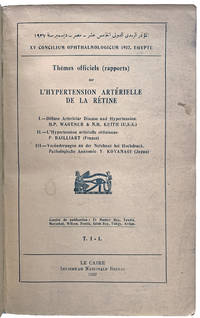
1937M12881Cairo:: Imprimerie Nationale Boulac 1937. 1937. At head of title: XV Concilium Ophthalmologicum 1937 Egypte. 248 x 166 mm. 8vo. Entire volume: ii 283 1 pp. 17 plates 42 figs. 83 plates 95 figs. bibliog.; EXTENSIVE UNDERLINING AND MARGINALIA pencil & inks on the Wagner-Keith paper otherwise clean. Modern quarter brown cloth with overstitching patterned paper over boards gilt spine original printed wrappers bound in. Ms. notation on original top cover. Bookplate of Jerry F. Donin. Very good binding good internally considering the notes. VERY RARE. Three ophthalmological papers from the XV Concilium Ophthalmologicum 1937 held in Egypt. The lead paper is by Wagner & Keith. The second contribution is by the noted French ophthalmologist Paul Alfred Marie Bailliart. The third paper is contributed by Yoshizo Koyanagi of Japan writing her in German on changes to the retina caused by high blood pressure with 83 plates showing the pathology. / This paper pre-dates the Garrison and Morton paper of the same topic & title published in the journal Medicine vol. 18 pp. 317-430 1939. "Wagner and Keith classified essential hypertension and lesions of the fundus into four groups." – Garrison and Morton 2723 and 2922. / Henry Wagener wrote mostly on ocular changes in hypertension. Together with Keith he set up a classification of retinal hypertensive changes that was popular." – Gorin History of ophthalmology p. 336. / This volume includes: Paul Alfred Marie Bailliart 1877-1969 "L'hypertension arterielle retinienne" Bailliart gained an international reputation for his work on the retinal circulation the ophthalmological manuals he co-authored and his development of Bailliart's ophthalmodynamometer Bailliart's goniometer and Bailliart's tonometer. ALSO: Yoshizo Koyanagi 1880-1954 "Veranderungen an der Netzhaut bei Hochdruck. Pathologische Anatomie." Yoshizo Koyanagi was a Japanese ophthalmologist who is recognized for his description of what is now known as Vogt–Koyanagi–Harada disease VKH. PROVENANCE: Jerry F. Donin was a distinguished ophthalmologist and medical book collector formerly of Claremont California. Imprimerie Nationale Boulac, 1937. hardcover