1 893 résultats
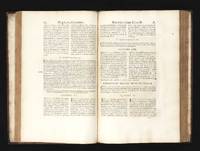
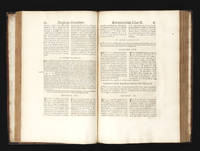
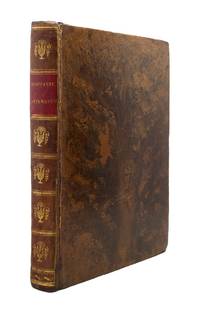
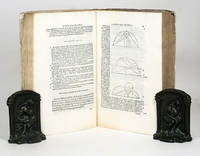
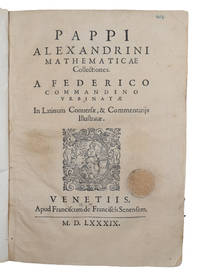
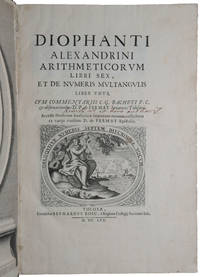
16706238Toulouse: Bernard Bosc 1670. First edition. <p>First edition large-paper issue with the rare engraved portrait of Pierre de Fermat by François Poilly - rare in this edition - and with the editor's presentation inscription on the title page: de Molieres ex dono authoris placing this copy with Louis de Molières Pierre de Fermat's brother-in-law and trésorier de France at Montauban in the year of publication. Prepared by Clément-Samuel de Fermat from his father's marginalia on Bachet's Diophantus the volume prints Fermat's forty-eight number-theoretic observations among them at page 61 the editio princeps of Fermat's Last Theorem - the marginal claim that no power above the second decomposes into two like powers and that a marvellous proof exists which the margin cannot contain. The theorem held for three hundred and fifty-eight years generating algebraic number theory the arithmetic of elliptic curves and modular forms in the course of the search for its proof until Wiles closed it in 1995. A contemporary hand has attempted corrections to Fermat's observation on cube differences at page 135.</p>. Box: 378 x 264 x45 mm. The First Printing of Fermat's Last Theorem. <p>First edition large-paper issue with the engraved portrait of Pierre de Fermat by François Poilly on the leaf facing the title - rarely found in copies of this edition - and with the editor's presentation inscription on the title page. The portrait a fine oval bust set above Fermat's family arms on a chevron three eagles and in base a crescent for the Fermats of Bas-Quercy is the work of one of the leading Parisian printmakers of the second half of the seventeenth century; most copies of the 1670 Diophantus lack it and its presence here together with the generous margins of the large-paper sheets and the inscription immediately below marks the volume as one of the small number of copies Clément-Samuel reserved for the inner circle of the Fermat family and their Toulouse connections. Beneath the printed line naming Pierre de Fermat as Senatoris Tolosani a period hand has added six Latin words: de Molieres ex dono authoris - "to de Molières from the gift of the author." The recipient is Louis de Molières 1610-1687 born at Cahors into the noblesse de robe of Bas-Quercy and established as trésorier de France at the Montauban bureau des finances a post he would hold for forty-two years. His first marriage in 1646 had been to Louise de Fermat c. 1613-c. 1650 Pierre de Fermat's younger sister. Louise had been dead twenty years by the time this copy left the press; Louis had long since remarried a demoiselle de Marqueyret; but the connection between the two robe families of the lower Garonne ran too deep for that to matter. The author named in the inscription is not Pierre - who had died in January 1665 - but Pierre's eldest son Clément-Samuel de Fermat c. 1632-1697 the lawyer and conseiller au parlement who had inherited his father's offices had spent the five years since his father's death transcribing the elder Fermat's mathematical marginalia into publishable form and who oversaw the volume through the Toulouse press of Bernard Bosc in 1670. By sending a large-paper copy to his late aunt's widower - the senior surviving link to his father's family in the generation above his own - Clément-Samuel placed his father's posthumous monument where it most properly belonged.</p> <br /> <br /> <p>The volume is the second edition of Bachet de Méziriac's 1621 Greek-and-Latin Arithmetica of Diophantus of Alexandria expanded by Clément-Samuel with his father's forty-eight mathematical observations and completed by the Doctrinae analyticae inventum novum of the Jesuit Jacques de Billy - a summary account of Fermat's analytical method drawn from the correspondence Billy had maintained with Fermat in the last years. The Arithmetica itself is the foundational work of Greek algebra and of Diophantine analysis setting out 189 problems in indeterminate analysis that had occupied mathematicians from Regiomontanus and Bombelli through Viète and Bachet. Fermat had annotated his personal copy of the 1621 Bachet edition - the copy he acquired in 1636 or 1637 probably through the circle of Carcavi and Mersenne - with marginal notes responding to individual Diophantine problems and in many cases generalising them into new theorems. That original annotated copy is lost. Its contents survive because Clément-Samuel working from his father's papers and almost certainly with the copy itself in hand transcribed the forty-eight observations and printed each at the appropriate point in the Diophantine text. The result is a conflation of the Bachet edition with Fermat's marginalia: Greek and Latin in parallel columns for the Diophantus with Bachet's commentary and Fermat's observation intervening at the relevant problems.</p> <br /> <br /> <p>At its centre - literally and historically - stands the single most consequential marginal note in mathematics. On page 61 of this volume as a commentary on Diophantus Book II Problem VIII the problem of dividing a given square into two smaller squares sits Fermat's observation in nine lines of italic Latin. Against the proposition that every square decomposes into two squares - the problem whose rational solutions are the Pythagorean triples - Fermat remarks that no cube decomposes into two cubes no fourth power into two fourth powers and in general no power higher than the second can be decomposed into two powers of the same kind. He has discovered he adds a truly marvellous proof of this proposition; the narrowness of the margin cannot contain it. This is Fermat's Last Theorem. It is printed here for the first time. The original 1621 Bachet that Fermat annotated no longer exists so the 1670 printing is the sole testimony to how Fermat actually wrote the proposition and the sole source for the evocative remark about the margin.</p> <br /> <br /> <p>The theorem held. For three hundred and fifty-eight years Fermat's claim resisted verification. Leonhard Euler produced the proof for exponent three in 1770 invoking the method of infinite descent that Fermat had set out in other contexts. Sophie Germain in the first decade of the nineteenth century opened a substantial class of exponents - the class of primes now called Sophie Germain primes. Dirichlet and Legendre settled exponent five in 1825. Gabriel Lamé reached exponent seven in 1839 and briefly claimed the full theorem a claim Liouville corrected within weeks by pointing to a failure of unique factorisation in the relevant cyclotomic integers. Ernst Kummer in 1847 working precisely on that failure introduced the ideal numbers that would become the foundation of algebraic number theory and proved Fermat's proposition for all regular primes. By the late nineteenth century Fermat's Last Theorem stood as a celebrated challenge and Paul Wolfskehl's 1908 bequest of a hundred-thousand-mark prize for a valid demonstration kept thousands of amateur attempts flowing to the University of Göttingen through the First World War and the Weimar collapse. The decisive modern move came in 1986 when Gerhard Frey suggested that any counterexample to the Fermat equation would produce a semistable elliptic curve whose properties must contradict the Taniyama-Shimura-Weil conjecture on modular forms. Kenneth Ribet proved the Frey implication the same year. Andrew Wiles working almost alone at Princeton announced a proof of the relevant portion of the modularity conjecture at Cambridge in June 1993; referee Nick Katz identified a subtle error; Wiles and Richard Taylor together closed the gap over fourteen further months; and the finished paper appeared in the Annals of Mathematics in May 1995. Fermat was right.</p> <br /> <br /> <p>The three and a half centuries between statement and proof generated a disproportionate share of modern number theory. Kummer's ideal numbers founded algebraic number theory. The theory of cyclotomic fields the arithmetic of elliptic curves and the whole modern apparatus of modular forms and Galois representations - together forming the present-day Langlands programme - all derive directly or by consanguinity from the long search for Fermat's proof. Wiles's demonstration runs past a hundred pages and invokes techniques Fermat could not have envisaged; the opinion of most specialists is that whatever proof Fermat believed he had was probably in error most likely a descent argument of the kind that works for exponents three and four but cannot be extended. Fermat himself in a 1659 letter to Carcavi set out his method of infinite descent in some detail and applied it to prove that the area of a rational right triangle can never be a square number - a proposition that by a short chain of reasoning implies his Last Theorem for exponent four. Whether that technique could be stretched to the general case is the question to which the answer three hundred and thirty-six years later was Wiles's hundred pages.</p> <br /> <br /> <p>Fermat's engagement with Diophantus ranged far beyond the single marginal note at page 61. Forty-seven further observations thread through the volume responding to Diophantine problems on rational squares Pythagorean right triangles the representation of integers as sums of squares and the arithmetic of cubes. Several of these observations announce theorems of comparable depth. The two-square theorem - that every prime congruent to one modulo four is the sum of two squares in essentially one way - sits among them as do the germ of the four-square theorem later proved by Lagrange the statement that every number is the sum of three triangular numbers and the generalised Fermat equation x2 − Ay2 = 1 the Pell equation which Fermat correctly recognised as always solvable in integers for non-square A. The observation at page 135 - headed OBSERVATIO D.P.F. and placed after Diophantus Book IV Question III - displays Fermat's characteristic fusion of correction and extension. Bachet had offered a partial treatment of the problem of finding two cubes whose difference equals a given number; Fermat shows that Bachet missed an entire further family of solutions which follow from his own method by continued iteration in infinitely many cases. Given the two cubes 8 and 1 whose difference is 7 Fermat produces a second pair of rational cubes with the same difference. His printed solution gives the sides 1265/183 and 1256/183 yielding the cubes 2024284625/6128487 and 1981385216/6128487. The verification is clean: the difference of these two new cubes reduces exactly to 7.</p> <br /> <br /> <p>Across the printed denominators on this page however a contemporary hand has drawn firm lines and written substitutions above the print: 61 in place of 183 for the sides and 226981 in place of 6128487 for the cubes. The substitution is not arbitrary - 183 is three times 61 and 6128487 is twenty-seven times 226981 which is itself 61 cubed. The annotator has evidently noticed that Fermat's fractions appear to contain a common factor of the cube of three and has tried to simplify them by cancelling it. But the correction does not preserve the answer. The revised sides 1265/61 and 1256/61 are each three times larger than their printed counterparts; the revised cubes are each twenty-seven times larger; and the difference of the revised cubes becomes 189 rather than 7. The substitution would solve a scaled version of Fermat's problem - one in which the given cubes were 216 and 27 rather than 8 and 1 - but it does not solve the problem as Fermat poses it on this page. The correction is the work of a contemporary reader who followed Fermat's argument closely enough to recognise the internal structure of the solution and who carried enough confidence to intervene in a freshly printed Toulouse folio but who stopped short of the final verification that would have caught the scaling error. That degree of engagement is itself worth marking. Fermat's observation on Book IV Question III was considered obscure even among the professional mathematicians of the period; the appearance of contemporary manuscript attention to its numerical detail in a copy that left the editor's hands in 1670 places this volume inside the very narrow circle of readers who took Fermat's more technical observations seriously from the moment of publication.</p> <br /> <br /> <p>Two further inserted slips of paper at pages 61 and 197 carry contemporary but more elementary annotations placing this copy plainly in the hands of a seventeenth-century reader working through the mathematics of the volume rather than merely its production. The slip at page 197 - facing the large printed table of eighty-one integer solutions to a Diophantine problem in four variables from Book V - carries calculations in a reader's hand involving the quantities eight hundred and ten thousand a cubic variable and a squared variable in a working attempt at the problem treated above. A later eighteenth-century English hand has added a note on the flyleaf framed as a dismissive verdict on Fermat's mathematical claims. A discreet twentieth-century dealer's mark on page 9 identifies the code of Lucien Scheler 1902-1999 the Parisian antiquarian bookseller and poet whose handling of the book places its modern provenance within a narrow compass of known trade hands.</p> <br /> <br /> <p>The recipient of the 1670 inscription belongs to a world of parliamentary offices and extended family connection that the inscription itself records in six Latin words. Louis de Molières born at Cahors in 1610 served forty-two years as trésorier de France at the Montauban bureau des finances one of the senior royal financial posts in lower Languedoc. His first marriage in 1646 was to Louise de Fermat daughter of Dominique de Fermat - the consul and leather merchant of Beaumont-de-Lomagne - and therefore sister of Pierre and paternal aunt of Clément-Samuel. Louise died in the late 1640s. Louis remarried a demoiselle de Marqueyret and continued as head of one of the prominent parliamentary families of Bas-Quercy until his death in 1687. His son by the second marriage Armand de Molières later served as second président of the Cour des aides at Montauban - the Armand whose name has occasionally been conflated with his father's in later bibliographic sources producing the hybrid 'Louis-Armand' that appears in some modern descriptions. The present inscription is addressed to Louis senior Pierre's brother-in-law and Clément-Samuel's uncle by marriage a man whose household at Montauban sat fifty kilometres north of Pierre's at Toulouse and who by 1670 was the senior family member in the generation linking back to Pierre's parents at Beaumont.</p> <br /> <br /> <p>Pierre de Fermat's reputation does not rest on the Last Theorem alone. A conseiller at the parlement of Toulouse and a magistrate of the Chambre de l'Édit at Castres he was an amateur mathematician in the technical sense only - an amateur who corresponded with Mersenne Pascal Descartes Huygens Wallis Carcavi and Roberval on terms of complete intellectual equality and who made fundamental discoveries in four distinct branches of mathematics. In number theory beyond the Last Theorem he discovered the theorem now called Fermat's Little that for any prime p and integer a not divisible by p the quantity a raised to the power p minus one is congruent to one modulo p stated and used the two-square theorem developed the method of infinite descent as a rigorous technique for negative existence proofs and extended the theory of amicable numbers well beyond the pair 220 and 284 known since antiquity. In analytic geometry his Ad locos planos et solidos isagoge - which he sent in manuscript to Carcavi and Mersenne in 1636 - predated Descartes's Géométrie in composition though not in print. In the calculus of variations his method of adequality supplied a systematic technique for locating maxima minima and tangents that Newton and Leibniz both later acknowledged as precursor. In the summer of 1654 in the correspondence with Pascal that Carcavi preserved he worked out with Pascal the foundations of the mathematical theory of probability solving the problem of the division of stakes in interrupted games of chance. In optics he enunciated the principle of least time - Fermat's principle - which furnished the first variational formulation in physics and served as direct ancestor to the principle of least action and the whole edifice of Lagrangian and Hamiltonian mechanics. Any one of these contributions would secure a reputation; that a sitting magistrate of the Toulouse parlement pursuing mathematics in stolen evening hours made all four is the condition Clément-Samuel set himself to commemorate in this volume.</p> <br /> <br /> <p>Of those four strands the 1670 Diophantus captures chiefly the number-theoretic Fermat and within that only the portion he wrote as marginalia on Bachet. His analytic geometry and his general method of maxima et minima appeared in 1679 as Varia Opera Mathematica again at Toulouse edited again by Clément-Samuel. His complete correspondence and further manuscripts were assembled definitively only in the late nineteenth century by Paul Tannery and Charles Henry whose four-volume Œuvres de Fermat 1891-1912 with a supplementary fifth volume by Cornelis de Waard in 1922 remains the standard scholarly edition. But the 1670 edition is the book in which Fermat's Last Theorem first entered print the book through which Fermat's name reached the working mathematicians of the late seventeenth and eighteenth centuries and the book Euler and Gauss both studied and built on. Its place in the foundational history of number theory is not in dispute. What is less often remarked - and what this particular copy preserves - is the presence in 1670 of readers who took Fermat's more technical observations seriously enough to attempt corrections in the margins even when as at page 135 those corrections did not finally succeed.</p> <br /> <br /> <p>References: Honeyman 885 - Norman 771 - Smith Rara Arithmetica pp. 348-349 - Brunet II 702 - Roberts & Trent Bibliotheca Mechanica p. 108 - Hoffmann 1242 - Weil Number Theory: An Approach through History from Hammurapi to Legendre Birkhäuser 1984 chapters II-IV - Mahoney The Mathematical Career of Pierre de Fermat Princeton University Press second edition 1994 - Goldstein Un théorème de Fermat et ses lecteurs Presses Universitaires de Vincennes 1995 - Singh Fermat's Enigma Fourth Estate 1997 - Wiles 'Modular elliptic curves and Fermat's Last Theorem' Annals of Mathematics 141 1995 pp. 443-551 - Taylor and Wiles 'Ring theoretic properties of certain Hecke algebras' Annals of Mathematics 141 1995 pp. 553-572.</p> <br /> <br/> <br/> <br /> <p>Folio 365 × 246 mm pp. xii 341; 48. Engraved portrait of Pierre de Fermat by François Poilly on the leaf facing the title Fermat in scholarly dress within an oval frame his arms below on the plinth - rarely found in copies of this edition. Engraved allegorical vignette on the title page Orpheus with the lyre encircled by the Virgilian motto obloquitur numeris septem discrimina vocum. Numerous woodcut diagrams in the text. Greek and Latin in parallel columns throughout the Diophantus. Separate pagination for the Inventum novum. Light browning. Contemporary calf gilt fillet on covers spine richly gilt in compartments with gilt-tooled lettering DIOPHANTI / FERMAT edges speckled red binding slightly rubbed. A fine copy.</p> . Bernard Bosc unknown
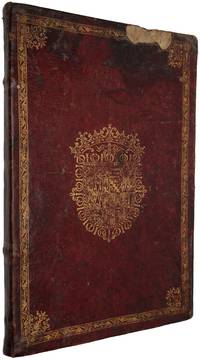
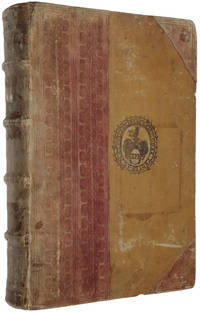
15756346Basel: Eusebius Episcopius & Heirs of Nikolaus Episcopius 1575. First edition. <p>First edition of Diophantus - the first printing of the Arithmetica in any language in any form - owned annotated and signed by Giovanni Camillo Gloriosi 1572-1643 Galileo's successor in the chair of mathematics at the University of Padua. Gloriosi's mathematical annotations dating from 1611 and 1612 revise and correct the calculations of Diophantus and of his Latin translator Xylander; the long note at page 59 against Proposition II.19 is the working source for Gloriosi's 1613 Ad theorema geometricum Venice Baglioni whose publication with Galileo's recommendation secured the Padua chair in October of that year. After Gloriosi's death the library passed for five hundred gold coins to Ramiro de Guzmán Viceroy of Naples who bound the books in red morocco with his armorial. Bouza's 2024 catalogue of thirty-five Gloriosi books surviving in Madrid libraries records signatures only; this copy stands apart by the density of its 1611-1612 marginalia and by the direct textual link between the note at page 59 and pages 28-29 of the printed Ad theorema geometricum.</p>. Hardcover. Giovanni Gloriosi's Signed and Annotated Copy of the First Systematic Treatise on Algebra. <p>First edition of Diophantus - the first printing of the Arithmetica in any language in any form - owned annotated and signed by Giovanni Camillo Gloriosi 1572-1643 Galileo's successor in the chair of mathematics at the University of Padua and subsequently acquired from Gloriosi's estate for five hundred gold coins by Ramiro de Guzmán Duke of Medina de las Torres and Viceroy of Naples who bound the book in red morocco with the combined armorial of himself and his wife Anna Carafa de Stigliano on the covers. When Antonio Favaro undertook his 1904 study of Gloriosi in the series on Galileo's acquaintances and correspondents he posed what seemed a straightforward question - what had become of the mathematician's books and papers - and reported that every effort he had made to trace them had been entirely in vain. The present copy bound in the viceroy's unmistakable red morocco and carrying Gloriosi's signature on the last leaf with extensive mathematical annotations in his hand is distinguished among the now-identified survivors of that library by the density of the annotations and by their demonstrable bearing on Gloriosi's own published mathematical work.</p> <br /> <br /> <p>Gloriosi was a Neapolitan Jesuit-trained and came to mathematics through the algebraic tradition rather than through natural philosophy. In 1604 a friar asked Galileo to write on his behalf for a lectureship in mathematics; the appointment did not materialise but the correspondence opened a cordial if occasionally pointed relationship between the two men. By 1606 Gloriosi was in Venice moving in the circle around Paolo Sarpi and Giovanfrancesco Sagredo where he also met Antonio Santini and Marino Ghetaldi who introduced him to the algebra of François Viète - the immediate and decisive influence on his reading of Diophantus. In October 1613 with Galileo's recommendation and on the strength of his first publication Ad theorema geometricum Venice: Tommaso Baglioni 1613 Gloriosi was nominated to the chair Galileo had just vacated at Padua. He held the post until 1622 returning thereafter to Naples where he lived as a private gentleman maintained correspondence with the mathematical communities at Padua Venice Bologna and the Roman College and continued to exchange letters with Galileo until at least 1635. He died in January 1643 leaving four surviving letters to Galileo as the record of a thirty-year intellectual acquaintance.</p> <br /> <br /> <p>Gloriosi's annotations transform the copy from a bibliographical rarity into a document of working mathematical scholarship. Dating from 1611 and 1612 - the two years immediately preceding the Ad theorema geometricum and the Padua appointment - they fall into two kinds. Many are brief marginal identifiers a single Latin word most often Theorema placed beside the statement of a particular proposition to fix its status in the flow of Diophantus's argument. The majority however are substantive mathematical calculations in Gloriosi's fine italic hand revising extending and in a number of cases correcting the work of Diophantus and of the book's Latin translator and commentator Wilhelm Holtzmann of Augsburg Xylander. They are concentrated in Book II and in the later books in which the more intricate indeterminate problems occur and they are dense enough in places to fill margins on both sides of the printed page. Where Xylander's own calculation has gone astray Gloriosi writes out the corrected arithmetic to several orders of fractional precision; where a proposition requires a generalisation Diophantus had not offered he supplies it.</p> <br /> <br /> <p>The most consequential of these annotations occupies the lower margin of page 59 against Proposition 19 of Book II - the problem that asks a given number to be divided into three parts such that each part on donating a specified fraction of itself plus a fixed number of units to the next yields three equal results. For the number 80 with the fractions one-fifth one-sixth and one-seventh and the added units 6 7 and 8 respectively Xylander's solution failed: the parts summed to 80 but the distribution did not in fact satisfy the equations. Gloriosi noted the failure precisely - aequatio facta est ad 16 2/3 cum fieri debebant ad 26 2/3 the equation had been set at 16 2/3 when it should have been set at 26 2/3 - and then in the same annotation recorded the three correct fractional parts 1N 9530/363 10200/363 and 9310/363 obtained from the corrected equation. He rejected the possibility that Diophantus himself had erred insisting that the Alexandrian would not have proposed a problem without knowing its solution and argued instead that the Greek text had been mutilated in transmission. The task he set himself was to recover a solution using as Diophantus's method required a single hypothesis. This is exactly the reconstruction carried out on pages 28-29 of the Ad theorema geometricum of 1613 - the annotation and the printed text correspond point by point in the equation in the numerator 9530 over the common denominator 363 and in the subsequent reasoning - and the book prints no other source for the reconstruction. The margin of the present copy is the working source.</p> <br /> <br /> <p>The causal chain is tight. The marginal notes of 1611-1612 fed into the printed argument of 1613 the printed argument of 1613 supplied the published credential on which Galileo's recommendation built and the appointment to the Padua chair followed in October of the same year. The book at hand is therefore not merely an annotated copy of a famous mathematical work but the physical support for the single published achievement that elevated Gloriosi into the most visible Italian chair of mathematics. That it emerged from a library thought lost - and emerged intact bound by a seventeenth-century viceroy with the annotations complete and legible - is among the more unusual recoveries of the last generation of rare-science-book scholarship.</p> <br /> <br /> <p>Favaro's search had run up against a problem he could not solve from the evidence then available. Gloriosi had died a private gentleman in Naples; his nephew in Tomasini's words in the 1644 Elogia was a stranger to the study of letters who disposed of the entire library at a single stroke for five hundred gold coins to the viceroy. The viceroy then transferred the books to Spain and after his own death in 1668 the collection dispersed into the Madrid book trade where the Gloriosi association was no longer visible to anyone not already looking for it. Fernando Bouza working from Tomasini's text and from the catalogue records of Spanish libraries reconstructed the trajectory in a 2024 article in Galilæana and catalogued thirty-five printed books once belonging to Gloriosi almost all of them in Madrid - at the Biblioteca Nacional de España the Biblioteca Histórica of the Universidad Complutense the Biblioteca Francisco de Zabálburu and the Real Academia de Bellas Artes de San Fernando - together with a further two outside Madrid a 1521 Alfonsine Tables rebound in the eighteenth century and a 1545 Cardano Ars Magna sold at the 1861 Guglielmo Libri auction at Sotheby's. In each of the thirty-five Madrid books Gloriosi is identified by his characteristic signature alone set on the title verso or after the colophon; Bouza does not describe any of them as carrying substantive mathematical annotation. The present copy stands apart from that group in two respects: the density of Gloriosi's 1611-1612 marginalia and the specific point-for-point correspondence between the note on page 59 and pages 28-29 of the printed Ad theorema geometricum which ties this particular volume to a particular publication in a way no other survivor has yet been shown to do.</p> <br /> <br /> <p>Ramiro Núñez de Guzmán 1600-1668 second Duke of Medina de las Torres by marriage to Anna Carafa and son-in-law of the Count-Duke of Olivares served as Viceroy of Naples from 1637 to 1644 and was one of the most powerful Spanish grandees of his generation. His library-building followed the pattern common to seventeenth-century Italian viceregal courts in which the acquisition of a scholar's entire legacy was an act of cultural prestige as well as of intellectual collecting. The red morocco binding with his armorial stamps - exclusive bindings known to collectors as medines combining the viceroy's quartered arms on one cover with those of Anna Carafa REVOLUTA FOECUNDANT the Carafa stars and crescent on the other - was presumably executed in Naples or in Madrid after the purchase. Of the small number of these bindings that survive the one on the present volume is identical in tool format and armorial layout to that on the Bodleian sammelband Rigaud.e.148 which contains Gloriosi's own copies of Galileo's Sidereus nuncius 1610 and Il Saggiatore 1623 Giulio Cesare La Galla's 1612 De phoenomenis in orbe lunae Francesco Sizzi's 1611 Dianoia astronomica and Mario Guiducci's 1620 Lettera al padre Tarquinio Galluzzi. Taken together the sammelband and the present copy demonstrate that the viceroy bound the mathematical and the Galilean-astronomical portions of Gloriosi's library in a single uniform style and that Gloriosi himself had studied Galileo's principal works at first hand.</p> <br /> <br /> <p>After Medina de las Torres's death in 1668 the library began to disperse. The principal buyer was William Godolphin c. 1634-1696 the English diplomat and Catholic convert then resident at the court in Madrid whose prominent ownership inscriptions identify a substantial block of former Guzmán books. The present Diophantus was not among them. A second buyer identified only as 'Ãlvarez' signed his name on the title page; the inscription survives covered by a contemporary paper slip that has been preserved in place. The same 'Ãlvarez' signature appears on three other former Guzmán books currently traceable in the Spanish antiquarian market and in one of them - a 1600 Brescia edition of Alessandro Manerba's Moralis sylva - Godolphin's own title-page inscription overlaps Ãlvarez's showing that the two were contemporaries and that Ãlvarez transferred part of his collection on to Godolphin. The absence of Godolphin's characteristic title-page or colophon signature from the present copy indicates that Ãlvarez acquired the book directly from the viceroy's dispersal and retained it and that it never entered Godolphin's library. Ãlvarez is therefore the third known owner standing between Guzmán and the Earls of Macclesfield from whose library at Shirburn Castle the book came to the market as lot 636 in the 2005 sale.</p> <br /> <br /> <p>The edition Gloriosi annotated was in 1611-1612 the only printed Diophantus in existence. Wilhelm Holtzmann of Augsburg 1532-1576 who Hellenised his name as Xylander was a classical philologist and professor of Greek at Heidelberg and his Latin Arithmetica of 1575 was the first complete European rendering of the text. The Greek editio princeps would not appear for another forty-six years when Bachet de Méziriac printed it in Paris in 1621 item 20 in this catalogue Bachet's own large-paper copy. Xylander worked from a single Byzantine manuscript derived like every surviving Greek witness from a single lost archetype and the manuscript was in André Weil's phrase marred throughout by the numerical errors of professional scribes who had not been mathematicians. He laboured for several years under these conditions supplied the text with a running Latin commentary - the Xylandri sections set beneath each Diophantine proposition in the present volume - and dedicated the book to his pupil Prince Ludwig of Württemberg. Thomas Heath writing in 1910 observed that Xylander's achievement had been inadequately appreciated by later commentators largely because the book itself was so rare: Nesselmann preparing his 1842 Algebra der Griechen was unable to find a copy at all. The translation's immediate and enormous influence on the shaping of European algebra as Heath put it ran through Bombelli Stevin Viète and - through Bachet's 1621 reprinting with improvements - Pierre de Fermat. Xylander himself did not live to see that influence take hold: he died the year after publication.</p> <br /> <br /> <p>The Arithmetica itself composed at Alexandria in approximately AD 250 is the first systematic treatise on algebra and the founding text of the tradition now called Diophantine analysis: the search for rational or integer solutions to polynomial equations in several unknowns. Diophantus introduced the earliest sustained symbolism in Greek mathematics - a character for the unknown for its powers up to the sixth and for the operations of addition and subtraction - and treated roughly two hundred and sixty problems whose solutions though always given in specific numerical terms tend to suggest general methods. The work was originally in thirteen books. Six survived in Greek transmitted by Byzantine scholars from Michael Psellus through Maximus Planudes whose scholia on the first two books Xylander prints alongside the text to the codex Cardinal Bessarion rescued before the fall of Constantinople and that Regiomontanus discovered at Venice; four further books surfaced in 1968 in a ninth-century Arabic translation by QustÄ ibn LÅ«qÄ dispersing the suspicion that the ancient numbering had corresponded straightforwardly to the surviving Greek sequence. Three books remain lost. The Arab reception had in fact been considerable: al-NadÄ«m's index of the sciences 987-988 lists commentaries by QustÄ ibn LÅ«qÄ and by AbÅ«'l-WafÄ' and a substantial fraction of the problems in al-KarajÄ«'s algebra are drawn directly from Diophantus's first three books.</p> <br /> <br /> <p>Xylander's volume prints at the end a fragment of the only other surviving work by Diophantus - a treatise on polygonal numbers which is differentiated from the Arithmetica by its use of geometric proofs and which breaks off in the middle of its investigation of the number of ways in which a given number can be expressed as a polygonal. The full transmission history of both texts from Bessarion and Regiomontanus through Bombelli's partial assimilation in his 1572 Algebra 271 problems of which 147 were taken directly from Diophantus to Viète's Zetetica of 1593 and on to Bachet's definitive 1621 edition runs entirely through this 1575 volume. It was in the margins of a copy of Bachet's 1621 reprint that Pierre de Fermat in the mid-1630s wrote the forty-eight observations that founded modern number theory - among them on page 85 against Problem II.8 on the decomposition of a square into two squares the proposition now known as Fermat's Last Theorem whose proof by Andrew Wiles in 1995 closed a gap that had stood for three hundred and fifty-eight years. The 1670 reprint of Bachet's edition with Fermat's observations printed in the margins the book that carried the Last Theorem into circulation is item 19 in this catalogue.</p> <br /> <br /> <p>Auction records since Honeyman list only three other copies of the 1575 Xylander; each is in a nineteenth- or twentieth-century binding and none has significant provenance. OCLC records eight copies in North American libraries. Copies in contemporary armorial bindings with identifiable early mathematical ownership are essentially unrecorded in commerce of the last century and the present volume - the Gloriosi copy in the Medina de las Torres binding standing as the material support for the 1613 Ad theorema geometricum and for the Padua appointment that followed it - is without known parallel.</p> <br /> <br /> <p>Almost nothing is known of the life of Diophantus. He quotes Hypsicles and so must have worked after roughly 150 BC; he is quoted in turn by Theon of Alexandria and so must have worked before AD 364. The conventional placement around AD 250 rests on a single passage in an eleventh-century Byzantine letter and on the absence of Diophantus's name from the commentaries of Pappus. His place of birth is unknown his teachers unknown and the fourteen-line Greek epigram in the Palatine Anthology that purports to record his age at death is generally regarded as a mathematical exercise rather than a biographical document.</p> <br /> <br /> <p>References: Adams D-652 - DSB IV 110-19 - Honeyman 890 - Norman 641 - Macclesfield 636 this copy - Bouza 'The mathematician and the viceroy' Galilæana XXI 1 2024 pp. 201-220 - Favaro Amici e corrispondenti di Galileo Galilei. IX. Giovanni Camillo Gloriosi 1904 - Tomasini Elogia virorum literis et sapientia illustrium 1644 - Heath Diophantus of Alexandria: A Study in the History of Greek Algebra 2nd ed. 1910 - Heath A History of Greek Mathematics 1921 vol. II pp. 448-517 - Weil Number Theory: An Approach Through History from Hammurapi to Legendre 1984 - Katz & Parshall Taming the Unknown 2014 ch. 4 - Schappacher 'Diophantus of Alexandria: a text and its history' IRMA Strasbourg - Smith Rara Arithmetica p. 348.</p> <br /> <br/> <br/> <br /> <p>Folio 307 × 200 mm pp. xii 152. Printer's device on title legend Episcop woodcut initials printed marginal notes. Occasional foxing light damp stains to blank corners of some leaves. Mid-seventeenth-century red morocco with gilt arms of the Duke of Medina de las Torres and his wife on the covers elaborate gilt borders and corner fleurons spine gilt; damage to upper edge of front board affecting gilt border.</p> . / Hardcover. Eusebius Episcopius & Heirs of Nikolaus Episcopius unknown
3548Cum Commentariis C.G. Bacheti.& observationibus D.P. de Fermat.Accessit Doctrinae Analyticae inventum novum collectum ex variis eiusdem D. de Fermat Epistolis. Large engraved vignette on title several finely engraved headpieces & initials & a few woodcut diagrams in the text. 6 p.l. 64 341 48 pp. one leaf of errata. Folio cont. speckled calf carefully rebacked with the orig. spine laid-down light browning as usual two corners discretely repaired spine richly gilt. Toulouse: B. Bosc 1670. First edition and a very fine and fresh copy. This edition is the first to contain Fermat's observations on the Arithmetica of Diophantus the first systematic treatise on algebra; it also contains on H3r the first statement of the celebrated "Last Theorem" which Fermat originally wrote by hand in the margins of his copy of Bachet's edition of Diophantus 1620. This theorem is the most famous problem in mathematics and remained unsolved for over 325 years until its recent solution by Andrew Wiles. But it should be remembered that Wiles was able to resort to sophisticated 20th-century techniques not available to Fermat. The exact form of Fermat's proof if indeed he had a genuine one thus remains one of the great unsolved puzzles of mathematics. The 1670 edition was published posthumously by Fermat's son Clement Samuel. It is based on his father's annotated copy of the Bachet edition of 1621 and contains a major part of Fermat's work on number theory a branch of mathematics that he virtually created. A nice copy with the extremely rare errata leaf. ❧ Smith Rara Arithmetica p. 348. unknown books
1670105031670. Cum Commentariis C.G. Bacheti…& observationibus D.P. de Fermat…Accessit Doctrinae Analyticae inventum novum collectum ex variis eiusdem D. de Fermat Epistolis. Large engraved vignette on title several finely engraved headpieces & initials & a few woodcut diagrams in the text. 6 p.l. 64 341 48 pp. one leaf of errata. Folio cont. speckled calf carefully rebacked with the orig. spine laid-down light browning as usual two corners discretely repaired spine richly gilt. Toulouse: B. Bosc 1670.<br/> <br/> First edition and a very fine and fresh copy. This edition is the first to contain Fermat’s observations on the Arithmetica of Diophantus the first systematic treatise on algebra; it also contains on H3r the first statement of the celebrated “Last Theorem†which Fermat originally wrote by hand in the margins of his copy of Bachet’s edition of Diophantus 1620. This theorem is the most famous problem in mathematics and remained unsolved for over 325 years until its recent solution by Andrew Wiles. But it should be remembered that Wiles was able to resort to sophisticated 20th-century techniques not available to Fermat. The exact form of Fermat’s proof if indeed he had a genuine one thus remains one of the great unsolved puzzles of mathematics. <br/> <br/> The 1670 edition was published posthumously by Fermat’s son Clement Samuel. It is based on his father’s annotated copy of the Bachet edition of 1621 and contains a major part of Fermat’s work on number theory a branch of mathematics that he virtually created. <br/> <br/> A nice copy with the extremely rare errata leaf. <br/> <br/> ⧠Smith Rara Arithmetica p. 348. unknown
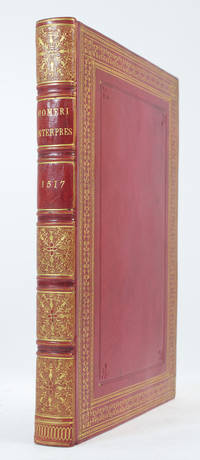
151766901Editio Princeps and the First Book Printed at the press of the Greek Gymnasium HOMER. DIDYMUS OF ALEXANDRIA. LASCARIS Janus editor. Homeric Scholia on the Iliad. Homeri interpres pervetustus in Greek. Edited by Janus Lascaris Rome: Vittore Carmelio and/or Zacharias Callierges for Angelo Colocci at the Press of the Greek Gymnasium caballini montis gymnasium. Not before 7 September 1517. Editio Princeps and the first book that was printed at the press of the Greek Gymnasium in Rome. Folio 10 1/2 x 7 3/4 inches; 265 x 197 mm. 172 leaves. Text in Greek. With "To the Reader" and "Address to Pope Leo X" which is dates 7 September 1517 in Latin. Colophon and register in Greek. This is the Longleat Beriah Botfield copy. We were not able to locate any copies besides the present copy at auction in the past fifty years and only one library on OCLC with a copy. Beautifully bound in early 19th Century straight-grain morocco by Francois Bozerian His stamp "Rel. F. Bozerian jeune" at bottom of the spine. Boards tooled in gilt and blind. Spine elaborately stamped and lettered in gilt. Boards edges gilt. Gilt dentelles. All edges gilt. Silk endpapers. Blue silk page marker. Two old circular previous ownership stamps on recto of first leaf not affecting text. Stamps are one of which is red and one of which is black are from the Seminaire des Missions Etrangeres. "Pope Leo X Giovanni de' Medici called Janus Lascaris to Rome to found a Greek College in 1513 and three years later it began to issue Greek texts principally edited by Lascaris. The printer was once thought to be Angelo Colocci a rich Roman proponent of Greek learning in whose house the press almost certainly operated but it was most likely Vittore Carmelio Hobson foreman to Callierges first printer of Greek at Rome or Callierges himself Layton. The types were designed by Lascaris cut possibly by Callierges and first used in 1494-96 by Lorenzo di Alopa at Florence to print books Lascaris edited. Cf. A. Hobson 'The Printer of the Greek Editions "In gymnasio Mediceo ad Caballinum montem"' Studi di biblioteconomia e storia del libro in onore di Francesco Barberi Rome: 1976: 331-335; E. Layton The 16th-century Greek Book in Italy pp.323-329; D.E. Rhodes 'The Printing of a Group of Greek Books in Rome' Studies in Early Italian Printing London: 1982 pp.111-113; Barker Greek Script pp.74-75. This first edition of the Homeric scholia on the Iliad has no author attribution although it is sometimes given erroneously to Didymus c.65 B.C.-10 A.D. It was a standard text in the study of Homer and clearly a required text for the students at the Greek Gymnasium." Christies 2002 HBS 66901RSL. $40000 Vittore Carmelio and/or Zacharias hardcover books
167069414Toulouse: Bernard Bosc 1670. Full Description:<br> <br> DIOPHANTUS OF ALEXANDRIA. Diophanti Alexandrini Arithmeticorum libri sex et De numeris multangulis liber unus. Cum commentariis C.G. Bachet V.C. et observationibus D.P. de Fermata . accessit Doctrinae analyticae inventum novum Toulouse: Bernard Bosc 1670.<br> <br> First edition of Fermat's notes and second edition of Bachet's Diophantus. Quarto 13 x 8 1/4 inches; 330 x 215 mm. xii 64 341ie 343 1 blank 48 pp. Bound without the scarce errata at the end also not present in the Norman copy. Pages 55/56 bound after page 57/58 in the preliminaries. Two leaves are both numbered 335/336 but collation is correct and text is complete. Leaf fii is bound after fiii in the final section. Latin Xylander's translation and Greek text in parallel columns. Separate pagination for De Numeris multangulis. Allegorical engraved title vignette featuring Orpheus playing the lyre. Handsome engraved headpieces and historiated initials. Numerous woodcut illustrations and ornaments.<br> <br> Contemporary tree calf. Spine stamped and ruled in gilt. Red morocco spine label lettered in gilt. Board edges tooled in gilt. All edges marbled. Marbled endpapers. Outer hinge of front cover repaired. Some slight rubbing to boards. Leaves sporadically toned and slightly foxed. Some minor light pencil marginalia. Signature A trimmed about 3 mm short on bottom margin but does not look supplied. A small paper flaw tear to inner margin of leaves Aaiii-Cciv not much larger than a pencil point and not affecting text. Evidence of a removed bookplate on front pastedown. Overall a very attractive and tall copy.<br> <br> This publication contains the first edition of Fermat's number theorems edited partially from his letters after his death in 1665. "Fermat was the first European to make extensive contributions to the theory of numbers taking up the challenge in number theory posed in Diophantus' Arithmetica. Fermat owned a copy f the editio princeps of Diophantus's work 1621 edited by Bachet de Mériziac and published with Xylander's Latin translation. Fermat took issue with Bachet's statements writing his own results for the most part in the margins of his copy. Five years after Fermat's death his son Claude Samuel published a second edition of Bachet's Diophantus adding to it his father's marginal notes. The remainder of Fermat's notes contained a large number of theorems on the theory of numbers only one of which he proved himself; the rest were proven in the eighteenth century" Norman.<br> <br> Diophantus of Alexandria fl 250 AD was the first mathematician to introduce symbolism into Greek algebra. The French scholar Bachet de Méziriac first published his edition of the Arithmetica of Diophantus in 1621 and it was the chief source of the many books on mathematical recreations issued during the seventeenth century.<br> <br> Norman I; 777. Honeyman 893.<br> <br> HBS 69414.<br> <br> $35000. Bernard Bosc unknown
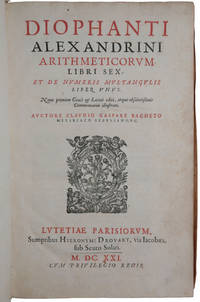
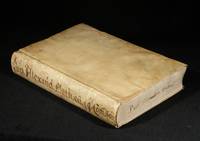
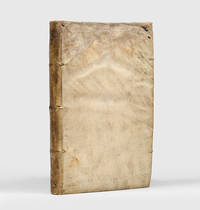
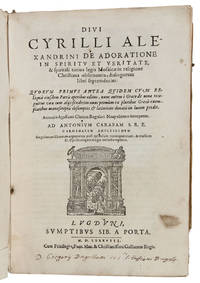
16216237Paris: Hieronymus Drouart 1621. First edition. <p>First edition of the Greek text extremely rare large-paper copy of the foundational work of algebra - the edition that Pierre de Fermat acquired in the mid-1630s and annotated with the forty-eight marginal observations that are the founding documents of modern number theory. Fermat's copy is lost; these are the sheets from the same Paris setting that he had in front of him. Claude Gaspard Bachet de Méziriac a country gentleman of Bas-Quercy whose entry into number theory had come through his 1612 Problèmes plaisants spent several years establishing a corrected Greek text improving Xylander's 1575 Latin translation filling the lacunae correcting errors and generalising Diophantus's procedures; his edition remained standard until Tannery's Teubner text of 1893-1895. Against Problem II.8 at page 85 - on the decomposition of a square into two squares - Fermat wrote the proposition now known as Fermat's Last Theorem closed by Andrew Wiles in 1995 three hundred and fifty-eight years after the margin.</p>. Editio Princeps of the First Systematic Treatise on Algebra. <p>First edition of the Greek text extremely rare large-paper copy of the foundational work of algebra and the book in whose margins Pierre de Fermat wrote the most celebrated annotations in the history of mathematics. Before this volume appeared from the Paris press of Hieronymus Drouart in 1621 the Arithmetica of Diophantus of Alexandria existed in print only in Latin: in Wilhelm Holzmann's pioneering but rough 1575 Basel translation - its translator who hellenized his name as Xylander was a humanist who had taken up algebra as a hobby - and in the partial adaptations Rafael Bombelli had incorporated into his 1572 Algebra after reading a Greek manuscript in the Vatican Library. Claude Gaspard Bachet de Méziriac a country gentleman of Bas-Quercy extraction with classical tastes and no professional mathematical training had come to number theory through mathematical recreations - the puzzles of the Greek Anthology and the Renaissance tradition of mathematical amusement that he had collected in his Problèmes plaisants et délectables qui se font par les nombres Lyon 1612 - and from there to Diophantus. He spent several years before 1621 establishing a corrected Greek text improving Xylander's Latin translation where Xylander had failed to understand his source filling the lacunae of the defective archetype from which all surviving manuscripts descend identifying and correcting numerical errors generalising Diophantus's procedures and appending three books of his own Porismata. The result is both the editio princeps of the Greek text and the standard scholarly edition unsurpassed until Paul Tannery's Teubner Diophantus of 1893-1895 and the single most consequential textual achievement in the early-modern reception of Greek mathematics.</p> <br /> <br /> <p>The copy offered here preserves the edition in its most ambitious form. Ordinary copies of the 1621 Bachet measure approximately 337 by 218 millimetres; this copy measures 353 by 225 placing it squarely within the small large-paper issue that Drouart ran alongside the ordinary impression. It is bound in its original yapped vellum the overhanging edges still intact and flexible; the edges of the text block are sprinkled red in the French manner of the early seventeenth century; the spine carries a handwritten manuscript title in Greek and Latin - Diophanti Alexandreos Arithmetikon kai peri polygonon arithmon bibl. followed by cum Commentariis Cl. Gasp. Bacheti - in a plainly contemporary hand the vellum itself serving as the label. The sheets are fresh crisp and unpressed. The title page printed in red and black carries a fine engraved vignette of a flowering thistle within an oval frame a cherub at either side of the cartouche and two satyrs at the base among fruits and foliage surrounded by the dividing mottoes si frote patere aut and ne tan abstine. Two imprints of the 1621 edition were issued simultaneously one under the name of Hieronymus Drouart sub Scuto Solari and one under the name of Sébastien Cramoisy identical in every other respect; the sheets are from the same setting and no priority between the two has been established. The present copy is the Drouart imprint.</p> <br /> <br /> <p>The Arithmetica itself is the foundational work of Greek algebra. Of the thirteen books that Diophantus's introduction - addressed to one Dionysius arguably Saint Dionysius of Alexandria - promises the Byzantine tradition preserved six in Greek and those are the books printed here. A ninth-century Arabic translation by QustÄ ibn LÅ«qÄ supplying four further books was discovered by Jacques Sesiano in the Astan-i Quds library at Meshed Iran in 1968 - one of the great manuscript finds of the twentieth century. The consensus that has emerged from Sesiano's edition is that the Arabic books correspond to Diophantus's original Books IV through VII and that the six preserved Greek books must be renumbered as Books I through III and after a lacuna Books VIII through X; Books XI through XIII are irretrievably lost. What Bachet had before him in 1621 and what Fermat in his turn would read and annotate was therefore the Byzantine six-book corpus: 189 problems in indeterminate analysis closing with a fragment on the theory of polygonal numbers cast in the older geometrical idiom.</p> <br /> <br /> <p>The introduction explains Diophantus's symbolism which is the first and only occurrence of algebraic notation anywhere in surviving Greek mathematics. He uses abbreviated signs for the unknown quantity corresponding to the modern x and for its powers up to the sixth for subtraction and for equality. The symbols are scribal abbreviations rather than arbitrary conventions but they function as an effective algebraic language intermediate between the purely verbal mathematics of his Greek predecessors and the fully symbolic algebra that would emerge in the sixteenth century with Viète and in the seventeenth with Descartes. Diophantus teaches the multiplication of positive and negative terms and the reduction of an equation to one with only positive terms - the standard form preferred in antiquity which treats negative coefficients as impermissible answers to be moved across the equals sign rather than as legitimate quantities in their own right. Throughout the work he uses the word arithmos rendered by Bachet as numerus to mean what would now be called a positive rational; negative and irrational solutions are never acknowledged.</p> <br /> <br /> <p>The Arithmetica is a collection of approximately two hundred and sixty problems in what is now called indeterminate analysis - the search for rational solutions to polynomial equations that have more unknowns than equations and that therefore admit in general infinitely many solutions to be found by ingenuity rather than algorithm. The problems of Book I are mostly simple illustrations of the algebraic reckoning that Diophantus has just established. The distinctive features of his method emerge in Books II and III which became the seedbed of modern number theory. In three problems of Book II - the first of them the celebrated Problem II.8 on dividing a given square into two squares whose rational solutions are the Pythagorean triples - Diophantus shows how to represent any given square as a sum of two rational squares; any given non-square that is itself the sum of two known squares as a sum of two other squares; and any given rational number as the difference of two squares. The second of these problems presupposes knowledge of one decomposition hinting that not every integer admits such a decomposition - a question Diophantus later addresses by giving the correct necessary condition: the number must not contain a prime factor of the form 4n 3 raised to an odd power. Diophantus states this condition without proof. It was taken up by Fermat proved by Euler and generalised by Gauss into the representation theory that occupies more than half of the Disquisitiones Arithmeticae.</p> <br /> <br /> <p>The Arabic books although not available to Bachet confirm the architecture of Diophantus's project as Bachet had intuited it. Their prefaces state that their purpose is to provide the reader with experience and skill and they extend the basic methods of Books I through III to problems of higher degree reducible to binomial equations. The former Greek Books IV and V now Books VIII and IX solve more demanding problems: one decomposes a given integer into two squares arbitrarily close to each other; another decomposes an integer into three squares excluding the impossible case of integers of the form 8n 7 - a result Diophantus asserts but does not prove and that would not be proved until the eighteenth century. The former Book VI now Book X treats right-angled triangles with rational sides subject to various further conditions. The work closes with a fragment of a separate treatise on polygonal numbers - those that can be arranged as regular polygons of dots: triangular numbers nn 1/2 the squares the pentagonals n3n − 1/2 and so on - differentiated from the Arithmetica proper by its use of geometrical proofs rather than algebraic methods and breaking off in the middle of an investigation of how many ways a given integer can be a polygonal number.</p> <br /> <br /> <p>The textual transmission of the Arithmetica is itself a chapter in the history of the book. In Byzantium where the Greek archetype was preserved Michael Psellus in the eleventh century saw what was perhaps the only surviving copy; Georgius Pachymeres 1240-1310 wrote a paraphrase of Book I; Maximus Planudes c. 1255-1310 wrote a commentary on Books I and II. Cardinal Bessarion rescued the manuscript from Constantinople before its fall in 1453 and Regiomontanus discovered it at Venice about 1463 proposing to make a Latin translation that he never produced. For a century thereafter nothing further was heard of Diophantus. He was rediscovered by Rafael Bombelli 1526-1572 the engineer from Bologna whose day job was draining the Chiana marshes and who read a Greek manuscript of the Arithmetica in the Vatican Library about 1570 translated most of it into Italian for his own use and incorporated one hundred and forty-seven of its problems eighty-one with the same numerical values into his Algebra of 1572 - the book that introduced complex numbers into European mathematics and that Bombelli substantially revised before publication as a consequence of his encounter with Diophantus. Three years later the first complete Latin translation by Wilhelm Xylander appeared at Basel; it was the basis for a free French rendering of the first four books by Simon Stevin 1585. Viète drew thirty-four problems from Diophantus for his Zetetica of 1593 restricting himself to those that did not violate his principle of homogeneity of dimension.</p> <br /> <br /> <p>Bachet's 1621 edition superseded every one of these earlier engagements. He studied the text with a thoroughness that no mere philologist could have equalled: Xylander had all too often failed to make sense of corrupt passages where Bachet succeeded because Bachet could read the mathematics as well as the Greek. He filled lacunae identified and corrected the numerical errors that earlier scribes and Xylander after them had introduced generalised the procedures and devised new problems continuing Diophantus's programme. His great critic and admirer André Weil whose Number Theory: An Approach through History from Hammurapi to Legendre Birkhäuser 1984 remains the standard scholarly account observed that Samuel Fermat's praise of Bachet in the preface to the 1670 reprint was by no means excessive and that Bachet's apparent disadvantage - his imperfect grasp of the new symbolic algebra of Viète - may actually have benefited number theory in the end. Because he could not readily translate Diophantus into the algebraic language then emerging Bachet laid emphasis on those aspects of the text that were most properly arithmetical and prominently among these on questions regarding the decomposition of integers into sums of squares. It was Bachet who asked for the conditions under which an integer is a sum of two or of three squares and who extracted from Diophantus the conjecture that every integer is a sum of four squares and asked for a proof. The questions passed directly to Fermat and through Fermat to Euler Lagrange and Gauss.</p> <br /> <br /> <p>Fermat acquired his copy of the Bachet Diophantus in the mid-1630s probably through the circle of Carcavi and Mersenne in Paris. Over the course of his long judicial career at Toulouse and Castres he annotated it with forty-eight marginal observations each written against a particular problem in Bachet's text that together constitute the founding documents of modern number theory. They include the two-square theorem which states that every prime congruent to one modulo four is the sum of two squares in essentially one way; the conjecture later proved by Lagrange that every integer is the sum of four squares; Fermat's Little Theorem that for any prime p and any integer a not divisible by p the quantity a raised to the power p − 1 is congruent to one modulo p; the method of infinite descent as a rigorous technique for negative existence proofs; and - written in the margin of Problem II.8 at page 85 of this edition adjacent to Diophantus's treatment of the decomposition of a square into two squares - the claim that no cube can be decomposed into two cubes no fourth power into two fourth powers and in general no power higher than the second into two powers of the same kind together with the famous remark that he had discovered a truly marvellous proof of this proposition which the narrowness of the margin could not contain. The proposition is Fermat's Last Theorem. It resisted proof for three hundred and fifty-eight years until Andrew Wiles closed it in a one-hundred-page paper in the Annals of Mathematics in 1995 using techniques - the theory of modular forms the arithmetic of semistable elliptic curves the Galois representations emerging from the Langlands programme - that Fermat could not have envisaged. Fermat's annotated copy the physical object on which he wrote those forty-eight notes has been lost for over three centuries; its contents survive because Clément-Samuel de Fermat working from his father's papers in the years after the elder Fermat's death in 1665 transcribed the observations and printed each at the appropriate point in Bachet's text in the 1670 Toulouse reprint the companion item in the present catalogue. Every surviving copy of the 1621 Bachet therefore bears in a material sense the weight of Fermat's missing copy: these are the sheets from the same setting of the same edition in the same Greek and Latin and with the same commentary against which Fermat was reading and writing.</p> <br /> <br /> <p>The decisive turn in the reception of Fermat's programme came a century after his death when Leonhard Euler produced the proof of the Last Theorem for exponent three in 1770 invoking the method of descent Fermat had developed for other purposes. Sophie Germain in the first decade of the nineteenth century opened a substantial class of exponents; Dirichlet and Legendre settled exponent five in 1825; Kummer's introduction of ideal numbers in the 1840s addressed to the failure of unique factorisation in the relevant cyclotomic integers founded algebraic number theory and proved Fermat's proposition for all regular primes. By the late nineteenth century the Last Theorem had become the most celebrated unsolved problem in mathematics and the whole of twentieth-century algebraic number theory and arithmetic geometry can be read as a cumulative response to the challenge Fermat set down in the margin of a page that is printed in this very edition. The two-square theorem the four-square theorem the little theorem and the sum of three triangular numbers all passed through similar cycles of Fermat's claim delayed demonstration and subsequent theoretical elaboration - and each of them like the Last Theorem itself began its public life as a marginal note in Fermat's copy of Bachet's 1621 Diophantus.</p> <br /> <br /> <p>The Arab reception of Diophantus although largely lost is documented by bibliographical sources that Bachet could not have known. Al-NadÄ«m's Fihrist of 987/988 records that QustÄ ibn LÅ«qÄ c. 900 wrote a commentary on three and a half books of the Arithmetica and that AbÅ«'l-WafÄ' 940-998 wrote both a commentary and a book of proofs of the propositions Diophantus had used; a commentary by Ibn al-Haytham with marginal notations by Ibn YÅ«nus is also attested but has not survived. The most substantial surviving witness to the Arab Diophantus is the algebra of al-KarajÄ« in early eleventh-century Baghdad which absorbed a third of the problems from Diophantus's Book I all the problems from Book II beginning with II.8 and almost all of Book III. In the Latin West problems of Diophantine type first appeared in Leonardo of Pisa's Liber Abbaci of 1202 transmitted from Arabic sources during Leonardo's journeys around the Mediterranean. The long chain from the lost Greek archetype through Byzantium Venice Rome Basel and Paris to the copies of Bachet's 1621 edition that passed into the working libraries of seventeenth-century mathematicians is reconstructed here in a single volume.</p> <br /> <br /> <p>Bachet himself having seen the Arithmetica through the press in 1621 retired to his country estate married and apparently gave up all mathematical activity beyond a second edition of his Problèmes plaisants that incorporated material originally intended for a treatise on arithmetic which he never wrote. He died in 1638 three years before his election to the Académie française and a generation before his work would reach its full consequence through Fermat's marginalia. Almost nothing is known about the life of Diophantus himself. He quotes Hypsicles fl. c. 150 BC and is quoted by Theon of Alexandria c. AD 364 and a date around AD 250 is generally accepted; that would place him in late Hellenistic Alexandria at the chronological edge of the tradition of Greek mathematical creativity that had begun with Thales. The Byzantine epigram that gives his age at death as eighty-four extrapolated from a series of Diophantine conditions on the years of his boyhood youth marriage and the birth and death of his son is textually reliable but biographically useless. What survives of him is the mathematics.</p> <br /> <br /> <p>The book's working life in the seventeenth and early eighteenth centuries can be measured by the hands through which it passed. Isaac Newton owned a copy Harrison 524 now at Trinity College Cambridge and referred to Diophantus in his mathematical notebooks. Leibniz studied the work. Euler began his revival of Fermat's number-theoretic programme in the 1730s by working through the Observationes in the 1670 reprint of precisely this edition. The continuous research that culminated in Gauss's Disquisitiones Arithmeticae of 1801 and from there in the whole nineteenth-century elaboration of algebraic and analytic number theory runs back through Euler and Lagrange to Fermat's marginalia and through Fermat's marginalia to Bachet's 1621 printing of the Greek text. Large-paper copies such as the one offered here were produced in small numbers - probably as presentation copies for Bachet's dedicatees and for purchase by serious mathematicians who wanted the generous margins for their own annotations. The sheets of this copy are unpressed and the state of preservation exceptional; the contemporary yapped vellum binding with its handwritten Greek and Latin spine title in a seventeenth-century hand is the same working binding in which the volume left the Paris trade in 1621.</p> <br /> <br /> <p>References: Honeyman 891 - Smith Rara Arithmetica pp. 348 and 368 - Brunet II 702 - Weil Number Theory: An Approach through History from Hammurapi to Legendre Birkhäuser 1984 chapters I-III - Heath Diophantus of Alexandria: A Study in the History of Greek Algebra Cambridge second edition 1910; Dover reprint 1964 - Sesiano Books IV to VII of Diophantus' Arithmetica in the Arabic Translation attributed to QustÄ ibn LÅ«qÄ Springer 1982 - Bashmakova Diophantus and Diophantine Equations Mathematical Association of America 1997 - Mahoney The Mathematical Career of Pierre de Fermat Princeton University Press second edition 1994 - Goldstein Un théorème de Fermat et ses lecteurs Presses Universitaires de Vincennes 1995 - Singh Fermat's Enigma Fourth Estate 1997 - Wiles 'Modular elliptic curves and Fermat's Last Theorem' Annals of Mathematics 141 1995 pp. 443-551.</p> <br /> <br/> <br/> <br /> <p>Folio 353 × 225 × 40 mm pp. 12 32 451 1 blank 58 2 errata. Title printed in red and black with large engraved allegorical vignette flowering thistle within oval cartouche cherubs above and satyrs below mottoes si frote patere aut and ne tan abstine. Greek and Latin in parallel columns throughout the Arithmetica. Woodcut historiated initials. Book headings in large capitals Greek capitals for the Greek heads. Separate signatures and pagination for Bachet's Porismatum libri tres pp. 1-32 and for the polygonal numbers fragment pp. 1-58 at the end followed by two leaves of errata. Contemporary yapped vellum the overhanging edges intact edges of the text block sprinkled red handwritten manuscript title on the spine in Greek and Latin in a period hand directly on the vellum. A fine crisp fresh unpressed copy with the full generous margins of the large-paper issue. The Drouart imprint; the Cramoisy imprint issued simultaneously from the same sheets differs only in the bookseller's name on the title page and no priority between the two has been established.</p> . Hieronymus Drouart unknown
15885234Pesaro: Girolamo Concordia 1588. <p>First edition of Pappus' Collection translated with commentary by Federico Commandino a princely copy from the notable collection of the great Papal family and patrons of learning the Piccolomini Dukes of Amalfi thence by marriage to the German nobleman von Troilo. The Collection is "by far the most important of Pappus' works . without it much of the geometrical achievement of his predecessors would have been lost forever" DSB.</p>. GREEK GEOMETRY - A CRUCIAL INFLUENCE ON DESCARTES. <p>First edition of Pappus' Collection translated with commentary by Federico Commandino a princely copy from the notable collection of the great Papal family and patrons of learning the Piccolomini Dukes of Amalfi thence by marriage to the German nobleman von Troilo. The Collection is "by far the most important of Pappus' works . without it much of the geometrical achievement of his predecessors would have been lost forever . The Collection deals with the whole body of Greek geometry mostly in the form of commentaries on texts which it is assumed the reader has to hand. It reproduces known solutions to problems in geometry; but it also frequently gives Pappus' own solutions or improvements and extensions to existing solutions. Thus Pappus handles the problem of inscribing five regular solids in a sphere in a way quite different from Euclid; gives a broader generalization than Euclid to the famous Pythagorean theorem and provides a demonstration of squaring the circle which is quite different from the method of Archimedes who used a spiral or that of Nicomedes who used the conchoid.<br /> Perhaps the most interesting part of the Collection measured by its influence on modern mathematics is Book VII which is concerned with the problems of determining the locus with respect to three four five six or more than six lines. Pappus' work in this field was called 'Pappus' problem' by René Descartes who demonstrated that the difficulties which Pappus was unable to overcome could be got round by the use of his new algebraic symbols. Pappus thus came to play an important if minor role in the founding of Cartesian analytical geometry. And it is another mark of his originality and skill that he spent much time working on the problem of drawing a circle in such a way that it will touch three given circles a problem sophisticated enough to engage the interest centuries later of both François Viète and Isaac Newton. For his own originality even if his chief importance is as the preserver of Greek scientific knowledge Pappus stands with Diophantus as the last of the long and distinguished line of Alexandrian mathematicians" Hutchinson Dictionary of Scientific Biography. "He formally defined analysis and synthesis as they are still commonly applied in the solution of geometrical riders. Pappus stumbled upon the projective invariance of the cross-ratio of four collinear points and other related results reclaimed by modern projective geometry; and he gave the first recorded statement of the focus-directrix property of the three conic sections. He formulated the 'centrobaric' theorems frequently attributed to Paul Guldin 1577-1643 for calculating the volume and surface generated by a plane figure rotating about an axis in its own plane. He discussed theoretical mechanics the equilibrium of a heavy body on an inclined plane the use of the mechanical powers and the construction of mechanical toys" Biographical Dictionary of Scientists.</p> <br /> <p>Provenance: Ex libris inscription of Princess Maria Piccolomini and signature of Count Franz Gottfried von Troilo on title; shelfmark on front free endpaper.</p> <br /> <p>Pappus of Alexandria c.  290 - c.  350 AD was the most important mathematical author writing in Greek during the later Roman Empire. Other than that he was born at Alexandria in Egypt and that his career coincided with the first three decades of the 4th century AD little is known about his life.</p> <br /> <p>"In the silver age of Greek mathematics Pappus stands out as an accomplished and versatile geometer. His treatise known as the Synagoge or Collection is a chief and sometimes the only source for our knowledge of his predecessors' achievements. The Collection is in eight books perhaps originally in twelve of which the first and part of the second are missing . The several books of the Collection many well have been written as separate treatises at different dates and later brought together as the name suggests . A. Rome concludes that the Collection was put together about AD 340 but K. Ziegler states that . the Collection may have been compiled soon after AD 320. It has come down to us from a single twelfth-century manuscript Codex Vaticanus Graecus 218 from which all the other manuscripts are derived .</p> <br /> <p>"The portion of book II that survives beginning with proposition 14 expounds Apollonius' system of large numbers expressed as powers of 10000. It is probable that book I was also arithmetical.</p> <br /> <p>"Book III is in four parts. The first part deals with the problem of finding two mean proportionals between two given straight lines the second develops the theory of means the third sets out some 'paradoxes' of an otherwise unknown Erycinus and the fourth treats of the inscription of the five regular solids in a sphere but in a manner quite different from that of Euclid in his Elements XIII. 13-17.</p> <br /> <p>"Book IV is in five sections. The first section is a series of unrelated propositions of which the opening one is a generalization of Pythagoras' theorem even wider than that found in Euclid VI.31 . The second section deals with circles inscribed in the figure known as the άÏβηλος or 'shoemaker's knife.' It is formed when the diameter AC of a semicircle ABC is divided in any way at E and semicircles ADE EFC are erected. The space between these two semicircles and the semicircle ABC is the άÏβηλος. In a series of elegant theorems Pappus shows that if a circle with center G is drawn so as to touch all three semicircles and then a circle with center H to touch this circle and the semicircles ABC ADE and so on ad infinitum then the perpendicular from G to AC is equal to the diameter of the circle with center G the perpendicular from H to AC is double the diameter of the circle with center H the perpendicular from K to AC is triple the diameter of the circle with center K and so on indefinitely. Pappus records this as 'an ancient proposition' and proceeds to give variants. This section covers as particular cases propositions in the Book of Lemmas that Arabian tradition attributes to Archimedes.</p> <br /> <p>"In the third section Pappus turns to the squaring of the circle. He professes to give the solutions of Archimedes by means of a spiral and of Nicomedes by means of the conchoid and the solution by means of the quadratrix but his proof is different from that of Archimedes. To the traditional method of generating the quadratrix Pappus adds two further methods 'by means of surface loci' that is curves drawn on surfaces. As a digression he examines the properties of a spiral described on a sphere.</p> <br /> <p>"The fourth section is devoted to another famous problem in Greek mathematics the trisection of an angle. Pappus' first solution is by means of a νευσις or verging-the construction of a line that has to pass through a certain point-which involves the use of a hyperbola. He next proceeds to solve the problem directly by means of a hyperbola in two ways; on one occasion he uses the diameter-and-ordinate property as in Apollonius and on another he uses the focus-directrix property. This property is proved in book VII. Pappus then reproduces the solutions by means of the quadratrix and the spiral of Archimedes; he also gives the solution of νευσις which he believes Archimedes to have unnecessarily assumed in On Spirals proposition 8.</p> <br /> <p>"In the preface to book V which deals with isoperimetry Pappus praises the sagacity of bees who make the cells of the honeycomb hexagonal because of all the figures which can be fitted together the hexagon contains the greatest area. The literary quality of this preface has been warmly praised. Within the limits of his subject Pappus looks back to the great Attic writers from a world in which Greek had degenerated into Hellenistic. In the first part of the book Pappus appears to be reproducing Zenodorus fairly closely; in the second part he compares the volumes of solids that have equal surfaces. He gives an account of thirteen semiregular solids discovered and discussed by Archimedes but not in any surviving works of that mathematician that are contained by polygons all equilateral and equiangular but not all similar. He then shows following Zenodorus that the sphere is greater in volume than any of the regular solids that have surfaces equal to that of the sphere. He also proves independently that of the regular solids with equal surfaces that solid is greater which has the more faces.</p> <br /> <p>"Book VI is astronomical and deals with the books in the so-called Little Astronomy-the smaller treatises regarded as an introduction to Ptolemy's Syntaxis Almagest. In magisterial manner he reviews the works of Theodosius Autolycus Aristarchus and Euclid and he corrects common misrepresentations. In the section on Euclid's Optics Pappus examines the apparent form of a circle when seen from a point outside the plane in which it lies.</p> <br /> <p>"Book VII is the most fascinating in the whole Collection not merely by its intrinsic interest and by what it preserves of earlier writers but by its influence on modern mathematics. It gives an account of the following books in the so-called Treasury of Analysis those marked by an asterisk are lost works: Euclid's Data and Porisms Apollonius' Cutting Off of a Ratio Cutting Off of an Area Determinate Section TangenciesInclinationsPlane Loci and Conics. In his account of Apollonius' Conics Pappus makes a reference to the 'locus with respect to three or four lines' a conic section. He also adds a remarkable comment of his own. If he says there are more than four straight lines given in position and from a point straight lines are drawn to meet them at given angles the point will lie on a curve that cannot yet be identified. If there are five lines and the parallelepiped formed by the product of three of the lines drawn from the point at fixed angles bears a constant ratio to the parallelepiped formed by the product of the other two lines drawn from the point and a given length the point will be on a certain curve given in position. If there are six lines and the solid figure contained by three of the lines bears a constant ratio to the solid figure formed by the other three then the point will again lie on a curve given in position. If there are more than six lines it is not possible to conceive of solids formed by the product of more than three lines but Pappus surmounts the difficulty by means of compounded ratios. If from any point straight lines are drawn so as to meet at a given angle any number of straight lines given in position and the ratio of one of those lines to another is compounded with the ratio of a third to a fourth and so on or the ratio of the last to a given length if the number of lines is odd and the compounded ratio is a constant then the locus of the point will be one of the higher curves .</p> <br /> <p>"In 1631 Jacob Golius drew the attention of Descartes to this passage in Pappus and in 1637 'Pappus' problem' as Descartes called it formed a major part of his Géométrie. Descartes begins his work by showing how the problems of conceiving the product of more than three straight lines as geometrical entities which so troubled Pappus can be avoided by the use of his new algebraic symbols. He shows how the locus with respect to three or four lines may be represented as an equation of degree not higher than the second that is a conic section which may degenerate into a circle or straight line. Where there are five six seven or eight lines the required points lie on the next highest curve of degree after the conic sections that is a cubic; if there are nine ten eleven or twelve lines on a curve one degree still higher that is a quartic and so on to infinity. Pappus' problem thus inspired the new method of analytical geometry that has proved such a powerful tool in subsequent centuries.</p> <br /> <p>"In his Principia 1687 Newton also found inspiration in Pappus; he proved in a purely geometrical manner that the locus with respect to four lines is a conic section which may degenerate into a circle .</p> <br /> <p>"Pappus observes that the study of these curves had not attracted men comparable to the geometers of previous ages. But there were still great discoveries to be made and in order that he might not appear to have left the subject untouched Pappus would himself make a contribution. It turns out to be nothing less than an anticipation of what is commonly called 'Guldin's theorem.' Only the enunciations however were given which state:</p> <br /> <p>'Figures generated by complete revolutions of a plane figure about an axis are in a ratio compounded a of the ratio of the areas of the figures and b of the ratio of the straight lines similarly drawn to sc. drawn to meet at the same angles the axes of rotation from the respective centers of gravity. Figures generated by incomplete revolutions are in a ratio compounded a of the ratio of the areas of the figures and b of the ratio of the arcs described by the respective centers of gravity; it is clear that the ratio of the arcs is itself compounded 1 of the ratio of the straight lines similarly drawn from the respective centers of gravity to the axis of rotation and 2 of the ratio of the angles contained about the axes of rotation by the extremities of these straight lines.'</p> <br /> <p>"Pappus concludes this section by noting that these propositions which are virtually one cover many theorems of all kinds about curves surfaces and solids 'in particular those proved in the twelfth book of these elements.' This implies that the Collection originally ran to at least twelve books.</p> <br /> <p>"Pappus proceeds to give a series of lemmas to each of the books he has described except Euclid's Data presumably with a view to helping students to understand them. He was half a millennium from Apollonius and elucidation was probably necessary. It is mainly from these lemmas that we can form any knowledge of the contents of the missing works and they have enabled mathematicians to attempt reconstructions of Euclid's Porisms and Apollonius' Cutting Off of an Area Plane Loci Determinate Section Tangencies and Inclinations. It is from Pappus' lemmas that we can form some idea of the eighth book of Apollonius' Conics" DSB.</p> <br /> <p>Adams P223; Pietro and Bonelli Catalogo della Biblioteca Mediceo-Lorense 151; Riccardi I 364 11.</p> <br/> <br/> Folio 307 x 204 mm ff. 4 including blank 334 recte 332 with woodcut printer's device on title several historiated woodcut initials and numerous woodcut diagrams in text small wormhole through blank area of last two leaves. Contemporary German half-pigskin over yellow boards pigskin dyed rose pink somewhat faded small split in upper joint and small wormhole in lower board with blind floral rolls gilt silver arms of Count Franz Gottfried von Troilo on upper cover and a phoenix surrounded by flames within a wreath on lower cover. A fine clean crisp copy. Girolamo Concordia unknown
147766848One of the Earliest Examples of a Venetian Woodcut Border APPIAN OF ALEXANDRIA. Historia romana. And: De bellis civilibus. Venice: Bernard Maler Pictor Erhard Ratdolt and Peter Lˆslein 1477. First complete edition of AppianÃs Roman history De bellis civilibus had been printed by Vindelinus de Spira in 1472. Two parts in one volume. Large quarto 11 1/4 x 8 1/8 inches; 286 x 206 mm. 131 of 132 lacks initial blank; 212 leaves. Roman type thirty-two lines printed marginalia. Two full-page white-vine woodcut title borders the first use of each border five- and nine-line white-on-black woodcut initials all hand-colored in this copy. Ruled in red throughout headlines supplied in red some paragraph marks supplied in red and blue. Early ink pagination in lower margin. The lower part of c1 verso and all of c2 recto have been left blank intentionally to correspond with a lacuna of one folio in AppianÃs manuscript with a printed marginal note to that effect. Modern antique-style vellum over boards. Gilt spine with brown morocco label. The binding is signed: ìBound for William Brown Edinburgh.î Leaf a2 reinforced at gutter. Recto of first leaf and verso of last leaf soiled some dampstains and light foxing or spotting. Three repaired tears in gutter of final leaf. From the Library of John A. Saks with his bookplate. Early ink signature in armorial medallion of Part I title border: ìRober/ti Koe/nigsman/ni/1627/12 Cal./April.î Effaced arms on Part II title border. Overall an excellent copy. An excellent copy of the third book from RatdoltÃs press at Venice. These volumes represent the earliest example of the use of a fully-developed woodcut border in a Venetian book. RatdoltÃs first border a three-sided simple black-on-white title designed for the Calendarium of 1476 is composed of fairly conventional plants growing out of vases. The borders for the Historia romana and De bellis civilibus by contrast are scrolling white vines and acanthus leaves full and lush black-on-white in some copies red-on-white with a medallion for the ownerÃs arms in the lower edge. RatdoltÃs initial letters which replaced the illuminated or rubricated initials are also of the utmost importance in the history of book-decoration see Hind A History of Woodcut II pp. 459-462. BMC V p. 244. Goff A-928. GW 2290. Hain 1307. Polain 284. Proctor 4367 4368. HBS 66848. $25000 Bernard Maler, Erhard Ratdolt and Peter Lˆslein hardcover books
399Numerous woodcut illus. & diagrams in the text. 4 p.l. the last a blank 334 i.e. 332 pp. Folio cont. limp vellum title a bit soiled last two leaves with some light dampstaining ties gone. Pesaro: H. Concordia 1588. First edition and a very fine and fresh copy of this uncommon book; this edition providing the complete extant text was the final work to be edited by Commandino and completes his life's work of reviving Renaissance mathematics by making available the best mathematical writings of antiquity. "In the silver age of Greek mathematics Pappus stands out as an accomplished and versatile geometer. His treatise known as the Synagoge or Collection is a chief and sometimes the only source for our knowledge of his predecessors' achievements. The Collection is in eight books perhaps originally in twelve of which the first and part of the second are missing. "Book VII is the most fascinating in the whole Collection not merely by its intrinsic interest and by what it preserves of earlier writers but by its influence on modern mathematics."D.S.B. X p. 293-95and see pp. 294-98 for a full discussion of the contents. This concerns in a passage on Apollonius' Conics the attempt to conceive of the product of more than three straight lines as geometrical entities known as "Pappus' Problem." Descartes devoted a major part of his own Géométrie to this and solved it by the use of algebraic notation. "Pappus' problem thus inspired the new method of analytical geometry that has proved such a powerful tool in subsequent centuries. In his Principia 1687 Newton also found inspiration in Pappus; he proved in a purely geometrical manner that the locus with respect to four lines is a conic section which may degenerate into a circle."D.S.B. X p. 296. Topics discussed in the other books include astronomy and mechanics. A very fine copy preserved in a green morocco-backed box. Rose The Italian Renaissance of Mathematics p. 214"Within 25 years of Commandino's death the first step in founding the mechanics of the seventeenth century was to be taken by Galileo when in criticising the inclined plane theorem of Pappus the Tuscan mathematician adumbrated the notion of inertia. This step was not taken in an intellectual vacuum but represents the culmination of the mathematical renaissance that had been achieved by the Restauratores."& see the whole of Chap. 9 for Commandino and this book. Smith History of Mathematics I pp. 136-37. hardcover books
15883991588. Numerous woodcut illus. & diagrams in the text. 4 p.l. the last a blank 334 i.e. 332 pp. Folio cont. limp vellum title a bit soiled last two leaves with some light dampstaining ties gone. Pesaro: H. Concordia 1588.<br/> <br/> First edition and a very fine and fresh copy of this uncommon book; this edition providing the complete extant text was the final work to be edited by Commandino and completes his life's work of reviving Renaissance mathematics by making available the best mathematical writings of antiquity. <br/> <br/> "In the silver age of Greek mathematics Pappus stands out as an accomplished and versatile geometer. His treatise known as the Synagoge or Collection is a chief and sometimes the only source for our knowledge of his predecessors' achievements. The Collection is in eight books perhaps originally in twelve of which the first and part of the second are missing. <br/> <br/> "Book VII is the most fascinating in the whole Collection not merely by its intrinsic interest and by what it preserves of earlier writers but by its influence on modern mathematics."D.S.B. X p. 293-95and see pp. 294-98 for a full discussion of the contents. <br/> <br/> This concerns in a passage on Apollonius' Conics the attempt to conceive of the product of more than three straight lines as geometrical entities known as "Pappus' Problem." Descartes devoted a major part of his own Géométrie to this and solved it by the use of algebraic notation. "Pappus' problem thus inspired the new method of analytical geometry that has proved such a powerful tool in subsequent centuries. In his Principia 1687 Newton also found inspiration in Pappus; he proved in a purely geometrical manner that the locus with respect to four lines is a conic section which may degenerate into a circle."D.S.B. X p. 296. <br/> <br/> Topics discussed in the other books include astronomy and mechanics. <br/> <br/> A very fine copy preserved in a green morocco-backed box. <br/> <br/> Rose The Italian Renaissance of Mathematics p. 214"Within 25 years of Commandino's death the first step in founding the mechanics of the seventeenth century was to be taken by Galileo when in criticising the inclined plane theorem of Pappus the Tuscan mathematician adumbrated the notion of inertia. This step was not taken in an intellectual vacuum but represents the culmination of the mathematical renaissance that had been achieved by the Restauratores."& see the whole of Chap. 9 for Commandino and this book. Smith History of Mathematics I pp. 136-37. unknown
15882080Pesaro: Girolamo Concordia 1588. First edition. original boards. Very Good. FIRST EDITION of arguably the most important source book for the works of the Greek mathematicians. The magnificent Horblit copy in contemporary probably original boards. Pappus of Alexandria fl 320AD was "the most important mathematical author writing in Greek during the later Roman Empire known for his Synagoge "Collection" a voluminous account of the most important work done in ancient Greek mathematics. Pappus seldom claimed to present original discoveries but he had an eye for interesting material in his predecessors' writings many of which have not survived outside of his work. As a source of information concerning the history of Greek mathematics he has few rivals." Pappus's principal work "was the Synagoge c. 340 a composition in at least eight books corresponding to the individual rolls of papyrus on which it was originally written. The only Greek copy of the Synagoge to pass through the Middle Ages lost several pages at both the beginning and the end; thus only Books 3 through 7 and portions of Books 2 and 8 have survived. A complete version of Book 8 does survive however in an Arabic translation. Book 1 is entirely lost along with information on its contents. Such a range of topics is covered that the Synagoge has with some justice been described as a mathematical encyclopedia. "The Synagoge deals with an astonishing range of mathematical topics; its richest parts however concern geometry and draw on works from the 3rd century BC the so-called Golden Age of Greek mathematics. The longest part of the Synagoge Book 7 is Pappus's commentary on a group of geometry books by Euclid Apollo Eratosthenes of Cyrene and Aristaeus collectively referred to as the "Treasury of Analysis." "Analysis" was a method used in Greek geometry for establishing the possibility of constructing a particular geometric object from a set of given objects. The analytic proof involved demonstrating a relationship between the sought object and the given ones such that one was assured of the existence of a sequence of basic constructions leading from the known to the unknown rather as in algebra. The books of the "Treasury" according to Pappus provided the equipment for performing analysis. With three exceptions the books are lost and hence the information that Pappus gives concerning them is invaluable. "Pappus's Synagoge first became widely known among European mathematicians after 1588 when a posthumous Latin translation by Federico Commandino was printed in Italy. For more than a century afterward Pappus's accounts of geometric principles and methods stimulated new mathematical research and his influence is conspicuous in the work of René Descartes 1596-1650 Pierre de Fermat 1601-1665 and Isaac Newton 1642 Old Style-1727 among many others. As late as the 19th century his commentary on Euclid's lost Porisms in Book 7 was a subject of living interest for Jean-Victor Poncelet 1788-1867 and Michel Chasles 1793-1880 in their development of projective geometry" Britannica. Provenance: Harrison D. Horblit with his bookplate on front pastedown. Pesaro: Girolamo Concordia 1588. Folio 315x220mm contemporary probably original boards; old paper spine label and ink "Pappus" written on spine; "Pappi Alexandrini" written neatly on bottom edge. Soiling and light wear to boards. Early cross-out of early signature on title very light marginal dampstaining to a few early gatherings. An outstanding copy with exceptionally wide margins. Girolamo Concordia unknown books
1814PHO-1225Paris , imprimerie Didot l’ainé , 1814 , 4 volumes composé de 3 tome de texte et un Atlas. TEXTE , 3 vol. in-8 (210x135) , relié demi maroquin et coins ,dos lisse avec auteur , titre et tomaison ,tranches marbrées, portrait de l’auteur en frontispice ,xix-395pp-1f (errata), 2ff-464pp-1f (errata),2ff-410pp-1f (errata) , dos et gardes refaits , cachets répétés , premiers feuillets brunis , quelques rousseurs , dos insolés. ATLAS , in-4 (330 x 260) Relié demi basane époque Portrait frontispice XIV-pp-texte 90 planches, dont 14 dépliantes ou sur double page, 5 grandes cartes d après les dessins de l auteur , les cartes Chypre, Maroc, Afrique du Nord, Cote d Arabie, El Cassaba ou le château de Tanger, Temple. Mission d Ali Bey à Tripoli. quelques rousseurs ,Pas de déchirures, coins usés, salissures , les gravures sont de Adam d’après les dessins de l’auteur. Très rare avec le texte
185682Russia: mid-17th century. On the Antichrist and the Harrowing of Hell A miscellany with three theological works the first apparently unrecorded outside Russia - all rare both on the market and institutionally especially from such early date. Hippolytus of Rome 3rd century opposed the Bishops of Rome forming a sort of schismatic group; his Slovo circulated in manuscript form and was among the earliest treatises on the Antichrist. It is a collection of passages from the Old and New Testament with an apocalyptic and millenarian tone especially focused on "the relationship between the antichrist and the events that would lead to the end of time" Valdez p. 145. The National Library of Russia lists five copies of this work none as early as this. The second work here attributed to Eusebius of Samosata also known as "of Caesarea" 3rd-4th century is instead believed to have been written by Eusebius Bishop of Alexandria 5th century of whom little is known. His homilies were very popular in Eastern Christianity. The subject of numerous paintings and illustrations this work focuses on St John the Baptist's posthumous descent into Hell where he continued to preach about the coming of the Messiah anticipating Christ's own Harrowing of Hell. The National Library of Russia lists three copies of this work all later. The third text - a reflection on life which opens with the statement "Where is the goodness of youth in all its glory" and occupies the last three leaves - has not been traced and appears to be unrecorded. Provenance: Dr Ellis H. Minns Pembroke College Cambridge his bookplate on front pastedown - Dylan's Book Store Swansea Wales July 1994 - Martin Schøyen. Three works in one vol. quarto 190 x 150 mm manuscript on paper. Ff. 68 18-20 lines in Cyrillic half-uncial and Skoropis cursive per full page in two hands. Watermark: double-headed eagle cf. Heawood 440 dated 1652. Rubricated titles and initials some with penflourishing in red ink. Quarter brown calf over marbled boards c.1800 rebacked. Chapters 22 to 24 of first work copied at end. Extremities rubbed spine flaking contents toned and finger-soiled some marginal ink marks or small ink-burn holes to text marginal glosses occasionally trimmed but legible: a very good example. None in Cleminson. A. Valdez Historical Interpretations of the "Fifth Empire" 2010. hardcover
1538126667Basel: Johann Walder 1538. Theon's valuable commentary on the Almagest Editio princeps. Theon father of the celebrated female mathematician and philosopher Hypatia composed his commentary on the Almagest as a redaction of his lectures said to have been given at the Museum in Alexandria. Edited by Joachim Camerarius 1500-1574 the commentary is of particular value to modern scholars because it preserves information about now-lost mathematical and astronomical treatises. The book was issued as a companion volume to the editio princeps of the Almagest published the same year by Walder. Folio 316 x 203 mm 1 vol. only of 2. Contemporary limp vellum sewn on three cords yapp edges ties lacking. Housed in a vellum-backed folding case spine lettered in gilt. Bookplate of Elizabeth Sprague. Light dampstain at head some gatherings lightly browned still a very good copy. hardcover
158862780Colophon: Pisauri (Pesaro), Hieronymum Concordiam, 1588. (Having the reprinted title-page: Venetiis, Franciscum de Franciscis Senemsem, 1589). Folio. Contemporary limp vellum. Repairs to upper part of spine and small nicks to back repaired. Edges of covers with tiny loss of vellum. Covers slightly soiled. Calligraphed title on back. Title-page with and old, partly erased stamp. Woodcut printer's device on title-page. Ff (3), 334 (332) (= 664 pp). Numerous woodcut diagrams and illustrations in the text. Printed on good paper. Ff. 2-3 with an old repair to inner margin (no loss). F2 browned, but otherwise remarkably clean with only a few brownspots. A few small worm-tracts to some margins. In spite of its flaws, a very good copy of this monumental work.
158862780Colophon: Pisauri Pesaro Hieronymum Concordiam 1588. Having the reprinted title-page: Venetiis Franciscum de Franciscis Senemsem 1589. Folio. Contemporary limp vellum. Repairs to upper part of spine and small nicks to back repaired. Edges of covers with tiny loss of vellum. Covers slightly soiled. Calligraphed title on back. Title-page with and old partly erased stamp. Woodcut printer's device on title-page. Ff 3 334 332 = 664 pp. Numerous woodcut diagrams and illustrations in the text. Printed on good paper. Ff. 2-3 with an old repair to inner margin no loss. F2 browned but otherwise remarkably clean with only a few brownspots. A few small worm-tracts to some margins. In spite of its flaws a very good copy of this monumental work. <br/><br/><em>First edition title-issue with the fresh title-page stating 1589 but with nothing else reprinted and otherwise through and through the 1588-printing of Commandino's seminal Latin translation of the work that constitutes the culmination of Greek Mathematics. This printing which contains the complete extant text of Pappos in Latin translation is responsible for reviving ancient mathematics in the Renaissance and shaping much modern mathematics profoundly influencing the likes of Descartes and Newton. "Pappos was the greatest mathematician of the final period of ancient science and no one emulated him in Byzantine times. He was the last mathematical giant of antiquity." George Sarton Ancient Science and Modern Civilization. p.82. "Pappus of Alexandria in ab. 320 composed a work with the title Collection Synagoge which is important for several reasons. In the first place it provides a most valuable historical record of parts of Greek Mathematics that otherwise would be unknown to us. For instance it is in Book V of the Collection that we learn of Archimedes' discovery of the thirteen semiregular polyhedra or "Archimedian solids". Then too the Collection includes alternative proofs and supplementary lemmas for propositions in Euclid Archimedes Appolonius and Ptolemy. Finally the treatise includes new discoveries and generalizations not found in any earlier work. The Collection Pappus' most important treatise contained eight Books but the first Book and the first part of the second Book are now lost" Boyer A History of Mathematics p. 205. "Each book 8 is preceded by general reflexions which give to that group of problems its philosophical and historical setting. The prefaces are of deep interest to historians of mathematics and therefore it is a great pity that three of them are lost . Book VII is far the longest book of the Collection . and here we find in it the famous Pappo's problem: "given several straight lines in a plane to find the locus point such that when straight lines are drawn from it to the given lines at a given angle the products of certain of the segments shall be in a given ratio to the product of the remaining ones". This problem is important in itself but even so because it exercized Descartes' mind and caused him to invent the method of coordinates explained in his Geométrie 1637. Think of a seed lying asleep for more than thirteen centuries and then helping to produce that magnificent flowering analytical geometry . The final Book VIII is mechanical and is largely derived from Heron of Alexandria. Following Heron Pappos distinguished various parts of theoretical mechanics geometry arithmetic astronomy and physics. The Book is considered the climax of Greek mechanics and helps us to realize the great variety of problems to which the Hellenistic mechanicians addressed themselves. If Book VIII is the climax of Greek mechanics we may say as well that the whole collection is a treasury and to some extent the culmination of Greek mathematics. . The ideas collected or invented by Pappos did not stimulate Western mathematicians until very late but when they finally did they caused the birth of modern mathematics- analytical geometry projective geometry centrobaric method. That birth or rebirth from Pappos' ashes occurred within four years 1637-40. This was modern geometry connected immediately with the ancient one as if nothing had happened between." Georg Sarton op.cit. - It is from Pappus we have the famous words of Archimedes: "Give me a place to stand and I will move the earth" Se PMM No 72. - "Without pretending to great originality the whole work shows on the part of the author a thorough grasp of all the subjects treated independent of judgement mastery of technique; the style is terse and clear; in short Pappus stands out as an accomplished and versatile mathematician a worthy representative of the classical Greek geometry." Heath A History of Greek mathematics Vol. II: p.358. Adams P 224 The sheets of the Pisauris edition with a fresh title. </em> hardcover
154334704(Colophon: Venice, Venturino Rossenelli, 1543). Folio. (30,5x22 cm.). Contemporary full Italian limp vellum. Remains of ties. Old handwritten title on spine. Upper part of front cover slightly creased. A few small nicks to hinges at cords. Vellum with brownspots. 242 leaves (2-241 numb. II-CCXXXIX). Misnumbering of leaves in sign. A (10 lvs.), due to the insertion of corrections on f A5. (Collation corresponds to that given by Thomas-Stanford No. 34). Large margins profusely illustrated with diagrams. Upper right corner of title gone with loss of of 3 letters ""NSE"" in MEGARENSE, f A2-A6 with upper right corners and a wormtract-hole in lower margin repaired. A wormtract in lower margin on the next 11 lvs. A1-A6 mounted skillfully on thin opaque parchment-paper. A rather faint dampstain in upper right corner throughout. Last 5 leaves with a small nick in right margin, no loss. Otherwise remarkably clean and printed on good, strong paper. On the title a large woodcut device with arms with G.T. (Gabriele Tadino, to whom the work is dedicated). Colophon with large woodcut device with the letters .P.Z.F. and this repeated on verso of last leaf.
154334704Colophon: Venice Venturino Rossenelli 1543. Folio. 305x22 cm. Contemporary full Italian limp vellum. Remains of ties. Old handwritten title on spine. Upper part of front cover slightly creased. A few small nicks to hinges at cords. Vellum with brownspots. 242 leaves 2-241 numb. II-CCXXXIX. Misnumbering of leaves in sign. A 10 lvs. due to the insertion of corrections on f A5. Collation corresponds to that given by Thomas-Stanford No. 34. Large margins profusely illustrated with diagrams. Upper right corner of title gone with loss of of 3 letters "NSE" in MEGARENSE f A2-A6 with upper right corners and a wormtract-hole in lower margin repaired. A wormtract in lower margin on the next 11 lvs. A1-A6 mounted skillfully on thin opaque parchment-paper. A rather faint dampstain in upper right corner throughout. Last 5 leaves with a small nick in right margin no loss. Otherwise remarkably clean and printed on good strong paper. On the title a large woodcut device with arms with G.T. Gabriele Tadino to whom the work is dedicated. Colophon with large woodcut device with the letters .P.Z.F. and this repeated on verso of last leaf. <br/><br/><em>Scarce first edition of the first translation of Euclid into any modern language by the famous Niccolo Tartaglia. The translation and Tartaglia's commentaries strongly accelerated the development of physics and mechanics in the 16th century as it showed how mathematics could be applied to dynamics and mechanics as well as to architecture construction and perspective. More than 20 years should elapse before the next language would receive the privilege of displaying Euclid among their goods this was the French translation published by Pierre Forcadel Paris 1564. "When Tartaglia submits that his redaction was made "secondo le due tradittioni" there is no question that Campanus - who appears to be heavely favored - and Zamberti are meant. When Campanus has added propositions or premises Tartaglia has approriately translated them and noted their absence "nelle seconda tradittione" while things omitted by Campanus but included by Zamberti receive the reverse treatment" John Murdoch in DSB. Niccolo Fontana Tartaglia of Brescia has a great name in the history of mathematics. A cut in the face from a French soldier caused him to stammer and as a consequence of this he was called 'Tartaglia' the stammerer. He is famous for his solution of third-degree equations which occasioned a long polemic with Cardano about priority. He is also known for "Tartaglia's Triangle" later known as "Pascal's Triangle" and he is well-known for his Archimedes-edition of 1543 and 1551 with his commentaries. "The most famous source of Greek geometry is the monumental work of Euclid of Alexandria called the "Elements" around 300 B.C. No other book of science had a comparable influence on the intellectual development of mankind. It was a treatise of geometry in thirteen books which included all the fundamental results of scientific geometry up to his time. Euclid did not claim for himself any particular discovery he was merely a compiler. Yet in view of the systematic arrangement of the subject matter and the exact logical procedure followed we cannot doubt that he himself provided a large body of specific formulations and specific auxiliary theorems in his deductions. It is no longer possible to pass judgement on the authorship of much of this material; his book was meant as a textbook of geometry which paid attention to the material while questions of priority did not enter the discussion." Cornelius Lanzos in "Space through the Ages". Max Steck III:40 - Thomas-Stanford: 34 - Riccardi Euclideana 1543 1 - Adams E:992. - Brunet II:1090. Premiere edition de ce travail estimé. - Graesse II:513. </em> hardcover
1520909<p>Paris: Joanne Paruo i.e. Jean Petit with Venundantur eidem Ascensio i.e. Badius Ascensius 1520. Bound in Alum-tawed pigskin elaborately tooled in blind over wooden boards with metal and leather clasps; one clasp perished. Binding with one corner tip broken off; small hole in leather on rear board; dust-soiled. Inside some early marginalia and underlining in red; narrow arc of old light water staining to fore-edges of one part. Pages generally very clean. This is a pleasing copy of two substantial books edited and assembled by very notable scholars_ _contemporary to the publications of the works. Two Folios bound together; leaf size: 32 x 22 cm. Signatures: ad. I a-z8&8A-H8I6K8 aaa-ggg6hhh4iii6iii6 is blank & present ad. IIA¹0 a-x⸠yⶠzⴠBoth are first editions of quite influential books. Moreau II Nr. 2242m; P. Renouard Bibliographie des impres Paris I908s II I46 and BL STC France 16th cent.; Ind Aur III 311; Wierda 2006; p. 210 nr. 40 p. 42; Moreau 1511-1520: 2246; Imprimeurs et libraires parisiens du 16. sie_̀cle . Bade-438/. St. Athanasius's text was translated into Latin by three noted Renaissance scholars and edited by Nicholas Beraldus and has the added prestige of apparatus by Erasmus. The title-page is printed within a four-piece woodcut border with the title in red and black and the page bears the famous Petit printer's device. The St. Basil is from Badius Ascensius's press and he acted as the editor the translators having been Johannes Argyropoulos Georgius Trapezuntius and otherssee above and below . The title-page uses the same four-part woodcut title-page border as found on the St. Athanasius bound in at the front which makes much sense given the familial relationship between Ascensius and Petit. <br />Moreau II Nr. 2242m; P. Renouard Bibliographie des impres Paris I908s II I46<br /><br />Athanasius was the greatest champion of Catholic belief of Incarnation that the Church has ever known and in his lifetime earned the characteristic title of "Father of Orthodoxy" by which he has been distinguished ever since. "Athanasius the Apostolic was the 20th bishop of Alexandria as Athanasius I. His intermittent episcopacy spanned 45 years c. 8 June 328 – _2 May 373 of which over encompassed five exiles when he was replaced on the order of four different Roman emperors. Athanasius was a Christian theologian a Church Father the chief defender of Trinitarianism against Arianism and a noted Coptic Christian Egyptian leader of the fourth century. Athanasius' earliest work Against the Heathen – _On the Incarnation written before 319 bears traces of Origenist Alexandrian thought such as repeatedly quoting Plato and using a definition from Aristotle's Organon but in an orthodox way. Athanasius was also familiar with the theories of various philosophical schools and with the developments of Neo-Platonism. Ultimately Athanasius would modify the philosophical thought of the School of Alexandria away from the Origenist principles such as the "entirely allegorical interpretation of the text". Still in later works Athanasius quotes Homer more than once Hist. Ar. 68 Orat. iv. 29. Athanasius was not a speculative theologian. As he stated in his First Letters to Serapion he held on to "the tradition teaching and faith proclaimed by the apostles and guarded by the fathers." He held that not only was the Son of God consubstantial with the Father but so was the Holy Spirit which had a great deal of influence in the development of later doctrines regarding the Trinity. <br /><br />Athanasius' "Letter Concerning the Decrees of the Council of Nicaea" De Decretis is an important historical as well as theological account of the proceedings of that council and another letter from 367 is the first known listing of all those books now accepted as the New Testament.<br />With <br />Basil the Great is sapientissimus potentissimus sanctissimus piissimus. <br />This volume includes the following works: the Hexameron translated by Argyro- pulos for Sixtus IV; Adversus Eunomium translated by George of Trebizond at the re- quest of Cardinal Bessarion and sent by him to Eugenius IV; Gregory Nazianzen's funeral oration on Basil the Great in the translation of Raphael Volaterranus; a large selection of Basil's sermons and several letters also translated by Volaterranus; and finally the De institutis monarchorum RuEinus' transation adaptation and fusion of Basil's two monastic rules the Regulaefusius tractatae and Regulae brevius tractatae. Texts in Migne P.G. XXIX XXX XXXI and F. Boulenger Gre'goire de NazEanze. Dis- coursfunebres en l'honneur de sonfrere Ce'saire et de Basile de Cesarete Paris I908 pp. S8-23I. Argyropulos' Hexameron was sent to Badius from Rome by Lefevre fol. Ir and Badius' preface: 'Nuper autem divi Basilii vere magni monumenta aeterna cedro dignissima ab urbe Roma ad nos usque perlata hinc ad negocia sua profecturus prelo nostro commisit'. It and the translations of Volaterranus had been printed in Rome by Mazochius in September and December ISIS Panzer vm 255 no. 92 and 256 no. 9S; inJune ISo8 Matthias Schurer had printed Basilfi Oratio de invidia Nic. Perotfo interprete in Strasbourg Panzer VI 42 no. I3I; the letters on reading the pagan classics and on the solitary life were well known; but Badius' is the first printing of so important a collection of Basil's works.</p> Joanne Paruo [i.e., Jean Petit] with Venundantur eidem Ascensio [i.e., Badius Ascensius
15880031131588 A Paris, Chez Hierosme de Marnef & la veufve Guillaume Cavellat, 1588. Petit in-quarto (165 X 222) veau marbré, double filet doré et guirlande dorée en place des nerfs, caissons dorés, pièce de titre maroquin grenat, encadrement de filet noir sur les plats, coupes filetées, tranches rouges (reliure XVIIIe) ; (1) f. blanc, titre, (11) ff. (épitre, préface, table et portrait), 468 pages, (1) f. (achevé d'imprimer et marque de l'imprimeur). Restaurations à deux angles et un mors. Exemplaire un peu court de marge en tête mais sans atteinte au texte, infime travail de vers dans la marge inférieure des premiers feuillets, à peine visible ; cerne de mouillure claire dans la marge inférieure des cinq premiers feuillets, minuscule manque de papier en pied des deux premiers feuillets (feuillet blanc et titre).
15084444Paris: Printed by Wolfgang Hopyl for himself Jean Petit and Thielmann Kerver 1508. First Complete Edition. Very good. Folio. a-o8 p3 A101 B-G8 H10 q-z8 A-C8 D4 COMPLETE. Inconsistent foliation: 115 64 116-223 i.e. 222 ff. With Wolfgang Hopyl's elegant title-page woodcut Sylvestre Marques typographiques 1066 depicting two eagles displayed in their beaks a circle crowned with letterpress title in the center in their claws a second circle early ownership canceled evidence of what may have been MS notes surrounding it in the margins are fine renderings of trees and plants. Slight foxing or toning occasional minor stains or wormholes in blank margins inexplicable 2 cm. tears in lower blank margins of a number of consecutive leaves 55-126 second numbering none affecting text. Occasional marginal notes and notes of chapter parts. Contemporary Italian blind stamped leather heavily restored SEE IMAGES modern smooth spine with portions of original spine laid down four deerskin ties replacements original pastedowns and endleaves retained 3 at the front and 3 at the back. The binding and annotations are INTRIGUING and the paper stock is VERY CRISP AND CLEAN. FIRST EDITION OF CYRIL'S COMMENTARY ON THE GOSPELS OF SAINT JOHN. OUR COPY WAS EXPORTED TO ITALY AT AN EARLY DATE WHERE IT WAS BOUND POSSIBLY IN ROME AND BEARS AN EXTREMELY INTRIGUING APOCALYPTIC POEM IN MANUSCRIPT AS WELL AS A MANUSCRIPT COPY OF A LITTLE KNOWN POEM BY PETRARCH. <br /> <br /> The Apocalyptic Prophecy: <br /> <br /> On the rear pastedown is following 14-line poem dated 1529: <br /> <br /> "Bella fames pestis fraudes Saturnia regna <br /> Sternent et veteres pellentur ubique tyranni. <br /> Monstra loquor tunc cum pariet bos rubeus hydram <br /> Nec Deus extinguet flammas nec deseret iram <br /> Ni prius Ausoniae feriant mala singula gentes. <br /> Poenae Tempus erit prope lustrum. Mox aliger ingens <br /> Surget et issomno rostro metuendus et ungue. <br /> Colla bovis caedet sitibundus iniqui draconis <br /> Viscera depascet. Gallorum insignia flores <br /> Sternet humi; reduces statuetque in propria reges. <br /> Galatia genitus terra Vir Justus et aequus <br /> Pastor erit coeli claves non sceptra gubernans. <br /> Pax erit: et toto surget Concordia Mundo. <br /> Una fides unus regnabit in omnia Princeps." <br /> <br /> TRANSLATION: "War famine pestilence and deceit shall prostrate the Saturnian i.e. ancient Italian kingdoms and the old tyrants shall everywhere be expelled. A shepherd will hold the keys not the one governing kingdoms. I speak of monsters! When the red cow shall give birth to the hydra God will not extinguish the flames nor abandon his anger until all these calamities shall have stricken the people of Ausonia. This state of affairs shall last about five years. Then an enormous bird shall awaken as from a sleep and with its terrible beak and claws shall cut off the neck of the ox and shall feed on the entrails of the thirty wicked dragon. He shall spread the insignia and flowers of the Gauls on the ground and restore the legitimate kings. Born in the land of Galatia is a just and equitable man he will lead as a shepherd with the keys of heaven not govern with scepters. There will be peace and harmony shall rise throughout the world. One faith one ruler shall reign over all." <br /> <br /> A number of variants of this extraordinary apocalyptic prophecy exist and its authorship remains unconfirmed. Petrus Galatinus Pietro Galatino has been proposed for which see Sharon Ann Leftley Millenarian Thought in Renaissance Rome with Special Reference to Pietro Galatino c. 1465- c. 1540 and Egidio da Viterbo c. 1469-1532 Univ. Bristol thesis 1995. Jennifer Britnell mentions Boethius Severinus in conjunction with Galatinus for which see "Jean Lemaire de Belges and Prophecy" in: Journal of the Warburg and Courtauld Institutes 42:1 p. 160 & n. 86. A revisionist political version of the poem was published in "I futuri destini degli stati e delle nazioni ovvero Profezie e predizioni" 1860 pp. 135-136 and it is presumably this that appears uncredited in R. Gerald Culleton's The Reign of Antichrist 2009 no. 347.<br /> <br /> The Petrarch Poem:<br /> <br /> On the front binder's blanks are written by the same hand as the preceding two poems the second and longer one being a copy of Francesco Petrarch's beautiful but little known 36-line "Dulcis amica Dei" Petrarch Seniles XV 15. 6 in hexameters in praise of and supplication to Mary Magdalen:<br /> <br /> "Dulcis amica dei lacrimis inflectere nostris<br /> Atque humiles attende preces nostræque saluti <br /> Consule namque potes. Nec enim tibi tangere frustra <br /> Permissum gemituque pedes perfundere sacros <br /> Et nitidis siccare comis ferre oscula plantis <br /> Inque caput Domini pretiosos spargere odores" etc.<br /> <br /> Petrarch had made a pilgrimage to the shrine of Mary Magdalene in Sainte Baume near Marsailles and wrote several Latin hymns in her honor. Petrarch here commences with a brief imprecation to Magdalen to "look kindly" on his tears. Michael Haag explains: "In a manner suggesting at once the spiritual and the carnal Petrarch is calling on Mary Magdalene who soaked the wounds of Jesus with her tears to soak his own wounds with her tears also" see The Quest for Mary Magdalene: History and Legend. Petrarch then reflects upon Mary Magdalene as a contemplative hermit in her cave where her "hunger cold and hard bed of stone were sweetened by her love and hope." <br /> <br /> THE WATERMARKS: On three of the six binder's blanks appear a very distinctive Bull's Head with 5-leaf flower above being a distorted version of Briquet 14950 which he recorded at Ferrara in 1505 and Constance in 1507. <br /> <br /> THE BINDING: At least one tool on this binding is reproduced by De Marinis i.a. the unmistakale corner ornaments which are shared on BAV R.I.II.1069 Vipera Rome 1517 and which De Marinis attributed to Rome. <br /> <br /> THE PUBLISHERS: Responsible for printing and publishing this book was a multinational consortium acting in Paris: Wolfgang Hopyl was from the Low Countries Thielmann Kerver was German and Jean Petit Parisian. Roger Chartier described the latter as "a capitalist who without question was at the head of the Paris book trade at the end of the 15th century and in the early 16th century. From 1493 to 1530 he published more than a thousand books most of them of major importance amounting to one tenth of the entire output of the Paris trade" The Coming of the Book p. 121. Our publishers engaged Judocus Clichtoveus Josse van Clichtove as the editor who utilized the Latin translation by Georgio Trapezontio. <br /> <br /> THE PRINTING TYPE: This was Wolfgang Hopyl's "English-bodied Roman" r 98 which was apparently used here for the first time and was apparently proprietary to him. Records of his 1523 estate list an entry for "texte romyn" almost certainly the type used for printing this book according to Vervliet "Early sixteenth-century Parisian Roman types" in: De Gulden Passer 83 2005 p. 27 and fig. 10. <br /> <br /> BIBLIOGRAPHICAL NOTE: Two so-called issues of this first edition exist; our copy belongs the second and obviously most complete issue "with fresh material inserted" according to Adams. This so-called "fresh material" consists of an additional 64 ! folios which literally constitute Books 5-8 of the total 12 books thereby rendering ours the first complete edition of Cyril's Commentary on the Gospels of Saint John. <br /> <br /> CATALOGUER'S NOTE: We believe that in this instance the term "issue" has been wrongly employed by bibliographers. "Issue" is a conscious publishing effort i.e. issued on fine paper special binding etc. Here however Hopyl's press made a series of colossal errors in which only Books 1-4 and 9-12 were printed and then sold. Was that intentional We find it to be very unlikely.<br /> <br /> RARITY ON THE MARKET. Rare Book Hub which currently lists more than 15 million records in the Rare Book Transactions database lists just three copies at auction in over a century:<br /> <br /> 1. Gonnelli Casa Daste 3/12/25 lot 340 lacking fols. A2 and A7 or p8; this copy is currently being offered on by a British dealer;<br /> 2. Bonhams 12/2/12 lot 1006 Serendipity copy;<br /> 3. Sotheby's 12/5/1991 lot 95 in a Sammelband of two other titles printed by Hopyl.<br /> <br /> Ours is currently the only complete copy on the market. <br /> <br /> § Adams C-3177. Moreau Inventaire chronologique 1508 no. 59. Index Aureliensis 149.143. Bibliographie des oeuvres de Josse Clicthove Gand 1888 pp. 401-402. Printed by Wolfgang Hopyl for himself, Jean Petit and Thielmann Kerver unknown
1521D6762Haguenau: Thomas Anshelm Badensis December 1521. First Edition. Hardcover. Very Good. Folio 319 x 203mm. Signatures: a-z in 8s; A-B in 6s. Double column numbered to 776 text in Greek. Woodcut initial beginning letter A. Large woodcut printers device on final leaf by Hans Baldung Grien d.1545 German artist and printmaker is called one of his best works Butsch I p. 48 pl. 75. Period limp vellum neatly rebacked remnants of old index tabs; light staining or wear with use otherwise very good. Few instances of marginalia in Greek mostly in letter A; Armorial bookplate of Reverend William B. Hayne Master of the free grammar school of Hinton Maurice in Devon; sold by Thomas Baker to Cuthbert H. Turner 1860-1930 English ecclesiastical historian and Biblical scholar his ownership inscription dated 1919 Magdalen College Oxford; John Waynflete Carter 1905-1975 English author diplomat and book collector his book label on front pastedown; BL early emblematical bookplate on front pastedown; gilt monogram on covers CML. <br/><br/>First edition printed in a German speaking country of Hesychius Lexicon of obscure Greek words this copy with an interesting scholarly provenance. First Edition printed in a German-speaking country correcting the Aldine edition of 1514. The Lexicon suffered substantial alterations including abridgements and additions on its way from the author to the only surviving manuscript of the fifteenth century. This production gives all-important information about the manuscript and the work of earlier scholars. Hesychius of Alexandria lived in the fifth century A.D. and compiled this dictionary of unusual or difficult Greek words with explanations in Greek. Approximately 51000 entries make it the richest surviving Greek lexicon compiled until the invention of printing. Hesychius Lexicon is of great importance to Ancient Greek studies because it contains countless words and expressions from poetry administration medicine and so on that are otherwise unknown or insufficiently explained. In particular this work preserves numerous words from the Greek dialects that are important not only for Greek but also for Indo-European philology. Staikos says A unique source book Hesychius Lexicon deals mainly with words that exist in unusual forms or have more than one meaning that is to say rare words that were not in everyday use. It also quotes a great many passages from lost works by orators poets historians and medical writers. Excellent survival and passed through many learned hands. Adams H509; Staikos I 348. Thomas Anshelm Badensis hardcover books
1588F4CBKZTH4G5BLyon 1588. 4to. Sybille de la Porte Contemporary limp calf parchment sewn on 2 tanned leather thongs manuscript title on spine remnants of tanned leather ties. With Porta's woodcut device on title-page showing Samson carrying the doors of Gaza with the motto "Libertatem meam mecum porto" Baudrier VII pp. 350 no. 3 a woodcut headpiece also incorporating an illustration of Samson with the doors Baudrier VII pp. 350 no. 1 several woodcut tailpieces numerous decorated woodcut initials at least 3 series and decorations built up from cast fleurons. 24 454 25 1 blank pp. First edition of Agelli's translation and first separate edition of any version of Cyril's "the adoration and worship of God in spirit and in truth" a commentary on the Old Testament concerning Mosaic law written in the form of a dialogue between Cyril and Palladius. It is the first commentary by the patriarch of Alexandria Cyril of Alexandria ca. 376-444 whose "precision accuracy and skill as a theologian has often been remarked" The Oxford Dictionary of Saints. "St. Cyril uncovers this mysterious allegorical and immutable sense of Mosaic Law and adds a coherent sketch of Old Testament foundations of spiritual preparation. In particular he dwells on the Old Testament prototypes of the Church" Florovsky. It is published by the female printer Sybille de la Porte 1540-1608 widow of the printer Henry de Gabiano.With 17th-century owner's inscription on title-page. In very good condition with a minor water stain in the outer margin of ca. 20 leaves some small stains from the ties of the binding through the first few leaves. Binding also very good only slightly chipped in the lower spine and ca. 10 tiny wormholes.l Baudrier VII pp. 355-356; French vernacular books 63857; USTC 156678; cf. Florovsky The Byzantine Fathers of the fifth century p. 186. hardcover
155832859Basel, Johannem Hervagium & Bernhardum Brand, 1558. Folio. (30,5x21,5). Bound in 19th century brown hmorocco with 5 raised bands. Light wear to back and corners a bit bumped. (2),587 pp.Numerous wood-cut diagrams and initials throughout. First ab. 20 leaves with different degrees of yellowing and occasional with marginal faint dampstaining. 3 leaves with upper right corners repaired without loss of text. The ""privilege"" at verso of title partly unreadable as a piece of paper is pasted on, some of these letters are faint, just as some letters in ""Basiliae"" on title are weak. Last leaf with colophon and printers large woodcut-device on verso is mounted, but not hiding the wood-cut. The word ""Basiliae"" on last leaf recto, is weak or nearly gone. Overall a large good copy as usually without the foreword by Melanchton. A small rubber-stamp on title: ""Duplum Bibliothecæ V.E."" and in old hand: ""Bibliothecæ Conventij Romani S. Andrea de Fratrij (?)""