12 358 résultats
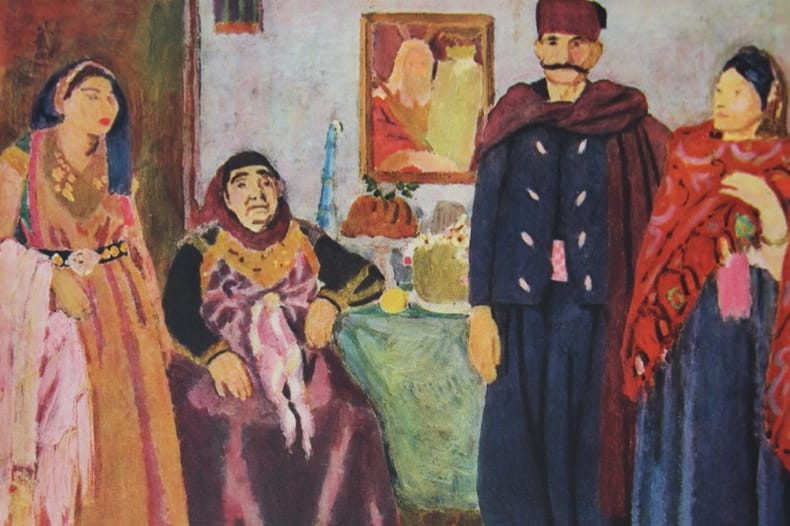
41134Edif.2000.Gd.in-4 toilé orange avec jaquette illustrée en couleurs.317 p.Pages entières de reproductions en couleurs. Etat neuf.
1942232231942. American serviceman's Sgt. T. Mansker's photo album compiled from experience moving between France and French colonial Algeria circa 1942-1945 A majority of the approx. 270 photographs take place in wartime Algeria under Allied military presence in French colonial Algeria. The album centers on occupied Algerian street life public space transport and military circulation in North Africa preserving roughly 100 views of of colonial Algeria spanning religious sites social street views and commercial districts shaped by foreign military presence during the war. Real photo postcards addressed by Mansker to Mrs. T. Mansker in Chicago place the album as depicting Mansker's time in France stamped and sent in November 1944 through the US Army's mailing system while the larger body of photographs are numbered North African and Algerian views indicating a commercial photographic market serving foreigners in North Africa.<br /> <br /> Photo archive of 274 items including 268 silver gelatin photographs and real photo postcards one press photograph and 5 unique negatives North Africa and France circa 1942-1945. The album begins with mailed postcards from France to Mansker's wife and continues with a dense run of black and white photographs mounted on black paper leaves many of the Algerian images uniformly numbered and consistent with commercial views sold to soldiers. Content includes parade formations marching through city streets lined with civilian spectators; a Red Cross "Enlisted Men's Service Club" entrance; harbor and rail scenes with locomotives freight cars wrecked machinery and transport corridors; bomb-damaged streets rubble and collapsed masonry in French urban settings; mosque and church exteriors and interiors; shrines cemeteries gardens monuments and civic buildings; palm-lined boulevards and colonial public architecture; and numerous Algerian street scenes with robed men children posed in portraits merchants and vendors donkey and horse transport roadside labor shepherding courtyard gatherings and small groups seated or standing beneath walls and arcades. Several street views also retain wartime control signs in the background including one reading "British Personnel Only" and another marked "Off Limits to U.S. Forces" giving direct visual evidence of restricted military space and overlapping Allied jurisdictions within the urban environment of wartime Algeria. Many photos record everyday business and movement continuing in streets and market spaces amid military passage colonial institutions. Some photos depict servicemen's entertainment and staged theatrical performance extending the album's wartime scope beyond transport and occupation into the organized leisure and morale culture surrounding Allied military life.<br /> <br /> French colonial Algeria served as a port staging ground administrative center and transportation hub after the North African landings with routes linking North Africa southern France and the wider Mediterranean war. The album's Algerian majority includes street commerce religious sites child portraiture transport routes and public ceremonies alongside Allied military presence in cities and towns under French colonial administration during the war. Black-paper leaves heavily worn with crumbling edges worn and delicate spine lots of tape residue lifted and loose photos and loose pages; photographs generally remain in good condition RPPCs remain legible. Mansker's postcards and the album's large numbered Algerian sequence anchor the material in the overlap of U.S. military movement colonial Algeria and wartime commercial photography. unknown
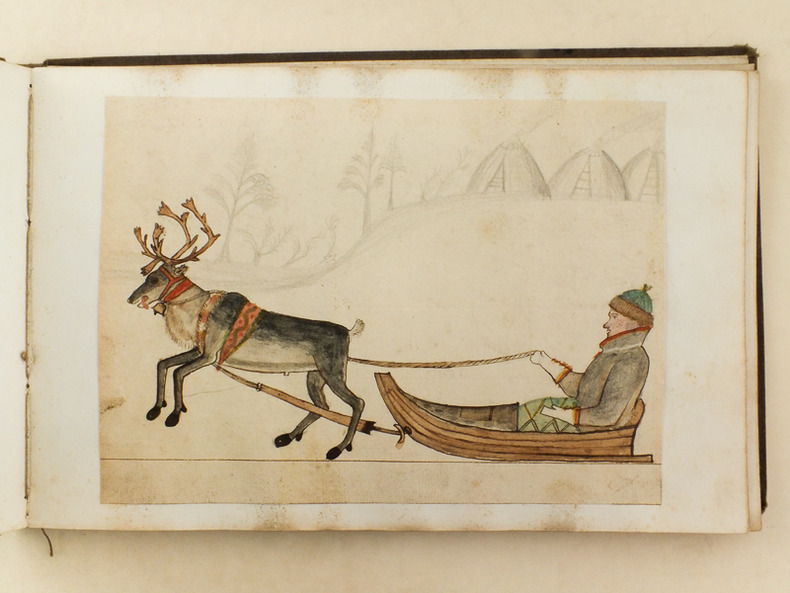
1847390891 album format à l'italienne grand et long in-8, reliure pleine percaline estampée, contenant (pour l'essentiel) : 1 - un grand et beau dessin d'époque (débroché) au crayon sur double avec titre volant : "Mostaganem en 1847. Demeure du "Général" logé par le Génie, signé Chamut (Chamuet ? Charnut ?) ; 2 - 4 aquarelles de bouquets (de facture naïve) ; 3 - 12 lithographies contrecollées (Château, portrait, paysan breton, ...) ; 4 - Dessin naïf au crayon (château) ; 5 - 6 lithographies (d'après Hans L. Reusch, tiré des recueils de Georg Prahl) rehaussées à l'aquarelle de vues pittoresques norvégiens : Fra Jedderen C.S. - 1,2,3 fra Soelbo, 4 fra Saelbo, 4 fra Byenaesset T.S. - Sans titre - Fiskere fra Selloe, samt Prospect af St. Synneve Kloster-Ruiner, B.S. - Bonder fra Wigoer - Hallingdoler
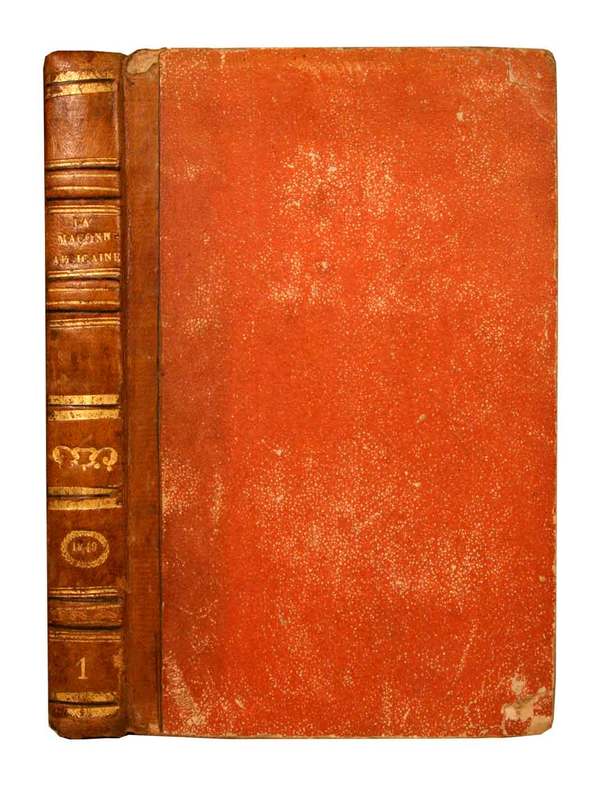
120634aafOrient Alger, Typographie et Lithographie du F. Bastide, 1849, gr. in-8vo, Frontispice lithogr. portrait de J. Descous + 388 p. (n° 1 du 15 févr. au n° 11, inclus. le supplément au n° 5 (juin/juillet) & 11 (31 déc. 1849): Cantiques Maçonniques p. 373 à 388) + 2 ff. de table (pagination erronnée 373-375), cachet ovale ‘MOATTI Peintre’, reliure en d.-cuir d’époque, dos orné, qqs traces d’usage, sinon très bon exemplaire.
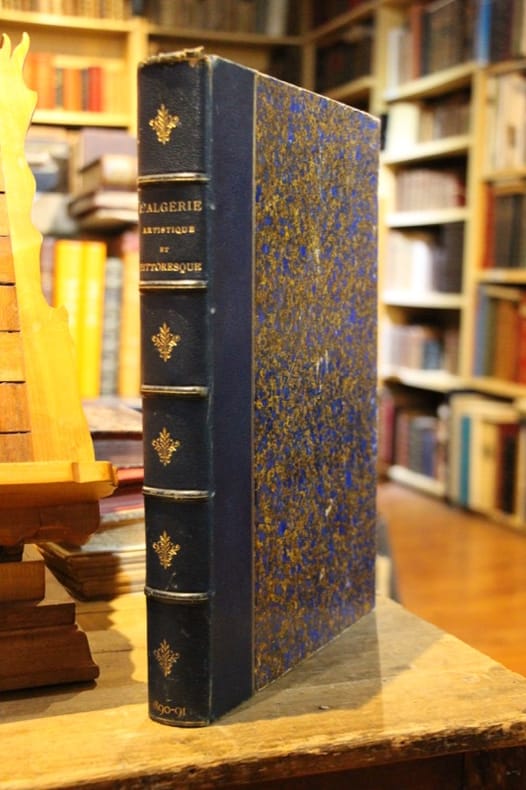
189096809Alger, J. Gervais-Courtellemont & Cie, éditeurs d’Art 1890 In-4 32 x 23 cm. Reliure demi-chagrin bleu-marine, dos à nerfs orné de filets dorés et encadrés de petits fers dorés, filets dorés, en pagination multiple, 72-XII-XXXI-V-18-12-12-12-12-15-18-56 pp., photographies en noir & blanc dans le texte, 45 photogravures et 1 eau-forte originale sous serpentes. Coupes frottées, sinon bon exemplaire à l’intérieur très frais.
193022949Grenoble, Arthaud 1930 In-4. Demi-basane rouge à coins, dos à faux-nerfs et caissons ornés à froid, couvertures conservées, 86 pp. et 24 planches en couleurs, chacune présentée dans une chemise légendée. Reliure passée et frottée. Sept cahiers d’illustrations 7 planches déliés.
Fine French Original wrappers. Roy. 8vo. (24 x 17 cm). In French. 10 p., 2 unnumbered b/w plates. Extremely rare early brief French edition of "Kitâb tu?fat al-zâ'ir fî târîkh al-Jazâ'ir wa-al-Amir 'Abd al-Qâdir" by Amir Abd al-Qadir's eldest son Mohammad Pasha, originally in Arabic in 1903 in 2 volumes, published for "the benefit of the national subscription of the Ottoman Fleet", including a brief biography of Abd al-Qadir, was an Algerian religious and military leader who led a struggle against the French colonial invasion of Algiers in the early 19th century. This pamphlet including Amir Abd al-Qadir's biography written by his eldest son Mohammad Pasha has two b/w plates showing a photograph of al-Qadir and his medal that the municipality of Paris had struck in 1862, in memory of the banquet offered on behalf of the Parisian population to the Emir Abd-el-Kader. Abd al-Qadir al-Jazairi (1808-1883), known as the Emir Abdelkader, Abdelkader ibn Muhieddine or Abdelkader El Hassani El Djazairi, was an Algerian religious and military leader who led a struggle against the French colonial invasion of Algiers in the early 19th century. As an Islamic scholar and Sufi who unexpectedly found himself leading a military campaign, he built up a collection of Algerian tribesmen that for many years successfully held out against one of the most advanced armies in Europe. His consistent regard for what would now be called "human rights", especially as regards his Christian opponents, drew widespread admiration, and a crucial intervention to save the Christian community of Damascus from a massacre in 1860 brought honors and awards from around the world. Within Algeria, his efforts to unite the country against French invaders saw him hailed as the "modern Jugurtha", and his ability to combine religious and political authority has led to his being acclaimed as the "Saint among the Princes, the Prince among the Saints". Amir Abd al-Qadir (Emir Abdelkader or Abdelkader El Hassani El Djazairi), (1808-1883), was a venerated Algerian Islamic scholar and a military leader who led a collective resistance against the mid-nineteenth century French colonial invasion of Algeria. He is remembered today as one of the nineteenth century's most inspiring leaders for his humane treatment of Christian opponents during Algeria's anti-colonial struggle and for leading an intervention to rescue the Christian community in Damascus from certain massacres in the midst of sectarian riots in 1860. Raised in his father's zawiya, he excelled as a student, memorizing the Qur'an by the age of 14, and studying the Islamic religious sciences as well as subjects such as philosophy, medicine, and mathematics. He was especially known as a gifted orator who outshone his peers in the recitation of poetry and in delivering religious talks. His father, a notable spiritual leader affiliated with the Qadiriyya order, recognized his son's precociousness and cast a leadership role upon him shortly after the invasion of Algeria by France in 1830. After his father, citing his old age, declined to lead a tribal campaign against the French in 1832, Abd al-Qadir found himself elected Emir, or Commander of the Faithful, to organize a resistance that, within a year under his leadership, would unite Algeria's western tribes. Emir Abd al-Qadir commenced a fifteen-year military struggle during which he often kept the French forces-which boasted one of the world's most advanced armies-at bay through skillful guerilla tactics, strategic negotiation and treaties, and visionary state-building. All the while, he demonstrated chivalry and compassion toward his opponents and allies alike, taking care, for instance, to respect the individual religious beliefs of his prisoners of war and also purposefully integrating Jews and Christians into his new state. At one point, he released his French prisoners because he did not have the means to feed them adequately. But, by 1847, partly due to ruthless scor
186989861Blida, A. Mauguin, éditeur-Libraire 1869 In-8. Reliure demi-maroquin havane, dos à nerfs encadrés de petits fers dorés, tranches dorées, XIV-310 pp., accompagné de 5 documents volants : 1 carte repliée des environs de Boufarik ; 1 plan replié sur calque du camp d’Erlon ; Histoire de Boufarik 4 ff., manuscrit autographe par le colonel Trumelet ; 3 feuillets repliés manuscrits autographes adressés au colonel Trumelet, concernant Boufarik, notamment les armoiries de la cité. Reliure légèrement frottée, petites décolorations sur les plats, intérieur frais. Ouvrage d’une relative rareté.
184613010Firenze 1846 2 volumes in-4 demi-basane, dos lisse orné, 626- 649 pp. Encadrement typographique. 78 planches hors-texte sous serpente finement coloriée 34 dont 12 en couleurs pour l’édition française de 1844. Reliure usée. Un cahier & 2 planches désolidarisés.
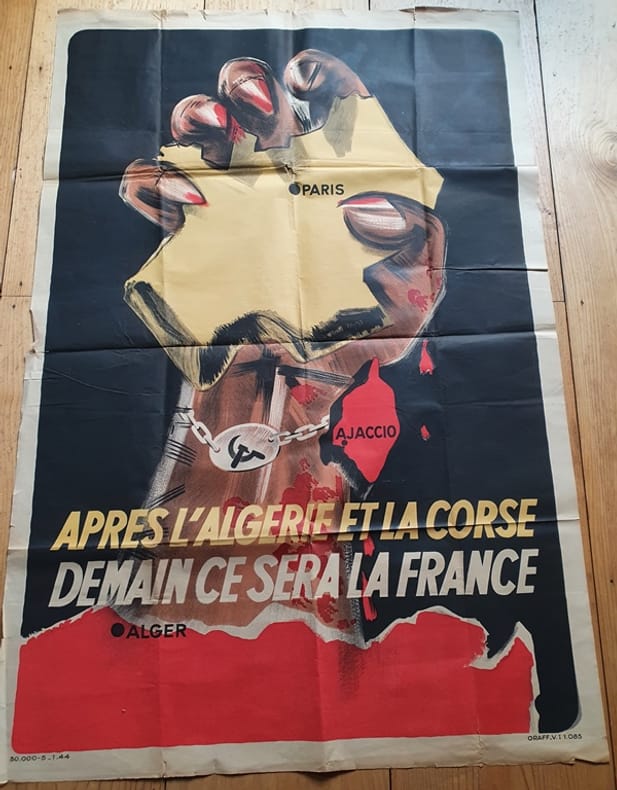
1944Aff151944 120 X 80 cm - nombreux plis - micro déchirures en bordures - une déchirure sur un pli ( prés du mot Paris ) + une autre petite déchirure sur un autre pli - Mention de l' Office de répartition de l'affichage (ORAFF) organisme Allemand contrôlant l'affichage public Sa finalité : contrôler et censurer les affiches placardées en France. Un numéro de visa attribué par l'ORAFF, ici le 1085, tient lieu d'autorisation de diffusion. Apparue sur les murs de France à partir de janvier 1944, cette affiche s'inscrit dans le contexte d'une avancée des Alliés sur tous les fronts.
204657Alger, Imprimerie du gouvernement, 1844 in-8, 75 pp., demi-vélin Bradel à coins, pièce de titre verte (rel. de la fin du XIXe s.). Pièce de titre un peu frottée.
201016225Paris, Imprimerie impériale, 1872 ; petit in-4, 540 pp., demi-velin teinté vert titre manquant (un peu débroché). Etat correct - rareOuvrage illustré de 162 figures (coupes), 8 planches hors-texte dont une en fin de volume est dépliante,en 14 volets (coupes géologiques), six tableaux. En outre ouvrage bien complet des tois superbes cartes en couleurs, dépliantes : 1.-Carte géologique du Beni Mzab, du Sahara et de la région des steppes de la Province d'Alger" par M. Ludovic Ville ; 2.-Carte de la Province d'Alger ; 3.-Carte géologique du Sahara oriental par M. Ville, exécutée en 1872 par report sur pierre de la carte topographique du Sahara oriental publiée par le Dépôt de la Guerre en 1861.
AMA-1085London, Richard Bentley, 1863. In 8°, percaline mauve de l’éditeur, fleuron doré sur le premier plat, encadrement de filet à froid sur les deux plats, tranches dorées, dos passé, mouillure en marge inférieure du frontispice. xvi, 362 pp., une planche en couleurs en frontispice.
201016224Paris, Imprimerie impériale, 1857-1852 ; petit in-4, 349-423-IV, demi-velin teinté vert mords fragiles ou abimé . Les 2 volumes. État correct voir bon - rare.
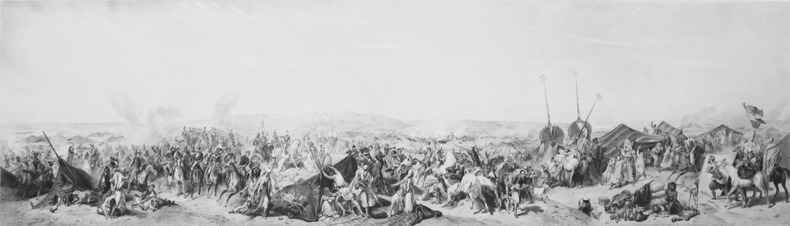
1850LBW-7640Vers 1850. Gravure originale (126 x 43 cm avec marges).
215722Paris, grand in-4, LXXVIII-261 pp., nombreuses héliogravures in et hors-t., demi-maroquin vert à coins, dos à nerfs, filets dorés, tête dorée (Garidel). Dos passé.
207688Paris, au bureau du journal Le Crédit, 1849 in-8, [4] ff. n. ch., 206 pp., demi-chagrin noir, dos à nerfs orné de filets à froid, coins en vélin vert, tranches mouchetées (reliure de l'époque). Bon exemplaire.
in 4° (cm 29,2x16,2), pp. 628, 651, m/pelle coeva con tit. e ricchi fregi in oro ai ds., sguardie colorate, testo incorniciato da fregio tip. "Con una introduzione su i diversi sistemi di colonizzazione che precessero il conquisto francese", volgarizzamento del dott. Anicio Bonucci. Importante studio storico e antropologico sul nord Africa di metà '800, con 76 (di 80) splendide tavv. litografiche fuori testo acquerellate a vivaci colori. Brunet VI, 28406. Rare fior. 407/29
occhietto (con dedica manoscritta a Benito Mussolini di Nicola Vito Traversa), frontespizio, 5-628pp, 36 tavole a colori incise fuori testo; occhietto con dedica a Benito Mussolini di Nicola Vito Traversa, frontespizio, 649pp, (1cc), 44 tavole a colori incise fuori testo. Legatura in piena pelle verde, con bordura in oro su entrambi i piatti, fregio con panoplia sui piatti, titolo in oro al dorso, con fregi pure in oro e iniziali T.M. in oro.
In una magnifica cartella editoriale in cartone rigido (con decorazioni in stile art nouveau e titoli in oro) dal titolo "ALGERIE" sono conservate 16 photogravures (in nero) del celebre fotografo francese GERVAIS - COURTELLEMONT (uno dei più grandi fotografi orientalisti dell'Ottocento). Sulla cartella è riportata, in basso a destra, la scritta in oro "Alger / Gervais-Coirtellemont & Cie éditeurs d'art / 10 rue des trois couleurs". Delle 16 photogravures presenti, 13 riportano, stampata, una didascalia indicativa del soggetto ritratto. A rendere unica questa raccolta, è una delle tavole che è stata firmata e datata (7 janvier 1890) a mano (a matita) dall'artista. Dimensioni della cartella: 27 x 34,5 cm circa. Dimensioni di ciascuna tavola: 25 x 32,5 cm circa. STATO DI CONSERVAZIONE: La cartella presenta qualche segno del tempo e dell'uso (in particolare non è più presente il rivestimento del dorso e i due piatti sono legati insieme solo più dalla tela che fungeva da base/supporto al dorso; mancano i tre laccetti, presumiamo in stoffa, posti ai lati che servivano per la chiusura della cartella); tre delle sedici photogravures presentano dei piccoli strappetti ai margini - si vedano le foto). Nell'insieme si tratta di una collezione decisamente ben conservata.Insieme sicuramente assai raro (forse unico con l'autografo di Gervais-Courtellemont) degno di figurare nelle raccolte di un grande collezionista. Didascalie presenti sulle photogravures: -Vue générale de Constantine (photogravure Gervais-Courtellemont et Cie - Alger PL. 144) - Bois-Sacré. - Blida (photogravure Gervais-Courtellemont et Cie - Alger Pl. 178) - Oued El-Kantara (photogravure Gervais-Courtellemont et Cie - Alger PL. 99) - Oued El-Kantara (photogravure Gervais-Courtellemont et Cie - Alger PL. 91) - Village Kabyle (photogravure Gervais-Courtellemont et Cie - Alger PL. 112) - Marché Kabyle (photogravure Gervais-Courtellemont et Cie - Alger PL. 138) - Gorges du Chabet - el - Akra (photogravure Gervais-Courtellemont et Cie - Alger PL. 93) - Prière du Soir (photogravure Gervais-Courtellemont et Cie - Alger PL. 27) - Allée des Bambous - Jardin l'Essai - Alger (photogravure Gervais-Courtellemont et Cie - Alger PL. 25) - Mosquée (Place du Gouvernement) (photogravure Gervais-Courtellemont et Cie - Alger PL. 80) - Mosquée Sidi Abd-er-Rhaman (photogravure Gervais-Courtellemont et Cie - Alger PL. 32) - Palais d'été du Gouverneur - Mustapha (photogravure Gervais-Courtellemont et Cie - Alger PL. 13) - Vue Générale d'Alger (photogravure Gervais-Courtellemont et Cie - Alger PL. 71). Jules Gervais-Courtellemont (1863 – 1931) nacque nella provincia di Seine-et-Marne, vicino a Parigi, ma crebbe in Algeria, dove sviluppò una passione per l'Oriente pre-coloniale e dedicò la maggior parte della sua carriera professionale alla ricerca dell'esotico.
1374986Alger: Imprimerie Pierre Fontana, 1894 gr. in-8 (24,5 x 16 cm), 179 pages. Reliure amateur moderne basane brune, première couverture conservée, petite tache en marge des derniers feuillets, autrement très bon état. Edition originale, très rare.
TiTOLO: “Nova Barbariae descriptio” from Nieuwen Atlas Amstelodami, Sumptibus Joannis Janssonii 1650 circa Dimensioni del foglio: 485 x 600 mm. Dimensioni dell'incisione: 355 x 525 mm. Tecnica: incisione su rame Condizioni generali: Eccellenti rare fioriture. Meravigliosa mappa del Nord Africa di grandi dimensioni acquarellata a mano tratta dall'Atlante "Nieuwen Atlas" [translation: The New Atlas], di Jan Jansson, pubblicata ad Amsterdam nel 1650 circa. La mappa mostra anche l'odierno Marocco, Algeria, Tunisia, Libia, Egitto. Titolo decorato con elaborato cartiglio e illustrazioni dell'interpretazione europea della flora e fauna africana. Descrizione completa dell'Egitto e Nord Africa in lingua latina al verso. Jan Jansson, celebre cartografo, appartenente ad una lunga stirpe di stampatori attivi a partire dal XVII secolo. Si stabilirono prima ad Arnhem poi ad Amsterdam. Furono stampatori di mappe, di libri e librai. Title: “Nova Barbariae descriptio” from Nieuwen Atlas Amstelodami, Sumptibus Joannis Janssonii 1650 circa Sheet size: 19.09 x 23.62 in; 485 x 600 mm. Plate area: 13.98 x 20.67 in; 355 x 525 mm. Technique: Copper engraving Overall condition: Excellent condition, with light foxing. A wonderful large scale hand-colored map of North Africa, from one of the great early 17th-century Atlas "Nieuwen Atlas" [translation: The New Atlas], by Jan Jansson, published in Amsterdam in 1650 circa. The map shows what is now Morocco, Algeria, Tunisia, Libya, Egypt. Elaborately decorated title and illustrations of European interpretations of african flora and fauna. Complete description of Egypt and North Africa in latin language in the verso. Jan Jansson was part of an influential family of map publishers from the Netherland throughout the 17th century and beyond. They were based in Arnhem than in Amsterdam. They were printers, publishers and booksellers. Overall Condition: Excellent
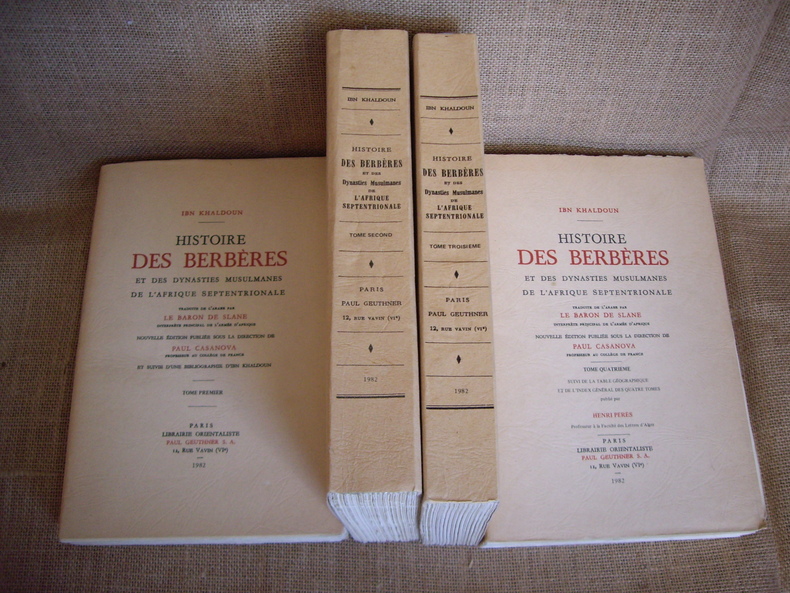
6957Librairie Orientaliste Paul Geuthner S.A., 1982, brochés, 17x25 cm, 447+605+507+628 pages. Le quatrième tome est suivi de la table géographique et de l'index général des quatre tomes.
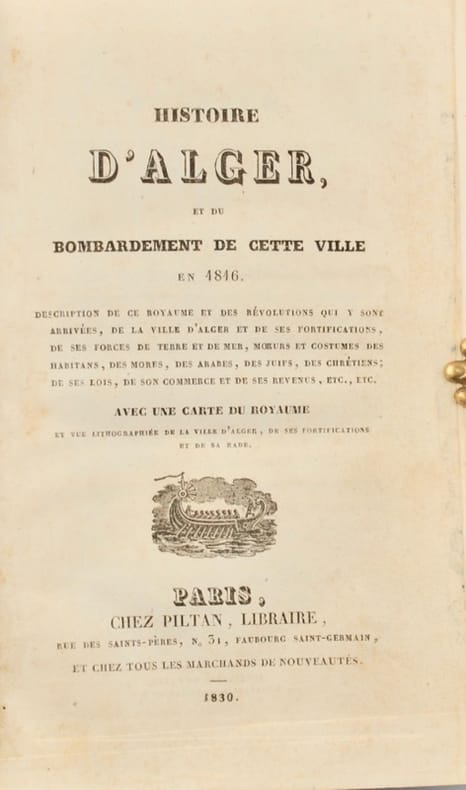
183040626Paris, Piltan, 1830. In-8 de 366 pp. demi-basane havane à petits coins de vélin ivoire, dos lisse orné, pièce de titre en veau rouge, tranches marbrées (reliure de l'époque).