857 résultats
BN329575Ediciones del Bronce. Softcover. El mayor de los huerfanos <br/><br/>El mayor de los huerfanos 1947. Residente en Francia y doctor en Ciencias Tierno Monénebo Guinea Ediciones del Bronce paperback
17852Lyon, Missions catholiques, 1884. In-8, 112 pp., illustrations. Bon état. Toile rouge, nombreux tampons de l'O.R.T.F., Radio-France, couvertures.
1954LFA00e87Carte Michelin 182 éditée en 1954 : 1 cm pour 30 km
ORD-58Nouvelle édition augmentée de 2 cartes avec un avertissement et un index alphabétique des noms, dressée au Service Géographique de l'A.O.F. à Dakar sous la direction du Commandant Ed. de Martonne. Paris. Forest. 1922. In-f°de 4ff. n. ch. et 9 cartes couleurs à double page (48x37cm) montées sur onglets, sous couverture cartonnée de l'éditeur un peu tachée, sans son dos. Cartes très fraîches.
1959V40646Hamburg (Spiegel Verlag ) 1959 (= Erste Ausgabe). 4°, illustirerter Originalumschlag (Klammerheftung), 66 S., Abbildungen, Werbung 1
4773Carte (42 x 31,5 cm hors marges) des côtes du golfe de Guinée (c. 1780) gravée sur cuivre. Frontières, côtes et encadrement réhaussés. Dimensions totales : 510 mm x 360 mm. Dimensions hors marges : 420 mm x 315 mm.Bel état. Papier légèrement jauni,quelques très légères rousseurs au dos et menus défauts.Tirage de l'époque.Rare.
1855AQ23016New London PA: Printed by Orvis & Berry 1855. 64pp. Contemporary original black roan-backed marbled boards ruled and lettered in gilt. Extremities worn upper board held by cords only. Endpapers foxed remnants of labels and some loss to pastedowns very occasional coloured pencil annotations to text. The first edition of a Pennsylvania-printed primer presumably intended primarily for missionaries to the Benga language the indigenous language spoken by the Benga people of Equatorial Guinea and Gabon. Divided into 22 'lessons' comprised of simple phrases and vocabulary. the book concludes with a catechism presented in parallel English and Benga text. OCLC records a single copy in the British Isles BL and a further 10 worldwide. COPAC adds no further. . First edition. 12mo. Printed by Orvis & Berry hardcover
71932Sans lieu ni nom ni date (vers 1970), in 8° broché, 640 pages ; documents photographiques hors-texte.
194713362Conakry Gouvernement de la Guinée Française, Institut Français d'Afrique Noire 1947-1952 Numéros 2, 4, 5, 6, 7, 9, 10-11, soit sept fascicules in-8 brochés, couvertures rouges imprimées, 89, 89, 112, 93, 81, 93 et 109 pages. Dos du fascicule 5 réparé, nombreux tampons d'ex-libris de Ziedonis Ligers.
195410211954 IFAN, Dakar, 1954. Tome XVI, n°1-4 et 1955, Tome XVII. Trois tomes en deux volumes in-8 demi basane rouge à coins, dos muet à quatre nerfs. Tome XVI: 447 pages. Suivi de: Bulletin de l'IFAN, T. XX sér. B., n° 1-2, 1958, pp. 191-204, puis de Bulletin de l'IFAN, T. XXIV, sér. B., n° 1-2, 1962, pp. 12-53 et de Revue Archéologique, PUF, pp. 203-209. Tome XVII: 248 pp., suivi de Bulletin de l'IFAN, T. XVII, sér.B, n° 3-4, 1955, pp. 477-499, puis Bulletin de l'IFAN, T. XX sér. B., n° 1-2, 1958, pp. 191-204, et de Bulletin de l'IFAN, T. XXIV, sér. B., n° 1-2, 1962, pp. 12-53. Bel état malgré épidermures et une petite mouillure au tome XVI et un mors fendu, mouillure notable sur les premières pages du tome XVII. Quelques notes au crayon, en marge. Tampons de la Bibliothèque de Z. Ligers.
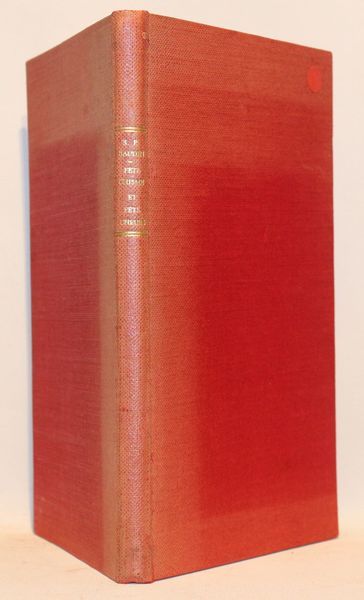
1998LFA-126736305Une publication de 212 pages, format 180 x 240 mm, illustrée, brochée, publiée en 1998, Centre Alpin et Rhodanien d'Ethnologie, bon état
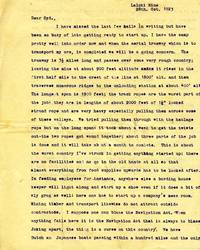
202912 page TLS describing in great detail the difficulties in setting up a mining operation in New Guinea. The author H. Edward Clayton is attempting to set up an aerial tramway to transport the ore. It is 3 1/2 miles long and passes over very rough country - the difficulty in hauling the cable is palpable. Clearly having been engaged in mining in other parts of the world before he speaks of Papua NG as "the worst country I've struck in getting anything started up" with no facilities the necessity of setting up your own company mess where as in the past "anywhere else a bording sic house keeper will light along and start up a show even if it does a bit of sly grog as well". He blames the "Navigation Act" which he calls "a curse on this country". "We have Dutch and Japanese boats passing within a hundred miles and the only ones allowed to call here are the little island boats of B.P's; the work is too much for them and the result is high fares and feights sic and infrequent service." <br /> <br /> Several other people are mentioned. There is a reference to "Bill Horsburgh" who is the assayer on this mine married with three children one of them was hospitalized for rheumatic fever in Port Moresby. "Bill has changed a good deal- as quiet as can be until he has a few in and the crust cracks." This could be a reference to William Horsburgh born in Queensland and married to Frances Stella Clayton. W.W. Horsburgh was an assayer and worked with the Dubuna and Laloki Mines of the New Guinea Copper Mines until at least 1927. It's possible that the author of the letter is related in some way to Horsburgh's wife. Clayton also asks after a George Osborne. <br /> <br /> We presume that the Laloki Mine is part of the Astrolabe mineral field near Port Moresby a massive copper mine that ran from 1907 to 1926 at the Laloki and Dubuna Mines and transported by light rail and aerial ropeway to a smelter near the Tahira Inlet wharf. Geology & Mining Potential of New Guinea by Wiliamson and Hancock 2005. <br /> <br /> 2 pp 8x10" signed H. Edward Clayton. Old folds very good condition overall. unknown
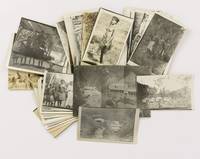
140780Very Good. Original gelatin silver photographs 33 postcard-format approximately 88 × 145 mm or the reverse and three smaller prints that overlap to form a panoramic view of Block 10 Gold Mine on Misima Island 127 × 190 mm. The majority have inscriptions on the verso see below; 11 have identifying captions six have routine messages to family members. Only a handful appear to be commercially-produced postcards. Undated but probably 1920s. Minimal signs of age and use; overall in excellent condition. The majority of the photographs form a near-complete series bearing a manuscript number and the initials 'W.D.W' in ink on the verso. There are 30 items numbered 2-13 15-24 26-29 32 and 34-36. We have established the initials are those of W.D. Wilson a builder and contractor and that he lived in suburban Adelaide at Largs Bay in the 1920s and Semaphore in the 1930s. The messages are to four of his children Rita Florrie Merle and an unidentified boy: curiously some of the names are scratched out of these messages; these tend to be on photographs taken in Rabaul. <p>The subject matter and captions of some of the photographs suggest he may have been working on the island possibly at Block 10 Misima Gold Mine at Umuna. The three-panel panorama and two other photographs feature the mine site with its 'crushing mills cyaniding vats sawmill black-smiths' and carpenters' shops electric lighting staff accommodation . and . tramway' Hank Nelson: 'Black White and Gold: Goldmining in Papua New Guinea 1878-1930' ANU Press 2016 now available online. Chapter 3 'Misima: warlike and civilised' is most informative. Other captions relating to Misima Island include 'Three Awaikivas Orokaivas'; 'Native hut Lappapai'; 'Ocean going Canoe with outrigger. Lappapai'; 'Shell hunting on the Coral. Lappapai'; and 'Bwagoia' one of the main villages. 36 items. unknown
1931184521931 Lyon et Paris, Vitte, et Vénissieux, Soeurs Missionnaires de N.-D. des Apotres, 1931, in 8° broché, XXII-193 pages ; illustrations hors-texte ; cachets ; couverture illustrée (légèrement fanée).
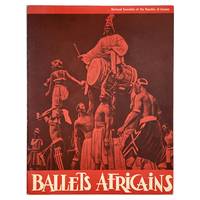
19666940New York: National Ensemble of the Republic of Guinea 1966. First Edition First Printing. Stapled Wraps. Unpaginated pp. 16. 4to. measuring 8.5" x 11". Twice-stapled pictorial card covers illustrated in black-and-white. Striking black-and-white photographs group portraits and illustrations throughout capturing views of the live performance those of the performers shots of dignitaries and VIP's backstage etc. Additionally comprises of a detailed programme of events featruing a rich commentary and history by various contributors on the founding and importance of the troupe and their perforamance. Bright clean and unmarked; fine. While other editions of such programmes exist we could not locate any instances of this programme particular edition. Charming and scarce. <br/><br/>Commemorative programme book published upon the occasion of the 1966 performance of the African Ballet by the National Ensemble of the Republic of Guinea held at the Barrymore Theatre in New York City. It would coincide with the nineteenth anniversary of the troupe. National Ensemble of the Republic of Guinea paperback
1929110841929 P., Editions de l'Oeuvre d'Auteuil (Collection "Les Défricheurs Africains"), 1929, in 8° broché, 168 pages ; illustrations hors-texte ; couverture fanée ; intérieur frais.
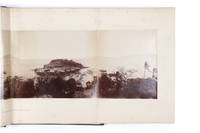
18854504633Sydney: Thomas Richards Government Printer 1885. Slight rubbing to binding in handsome & original condition; interior lightly foxed in places; map with repaired tear; images all bright and crisp. Large square folio with a folding map three coloured lithograph plates 33 original silver albumen photographs 283 x 212 mm mounted on card with printed captions and borders and two superb panoramas one of them double-page 240 x 553 mm and the other on four sheets 242 x 1053 mm; original dark blue grained morocco binding bevelled edges spine banded and sides with multiple borders in gilt front cover lettered in gilt all edges gilded. <p><p>This rare and sumptuous album published in very small numbers and illustrated with actual photographs has been called the first example of Australian photo-journalism: 'the most magnificent example of an Australian work in this genre the high point in relation to which all other examples can be considered' Holden. It is most impressive as an ethnographic album one of the first such produced in the South Pacific. A special copy was delivered to Her Majesty the Queen as "a keen supporter of photography." </p> <p>The photographs all date from the 1884 expedition when Commodore Erskine proclaimed a British protectorate over the south coast of New Guinea. Although unattributed at the time all images were made by the New South Wales Government Printing Office and were chiefly the work of Augustine Dyer 1873-1923. Principally intended as a visual record the album shows the importance of the Hood Lagoon area of Papua New Guinea in British and Australian ambitions with six depictions of the region effectively a sixth of the finished work.</p> <p>The superb series of ethnographic and exploration photographs commemorating the 1884 expedition was printed and the albums assembled in Sydney in a small edition for presentation. Sir James Erskine R.N. 1838-1911 in 1885 was Private Secretary to Lord Northbrook the first Lord of the Admiralty and became Commodore of the Australian Station in January 1882. Erskine leased "Carthona" the grand Gothic-revival house built on Darling Point in 1841 for the explorer Sir Thomas Mitchell. In the 1880s it was owned by the solicitor Arthur Mansfield Allen but he was offering it to be let fully furnished in June 1884 and Erskine is known to have been resident there soon after.</p> <p>It is a piece of photo-reportage unmatched by any other work of this time and place. Through the positioning of images of the official ceremonies alongside topographical views of the surrounding areas the photographs themselves become a true part of the narrative: the first photographic images of the meeting between Imperial forces and Hood Bay chiefs. One of the remarkable images is a scene on board HMS Nelson as Erskine addressed some of the assembled tribal elders 'Commodore addressing Chiefs on board HMS Nelson Hood Bay' one seen grasping an ebony staff. Erskine had handed out a number of the staffs to local chiefs as "an emblem of authority in the form of an ebony stick with a florin let in at the top the Queen's Head being uppermost and encircled by a band of silver" Lyne New Guinea pp. 13 114-118.</p> <p>The motivation for the Australian Squadron's to New Guinea expedition under Erskine's command was imperialistic: "The Imperial Government. decided to take steps to establish a Protectorate over that part of the southern shores of new Guinea to the east of the territory claimed by the Netherlands with the double object of preventing any foreign occupation of the country and of protecting the inhabitants from aggression.". This declaration of the expedition's objective belies the tone of much of Erskine's Narrative which reads more like a travelogue than an official account. "Picturesque" is the most often used descriptive term along with such passages as "the striking variety and beauty of the colour in the adjacent water were enchanting and struck the beholder with wonder and admiration." Similarly Erskine's own speech considered for many years as a "Declaration of Rights" for New Guinea contrasts strongly with the text of the Proclamation itself. The latter is couched in formal imperial language whereas the former looks ahead in more open terms to the real benefits that the tribesmen might expect and is very specific regarding the protection offered by Her Majesty Queen Victoria: "look upon white persons whom the Queen permits to reside amongst you as your friends .". </p> <p>A full list of the images can be seen at hordern.com.</p> <p>The photographs are: 1 "Port Moresby from the Mission Station." Four-sheet panorama. 2 "H.M.S. 'Nelson' at Port Moresby S.W." 3 "General View of Settlement at Port Moresby N.N.E." 4 "Commodore shaking hands with Native Chief 'OBE Vagi' on board H.M.S. 'Nelson' at Port Moresby." 5 "Native Village Port Moresby W." 6 "Ethel Island and landing-place at Native Village Port Moresby S.W." 7 "Native Houses Port Moresby." 8 "Native Village Port Moresby S." 9 "Native Village Port Moresby N.W." 10 "Hoisting Flag at Port Moresby N.W." 11 "Yule Island from Delena Hall Sound N.W." 12 "Landing-place at Delena Hall Sound N." 13 "Hoisting flag at Delena Hall Sound." 14 "Koloka the Queen of the Lolo Tribe at Delena." 15 "Landing at Motumotu." 16 "Landing at Motumotu." 17 "Firing the Feu de joie Motumotu." 18 "New Guinea Chief Motumotu." 19 "Native Village Kerepunu Hood Lagoon S.W." 20 "Commodore reading Proclamation at Kerepunu Hood Lagoon W." 21 "H.M.S. 'Espiegle' saluting Flag Hood Lagoon." 22 "Scene near Kerepunu Hood Lagoon N.E." 23 "A Chief's House Kerepunu Hood Lagoon S.W." 24 "Commodore addressing Chiefs on board H.M.S. 'Nelson' Hood Bay." 25 "Argyll Bay W.N.W." Two-sheet panorama. 26 "Commodore reading Proclamation at Argyll Bay N.W." 27 "H.M.S. 'Nelson' saluting Flag at Mission Station Suau Stacey Island South Cape." 28 "View from Stacey Island N." 29 "Native Village Suau S.W." 30 "Native House at Suau." 31 "View from Dinner Island China Strait - H.M. Ships 'Nelson' and 'Espiegle' at anchor N.W." 32 "View from Dinner Island S.W." 33 "Natives on board H.M.S. 'Nelson' at Dinner Island." 34 "View from Anchorage N. side of Teste Island W. by N." 35 "West end of Teste Island from Anchorage S.W."</p> </p> . Provenance: A Paré "Elgin" Durban Rd. Wynberg South Africa pencil inscription on front flyleaf. Thomas Richards, Government Printer unknown
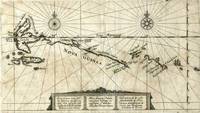
161918935Frankfurt: Blaeu 1619. Scarce copper engraved map of the northwest coastline of New Guinea and Moluccas showing the track of the Dutch explorers Le Maire and Schouten in 1616 in the ships Eendracht and Hoorn. The two explorers made the third complete circumnavigation and were the first to round Cape Horn from the east a more efficient way to get to the East Indies and thus a significant threat to the monopoly held by the Dutch East India Company. The expedition was headed for Batavia which it reached in October of 1616. The Dutch governor there obliged them by confiscating their cargo and sending them back to Holland but Schouten published his journals and now the word on the Drake Passage was out. With title cartouche in Dutch Latin and French. With two compass rose and sailing ship. From Schouten's account of his and Le Maire's first rounding of Cape Horn. Slightly toned otherwise very good condition. Blaeu unknown
1923233431923. Very good condition. Original publicity photograph by James Francis Frank Hurley 1885-1962 the Australian photographer filmmaker and writer known for his Antarctic photographs including the destruction of Ernest Shackleton's ship 'Endurance'. Hurley undertook two long expeditions to the Torres Strait and New Guinea between 1920 and 1923. From this he developed a successful anthropological film 'Pearls and Savages' and the book by the same title. He documented the people their rites houses villages artifacts and mountain scenes. Although reviews in Australia were strong one critic called it "probably the most beautifully photographed pictorial of the kind that has ever been screened" the film release in America resulted in a financial loss for Hurley retitled "The Lost Tribe". <br /> <br /> The b&w 8 x 10" Hurley print is stamped International Newsreel 226 William Street New York City on the verso. Manuscript note in pencil "New Guinea Island Pacific" on verso. unknown
192459714New York & London: G.P. Putnam’s Sons 1924. Thick tall 8vo. xiii 1 414 pp. Illustrated title page. Photo frontisp. 79 photo illustrations. Green publisher’s cloth gilt decorative lettering front cover gilt lettering on spine photo-illustrated endpapers t.e.g. minor bumping to couple corners still VG bright copy. First American edition of this lavishly illustrated work featuring the photo illustrations drawn from Hurley’s 1921 silent film documentary Pearls and Savages. He further edited and enhanced the film for re-release in October 1923 with the follow-up film title “With the headhunters in Papua†released in October 1923. The documentary expedition surrounded photographing and recording the work of Anglican missionaries working amongst the peoples of Papua New Guinea and the Torres Strait. Hurley and McCulloch dubiously obtained hundreds of objects including sacred items from indigenous peoples at the time and in fact the territorial administrator Sir Hubert Murray intervened by ordering some returned and Hurley was refused reentry to shoot more films. G.P. Putnam’s Sons, hardcover
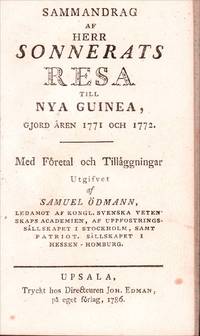
1786214528Upsala.: Samuel Odmann. 1786. Title page 61 pages including foreword and contents publisher's advertsements 7 pages 15 x 8.9 cms disbound text in very good clean condition.<P> Rare Swedish translation of the French naturalist and explorer Pierre Sonnerat's 1749-1811 voyage to New Guinea. Between 1769 and 1772 Sonnerat made a voyage to Madagascar the Seychelles the Philippines and New Guinea discovering many new plants birds and mammals during his travels. <br> <br>The list of publisher's advertisements is notable for a translation of Cook's Second Voyage to the South Pole: "Cooks Jac. Sammandragaf defs aren 1772 73 74 och 1775 omkring Sodr Polen."<P> <b>When referring to this item please quote stockid 214528</b> . Samuel Odmann unknown
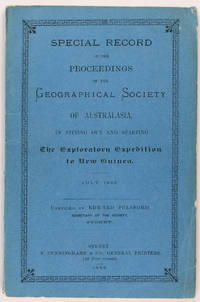
188517715Sydney: Geographical Society of Australasia F. Cunninghame & Co. General Printers 1885. First Edition. Paperback. Very Good. Sydney Geographical Society of Australasia F. Cunninghame & Co. General Printers 1885. Octavo 80 pages. Original blue wrappers with the full title page details repeated on the front cover within a decorative border; foot of the spine and the leading edges slightly chipped with minimal expert conservation to the latter; light scattered foxing; an excellent copy. A scientific expedition from June to December 1885 under the leadership of Captain Henry Charles Everill on SS 'Bonito'; it explored the Fly and Strickland Rivers. Everill's short report was published in 1886. Ferguson 14504; not in McLaren but see 8031 for a separately issued portion of it. Geographical Society of Australasia (F. Cunninghame & Co., General Printers) paperback
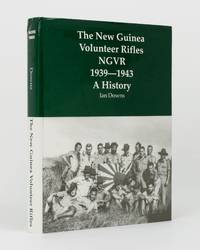
1999145141Broadbeach Waters: Pacific Press 1999. First Edition. Hardcover. Fine/Very Good. Broadbeach Waters Pacific Press 1999. Quarto 359 pages with numerous illustrations one in colour and 8 maps plus a colour frontispiece and endpaper maps. Pictorial papered boards; a fine copy with the excellent dustwrapper a little creased at the top edge. Includes a seven-page nominal roll. Pacific Press hardcover
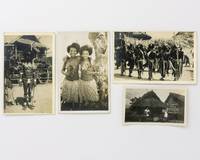
1930128061New Guinea: Unknown Photographer 1930. Very Good. New Guinea Unknown Photographer circa 1930s. Postcard-format gelatin silver photographs 140 × 89 mm or the reverse one on Kodak Post Card stock the others on plain stock. One bottom margin unevenly trimmed; minor silvering-out and trifling signs of handling; in excellent condition. Two photographs show ornately decorated men in a village. The other one features two young girls in grass skirts holding posies or something similar; the word 'lusious sic' is written in ink on the verso. A fourth snapshot 64 × 108 mm on 'Velox' paper with the words 'Native Huts' written on the verso is included: a small group of people including two white men and two local women are shown at the front of one of the dwellings. 4 items. Unknown Photographer unknown
198169177Bathurst Australia: The National Cultural Council of Papua New Guinea in association with Robert Brown and Associates 1981. First edition. Hardcover. Very Good. 408pp. Quarto 33.5 cm With prominent fading to the spine and edges of the covers. No dust jacket. Illustrated throughout. May require extra postage due to weight. From the Foreword-<br /> <br /> "The Gogodala story is an attempt to place contemporary society within the correct historical perspective. The Gogodala survived in the swampy plains of the Aramia Tiver without the Bible or the government. They had forged an organic relationship with their environment as reflected in complex cultural practices. The National Cultural Council of Papua New Guinea in association with Robert Brown and Associates hardcover