[Georgia]Biblio.com
5 587 résultats
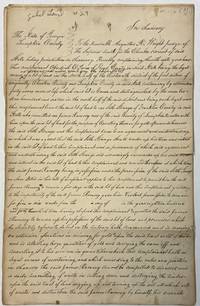
184441397Lumpkin County Georgia 1844. Folio 8" x 12-3/4". Three leaves: 1 1 blank 1 1 blank 2 pp. Completely in ink manuscript. Light tanning old folds minor wear and some short splits at fold edges. Prepared and signed by William H. Underwood as Solicitor for the complainant. Very Good.<br /> <br /> From 1805 through 1832 Georgia used a lottery system to distribute land taken from the Cherokee and Creek Indians. The Georgia Gold Rush began in 1829 and continued through the early 1840s. Separate Gold Lotteries in 1832 and 1833 divided lots into 40 acres and distributed them. The Georgia Gold Rush was the second significant gold rush in the United States and was particularly significant in the county seat of Dahlonega Lumpkin County where it began soon spreading through the North Georgia Mountains. Due to the significant amount of mined gold Congress established the Dahlonega Mint in 1838. By the early 1840s gold became less plentiful and many miners migrated to California for the California Gold Rush. "Dahlonega Gold Museum" Roadside Georgia website accessed on Wayback Machine Internet Archive October 2025; Wikipedia.<br /> Judge A. R. Wright issued a ruling 15 April 1844 enjoining Ramsey "from committing future waste spil or destruction in and upon the lot of land" until further order of the Court and required him to appear and respond to the complaint.<br /> Obadiah E. Payne a/k/a Paine 1807-1892 was a farmer from Floyd County Seth Strange c.1804-1881 was a farmer from Franklin County and James Ramsey c.1798-1869 was a farmer from Cherokee County doing gold mining in Lumpkin County for a time. United States Federal Census records on Ancestry website.<br /> William Henderson Underwood 1779-1859 was a Georgia lawyer a Captain in the War of 1812 and was elected Judge of the Western Circuit of Georgia in 1825. "Sketches of Georgia Lawyers. . . William Henderson Underwood" The Weekly Telegraph 14 June 1867 page 2.<br /> Augustus Romaldus Wright 1813-1894 was an American politician and lawyer who served in the U.S. House of Representatives from 1857-1859 served in the First Confederate Congress organized "Wright's Legion" of Georgia Volunteers and served as a colonel in the Georgia 38th Infantry C.S.A. President Lincoln offered him a position of provisional governor of Georgia in 1864 if the state withdrew from the Confederacy which it did not. "Wright Augustus Romaldus" online Biographical Directory of the United States Congress. unknown
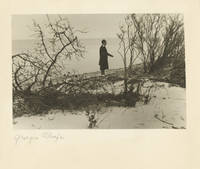
1948162811New York: N.p. 1948. Vintage matte finish photograph of artist Georgia O'Keeffe amidst driftwood on the beach taken at the Fire Island home of photographer George Daniell circa 1948. Captioned by Daniell in manuscript pencil on the recto margin with a PIX agency label affixed to the verso.<br /> <br /> Yonkers-born photographer George Daniell befriended O'Keeffe in the 1940s. Daniell took many now-iconic portraits of O'Keeffe throughout the ensuing decades many of which are today held by the Georgia O'Keeffe Museum in Santa Fe.<br /> <br /> From the archive of the PIX Agency an American photo house that acted as an intermediary between émigré photographers as well as those still living in Europe and the American magazine and newspaper market between 1935-1969. <br /> <br /> 8.5 x 7 inches archivally mounted in a white mat measuring 17 x 14 inches. Faintly and evenly toned else about Fine. N.p. unknown
20081-0439935342Scholastic Paperbacks 2008. Paperback. New. 65 pages. 7.50x5.25x0.25 inches. Scholastic Paperbacks paperback
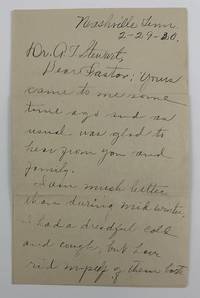
19205516Nashville: February 29 1920. Very good plus. 6pp. on plain paper with original transmittal envelope. Original mailing folds light wear. A friendly and informative correspondence written by Georgia Blakemore later Georgia Blakemore Williams while studying at the famed Meharry Medical College in Nashville. Georgia Blakemore Williams was born in Tennessee in 1883. She graduated from Tuskegee Institute at the turn of the century and worked as a teacher in the East Texas Baptist Academy and in the public schools around Tyler Texas in her early career. Georgia graduated from Meharry two years after the present letter was written and opened her own pharmacy in Tyler in 1923 called the People's Pharmacy. By 1930 Georgia married a laborer named E.Z. Williams; she was noted in the 1930 census as the owner/manager of a retail drug store. Her correspondent in the present letter was Rev. A.T. Stewart a distinguished pastor educator and author in Tyler in the first half of the 20th century who was apparently a mentor to Georgia.<br /> <br /> In the present letter Georgia reports on her life at Meharry in Nashville. She details the harsh winter weather "I am 'snow bound' as Whittier wrote" her recent illness "I had a dreadful cold and cough but have rid myself of both" missing a local public lecture but avoiding disease "I'm sorry as I wanted to hear Dr. Ellington at Ryman auditorium this P.M. on his famous annual sermon 'The Prodigal Son' but the flu and pneumonia are raging and I am taking no chances" joining a church "You speak about the minister and the church I joined. It is exactly the one on Spruce & Cedar below the capital" reporting on visitors "Prof. A.M. Moore was here Xmas visiting his sons in Rodger Williams" and more. In her most interesting passage Georgia reports on her studies and the atmosphere at Meharry: "I went over the top in one exam in pharmaceutical arithmetic. Made 100% does that sound like I'm working I hope so. The passing mark is 80 and so one has to work hard to even make that as these old instructors are so hard expect so much and explain so little." She reiterates that "I don't go out so much. Have to study too hard. Went to the theater once this year to see the Smarter set. Everybody here dances. My dept. will give a big ball in March but that leaves me out. I just go to school and back home." A rare letter from an important and hard-working African-American pharmacy student in the years before she worked in this monumentally challenging field especially for a Black woman in Jim Crow Texas. <br /> <br /> Georgia's letter is accompanied by a typed letter of recommendation from Reverend Stewart dated September 28 1919. In his recommendation Stewart describes Blakemore as "a young woman of sterling worth" who has "as a student distinguished herself for her diligence accuracy integrity and conscientious discharge of every duty." Stewart closes by writing: "I hereby cordially recommend her to all good people every where and especially to those to whom she may offer her service."<br /> <br /> A unique correspondence from an educated African-American woman getting even more professional education for her pharmacy career at the outset of the Roaring Twenties. February 29 unknown
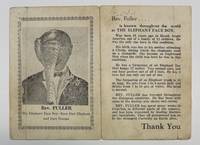
19405368N.p. likely Georgia 1940. Very good. 4pp. on a single folded sheet. Illustrated portrait. Old folds minor wear and soiling. Former owner's pencil inscription and notations on front and rear covers. A seemingly unrecorded and intriguing ephemeral item presumably handed out during a preaching tour of Georgia around 1940 by an extraordinarily obscure African-American minister who billed himself as "Rev. Fuller The Elephant Face Boy." Very little is recorded about Reverend Fuller; the only mention we could locate occurs in the January 8 1940 edition of The Macon News mentioning Fuller's recent appearance in Dawson Georgia about 120 miles southwest of Macon: "Dawsonites listened to an 'elephant-faced' preacher recently when they were visited by 'the Rev. Fuller a colored preacher born part human and part elephant and known throughout the world.' Fuller is said to be the only of 13 children in his family born in his condition. He has a formation of an elephant ear that hangs 17 inches two normal ears and three eyes but can see out of only one. An elephant trunk formation hangs 24 inches."<br /> <br /> The present leaflet echoes some of the language in the news article touting Reverend Fuller as "The Elephant Face Boy -- Born Part Elephant and Part Human" mentioning that he is one of thirteen children "born in this condition" and describing the same physical features. Additionally the work states that Fuller was "born 41 years ago in Brazil South America" and that he was born presumably with elephantiasis "due to his mother attending a Circus during which the elephants went on stampede" after which she became "so frightened that when the child was born he was in this condition." The brochure also states that Fuller "eats from 5 to 6 meals daily and drinks from 7 to 10qts. of water" that his "mind is normal" and he has "traveled throughout the European countries.with some of the leading side shows and circus." The text concludes by mentioning that Fuller has "spent many weeks in Hospitals in different parts of the country and has been examined by leading Doctors and Specialists. They all pronounced him to be the strangest Curiosity on Earth alive."<br /> <br /> Interestingly unlike the newspaper article quoted above the text of the present work does not identify Fuller as someone of African descent. The text is illustrated with a full-page drawing of Fuller on the second page in which about half of his face is obscured. In the illustration Fuller does appear to be of African descent; whether he was born in Brazil of American parents or immigrated to the United States at a later time is unknown. In fact a great deal about Fuller is unknown and the present work provides a wonderful opportunity to dive deeper into the mystery. The leaflet is also interesting for its treatment of Fuller as a medical oddity. No other copies located in trade auction history or institutional records. unknown
192241210Washington D.C.: Published by the United States Coast and Geodetic Survey 1922. Large folding nautical chart printed on heavy paper stock. Colored. A rare original coastal survey of the border between Georgia and South Carolina including Savannah Bluffton Beaufort Hilton Head Island Port Royal Island Phillips Island Fripp Island Hunting Island Edisto Beach and Parris Island.<br/> <br/> Established by President Thomas Jefferson in 1807 as the Survey of the Coast the U.S. Coast and Geodetic Survey was the United States' first civilian scientific agency. This agency has followed its mission to survey the U.S. coastline create nautical charts of the coast and help increase maritime safety since its founding and has often played fascinating roles in significant chapters of U.S. history. It served in all theaters of the Civil War in the service of the Union Army and Navy pioneered acoustic exploration in the wake of the sinking of the Titanic and during WWI it worked to detect enemy submarines. In addition this agency worked to survey and produce detailed maps and renderings of the U.S. coast. These nautical survey maps commonly referred to as "T-sheets" provide fascinating insights into the history of the United States coastline which has and will continue to shift. These maps are the most important data source for understanding the physical and ecological characteristics of the U.S. shoreline. The present map is a highly detailed and accurate sea chart of the coastal border of Georgia and South Carolina and an important historical view of the developing states. Published by the United States Coast and Geodetic Survey unknown
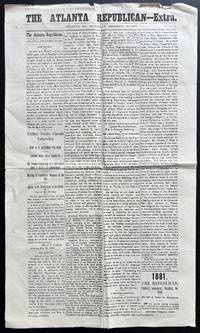
18805904Atlanta: December 18 1880. About very good. Broadside newspaper extra 19 x 11.25 inches. Old folds and creases a bit wrinkled minor soiling minor fraying and light staining to top edge tiny hole at center crossfold. An extraordinarily rare broadside newspaper extra from the only Republican paper in the state of Georgia to survive the end of Reconstruction. The Atlanta Republican was issued weekly between 1874 and 1886 and was devoted to Republican Party causes during Reconstruction. The present extra issue is a ringing endorsement of Hon. Amos T. Akerman 1821-1880 the Republican nominee to a recent open circuit judgeship in the state. Akerman was a Dartmouth-educated jurist who moved south to practice law. He settled in Georgia in 1850 and true to his surroundings owned several slaves and served as a colonel in the Confederate Army. Following the war Akerman became an advocate for Reconstruction and freedmen's rights served as U.S. Attorney for Georgia and eventually worked as President Grant's attorney general crusading against the first incarnation of the Ku Klux Klan during the early 1870s. Though a Republican in Reconstruction Georgia Akerman remained a largely popular figure in the state.<br /> <br /> The present broadside documents a meeting by the Atlanta Bar in which they speak glowingly about the "ability learning and integrity" of Akerman praise his "unswerving fidelity to the Republican Party at the most stormy and trying periods of the struggles of the South" and note both his "manly services in the cause of the true national and human and sentiments and principles in the trying days of reconstruction" and "valuable services to the cause of Republicanism during the last fifteen years." The work also mentions Akerman's volunteer services during a supposed "negro insurrection" in Georgia in the mid-1870s in which Akerman's work "resulted in restoring peace and satisfying the impassioned and infuriated whites that there was no insurrection attempted or contemplated." The Bar calls for united support for Akerman and the broadside concludes with an article about a "Committee of Lawyers appointed to press the claims of Mr. Akerman for the Circuit Judgeship." Despite the strong support statewide Akerman was never able to accept the judgeship had it been offered to him; unfortunately he died three days after the issuance of the present newspaper extra. Still the broadside remains an interesting example of the waning though remaining Republican influence in very late-to-post-Reconstruction Georgia.<br /> <br /> The present newspaper extra is not in the collection of the American Antiquarian Society nor in OCLC but one is apparently located at the University of Georgia's broadside collection. December 18 unknown
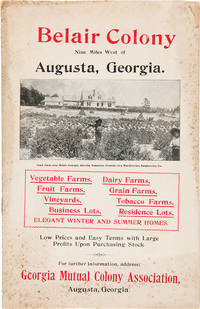
1897WRCAM55574N.p. likely Augusta Ga 1897. 173pp. plus a sample stock certificate from the Georgia Mutual Colony Association laid in. In-text illustrations. Tall octavo. Original pictorial wrappers. Front wrapper soiled around the edges upper corner of front wrapper chipped. Text a bit tanned but clean. Very good. An uncommon promotional for a small agricultural community developed in Georgia in the last decade of the 19th century. The work touts the "extraordinary suitability of the Belair lands for settlement into a prosperous suburban farm and town colony.surrounded by the most favorable conditions and attractive environments." The Belair Colony was comprised of 4000 acres of land near Augusta and most of the directors of the board were Augusta businessmen. The text includes a description of the area in and around Belair and has chapters on the "Plan of Colonization" and the "System of Farming Recommended." The work has numerous photographic illustration showing the Belair railroads housing in the area a "famous spring" in Belair local farmlands watermelon and cantaloupe dealers in Augusta the Richmond County Agricultural Society building a cluster of pears grown near Belair the Augusta high school and fields of sugar cane pears peaches and a poultry farm near Belair. The last three pages include samples of the stock application the title bond and one page of promotional text about Augusta. A sample stock certificate is laid in. OCLC records two physical copies of this rare promotional at Augusta University and the University of Georgia. OCLC 13997010. unknown books
SLIVCN-9781620814253NOVA SCIENCE PUBLISHERS INC (10/2012)
Telephone Talk was the glossy bimonthly publication of the British Columbia Telephone Company. It was written by employees for employees to present information of interest to those engaged in the plant, traffic, commercial, operating, accounting and other departments of the service. Each issue is replete with black and white photos and information on topics such as: company, industry and technological news, traffic levels, expansion plans, personnel announcements, publicity and social events, deaths, weddings, lists of exchanges, and more. As such, these issues serve as a vital preserve of rare and fascinating British Columbia history. This volume covers topics including: Twentieth Year of Telephone Talk; P.A.B.X. for Telephone Company in Vancouver; When this magazine was a bab - by the first editor of Telephone Talk; North-west Telephone Company acquires Prince George System; Hard battle for phone men in rough country along Howe Sound; Christmas gale puts 75% of toll lines out of order; cover photo of 20 ton cable reel for use in Fraser River link in Vancouver-Victoria line; Preparatory work on new trans-gulf cable job nears completion; Speeding Aeroplanes can keep in touch with the earth - two; George Gaetz - Victoria 'heavy' gang foreman; Cover photo of woman demonstrating how to use dial phone; Full page photo of cable barge Brico; First section of new trans-gulf cable successfully laid - 6 pages with many photos; New construction in Victoria; Night work required to build line across Ladner Marsh; The Brico succeeds the Iwalani; Heavy Gang Foreman Andrew Bertram (Andy) Jackson; Land portion of new Victoria-Vancouver cable route now complete - 3 pages with many photos; New Traffic Headquarters in the Georgia Building - several photos; Richmond is thriving Neighbour of big coast cities - photos and text; Picture for Telephone Talk obtained via ship-to-shore phone call; Over half of Trans-Atlantic calls are with Great Britain; We can now talk with South America; Nanaimo heavy gang restores Nanaimo-Victoria service; Vancouver can talk to ship on the Atlantic; Wilfred Calman; 5 page illustrated article announcing completion of Vancouver-Victoria cable; B.C.'s first radiotelephone service now open; Second Calgary Circuit provides Windermere Valley connection; Cable to link Europe with North America; New type of conduit being used for underground work; Record load handled by New Westminster staff; Work on Victoria's central office equipment progressing - many photos; Nice cover photo of the Prince Henry, first passenger ship on the Pacific equipped with dial phone system; New type of pay telephone in Vancouver; Burnaby feature - rapidly industrializing; Bob Perry - Blaster - The Lone Canadian; Ruined Burrard Inlet cable to be replaced; Phone service now available to/from a train; Dunsmuir residence in Victoria speaks with London, England; Dials being placed on Victoria phones - 4 pages with photos; Direct coast and Alberta service now available for Revelstoke; Phone men fight fire which takes 5 buildings in Nanaimo; Dial demonstration popular at Victoria Exhibition; John (Jack) C. Miles; Prince George Reconstruction; Many photos of new Plant and Engineering building in Vancouver; Radiotelephone experiments at coast points successful - 6 pages with photos; William Palliser; Powell River System joins phone family; Trans-Gulf cable now in service; The Terminal and Repeater Equipment of the all-cable toll route - 4 pages with photos; Victoria now using new dial system - photos; Nanaimo high span replaced with submarine cable; Building the B.C. link of the Trans-Canada Line; 17,500 mile link connects Vancouver to Australia; and more. Half-leather binding. Average wear. Ink stamp of company executive E.P. LaBelle upon top edge of text else unmarked. Binding intact. Backstrip almost entirely loose. Book
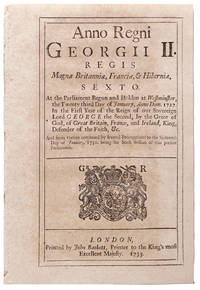
1733319970London: Thomas Baskett 1733. pp. 2 443-455 1 blank. Woodcut seal on the title. Folio. Disbound. Foxing trimmed. pp. 2 443-455 1 blank. Woodcut seal on the title. Folio. This Parliamentary Act authorized a grant of £10000 "for establishing the colony of Georgia in America to be applied toward defraying the charges of carrying over and settling foreign and other Protestants in the said colony" p. 448. The act further authorizes the application of £500000 from the sinking fund to pay off one million South Sea annuities. Not in Sabin Howes Rich Church Streeter or De Renne. Thomas Baskett unknown
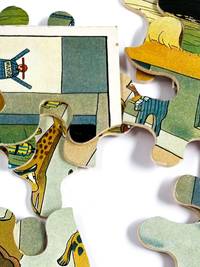
190732022London / New York: Ernest Nister / E.P. Dutton 1907. Fine in very good box. Charming puzzle adaptation of Greenland's illustrations for Georgia Roberts's THE TOY VILLAGE containing one more puzzle than recorded in the standard Nister reference. 10.25'' x 8''. Five wooden puzzles with color illustrations by Greenland in original publisher's cardboard box with pictorial paste-on. Four puzzles listed in Hunt 108. Illustrated instruction sheet mounted to inside of box lid. Minor wear to puzzles. Moderate wear and scuffing to boxes with tears at corners and repairs to lid. (Ernest Nister / E.P. Dutton) unknown
19792279180729014The National Society of Colonial Dames of America in the State of Georgia 1979-01-01. Paperback. Good. Nice looking book has minor edge wear. has light oil stain on rear cover. The National Society of Colonial Dames of America in the State of Georgia paperback
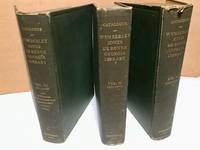
193135372Wormsloe Georgia: Privately Printed 1931. Limited Edition. Hardcover. Good. Large quartos. Three volumes. Green cloth hardcovers with titles on the spines. Untrimmed foredge and bottom edges. Top edges gilt. Volume I 1700-1836: xxxiii 1 448 pages 1. Volume II 1836-1891: x 1 449-896 pages 1. Volume III 1891-1929 and Newspapers Maps & Engravings Bibliography Addenda Index: x 1 897-1396 pages. Illustrated with frontispiece engravings each volume including Wymberly Jones De Renne photograph portrait the library at Wormsloe and the interior view of the library. <br /> <br /> Small tear to the cloth top of volume I. Light edge wear to the cloth top of volume II. Cloth is chipped at the head of volume III. Interior text in all three volumes is in very good condition. On the verso of the right front flyleaf volume I is a tipped in printed presentation page that reads - "Presented to Joseph Leiter Esq. By The Heirs of the Late Wymberly Jones De Renne. Please acknowledge receipt to Stanley Howland P.O. Box 530 Asheville N.C." <br /> <br /> This is a massive collection of Georgia titles eventually placed with the University of Georgia. A great reference set for the Georgia researcher or collector. This set was limited to 300 copies and numbered. This set is numbered 16. Privately Printed hardcover
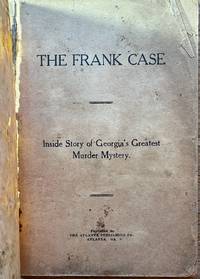
191336796Atlanta: The Atlanta Publishing Company 1913. Soft cover. Poor. Wraps. Approx. 8" x 5". 144 pages. Complete. Wraps are in poor condition. Paper is extremely fragile with multiple chips tears and loss to the covers and spine. A poor earlier glue repair job has left the remains of the covers stained. Covers are mostly detached and at the time of this catalog description are barely attached by old tape repairs. First and last pages are near detached. Page edges for the first few pages are chipped and creased. Browned pages to the text<br /> <br /> This extremely scarce coverage of the Leo Frank Trial was published shortly after the trial was completed. Two years later a mob broke into the Milledgeville prison where Frank was an inmate and kidnapped Frank. The mob drove Frank to Marietta Georgia where he was hanged. From the author name not provided on page 2 - "This work ends with the conviction of Frank in the superior court of Fulton Atlanta county. Trial did not end the case for immediately after the young defendant was sentenced to pay the death penalty a motion for a new trial was made and it will be months probably years before he hangs if he ever does. From the day of conviction however the fight for Frank's life became a technical legal battle. The real story ends with the trial and every essential feature is given here." The last two pages of this narrative express the fears of Atlanta officials if a not guilty verdict and the potential of lynching before the jury reached its guilty verdict. An extremely scarce fragile and period narrative of one of the most violent Civil Rights abuses in Georgia history. No physical copies located in OCLC. No copies showing in auctions or the trade. Leo Frank was a superintendent at the National Pencil Company in Atlanta. He was charged with the murder of Mary Phagan a 13 year old employee of the National Pencil Factory. She was found murdered at the factory on April 26 1913. <br /> <br /> From the New Georgia Encyclopedia: "Based mainly on the testimony of the janitor who had been held in seclusion for six weeks before the trial on orders from Solicitor General Hugh M. Dorsey the jury convicted the defendant. Frank's attorneys were unable to break Conley's testimony on the stand. They also allowed evidence to be introduced suggesting that Frank had many dalliances with girls and perhaps boys in his employ. Atlantans hoped for a conviction. They surrounded the courthouse cheered the prosecutor as he entered and exited the building each day and celebrated wildly when the jurors after twenty-five days of trial found Frank guilty". <br /> <br /> Shortly after the trial concluded the appeals process began. From New Georgia Encyclopedia: "Within weeks of the trial's outcome in early September friends of Frank sought assistance from northern Jews including constitutional lawyer Louis Marshall of the American Jewish Committee. Marshall gave advice about what information to include in the appeal but Frank's Georgia attorneys ignored his counsel. Frank's lawyers filed three successive appeals to the Supreme Court of Georgia and two more to the U.S. Supreme Court all on such procedural issues as Frank's absence when the verdict was rendered and the excessive amount of public influence placed on the jury. Ultimately the U.S. Supreme Court still on procedural grounds denied Frank's appeals; however a minority of two Oliver Wendell Holmes and Charles Evans Hughes dissented. They noted that the trial was conducted in an atmosphere of public hostility: "Mob law does not become due process of law by securing the assent of a terrorized jury." Governor John Slaton of Georgia reviewed the testimony and went to the Pencil factory. After reviewing the case the Governor commuted Frank's sentence in 1915. This infuriated Georgians leading to Atlanta riots and the safety of Frank Slaton. Slaton left the state for 10 years after his term in office ended. In August of 1915 25 leading citizens of Marietta kidnapped Leo Frank and drove him to Marietta where he was hanged. The Atlanta Publishing Company unknown
1795WRCAM839Hartford 1795. 64pp. Gathered signatures stitched as issued. Lightly tanned. Tear in upper margin of final two leaves affecting four words of text else very good. Untrimmed and partially unopened. One of the pamphlets relating to the Yazoo Claims problem. The controversy was a result of the granting of lands by the state of Georgia in the area of present-day Alabama and Mississippi touching on the course of the Yazoo River. This pamphlet was issued by the Georgia Mississippi Company to defend their rights to the lands they were offering for sale in Georgia Alabama and Mississippi. The lands were granted to the Company by the Georgia legislature after extensive bribes changed hands and the case quickly became a major scandal. Georgia rescinded the grant the following year although the case dragged on in court until 1814. According to Everitt Wilkie this was printed in Hartford not Philadelphia as stated in Evans. HOWES G126 "aa." EVANS 28745. STREETER SALE 1158. DE RENNE I p.270. VAIL 1027. COHEN 7867. SABIN 27112. DAH V p.503. REESE FEDERAL HUNDRED 51. unknown books
197721329New York: Atlantic Editions 1977. First edition. Broadside. Fine. Lithograph 26¾ by 34¼ inches finely printed in full color at the Press of A. Colish in Mt. Vernon NY. It features O'Keeffe's 1925 work "Black and Purple Petunias" reproduced in actual size of the original. So far as we know there was but a single printing for the 1977 Santa Fe Chamber Music Festival. Except for a tiny marginal closed tear along the side it is in fine condition. Atlantic Editions unknown books
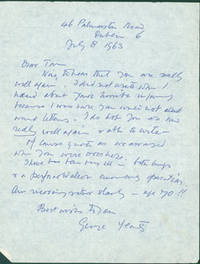
63-4829Dublin Ireland: Georgie Hyde-Lees 1963. Hand-written Letter with original autograph 7" x 9" Single Page Good with tiny marginal tears to top edge creasing.Provenance: Peter Howard Serendipity Books Berkeley. Dublin, Ireland: Georgie Hyde-Lees, 1963. unknown
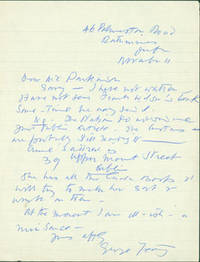
63-4830Dublin Ireland: Georgie Hyde-Lees 1963. Hand-written Letter with original autograph 7" x 9" Single Page Very Good.Provenance: Peter Howard Serendipity Books Berkeley. Dublin, Ireland: Georgie Hyde-Lees, [1963]. unknown
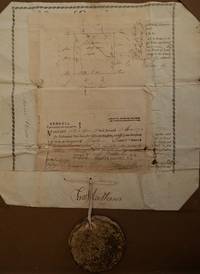
17936592Washington County Georgia 1793-1794. Acceptable. 2 leaves with pendant wax seal. Georgia Land Office grant 33 cm x 33cm signed by Governor George Mathews countersigned by Edward Watts and docketed by Secretary of State John Milton. Attached surveying document 17cm x ~28cm with manuscript plan of property and surveyor's warrant signed by surveyor George Wetherby and endorsed by T. McCall naing chain carriers H. Holley and J. Coleman <br /><br />1000 acres granted to Richmond Dawson by the governor who would in the succeeding years mastermind the Yazoo Land Fraud selling large tracts of land at bargain basement prices to political insiders. The grant for 1000 acres in Washington County is to Richmond Dawson. unknown
66436Fine illustrated and antiquarian Botany . 1st. Ed. thus Pub. Tate. 2016. A portfolio of four colour archival quality prints with supporting illustrated text leaf all housed in publishers solander box. Folio each print measuring 40cm x 30cm. Contents fine. Solander box nr. fine. Out-of-print. In 2016 Tate Modern held an impressive Georgia OKeeffe exhibition and this specially printed portfolio was produced in support of it. The prints illustrate OKeeffes illustrations of Abstraction White Rose Jimson Weed / White Flower No. 1 Jimson Weed and Black Iris. Giclee printed in the UK on Somerset Enhanced 100% cotton rag paper with hand-finished edges. Fine illustrated and antiquarian Botany unknown
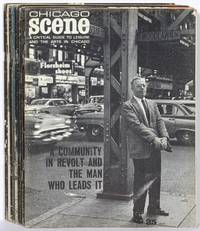
1962596624Chicago: Chicago Scene Publications Inc 1962. Softcover. Very Good. Volume 3 No. 12 - Volume 4 No. 5. Slim small quartos. Heavily illustrated in black and white. General wear each issue with a mailing label and owner signature two issues with inked tic marks next to an article or two and one with a small area of loss to the corner of the first leaf a very good set of a rather uncommon magazine. <br /> <br /> A nice-sized run of an interesting Chicago magazine that covered Chicago politics culture nightlife and restaurants. The magazine prints interviews Bobby Hull Howard K. Smith and is also notable for printing two early articles by noted journalist and foreign correspondent Georgie Anne Geyer: "Birth Control Moves Ahead" and "Woodlawn: A Community in Revolt" the June 1962 cover story about the growing political power of the African-American community of Woodlawn. Issues appear to be uncommon; OCLC locates nine serial entries six in Illinois and show no holdings after Volume 5 Number 2 February 1964 which we presume to be its final issue. An interesting snapshot of Chicago in the early 1960s. Chicago Scene Publications, Inc unknown
192041211Washington D.C.: Published by the United States Coast and Geodetic Survey 1920. Large folding nautical chart printed on heavy paper stock. Uncolored. A rare original coastal survey of the border between Georgia and South Carolina including Savannah Ossabaw Island Wassaw Island Skidway Island Tybee Island. Bluffton Beaufort Hilton Head Island Port Royal Island Phillips Island Fripp Island Hunting Island and Parris Island.<br/> <br/> Established by President Thomas Jefferson in 1807 as the Survey of the Coast the U.S. Coast and Geodetic Survey was the United States' first civilian scientific agency. This agency has followed its mission to survey the U.S. coastline create nautical charts of the coast and help increase maritime safety since its founding and has often played fascinating roles in significant chapters of U.S. history. It served in all theaters of the Civil War in the service of the Union Army and Navy pioneered acoustic exploration in the wake of the sinking of the Titanic and during WWI it worked to detect enemy submarines. In addition this agency worked to survey and produce detailed maps and renderings of the U.S. coast. These nautical survey maps commonly referred to as "T-sheets" provide fascinating insights into the history of the United States coastline which has and will continue to shift. These maps are the most important data source for understanding the physical and ecological characteristics of the U.S. shoreline. The present map is a highly detailed and accurate sea chart of the coastal border of Georgia and South Carolina and an important historical view of the developing states. Published by the United States Coast and Geodetic Survey unknown
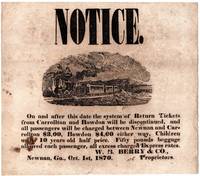
187012823Newnan Ga: October 1 1870. Broadside 7.75 x 9 inches with engraved vignette at center. Old folds moderate foxing and dust-soiling light staining. Short closed tear to bottom edge. Overall very good. A delightful mid-19th-century Georgia railroad broadside advertising changes to the ticketing system for one of the southern rail lines owned by William Byrd Berry. Here rates for travel between Berry's hometown of Newnan and Carrollton or Bowdon are specified and the rates for children under the age of 10 are noted as half price. Further the broadside stipulates baggage is capped at fifty pounds and the excess will be charged "Express rates." The work is signed in type by "W.B. Berry & Co." and dated October 1 1870 in Newnan. The text is enhanced with a striking central vignette of a locomotive pulling several railcars through a mountainous region. William Byrd Berry 1831-1902 was a prominent businessman and landowner born and raised in Newnan Georgia. He served as president of various banks and was involved in a number of railroad interests in the state. As far as we can tell the present broadside is unrecorded. October 1 unknown
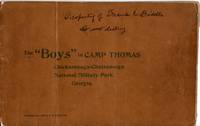
189813100Chattanooga TN: Sidebottom & Kerr 1898. 48pp. Slim oblong octavo. Original orange-tan wrappers printed in black stapled. Wrappers soiled creased and chipped with contemporary ownership inscription on front wrapper. First and last leaves detached from text block text block itself detached from wrappers. Good only. A scarce historical photobook that doubles as a catalogue for a Chattanooga photography studio at the outset of the Spanish-American War. Named after Union General George H. Thomas Camp Thomas was a massive temporary military training facility established at the Chickamauga Battlefield in Georgia during the Spanish-American War. The camp hosted up to 70000 troops but became a national scandal after deadly disease outbreaks. The work features seventy total monotone photographs from third-page to full-page with brief printed captions and plate sizes memorializing various scenes at Camp Thomas in 1898. The subjects of the photographs include military structures scenes on the training ground soldiers from various state units in small and large groups soldiers hosting local visitors the large corral of horses at the camp monuments inside the camp / national park views of the natural scenery and more. According to explanatory text on the inside front wrapper "the main idea is to show by photograph such scenes of every day occurrence; routine work both on and off duty as will give nearest a correct idea of what the life of a soldier in camp is made of or as you would see him were you on the grounds in person."<br /> <br /> The rear wrapper reveals an additional motivation for the publication of the work in the form of instructions for ordering any of the photographs featured within. Such is the reasoning behind the plate sizes listed by each example. The Chattanooga studio Sidebottom & Kerr states that "Every Plate in this Book was made expressly for it and having the negative can furnish upon short notice photograph of any plate." The company offers to send the catalogue free of charge to anyone east of the Rocky Mountains. A scarce and unusual photobook that does double duty as a Tennessee photographic studio's order book. OCLC reports just eight total institutional holdings. Sidebottom & Kerr unknown