RussiaBiblio.com
RussiaBiblio.com
The Cabinet Cyclopædia Vol. 3
1330027108.Gpaperback. Good. Access codes and supplements are not guaranteed with used items. May be an ex-library book. paperback
Bonita · États-Unis58,68 $US≈ 49,65 €
642 résultats
1995055257Russia. very nice copy; larger-format . Near Fine. Hardcover. 1st Edition. 1995. Russia hardcover
1995055258Russia. very nice copy; larger-format . Near Fine. Hardcover. 1st Edition. 1995. Russia hardcover
1966ZB1278337London Math Soc 1966. Russian Mathematical Surveys. v. 21; 22; 25; 27; 32; 33; 34; 35 including postage to Germany. - If you are reading this this item is actually physically in our stock and ready for shipment once ordered. We are not bookjackers. Buyer is responsible for any additional duties taxes or fees required by recipient's country. Photos available upon request. London Math Soc unknown
1330027108.Gpaperback. Good. Access codes and supplements are not guaranteed with used items. May be an ex-library book. paperback
ria9783337351137_inpPaperback. New. New Book; Fast Shipping from UK; Not signed; Not First Edition; World's Columbian Exposition 1893 Chicago - Catalogue of the Russian section is an unchanged high-quality reprint of the original edition of 1893. Hansebooks is editor of the literature on different topic areas such as research and sc paperback
B9783337351137Paperback / softback. New. paperback
3337351131.Gpaperback. Good. Access codes and supplements are not guaranteed with used items. May be an ex-library book. paperback
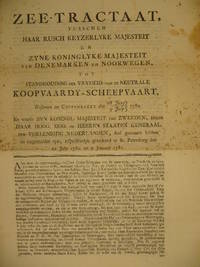
#[33546]Amsterdam H.W. & C. Dronsberg 1781. Folio. 4 pp. Sea-treaty between Russia Denmark and Norway concluded in Kopenhagen in 1780. Sweden and the Netherlands became a party to the treaty in St. Petersburg. - Some staining. - Rare. Knuttel 19490. unknown
5891230488.Ghardcover. Good. Access codes and supplements are not guaranteed with used items. May be an ex-library book. hardcover
5907850086.Ghardcover. Good. Access codes and supplements are not guaranteed with used items. May be an ex-library book. hardcover
5720503935.Ghardcover. Good. Access codes and supplements are not guaranteed with used items. May be an ex-library book. hardcover
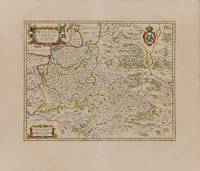
1664200038AG1664. Amsterdam Blaeu c.1664. Original hand-coloured engraving. Plate Size: 48.7 cm x 38.6 cm. Sheet Size: 65.2 cm x 55.7 cm. Original map. In very good clean condition. Wide margins. Latin text on reverse. Koeman II 1803:2. From: J. Blaeus Grooten Atlas oft Werelt- Beschryving in welcke 't Aerdryck de Zee en Hemel wort vertoont en beschreven. Amsterdam J. Blaeu 1664. Van der Krogt 2 621. Beautiful map of mid-17th Century Russia published during the reign of Tsar Alexis of Russia of the Romanov Dynasty as Moscow vied for regional hegemony with the PolishLithuanian Commonwealth and Sweden. 'Mosqua' Moscow is in the lower right corner. Smolesnsk is just squeezed in within the maps lower border. Novogorod can be seen just below the outflow of Lake Ilmen. In the upper left lies Estonia and the Gulf of Finland. Below this is the 'Livonia' region which is now between Latvia and Estonia. The regions listed as 'Ingria' and 'Careliae Pars' on the map were then under the control of the Swedes. The Russians would eventually seize this territory and dominance of the Baltic and build their new capital St. Petersburg there. This lay in the future. The map's political delineation shows the westward extent of Moscow's reach. 'Lithva' in the lower left of the map was then within the territory of Polish-Lithuanian Commonwealth. This region is now modern-day Belarus: 'Witespk' is now the Belarussian city of Viciebsk. Relief depicted pictorially and the historic place-names are in Latin. The cathedral cities such as Pereslaw Pereslavl-Zalessky and Ieroslaw Yaroslavl and Pseskow/Pskouwa Pskov are depicted. With numerous deers and foxes seen across the map the mapmaker indicates that this is a vast region still untamed. In the 'Megrina' province the mapmaker shows a bear-hunt at its deadly denouement. The map is covered with forested areas and vast waterways such as the Volga and Volkhov and Daugava/Dvina 'Duna flu' Dnieper Boristenis Flu rivers and a patchwork of lakes such as Lake Peipus and 'Biela Osera' Rybinsk Reservoir. Large decorative title cartouche accompanied with busts of moose and deer in the left top corner of the map. The eagles of the Russian coat of arms look east and west from the top right corner of the map. In the lower left corner an ornate cartouche contains two milliaria bar scales. Blaeu as it is noted on the cartouche based the map on the travels and maps of Isaac Massa. Isaac Abrahamszoon Massa 1586 - 1643 was a Dutch grain trader traveller and diplomat the envoy to Muscovy. He wrote memoirs related to the Time of Troubles and created some of the earliest maps of Eastern Europe and Siberia. Massa in Moscow witnessed the second half of Boris Godunov's reign during which a civil war broke out now known as the Time of Troubles. He survived the capture of Moscow by False Dmitriy I and left Russia in 1609 before the fall of Tsar Vasily Shuysky. Massa compiled an account of the 16011609 events Dutch: Een cort Verhael van Begin en Oorspronk deser tegenwoordighe Oorloogen en troeblen in Moscovia totten jare 1610 which he presented to Stadtholder Maurice. In 16121613 Massa published two articles on Russian events and the geography of the Land of Samoyeds accompanied by a map of Russia which were published in an almanac edited by Hessel Gerritsz. His notes on his various travels have been published in conjunction with maps made by the explorer Henry Hudson. Massa is credited with five published maps of Russia and its provinces the last ones compiled around 1633 and two maps of Moscow city including the schematic account of the 1606 battle between Vasily Shuysky and Ivan Bolotnikov's armies. He returned to Russia in 1614 and became an active agent in a myriad of diplomatic and commercial schemes and endeavours between Western states and companies and Moscow. Massa a wealthy and prominent man of the world has been the subject of several portraits by Dutch painter Frans Hals. Wikipedia Willem Janszoon Blaeu 1571-1638 was a Dutch cartographer atlas maker and publisher. Along with his son Johannes Blaeu Willem is considered one of the notable figures of the Netherlandish/Dutch school of cartography in its golden age the 16th and 17th centuries. Blaeu set up his mapmaking and publishing business in Amsterdam where he sold instruments and globes published maps and edited the works of intellectuals like Descartes and Hugo Grotius. In 1633 he was appointed map-maker of the Dutch East India Company. In 1635 he released his atlas Theatrum Orbis Terrarum sive Atlas novus. Willem died in 1638. He had two sons Cornelis 1610-1648 and Johannes 1596-1673. Joan trained as a lawyer but joined his father's business rather than practice. After his father's death the brothers took over their father's shop and Joan took on his work as hydrographer to the Dutch East India Company. Later in life Joan would modify and greatly expand his father's Atlas novus eventually releasing his masterpiece the Atlas maior between 1662 and 1672. Wikipedia unknown
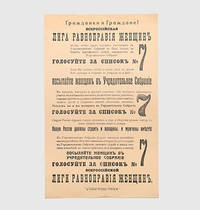
1917134554Petrograd: Tsentr. Tipograf 1917. A new Russia should be built by women and men together A remarkable survival of a flyer printed by the All-Russian League of Equal Rights for Women for their political campaign for the election to the Constituent Assembly in November 1917. The League participated in elections as its own party under the number 7. In English the flyer text reads: ''Female Citizens and male citizens! The League of Equality for Women wishing that the right of women to participate in the Constituent Assembly was not only on paper expose its candidates to the Constituent Assembly. Vote for the list number 7. If you want our children not to grow up without a home and the old people to not die on the street - send women to the Constituent Assembly. In America Australia and other countries where women take part in the drafting of laws the number of schools is multiplied prisons are empty debauchery and drunkenness noticeably diminish the protection of children and the elderly is fully secured by law. Let's send women to the Constituent Assembly too. The old Russia was built only by men and the grief and misfortunes of the motherland were always shared with them by mothers wives and daughters. A new Russia should be built by women and men together! The most important Russian laws will be written in the Constituent Assembly. From the laws that will be created in the Constituent Assembly the fate and life of many generations depends not only on men but also on women and so send women to the Constituent Assembly.''. The campaign for women's political rights in Russia termed the ''women's liberation movement'' became possible only with the beginning of the revolution in 1905 when the question of the democratization of the political system arose. The oldest women's association in Russia the All-Russian Women's Mutual Charity Society established in 1895 was actively involved and new organizations were created: the Union for the Equality of Women 1905 Women's Progressive Party 1905 and the All-Russian League of Equal Rights for Women 1907. The most influential organization was the first the Union which had 48 offices in various cities across Russia and actively conducted agitation among women workers and peasants. After its disintegration the League of Equal Rights for Women became its successor. Members of the League deliberately abandoned the broad political programme and focused their attention only on suffragist demands practising agitation tours through the provinces Orel Saratov Rostov-on-Don Kremenets Tomsk Kiev Simferopol and Narva. As a result branches of the League emerged in many cities including Moscow 1910 Kharkov 1912 Tomsk 1914 and Yekaterinburg 1914. This included the establishment of the following departments: a reading room for street children with a view to preventing child prostitution; a publishing committee that printed cheap pamphlets and books on women's issues; and an editorial commission that published the proceedings of the congress. Every day reports were given on the issues of women's equality in the League's premises. After the February Revolution delegates from the League repeatedly met with the leaders of the Soviet of Workers' and Soldiers' Deputies on the issue of women's suffrage. Despite initial promises of support they refused to immediately act on granting political rights to women. In response the League organized the famous mass march on 20 March 1917 which brought together about 40000 women. To that date it was the most numerous and memorable stand by the Russian women's movement and resulted in the adoption by the Provisional Government of a decree on universal suffrage which was passed on 20 July 1917. Single-sided flyer 365 x 220 mm. In near-fine condition. unknown
0666977690.Ghardcover. Good. Access codes and supplements are not guaranteed with used items. May be an ex-library book. hardcover
RGW19426AAquatint with original hand-colouring from 'A Picture of St Petersburgh represented in a collection of Twenty interesting Views of the City the Sledges and the People . . .' unknown
RGW19683Aquatint with original hand-colouring from 'A Picture of St Petersburgh represented in a collection of Twenty interesting Views of the City the Sledges and the People . . .' unknown
RGW19427AAquatint with original hand-colouring from 'A Picture of St Petersburgh represented in a collection of Twenty interesting Views of the City the Sledges and the People . . .' unknown
RGW20400Aquatint with original hand-colouring from 'A Picture of St Petersburgh represented in a collection of Twenty interesting Views of the City the Sledges and the People . . .' some fading to colouring unknown
B9781345728569Hardback. New. hardcover
A9781345728569Hardback. New. hardcover
0428306128.Ghardcover. Good. Access codes and supplements are not guaranteed with used items. May be an ex-library book. hardcover
0484991124.Gpaperback. Good. Access codes and supplements are not guaranteed with used items. May be an ex-library book. paperback
0266273548.Ghardcover. Good. Access codes and supplements are not guaranteed with used items. May be an ex-library book. hardcover
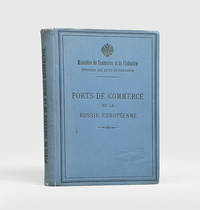
1908189307St- Petersburg: R. Golicke & A. Willborg for the Ministère du Commerce et de l'industrie 1908. Havens for Tsarist maritime commerce First and only edition. Officially sanctioned painstaking survey of the Russian ports of Europe recorded at the height of their influence. Rare WorldCat locates a single copy in the University of Genoa. Altogether sixty-five ports are described in great detail accompanied by photographs plans and engineer's sections for aspects of their construction. This sort of close scrutiny would very soon be confined behind a wall of Soviet state secrecy. The report covers the White Sea Black Sea Baltic Sea and Sea of Azov; more than a half of the ports analyzed are now located outside of Russia in the Baltic states Ukraine and Georgia. This volume was never intended for general distribution but rather was passed through official channels a presentation of the ports as a manifestation of the of Russian Empire's influence on European maritime commerce. Finely produced the presswork was carried out by R. Golicke & A. Willborg a house known for its involvement in Russian livres d'artiste and other fine editions the binding was commissioned from the workshop of M. Uleman small gilt on white ticket to the front pastedown. Two pre-Revolutionary ink stamps to the title page one repeated on the front cover. Crossed out on the title is of that of the Imperial Library of the Central Statistical Committee of Ministry of Internal Affairs the repeated stamp is for "Professor Emeritus of the St Petersburg Institute of Communication Routes Vsevolod Evgenievich Timonov". Timonov 1862-1936 was a hydraulic engineer hydrologist and transportation engineer typical of the intended constituency for the volume. From 1886 to 1895 he served in the Ministry of Railways working on the Commission for the Construction of Commercial Ports. During this time Timonov supervised the first work on the construction of stone block breakwaters for ports on the Baltic 1887 organized and implemented the initial marine dredging works there 1889 explored the mouths of the Dnieper Don and Volga rivers 1890 selecting the branches for development drew up a project for improving the rapids on the Dnieper carrying out exploratory work on one section 1894 explored the shores of the Pacific Ocean to assist in the selection Vladivostok as the location for the Pacific port terminal of the Siberian railway and explored the rivers of the Amur region developing measures to increase navigability 1895. Octavo 280 203 mm. pp. 24 33 94 128 91 vii. Printed throughout on coated paper numerous half-tone illustrations maps and plans to the text large folding three-colour printed map 695 x 560 mm retained by a band at the rear endpaper. Original light greenish blue cloth lettered in black on the spine and front cover French fillet panel to both covers in black to the front in blind on the back light greenish grey endpapers. Slightly rubbed and a little bumped some short splits to head and tail of the spine endpapers a touch browned at the edges; text-block marginally toned but clean and sound; very good. hardcover
ria9781019196748_inpHardcover. New. New Book; Fast Shipping from UK; Not signed; Not First Edition; N/A hardcover