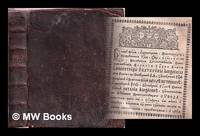
[RUSSIA]. [SLAVONIC LITURGY].Biblio.com
642 résultats
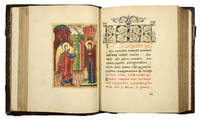
94903Russia 1866. . 4to 23 x 185 cm. Illuminated manuscript on paper ff. 4 index 4 blank 344 17 lines per page alphabetic signatures and pagination of Cyrillic alphabetic numerals 35 full-page illuminations in watercolour 36 headpieces in black and gold with first lines in gilt; occasional light spotting and soiling mostly marginal. Contemporary gilt-stamped red morocco gilt spine with raised bands edges gilt and gauffered gilt endpapers; slightly rubbed lacking both clasps.<br /> An exceptionally fine example of an Old Believer liturgical book beautifully illustrated with 35 full-page illuminations.<br /><br />Created by a skilful master they depict in great detail the most significant events of the New Testament including the Annunciation the Nativity the Baptism of Christ the Ascension the Twelve Apostles and more.<br /><br />This volume was made for and used by Old Believers who separated from the official Russian Orthodox Church as a protest against church reforms introduced by Patriarch Nikon of Moscow between 1652 and 1666. These Old Believers refused to accept alterations and amendments to the Holy texts aimed at bringing their religious practice closer to the 'original' Greek Orthodoxy. They refused to allow sacred texts to be printed instead reproducing them as manuscripts. <br /><br />The large size of this book its high-quality paper neat script very detailed illuminations and attractive gilt binding prove beyond doubt that no expense was spared on its production. As the colophon indicates it was made for Evdokiia Ivanovna Babaeva the wife of a merchant in Kolomna which was then an important trade point near Moscow. There are records of several men with this surname in Kolomna during the mid-XIX century all of them owners of factories in the city and probably members of the same wealthy merchant family. Kolomna was also important as a centre of the Old Believer community. The city's Bishop Paul fiercely opposed Patriarch Nikon's reforms and was consequently stripped of the rank of Bishop exiled and eventually killed in 1656 rendering him a martyr in the view of many Old Believers.A century later 156 Old Believers were officially registered in Kolomna then a city of 5400 inhabitants. Many more practised their beliefs in secret to avoid persecution.<br /><br />This volume later belonged to Cornelius J. Hauck 1893-1967 whose outstanding and somewhat eclectic collection was formed with the help of the well-respected antiquarian bookseller Emil Offenbacher between 1945 and 1965. The collection was given to the Cincinnati Historical Society Library in 1966 where it remained largely unknown to the world until part of it was auctioned by Christie's in New York in 2006.<br /><br />Russian manuscripts of this quality and preserved in such pristine condition are extremely rare.<br /> S.S. Mikhailov Istoriya staroobriadchestva g. Kolomna i ego okrestnostey Kolomna Staroobriadcheskaya obshchina khrama Nikoly na Posade v g. Kolomna 2013. Russia, [1866]. hardcover
1815120459London: Printed for Edward Orme 1815. Magnificent hand-coloured views of St Petersburg First edition "one of the most beautiful plate books of St Petersburg" Bobins Collection offering a wonderfully evocative picture of the city in the wake of the Napoleonic Wars issued during the lifetime of one of its most famous inhabitants Alexander Pushkin. Published at 6 guineas coloured this is a superb record of the city of Peter the Great and is divided into two sections: the first 12 plates represent the months of the year through characteristic views of the city; the other 8 illustrate different modes of transport various types of sledges and carriages but include excellent character studies showing diverse types of costume by class and by season. The 26-page introduction entitled "The present state of St Petersburgh" includes a brief historical survey and a few statistics along with descriptions of the main sites and monuments. "Though unsigned the letterpress was chiefly compiled from Robert Ker Porter's Travelling Sketches in Russia and Sweden during the years 1805-1808 as many sections repeat his text verbatim" Giroud p.72. Mornay the artist responsible for the original sketches upon which Clark and Dubourg's aquatints were based eludes identification and does not appear in Thieme-Becker. Martin Hardie in characteristically waspish fashion describes the plates as "lurid in colouring very much in the style of toy theatre scenery" English Coloured Books 1906 p. 138; this is entirely unfair the colouring in the present copy is certainly not "lurid" and the "toy theatre" quality of the views only lends them a most appealing charm: many of them are composed in such a way that they resemble vues d'optiques - symmetrical and theatrical middle-distance perspectives - which combine well with the small scaling figures staffage adding splashes of bright colour against backgrounds of snowy streets grey skies and yellowish-brown buildings of this "city of stone" forming a satisfyingly picturesque effect. Two of the buildings shown - the Exchange 1809 and the Kazan Cathedral 1811 - had only recently been completed. Edward Orme - "Publisher to His Majesty and HRH the Prince Regent" - was "after Rudolph Ackermann the most important publisher of illustrated books during the short golden age of the coloured aquatint" ODNB. He would have had a prudent eye on the visit of the Allied sovereigns to London in June 1814 which celebrated the Treaty of Fontainebleau 11 April 1814 and the peace following the defeat and abdication of Napoleon. Among them was Tsar Alexander I who stayed with his sister the Grand Duchess of Oldenburg at the Pulteney Hotel on Piccadilly. "In 1809 Edward Orme had begun buying land and property in Bayswater London. He exploited the gravel deposits built houses and in 1818 added a chapel of ease. Orme Square developed between 1823 and 1826 was named after him and Moscow Road and St Petersburgh Place nearby may have commemorated the state visit of Tsar Alexander I in June 1814. In the following year he published a volume of twenty coloured aquatint views of St Petersburg and the reference in his will to jewellery presented to him by the emperor of Russia may be connected with these events" ibid. This is a marvellous survey of one of the world's great cities captured at the time when it served as the backdrop for Tolstoy's War and Peace. Folio 469 x 310 mm. Additional engraved title page incorporating a large double-headed Russian eagle 20 hand-coloured aquatint plates by Clark & Dubourg after Mornay; watermarks: plates J. Whatman 1825 text W. Balston 1813. Late 19th-century dark brown morocco-grain half skiver professionally refurbished marbled sides gilt edges drab grey endpapers. From the library of noted bibliophiles Maxine and Joel Spitz with their "Trail Tree" bookplate Joel Spitz was a member of Chicago's prestigious Caxton Club. Light offsetting from frontispiece to engraved title. An excellent copy the plates fresh and bright and with the four leaves of explanation of the plates in French and English. Abbey Travel 226; Bobins Collection 203; Tooley 355; Vincent Giroud St. Petersburg: A Portrait of a Great City Yale University Press 2003. unknown
110232. <br/><br/><em>An account of Jean Francois Gamba 1763-1833 French Consul at Tiflis describing his journey along the Black Sea littoral and into the Caucaus. Provenance: Gösta Nobel 1886-1955. Gösta Nobel was the youngest son of Ludvig and Edla Nobel. He took over as Branobel`s Managing Director at the time of the Russian Revolution and had to flee Russia in 1918. Branobel or The Nobel Brothers Petroleum Company was founded by Robert and Ludvig Nobel in Baku in 1876. </em> unknown
1803ST15927London: Cadell and Davies 1803. ONE OF 60 LARGE PAPER COPIES of the "considerably enlarged" Fourth Edition ours a variant retaining the date of 1803 on the title-page rather than 1804. 330 x 252 mm. 13 x 9 7/8". xviii 4 xix 1 380 pp. Two leaves usually bound at the end and containing the "List of Principle Books Referred to in this Work" and "Works by the same Author" bound between pp. xvii and xix here. <br/> VERY FINE CONTEMPORARY SPRINKLED CALF raised bands flanked by plain and decorative gilt rules and chain roll spine panels with star centerpiece red morocco label marbled endpapers. With six engravings: five maps two folding and one view. A Large Paper Copy. Front pastedown with engraved armorial bookplate of Marcus Gage; title page with ink inscription at head: "M. Gage's Book got from Mr. Asperne London April 15th 1805." Lada-Mocarski 29 note; Howes C-834; Sabin 17309; Streeter VI 3501; Cordier Bibliotheca Sinica pp. 2447-48. ◆Small chip to tail of spine corners a bit rubbed flyleaves somewhat foxed the usual minor foxing to plates and a bit of offsetting to adjacent pages otherwise A VERY FINE COPY OF AN ESPECIALLY DESIRABLE EDITION clean and fresh internally with vast margins and the binding firm lustrous and with only very minor wear to the joints.<br/> <br/> This is an extremely well-preserved copy in an elegant contemporary binding of the most sought-after edition of a key source on Russian exploration and that country's efforts to expand trade with China and Alaska. Eminent historian William Coxe 1747-1828 studied the voyages and exploration by Bering and others to the regions of Kamchatka the Aleutian Islands and Siberia to prepare this overview of the geography and cultures of the lands between Russia and North America and to analyze the economic potential of trade--particularly in furs--with the region. According to Sabin "Mr. Coxe's book contains many curious and important facts with respect to the various attempts of the Russians to open a communication to the New World." The 1780 first edition of this work covered Russian voyages of discovery between 1740 and 1769; the 1787 third edition added a supplement comparing these explorations to those of Captains Cook and Clerke. Our much-expanded fourth edition gives in the words of the Preface "a complete series of voyages from 1711 to 1792 comprising all that is known on the subject." Some of this supplementary information was gleaned from earlier accounts by German historians G. F. Muller and P. S. Pallas and some from Coxe's own travels in Russia. According to Lada-Mocarski Coxe "also succeeded in securing additional material: for instance the narrative and maps of Krenitzin and Levashev's 'secret' expedition the first official Russian government expedition since Bering's 2nd expedition of 1741. He was able to secure this particular information not widely known at the time even in Russia from Dr. Wm. Robertson who in turn obtained it through his friend Dr. Rogerson first physician to the Empress Catherine II. . . . In view of the above additions one should consider the fourth edition of 1803 as the most desirable." He concludes: "Coxe's work particularly the fourth edition is a result of contemporary and authoritative sources translated into English not to be overlooked by scholars and collectors alike." There are also distinct aesthetic advantages to the present Large Paper version over the octavo printing. Not only is the type beautifully re-set and laid out as well as surrounded by vast margins but as Streeter notes there are two charts here that are not included in the octavo issue of 1803. The original owner of this volume Marcus Gage is known to have assembled a substantial library of beautifully cared-for books on travel and discovery see for example "Exploration & Discovery 1576-1939 Books from the Library of Franklin Brooke-Hitching" passim. Gage notes that he got the book from "Mr. Asperne"—no doubt the London publisher and bookseller James Asperne 1757-1820. ABPC and RBH find just four other Large Paper copies at auction in the past 45 years two of which had condition issues. One could wait a considerable time to find a copy as attractive and desirable as the present one. Cadell and Davies unknown
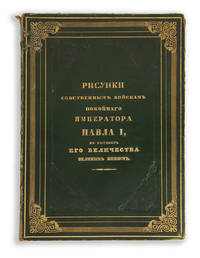
109898St. Petersburg Lithographic Department of the Military Settlement 1835. . First edition small folio 31 x 22 cm; lithographic title and 10 unnumbered coloured by contemporary hand title soiled at foot where mark of ownership erased bottom corners of leaves with very light staining pl. 7 with printed Russian caption and early manuscript German translation; contemporary green Russian morocco upper cover lettered in gilt both covers with elaborate panelling in gilt and blind flat spine in gilt panels gilt turn-ins blue endpapers gilt edges extremities rubbed tiny split in joint at head of spine a fine copy.<br /> Remarkably fine series of hand-coloured prints of military costumes after Paul I in an exceptional contemporary Russian binding. The book was printed at the personal bequest of his son Tsar Nicholas I in an incredibly small edition. The short reign of Paul I ended with his murder in 1801 and was marked by his obsession with dress uniforms. All ten of the figures in this rare suite are drawn in the same posture at attention with arms firmly clasped to sides and though this gives them a slightly doll-like quality they are painstakingly and beautifully coloured by a contemporary hand. Nicholas I viewed his father with deep reverence and also admired the pomp and order of the Imperial army this publication was an attempt to honour his father's legacy.<br /> [St. Petersburg], Lithographic Department of the Military Settlement, 1835. unknown
178089640Saint Petersburg: Sans nom d'éditeur 1780. Fine. Sans nom d'éditeur Saint Petersburg 1780 20.8 x 27 cm Relié Very rare first edition of the new laws enacted in 1775 by Catherine II Empress of Russia here translated into Turkish for the recently annexed Turkic-speaking provinces taken from the Ottoman Empire.The work is divided into two parts: the first dated 12 November 1775 comprises the first 28 chapters pp. 1190; the second contains chapters 29 to 31 pp. 191248.Contemporary-style half mottled sheep with small corners unlettered spine with five raised bands decorated with double gilt fillets and gilt thistle tools marbled paper boards red edges modern binding.Pale marginal dampstaining to the upper right corner of the initial leaves. Sans nom d'éditeur hardcover
1960475Marc Chagall B. 1887 VITEBSK RUSSIA; D. 1985 SAINT-PAUL-DE-VENCE FRANCE DRAWINGS FOR THE BIBLE as published for Verve.<br /> Verve Vol. X no. 37/38. 1960. Text by Gaston Bachelard. Folio. With 24 original lithographs in color including the cover by Chagall and 96 reproductions in black and white. Complete as issued. Verve hardcover
110201The second edition corrected. London Printed for John Starkey and Thomas Basset 1669. Folio. 20 316 6 232 9 1 blank pp. Additional engraved title-page. 2 engraved portraits. 6 engraved folding maps 2 with neatly repaired tear. Contemporary vellum. Red labels. Joints skilfully repaired. New endpapers. . <br/><br/><em>Originally published in 1662. This is the second English edition. </em> hardcover
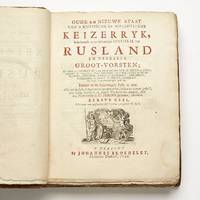
110601Utrecht Johannes Broedelet 1744. 4to. 16 1-296 2 1-200 2 blank 2 201-501 1 blank 2 503-830 2 blank pp. 4 title-pages printed in red and black with engraved vignette. 3 folding engraved maps. 1 folding engraved plan. 1 folding table. 3 folding engraved plates. Contemporary half calf with five raised bands. Gilt spines. Occasional minor spotting and dampstaing. . <br/><br/><em>Provenance: Gösta Nobel 1886-1955 was the youngest son of Ludvig and Edla Nobel. He took over as Branobel`s Managing Director at the time of the Russian Revolution and had to flee Russia in 1918. Branobel or The Nobel Brothers Petroleum Company was founded by Robert and Ludvig Nobel in Baku in 1876. </em> hardcover
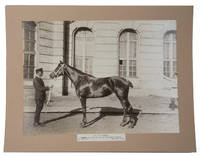
1900L7NBLF1PS3N8Russia 1900. Each photo ca. 27 x 37 cm. Pasted on cardboard. Series of 12 fine large and sharp photographs of Russian race horses. Pasted below each photo a slip with text written in cyrillic script names the horse owner pedigree and breed of horse in the photograph. Each horse is accompanied by a man holding the reins dressed in possibly a matching costume. They were all photographed at the same track in the yard of what seems to be a palace. The names of the horses are: Prezes Jako Velizarij Fanfara Taran Lenta Mon Barry Karina Lusty Nord-Ost Lena and Forteca.With a blind stamped signature of the photographer unidentified by us. Paperboard supports slightly warped. One photo with a minor tear otherwise all in very good condition. unknown
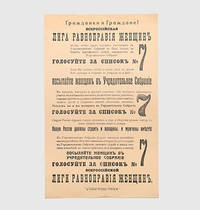
1917134554Petrograd: Tsentr. Tipograf 1917. A new Russia should be built by women and men together A remarkable survival of a flyer printed by the All-Russian League of Equal Rights for Women for their political campaign for the election to the Constituent Assembly in November 1917. The League participated in elections as its own party under the number 7. In English the flyer text reads: ''Female Citizens and male citizens! The League of Equality for Women wishing that the right of women to participate in the Constituent Assembly was not only on paper expose its candidates to the Constituent Assembly. Vote for the list number 7. If you want our children not to grow up without a home and the old people to not die on the street - send women to the Constituent Assembly. In America Australia and other countries where women take part in the drafting of laws the number of schools is multiplied prisons are empty debauchery and drunkenness noticeably diminish the protection of children and the elderly is fully secured by law. Let's send women to the Constituent Assembly too. The old Russia was built only by men and the grief and misfortunes of the motherland were always shared with them by mothers wives and daughters. A new Russia should be built by women and men together! The most important Russian laws will be written in the Constituent Assembly. From the laws that will be created in the Constituent Assembly the fate and life of many generations depends not only on men but also on women and so send women to the Constituent Assembly.''. The campaign for women's political rights in Russia termed the ''women's liberation movement'' became possible only with the beginning of the revolution in 1905 when the question of the democratization of the political system arose. The oldest women's association in Russia the All-Russian Women's Mutual Charity Society established in 1895 was actively involved and new organizations were created: the Union for the Equality of Women 1905 Women's Progressive Party 1905 and the All-Russian League of Equal Rights for Women 1907. The most influential organization was the first the Union which had 48 offices in various cities across Russia and actively conducted agitation among women workers and peasants. After its disintegration the League of Equal Rights for Women became its successor. Members of the League deliberately abandoned the broad political programme and focused their attention only on suffragist demands practising agitation tours through the provinces Orel Saratov Rostov-on-Don Kremenets Tomsk Kiev Simferopol and Narva. As a result branches of the League emerged in many cities including Moscow 1910 Kharkov 1912 Tomsk 1914 and Yekaterinburg 1914. This included the establishment of the following departments: a reading room for street children with a view to preventing child prostitution; a publishing committee that printed cheap pamphlets and books on women's issues; and an editorial commission that published the proceedings of the congress. Every day reports were given on the issues of women's equality in the League's premises. After the February Revolution delegates from the League repeatedly met with the leaders of the Soviet of Workers' and Soldiers' Deputies on the issue of women's suffrage. Despite initial promises of support they refused to immediately act on granting political rights to women. In response the League organized the famous mass march on 20 March 1917 which brought together about 40000 women. To that date it was the most numerous and memorable stand by the Russian women's movement and resulted in the adoption by the Provisional Government of a decree on universal suffrage which was passed on 20 July 1917. Single-sided flyer 365 x 220 mm. In near-fine condition. unknown
1698112625London: R. Baldwin 1698. First edition of this work. Octavo bound in modern wrappers 28 pages. In very good condition with some browning and toning to the text. Rare with no other examples appearing at auction in the last 80 years. R. Baldwin unknown
1919223031919. Photographs measuring 6 x 4 inches and smaller. 1 vols. Oblong 8vo 8 3/4 x 6 1/2 inches. Contemporary gray cloth ms. title to upper board upper joint wearing but holding nicely. Photographs measuring 6 x 4 inches and smaller. 1 vols. Oblong 8vo 8 3/4 x 6 1/2 inches. A rare survival from a distinguished World War One veteran. Born in India Nightingale was educated at Rugby and Sandhurst and joined the Royal Fusiliers in 1910. He survived the landing on V beach Cape Helles Gallipoli April 25th 1915 and the following year he was awarded both the Military Cross and the Legion D'Honneur for his services. <br /> Nightingale subsequently served with the 46th Battalion Royal Fusiliers in the North Russian Relief Force part of the invasion of Russia by the English Irish and the Americans. The operation was conducted under the command of General H. de V. Sadleir-Jackson.<br /> Arriving in Archangel on 5 June 1919 the 46th proceeded along the Dvina River to Osinova where preparations were made for an attack on rail and river transport. The objective was to repel the Red Army from their established positions and generally improve the position of the White Russian forces. The hope was that the NRRF would be able to subsequently withdraw without significant casualties. In addition smaller raids on Red Army positions were carried out to the south partly to destabilize them partly as reconnaissance. Nightingale was in command of the Borok Column on the right bank of the Dvina River for the August 10 offensive.<br /> The first photos are of the H.M.T. "War Summit" & H.M.T. "Pretorian" chugging through the Arctic Ocean and White Sea in Midsummer June 1919 on its way to Archangel. They were billeted at Troitsa and among the many images of the town and its surroundings is one of where the mutiny of Dyer's Battalion took place. Equally there are shots of Russian batteries Allied defenses company headquarters and regimental aid posts as well as images of the Dvina River Yaroslovskoe and Selso. A page is devoted to "Col. Davies Headquarters at Commencement of Action Aug 10th" and shows how the British troops organized themselves in the Selmenga Forest namely with three shots of "Piccadilly Circus Selmenga Forest with Shaftesbury Avenue and Regent Street."<br /> The attack commenced at noon and despite the difficulty of the terrain was successful. We know that Borok Nightingale's objective was reported captured along with 80 POWs by eleven o'clock that evening. Nightingale was evacuated in late September.<br /> This is not only a record of the battle but includes many poignant personal touches too. Namely there are several shots of men with whom he served and the Russians with whom he stayed. The captions not only name the men in each photograph but in many cases reveal their fate: "Lt Taylor killed Aug 10th Lt Grant wounded Aug 1st Capt. Driver killed Aug 10th."<br /> The album also includes a typed order - dated September 9 1919 - which is a reminder that despite the success of the August attack the Russian Civil War was ongoing and would ultimately be won by the Bolsheviks. "You will send one platoon to SELMENGA to hold the SELMENGA BRIDGE and the beach road to GORODOK. The enemy are known to be in force in the vicinity of BOROK and GORODOK and may attempt an outflanking movement . The platoon remain in position there and will withdraw when Captain de Miremont with the GORODOK Infantry comes through there tonight . The Platoon should form a right flank guard to Captain de Miremont from SALMENGA to PLESS."<br /> The photographs of Russia occupy the first half of the album the rest is devoted to Nightingale's time in Ireland with the 7th Cadet Battalion. Despite his distinguished service in the military Nightingale's fate was a melancholy one. He died in 1935 reportedly either by suicide using his own revolver of from alcoholism. unknown
180319922London: for William Miller by Howlett and Brimmer 1803. First edition. Illustrated with 73 hand-colored stipple engravings text in both English and French. Folio bound in contemporary full blue straight-grain morocco gilt lettered in two panels richly decorated in gilt in the remaining three and on the bands; the covers with a fine gilt dentelle border enclosing a blind-tooled border gilt turn-ins a.e.g. 73 plates and 73 text leaves the text is in English on the recto and French on the verso. A very handsome copy with just light rubbing to the binding. The plates are fine and clean. With the engraved bookplate of Hugh Cecil Earl of Lonsdale. A BEAUTIFUL BOOK AND SCARCE NOW. Abbey records a copy printed for Miller by S. Gosnell and states that "the Cat. Russica records what it calls another edition in 1803 and an edition printed by Howlett and Brimmer in 1803 but other references to these have not been found"<br> The others in the series were THE PUNISHMENTS OF CHINA THE COSTUME OF TURKEY THE COSTUME OF AUSTRIA and THE COSTUME OF GREAT BRITAIN. For a full account of the series see Abbey Travel 533. The plates for this book are closely copies but somewhat enlarged from a book by J. G. Georgi published by Müller in St. Petersburg four volumes quarto in 1776-80 under the patronage of the Empress. for William Miller by Howlett and Brimmer unknown
WB16908Paris. Hardcover. Near Fine. 1764-1774 but circa 1820 paper watermarked 18181 4to 280 x 222 mm comprising 87 engraved or aquatint plates including engraved titles modern morocco backed boards minor foxing. In 1758 Le Prince journeyed to Russia to work for Catherine the Great at the Imperial Palace St Petersburg. He remained in Russia for five years and also travelled extensively throughout Finland Lithuania and Siberia When Le Prince returned to Pans in December 1763 he brought with him an extensive collection of drawings which served as the source material for the present suites. As usual the present album contains plates from several of Le <br />Prince's suites not necessarily bound in order including the following Divers Ajustements et Usages de Russie; Divers Habillements des Femmes de Moscovie lie. Suitte d'Habiliement des Femmes de Moscovie Divers Habillements des Pretres de Russie- Les Strelits Premier Suite de Cris et Divers Marchands de Petersbourg et de Moscou- 2me Suitte de Divers Cns de Marchands de Russie- Ille Suitte de Divers Cns de Marchands de Russie- Habillements de Diverses Nations; Suite de divers Habillements des Peuples du Nord Vue des Environs de St Peterbourg Diverses Vues de Livonte and Ile Suitte d'Habillements de Diverses Nations Cf. Colas 1838-1850 cf Hiler p539; cf Cohen/de Ricci 625-626. <br/><br/> hardcover
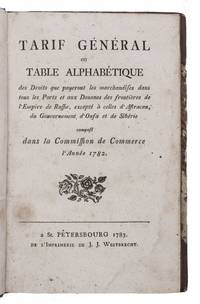
178318774St. Petersburg: J.J. Weitbrecht 1783. Contemporary half calf marbled sides sprinkled edges. 8vo. Second known copy of a commercial publication of statutes promulgated in French by the Russian Empress Catharine the Great concerning import duties for commercial merchandise in Russian ports and at other frontiers of the Russian Empire as they were determined and accepted in 1782. There is an exception for Astrakhan a major port and market city in southern Russia at the head of the Volga river which was under the government of Siberia which apparently maintained its own commercial regulations.This publication is very rare WorldCat lists only 1 copy Kress Library of Business and Economics Harvard University. Other libraries worldwide have only the microfilm of the Kress copy.A faint stain and one tiny hole in the margin of the first 20 pp. Cover slightly rubbed. Otherwise in good condition.l Goldsmiths'-Kress 12431.16. J.J. Weitbrecht, unknown
1999BIBLIO-45059M. Moleiro Editor Barcelona limited edition facsimile 1999 and commentary. Limited edition of 987 numbered copies. 2 vols facsimile: original blind-stamped calf folio 31 cm; commentary: cloth 4to. facsimile: 298 pages and 115 miniatures most heightened in gold commentary: 4961 pp ills. A superb high-quality facsimile of and separate commentary on 'The book of Treasures' which is an encyclopaedia by Brunetto Latini circa 1230-1294 a Florentine politician poet historian and philosopher teacher and friend of Dante's written in French during the author's exile in France 1260-1267. From the publisher's description: " It consists of three books: the first begins with the biblical history the history of Troy Rome and the Middle Ages followed by a natural history: a comprehensive compilation of information about astronomy and geography. It also addresses certain animal and bird species in depth. The second book concerns ethics: it features the thinking of modern and classical moralists and studies the vices and virtues that characterise humanity. The third book the most original part of this work deals with matters related to politics and the art of government which is according to the author the most important and noblest of all sciences. The miniatures in this codex are extremely rich and varied. The artist's boundless imagination fills the margins of the 18 folios with countless arabesques and drolleries which constitute one of the most highly developed most interesting and earliest series of this genre in the history of the European miniature. There are also countless beasts grotesque and peculiar figures dwarves up to all sorts of tricks acrobats doing balancing acts and juggling musicians playing trumpets flutes violas tambourines organs and bagpipes. Birds hares fawns lions and hounds hunting boars and even the creation of Eve are depicted too." The commentary volume includes in both English and Spanish: Foreword by V.N. Zaitsev Director of the National Library of Russia St Petersburg; Codicological and palaeographic study of Li Livres dou Tresor by Brunetto Latini by L.I. Kisseleva National Library of Russia St Petersburg; Artistic and iconographical traits of the St Petersburg manuscript by I.P. Mokretsova State Research Institute for Restoration GosNIIR; The animal chapters in the Saint Petersburg Li Livres dou Tresor by W.B. Clark Marlboro College; and Technical research and manuscript restoration; by I.P. Mokretsova G.Z. Bykova V.N. Kiréyeva State Research Institute for Restoration GosNIIR. Copy No. 80. . A Fine set in the publisher's leather box which has the leather booklabel of Robert M. Wilson on the inside face. M. Moleiro Editor, Barcelona, limited edition facsimile, 1999 and commentary hardcover
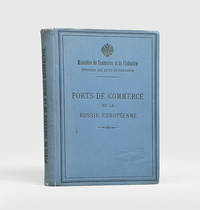
1908189307St- Petersburg: R. Golicke & A. Willborg for the Ministère du Commerce et de l'industrie 1908. Havens for Tsarist maritime commerce First and only edition. Officially sanctioned painstaking survey of the Russian ports of Europe recorded at the height of their influence. Rare WorldCat locates a single copy in the University of Genoa. Altogether sixty-five ports are described in great detail accompanied by photographs plans and engineer's sections for aspects of their construction. This sort of close scrutiny would very soon be confined behind a wall of Soviet state secrecy. The report covers the White Sea Black Sea Baltic Sea and Sea of Azov; more than a half of the ports analyzed are now located outside of Russia in the Baltic states Ukraine and Georgia. This volume was never intended for general distribution but rather was passed through official channels a presentation of the ports as a manifestation of the of Russian Empire's influence on European maritime commerce. Finely produced the presswork was carried out by R. Golicke & A. Willborg a house known for its involvement in Russian livres d'artiste and other fine editions the binding was commissioned from the workshop of M. Uleman small gilt on white ticket to the front pastedown. Two pre-Revolutionary ink stamps to the title page one repeated on the front cover. Crossed out on the title is of that of the Imperial Library of the Central Statistical Committee of Ministry of Internal Affairs the repeated stamp is for "Professor Emeritus of the St Petersburg Institute of Communication Routes Vsevolod Evgenievich Timonov". Timonov 1862-1936 was a hydraulic engineer hydrologist and transportation engineer typical of the intended constituency for the volume. From 1886 to 1895 he served in the Ministry of Railways working on the Commission for the Construction of Commercial Ports. During this time Timonov supervised the first work on the construction of stone block breakwaters for ports on the Baltic 1887 organized and implemented the initial marine dredging works there 1889 explored the mouths of the Dnieper Don and Volga rivers 1890 selecting the branches for development drew up a project for improving the rapids on the Dnieper carrying out exploratory work on one section 1894 explored the shores of the Pacific Ocean to assist in the selection Vladivostok as the location for the Pacific port terminal of the Siberian railway and explored the rivers of the Amur region developing measures to increase navigability 1895. Octavo 280 203 mm. pp. 24 33 94 128 91 vii. Printed throughout on coated paper numerous half-tone illustrations maps and plans to the text large folding three-colour printed map 695 x 560 mm retained by a band at the rear endpaper. Original light greenish blue cloth lettered in black on the spine and front cover French fillet panel to both covers in black to the front in blind on the back light greenish grey endpapers. Slightly rubbed and a little bumped some short splits to head and tail of the spine endpapers a touch browned at the edges; text-block marginally toned but clean and sound; very good. hardcover
110609Stockholm Ignatius Meurer 1615. 4to. 3 blanks 12 111 4 2-274 2 36 2 15 3 33 3 50 pp. Title-page with woodcut border. Woodcut arms on verso of title-page. Contemporary paper boards. Spine worn. Rubbed. PP. 33-40 loosely inserted from another copy. Some browning and staining. Small piece torn from title-page to part II no loss. One of the earliest accounts of Muscovite Russia. The Swedish traveller and historian Petrus Petrejus Peer Persson 1570-1620 visited Russia several times between 1608 and 1620. He provides an important eye-witness account particulary for the history of Boris Godunov and the false Dimitri as well as descriptions of places lifestyle language customs and rituals in Russia at the beginning of the 17th century. . hardcover
1798132180St Petersburg: A l'Academie Imperiale des Sciences 1798. First and only edition. Single location on WorldCat at BL KVK adds a copy in the Austrian National Library lacking 2 plates; and copies in the Zentralbibliothek der Bundeswehr Düsseldorf and Universitäts- und Landesbibliothek Sachsen-Anhalt Halle. Decidedly uncommon infantry manual for the Imperial Russian Army from the brief reign of Tsar Paul I r.1796-1801. Paul had travelled extensively in Europe and had developed a taste for French and Italian architecture and Prussian military practice taking immense pleasure in rigidly drilling his private brigade of troops in the Versailles-inspired grounds of his estate at Gatchina. When he ascended the throne he attempted to remodel the army along Prussian lines introducing entirely impractical uniforms a regime of elaborate ceremonials and parades and as shown here the implementation of rigourous regulations and drill. The present manual was directly translated into French from its Prussian equivalent the words of command also being given in phonetically rendered Russian. Paul was assassinated by a group of disaffected army officers after just 4 years on the throne. Octavo 196 x 110 mm. 13 folding plates at the rear; somewhat erratically numbered no plate 1 2 plans numbered 4 but apparently complete. Recent mottled sheep-backed marbled boards by G. Gauché Paris red morocco label gilt rules to the spine. Spine lightly sunned light soiling to the title page pale toning to the text-block throughout overall very good. hardcover
1770648241770. St. Petersburg 1770. 4th & best ed. St. Petersburg 1770. 4th & best ed. "The Best and Most Luxurious" Four-Language Edition of Catherine the Great's Nakaz Catherine II 1762-1796 Empress of Russia. Kozitzki Grigorii Vasil'yevich d. 1775 Latin Translation. Nakaz Eia Imperatorskago Velichestva Ekateriny Vtoryia Samoderzhitsy Vserossiiskiia Dannyi Kommissii o Sochinenii Proekta Novago Ulozheniia. Instructions of Her Imperial Majesty Catherine II to the Commission on the Work of the Projected New Code of Laws. St. Petersburg: Imperatorskaya Akademii Nauk 1770. viii 403 pp. Four title pages one in each language. Printed in double columns Russian and Latin on one page and German and French on the opposite page. Allegorical engravings by C. M. Roth at head and tail pieces. Latin translation by Grigorii Vasil'yevich Kozitzki. Quarto 9-1/2" x 8". Contemporary calf raised bands lettering piece and black-stamped ornaments to spine edges rouged patterned endleaves. Light rubbing faint stains scratches and ink marks to boards which are slightly bowed moderate rubbing to extremities corners bumped and worn. Large copperplate vignettes at beginning and end of text. Light toning to text somewhat heavier in places faint dampstaining to margins in a few places internally clean. A nice copy. $3000. Only four-language edition the fourth and best edition overall. Described by Count M.A. Korf then director of the Imperial Library as "The Best and Most Luxurious Edition." The Nakaz or Instruction is a statement of legal principles written by Catherine II between 1764 and 1766. It was among her most ambitious and significant undertakings. Infused with the ideas of the French Enlightenment and copied mostly from the work of Voltaire Montesquieu and Beccaria it was compiled as a guide for the All-Russia Legislative Commission convened by the Empress in 1767 to create a new code to replace the 1649 Muscovite Code. Revised in consultation with Frederick the Great and Voltaire the Instruction proclaimed the equality of all men before the law and denounced torture and the death penalty. Unfortunately her proposed code was never completed. Catherine's manuscript was written in French and she later produced a Russian translation. Editions in German and Russian were published in Moscow in 1767. The book was initially banned i. unknown
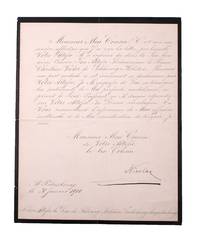
1901346384St. Petersburg 1901. One-page secretarial letter in French on mourning stationery with a secretarial copy marked in ink Copie . signé Nicolas. 1 vols. 10 x 8 inches. Old folds generally fine. With transcription and translation. One-page secretarial letter in French on mourning stationery with a secretarial copy marked in ink Copie . signé Nicolas. 1 vols. 10 x 8 inches. A formal note of condolence from Nicholas II Emperor of all the Russias styled "le bon Cousin" in the closing addressed to Ernst Gunther II 1863-1921 third Duke of Schleswig-Holstein "Monsieur Mon Cousin!" after learning of the death of Prince Christian Victor of Schleswig-Holstein a grandson of Queen Victoria and British officer who died of malaria in Pretoria on 29 October 1900.<br /> <br /> A somber and attractive autograph documenting the close connections between the royal and imperial household of prewar Europe. Provenance: Dr. Herbert Ernest Klingelhofer 1915-2015 collector and former President of the Manuscript Society bought from Karl Faber 1957 unknown
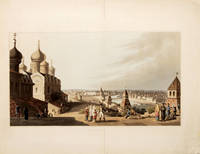
181671411London: Robert Bowyer. c.1816. A very fine hand coloured aquatint by Robert Bowyer 1758-1834 published in 1815. From; 'An Illustrated Record of Important Events in the Annals of Europe During the Years 1812 1813 1814 & 1815 Comprising a series of Views of Paris Moscow The Kremlin Dresden Berlin. together with a History of those Momentous Transactions'. This delightful view shows Muscovites in the foreground with parts of The Kremlin and the greater city in the background whilst The Moskva River is seen carrying mercantile craft. The colouring is soft and subtle and gives a this view a wonderful depth and clarity. Size: 465 x600 mm. Original hand coloured aquatint. In good condition. Central fold with old repairs to splits some soiling and minor staining. unknown
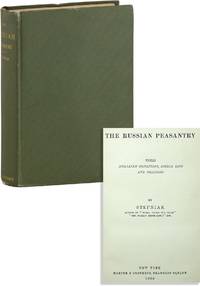
188884805New York: Harper and Brothers 1888. First Edition. Octavo. 17.5cm. Publisher's green pebble grain cloth titled in gilt to spine. vi; 1; 401pp.6pp. ads to rear. Light rubbing to corners slight scuffing and some minor bumping to spine ends with a small spot stain at the very head of the spine small dent to upper edges of the boards; internally clean with some superficial soiling to the page edges ownership of Pennsylvania historian Gertrude Bosler Biddle to front flyleaf. A very good clean and handsome copy.<br /> <br /> WITH<br /> <br /> London: 1890-93. Three ALS autograph letters signed on folded stationery sheets as follows: <br /> <br /> 1. Dated "March 31" without year; from context ca. 1888-1890. 2pp ca. 250 words in black ink; datemarked St. John's Wood March 31. Requesting the publisher's permission to commission a German translation of his Russian Peasantry which first appeared in 1888 with a second edition in 1890. Stepniak proposes 50/50 division of royalties and identifies the translator as Victor Adler who has just been sentenced to three months in prison and thus now has "ample leisure" for undertaking the translation. Adler 1852-1918 was founder and first chairman of the Austrian Socialist Democratic Workers Party in 1888. Signed at close "S. Stepniak." Near Fine. <br /> <br /> 2. Dated November 6 1890. 1pp ca. 75 words in blue ink. Declines a request from his publisher to undertake a book on the Jewish Question: ".it is impossible for me to write upon any question upon Jews or anything else for I am quite full with preparing a series of American lectures." Signed at close "S. Stepniak." Slight smudging final two lines and left margin not affecting legibility. Very Good. <br /> <br /> 3. Dated May 15 1893. 2pp ca. 120 words in black ink. Addressed to "Dear Mrs i.e. messieurs Sonnenschein" accepting an invitation to visit but stating he cannot arrive early. Signed at close "S. Stepniak." Light soil; Near FIne. <br /> <br /> Sergei Stepniak aka Sergius; aka Sergey Stepnyak-Kravchinskii 1851-1895 made his revolutionary bones during the Narodnik Rebellion of 1877-78 by openly assassinating Nikolai Mezentsov the head of the Czar's secret police on the streets of St. Petersburg. Kravchinskii committed the act in broad daylight and made no attempt to disavow his guilt living publicly if dangerously for several months before finally escaping to Switzerland. He arrived in London around 1880 and quickly became the center of a lively Russian revolutionary exile scene. He founded the Society of Friends of Russian Freedom in 1891 and wrote a number of well-received books on revolutionary Russia including Underground Russia which had in fact been published in translation prior to his exile The Russian Peasantry 1888; and a fictionalized account of his own exploits The Career of a Nihilist 1889. He was killed somewhat mysteriously we think by an onrushing train in December of 1895 depriving him of any opportunity to witness the fruit of his labors in the Revolutions of 1905 and 1917. Dying young Stepniak did not leave a great body of manuscript material behind him and relatively few letters with good content have appeared in commerce. Harper and Brothers unknown
1726368922Moscow: By order of the Holy Empress Ekaterina Alexeevna of all Russia and the Crown Prince Tzarevich Pavel. Petrovich and his wife Grand Duchess Natalia Alexeevna and the Benediction of the Holy Ruling Synod 1726. First Edition. Hardcover. Worn copy bound in full aniline calf with a leather gilt-blocked label to the spine. Some wear and tear to the spine and panel edges as with age. Physical description; unnumbered pages. Subjects; Christian Scripture. Christian quotations. Christian Dogma. Christian Morals. Russian Christianity. Moscow: By order of the Holy Empress Ekaterina Alexeevna of all Russia and the Crown Prince Tzarevich Pavel. Petrovich and his w hardcover