(Russia) [Vigor, Jane]Biblio.com
642 résultats
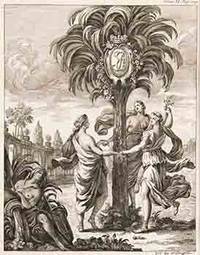
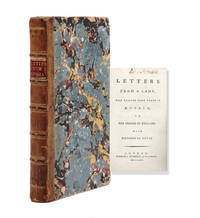
1775318234London: J. Dodsley 1775. First edition. viii 207pp 1p. table. 1 vols. 8vo. Quarter contemporary brown calf and blue marbled boards red label on spine. Red speckled edges. Some wear to the spine and boards text block in otherwise excellent shape. Bookplate of E. H. Greenly. Very good. First edition. viii 207pp 1p. table. 1 vols. 8vo. Jane Vigor née Goodwin b. 1699 d. 1783 was born to a clergyman in Yorkshire. Her first husband was Thomas Ward Esq Consul General to Russia and it was through that marriage that she embarked upon her experiences in Russia and wrote the passages for this volume some forty years later. She was married twice more to Claudius Rondeau Esq. and to William Vigor Esq. whom she survived. <br /> <br /> Mrs. Vigor inherited her father's fortune after her brother died and she then married Ward. Both her first and second husband who was Ward's secretary were stationed in St. Petersburg which is where she lived throughout her first two marriages. She returned to England after her second husband's death: frail pregnant and accompanied by William Vigor a Quaker minister who became her third husband. <br /> <br /> These first "Letters from a Lady" were followed posthumously by "Eleven Additional Letters" which provided a biography of Vigor.<br /> <br /> Errata printed on verso of title page. ESTC T64790 J. Dodsley unknown
51-3674Amsterdam Marc-Michel Rey 1775. 2 volumes bound in one 4to 265 x 205mm. 2 half-titles 7 engraved plates including 3 folding 68 engraved head-and tail-pieces and vignettes5 folding tables 2 3 Contemporary roan. Hinges cracked but solid.OCLC Number: 491684666Notes: Citation française au titre.EpiÌ‚tre deÌdicatoire aÌ€ Catherine II. Introduction.Deux front. gr. s. c. Vignettes aux titres gr. s. c. avec la devise "Ingeniosa assiduitate". Vignettes in-texte gr. s. c. Planches deÌpl. graveÌes.Sig. 4 A-V4 A-F4 A-V4.Reproduction Notes: Tome 2 Description: 2 tomes en 1 vol. VI-2-160-42-6-160 p. 5 tableaux deÌpl. 6 f. de pl. : ill. ; in-4.Ivan Ivanovich Betskoi or Betsky 1704-1795 was appointed by Catherine II tobe her principal adviser on education in 1763. This work contains his proposalsfor a svstem of state education in Russiaincluding reports of various commissions and imperial edicts and orders. The plans set out the general principles of education that Catherine proposed to adopt with the aim of creating a newly educated class.The first part contains Le plan general de la Maison Imperiale d'Education fondee a Moscou. This private foundation dating from 1764 was under the direct control of the Empress and relied solely on private subscription. The second part is concerned with the work of other similar foundations in Russia and concludes with an essay Observations physiques sur I'education des enfans. The translator Nicolas Gabrielle Clerc 1726-98 was a member of the St Petersburg Academy of Sciences and was involved in the reorganization of Russian charitable institutions. At the end of the book there is a short paragraph by Diderot in which he eulogizes the achievements of Betskoi p.157.Originally published in Russian at St Petersburg in 1774 this is the first French edition arranged by Diderot after his return from Russia during which he advised Catherine on educational matters. Amsterdam, Marc-Michel Rey, 1775. unknown
1893653421893. St. Petersburg: Izd. L.F. Pantelieeva 1893. St. Petersburg: Izd. L.F. Pantelieeva 1893. The Last Edition of the Nakaz Published in the Nineteenth Century Catherine II 1762-1796 Empress of Russia. Bezgin Il'ia Grigor'evich Editor. Nakaz Eja Imperatorskago Velicestva Ekateriny Vtoryja Samoderzicy Vserossijskija Dannyj Kommissii o Socinenii Proekta Novago Ulozenija. St. Petersburg: Izd. L.F. Pantelieeva 1893. 53 201 pp. Text of Nakaz in Russian with parallel French translation. Original printed stiff wrappers bound into recent quarter calf over cloth gilt fillets and lettering piece to spine endpapers renewed. Gilding mostly rubbed away from lettering piece light soiling and edgewear to wrappers moderate toning to text faint dampspotting to a few leaves. Small early owner label to front free endpaper internally clean. $1750. The last edition published in the nineteenth century. The Nakaz or Instruction is a statement of legal principles written by Catherine II between 1764 and 1766. It was among her most ambitious and significant undertakings. Infused with the ideas of the French Enlightenment and copied mostly from the work of Voltaire Montesquieu and Beccaria it was compiled as a guide for the All- Russia Legislative Commission convened by the Empress in 1767 to create a new code to replace the 1649 Muscovite Code. Revised in consultation with Frederick the Great and Voltaire the Instruction proclaimed the equality of all men before the law and denounced torture and the death penalty. Unfortunately her proposed code was never completed. The first two editions one with parallel texts in Russian and German were published in 1767. OCLC locates 1 copy in a North American law library Columbia. Another copy located at Harvard Law School. Butler The Nakaz of Catherine the Great 526 Entry 18. unknown
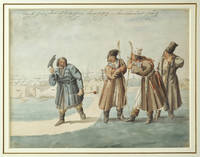
85645mid. XIX c. . Original watercolour 23 x 29 cm. Mounted and framed. <br /> mba004 This charming watercolour shows a group of four Russian workmen in front of semi-derelict barracks. The expressions and gestures of the figures endow the work with life and character as three men leaning on long staffs dressed in heavy coats with high hats of fur or wool turn to glare at a passing official in braided coat who gingerly raises his peaked cap in response. The work is both a delightful study of local costumes in nineteenth century Russia and a window into the life of the lower classes in the Empire at the time.<br /> [mid. XIX c.]. unknown
1934011033Moscow Russia: Academia 1934. Elephant folio. 49 3pp. Uncut. Original cloth overlaid with Palekh style illustration. The cover is designed like a ceiling fresco seen from below. Illustrated endpapers.This volume contains the old Russian text of "Slovo o Polku Igoreve Host of Igors Lay one of the greatest literary masterpieces not only of Russia but the world." It explains that the illustrator Ivan Golikov works "in the old artistic manner of the Palekh School. Chromolithographed title page. Decorative head- tailpieces and initials. Ribbon marker. Magnificent edition of this anonymous epic poem originally written in the Old East Slavic language. The title is occasionally translated as The Song of Igor's Campaign The Lay of Igor's Campaign and The Lay of the Host of Igor. The poem gives an account of a failed raid of Igor Svyatoslavich 1202 against the Polovtsians of the Don River region. While some have disputed the authenticity of the poem the current scholarly consensus is that the poem is authentic and dates to the medieval period late 12th century. The Tale of Igor's Campaign was adapted by Alexander Borodin and became one of the great classics of Russian opera. This edition is lavishly illustrated with 10 mounted Palekh illustrations by Golikov each within a chromolithographed border. Some rubbing on covers with slight abrasion on front cover and heavy abrasion on back cover. Text in old Russian. Binding in overall good interior in near fine to fine condition. The Palekh school works are painted in an ornate style that usually utilized bright primary colors especially red against a shiny black background to decorate lacquer boxes with fairy tale motifs. A clean beautiful rare volume. 1st Edition. Glossy Hard Cover/Boards. Near Fine/No Jacket - Issued. Illus. by Golikov Ivan. Folio - over 12" - 15" tall. Academia Hardcover
25091The first three-quarters from Paris 18 June to 16 November 1859. The last quarter from Dresden and Copenhagen 1860 to 1863. The papers of Sir Charles Stewart Scott an Ulsterman: see his entry in the Ulster Dictionary of Biography are held by the British Library. The present journal described by its writer as ‘Private & most Confidential’ covers the very start of his career from Paris in 1859 to Copenhagen in 1863. The basic details of his career to this point together with information regarding his colleagues are to be found in the Foreign Office List for January 1865: Scott was nominated attaché in 1858 and transferred to Paris on 31 March 1859 and to Dresden on 5 October of the same year to Copenhagen three years later and was promoted to position of a third secretary in April of 1863. This journal is 186pp 8vo; all edges gilt in embossed brown cloth binding with the label of Paris stationers Delarue & Hivert. The paper is lightly aged with a little discoloration and a few loosening leaves and the binding is worn but the general overall condition is good. On reverse of front free endpaper: ‘33 Rue de la Madelaine / Charles: S: Scott. / Attached to H.B.M Embassy Paris’. The diary is as Scott admits kept in a ‘negligent way’. The first page is headed ‘Private / Paris’ and the first three-quarters of the journal consist of 140pp covering the period between 18 June to 16 November 1859 followed by three and a half pages headed ‘Nearly A year afterwards in Octr 1860’ but with only one entry: 4 October 1860. After a blank page the final quarter of the journal consists of 45pp carrying desultory entries between March 1861 and January 1863 as follows: 4pp Dresden 26 March 1861; 6pp ‘January 1862’; 7pp 6 to 14 January 1862’; 16pp 16 October to 12 November 1862; 2pp Copenhagen 21 December 1862; 2pp ‘January 1863’; 3pp ‘Princess Alexandra’. The diary contains a good mixture of the personal and professional. Of particular interest is Scott’s description of Embassy news and gossip: reports and telegrams received communications composed the views of superiors articles in the newspapers. The pre-eminent topic is the Parisian response to the conclusion of the 1859 Franco-Austrian War Second Italian War of Independence including a description of Napoleon III’s victory parade and a couple of references to Garibaldi. Other topics include the American Civil War and the marriage of Princess Alexandra of Denmark to the future King Edward VII. There is also a description of initial reports of the Second Battle of the Taku Forts June 1859 in the Second Opium War. On the personal side there what Scott himself sees as his ‘illspent youth’ with frequent references to money worries 4 August: ‘we all dined at Voisin’s capital dinner but enormously dear 18 frs a head. Afterwards we played Loo and I lost £16 - my state of mind is something awful. I could scarcely sleep a wink all night & vowed I never should play a gambling game again’. The following day he ‘must borrow £25 from somebody’. He searches for new lodgings in Paris describes his dinner engagements and socializing ‘I saw some very pretty faces in the Champs Elysees’ his private reading ‘I finished Tennyson’s New poem. I like it as a whole very much Enid is very pretty & so is the last Guinevre sic I think my favorite is Alaine evidently the Lad of Shalott’ the weather and much Embassy news and gossip. With reference to the Franco-Austrian War Second Italian War of Independence on 25 June Scott describes an early report of the victory of Napoleon III and the Sardinians at the Battle of Solferino: ‘On my way down to the Chancery at 12.30 I saw an “Affiche†giving the news of a great battle dated Caravina June 24 9.15 in the morning to the effect that the Allies had engaged the whole Austrian. Army in a line of 15 miles taken all the positions & captured several guns flags & prisoners. The details have not yet been given. It appears to have been a very bloody affair & I should not wonder at hearing a very different version soon.’ The following day is the Fête de Dieu: ‘The Chancery was very intolerable & as there was no news of any importance we had not much to do. Laurence & I spent the afternoon on chairs in the Champs: Elysee. The rest of the Chancery seem to have done ditto - We then drove to the Tavern & dined. We found Atlee there too. A very fine woman was dining near me I liked her face very much. Atlee seemed to know her. After dinner we did the coffee & liqueur dodge at the Cardinal & while we were there the newest telegram was posted up stating that the Austrians had lost 1500 prisoners in the hands of the French 30 guns & 3 flags. On one side of us as the news arrived were some Italians on the other Germans. The effect on the respective parties was worth seeing.’ The long entry for 12 July is headed ‘Conclusion of Peace of Villafranca’ discusses aspects of the conclusion of the war. The entry for 21 July begins: ‘I was in the Embassy at 11.30 Cowley sent down an angry minute with a request that some of us shd. be in the Chancery every day from 11. till 7. & that we shd be on duty by turns. He & Norton went in full tog to St Cloud where the Emperor received the Corps Deputations. made a short speech expressing the pleasure of the Corps at his safe return & the speedy reestablishment of peace. The Emperor replied with some little asperity in his tone that Europe had been unjust to him at the commencement of the war that he was glad now to have an opportunity of proving that once the honor & interests of France satisfied he did not desire to provoke further confusion of a more general war. A very important Tel: from Rome passed thro’ Paris this morning a measure of reforms has been recd by the French Ambassador at Rome to be submitted to HH. The Pope is in secret negotiation with Spanish. Minister. to reconquer Legations. In case of distress he will probably retire to Spain.’ Scott speculates regarding ‘what sort of a Foreign. Minister. Ld John will make’ Lord John Russell had been appointed to the post in the new Liberal government. On 4 July he reports: ‘There was rather an important Desp: from Ld. John relative to the Perugia atrocities he desires C. to read the Desp: to Wal: & in it he expresses his conviction that the Papal Govt is a crying evil in Italy & that at any future negotiations it would be desirable to take steps to deprive H.M. of all temporal powers - C. wrote an important Conf: Desp home upon the rumoured agreement between France & Sardinia. respecting cession to former of Savoy he expressed a wish that the gentlemen of the Chancery shd not speak about it to anyone. It appears that steps have been already taken towards negotiation by Prussia she has made proposals at London & St. Petersburg to England & France to join her in settling Bases Austria wished Prussia to act alone Prussia will not assent to do so. Claremont writes from Valeggio the Sardinian Army are besieging Peschiera the Emperor seems to have turned his attention to Venice.’ The entry for 22 July contains a long account of a despatch from Cowley: ‘a 5 sheeter an important one which he has taken two days to concoct. it is in answer to the question “should England take part or not in a Congress on Italyâ€â€™ ‘C. answers emphatically no’. He describes the French victory parade on 14 August: ‘Up at 7. dressed in white tie & tails & down & sic the Chancery at 9. there I found Lord C. and Atlee in morning coats so went back to the Rue de la Madelaine changed & got to the Place Vendome at 9.30. The Place had a most gorgeous appearance one enormous amphitheatre packed tight with well dressed ladies & gay uniforms among them an Irish milita uniform. Proh sic Patria! above us in front of the Ministere de la Justice & facing the column the Imperial balcony. Covered with crimson flock & shaded by a crimson velvet awning & this was crowded with the members of the court among them the Prince Jerome Princesse Mathilde Walewski Hamelin Gould & c. After a short time the Empress’s carriage drove into the Place amid the most enthusiastic cheering. She made her appearance some minutes afterwards in the balcon with the Prince Imperial. The latter in the uniform of the chasseurs de la garde. He is a pleasing looking little child yellow like most French babies with pudding cheeks. His mother looked very nice it was the first time I had any chance of seeing her to advantage she has such a charming expression. & was looking her very best. After this there came a long pause which I employed in looking round at my neighbours I was in the diplomatic gallery. Ld Cowley & Kisseleff Nikolai Kiselyov the Russian ambassador below me the Swedish Minr. behind some Persian attaches beside me in full uniform & the American mission a little in front. On the neat tribune the Duchess of Montrose & Lady H Graham & lots of charming English faces everybody nicely dressed & as happy as possible under the hotters sun I have felt for some time. - Soon a rustling of dresses & a number of impatient & excited explosions of “les voila†made us all strain our eyes towards the entnree by the Re de la Paix & in a few seconds the Emperor at the head of the Cent Gardes & surrounded by his staff cantered into the Place on a beautiful charger. I shall never forget the magnificence of this sight.’ The following two pages contain a description of the review of the troops ‘the Cent Gardes with the captured Austrian colours & the assorted colors of some of the regts.’. news articles in French papers ‘The Patrie has this evening rather a bitter article against the English dread of invasion - alluding to article in Moniteur.’. English fears of invasion are apparently genuine. On 28 July he writes: ‘There was an article in the Moniteur to-day giving notice of the Emperor’s intention to place the army & navy on a peace footing if this be really carried out it will be a stopper on the fears of invasion on the other side of the Channel. This Announcement is said to be the result of a Privy Council meeting who upon the suggestion of to do something to appease the fears in England met yesterday to consider what course they should take.’ News from Italy on 1 August: ‘I decyphered a long Tel. from Elliot this morning to the effect that the Neapolitan. Govt had been informed that Garibaldi with 12000 men meditated a descent on some part of the Neapoln. States & had engaged steamers at Genoa & Cagliari for that purpose. the Govt of H.S.N. wished to know whether Her .Majesty’s. Government. would protest agst Sardinia permitting this expedition & if H.Ms. fleet wd allow it to be carried out.’ Cowley asked Wal: whether he had received any intimation to the same effect he said he had been applied to by the Neapn. Govt & had accordingly written to Sardinian Govt but he did not believe there was any foundation for these apprehensions.’ On 7 September 1859 he is ‘again reduced to the same miserable pauper state’ and ‘thinking of changing to Lisbon. I have been spending too much money here - and as Sir A. Magennis is appted: Minister at that place & Grey his greatest friend has offered to recommend me strongly to him. I have thought to accept Grey’s offer & have written to Papa about it’. The same entry contains a discussion of ‘political news’ including ‘the great question’: ‘What is to become of the Duchies’ A week later 15 September he is ‘of course getting poorer & poorer. to-day Friday I had to borrow 60 frs. from Adams 20 of which went to little A - who is also hard up.’ In the same entry he gives an account of the Second Battle of the Taku Forts June 1859: ‘Matters are coming to an interesting crisis and a new European mess is brewing & this time on a very respectable scale. 1st. in China. The Frh: & English Minrs: proceeding up the Reiko in order to ratify Treaty were fired upon on the 20th of June & 3 guns boat were lost 460 men killed & wounded & the Minrs. forced to retire to Shangai. This was the first telegram which came to our hands. & a startler it certainly was. The details soon followed telegraphed by Rumboldt sic who was on his way home with Desps:’. Further details are given including ‘the P.P. ordered Adml. Hope to force the passage which he succeeded in doing when all of a sudden the batteries on either bank were unmasked & a slashing fire poured upon them. The batteries were manned by Mongols an enemy which we met for the first time in the field. An attempt to land some of our marines in gun-boats was signally unsuccessful the banks being formed of a soft mud in which our men sank up to their middle exposed all the time to a desperate fire. Adml. Hope is wounded & the affair is altogether a most signal disaster’. He continues to discuss this and ‘The 2nd mess’ - ‘a more serious one . the result of the Death of the Emperor of Morocco’. ‘Papa & the girls’ pay a visit in mid-September and he reports ‘My people are gone’ at the beginning of the following month. On 16 September 1859 he writes from ‘Dresden’ stating that he came to the place ten days before and that his ‘first fealing on hearing of my appointment was sheer disgust’ but that he is ‘beginning to know the place’ and ‘far happier than at Paris. Strange enough Dresden is to me twice as gay as Paris.’ In the pages that follow he describes the opera at Dresden and a visit to ‘Saxon Switzerland’ before giving a review headed ‘January 1862’ of his ‘illspent youth that has planted its vices in my blood and weighs me down into the mire’ and his desire to ‘emerge mothlike from the chrysalis of the past & with blood keeping an even tenour follow the “Beautiful†that now only comes to visit me in visions. - How hard now to acquire the strenghth of will that has failed me hitherto! and yet I feel that unless the change be effected now my future happiness will be ruined.’ Regarding the brewing American Civil War he writes: ‘Each day may bring us important answers from America: I fervently hope such an unnatural war may be averted.’ On 5 January 1862 he writes that ‘The news from America continues to be pacific’ but on the following day: ‘A Telegraph has come in to the effect that the Privateer Sumpter has made some prizes has sunk them & run into Cadiz. - pretty warfare this for the 19th: Century’. On 16 October: ‘Little prospect of a peaceable settlement of affairs on the other side of the Atlantic. Lincoln’s proclamation emancipating the slaves not only an uncivilized but a useless & an impolitic move. / Prussian affairs looking bad. The lower House has unanimously refused to vote the military Budget “in toto†without details. The Herrenhaus sides with the Govt: & the Chambers closed. - I do not see how the question can be settled. - We have also had a meeting of Deputies at Weimar & the National Verein at Coburg. both seem bent upon restoring the Reich Verfassung of 49. - the 1st: in favor of exclusion of Austria.’ 24 October: ‘2 new battles in America account as yet confused. - Confederates. said to have retreated. - Garibaldi a little better.’ He gives a full-page description of a ‘Jewish wedding’ on 25 October: ‘The Congregation a most curious assemblage of Jewish faces in wh: the hooked nose was the most characteristic feature.’ On 30 October he responds to a speech by Cobden proposing ‘to exempt private property from capture at sea’ and the blockade of continental ports: ‘the raw material of our food & industry come fm. America the only three powers w. whh. we cd. go to naval war are France Russia U. States. F. cd. always make use of Haburgh & the free ports & from Russia & the U:S: we draw our principal imports. In the Crimean War we purposely abstained from enforcing a blockade until we had imported sufficient grain fm. the Rn: ports. - Disputation in N of England showed what a state we shd. be reduced to if we strictly enforced the blockade of the Baltic Ports.’ On 12 November 1862 he comments sarcastically on the ‘pleasant announcement’ that he has received his orders to proceed to Copenhagen. On 21 December he records his arrival there ‘This place is certainly no pleasant residence in winter.’. January 1863 sees ‘the Federals in a worse state than ever the accounts of the late battle at Fredericksburg are terrible & the loss almost unparalleled’. Another question he discusses at this time is the ‘Affairs of Greece’. On 12 January 1863 he describes his socializing: ‘I dined twice with the Chief and went to the Lutzerodes where I met everybody & did my duty to all acquaintances. I was presented to Countess: Hohenan Prince: Albert of Prussia’s wife. She seems agreeable. - A party at the Sawyers where I was introduced to Mme: de Benst Freyburg & her daughter who has the reputation of being a beauty. I was disappointed.’ He is presented to ‘Princess. Alexandra our future Pss: of Wales she is lovely & graceful natural & charming in her manners & will certainly have great success in England.’ Over a page he describes the ‘“tableau†at the Landgraf’s’ at which he first saw Alexandra. ‘It was the Landgts. birthday & the Pce: & Psses: had arranged a series of tableaux vivants each subject to begin with one of the Initial Letters of H. Hs. name.’ The last three pages give an ecstatic account headed ‘Princess Alexandra’: ‘without being a great beauty has one of the loveliest faces & expressions I have ever seen . She leaves Denmark in tears & will find England awaiting her with smiles & English welcomes!’ In conclusion we give in its entirety the very first entry in the journal 17 June 1859. It is lengthy and gives a good indication of the general tone and level of detail and the good mix of personal and professional: ‘I found some difficulty in opening my eyes at 10 A.M. & when I succeeded in doing so found them fixed on Darand’s garçon arranging my breakfast. My conscience painfully reminding me that I owed him 60 francs for breakfast & that each day I had promised to pay his little “note†“demainâ€. Future entrie contain complaints against his debtor ‘Conyngham the wretch’ and a row with ‘Duraud’s garçon’ takes place ‘consisting of mild expostulation on his part confusion and indignation on mine’. I closed them again & answered his ‘Monsieur est serve†said in a hesitating tone only by a low grunt & he departed. After taking my usual time for consideration before committing the rash act of getting up and after taking my bath I found my breakfast as cold as my breakfasts generally are when I take half an hour to consider about getting up. / I did not go to fence but booted slowly down to the Embassy we only moved to our new pig stye of a Chancery yesterday. I found Laurence in the Chancery he had deserted Ruas too. There was no work a Tel: had been sent off about Despatches. to be forwarded to Turin. Bayly soon made his appearance I answered a Mons d’Hartville about some book which he had sent Cowley a copy of. Little news in any of the Papers. Later in the day there came in news of a conspiracy in Athens to dethrone King Otto & the intelligence was sent in cypher to the F.O. details to be sent by messenger. It appears that the Conspirators have called themselves the Italian French Society & tried to implicate the French. Minister. / Very important news arrived of the state of the Prussian policy drawn from a Convention. of French. Ministers. with Schlemetz. General. opinion in Chancery that Germany wd. join Austria before the end of the month. / I wrote to Conyngham about the £4. 10 travelling expenses asking him to send it to me. I am in a fearful state in the way of finances and I am afraid to tell the Govenor but what am I to do this is the 17th. Quarter does not commence before 23rd day of July & I have only the £4. 10 with lots of debts. - I read a book called Lama the style & character ridiculously extravagant & unnatural. Something in it excites me so I could not put it down I think it must be the present unhealthy state of my mind. / We dined at the Tavern why I say we I mean Atlee Sandford Laurence & myself. My dinner cheapest 3.75 with waiter. Then to the Cardinal coffee & petits verres. Atlee & Sandford went to their - & Laurence & I to the Embassy & his diggings where we played double dummy & talked on various subjects. I borrowed Shelley from him - walked home by the Avenue Gabriel beautiful moonlight tho’ nothing to what I saw on Wednesday night in the Place de la Concord - / Letters - from Tom. is going to be priested - Parish matters. good advice &c / Lizzie - State of religious excitement in North - to my weak mind this looks like a damned humbug. & that it is the effect of living in the same uncivilized spot without new ideas that has made everybody so superstitious. However Liz: seems rather to believe in it. / I feel rather maudlin & sentimental in fact in low-spirits tonight - the state of my funds. Darand’s bill & other details weigh upon me like a nightmare or an over feed - I have been a great fool I am doing nothing to get myself on in my profession & instead of improving my mind I think I am stupifying myself more & more every day. I wonder if the Diary will do me any good. It will never do to go on at this rate writing 5 pages a day so good-night I am off to Shelley & Bed. -’ The first three-quarters from Paris, 18 June to 16 November 1859. The last quarter from Dresden and Copenhagen, 1860 to 1863. hardcover
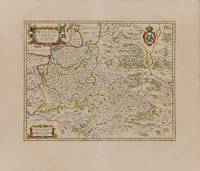
1664200038AG1664. Amsterdam Blaeu c.1664. Original hand-coloured engraving. Plate Size: 48.7 cm x 38.6 cm. Sheet Size: 65.2 cm x 55.7 cm. Original map. In very good clean condition. Wide margins. Latin text on reverse. Koeman II 1803:2. From: J. Blaeus Grooten Atlas oft Werelt- Beschryving in welcke 't Aerdryck de Zee en Hemel wort vertoont en beschreven. Amsterdam J. Blaeu 1664. Van der Krogt 2 621. Beautiful map of mid-17th Century Russia published during the reign of Tsar Alexis of Russia of the Romanov Dynasty as Moscow vied for regional hegemony with the PolishLithuanian Commonwealth and Sweden. 'Mosqua' Moscow is in the lower right corner. Smolesnsk is just squeezed in within the maps lower border. Novogorod can be seen just below the outflow of Lake Ilmen. In the upper left lies Estonia and the Gulf of Finland. Below this is the 'Livonia' region which is now between Latvia and Estonia. The regions listed as 'Ingria' and 'Careliae Pars' on the map were then under the control of the Swedes. The Russians would eventually seize this territory and dominance of the Baltic and build their new capital St. Petersburg there. This lay in the future. The map's political delineation shows the westward extent of Moscow's reach. 'Lithva' in the lower left of the map was then within the territory of Polish-Lithuanian Commonwealth. This region is now modern-day Belarus: 'Witespk' is now the Belarussian city of Viciebsk. Relief depicted pictorially and the historic place-names are in Latin. The cathedral cities such as Pereslaw Pereslavl-Zalessky and Ieroslaw Yaroslavl and Pseskow/Pskouwa Pskov are depicted. With numerous deers and foxes seen across the map the mapmaker indicates that this is a vast region still untamed. In the 'Megrina' province the mapmaker shows a bear-hunt at its deadly denouement. The map is covered with forested areas and vast waterways such as the Volga and Volkhov and Daugava/Dvina 'Duna flu' Dnieper Boristenis Flu rivers and a patchwork of lakes such as Lake Peipus and 'Biela Osera' Rybinsk Reservoir. Large decorative title cartouche accompanied with busts of moose and deer in the left top corner of the map. The eagles of the Russian coat of arms look east and west from the top right corner of the map. In the lower left corner an ornate cartouche contains two milliaria bar scales. Blaeu as it is noted on the cartouche based the map on the travels and maps of Isaac Massa. Isaac Abrahamszoon Massa 1586 - 1643 was a Dutch grain trader traveller and diplomat the envoy to Muscovy. He wrote memoirs related to the Time of Troubles and created some of the earliest maps of Eastern Europe and Siberia. Massa in Moscow witnessed the second half of Boris Godunov's reign during which a civil war broke out now known as the Time of Troubles. He survived the capture of Moscow by False Dmitriy I and left Russia in 1609 before the fall of Tsar Vasily Shuysky. Massa compiled an account of the 16011609 events Dutch: Een cort Verhael van Begin en Oorspronk deser tegenwoordighe Oorloogen en troeblen in Moscovia totten jare 1610 which he presented to Stadtholder Maurice. In 16121613 Massa published two articles on Russian events and the geography of the Land of Samoyeds accompanied by a map of Russia which were published in an almanac edited by Hessel Gerritsz. His notes on his various travels have been published in conjunction with maps made by the explorer Henry Hudson. Massa is credited with five published maps of Russia and its provinces the last ones compiled around 1633 and two maps of Moscow city including the schematic account of the 1606 battle between Vasily Shuysky and Ivan Bolotnikov's armies. He returned to Russia in 1614 and became an active agent in a myriad of diplomatic and commercial schemes and endeavours between Western states and companies and Moscow. Massa a wealthy and prominent man of the world has been the subject of several portraits by Dutch painter Frans Hals. Wikipedia Willem Janszoon Blaeu 1571-1638 was a Dutch cartographer atlas maker and publisher. Along with his son Johannes Blaeu Willem is considered one of the notable figures of the Netherlandish/Dutch school of cartography in its golden age the 16th and 17th centuries. Blaeu set up his mapmaking and publishing business in Amsterdam where he sold instruments and globes published maps and edited the works of intellectuals like Descartes and Hugo Grotius. In 1633 he was appointed map-maker of the Dutch East India Company. In 1635 he released his atlas Theatrum Orbis Terrarum sive Atlas novus. Willem died in 1638. He had two sons Cornelis 1610-1648 and Johannes 1596-1673. Joan trained as a lawyer but joined his father's business rather than practice. After his father's death the brothers took over their father's shop and Joan took on his work as hydrographer to the Dutch East India Company. Later in life Joan would modify and greatly expand his father's Atlas novus eventually releasing his masterpiece the Atlas maior between 1662 and 1672. Wikipedia unknown
188053786Moscow 1880. 10 hand-colored albumenprints some captioned in type in French and Russian. Oblong 4to. Contemporary quarter maroon morocco and boards cover titled in gilt "Photographs." Front joint cracked photographs in fine condition. 10 hand-colored albumenprints some captioned in type in French and Russian. Oblong 4to. Beautifully and finely hand-colored photographs of Moscow and St. Petersburg. Provenance: Baldur Bookshop Richmond Surrey receipt laid-in unknown
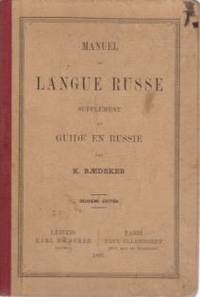
189717354Leipzig: Karl Baedeker. 1897. Second Edition. Stiff Wraps. Very Good. Boards browned and with small ink soiling to front and a larger ink stain to back. ; The rare supplement to the French edition of the Russia Baedeker; 16mo 6" - 7" tall; 108 pages . Karl Baedeker paperback
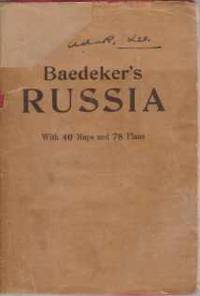
191417923Leipzig: Karl Baedeker. 1914. Hardcover. Very Good in Good dust jacket. DJ browned as usual and chipped. DJ spine laid-in book. Top DJ professionally repaired. Former owner's address on front endpaper. ; 1st and only edition. One of the most scarce and precious titles of the Baedeker series. A description of the country before the revolution. 40 fold out maps in color and 78 plans. A very well preserved copy - especially rare with DJ. Marbled edges nicely preserved - this is the best copy we have ever seen ; 16mo 6" - 7" tall; 590 pages . Karl Baedeker hardcover
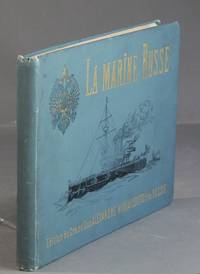
189258067St. Pétersbourg: Stadler & Pattinote 1892. Oblong folio 3 p.l. plus 56 chromolithograph plates each with descriptive text on the verso of the preceding plate 1 leaf of index; original pictorial blue cloth stamped in gilt and black on the upper cover; front hinge reglued the contents slightly shaken otherwise on the whole very good the plates clean. With explanatory letter-press in Russian and French. Four copies in OCLC only the U.S. Navy and Miami University in the U.S. Stadler & Pattinote unknown
1771647971771. Amsterdam 1771. 2nd Dutch ed. Amsterdam 1771. 2nd Dutch ed. Early Amsterdam Edition of Catherine's Nakaz Catherine II 1762-1796 Empress of Russia. Instruction de Sa Majeste Imperiale Catherine II. Pour la Commission Chargee de Dresser le Projet d'un Nouveau Code de Loix. Amsterdam: Chez Marc Michel Rey 1771. vii 229 pp. Frontispiece engraved copperplate medallion portrait of Catherine II by C.A. Boily. Octavo 7-3/4" x 4-3/4"; 19.68 x 12.06 cm. Contemporary mottled calf blind rules to boards gilt spine with lettering piece edges rouged marbled endpapers. A few minor scuffs to boards moderate rubbing to extremities spine ends worn front joint starting at ends corners bumped and somewhat worn. Light toning to text dampstaining and light foxing to a few leaves internally clean. An attractive copy. $1250. Second Dutch edition. This important text also known as the Nakaz or Instruction is a statement of legal principles written by Catherine II from 1764 and 1766. Permeated with the ideas of the French Enlightenment and copied mostly from the work of Voltaire Montesquieu and Beccaria it was compiled as a guide for the All-Russia Legislative Commission convened by the Empress in 1767 to create a new code to replace the 1649 Muscovite Code. Revised in consultation with Beccaria Frederick the Great and Voltaire the Nakaz proclaimed the equality of all men before the law and disapproved of death penalty and torture. Unfortunately her proposed code was never completed. Catherine's manuscript was written in French and she later produced a Russian translation. Editions in German and Russian were published in Moscow in 1767. Several editions followed in nations ranging from Italy to Latvia. The first Dutch edition in Dutch translation was published in Amsterdam in 1769. The 1771 Amsterdam edition was the first Dutch edition in French. This is a scarce imprint. OCLC locates 2 copies in North American law libraries Library of Congress UC-Berkeley. Butler and Tomsinov Eds. The Nakaz of Catherine the Great 528 entry 28. unknown
1771648601771. Amsterdam: Chez Marc Michel Rey 1771. Amsterdam: Chez Marc Michel Rey 1771. Attractive Early Amsterdam Edition of Catherine's Nakaz Catherine II 1762-1796 Empress of Russia. Instruction de Sa Majeste Imperiale Catherine II. Pour la Commission Chargee de Dresser le Projet d'un Nouveau Code de Loix. Amsterdam: Chez Marc Michel Rey 1771. vii 229 pp. Copperplate portrait frontispiece. Octavo 7-3/4" x 4-3/4". Later patterned-paper covered boards calf lettering piece to spine patterned endpapers. Minor wear to spine ends and corners front joint starting at ends. Negligible light toning to text dampstaining to bottom and fore-edges of text block very faint in most places in preliminaries somewhat darker. A nice copy. $1250. Second Dutch edition. This important text also known as the Nakaz or Instruction is a statement of legal principles written by Catherine II from 1764 and 1766. Permeated with the ideas of the French Enlightenment and copied mostly from the work of Voltaire Montesquieu and Beccaria it was compiled as a guide for the All-Russia Legislative Commission convened by the Empress in 1767 to create a new code to replace the 1649 Muscovite Code. Revised in consultation with Beccaria Frederick the Great and Voltaire the Nakaz proclaimed the equality of all men before the law and disapproved of the death penalty and torture. Unfortunately her proposed code was never completed. Catherine's manuscript was written in French and she later produced a Russian translation. Editions in German and Russian were published in Moscow in 1767. Several editions followed in nations ranging from Italy to Latvia. The first Dutch edition in Dutch translation was published in Amsterdam in 1769. The 1771 Amsterdam edition was the first Dutch edition in French. It is a scarce imprint. OCLC locates 2 copies in North American law libraries Library of Congress UC-Berkeley. Butler The Nakaz of Catherine the Great 528 entry 28. unknown
1907653411907. The First Edition of the Nakaz Published in the Twentieth Century Catherine II 1762-1796 Empress of Russia. Chechulin Nikolai Dmitrevich 1863-1927 Editor. Nakaz Imperatritsy Ekateriny II Dannyi Kommissii o Sochinenii Proekta Novago Ulozheniia. St. Petersburg: Izd. Iurid. Knizhnago Sklada "Pravo" 1907. ii cliv 174 pp. Three folding plates of facsimile manuscript leaves. Text of Nakaz in Russian with parallel French translation. Contemporary pebbled cloth light rubbing to extremities with minor wear to spine ends and corners which are bumped. Light toning to text a few leaves have carefully repaired tears. Early inscription and owner inkstamp to title page interior otherwise clean. $1250. The first edition published in the twentieth century. Title two in the series Pamiatniki Russkago Zakonodatel'stva 1649-1832. The Nakaz or Instruction is a statement of legal principles written by Catherine II between 1764 and 1766. It was among her most ambitious and significant undertakings. Infused with the ideas of the French Enlightenment and copied mostly from the work of Voltaire Montesquieu and Beccaria it was compiled as a guide for the All- Russia Legislative Commission convened by the Empress in 1767 to create a new code to replace the 1649 Muscovite Code. Revised in consultation with Frederick the Great and Voltaire the Instruction proclaimed the equality of all men before the law and denounced torture and the death penalty. Unfortunately her proposed code was never completed. The first two editions one with parallel texts in Russian and German were published in 1767. Our 1907 edition may have been inspired by a spirit of reform fired by the Russian Revolution of 1905. OCLC locates 1 copy in a North American law library Columbia. Another copy located at Harvard Law School. Butler The Nakaz of Catherine the Great 526 Entry 19. unknown
1929505546Paris: Editions J. Oliven 1929. Book. Good / État Satisfaisant. Soft cover. Signed and inscribed by the Author. Inscribed to previous owner and signed in English by the Grand Duke Alexander of Russia. Text in French. A good copy. . Editions J. Oliven Paperback
1966ZB1278337London Math Soc 1966. Russian Mathematical Surveys. v. 21; 22; 25; 27; 32; 33; 34; 35 including postage to Germany. - If you are reading this this item is actually physically in our stock and ready for shipment once ordered. We are not bookjackers. Buyer is responsible for any additional duties taxes or fees required by recipient's country. Photos available upon request. London Math Soc unknown
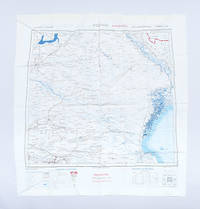
1952183941London: Ordnance Survey 1952. Later editions marked "restricted" revised from those produced by the War Office in 1919 and 1916 with isogonals correct to 1953. These maps were issued in the early years of the Cold War only a decade after the region was ravaged in the Battle of Stalingrad. Stepnoy now Elista was renamed only five years after this map's publication. In the early years of the Cold War the CIA attempted to gather information on the Soviet Union through aerial spying missions flown with the co-operation of the British government. "The RAF formed a top-secret reconnaissance outfit in the spring of 1951. Churchill approved the RAF overflight program knowing that if one of the planes came down on Russian territory Labour MPs in an embarrassed and angered House of Commons undoubtedly would force a vote of confidence to bring down his government. But he balanced that possibility against the desperate need for radar pictures of Soviet military targets that would held SAC and RAF bombers in the event of war" Burrows pp. 131-33. In 1952 John Crampton flew a high-speed high-altitude test run over the Berlin corridor which Bomber Command followed with three simultaneous sorties reaching as far as Moscow itself. After a ten-hour mission that triggered the Soviet air defences "All three planes made it back to Sculthorpe with their radar imagery and without a scratch" Burrows p. 134 angering the Kremlin and prompting a review of the nation's air warning systems. The map of Stalingrad is the fourth edition and the map of Stepnoy is the fifth. Single sheet of cloth 605 x 554 mm colour maps with key on each side pale border on Stalingrad side lettered in red blue and black. Map bright sometime folded and creased edges a little frayed: a very good copy. William Burrows By Any Means Necessary: America's secret air war in the Cold War 2001. hardcover
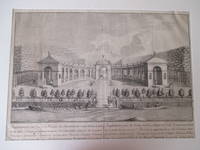
175014523AB1750. Sta. Petersburg Academie Imp. des Scien et des Arts ca. 1750 48 : 69 cm Original engraving with text in Russien and Frenche below the image. Rare engraving of the Amphitheatre near St. Petersburg. unknown
1769647731769. Early French-Language Edition of Catherine's Nakaz Catherine II 1762-1796 Empress of Russia. Landres J. Rodolphe Frey de Translator. Instructions Adressees par Sa Majeste L'Imperatrice de Toutes les Russies: A la Commission Etablie Pour Travailler a L'Execution du Projet d'un Nouveau Code de Lois. Traduit de l'Allemand. "A Petersbourg" i.e. Yverdon Switzerland: s.n. 1769. 286 pp. 12mo. 6" x 4". Early quarter vellum over marbled boards untrimmed edges a few unopenened signatures. Light soiling corners lightly bumped and worn. Moderate toning to interior somewhat heavier in places some leaves have light foxing a few have light dampstaining to margins internally clean. Ex-library with a small inkstamp to title page. A handsome copy. $1000. Reissue of the first edition in French published by the St. Petersburg Academy of Sciences for private distribution in 1769. This important text also known as the Nakaz or Instruction is a statement of legal principles written by Catherine II from 1764 and 1766. Permeated with the ideas of the French Enlightenment and copied mostly from the work of Voltaire Montesquieu and Beccaria it was compiled as a guide for the All-Russia Legislative Commission convened by the Empress in 1767 to create a new code to replace the 1649 Muscovite Code. Revised in consultation with Beccaria Frederick the Great and Voltaire the Instruction proclaimed the equality of all men before the law and disapproved of death penalty and torture. Unfortunately her proposed code was never completed. Catherine's manuscript was written in French and she later produced a Russian translation. Editions in German and Russian were published in Moscow in 1767. The book was initially banned in France because it was too liberal which is why the first French-language edition was produced in Switzerland with a false imprint. French and Latin editions were eventually published in 1770. OCLC locates 6 copies of this imprint in North American law libraries Columbia George Washington University Harvard Library of Congress UC-Berkeley Yale. Butler The Nakaz of Catherine the Great 531 Entry 40. unknown
19990008049Boulder CO: Westview Press 1999. First English language edition. Hardcover. As New/issued without. 8vos; xxxiv 562; ix 389 pages maroon cloth in original shrinkwrap. Not x-library. Scarce. O.P. <br/><br/>This English translation contains an autobiography by Mironov which was not in the Russian edition. It details his anti-Marxism philosophy while a student in Leningrad. "The author has assimilated a large body of foreign scholarship primarily "new social history" produced by Anglo-American authors along with a sprinkling of more broadly European economic and demographic history from the 1970s and 1980s which is effectively incorporated into his own very deep empirical knowledge. . The reader does not find in this extensively researched account the standard Soviet answers to specific historical questions. Mironov has abandoned most Soviet cliches though he still assumes that laws of Russian history can be identified based on social science theory and quantitative analysis Elise Kimerling Wirtschafter." "This is a massterful work that provides other scholars with a wealth of useful information while confrontimg them with an argument that compels a response - William G. Wagner." Maps. Westview Press hardcover
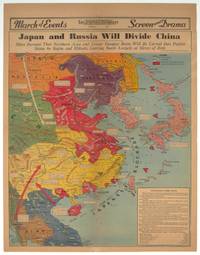
1940209821Los Angeles.: Los Angeles Examiner. 1940. Printed colour pictorial map on a single newspaper leaf 42.3 x 39.9 cms; 54.3 x 42.5 cms sheet archivally laid down on linen slight discoloration to lower centrefold and sheet slightly age-toned but in very good condition. A striking geopolitical map by Los Angeles Examiner artist Howard Burke covering China Japan Southern Russia and the northern part of French Indochina and Siam showing how the "Aggressors Divide China." Areas under Japanese occupation are shown in red and their naval blockade shown by an arc of naval vessels with vivid arrows indicating lines of supply. Text labels including sources of agricultural and raw materials provide a dynamic overview of the geopolitical situation and show the influence of American scientific illustrator and cartographer Richard Edes Harrison who argued for examining geographic issues from multiple perspectives and Los Angeles Times artist Charles Owens. . Los Angeles Examiner. unknown
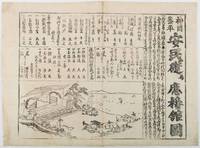
1854177799Japan. Circa1854. Black and white woodblock kawaraban printed on two joined sheets vertical central crease 41 x 63cm a little worming mainly on margins and repaired with paper on the reverse a little light browning but still presents very well. This kawaraban reports on how foreign visitors from the United States and Russia were treated in order to keep the peace and safety of God's country Japan. <br> <br>It reports that foreigners had arrived in Uraga this being the time of the second visit of Perry to Japan in 1854. The kawaraban goes on to list official gifts from the Shogunate to the President and his delegation members from the United States as well as to the Russian delegation. The gifts include lacquer boxes silk textiles as well as rice and chickens for the crew. <br> <br>The attractive black and white image at the foot of the report depicts a meeting in Yokohama at which a high ranking Tokugawa official received foreign visitors. The visitors are shown prostrating themselves in the open outdoor space in front of the building where the official sits. . unknown
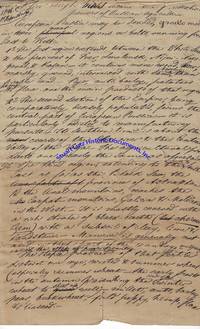
4678JOSEPH SLOCUM 1800-1853. Slocum was a merchant from Syracuse New York who attempted to sell farm equipment to Russia in the nineteenth century. He was unable to turn a profit from his endeavors and his family fell into financial hardship. His daughter Margaret Olivia Scolum Sage became an influential philanthropist and teacher. She endowed a building and a now-defunct agricultural school at Syracuse University both named after him.Archive. 9 pieces. 1830s-40s. An archive related to Joseph Slocum and his business with Russian agriculture. There are nine letters and documents predominately letters written to Slocum from various Americans and Russians. Highlights are listed below and the best piece is the first one the lengthy manuscript detailing Russian agriculture and natural resources:Handwritten document. 4pgs. September 12 1846. St. Petersburg Russia. The four page handwritten manuscript is entitled Some Rough Hints About the Productive Power of Russian Agriculture. It states in part: European Russia it may be divided grosso muto in three great regions or belts running from East to West. 1st - The first region extends between the White Sea and the provinces of Tver Smolensk Nijni-Novogorod & Kazan - it contains more wood low marshy ground intermixed the sand Baron then arable land. Rye oats barley potatoes hemp and flax are the main products of that region. 2nd - the second section of the Empire being comparatively densely populated forms a central part of the European Russia it is particularly addicted to manufacturing pursuits. It's Southern limits is about the course of the Oka River & the Central Valley of the Volga. The agricultural products are nearly the same as aforesaid. 3rd - the third region extending to the south and southeast as far as the Black Sea the provinces of Ashnaklan and the Ural Mountains reaches the Carpathian mountains Galicia & Moldavia in the West. It is mostly covered with a rich strata of black earth with a subsoil of clay lime & sandstone. Minoru is generally not used in this part of the country vulgarly called the step or prairie count the staple products of the fertile district are rye winter and summer wheat especially summer wheat - the summer frosts in the autumn preventing the seeds of the winter week to start up well millet oats barley peas buckwheat field poppy hemp flax & linseed. Cotton & Vine are raised merely in the most remote districts of the South such as Georgia Astrakhan the territory of the Cossacks of the Don Crimea & Bessarabia. Three other very important staples of Steph region are livestock & saltworks & fisheries. The stock consists mainly of horned cattle and horses grazing in large herds on the pastorate of the steps of the Black Sea As well as on both sides a lower Volga. Sheep both Merinos Saxon & form and main object of the agricultural industry of the step and owners. The Russian or common sheep is generally the property of the peasantry. The wool and tallow are usually sent overland in the winter to the manufacturing districts of the central belt of Russia Moscow. Or exported via Odessa Taganrog Riga & Petersburg to England and France. The saltworks are especially remarkable on the left sure the Volga on the verge of the province of Astrakhan as well as near the Ural River not far from the city of Orenburg. The Lake Elton alone of a circumference of nearly 180 miles is a solid mass of salt inexhaustible in its mineral riches. The stone saltworks of Gletznaia.As well as the saltworks a Crimea produce an immense quantity of that precious mineral. Besides that all the basin of the Caspian is full of an infinity of small salt lakes. The main fisheries are at the mouth of the Volga on the Caspian they produce an enormous quantity of fish of all kind. Besides that of the fisheries of the Ural River on the Don. The main fluvial artery of Russia is the Volga it is a Mississippi of our country. Its length is upwards 3000 miles. Unfortunately it is frozen up during nearly 6 months of the year. There are but very few steamboats in it. This year a large steam tow boat has been put into action on the Volga attended with great success. The manuscript continues extolling Russias natural resources. It is uncertain who wrote it and the condition is good with folds and fold separations. A partial typewritten transcript is included.LS. 1pg. August 1843. Russia. A letter signed L. Perovsky by Russian nobleman Lev Perovski 1792-1856 as Russian Minister of the Interior. Perovski thanked Slocum: The Directo fo the AgronomicalSchool having informed me that you presented to the museum of this Institution several agronomical instrument I feel myself much gratified to acknowledge. Agronomy is crop and soil science. The letter is in very good condition with folds and short fold separations.ALS. 4pg. 5 x 8 . November 7 1846. St. Peterburg Russia. An autograph letter signed by an American working for the United States Legation at St. Petersburg. He wrote in part to Slocum: The only reproach I ever heard from the Minister as I told you at that time and which certainly stands on a misunderstanding concerns the establishment of a cast iron fabrication. The Minister is in full belief you had spoken to him about ain the Union that as soon as a new colony any where is establishedThis seemed to His Excellency excellent means to introduce in Russia and toin this way thepossibility to the peasants to have their implements cheap & well one. The letter is in fine condition.ANS. 1pg. 1834. New York. A brief note acknowledging money received from Slocum signed Ja J Roosevelt by Jacobus James Roosevelt III 1760-1847 the New York state businessman and politician who was great-grandfather of FDR. In fine condition.ALS. 1pg. June 6 1834. New York. An autograph letter signed Jab J Roosevelt by Jacobus Roosevelt. Roosevelt wrote to Slocum requesting the return of an item. In very good condition.ALS. 3pgs. October 22 1846. St. Petersburg Russia. A lengthy letter to Slocum signed Chas Cramer to Slocum. Charles Cramer 1799-1879 was an important trader to Russian and his letter concerns finance: he gave you an order for the purchase of Implements for Agricultural purposes & that he assigned you a credit againstof the Government. He fully confirmed the contents of the letter you communicated to me & promised to reply to your letterMr. Clay stated when I asked him on your behalf that he could do nothing in the case to further your interest. Major Whistler whom I called on several time but missed has not yet returned my calls. I rather think he will not be able to serve you better than I can with the Government of this EmpireWe merchants often meet with heavy losses Do consider your Adventure to Russia misfortune & think no more about it for you will not gain anything. The penciled letter is in very good condition with a tear in the address leaf.Letter. 1pg. 5 x 8 . 1846. St. Petersburg. A contemporary copy of an 1846 letter by Rhesa Griffin a Syracuse area merchant: Received St. Petersburg 31 July 1846 of the Russian Imperial Departmentfive hundred thirty six silver rubles and sixteen seven coppers in full satisfaction of all and every claim or Demand on the above Department or if any other Department of the Russian Government and in full satisfaction of all and every agreement or understanding made by me with Joseph Slocum as an agent of the Russian Government. The document is wrinkled and in very good condition. unknown
1996012534<p>New York New York U.S.A.: Doubleday 1996. 769pp/illus. Gorbachev's autobiography Gorbachev has autographed the title page. Signature guaranteed original. Was purchased at Gorbachev's booksigning in Washington DC in 1996. Clean no marks. 1st Printing. Hard Cover. Near Fine/Very Good. 8vo - over 7¾" - 9¾" tall.</p> Doubleday hardcover
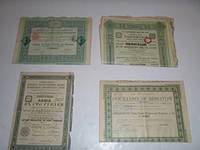
16-4567Moscow and St. Petersburg: 1869 -1918. Includes Société du Chemin de Fer de Tauris; Société Franco-Russe de Produits chimiques & d'explosives; Société . de machines de Briansk; Houilleres de Berestow; Imperial Russian Government; Forges .de la Kama; Gouvernement Imperial de Russie .4% Or de 1889; Various sizes often with coupons. Russian 3% Gold Loan of 1896; Emprunt de l'Etat Russe 5% de 1906; Banque Russo-Asiatique; Emprunt de l'Etat Russe 4-1/2% de 1909; Compagnie du Chemin de Fer du Nord-Donetz; Nicolas Railroad ; Ville de SDt-Petersburg 1908; Ville de Moscou 1908; Banque Fonciere des Paysans 1912; Grand Russian Railroad 1890; Chemin de fer de Moscou-Kief-Voronege 1914.; Manufactures de Lin de de Cotoi de Kostroma; Muliples of most. Moscow and St. Petersburg: 1869 -1918 unknown