Stravinsky IgorABAA

263 résultats
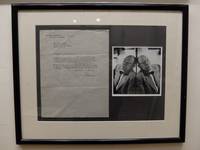
1962847621962. Single page typed signed letter with notes in Stravinsky's hand. Typed signed letter from 1962 to Igor Styravinsky from Carl Haverlin pioneer in radio broadcasting and longtime president of Broadcast Music Inc. The letter is on Broadcast Music Inc. stationary and Haverlin writes to inquire about some illustrations which Dulac had made for Stravinsky's Firebird Ballet. He writes: "I.take the liberty of asking you if your memory will bring forth any background on the sketches." In the margin adjacent to this sentence Stravinsky writes "Not at all!" in red pen. Haverlin closes the letter with: "Photostats of the sketchbook pages are enclosed." Beneath this Stravinsky writes along with his signature "I find it unfortunately very bad." Matted and framed opposite a photograph of Stravinsky. The entire piece measures 26.5 inches by 19.25 inches. Igor Stravinsky was a Russian-born composer pianist and conductor. He is widely considered one of the most important and influential composers of the 20th century. Stravinsky's compositional career was notable for its stylistic diversity. He first achieved international fame with three ballets commissioned by the impresario Serge Diaghilev and first performed in Paris by Diaghilev's Ballets Russes: The Firebird 1910 Petrushka 1911 and The Rite of Spring 1913. The last of these transformed the way in which subsequent composers thought about rhythmic structure and was largely responsible for Stravinsky's enduring reputation as a musical revolutionary who pushed the boundaries of musical design. His "Russian phase" which continued with works such as Renard the Soldier's Tale and Les Noces was followed in the 1920s by a period in which he turned to neoclassical music. The works from this period tended to make use of traditional musical forms concerto grosso fugue and symphony drawing on earlier styles especially from the 18th century. In the 1950s Stravinsky adopted serial procedures. His compositions of this period shared traits with examples of his earlier output: rhythmic energy the construction of extended melodic ideas out of a few two- or three-note cells and clarity of form and of instrumentation. unknown books
1962293971Hollywood 1962. unbound. very good. Fine content T.L.S. 4to 1 page Hollywood California December 12th 1962 to singer Jerry McLain attempting to give him musical advice without hurting his feelings in full: "I would be certainly glad yo give you advice but never hearing you singing and not knowing how far you are in the knowledge of works in general their spirit and technique I am in difficulty if not in impossibility to help you. The transposition of the Shakespearean songs in a higher or lower key is a ruin of my instrumentation and the piano reduction of them is not for a concert performance only for the study of the music." Placed into a white matte with a black background with two openings - whereby the letter is actually floated while the second opening accommodates a photograph by Weegie of the composer leaning against a mirror that gives the illusion of a double exposure and set into a black acrylic frame to 21.5" x 18.5". Excellent condition.<br/><br/> Russian composer pianist and conductor widely considered one of the most important composers of the twentieth century.<br/><br/> unknown books
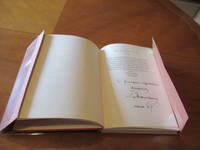
1936028516New York: G. Schirmer 1936. 1st Edition 1st Printing. Hardcover. Fine/Fair DJ. 158 Pp. A Compilation Of Articles With New Articles By Goosens Komroff Danz Rodriguez And Armitage Written For This Book. The Book Is Fine No Wear And Inscribed By Stravinsky To Pasquale Giovanni Napolitano Who Illustrated This Book "To Giovanni Napolitano Sincerely I Strawinsky March 37". With The Scarce Pink Dj Worn And Chipped With Very Large Piece Missing At Bottom Of Front Panel And Spine Leaving Title And Editor's Name On Spine But Removing Some Of Descriptive Text At Bottom Of Front Panel Flaps Intact Tape Reinforcement Inside Of Dj. <br/> <br/> G. Schirmer hardcover
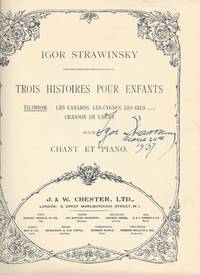
1927838London: J. & W. Chester Ltd 1927. Signed and dated by Stravinsky in March 1937. Plate no. 3830.1. In publisher’s printed brown wrappers. Torn at head of spine. A small blot on front cover. Trace of creasing to lower corner. Overall in fine condition. Signed and dated by Stravinsky in March 1937. Plate no. 3830.1. In publisher’s printed brown wrappers. 7 1 p. <p><br /> Composed in 1917 in Morges and first published in 1923 by J. & W. Chester. <br /> <p><p><br /> Tilimbom is a piece wherein Stravinsky continues his exploration of the animal world it tells the story of a fire in a farmyard.<br /> <p>. J. & W. Chester, Ltd unknown
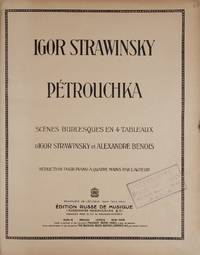
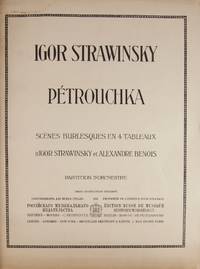
191241390Berlin Moscou Leipzig New-York: Édition Russe de Musique PN R.M.V. 150 1912. Folio. Contemporary half black calf with marbled boards label of the Parisian music rental firm Rouart-Lerolle to upper marbled endpapers. 1f. recto title verso blank i named cast list referring to first production of 1911 in French i synopsis in Russian and French i "general remarks" in Russian and French i blank i dedication to A. Benois i blank 7-84 ii blank pp. Photographic transfer from engraved plates. With "ROME MAI 1911" and printer's note "Imp. C. G. Röder Leipzig." to lower outer corner of p. 84.<br /> <br /> Rouart Lerolle and "5" handstamps to title and first four leaves.<br /> <br /> Binding worn rubbed bumped and abraded; hinges split; small label with "143" in manuscript to upper board. First Edition first issue. Kirchmeyer 12-4. De Lerma P17. Crawford p. 533.<br /> <br /> Distinguishing imprint to title below crest found in the first issue is as follows:<br /> <br /> PROPRIÉTÉ DE L'ÉDITEUR POUR TOUS PAYS / ÉDITION RUSSE DE MUSIQUE / RUSSISCHER MUSIKVERLAG G.M. above BH below/ FONDÉE PAR S. ET N. KOUSSEWITZKY / BERLIN MOSCOU LEIPZIG NEW-YORK / POUR LA FRANCE ET SES COLONIES: MUSIQUE RUSSE PARIS 3 RUE DE MOSCOU / POUR L'ANGLETERRE ET SES COLONIES; THE RUSSIAN MUSIC AGENCY LONDRES W.I 34 PERCY STREET<br /> <br /> "The emergence of Stravinsky as a modernist with an individual manner unlike any other can be dated with some precision to his early work on Petrushka. In March 1910 during the later stages of composing The Firebird he had experienced the famous 'fleeting vision' out of which The Rite of Spring was to grow. But when Diaghilev and Nijinsky visited him in Lausanne in September 1910 they found him at work on something quite different a concert piece for piano and orchestra called 'Petrushka's Cry'. Together with a 'Russian Dance' composed soon afterwards this music was to form the basis of the ballet which Diaghilev instinctively urged him to write instead. . <br /> <br /> It is from the systematic attempt to render the particular flavour of traditional Russian life into music that Petrushka derives many of its freshest and most original qualities. . <br /> <br /> Looked at in general terms the opening sequence of Petrushka is a prototype of later Stravinskian form. Its underlying rhythmic design may not be complex in the same way as that of The Rite of Spring or the later Russian works but its intricacy of rhythmic detailing and its mixture of a highly fluid pattern of melodic stress with an inert background harmony laid the groundwork for a technique which through many changes of superficial style was to serve him for the rest of his life." Walsh: The Music of Stravinsky pp. 24-29. <br /> <br /> "Petroushka proved just as successful with the public and critics as The Firebird had been; but it was undoubtedly a more original work. In the first place Stravinsky had been able to play a leading part in the construction of the scenario which had not been the case with The Firebird. Secondly whereas the music of The Firebird showed that the pupil had learnt all that his master had had to teach him in Petrushka for the first time the authentic voice of the new master is heard." TNG Vol. 18 pp. 244-245. <br /> <br /> Petrushka one of Stravinsky's best-known and loved works represents the essence of Diaghilev's monumental Ballets Russes era. The ballet received its first performance with the incomparable Nijinsky in the title role at the Théâtre du Châtelet on 13 June 1911 conducted by Pierre Monteux with choreography by Fokine and designs by Alexandre Benois. Édition Russe de Musique [PN R.M.V. 150] unknown
19501084781950. Signed. STRAVINSKY Igor. Photograph inscribed. No place 1950. Black-and-white postcard portrait measuring 3-1/2 by 5-1/2 inches; matted and framed entire piece measures 9-1/2 by 12 inches. $2200.Postcard photograph of Igor Stravinsky inscribed Pour Monsieur Maurice Dubois avec mes meilleurs compliments Igor Stravinsky 1950.""Few 20th-century composers enjoyed international influence and importance equal to that of Stravinsky. This influence exists in the materials of his music and in his rigorous search for an individual sound For many years he was with Schoenberg one of the two unofficial poles of Western music"" ANB. The postcard portrait is dated September 1948 and is attractively matted and framed with a page of music from Stravinsky's Four Etudes. An attractive inscribed and signed framed piece in fine condition. unknown
19621004541962. First Edition. Signed. STRAVINSKY Igor. CRAFT Robert. Expositions and Developments. Garden City New York: Doubleday 1962. Octavo original black cloth original dust jacket. $2500.First edition warmly inscribed on the half title to neighbor and longtime friend Miranda Levy ""To my dear Miranda with love and kisses from I Stravinsky Nov /63.""""Few 20th-century composers enjoyed international influence and importance equal to that of Stravinsky. This influence exists in the materials of his music and in his rigorous search for an individual sound For many years he was with Schoenberg one of the two unofficial poles of Western music"" ANB. In these conversations with his protégé conductor Robert Craft who coauthored seven books with him Stravinsky discusses his childhood in St. Petersburg Russia; recalls such musical luminaries as Tchaikovsky and Rimsky-Korsakov; reflects on the intersection of music and modern recording technology; and discusses scores including The Firebird The Rite of Spring and his then-new work The Flood. Illustrated with eight pages of black-and-white photographs. Inscribed to Miranda Levy a founding member of the Santa Fe Opera and wife of pioneering television director Ralph Levy whose credits include directing the original I Love Lucy pilot episode. Miranda ""met Stravinsky at the Aspen Colorado Music Festival in 1950 then hosted him on a New Mexico visit When the composer let it be known he was interested in D.H. Lawrence Miranda introduced Stravinsky to Lawrence's widow Miranda and Ralph Levy moved to Los Angeles and bought a house less than a block from Stravinsky's Just as she had once kept Santa Feans up to date on the latest news and gossip she now regaled Igor and Vera Stravinsky with daily updates on movie studio gossip"" Albuquerque Journal.Dust jacket with light rubbing to spine ends and edges. A very nearly fine inscribed presentation/association copy. hardcover
19593117054New York: Doubleday. Fine in Near Fine dust jacket. 1959. First Edition; First Printing. Hardcover. First edition. INSCRIBED & dated in year of publication with place "Hollywood" noted by Igor Stravinsky on front end-paper. 162pp. 5 3/4" X 8 1/4" Fine in close to fine dust jacket. Hint of faint shelf-wear to jacket. Signed or inscribed copies of this title are scarce in the marketplace. GC ; 5 3/4" x 8 1/4"; 162 pages . Doubleday hardcover
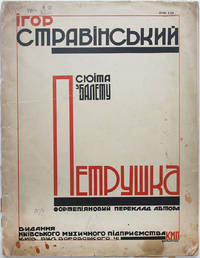
1927503Kiev: Muzgiz 1927. 35 pp. 34x25.5 cm. Some tears and stains on the wrappers and lower margin otherwise very good.<br /> <br /> First Ukrainian edition. Rare.<br /> <br /> This is a piano transcription of Igor Stravinsky's early composition 'Petrushka'. He began to create the ballet in Ukrainian town Ustyluh in 1907. Performed for the first time in 1911 the composition has been one of the most popular Ballets Russes. Its piano version presented not mere piano reduction of the composition but an attractive independent work that is now known as ''Trois mouvements de Petrouchka''. Stravinsky created piano version of the suite in 1921 for his friend pianist Arthur Rubinstein. He was the only musician who made Stravinsky believe in the soft sounds of piano performance. This is one of the early publications of the music.<br /> <br /> The edition is designed by Grygory Berkovitch 1905-1976 a Soviet artist and designer from Kharkiv.<br /> <br /> Not in the Worldcat. Muzgiz unknown
191241313Berlin Moscou St. Pétersbourg .: Édition Russe de Musique PN R.M.V. 127 1912. Folio. Newly bound in quarter dark green cloth with mid-brown paper boards dark red title label gilt to upper and spine. 1f. recto title verso blank i named cast list ii synopsis i orchestration i recto dedication "À Alexandre Benois" verso blank 7-156 pp. 1f. errata tipped in to rear pastedown. With text in Russian and French.<br /> <br /> Named cast for the first performance by Diaghilev's Ballets Russes at the Théâtre du Chatelet in Paris on 13 June 1911 includes Tamar Karsavina Le Ballerine Vaslav Nijinsky Petrushka Orlow Le Maure and Enrico Ceccheti Le vieux Charlatan; the performance was conducted by Monteux with maître du ballet Fokine and sets and costumes designed by Benois and executed by Anisfeld sets and Caffi and Worobiew costumes.<br /> <br /> Small area of faint dampstaining and minor cockling to upper inner margins. <br /> <br /> An attractive copy. First Edition first issue. Rare. Kirchmeyer 12-1. Hirsch II 905. De Lerma P15. White p. 193. Crawford p. 533. <br /> <br /> "The emergence of Stravinsky as a modernist with an individual manner unlike any other can be dated with some precision to his early work on Petrushka. In March 1910 during the later stages of composing The Firebird he had experienced the famous 'fleeting vision' out of which The Rite of Spring was to grow. But when Diaghilev and Nijinsky visited him in Lausanne in September 1910 they found him at work on something quite different a concert piece for piano and orchestra called 'Petrushka's Cry'. Together with a 'Russian Dance' composed soon afterwards this music was to form the basis of the ballet which Diaghilev instinctively urged him to write instead. . <br /> <br /> It is from the systematic attempt to render the particular flavour of traditional Russian life into music that Petrushka derives many of its freshest and most original qualities. . <br /> <br /> Looked at in general terms the opening sequence of Petrushka is a prototype of later Stravinskian form. Its underlying rhythmic design may not be complex in the same way as that of The Rite of Spring or the later Russian works but its intricacy of rhythmic detailing and its mixture of a highly fluid pattern of melodic stress with an inert background harmony laid the groundwork for a technique which through many changes of superficial style was to serve him for the rest of his life." Walsh: The Music of Stravinsky pp. 24-29. <br /> <br /> "Petroushka proved just as successful with the public and critics as The Firebird had been; but it was undoubtedly a more original work. In the first place Stravinsky had been able to play a leading part in the construction of the scenario which had not been the case with The Firebird. Secondly whereas the music of The Firebird showed that the pupil had learnt all that his master had had to teach him in Petrushka for the first time the authentic voice of the new master is heard." TNG Vol. 18 pp. 244-245. <br /> <br /> The rare first edition first issue of Stravinsky's colorful and well-loved ballet inspired by the St. Petersburg Shrove-tide Fair. Édition Russe de Musique [PN R.M.V. 127] unknown
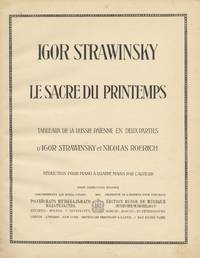
191341314Berlin - Moscou - St. Petersbourg: Édition Russe de Musique PN R.M.V. 196 1913. Folio. Original publisher's ivory cloth-backed dark ivory printed boards 1f. reco title verso blank 1f. recto half-title in French verso blank 1f. recto half title in Russian verso blank 1f. recto dedication to Nicolas Roerich verso blank 9-89. i blank pp. <br /> <br /> Binding slightly worn browned and foxed with manuscript annotation to blank upper margin of upper deleted in black ink. Slightly browned throughout; corners thumbed; some minor imperfections.<br /> <br /> In very good condition overall. First Edition first issue of the four-hand piano arrangement and the first appearance in print of the music pre-dating the full score by eight years. Rare. Kirchmeyer 15-1. De Lerma S3. White 21 p. 207. Crawford p. 543. <br /> <br /> "Unlike the orchestral score which did not appear in print until early 1922 the piano-duet version was published by Édition Russe de Musique shortly before the première and was soon reissued in response to considerable demand. But special importance attaches to this four-hand version not only for historical reasons but because of its specific aesthetic quality for it directly brings out the "pianistic" nature of many of the work's musical ideas. True not for a moment do we forget that The Rite of Spring owes a large part of its impact to its orchestral sound now subtly differentiated now brutally violent. But it allows the structural workings of a piece invented at the piano and developed in close contact with the instrument to come all the more trenchantly to the fore. It was not least because of this trenchancy and "closeness to the origin" that the piano version has in recent decades begun to emerge from its primary role as an object of study and a rehearsal aid and to take on a second life as an independent concert piece. It has even formed the basis of a number of ballet productions." Meyer ed.: Igor Stravinsky Le Sacre du printemps Manuscript of the Version for Piano Four Hands Facsimile p. 23<br /> <br /> The momentous first performance of The Rite took place in Paris at the Théâtre des Champs-Elysées on 29 May 1913. It was conducted by Monteux with choreography by Vaslav Nijinsky and set and costume designs by Nicolas Roerich. <br /> <br /> "It is now theatrical history that the first performance by the Russian Ballet . created a scandal of the first magnitude ." White: Stravinsky. The Composer and His Works p. 216. <br /> <br /> Since that time there have been a number of other versions of the ballet one choreographed by Leonide Massine 1920 at the Théâtre des Champs-Elysées with Roerich's original set designs and another by Kenneth Macmillan 1962 at Covent Garden with set designs by Sydney Nolan "but the work is more popular and seems to make a greater impact in the concert hall than on the stage. <br /> <br /> Its triumphant rehabilitation as one of the most important works in the symphonic repertory of the twentieth century dates from its first concert performances - in Moscow February 1914; conductor S. Koussevitzky Paris Casino de Paris April 1914; conductor Monteux and London Queen's Hall 7 June 1921; conductor Eugene Goossens." Ibid<br /> <br /> Diaghilev referred to The Rite of Spring as "the 20th century's Ninth Symphony." Austin: Music in the 20th Century p. 252. <br /> <br /> "Le sacre du printemps was to remain the most notoriously violent score of a time when huge noisy orchestras and harsh dissonance were more or less commonplace appurtenances of the new music. The primitive imagery of Russian symbolism of the kind exploited by Roerich had always carried a certain revolutionary tone a note of challenge to ossified social structures. But behind all the racket behind the wilfully discordant harmonies and convulsive metric irregularities lay a genuinely innovatory kind of musical thinking whose point would not become clear until Stravinsky himself began to deconstruct it in subsequent works." Stephen Walsh in Grove Music Online. Édition Russe de Musique [PN R.M.V. 196] unknown
1936255987London: Gollancz 1936. First English edition. Illustrated. 286 pp. 1 vols. 8vo. Publisher's black cloth repaired at head of spine in yellow printed dust jacket spine darkened and chipped with some loss to title small book ticket to spine. First English edition. Illustrated. 286 pp. 1 vols. 8vo. Inscribed on the ffep "A Sam & Louise Dushkin. Leur ami I Stravinsky. Paris 30.3.36."<br /> Samuel Dushkin 1891-1976 was a concert violinist who worked closely with Stravinsky on the composition of the latter's Violin Concerto 1931 his first major work for the instrument. Dushkin premiered the work in concert with Stravinsky conducting the Berlin Symphony Orchestra. Stravinsky recounts his collaboration with Dushkin on pp. 268-278 of his memoir. "I was very glad to find in him besides his remarkable gifts as a born violinist a musical culture a delicate understanding and - in the exercise of his profession - an abnegation that is very rare" p. 270. Stravinksy was inspired by his success with the Violin Concerto to compose a sonata for violin and piano which he took on tour with Dushkin to Europe and America ". a deeper knowledge of the violin and close collaboration with a technician like Dushkin had revealed possibilities which I longed to explore" p. 275.<br /> An important association marking a milestone in the expansion of Stravinksy's evolution as a composer. Gollancz unknown
1936255987London: Gollancz 1936. First English edition. Illustrated. 286 pp. 1 vols. 8vo. Publisher's black cloth repaired at head of spine in yellow printed dust jacket spine darkened and chipped with some loss to title small book ticket to spine. First English edition. Illustrated. 286 pp. 1 vols. 8vo. Inscribed to Violinist Samuel Dushkin. Inscribed on the ffep "A Sam & Louise Dushkin. Leur ami I Stravinsky. Paris 30.3.36."<br/>Samuel Dushkin 1891-1976 was a concert violinist who worked closely with Stravinsky on the composition of the latter's Violin Concerto 1931 his first major work for the instrument. Dushkin premiered the work in concert with Stravinsky conducting the Berlin Symphony Orchestra. Stravinsky recounts his collaboration with Dushkin on pp. 268-278 of his memoir. "I was very glad to find in him besides his remarkable gifts as a born violinist a musical culture a delicate understanding and - in the exercise of his profession - an abnegation that is very rare" p. 270. Stravinksy was inspired by his success with the Violin Concerto to compose a sonata for violin and piano which he took on tour with Dushkin to Europe and America ". a deeper knowledge of the violin and close collaboration with a technician like Dushkin had revealed possibilities which I longed to explore" p. 275.<br/>An important association marking a milestone in the expansion of Stravinksy's evolution as a composer. Gollancz unknown books