258 résultats
20221-1638875030Alfred Pub Co 2022. Paperback. New. spiral-bound edition. 95 pages. 12.25x9.50x0.50 inches. Alfred Pub Co paperback
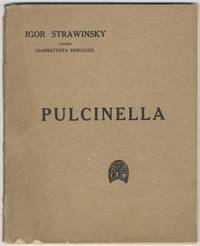
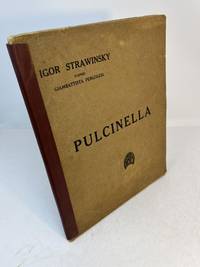
192041305London Genève: J. & W. Chester Ltd. PN J. & W. C. 9707 1920. Folio. Original publisher's printed dark ivory wrappers with decorative device to upper and publisher's details within decorative border to lower. 1f. recto title verso printed notice regarding first performance with named cast list and scenario 86 pp.<br /> <br /> Named cast includes Massine Pulcinella Thamar Karsavina Pimpinella Tchernicheva Prudenza Nemtchinova Rosetta Novac Fourbo Idzikowky Caviello Zverew Florindo Cecchetti Il Dottore Kostetsky Tartaglia and Bourman Okimowsky Micholaitchik and Loukin Petits Pulcinella.<br /> <br /> Wrappers somewhat worn and soiled; torn at spine with minor loss; partially detached. Minor internal wear; two small chips to blank lower margin of title and upper wrapper. First Edition. Scarce. Kirchmeyer 34-1. White p. 282. De Lerma P60. CPM Vol. 54 p. 440.<br /> <br /> Pulcinella commissioned by the Russian impresario and founder of the Ballets Russes Sergei Diaghilev 1872-1929 was first performed in Paris at the Opéra on 15 May 1920 with Ernest Ansermet conducting. The libretto and choreography were by Léonide Massine with costumes and sets designed by Pablo Picasso. J. & W. Chester, Ltd. [PN J. & W. C. 9707] unknown
1920CE236960London: J & W Chester Ltd 1920. 1st ed. thus. Paperback. Good. large quarto tan wraps 1st thus 1920 86 pages text in French. Spine covered with maroon cloth tape Exterior lightly soiled & edgeworn bumped corners owners names inside one is Reba Paeff; text clean / unmarked but slight soil / edgewear to final page. SHEET MUSIC.- Piano - vocal. J & W Chester, Ltd paperback
1019567791.Ghardcover. Good. Access codes and supplements are not guaranteed with used items. May be an ex-library book. hardcover
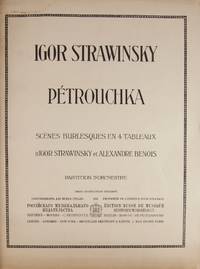
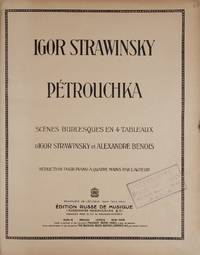
191241313Berlin Moscou St. Pétersbourg .: Édition Russe de Musique PN R.M.V. 127 1912. Folio. Newly bound in quarter dark green cloth with mid-brown paper boards dark red title label gilt to upper and spine. 1f. recto title verso blank i named cast list ii synopsis i orchestration i recto dedication "À Alexandre Benois" verso blank 7-156 pp. 1f. errata tipped in to rear pastedown. With text in Russian and French.<br /> <br /> Named cast for the first performance by Diaghilev's Ballets Russes at the Théâtre du Chatelet in Paris on 13 June 1911 includes Tamar Karsavina Le Ballerine Vaslav Nijinsky Petrushka Orlow Le Maure and Enrico Ceccheti Le vieux Charlatan; the performance was conducted by Monteux with maître du ballet Fokine and sets and costumes designed by Benois and executed by Anisfeld sets and Caffi and Worobiew costumes.<br /> <br /> Small area of faint dampstaining and minor cockling to upper inner margins. <br /> <br /> An attractive copy. First Edition first issue. Rare. Kirchmeyer 12-1. Hirsch II 905. De Lerma P15. White p. 193. Crawford p. 533. <br /> <br /> "The emergence of Stravinsky as a modernist with an individual manner unlike any other can be dated with some precision to his early work on Petrushka. In March 1910 during the later stages of composing The Firebird he had experienced the famous 'fleeting vision' out of which The Rite of Spring was to grow. But when Diaghilev and Nijinsky visited him in Lausanne in September 1910 they found him at work on something quite different a concert piece for piano and orchestra called 'Petrushka's Cry'. Together with a 'Russian Dance' composed soon afterwards this music was to form the basis of the ballet which Diaghilev instinctively urged him to write instead. . <br /> <br /> It is from the systematic attempt to render the particular flavour of traditional Russian life into music that Petrushka derives many of its freshest and most original qualities. . <br /> <br /> Looked at in general terms the opening sequence of Petrushka is a prototype of later Stravinskian form. Its underlying rhythmic design may not be complex in the same way as that of The Rite of Spring or the later Russian works but its intricacy of rhythmic detailing and its mixture of a highly fluid pattern of melodic stress with an inert background harmony laid the groundwork for a technique which through many changes of superficial style was to serve him for the rest of his life." Walsh: The Music of Stravinsky pp. 24-29. <br /> <br /> "Petroushka proved just as successful with the public and critics as The Firebird had been; but it was undoubtedly a more original work. In the first place Stravinsky had been able to play a leading part in the construction of the scenario which had not been the case with The Firebird. Secondly whereas the music of The Firebird showed that the pupil had learnt all that his master had had to teach him in Petrushka for the first time the authentic voice of the new master is heard." TNG Vol. 18 pp. 244-245. <br /> <br /> The rare first edition first issue of Stravinsky's colorful and well-loved ballet inspired by the St. Petersburg Shrove-tide Fair. Édition Russe de Musique [PN R.M.V. 127] unknown
191241390Berlin Moscou Leipzig New-York: Édition Russe de Musique PN R.M.V. 150 1912. Folio. Contemporary half black calf with marbled boards label of the Parisian music rental firm Rouart-Lerolle to upper marbled endpapers. 1f. recto title verso blank i named cast list referring to first production of 1911 in French i synopsis in Russian and French i "general remarks" in Russian and French i blank i dedication to A. Benois i blank 7-84 ii blank pp. Photographic transfer from engraved plates. With "ROME MAI 1911" and printer's note "Imp. C. G. Röder Leipzig." to lower outer corner of p. 84.<br /> <br /> Rouart Lerolle and "5" handstamps to title and first four leaves.<br /> <br /> Binding worn rubbed bumped and abraded; hinges split; small label with "143" in manuscript to upper board. First Edition first issue. Kirchmeyer 12-4. De Lerma P17. Crawford p. 533.<br /> <br /> Distinguishing imprint to title below crest found in the first issue is as follows:<br /> <br /> PROPRIÉTÉ DE L'ÉDITEUR POUR TOUS PAYS / ÉDITION RUSSE DE MUSIQUE / RUSSISCHER MUSIKVERLAG G.M. above BH below/ FONDÉE PAR S. ET N. KOUSSEWITZKY / BERLIN MOSCOU LEIPZIG NEW-YORK / POUR LA FRANCE ET SES COLONIES: MUSIQUE RUSSE PARIS 3 RUE DE MOSCOU / POUR L'ANGLETERRE ET SES COLONIES; THE RUSSIAN MUSIC AGENCY LONDRES W.I 34 PERCY STREET<br /> <br /> "The emergence of Stravinsky as a modernist with an individual manner unlike any other can be dated with some precision to his early work on Petrushka. In March 1910 during the later stages of composing The Firebird he had experienced the famous 'fleeting vision' out of which The Rite of Spring was to grow. But when Diaghilev and Nijinsky visited him in Lausanne in September 1910 they found him at work on something quite different a concert piece for piano and orchestra called 'Petrushka's Cry'. Together with a 'Russian Dance' composed soon afterwards this music was to form the basis of the ballet which Diaghilev instinctively urged him to write instead. . <br /> <br /> It is from the systematic attempt to render the particular flavour of traditional Russian life into music that Petrushka derives many of its freshest and most original qualities. . <br /> <br /> Looked at in general terms the opening sequence of Petrushka is a prototype of later Stravinskian form. Its underlying rhythmic design may not be complex in the same way as that of The Rite of Spring or the later Russian works but its intricacy of rhythmic detailing and its mixture of a highly fluid pattern of melodic stress with an inert background harmony laid the groundwork for a technique which through many changes of superficial style was to serve him for the rest of his life." Walsh: The Music of Stravinsky pp. 24-29. <br /> <br /> "Petroushka proved just as successful with the public and critics as The Firebird had been; but it was undoubtedly a more original work. In the first place Stravinsky had been able to play a leading part in the construction of the scenario which had not been the case with The Firebird. Secondly whereas the music of The Firebird showed that the pupil had learnt all that his master had had to teach him in Petrushka for the first time the authentic voice of the new master is heard." TNG Vol. 18 pp. 244-245. <br /> <br /> Petrushka one of Stravinsky's best-known and loved works represents the essence of Diaghilev's monumental Ballets Russes era. The ballet received its first performance with the incomparable Nijinsky in the title role at the Théâtre du Châtelet on 13 June 1911 conducted by Pierre Monteux with choreography by Fokine and designs by Alexandre Benois. Édition Russe de Musique [PN R.M.V. 150] unknown
2005Q-0060559594Harper Paperbacks 2005-03-15. Paperback. New. In shrink wrap. Looks like an interesting title! Harper Paperbacks paperback
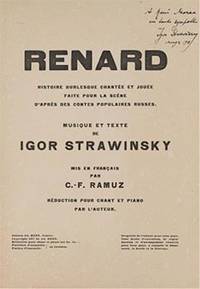
16-4191Genève Edition Ad. Henn 1917. . 4to. 28 x 19.8 cm. 8 64pp. Original wraps. Front cover mainly detached. Signed at Morges Switzerland and dated 1918 and inscribed .The poet and playwright René Morax founded his Théâtre du Jorat near Mézières Switzerland in 1903. Made entirely of wood so as to be integrated into the barns of the surrounding countryside it was described this way in an early account: “A theater decidedly unlike any other. A sort of vast chalet a kind of huge barn smelling of resin dried hay fresh fruit and on days when there was a performance Sunday clothes but retaining the rustic dignity of a shrine. A large stage descending in broad steps toward the orchestra pit …â€The theater was closed for several years during the Great War and Morax conceived a drama on the subject of King David to reopen it in 1921. When he turned to his wealthy friend Werner Reinhart who incidentally had recently funded the creation of Stravinsky’s Soldier’s Tale telling him that he was taking inspiration from Hindu theater for this work his patron offered to lend rare Hindu drums in addition to financial assistance. The text is drawn from the Hebrew Bible I and II Samuel I Kings in addition to the Huguenot Psalter which includes poetry by Clément Marot. The poet’s brother Jean Morax set to work designing costumes and sets. After several more established composers turned him down René on the advice of Stravinsky and the distinguished conductor Ernest Ansermet chose the then unknown twenty-eight year old Arthur Honegger. “When Swiss poet Rene Morax 1873-1963 was looking for a composer for his new King David libretto Stravinsky recommended the twenty-nine-year-old Arthur Honegger a composer who just six years later creating the film score for Abel Gance’s Napoleon would reveal himself as a master of music’s ability to translate epics into sweeping evocative sound. In 1921 right on the cusp of his first successes Honegger wrote the David score in a flush of creative energy.â€. Provenance from the estate of René Morax. Expertise by Claire PIGUET Geneva Genève, Edition Ad. Henn, 1917. paperback
1969256031New York: Alfred A Knopf 1969. First edition. ix i 350 xi pp. 8vo. Publisher's green cloth faded at edges in very good edge-worn dustjacket. First edition. ix i 350 xi pp. 8vo. Signed on the flyleaf "Igor Stravinksy / 1.30.70" and inscribed by co-author Robert Craft. The recipient was Miranda "Mirandi" Massoco Levy 1914-2011 the doyenne of Sante Fe cultural life instumental in the success of the Sante Fe Opera and a close friend of Stravinsky. Alfred A Knopf unknown
19971-0851621910Boosey & Hawkes Music Pub Ltd 1997. Paperback. New. new edition. 168 pages. 12.00x9.00x0.40 inches. Boosey & Hawkes Music Pub Ltd paperback
1997754181997. First Edition; First Printing. Softcover. Very Good in wrappers. Text is in Italian. ; 4to - over 9¾" - 12" tall. unknown
048643821X.Gpaperback. Good. Access codes and supplements are not guaranteed with used items. May be an ex-library book. paperback
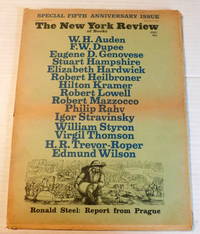
196899602<p>New York: September 26 1968. 1968. Very good. - Folio 15 inches high by 11-3/4 inches wide. Softcover unbound signatures laid into printed green self-wraps. Once folded horizontally the edges and center of the covers are faded to tan. A tear along the front edge has been reinforced with clear document tape from the verso. There is chipping to the top edges of the covers and along the spine. 80 pages of newsprint including the wrappers illustrated by David Levine and Grandville. There are tiny holes to the front border of the last few leaves. Very good.</p><p>RARE First edition.</p><p>Among the contents of this issue Igor Stravinsky in reviewing a book on the Beethoven string quartets offers his own impressions of them. Elizabeth Hardwick posts a powerful description of Mayor Daley and the notorious Chicago convention. Her article is illustrated with a David Levine caricature. William Styron offers his impressions of the same event in his article "In the Jungle" also illustrated with a Levine caricature. Ronald Steel reports from Prague "Up Against the Wall in Prague". F.W. Dupee writes of "The Uprising at Columbia". H.R. Trevor-Roper writes on "Hitler's Last Minute". Virgil Thomson discusses Pierre Boulez in his article "The Genius Type". Three poems are published in this issue: "Forty Years On" by W.H. Auden "Those Older" by Robert Lowell and "Barbara" by Robert Mazzocco.</p> New York: September 26, 1968. paperback
1998C5890Vanguard Classics 1998-06-23. Audio CD. Like New. CD case and liner all in Excellent condition. Vanguard Classics unknown
15-8077New York: Perls Gallery 1940. 8vo. Printed Wrappers Very Good Illustrations. 4 pp. Theodore Stravinksy was the son of Igor Stravinksy.The Perls Gallery in New York was founded in 1937 by Klaus Gunther Perls 1912-2008 and his brother Franz R. Perls1910-1975 after having worked at their mother's Galerie Kate Perls in Paris. Following his marriage to Amelia Blumenthal of Philadelphia in 1940 Klaus and Amelia B. Perls jointly ran the gallery. They specialized in modern French painting while Franz established the Frank Perls Gallery in Beverly Hills He originally dealt in works by Maurice Utrillo Maurice de Vlaminck and Raoul Dufy that his mother sent from Paris until the Nazi occupation. When she was forced to flee France he began dealing in now little known contemporary American artists including Darrel Austin and in Mexican and South American art such as Mario Carreno. After the war Klaus again dealt in French art from the School of ParisArtists in the Perls' stable included Rouault Picasso Léger Derain Dufy Matisse Modigliani Pascin Soutine and Vlaminck. The Perls Galleries closed in 1997. New York: Perls Gallery, 1940. unknown
1978017881Simon and Schuster 1978. This is a very good hardcover copy with a very good dust jacket not price-clipped with just light wear. SIGNED by Vera Stravinsky and dated December 1978 and inscribed to a well known music archivist on the front endpaper. Also signed by Robert Craft. Otherwise completely clean slight moisture rippling to bottom page edges.Closed tear to top edge of dust jacket spine. Illustrated in black & white. 11" high X 8" wide 688 pages. Large heavy book foreign shipping will be extra. This book will be securely wrapped and packed in a sturdy box and shipped with tracking. Signed by Author. First Edition. Hard Cover. Very Good/Very Good. Simon and Schuster, Hardcover
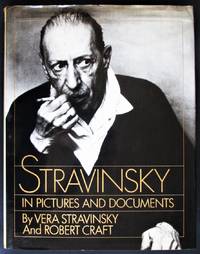
1978152209New York: Simon and Schuster 1978. First edition of this authoritative biography of Igor Stravinsky. Quarto original cloth profusely illustrated with black-and-white photographs. From the collection of Tony Grammy and Emmy Award-winning composer Charles Strouse and his wife choreographer Barbara Siman. Over his 50-year career Charles Strouse wrote the music for such iconic musical theater hits as Bye Bye Birdie Applause and Annie as well as the theme song for the classic sitcom All in the Family "Those Were the Days". His partnership with Martin Charnin on Annie produced one of Broadway's most successful scores ever with "Tomorrow" and other songs from the production becoming enduring American musical standards admired by generations. His reach knew no genre or generation – from a number-one Billboard hit in 1958 to Jay-Z's Grammy-winning sampling of "It's the Hard-Knock Life" four decades later – and his honors include three Tony Awards and induction into both the Songwriters and Theater Halls of Fame. With his ownership stamp to the front free endpaper. Near fine in a very good dust jacket. Designed by Edith Fowler. Jacket design by Robert Anthony. Stravinsky in Pictures and Documents 1978 is a monumental documentary biography of Igor Stravinsky 1882-1971 assembled by the composer's widow Vera Stravinsky 1888-1982 and his longtime musical associate and amanuensis Robert Craft 1923-2015. Departing from conventional narrative the authors tell the story of one of the twentieth century's supreme musical figures largely through primary materials hundreds of photographs letters diary entries contracts and other documents drawn from the Stravinsky archive many published here for the first time accompanied by Craft's connecting commentary and a wealth of annotation. The result is an unusually intimate chronicle that follows Stravinsky from his Russian childhood and the epoch-making early ballets The Firebird Petrushka and The Rite of Spring through his years in Switzerland France and the United States illuminating not only his music but the artists writers and impresarios among them Diaghilev Picasso and Cocteau who populated his extraordinary life. Vera a painter and former dancer who became Stravinsky's second wife and Craft who lived within the Stravinsky household for more than two decades were uniquely placed to compile this rich and authoritative record. Simon and Schuster hardcover
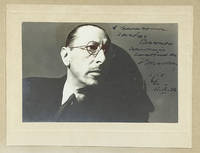
1203A vintage gelatin silver print photograph head and shoulders portrait in part profile with shadow by George Hoyningen-Huene 1934 inscribed and signed in blue ink on the upper right-hand area of the photograph 85x135 cm original mount framed and glazed. <br /> This original vintage photograph of Igor Stravinsky 1882 - 1971 was taken in Paris on November 16 1934 by the famous fashion photographer George Hoyningen-Huene 1900 - 1968.<br /> This is likely to be the second collaboration between the composer and the photographer as Igor Stravinsky's print taken by Hoyningen-Huene first appeared in the 1927 November issue of Vanity Fair. At the time both Stravinsky and Huene resided in France where their second collaboration took place. After their departure from the Russian Empire at the outbreak of WWI the Stravinskys first settled in Switzerland and then in France where they lived up until 1939. Although during the French era Igor created some of his most famous pieces notably Concerto for Two Pianos - 1935 and even managed to find his second love Vera de Bosset 1889 - 1982 the composer later described the Parisian period as the most unhappy time in his life: in 1938 Stravinsky lost his daughter Lyudmila in 1939 - died his wife and mother. The 1934 photograph one of a series was taken shortly after Stravinsky acquired French citizenship and together with his wife Ekaterina moved from Voreppe to Paris. During that period Stravinsky mainly focused on writing music and his autobiography book Chronicle of My Life. Less than a year and a half following the November encounter with George Hoyningen Stravinsky and his son Soulima embarked upon their first voyage to South America during which Igor inscribed this photograph. In the period from April to June 1936 the two visited Buenos Aires Montevideo and Rio de Janeiro. Stravinsky's tour in South America was not only arranged but also largely underwritten by his friend Victoria Ocampo 1890-1979 a wealthy Argentine author and publisher of the literary periodical Sur. After giving a series of concerts in Argentina and while passing through Rio de Janeiro Stravinsky had stopped for a few days in order to perform at the Municipal Theater the presentation of his melodrama Persephone with Victoria Ocampo declaiming on June 5 and 12. The event was mostly attended by music critics artists journalists and intellectuals. Stravinsky got extremely upset when the small number of spectators applauded him on the night of the show. When embarking for Europe he declared to journalists: Brazil is still too green for my music. Maybe in fifty years it will understand. The composer signed this photograph a day before his second performance at the Municipal Theater. Shortly after the photograph was taken both Stravinsky in 1939 and Huene in 1935 permanently moved to the United States where their careers continued to blossom. unknown
1999Q-085162216XBoosey & Hawkes 1999-08-01. Paperback. New. In shrink wrap. Looks like an interesting title! Boosey & Hawkes paperback
2004Q-0851621910Boosey & Hawkes 2004-06-01. Paperback. New. New. In shrink wrap. Looks like an interesting title! Boosey & Hawkes paperback
2001Q-0851623182Boosey & Hawkes 2001-07-01. Paperback. New. In shrink wrap. Looks like an interesting title! Boosey & Hawkes paperback
0571117244.Ghardcover. Good. Access codes and supplements are not guaranteed with used items. May be an ex-library book. hardcover
200129873AB2001. Holland Sony Classical Music 2001. CD Size. Booklet and 9 CD's. Original Hardcover. Besides some minor foxing to the booklet and box this rare set of 9 CD's is in excellent condition. Sony Classical. Igor Fyodorovich Stravinsky 17 June O.S. 5 June 1882 6 April 1971 was a Russian composer pianist and conductor later of French from 1934 and American from 1945 citizenship. He is widely considered one of the most important and influential composers of the 20th century. Stravinsky's compositional career was notable for its stylistic diversity. He first achieved international fame with three ballets commissioned by the impresario Sergei Diaghilev and first performed in Paris by Diaghilev's Ballets Russes: The Firebird 1910 Petrushka 1911 and The Rite of Spring 1913. The last transformed the way in which subsequent composers thought about rhythmic structure and was largely responsible for Stravinsky's enduring reputation as a revolutionary who pushed the boundaries of musical design. His "Russian phase" which continued with works such as Renard L'Histoire du soldat and Les noces was followed in the 1920s by a period in which he turned to neoclassicism. The works from this period tended to make use of traditional musical forms concerto grosso fugue and symphony and drew from earlier styles especially those of the 18th century. In the 1950s Stravinsky adopted serial procedures. His compositions of this period shared traits with examples of his earlier output: rhythmic energy the construction of extended melodic ideas out of a few two- or three-note cells and clarity of form and instrumentation. Wikipedia hardcover
197976840London: Hutchinson and Co 1979. Pages clean and bright biro inscription on front endpaper spotting on closed edges boards tidy shelf wear and chipping to edges of dust jacket. Hard. Good/Good. 4to. Hutchinson and Co Hardcover
19362090502125700963Daiichishobo 1936. Soft Cover. Fine. Number of pages: 309 pages Size: B6 size Number of books: 1 volume Daiichishobo paperback