[War; Crimea] J HBiblio.com
716 résultats
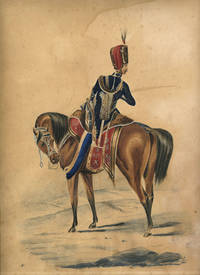
1850236911850. Very good condition. A wonderful watercolor of a British cavalry officer at the siege of Sevastopol signed "J.H." at the lower right. Perhaps the original study for the finished painting by Richard Simkin stance and details are identical to Simkin's image britishcavalryregiments.com/30-10h/10h5.jpg depicting the officer from the back turning in the saddle to his right his uniform and the horse's tack are painted in lavish and painstaking detail down to the studs on the bridle. This artwork predates Simkin's work.<br /> <br /> On the outbreak of war in the Crimea 1854-56 the 10th Hussars left India and traveled to the Black Sea but luckily were not part of Cardigan's charge of the Light Brigade avoiding the battle of Balaclava which took place in October of 1854. The regiment was heavily involved in the siege of Sevastopol and the triumphant battles of Eupatoria and Kerch.<br /> <br /> The Regiment returned to England in 1856 and in 1863 the 10th The Prince of Wales's Own Royal Hussars again had a Prince of Wales as their colonel this was Prince Edward later King Edward VII. The 10th Hussars are credited with introducing polo to England having learned it in India when a captain in the 10th Hussars observed a match and immediately formed a team with his fellow officers.<br /> <br /> 9 3/4 x 11 3/4". Overall tanned slight water mark in area above the soldier's head. Painted on card stock. unknown
244442Paris, Imprimerie impériale, novembre 1856, in-8, [2] ff. n. ch., 58 pp., broché sous couverture bleue imprimée.
Very Good Turkish, Ottoman (1500-1928) Original autograph manuscript letter sent to Haci Giray family for condolences on Haci Giray's death. 38x21 cm. On a special paper with 'ahar'. Sealed. 1 p. Has six lines. With a legible script and fine calligraphic style. It starts with 'huve'. He was a Turkish statesman, governor and member of state council according to Sicill-i Osmânî by Süreya and Türkischer Biographischer Index. The House of Giray (Crimean Tatar: Geraylar, Turkish: Âl-i Cengiz), also Girays, were the Genghisid/Turkic dynasty that reigned in the Khanate of Crimea from its formation in 1427 until its downfall in 1783. The dynasty also supplied several khans of Kazan and Astrakhan between 1521 and 1550. Apart from the royal Girays, there was also a lateral branch, the Choban Girays (Çoban Geraylar). Before reaching the age of majority, young Girays were brought up in one of the Circassian tribes, where they were instructed in the arts of war. The Giray khans were elected by other Crimean Tatar dynasts, called myrzas (mirzalar). They also elected an heir apparent, called the qalgha sultan (qalga sultan). In later centuries, the Ottoman Sultan obtained the right of installing and deposing the khans at his will. Giray family settled in Adrianople (Edirne) city in 17th century.
217089Paris, Maradan, Imprimerie de Crapelet, an X - 1802 in-8, VIII-398 pp., un f. n. ch. (table des matières et errata), demi-basane brune, dos lisse (reliure postérieure). Modeste reliure d'amateur, sans pièce de titre. Coiffe abîmée. Petites mouillures marginales sans gravité. Non rogné.
180694431Paris, Bossange, Masson et Besson 1806 In-8, demi- maroquin rouge à coins, dos lisse orné de filets argentés, 4- XIX- 302 pp. Un plan dépliant de Sébastopol dressé par Tardieu, 3 tableaux dépliants état des marchandises exportées d’Odessa, dans le courant de l’an 1802 - état des marchandises importées d’Odessa, dans le courant de la navigation 1802 – prix des marchandises d’exportation et d’importation, le 14 mars 1803, une grande carte dépliante faite en 1803 par Jean Reuilly dressée par J. B. Poirson petite déchirure angulaire avec restauration adhésive, trois planches dont deux de monnaies et médailles trouvées par J. Reuilly accompagnée d’une note de M. Langlès sur les monnaies de Crimée et d’une note de M. Millin sur les médailles.
215993Paris, Imprimerie Beaulé et Compagnie, s.d. (1854) placard in-folio (56 x 44 cm), texte sur 4 colonnes, en feuille.
216007Paris, Imprimerie de Beaulé et Compagnie, s.d. (1854) placard in-folio (55 x 44 cm), texte sur 4 colonnes, avec un grand bois gravé central représentant le sultan Abdülmecid Ier, en feuille, ébarbé, roussi.
215996Paris, Typographie Beaulé et Compagnie, s.d. (1854) placard in-folio (56 x 45 cm), texte sur 5 colonnes, avec un bois gravé central représentant le Sultan, en feuille.
216008Paris, Mme Bréau, s.d. (1854) placard in-4 (26 x 20 cm), texte sur deux colonnes, en feuille.
215999Paris, Boucquin, 1855 placard petit in-folio (45 x 27 cm), texte sommé d'un buste de Napoléon III, en feuille.
215998[Paris], Boucquin, s.d. (1855) placard petit in-folio (45 x 27 cm), texte sommé d'une aigle impériale laurée, en feuille.
221827S.l., s.d. (vers 1860) in-4, titre (détaché), 202 pp., couvertes d'une écriture fine, régulière, extrêmement soignée (environ 25 lignes par page), présentant aussi des notes infra-paginales de la même main, des biffures et ajouts au crayon de bois semblent postérieurs à la rédaction, de même que quelques ajouts marginaux à l'encre d'une autre main, demi-chagrin Bradel bouteille, dos muet orné de filets à froid, encadrements de filets à froid sur les plats de toile chagrinée, titre poussé en lettres dorées au centre du plat supérieur, tranches jaunes (reliure de l'époque). Plat supérieur un peu taché.
Very Good English Paperback. Pbo. Demy 8vo. (21 x 14 cm). In Turkish. 247, [1] p. Pro-Nazi account of German-Russian Front in II. World War by a Turkish General. Sark cephesinde gördüklerim, Führerle tarihi mülâkat.
Fine English Paperback. Demy 8vo. (21 x 14 cm). In English. 32 p. Complex of the Karaite Kenasa in Yevpatoria. Prepared for the 200th anniversary of the Big Kenasa Foundation. Translated by Valentin I. Kefeli. History and architecture of the Qirim-Tatar synagogue
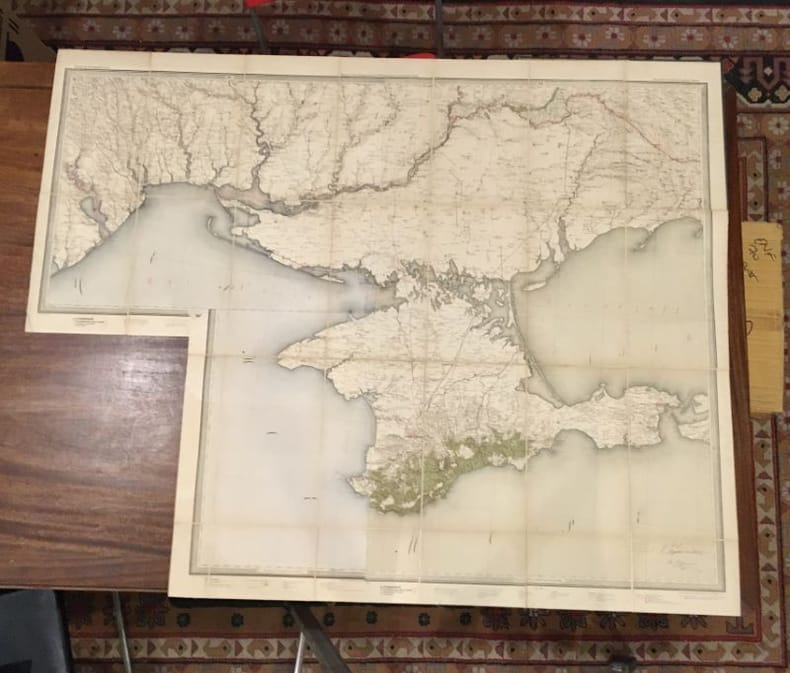
216771Paris, Longuet, s.d. (1855) grande carte de 59 x 77 cm, en feuille, petites déchirures latérales.
216012Paris, Lemercier, s.d. (1854) 3 cartes in-4 (32 x 44 cm), en feuilles.
216009Mâcon, Imprimerie de Romand, s.d. (1854) in-4, texte sur deux colonnes, en feuille.
185422570Paris Paulin et Le Chevalier 1854 -in-folio pleine toile un volume, reliure pleine toile vert foncé in-folio (cloth-bound in-folio), RELIURE D'EPOQUE, dos long (spine without raised band), décoration or (gilt decoration), titre et auteur frappés "or", pièce de titre sur fond bordeaux avec filets "or" de part et d'autre, toutes tranches lisses, cachet bleu de colportage de la prefecture de Paris en bas de la page de titre, édition populaire a texte sur trois colonnes, orné d'une gravure au titre + une carte hors-texte "du théâtre de la guerre" en couleurs + de trés nombreuses gravures et cartes in et hors-texte en noir, 176 pages, 1854 Paris : Paulin et Le Chevalier Editeur,
233202Paris, Plon, 1885 in-8, 408 pp., portrait-frontispice, 3 cartes dépliantes, fac-similés, broché. Dos en partie refait, manque le second plat de couverture, qqs rousseurs.
18159S.l., s.n., 1868. In-plano, 108 x 136 cm environ, feuillets contrecollés sur toile, couverture de toile chagrinée verte.
AQ29397Two volumes. Manuscript on paper. 109; 119pp. Contemporary half- morocco and morocco-backed marbled paper boards respectively. Cocked and a little soiled remaining tight some rear leaves removed from earlier volume. The first and more interesting of this pair of manuscript journals narrates a voyage from London to Balaklava in the transport ship Mary-Ann of Bristol commanded by Captain Lambert. Having departed the English coast on June 9th 1856 the Mary-Ann passes Cape St Vincent on June 16th bound for the Crimea. By the next day she sails abreast of the strait passing the Rock of Gibraltar by the third day. Another transport ship the Onward is pulled alongside by the Chief Mate returning from the Crimea with troops and horses onboard bound for for England. The message is relayed to the captain that ‘all the troops were waiting in Constantinople for ships to convey them home'. So begins the journal of Second Mate Thomas Nunn Hall recently married on his voyage to Balaklava. Hall mentions the other ships he encounters on voyage - the Lady Eglington is signalled and he notes he remembers her from a tour of the Dardanelles the previous year. Also mentioned are the ships sailing in company with the Mary-Ann The Herefordshire 'lazy 1800 tons' being most named. It becomes more apparent that our narrator - a most unwilling and witless seaman - has sailed this voyage before. Though it remains unclear if Hall served actively in the war he later reminisces about 'standing on the deck of the ship 'Chalmers'.from the Crimea to the Holy Land instead of being on the poop deck of the 'Mary-Ann'.' By the 6th of July they pass the island of Malta three days later sight the Greek mainland though it takes a further four days for Mytilene to come into view. Finally they come to anchor at the Dardanelles and by July 20th reach the Sea of Marmara to take on several guests including a Mrs Hunter “a fine handsome woman of about 26 years of age” whom Hall determines to make speak to him. Fortunately she seems none too perturbed. The troops previously thought to be collected are nowhere to be found and the Mary-Ann is to take on stores for England instead. Steam tug Helen Fancet tows the ship up the Golden Horn though a mishap takes place damaging the ship. They later anchor up among the ships of war. During an evening walk in Pera he witnesses some society event with the French military band playing to 'hundreds of people' including 'many beautiful and elegantly dressed English and French ladies'. Given the relative paucity of interesting narrative presented in his frequently introspective often 'vexed' and occasionally calamitous account we should perhaps consider it a blessing that the journal ends before the voyage was completed. . 8vo. hardcover
186330083Edinburgh and London: William Blackwood and Sons 1863-1887. 8 volumes. First Edition of each of the eight volumes. With a profusion of maps and plans throughout. 8vo handsomely bound in three-quarter red calf over red cloth covered boards the spines with raised bands central gilt ornamental tooling in the compartments two compartments lettered in gilt gilt rules to the joins marbled endleaves top edges gilt with the signification of the old Bournemouth bookseller of the late 1800's Horace G. Commin. A handsome set well preserved the text-blocks and illustrated portions all in very pleasing condition the bindings with very little evidence of wear hinges all strong and the bindings tight and sound. A COMPLETE SET OF THE FIRST EDITIONS OF THIS HISTORICALLY IMPORTANT AND WELL RESPECTED WORK. PERHAPS THE MOST IMPORTANT OF ALL WRITINGS ON THE CRIMEA. Alexander William Kinglake was an English travel writer and historian. He was educated at Eton College and Trinity College Cambridge. was called to the Bar in 1837 and built up a thriving legal practice which in 1856 he abandoned to devote himself to literature and public life. His magnum opus was this great work--The Invasion of Crimea: Its Origin and an Account of its Progress down to the Death of Lord Raglan in 8 volumes published from 1863 to 1887 by Blackwood Edinburgh one of the most effective works of its class. The History which Geoffrey Bocca describes as a book "by which no intelligent man can fail immediately to be fascinated no matter to what page he might open it" is presented here.<br> Kinglake's subject is the Crimean War of the mid-nineteenth century which was fought from October 1853 to February 1856 in which Russia lost to an alliance of the Ottoman Empire France the United Kingdom and Piedmont-Sardinia. The immediate cause of the war involved the rights of Christian minorities in Palestine then part of the Ottoman Empire with the French promoting the rights of Roman Catholics and Russia promoting those of the Eastern Orthodox Church. Longer-term causes involved the decline of the Ottoman Empire the expansion of the Russian Empire in the preceding Russo-Turkish Wars and the British and French preference to preserve the Ottoman Empire to maintain the balance of power in the Concert of Europe. <br> The churches worked out their differences with the Ottomans and came to an agreement but both the French Emperor Napoleon III and the Russian Tsar Nicholas I refused to back down. Nicholas issued an ultimatum that demanded the Orthodox subjects of the Ottoman Empire be placed under his protection. Britain attempted to mediate and arranged a compromise to which Nicholas agreed. When the Ottomans demanded changes to the agreement Nicholas recanted and prepared for war. <br> The Crimean War was one of the first conflicts in which military forces used modern technologies such as explosive naval shells railways and telegraphs and it was one of the first to be documented extensively in written reports and in photographs. The war quickly became a symbol of logistical medical and tactical failures and of mismanagement. The reaction in Britain led to a demand for the professionalizing of medicine most famously achieved by Florence Nightingale who gained worldwide attention for pioneering modern nursing while she treated the wounded.<br> The war also marked a turning point for the Russian Empire. The war weakened the Imperial Russian Army drained the treasury and undermined Russia's influence in Europe. The empire would take decades to recover. Russia's humiliation forced its educated elites to identify its problems and to recognize the need for fundamental reforms. They saw rapid modernization as the sole way to recover the empire's status as a European power. The war thus became a catalyst for reforms of Russia's social institutions including the abolition of serfdom and overhauls in the justice system local self-government education and military service. <br> As the Ottoman Empire steadily weakened during the 19th century the Russian Empire stood poised to take advantage by expanding southward. In the 1850s the British and the French Empires were allied with the Ottoman Empire and were determined to prevent that expansion. The historian A. J. P. Taylor argued that the war had resulted not from aggression but from the interacting fears of the major players:<br> "In some sense the Crimean war was predestined and had deep-seated causes. Neither Nicholas I nor Napoleon III nor the British government could retreat in the conflict for prestige once it was launched. Nicholas needed a subservient Turkey for the sake of Russian security; Napoleon needed success for the sake of his domestic position; the British government needed an independent Turkey for the security of the Eastern Mediterranean. Mutual fear not mutual aggression caused the Crimean war."<br> Field Marshal FitzRoy James Henry Somerset 1st Baron Raglan known before 1852 as Lord FitzRoy Somerset as a junior officer served in the Peninsular War and the Waterloo campaign latterly as military secretary to the Duke of Wellington. He also took part in politics as Tory Member of Parliament for Truro before becoming Master-General of the Ordnance.<br> He became commander of the British troops sent to the Crimea in 1854: his primary objective was to defend Constantinople and he was also ordered to besiege the Russian port of Sevastopol. After an early success at the Battle of Alma a failure to deliver orders with sufficient clarity caused the fateful Charge of the Light Brigade at the Battle of Balaclava. <br> Dissatisfaction with the conduct of the war was growing with the public in Britain and other countries and was worsened by reports of fiascos especially the devastating losses of the Charge of the Light Brigade at the Battle of Balaclava. On Sunday 21 January 1855 a "snowball riot" occurred in Trafalgar Square near St Martin-in-the-Fields in which 1500 people gathered to protest against the war by pelting buses cabs and pedestrians with snowballs. When the police intervened the snowballs were directed at the constables. The riot was finally put down by troops and police acting with truncheons. In Parliament the Conservatives demanded an accounting of all soldiers cavalry and sailors sent to the Crimea and accurate figures as to the number of casualties sustained by all British armed forces in Crimea especially concerning the Battle of Balaclava. When Parliament passed a bill to investigate by the vote of 305 to 148 Aberdeen said he had lost a vote of no confidence and resigned as prime ministe. The veteran former Foreign Secretary Lord Palmerston became prime minister and took a hard line wishing to expand the war foment unrest inside the Russian Empire and reduce the Russian threat to Europe permanently. Sweden–Norway and Prussia were willing to join Britain and France and Russia was isolated.<br> France which had sent far more soldiers to the war and suffered far more casualties than Britain had wanted the war to end as did Austria. Negotiations began in Paris in February 1856 about seven months after Lord Raglan's death and were surprisingly easy. France under the leadership of Napoleon III had no special interests in the Black Sea and so did not support the harsh British and Austrian proposals.<br> Peace negotiations at the Congress of Paris resulted in the signing of the Treaty of Paris on 30 March 1856. In compliance with Article III Russia restored to the Ottoman Empire the city and the citadel of Kars and "all other parts of the Ottoman territory of which the Russian troop were in possession". Russia returned the Southern Bessarabia to Moldavia. By Article IV Britain France Sardinia and Ottoman Empire restored to Russia "the towns and ports of Sevastopol Balaklava Kamish Eupatoria Kerch Jenikale Kinburn as well as all other territories occupied by the allied troops". In conformity with Articles XI and XIII the Tsar and the Sultan agreed not to establish any naval or military arsenal on the Black Sea coast. The Black Sea clauses weakened Russia which no longer posed a naval threat to the Ottomans. The Principalities of Moldavia and Wallachia were nominally returned to the Ottoman Empire and the Austrian Empire was forced to abandon its annexation and to end its occupation of them. The Treaty of Paris admitted the Ottoman Empire to the Concert of Europe and the great powers pledged to respect its independence and territorial integrity. wiki<br> Tuckwell wrote in 1902 that In 1854 Kinglake "accompanied Lord Raglan to the Crimea.He had hoped to go in an official position as non-combatant but this was refused by the authorities. His friend Lord Raglan whose acquaintance he had made while hunting with the Duke of Beaufort’s hounds took him as his private guest. Arrested for a time at Malta by an attack of fever he joined our army before hostilities began rode with Lord Raglan’s staff at the Alma fight and accompanied the chief in his visit of tenderness to the wounded when the fight was over. Throughout the campaign the two were much together. There are often slight but unmistakable signs of Kinglake’s presence as spectator and auditor of Lord Raglan’s deeds and words; his affection and reverence for the great general animate the whole; in outward composure and latent strength the two men resembled each other closely. The book is in fact a history of Lord Raglan’s share in the campaign; begun in 1856 at the request of Lady Raglan the narrative ends when the Caradoc with the general’s body on board steams out of the bay “Farewell†flying at her masthead the Russian batteries with generous recognition ceasing to fire till the ship was out of sight. “Lord Raglan is dead†said Kinglake as Vol. VIII. was sent to press “and my work is finished.â€<br> Tuckwell wrote that: "In order therefore rightly to appreciate The Invasion of the Crimea we must look upon it as a great prose epic; its argument machinery actors episodes subordinate to a predominant ever present hero. In its fine preamble Lord Raglan sits enthroned high above generals armies spectators conflicts; on the quality of his mind the fate of two great hosts and the fame of two great nations hang. He checks St. Arnaud’s wild ambition; overrules the waverings of the Allies; against his own judgment but in dutiful obedience to home instruction carries out the descent upon the Old Fort coast. The successful achievement of the perilous flank march is ascribed to the undivided command which during forty-eight hours accident had conferred upon him. From his presence in council French and English come away convinced and strengthened; his calm in action imparts itself to anxious generals and panic-stricken aides-de-camp. Through Alma fight from the high knoll to which happy audacity had carried him he rides the whirlwind and directs the storm. In the terrible crisis which sees the Russians breaking over the crest of Inkerman in the ill-fated attack on the Great Redan where Lacy Yea is killed his apparent freedom from anxiety infects all around him and achieves redemption from disaster. William Blackwood and Sons hardcover
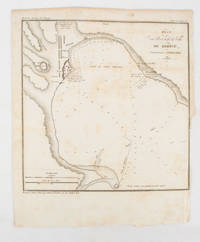
1839175248Paris.: Librairie de Gide. 1839. Engraved map 21.1 x 20.8 cm 27 x 22 cm sheet original folds trimmed to the inner margin with slight loss to the border only map spotted but otherwise in sound condition. Map of the Port of Kerch in Crimea prepared for the 1839 edition of the French Journal "Nouvelles Annales des Voyages." the editors for this edition amongst others the translator and geographer Jean-Baptiste Benoît Eyriès and Alexander von Humboldt founding members of the world's first geographical society the Société de Géographie. . (Librairie de Gide). unknown
185444912P., Amyot, 1854, in-8°, xxii-135 pp, broché, dos factice muet, qqs rousseurs éparses, bon état, envoi a.s. (Barbier III, 412b)
236266Paris, Plon, 1898 gr. in-8, 434 pp., table in-fine, 4 cartes dépl., demi-chagrin rouge, dos lisse (reliure postérieure).