716 résultats
Very Good Tatar Original wrappers. Demy 8vo. (21 x 14,5 cm). In Crimean Tatar in Arabic script. 25 p. Chipped on extremities, wear on spine, slightly stained and dusty covers. Overall a good copy. First and only edition of this first regulations consisting of 87 articles under 11 main headings, of the parliamentary (qurultai) of the Crimean People's Republic, which was the first Turkic and Muslim democratic republic in the world, existed from December 1917 to January 1918 in the Crimean Peninsula, a modern day Ukrainian territory currently occupied by the Russian Federation. The Crimean People's Republic was declared by the initiative of the Qurultai of Crimean Tatars, which stipulated the equality of all ethnicities within the peninsula. Noman Çelebicihan (1885-1918) was chosen as the first President of the nascent Republic. The Qurultai, in opposition to the Bolsheviks, published a "Crimean Tatar Basic Law", which convened an All-Crimean Constitutional Assembly, established a Board of Directors as a provisional government, and erected a Council of National Representatives as a provisional parliament. The Board of Directors and the Central Council of Ukraine both mutually recognized each other. This attempt to build a new nation was quickly defeated by the Bolshevik- and anarchist-dominated Black Sea Fleet. Already on 16 December 1917, the Bolsheviks captured Sevastopol where the headquarters of the Black Sea Fleet was located and dissolved the local council of deputies. The power in the city was transferred to the local revkom. The Bolsheviks were supported by some ships of the Black Sea Fleet. To defend itself, the Crimean government created a United Crimean Headquarters on 19 December 1917, that had at its disposal two cavalry and one infantry regiment of Crimean Tatars as well as some Ukrainian and Russian formations that amounted to some thousand people. Several armed incidents took place during January 1918. On 14 January 1918, the Bolsheviks captured Simferopol where they managed to arrest former President of Crimea (Head of Directorate) Noman Çelebicihan who had just resigned on 4 January 1918. He was transferred back to Sevastopol and interned until 23 February 1918, when he was executed without trial. The body of Çelebicihan was thrown into the sea. On the initiative of Çelebicihan on 10 January 1918, the Qurultai created a special commission that conducted talks with the Bolsheviks to stop the armed conflict in Crimea. On the initiative of Çelebicihan on 10 January 1918, the Qurultai created a special commission that conducted talks with the Bolsheviks to stop the armed conflict in Crimea. By the end of January 1918, the Bolsheviks had captured the whole of Crimea and dissolved both the Kurultai as well as the Council of National Representatives. The Red Terror engulfed the peninsula. With Çelebicihan in the Reds' custody, another leader of the Crimean Tatars, Cafer Seydamet Qirimer, managed to escape to the Caucasus across continental Ukraine. Many Crimean military formations retreated to the mountains. The government of Ukraine blockaded Crimea while trying to re-establish control over the Black Sea Fleet and the city of Sevastopol. Any Muslim supporting military formations on the way to Crimea was stopped. That, in turn, triggered a protest from the All-Russian Muslim military council. By the end of January 1918, the Ukrainian government itself was forced to declare war on the Russian SFSR due to the advancement of the Red Guard forces of Moscow and Petrograd into Ukraine without explicit notification. The Bolsheviks briefly established the Taurida Soviet Socialist Republic on Crimean territory in early 1918 before the area was overrun by forces of the Ukrainian People's Republic and the German Empire. Some officials of the national government, such as Seydamet Qirimer who managed to escape the Bolsheviks' terror sought political asylum in Kyiv and petitioned for military help from the advancing Ukrainian Army as w
8vo., First Edition thus, with plates, small neat signature on front free endpaper; black cloth, gilt back, a near fine copy in unclipped dustwrapper. First published by John Murray in 1977. Turan 199 (recording the first edition).
189057961Lille Grammont, Maison Saint-Joseph, Oeuvre de Saint-Charles, impr. Desclée, De Brouwer et Cie, Bruges 1890 In-4 22 x 31 cm. Cartonnage de l’éditeur pleine percaline rouge, dos lisse orné d’un décor floral noir et or, premier orné d’une composition figurative noir et or, tranches dorées, illustrations dans et hors-texte. Coiffes et coins légèrement frottés et émoussés, intérieur frais. Exemplaire en bon état. en Algérie : souvenirs e la conquête - Sous les murs de Sébastopol - La journée de Solférino - Au Mexique : les Héros de Cameron - En chine : Prise de Pei-Ho - Souvenir de l’Année terrible - La france au Tonkin.
New English Paperback. Roy. 8vo. (24 x 17 cm). In English. 192 p. A precarious balance: Conflict trade, and diplomacy on the Russian-Ottoman frontier.
Tratta da “Seat of War in the East”. Paul & Dominic Colnaghi & C.°, London 1855 – 1856. Tonolitografia in recente ma bella coloritura a mano, cm 37 x 55,5 circa (il foglio). Disponiamo di numerose tavole appartenenti alla prima o seconda serie. Le tavole sono tutte delineate da William Simpson e litografate da vari autori, tra cui E. Walker, J. Needham, T. Picken e altri. Tranne un minimo e lieve foxing, bella coloritura e in buono stato di conservazione.
Paris, Perrin et Cie Libraires-Editeurs, 1926, in-16, br. editoriale, pp. (4), 294, (2). Ottime condizioni.
411, (3 ads) pages. "This volume of war correspondence and travel bridges forty years of personal wanderings and adventure." - from Introductory. The adventures described took place in many places around the world. Here are the author's thoughts after a time in China: "The Chinese are noted for their savage cruelty. I had several instances, but I will not jar my readers' feeling by going into details of the Chinaman's 'gentle art' of disposing of his captive enemies. China, too, is the land of corruption. Every man considers it his duty to cheat his neighbour. It is a cardinal article of Celestial life. The process is known as 'squeezing' and, beginning with the Emperor, it is prosecuted down step-by-step." - from page 224. Unmarked. Somewhat above-average wear to publisher's red cloth adorned with gilt lettering. Binding intact. Moderate spine slant. Backstrip all but loose. (Prior owner secured it with tape, now moved, leaving some tackiness.) A worthy vintage copy. Book
215993Paris, Imprimerie Beaulé et Compagnie, s.d. (1854) placard in-folio (56 x 44 cm), texte sur 4 colonnes, en feuille.
213850Paris, Charles-Lavauzelle, s.d. in-8, III-209 pp., 1 portr., 5 cartes dépl., toile rouge (rel. moderne).
Very Good Turkish Paperback. Cr. 8vo. (20 x 14 cm). In Crimean Turkish (Cyrillic script). 222, [2] p., color ills. ISBN: 582501247. Akilli kirpinen ayneci tilki. Krimtatar halk masallari. Toplagan, islegen ve tertib etgen: Ablüziz Veliev. A rare fairytale book compiled and printed by Crimean intellectuals during their exile in Uzbekistan.
In- 8 oblungo (mm 245 x 205), frontespizio, pp. 118 di testo e 40 tavole litografiche a colori (la n.39 dell'assedio di Peschiera non è mancante ma inserita come vignetta al frontespizio) e 2 carte delle battaglie di Magenta e Solferino comprese nel testo. Legatura mezza pelle, titolo e fregi oro al dorso.Titolo litografato a colori con vignetta, seguono la Prefazione, "Proclama di Napoleone III" stampato con caratteri oro su fondo blu. Testo descrittivo racchiuso entro cornice litografica (impressa in verde, blu, rosso, marrone) con motivi militareschi. Nell'indice dei ritratti al n.12 è indicato il Gen. Castelborgo, mentre al suo posto è presente il ritratto del Gen. Mollard. Edizione originale completa delle 62 incisioni (40 a colori, 20 ritratti su fondo ocra e 2 carte geografiche in b/n). Le belle tavole furono disegnate dal Bossoli ed eseguite in litografia da vari autori. Il ticinese Carlo Bossoli (1815-1884) pittore, disegnatore e litografo, fu inviato a seguito dell'esercito sardo nella guerra del 1859 e documentò con grande realismo gli episodi bellici. Il testo si basa sulle lettere dell'ungherese Nandor Eber, corrispondente per il Times. Questa importante raccolta di stampe a colori era stata pubblicata l'anno precedente a Londra con il titolo The war in Italy. Il successo di questo primo volume portò l'editore alla pubblicazione di una seconda parte, dedicata alle imprese di Garibaldi nelle due Sicilie e dell'Armata Piemontese di Vittorio Emanuele nelle Romagne e nel Napoletano.Qualche segno del tempo alla legatura, qualche macchietta e piccola arrossatura su alcune tavole, nel complesso ben conservato. . Abbey, J.R. Travel, 177 .
1) Cesare ROVIGHI, ALFONSO LA MARMORA Luogotenente -Generale del Corpo Sardo di Spedizione [in CRIMEA]. 20 pp. + RITRATTO fuori testo disegnato dal vero da F. Gonin e litografato da C. Kreuzberger per Doyen. La spedizione iniziata il 14 aprile 1855, finì il 14 marzo 1856, ma il rientro si completò solo il 15 giugno. 2) Il vivace resoconto sul Carnevale di IVREA è, in primissima edizione, un'anticipazione delle 44 pagine su Ivrea pubblicate poi, nel 1877, nel libro "Bozzetti alpini" edito dagi Eredi Botta. Il fasc. in-8° (cm. 25,6x16,4), bross. edit., è completo delle sue 234 pagiene contiene inoltre: 1) Una dura critica di Nicolò TOMMASEO a uno scritto del Troplong sulla fine della Repubblica Romana. 2) La libertà, poesia di Lorenzo COSTA elogiata da Terenzio Mamiani. 3) Michele COPPINO.La COMETA di Leverrier eil genio della Terra (poesia di 3 pp.). Ecc.
Very Good English Paperback. Large roy. 8vo. (24 x 18 cm). In English. 11-14 pp., 3 numerous b/w plates. An illustrated Turkish treatise on the zodiac.
Very Good Italian Paperback. 4to. (28 x 20 cm). In Italian. 22 p. Appunti su alcuni aspetti dell'immigrazione Ebraica in Israele. [Estratto dalla Rivista mensile Oriente Moderno, Anno XLI. Nr. 5. Maggio 1961]. Notes on some aspects of Jewish immigration in Israel.
1997LFA-126746942N° 336 (Juille-août 1997) : revue de 78 pages, format 215 x 285 mm, illustrée, brochée couverture couleurs, bon état
Fine Tatar Paperback. Cr. 8vo. (20 x 14 cm). In Crimean Turkish, Crimean-Tatar, and Russian. 189 p. 1000 copies were printed.
Very Good English Paperback. Pbo. Demy 8vo. (21 x 14 cm). In Turkish. 1 b/w portrait of Resulzade, 71 p. Asrimizin Siyavus'u. Prep. by Arasoglu. F¿rst Edition in 1923 in Ottoman Turkish. This is Second Edition. In modern Turkish. A study on thoughts on independence and future of Azerbaijan and Russian imperialism.
IN 8° OBLUNGO ( cm.26,5 X 39, 1 CARTA CON NOTIZIE STATISTICHE INTORNO ALLE POTENZE BELLIGERANTI + c.5 COSI' RIPARTITE : a) PIANTA DI SEBASTOPOLI CON LE SUE FORTIFICAZIONI BATTERIE E PORTATA DEI SUOI CANNONI .b) PIANTA DELLA CRIMEA.<BR> c) PIANTA DELLA GUERRA DEL DANUBIO. d) PIANTA DELLA GUERRA IN ASIA. e) PIANTA DI KRONSTAD CON SUE FORTIFICAZIONI, BATTERIE E PORTATA DEI SUOI CANNONI. f) PIANTA<BR>DELLA GUERRA DEL NORD. LE CARTE, SONO DELLA LITOGRAFIA BALLAGNY in b/n. COPERTINA EDITORIALE IN BROSSURA VERDE CON TITOLO. INTERESSANTE ATLANTE SULLA GUERRA DI CRIMEA ( 1854 - 55 ), CAUSATA DALLE MIRE ESPANSIONISTICHE DELLA RUSSIA ZARISTA VERSO I BALCANI, ED ALLO SBOCCO DELLE NAVI RUSSE SUL MAR NERO, CONTRASTATE DA UNA COALIZIONE DI STATI EUROPEI ALLEATI DELL'IMPERO OTTOMANO TRA CUI REGNO UNITO, FRANCIA E REGNO DI SARDEGNA.NEL MARZO DEL 1854, LA REGINA VITTORIA E NAPOLEONE III, DICHIARAVANO UFFICIALMENTE GUERRA ALLA RUSSIA. ANCHE IL REGNO DI SARDEGNA SI UNI' ALL'IMPRESA : IL PRESIDENTE DEL CONSIGLIO CAVOUR CONSIDERAVA L'INTERVENTO UN BUON TRAMPOLINO DI LANCIO PER ENTRARE A FAR PARTE DEL GIOCO POLITICO EUROPEO E, NEL 1855 INVIO' UN CORPO DI SPEDIZIONE CAPEGGIATO DAL GENERALE ALFONSO LAMARMORA. NEL 1856, SEBASTOPOLI CADDE. AL CONGRESSO DI PARIGI LO ZAR ALESSANDRO II, ACCETTO' IL PRINCIPIO DI NEUTRALITA' SUL MAR NERO.TRACCE DI POLVERE ALLE CARTE ED ALLA BROSSURA, MINIMI SEGNI DEL TEMPO<BR>AL DORSO DELLA BROSSURA NEL PIEDE, ALTRIMENTI OTTIMA CONSERVAZIONE.ID 3373
30991Paris, Phébus, coll. "D'ailleurs", 1991 - in-8 broché, couv. illustrée à rabats, 264 pages, avec 6 dessins de l'auteur - excellent état
Very Good Turkish Original autograph greeting card signed by Edige Mustafa Kirimal sent to 'Bahire Hanim'. 10x12 cm (Open size: 10x24 cm). In Turkish. 1 p. Written on the card as print 'Die besten Münche zum Jahresmeschel'. Dated 'Münih, 23.12.1963'. 8 lines. Written 'Yeni yilinizi candan kutlar, saglik ve saadet diler, samimî selâm ve hürmetlerimizin kabulünü rica ederiz'. This is a new year celebration and greetings. Kirimal is best known for his meticulous research and publications on the history of Crimean Tatars in the first half of the 20th century. He served as the editor of Dergi, one of the publications of the Institute for the Study of the USSR in Munich, and was among the first scholars to explore the fate of ethnic minorities living in the Soviet Union. Edige's father Mustafa Shinkievich, who came from a Lithuanian Tatar (also known as Polish Tatar) family, had moved to Crimea before World War I. He was a descendent of soldiers under the command of the Golden Horde Khan Toktamish who had fled to Lithuania in the late 14th century. Born in Bahçesaray in 1911, Edige received his early education in Dereköy, near Yalta and graduated from the Russian gymnasium in Yalta. He enrolled in the Institute of Pedagogy in Simferopol (now Crimean State University of Engineering and Pedagogy), but his involvement in Crimean Tatar nationalist activities made it impossible for him to remain in Crimea. The Soviet repression, marked by the arrest, execution and deportation of thousands of Tatars, forced him to flee to Azerbaijan and then to Iran. He arrived in Istanbul in 1932. Two years later, he joined his uncle Yakup Shinkievich, who was serving as Muftu of the Lithuanian Muslims in Vilnius, a city then under Polish occupation. Edige graduated from the University of Vilnius with a degree in political science in 1939. Following the invasion of Poland by German forces in September 1939, he left for Berlin and then for Istanbul. During the German occupation of Ukraine and Crimea (1941-44), Kirimal was active in Germany, trying to secure rights and protection for the Crimean Tatars, and later helped refugees from Crimea settle in German camps. After World War II ended, Kirimal pursued graduate studies and received his doctorate degree from the University of Münster in Germany. His often quoted monograph, Der nationale Kampf der Krim-türken (Emsdetten/Westfalen, 1952), was based on his dissertation. He joined the staff of the newly founded Institute for the Study of the USSR (Institut zur Erforschung de UdSSR) in Munich in 1954 and became the editor of Dergi, the Institute's publication in Turkish. Kirimal published numerous articles on the history and nationalist struggle of Crimean Tatars under Russian and Soviet rule. He was fluent in Russian, Turkish, Polish and German. He retired in 1972 when the Institute closed, and died in 1980 in Munich. (Source: International Committee for Crimea).
Very Good English Original autograph letter signed by Vladimir Fedorovich Minorsky, sent to Turkish professor and historian Osman Turan, (1914-1978), was born in year when World War I started. He had some bad conditions in his childhood. Being in Ankara in years when DTCF established was a great chance for him. He was trained by Fuat Köprülü. His studies in the first period were about pre-Islamic Turkish history. But his studies after he became associate-professor were about Seljukians. There isn't a better studying in this field yet than his studies. (Source: Osman Turan's Life (1914/17 - 1978) and Historiography, Tufantoz). Letter has 12 lines in front, and 4 lines on verso, in English completely. It has a plan of a library, probably in the UK which shows Trinity and Sydney Colleges, etc. Letter says: "Dear Dr. Turan, Very good. We shall be waiting for your on Friday. If you are not engaged come andd have lunch with us at 12.45. If you cannot come at 2.30 and I shall show you the Library. Looking forward to meeting you. Yours sinccerely, V. Minorsky'. "When you come to No 9 push the door in front of you...". Repaired margins. Minorsky was a Russian Orientalist best known for his contributions to the study of Persian and Kurdish history, geography, literature, and culture. Minorsky was born in Korcheva, in the Konakovsky District of the Russian oblast of Tver, northwest of Moscow on the upper Volga River, a town now submerged beneath the Ivankovo Reservoir. There he was a gold medallist of the Fourth Grammar School. In 1896 he entered Moscow University to study law, graduating in 1900, then entered the Lazarev Institute of Oriental Languages where he spent 3 years preparing for a diplomatic career. He made his first trip to Iran in 1902, where he collected material on the Ahl-e Haqq. In 1903 he entered the Russian Ministry of Foreign Affairs, serving 1904-1908 in Persia (now Iran), first in the Tabriz Consulate-General and then the Tehran Legation, and 1908-1912 in Saint Petersburg and Tashkent. In 1911, jointly the Four-Power (British, Russian, Turkish, and Persian) Commission, he carried out a mission in North-Western Persia to delimit the Turko-Persian border, and also published a monograph on the Ahl-i ?aqq religion for which he was awarded the Gold Medal of the Ethnography Section of the Imperial Society of Natural Sciences in Moscow. One of the most important Kurdish manuscripts he obtained during this period was The Forqan ol-Akhbar, by Hajj Nematollah, which he later wrote about in "Etudes sur les Ahl-I Haqq, I.", Revue de L'Histoire des Religions, tome XCVII, No. 1, Janvier 1928, pp. 90-105. His surveys in Iran also provided invaluable material for his 1915 work, Materialï dlya izucheniya vostoka (Materials for the Study of the East), published by the Imperial Russian Ministry of Foreign Affairs, St. Petersburg. From 1915-17 he served as Chargé d'affaires in the Russian Legation at Tehran. As the Bolshevik Revolution of 1917 made problematic his return to Russia, in 1919 he moved to Paris where he worked at the Russian Embassy. There his expertise in Middle Eastern and Caucasian affairs was useful during the Versaille and Trianon peace settlements. In 1923 he began to lecture on Persian literature at the École nationale des langues orientales vivantes, where he subsequently taught Turkish and Islamic history. In 1930 he was named Oriental Secretary to the 1931 International Exhibition of Persian Art at Burlington House, London, and in 1932 was made a lecturer in Persian at London's School of Oriental Studies. In 1933 he became Reader in Persian Literature and History, University of London; Professor of Persian in 1937; and in 1944 retired. During World War II, SOAS had evacuated to Christ's College, University of Cambridge, and there the Minorskys retired apart from a year (1948-49) at Fuad University, Cairo. In 1934 Minorsky was one of the distinguished participants in the Ferdowsi Millenary Celebration in Tehran. Minorsky received n
Very Good Turkish, Ottoman (1500-1928) Original autograph manuscript letter sent to Haci Giray family for condolences on Haci Giray's death. 38x21 cm. On a special paper with 'ahar'. Sealed. 1 p. Has six lines. With a legible script and fine calligraphic style. It starts with 'huve'. He was a Turkish statesman, governor and member of state council according to Sicill-i Osmânî by Süreya and Türkischer Biographischer Index. The House of Giray (Crimean Tatar: Geraylar, Turkish: Âl-i Cengiz), also Girays, were the Genghisid/Turkic dynasty that reigned in the Khanate of Crimea from its formation in 1427 until its downfall in 1783. The dynasty also supplied several khans of Kazan and Astrakhan between 1521 and 1550. Apart from the royal Girays, there was also a lateral branch, the Choban Girays (Çoban Geraylar). Before reaching the age of majority, young Girays were brought up in one of the Circassian tribes, where they were instructed in the arts of war. The Giray khans were elected by other Crimean Tatar dynasts, called myrzas (mirzalar). They also elected an heir apparent, called the qalgha sultan (qalga sultan). In later centuries, the Ottoman Sultan obtained the right of installing and deposing the khans at his will. Giray family settled in Adrianople (Edirne) city in 17th century.
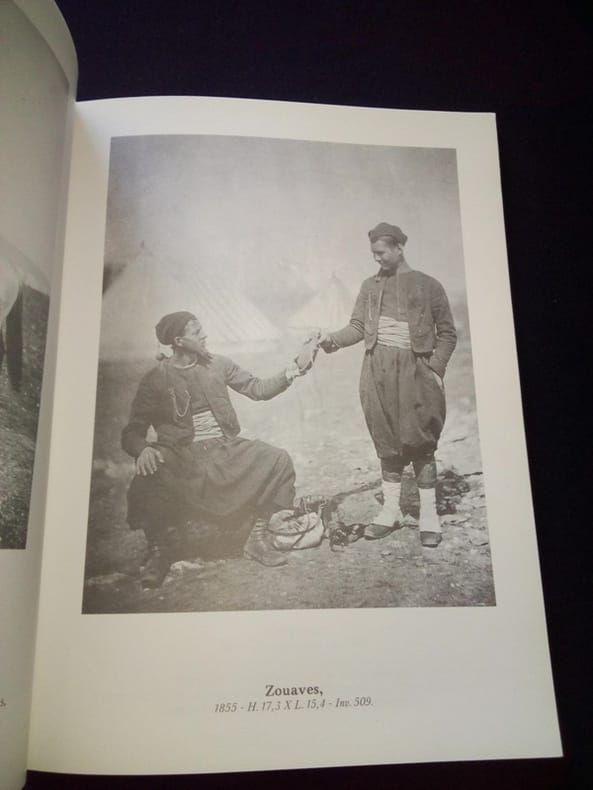
1994RES34L315Musée de Chantilly 1994 Catalogue de l'exposition des photographies de Fenton sur la guerre de Crimée - broché - non paginé ( 72 pages ) - Fenton fit 360 photographies en Crimée .
Fine English Paperback. Cr. 8vo. (20 x 14 cm). In Turkish. [vi], 120 p., b/w plts. Avraham Firkowicz was a Turkic-speaking Karaite Jew from what is now Western Ukraine, who spent much of his life in extensive travels, during which he obsesively looked for ancient Jewish manuscripts. The academic world owes to this picturesque man three most important collections of Jewish manuscripts ever collected by a single man. During his short stay in Istanbul in the Tanzimat Period produced there several important Karaite books in Turkish, and his activities in the Ottoman capital paved, in many senses, the way for far-going transformation of Karaite life there and in Russia, which ultimately helped rise of Turkic nationalism.