108 résultats
1893H120561S. Petersburg, Pantleev brothers 1893 CCCV + 129pp., 26cm., original softcover (spine bit repaired, well protected by an extra transparant cover), pages are still uncut, text is clean and bright, [Translation of title: "Russian-Byzantine Studies, part 2: The lives of saint George Amastris (Amastrida) and Stephen of Sourozh (Souros, Sudak)". Study in Russian with text editions in Greek and translation into Russian. A rare original Russian publication and critical study by the famous Russian byzantinist Vasily Vasilievsky on the lives of the byzantine saints George of Amastris and Stephen of Sourozh], H120561
1859115188Paris - Strasbourg, Vve Berger-Levrault & fils, Libraires-éditeurs 1859 In-4 28 x 21,5 cm. Reliure demi-percaine rouge, dos lisse orné d’un petit fer doré, pièce de titre noire, XII-681 pp., table des matières.
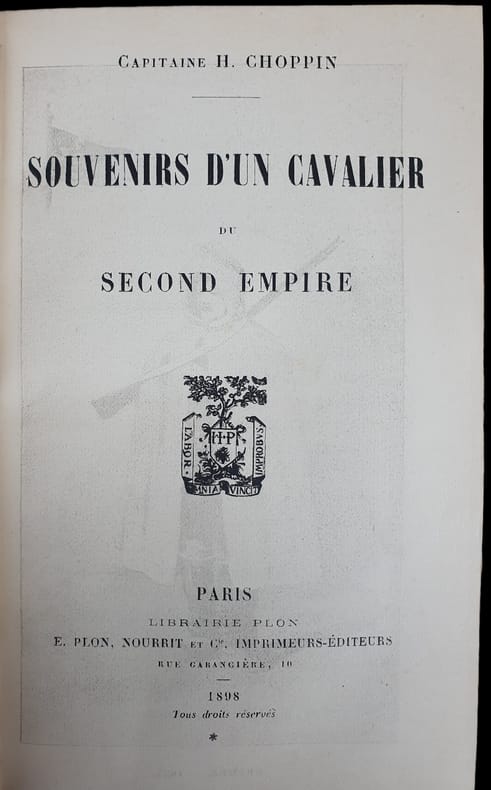
1898113387Plon, 1898, in-12, xi-323 pp, une gravure en frontispice, reliure demi-chagrin noir, dos à 5 nerfs soulignés à froid, titres et fleurons dorés (rel. de l'époque), bon état. Bel exemplaire
185926346Paris Michel Lévy 1859 In-12 couvertures conservées , 263 pp. ouvrage attirbué au Général Jean-Joseph-Gustave Cler, mais rédigé sur des notes par Albert du Casse et publié d'abord dans " Le spectateur militaire " sous le nom de Forville, l'un des pseudonyme d'Albert Du Casse ( D'après une notice ancienne trouvée dans l'ouvrage ) Rousseurs éparses reliure légèrement déformée du XIX ème siècle mais bon aspect de fraicheur
189886223Plon, 1898-1913 6 vol. in-8°, xv-560, 576, ii-547, ii-437, 491 et xxix-635 pp, un portrait en héliogravure en frontispice, 15 cartes hors texte, dont 9 dépliantes (une en couleurs), brochés, bon état
186716065Paris J. Dumaine 1867 In-8 379 pp, 14 planches hors-texte dont un fac-similé dépliant, 3 cartes dépliantes in-fine. Faibles rousseurs éparses, plats muets, quadruples filets dorés avec roulettes en tête et queue du dos frotté, avec fines épidermures et manque de cuir en tête du 2d plat. Coupes et coins émoussés.
186750782P., Dumaine, 1867, in-8°, 379 pp, 14 planches hors texte dont un fac-similé dépliant, 3 cartes dépliantes in-fine, reliure demi-basane vert bouteille, dos lisse, titres et filets dorés (rel. de l'époque), rousseurs, mors en partie fendus, état correct. Edition originale rare, enrichie d'un envoi a.s.
1889GITh832Paris Dentu 1889. In-12 336pp. Demi chagrin rouge, dos à nerfs orné de compartiments dorés, tête dorée, reliure de l'époque. Orné de 4 cartes dépliantes. Rousseurs. exemplaire bien relié.
1881GIT0130eParis Dentu 1881. In-12 broché 274pp + 7pp catalogue. Petits manques sur le dos, mouillure claire sur le 1er plat.
18958916Paris, E. Dentu éditeur In-8, reliure demi cuir, dos à cinq faux nerfs, titre et motifs au petit fer, 324 pages, avec fac-simile de l'écriture de deux pages du manuscrit, ensemble dense, fané , les coiffes élimées sans altération préoccupante, les coins piquants; la reliure, sans grande élégance, est solide ( pas de ressauts de pages) .
1877122582P., G. Téqui, 1877, in-12, 324 pp, reliure demi-chagrin vert empire, dos à 5 nerfs, titres et caissons dorés, fer de collège doré au centre du 1er plat et encadrements à froid sur les plats (rel. de l'époque), bon état
1866020666Paris Joseph Albanel 1866 un volume in-12°, VII (1) 292 pp., couverture imprimée et ornée d'une vignette. (couvertures défraichies, plis et fente au dos, présence de rousseurs sur les tranches, sur la gouttière et parfois dans le texte, petite tâche brune angulaire sur la plupart des feuillets, un feuillet mal coupé). Nom manuscrit en haut de couverture. Extrait du catalogue in fine (4 pp.).
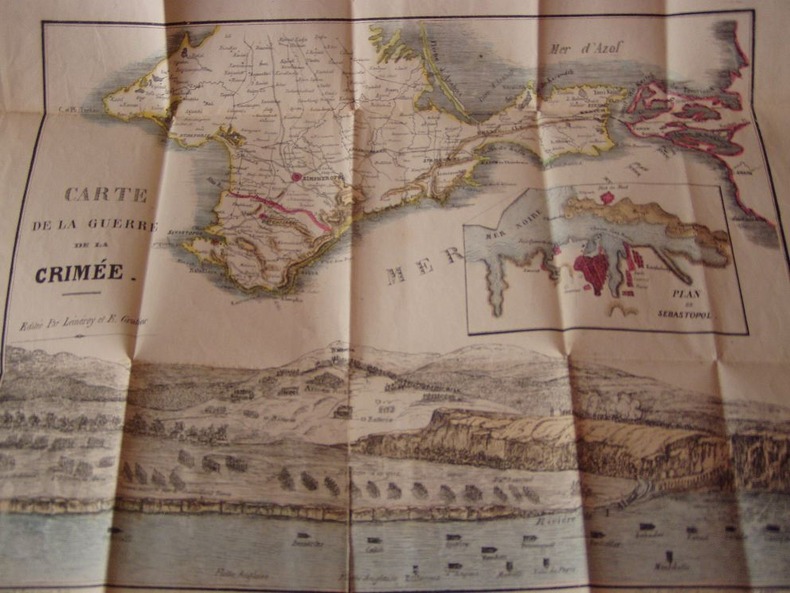
185422570Paris Paulin et Le Chevalier 1854 -in-folio pleine toile un volume, reliure pleine toile vert foncé in-folio (cloth-bound in-folio), RELIURE D'EPOQUE, dos long (spine without raised band), décoration or (gilt decoration), titre et auteur frappés "or", pièce de titre sur fond bordeaux avec filets "or" de part et d'autre, toutes tranches lisses, cachet bleu de colportage de la prefecture de Paris en bas de la page de titre, édition populaire a texte sur trois colonnes, orné d'une gravure au titre + une carte hors-texte "du théâtre de la guerre" en couleurs + de trés nombreuses gravures et cartes in et hors-texte en noir, 176 pages, 1854 Paris : Paulin et Le Chevalier Editeur,
185453764P., Paulin et Le Chevalier, 1854, in-folio, (2)-177 pp, texte sur trois colonnes, avec 162 gravures sur bois en noir dans le texte (certaines à pleine page) et 3 planches dont deux vues en noir à double page et une carte du théâtre de la guerre gravée sur acier en couleurs, reliure percaline noire, plats ornés à froid, titre doré au 1er plat (rel. de l'éditeur), un mors en partie fendu sans gravité, bon état. Edition originale
186330083Edinburgh and London: William Blackwood and Sons 1863-1887. 8 volumes. First Edition of each of the eight volumes. With a profusion of maps and plans throughout. 8vo handsomely bound in three-quarter red calf over red cloth covered boards the spines with raised bands central gilt ornamental tooling in the compartments two compartments lettered in gilt gilt rules to the joins marbled endleaves top edges gilt with the signification of the old Bournemouth bookseller of the late 1800's Horace G. Commin. A handsome set well preserved the text-blocks and illustrated portions all in very pleasing condition the bindings with very little evidence of wear hinges all strong and the bindings tight and sound. A COMPLETE SET OF THE FIRST EDITIONS OF THIS HISTORICALLY IMPORTANT AND WELL RESPECTED WORK. PERHAPS THE MOST IMPORTANT OF ALL WRITINGS ON THE CRIMEA. Alexander William Kinglake was an English travel writer and historian. He was educated at Eton College and Trinity College Cambridge. was called to the Bar in 1837 and built up a thriving legal practice which in 1856 he abandoned to devote himself to literature and public life. His magnum opus was this great work--The Invasion of Crimea: Its Origin and an Account of its Progress down to the Death of Lord Raglan in 8 volumes published from 1863 to 1887 by Blackwood Edinburgh one of the most effective works of its class. The History which Geoffrey Bocca describes as a book "by which no intelligent man can fail immediately to be fascinated no matter to what page he might open it" is presented here.<br> Kinglake's subject is the Crimean War of the mid-nineteenth century which was fought from October 1853 to February 1856 in which Russia lost to an alliance of the Ottoman Empire France the United Kingdom and Piedmont-Sardinia. The immediate cause of the war involved the rights of Christian minorities in Palestine then part of the Ottoman Empire with the French promoting the rights of Roman Catholics and Russia promoting those of the Eastern Orthodox Church. Longer-term causes involved the decline of the Ottoman Empire the expansion of the Russian Empire in the preceding Russo-Turkish Wars and the British and French preference to preserve the Ottoman Empire to maintain the balance of power in the Concert of Europe. <br> The churches worked out their differences with the Ottomans and came to an agreement but both the French Emperor Napoleon III and the Russian Tsar Nicholas I refused to back down. Nicholas issued an ultimatum that demanded the Orthodox subjects of the Ottoman Empire be placed under his protection. Britain attempted to mediate and arranged a compromise to which Nicholas agreed. When the Ottomans demanded changes to the agreement Nicholas recanted and prepared for war. <br> The Crimean War was one of the first conflicts in which military forces used modern technologies such as explosive naval shells railways and telegraphs and it was one of the first to be documented extensively in written reports and in photographs. The war quickly became a symbol of logistical medical and tactical failures and of mismanagement. The reaction in Britain led to a demand for the professionalizing of medicine most famously achieved by Florence Nightingale who gained worldwide attention for pioneering modern nursing while she treated the wounded.<br> The war also marked a turning point for the Russian Empire. The war weakened the Imperial Russian Army drained the treasury and undermined Russia's influence in Europe. The empire would take decades to recover. Russia's humiliation forced its educated elites to identify its problems and to recognize the need for fundamental reforms. They saw rapid modernization as the sole way to recover the empire's status as a European power. The war thus became a catalyst for reforms of Russia's social institutions including the abolition of serfdom and overhauls in the justice system local self-government education and military service. <br> As the Ottoman Empire steadily weakened during the 19th century the Russian Empire stood poised to take advantage by expanding southward. In the 1850s the British and the French Empires were allied with the Ottoman Empire and were determined to prevent that expansion. The historian A. J. P. Taylor argued that the war had resulted not from aggression but from the interacting fears of the major players:<br> "In some sense the Crimean war was predestined and had deep-seated causes. Neither Nicholas I nor Napoleon III nor the British government could retreat in the conflict for prestige once it was launched. Nicholas needed a subservient Turkey for the sake of Russian security; Napoleon needed success for the sake of his domestic position; the British government needed an independent Turkey for the security of the Eastern Mediterranean. Mutual fear not mutual aggression caused the Crimean war."<br> Field Marshal FitzRoy James Henry Somerset 1st Baron Raglan known before 1852 as Lord FitzRoy Somerset as a junior officer served in the Peninsular War and the Waterloo campaign latterly as military secretary to the Duke of Wellington. He also took part in politics as Tory Member of Parliament for Truro before becoming Master-General of the Ordnance.<br> He became commander of the British troops sent to the Crimea in 1854: his primary objective was to defend Constantinople and he was also ordered to besiege the Russian port of Sevastopol. After an early success at the Battle of Alma a failure to deliver orders with sufficient clarity caused the fateful Charge of the Light Brigade at the Battle of Balaclava. <br> Dissatisfaction with the conduct of the war was growing with the public in Britain and other countries and was worsened by reports of fiascos especially the devastating losses of the Charge of the Light Brigade at the Battle of Balaclava. On Sunday 21 January 1855 a "snowball riot" occurred in Trafalgar Square near St Martin-in-the-Fields in which 1500 people gathered to protest against the war by pelting buses cabs and pedestrians with snowballs. When the police intervened the snowballs were directed at the constables. The riot was finally put down by troops and police acting with truncheons. In Parliament the Conservatives demanded an accounting of all soldiers cavalry and sailors sent to the Crimea and accurate figures as to the number of casualties sustained by all British armed forces in Crimea especially concerning the Battle of Balaclava. When Parliament passed a bill to investigate by the vote of 305 to 148 Aberdeen said he had lost a vote of no confidence and resigned as prime ministe. The veteran former Foreign Secretary Lord Palmerston became prime minister and took a hard line wishing to expand the war foment unrest inside the Russian Empire and reduce the Russian threat to Europe permanently. Sweden–Norway and Prussia were willing to join Britain and France and Russia was isolated.<br> France which had sent far more soldiers to the war and suffered far more casualties than Britain had wanted the war to end as did Austria. Negotiations began in Paris in February 1856 about seven months after Lord Raglan's death and were surprisingly easy. France under the leadership of Napoleon III had no special interests in the Black Sea and so did not support the harsh British and Austrian proposals.<br> Peace negotiations at the Congress of Paris resulted in the signing of the Treaty of Paris on 30 March 1856. In compliance with Article III Russia restored to the Ottoman Empire the city and the citadel of Kars and "all other parts of the Ottoman territory of which the Russian troop were in possession". Russia returned the Southern Bessarabia to Moldavia. By Article IV Britain France Sardinia and Ottoman Empire restored to Russia "the towns and ports of Sevastopol Balaklava Kamish Eupatoria Kerch Jenikale Kinburn as well as all other territories occupied by the allied troops". In conformity with Articles XI and XIII the Tsar and the Sultan agreed not to establish any naval or military arsenal on the Black Sea coast. The Black Sea clauses weakened Russia which no longer posed a naval threat to the Ottomans. The Principalities of Moldavia and Wallachia were nominally returned to the Ottoman Empire and the Austrian Empire was forced to abandon its annexation and to end its occupation of them. The Treaty of Paris admitted the Ottoman Empire to the Concert of Europe and the great powers pledged to respect its independence and territorial integrity. wiki<br> Tuckwell wrote in 1902 that In 1854 Kinglake "accompanied Lord Raglan to the Crimea.He had hoped to go in an official position as non-combatant but this was refused by the authorities. His friend Lord Raglan whose acquaintance he had made while hunting with the Duke of Beaufort’s hounds took him as his private guest. Arrested for a time at Malta by an attack of fever he joined our army before hostilities began rode with Lord Raglan’s staff at the Alma fight and accompanied the chief in his visit of tenderness to the wounded when the fight was over. Throughout the campaign the two were much together. There are often slight but unmistakable signs of Kinglake’s presence as spectator and auditor of Lord Raglan’s deeds and words; his affection and reverence for the great general animate the whole; in outward composure and latent strength the two men resembled each other closely. The book is in fact a history of Lord Raglan’s share in the campaign; begun in 1856 at the request of Lady Raglan the narrative ends when the Caradoc with the general’s body on board steams out of the bay “Farewell†flying at her masthead the Russian batteries with generous recognition ceasing to fire till the ship was out of sight. “Lord Raglan is dead†said Kinglake as Vol. VIII. was sent to press “and my work is finished.â€<br> Tuckwell wrote that: "In order therefore rightly to appreciate The Invasion of the Crimea we must look upon it as a great prose epic; its argument machinery actors episodes subordinate to a predominant ever present hero. In its fine preamble Lord Raglan sits enthroned high above generals armies spectators conflicts; on the quality of his mind the fate of two great hosts and the fame of two great nations hang. He checks St. Arnaud’s wild ambition; overrules the waverings of the Allies; against his own judgment but in dutiful obedience to home instruction carries out the descent upon the Old Fort coast. The successful achievement of the perilous flank march is ascribed to the undivided command which during forty-eight hours accident had conferred upon him. From his presence in council French and English come away convinced and strengthened; his calm in action imparts itself to anxious generals and panic-stricken aides-de-camp. Through Alma fight from the high knoll to which happy audacity had carried him he rides the whirlwind and directs the storm. In the terrible crisis which sees the Russians breaking over the crest of Inkerman in the ill-fated attack on the Great Redan where Lacy Yea is killed his apparent freedom from anxiety infects all around him and achieves redemption from disaster. William Blackwood and Sons hardcover
1852201871852 1852 P.,sans date vers 1852,pliées,bon etat,complet malgré une fente
187072129Paris, Charavay, Martin, éditeurs, 1870. Leinen, gebunden; grauer, farbig geprägter, illustrierter Einband, Farbschnitt / Anz. Seiten: unpaginiert / 29 x 36 cm / mit zahlreichen Farbillustrationen auf teils doppelseitigen Tafeln und im Text von Job / Zustand: gut, leichte bis mässige Gebrauchsspuren; Buchblock angeplatzt, Einband leicht berieben und etwas fleckig, Ecken bestossen und beschabt, Kapitale und Rücken leicht lädiert, vorderes Innengelenk angeplatzt, Papier etwas gebräunt und leicht fleckig,
1878459901878 PARIS,A. Quantin, collection Petite bibliothèque de luxe -1878 - In-8 - Reliure 1/2 velin - coins frottés - Préface de Parisot - Eaux-fortes de M. Leloir - 2 pages dépliantes de fac-similé d'écritures - Variantes et Bibliographie - Texte entouré de filets rouges -Portrait en frontispice, protégée par serpente - 336 pages - rousseurs - Ex-libris armorié André Goüin - Envoi rapide et soigné
1857139490Couverture souple. Broché. 343 pages. Légèrement défraîchi. Manque à la couverture.
1840123BtParis Bourdin et Cie 1840 In4 ( 27 X 18 cm ) - demi basane - dos a nerfs - titres dorés - 621 pages - Complet des 24 hors texte tiré sur chine ( dont la partition valaque qui manque souvent ainsi que de la dédicace au Tzar qui manque également souvent )- Rousseurs éparses - le 1er feuillet est presque détaché du corps de l'ouvrage - coins fortement rognés - tranches avec manque de papier - mors i,férieur touché sur 3 cm .
1854PHO-2122Paris, Ernest Bourdin & Cie, 1854. Grand in-8 (27,5x18,5cm), XIV-510pp.-2ff., demi chagrin époque, dos lisse avec auteur et titre, légères rousseurs, manque de papier sur le dernier plat Illustré de 27 gravures dont plusieurs en couleurs et 2 cartes repliées et en couleurs dans une pochette in-fine.
1841127704Paris, Ernest Bourdin et Cie 1841 In-4 27,5 x 17,5 cm. Reliure de l’époque demi-chagrin vert-émeraude à petits coins, filets dorés, dos à nerfs, caissons ornés de cadres à froid, tête dorée, V-619 pp., illustrée de 64 dessins de Denis Auguste Marie Raffet, table des matières. Reliure frottée, mouillure et rousseurs,marginales, mors inférieur cassé. En l’état.
18370022921837 Paris, Chez Ladvocat, 1837-38. Cinq volumes in-8 (138 X 209) toile chagrinée vert lierre entièrement décorée d'entrelacs à froid, titre et tomaison dorés au dos, gardes papier jonquille (reliure de l'époque). Tome I : (2) ff. de faux-titre et titre, portrait frontispice, 402 pages ; Tome II : (2) ff. de faux-titre et titre, 396 pages, 1 carte et 4 vues dépliantes ; Tome III : (2) ff. de faux-titre et titre, 406 pages, (1) f. de table, 3 cartes et 7 vues ; Tome IV : (2) ff. de faux-titre et titre, 384 pages, 1 carte et une vue dépliantes ; Tome V : (2) ff. de faux-titre et titre, 372 pages, 3 cartes dépliantes. Habile restauration à l'angle inférieur du second plat du tome III, rousseurs claires éparses. Mention fictive de «Quatrième édition » sur le faux-titre des quatre premiers volumes, et de «Troisième édition » sur le titre du cinquième et dernier volume.
180694431Paris, Bossange, Masson et Besson 1806 In-8, demi- maroquin rouge à coins, dos lisse orné de filets argentés, 4- XIX- 302 pp. Un plan dépliant de Sébastopol dressé par Tardieu, 3 tableaux dépliants état des marchandises exportées d’Odessa, dans le courant de l’an 1802 - état des marchandises importées d’Odessa, dans le courant de la navigation 1802 – prix des marchandises d’exportation et d’importation, le 14 mars 1803, une grande carte dépliante faite en 1803 par Jean Reuilly dressée par J. B. Poirson petite déchirure angulaire avec restauration adhésive, trois planches dont deux de monnaies et médailles trouvées par J. Reuilly accompagnée d’une note de M. Langlès sur les monnaies de Crimée et d’une note de M. Millin sur les médailles.