477 résultats
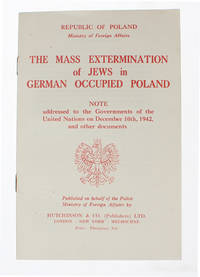
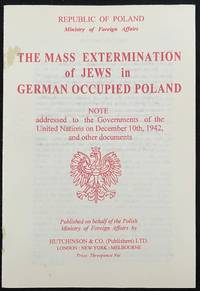
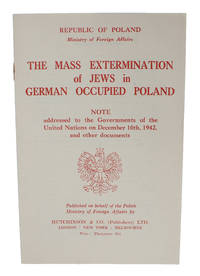
194360436London New York Melbourne printed in Great Britain Published on behalf of the Polish Ministry of Foreign Affairs 1943. 8vo. Stapled as issued. Title-page printed in red. Stapels with rust slightly affecting surrounding paper. A very fine near mint copy. 16 pp. <br/><br/><em>The scarce first printing of this hugely important publication which constitutes one of the very first official reports on Holocaust and one of the most accurate accounts that had been presented to the West changing their knowledge of what was actually going on. This seminal pamphlet consists of 1 Raczynski's account of the ongoing Holocaust based among other reports on the eye-witness-report by Jan Karski a Polish Government emissary in occupied Poland who bribed his way into a German concentration camp and witnessed the mass extermination of Jews 2 the seminal "Joint Declaration" by members of the United Nations in which "The above-mentioned Govenments and the French National Committee condemn in the strongest possible terms this bestial policy of cold-blooded extermination. They declare that such events can only strengthen the resolve of all free-loving peoples to overthrow the barbarous Hitlerite tyranny. They reaffirm their solems resolution to ensure that those responsible for these crimes shall not escape retribution and to press on with the necessary practical measures to this end." p. 12 3 an extract of Deputy Prime Minister Mikolajczy's statement on behalf of the Polish Government and 4 the text of Raczynski's broadcast of December 1942 in which pleaded for action wishing to make the public and the Allied nations "understand how real is the tragedy which is taking place not so very far from the shores of this island on the continet of Europe - on the soil of Poland. For more than three years the Germans have consistently done everything they could to hide from the eyes of the world the martyrdom of the Polish nation the like of which has never been known in the history of humanity. But "when we would keep silence the very stones will cry out"." p. 15.While the details were neither complete nor wholly accurate the Allies were aware of most of what the Germans had done to the Jews at a relatively early date. The mass murder of the Jews was of such dimensions however that at first they could not believe the reports that reached them. This quickly changed though.In February of 1942 Jacob Grojanowski an escaped prisoner of the Chelmno extermination camp provided the Oneg Shabbat group with detailed information about what went on at the Chelmno camp. His report became known as the Grojanowski Report. It was smuggled out of the Warsaw Ghetto via the Polish underground and reached London in June of 1942. It is not known exactly what happened to the report at that point but by February of 1942 the United States Office of War Information had decided not to release information about the extermination of Jews thinking that there was a risk of the public viewing the war as only being a Jewish problem. Thus the Grojanowski Report was not released. By at least October of 1942 British radio had broadcast news of the gassing of Jews to the Netherlands and in December 1942 the Western Allies released their Joint Declaration which is printed in the present publication describing and condemning in the strongest manner Hitler's violent attempts at exterminating the Jews of Europe. In 1942 Jan Karski 1914-2000 a Polish World War II resistance movement fighter and later professor at Georgetown University gave his first report to the Polish British and U.S. governments on what was going on in the German extermination camps in Poland.Karski reported to the Polish government in exile i.e. Raczynski who was the Ambassador and one of its most prominent leaders and the Western Allies on the situation in German-occupied Poland. Karski personally met with Franklin Roosevelt and British Foreign Secretary Anthony Eden to explain what went on in Poland and Raczynski wrote up the report. Eventually the American Government confirmed the reports to Jewish leaders in late November 1942 and shortly thereafter they were publicized i.e. in the present publication. Karski's report through Raczynski became one of the most important reports in the history of the Holocaust being a major factor in informing the West. It sparked one of the first official publications from the Allies on the mass extermination of Jews in Poland and resulted in the official reports and condemnations from the Allied countries i.e. the "Joint Declaration" also published here."The purpose of this publication is to make public the contents of the Note of December 10th 1942 addresses by the Polish Government to the Governments of the United Nations concerning the mass extermination of Jews in the Polish territories occupied by Germany and also other documents treating on the same subject. . In the hope that the civilized worlds will draw the appropriate conclusions the Polish Government desire to bring to the notice of the public by means of the present White Paper these renewed German efforts at mass extermination with the employment of fresh horrifying methods." From the Introductory Note p. 3."Most recent reports present a horrifying picture of the position to which the Jews in Poland have been reduced. The new methods of mass slaughter applied during the last few months confirm the fact that the German autorities aim with systematic deliberation at the total extermination of the Jewsih population of Poland and of the many thousands of Jews whom the German authorities have deported to Poland from Western and Central European countries and from the German Reich itself.The Polish Government consider it their duty to bring to the knowledge of the governments of all civilized countries the following fully authentical information received from Poland during recent weeks which indicates all too plainly the new methods of extermination adopted by the German authorities." p. 4. </em> unknown
194360182London New York Melbourne printed in Great Britain Published on behalf of the Polish Ministry of Foreign Affairs 1943. 8vo. Stapled as issued. Title-page printed in red. Stapels with rust slightly affecting surrounding paper. A very fine near mint copy. 16 pp. <br/><br/><em>The scarce first printing of this hugely important publication which constitutes one of the very first official reports on Holocaust and one of the most accurate accounts that had been presented to the West changing their knowledge of what was actually going on. This seminal pamphlet consists of 1 Raczynski's account of the ongoing Holocaust based among other reports on the eye-witness-report by Jan Karski a Polish Government emissary in occupied Poland who bribed his way into a German concentration camp and witnessed the mass extermination of Jews 2 the seminal "Joint Declaration" by members of the United Nations in which "The above-mentioned Govenments and the French National Committee condemn in the strongest possible terms this bestial policy of cold-blooded extermination. They declare that such events can only strengthen the resolve of all free-loving peoples to overthrow the barbarous Hitlerite tyranny. They reaffirm their solems resolution to ensure that those responsible for these crimes shall not escape retribution and to press on with the necessary practical measures to this end." p. 12 3 an extract of Deputy Prime Minister Mikolajczy's statement on behalf of the Polish Government and 4 the text of Raczynski's broadcast of December 1942 in which pleaded for action wishing to make the public and the Allied nations "understand how real is the tragedy which is taking place not so very far from the shores of this island on the continet of Europe - on the soil of Poland. For more than three years the Germans have consistently done everything they could to hide from the eyes of the world the martyrdom of the Polish nation the like of which has never been known in the history of humanity. But "when we would keep silence the very stones will cry out"." p. 15. While the details were neither complete nor wholly accurate the Allies were aware of most of what the Germans had done to the Jews at a relatively early date. The mass murder of the Jews was of such dimensions however that at first they could not believe the reports that reached them. This quickly changed though. In February of 1942 Jacob Grojanowski an escaped prisoner of the Chelmno extermination camp provided the Oneg Shabbat group with detailed information about what went on at the Chelmno camp. His report became known as the Grojanowski Report. It was smuggled out of the Warsaw Ghetto via the Polish underground and reached London in June of 1942. It is not known exactly what happened to the report at that point but by February of 1942 the United States Office of War Information had decided not to release information about the extermination of Jews thinking that there was a risk of the public viewing the war as only being a Jewish problem. Thus the Grojanowski Report was not released. By at least October of 1942 British radio had broadcast news of the gassing of Jews to the Netherlands and in December 1942 the Western Allies released their Joint Declaration which is printed in the present publication describing and condemning in the strongest manner Hitler's violent attempts at exterminating the Jews of Europe. In 1942 Jan Karski 1914-2000 a Polish World War II resistance movement fighter and later professor at Georgetown University gave his first report to the Polish British and U.S. governments on what was going on in the German extermination camps in Poland.Karski reported to the Polish government in exile i.e. Raczynski who was the Ambassador and one of its most prominent leaders and the Western Allies on the situation in German-occupied Poland. Karski personally met with Franklin Roosevelt and British Foreign Secretary Anthony Eden to explain what went on in Poland and Raczynski wrote up the report. Eventually the American Government confirmed the reports to Jewish leaders in late November 1942 and shortly thereafter they were publicized i.e. in the present publication. Karski's report through Raczynski became one of the most important reports in the history of the Holocaust being a major factor in informing the West. It sparked one of the first official publications from the Allies on the mass extermination of Jews in Poland and resulted in the official reports and condemnations from the Allied countries i.e. the "Joint Declaration" also published here. "The purpose of this publication is to make public the contents of the Note of December 10th 1942 addresses by the Polish Government to the Governments of the United Nations concerning the mass extermination of Jews in the Polish territories occupied by Germany and also other documents treating on the same subject. . In the hope that the civilized worlds will draw the appropriate conclusions the Polish Government desire to bring to the notice of the public by means of the present White Paper these renewed German efforts at mass extermination with the employment of fresh horrifying methods." From the Introductory Note p. 3. "Most recent reports present a horrifying picture of the position to which the Jews in Poland have been reduced. The new methods of mass slaughter applied during the last few months confirm the fact that the German autorities aim with systematic deliberation at the total extermination of the Jewsih population of Poland and of the many thousands of Jews whom the German authorities have deported to Poland from Western and Central European countries and from the German Reich itself.The Polish Government consider it their duty to bring to the knowledge of the governments of all civilized countries the following fully authentical information received from Poland during recent weeks which indicates all too plainly the new methods of extermination adopted by the German authorities." p. 4. </em> unknown
1943140946511London New York & Melbourne: Hutchinson & Co. Publishers Co 1943. First edition. First edition. 16 pp. Staple bound in publisher's self wraps. Near Fine with a little rusting to staples and staining along spine. A bright attractive copy of a momentous historical document. <p>For the first time this pamphlet publicly disclosed the ongoing Holocaust for an Allied audience in the midst of World War II with information provided by Polish diplomat-tuned-secret-agent Jan Karski. It focused on events in Poland including the Warsaw Ghetto rebellion and mentioned various concentration camps in Eastern Europe. It also contained the text of the Joint Declaration by Members of the United Nations of 17 December 1942 and an excerpt of a statement by Deputy Prime Minister Stanisław Mikołajczyk of 27 November 1942. Rare in commerce. Hutchinson & Co. (Publishers) Co unknown
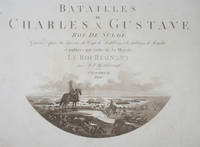
180645461Stockholm 1806. Large folio oblong. 44 x 61 cm. Contemp. hcalf covers with marbled paper. Titlelabel in red and gilt pasted on frontcover. Wear to foot of spine otherwise fine. Engraved titlepage battle view engraved plate depicting the Carl Gustav on horseback in front of a battle scene and 11 engraved plates showing battlescenes after Dahlberg's drawings. All engravings in beautiful toned sepia aquatint. A few marginal brownspots. A very fine copy. <br/><br/><em>Very scarce first printing of this series of plates aiming at glorifying the Swedish victories showing battlescenes - Warsaw Carnova Columbi Guesne and the crossing of the Belt in Denmark - from the wars against Poland and Denmark 1655-58 in fine engravings by Skjöldebrand. </em> unknown
194343453London New York; Published on Behalf of the Polish Ministry of Foreign Affairs by Hutchinson & Co 1943. 1st edition. Original illustrated red and white paper wrappers. 8vo. 16 pages. 22 cm. National Government Publication. Printed in red and black ink. Includes a note by Polish Foreign Minister Edward Raczynski and speeches by Deputy Prime Minister Stanislaw Mikolajczyk.<br> The official 16-page diplomatic publication from December 1942 by the Polish Government-in-Exile in London marking a turning point in international understanding of the Nazi destruction of the Jews of Europe. <br> Jan Karski a courier for the Polish Underground had smuggled microfilmed evidence and intelligence out of occupied Poland to London. This raw intelligence gathered from his time secretly inside the Warsaw Ghetto and the Izbica transit camp formed the core of the facts published in the booklet.<br> <br> "In October 1942 at the height of the destruction of Polish Jewry Jan Karski born Jan Kozielewski was ordered to clandestinely go to the West and deliver a report on the situation of occupied Poland to the Polish government-in-exile in London. The situation of the Jews in Poland was to be one section of that report. Since the government in exile was concerned with the internal politics of Poland's underground parties Karski held meetings with the different factions including the Jewish Zionist and the Jewish Socialist Bund movements. <br> Thus shortly before his departure Karski met with two Jewish leaders who asked him to inform the world's statesmen of the desperate plight of Polish Jewry and of the hopelessness of their situation. Their message was: 'Our entire people will be destroyed.'<br> The Jewish leaders' appeals touched Karski and he decided to see things with his own eyes in order to make his report. With great risk to his life he was smuggled into the Warsaw ghetto and into a camp in the Lublin area. The horrors he witnessed marked him deeply and propelled him to become not only the messenger of the Polish underground but to concentrate on giving voice to the suffering of the dying Jews.<br> In November 1942 Karski reached London delivered the report to the Polish government-in-exile and set out to meet Winston Churchill other politicians journalists and public figures. Upon completing his mission Karski went on to the United States where he met with President Roosevelt and other dignitaries and tried in vain to stir up public opinion against the massacre of the Jews. In 1944 while in the United States Karski wrote a book on the Polish Underground Story of a Secret State with a long chapter on the Jewish Holocaust in Poland.<br> After the war Karski stayed in the United States where he was later appointed Professor at Georgetown University Washington DC.<br> On 2 June 1982 Yad Vashem recognized Jan Karski as Righteous Among the Nations" Yad Vashem. <br> <br> Leading Holocaust scholar Lucy Dawidowicz cites the booklet in her now classic work "The Holocaust and the Historians" Harvard 1983 p. 167; the report could not be more explicit in its description of the horrors nor in its plea for help: <br> "The new methods of mass slaughter applied during the last few months confirm the fact that the German authorities aim with systematic deliberation at the total extermination of the Jewish population of Poland and of the many thousands of Jews whom the German authorities have departed to Poland from Western and Central European countries and from the German Reich itself. The Polish Government considers it their duty to bring to the knowledge of the Governments of all civilised countries the following fully authenticated information received from Poland during recent weeks which indicates all too plainly the new methods of extermination adopted by the German authorities." <br> The report elaborates: "The actual process of deportation was carried out with appalling brutality. At the appointed hour on each day the German police cordoned off a block of houses selected for clearance entered the back yard and fired their guns at random as a signal for all to leave their homes and assemble in the yard. Anyone attempting to escape or to hide was killed on the spot. No attempt was made by the Germans to keep families together. Wives were torn from their husbands and children from their parents. Those who appeared frail or infirm were carried straight to the Jewish cemetery to be killed and buried there. <br> On the average 50-100 people were disposed of in this way daily. After the contingent was assembled the people were packed forcibly into cattle trucks to the number of 120 in each truck which had room for forty. The trucks were then locked and sealed. The Jews were suffocating for lack of air. The floors of the trucks were covered with quicklime and chlorine. As far as is known the trains were dispatched to three localities - Treblinka Belzec and Sobibor to what the reports describe as 'Extermination camps.' <br> The very method of transport was deliberately calculated to cause the largest possible number of casualties among the condemned Jews. It is reported that on arrival in camp the survivors were stripped naked and killed by various means including poison gas and electrocution. The dead were interred in mass graves dug by machinery." <br> <br> Read more about the singular importance of this publication at <br> en.wikipedia.org/wiki/The_Mass_Extermination_of_Jews_in_German_Occupied_Poland# . <br> In 2020 Polish Postal authorities chose this very publication to illustrate their official first day cover honoring righteous Poles who had saved Jews during the Holocaust see illustration. <br> <br> Subjects: World War 1939-1945 - Jews - Poland. World War 1939-1945 - Poland - Atrocities. Holocaust Jewish 1939-1945 - Poland. Jews - Poland. OCLC: 234118765. <br> Touch of staining at staples without the rust almost always seen in other surviving copies. Very Good condition. A copy with rust stains sold in 2018 at auction for over £6000. Rare and very important. BHOLO2-97-48-MMXRLADFACC. London, New York; Published on Behalf of the Polish Ministry of Foreign Affairs by Hutchinson & Co unknown
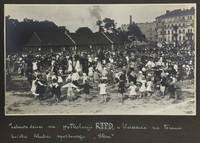
3728825<p>Poland c.1920s. 21ff. Album. 9½ x 13 inches. Beige cloth with colorful woven onlay; cord-bound. 23 captioned photographs mounted on black cardstock rectos approx. 4¾ x 8¾ inches tissue guards. Brief wear to head and tail of spine and corners; very good.</p> <p>Made by the Workers’ Society of Friends of Children in Warsaw and given to their Chicago branch this 1920s photograph album illustrates the strong link between Poles living in Warsaw and Chicago reflecting the wider story of the Polish diaspora at that time. The album documents that Polish immigrants in Chicago supported social projects back in Poland highlighting the cross-continental connections among Polish communities.</p> <p>The Workers’ Society of Friends of Children was established in 1919 to provide childcare and education centers for workers’ children and the children of the unemployed. The outreach included kindergartens schools summer camps meals and medical care. </p> <p>The album’s photographs show children’s homes and tents kindergarten-age children playing with blocks playtime camp scenes communal meals calisthenics sports clubs and a view of children on a beach along the Vistula River. Places seen include Warsaw the Helena Dłuska Children’s Home in Helenów Broszków Brok and Brest.</p> <p>The album is autographed inside by Tomasz Arciszewski 1877–1955 and Dr. Aleksander Landy 1881–1969 the Society’s founders in Poland. Arciszewski served as founding chairman of The Workers’ Society of Friends of Children Robotnicze Towarzystwo Przyjaciół Dzieci RTPD and along with Landy was an active member of the Polish Socialist Party PPS. Arciszewski served in the Socialist party and became Poland’s 31st Prime Minister. The album’s first image shows children at a Warsaw “Children’s Home†featuring Bolesław Limanowski 1835–1935 PPS co-founder among them.</p> <p>Clear evidence of how Polish immigrants in Chicago supported and engaged with social efforts back in Poland showing the strong international connections among Polish communities worldwide.</p> unknown
16-5052LuneÌville: Chez Claude-François Messuy 1761 and 1762. Folio. 24.5 x 40.2 cm. Contemporary calf with gilt spine; covers rubbed. 6-188-2-136-XII-2pp. The "compte général" lacks the plan de Nancy and 3 plates of ferronnerie.Cohen 250; OCLC Number: 939437546: While in exile in Lorraine between 1737 and 1766 the Polish King Stanislaw I was granted the title of Duke of Lorraine and Bar and used his position to endow a number of buildings and monuments in Nancy where he had his seat. The designs for the new buildings which included orphanages schools hospitals churches libraries and a new Hote de Ville for Nancy were drawn up by Emmanuel HeÌreÌ who published many of them in his Recueil des plans elevations et coupes tant geometrales qu'en perspective des chateaux jardins et dependances que le Roy de Pologne occupe en Lorraine . 2 vols Paris 1750-1752. In 1753 a supplementary volume was published as Plans et elevations de la Place Royale de Nancy . Paris; q.v. in the Supplement. While HeÌreÌ drew up the plans and oversaw the building work the administration and finances of the King's building programme were overseen by Nicolas LeÌopold Michel 'Controlleur de la Maison du Roi' see page 1 of part 2. The second part of the present work is explicitly said to be a public statement of the accounts kept by Michel. The first part has also been attributed to Michel by QueÌ€rard Rau and France-Lanord see below and by most library catalogues see the Avery Cat. Berlin Kat. and the BM. Gen. Cat although UCBA attributes both parts to HeÌreÌ. Although no firm evidence has been advanced for Michel's authorship of the first part of the text it is highly likely that he was involved. The text describes the buildings not in architectural terms but by detailing their planning and approval by official bodies the specifications for their construction the contracts and estimates drawn up and the administration of the actual building work. In many cases the specifications given to HeÌreÌ and to others are reprinted in full. Thus the first volume is to some extent a collection of official documents relating to the buildings edited together for public presentation and it can be presumed that many of the texts were drawn up under Michel's supervision. It could also be argued that primary responsibility for this part of the work lay with the King himself who had ordered and defined the limits of the works; indeed he is referred to as the 'Auteur' on page 8 of the 'Discourse PreÌliminaire' although this use of the word is more of a homage to Stanislaw's patronage than an actual statement of responsibility for the text. The 'Discourse PreÌliminaire' lavishes much praise on the King for his generosity and public spirit and notes that 'notre Ouvrage est un nouveau preÌsent que le Roi fait aÌ€ ses Peuples' p.5. The King paid for the publication which is also described as 'donneÌ lieu aÌ€ un suppleÌment' presumably supplementing HeÌreÌ's own very different work describing the buildings. HeÌreÌ's book contains 63 large-scale engraved plates and was no doubt expensive and the present publication may have been seen at least in part as a way of producing a rather cheaper and more generally accessible advertisement for Stanislaw's good works. For further details of the buildings involved see Julia Rau Emmanuel HeÌreÌ: premier Architecte von Stanislas Leszczynski in Lothringen 1705-1763 Berlin: Mann 1973; and Albert France-Lanord Emmanuel HeÌreÌ: architecte du roi Stanislas Nancy: Presses Universitaires de Nancy 1984. Both of these books reproduce many of the etched illustrations from the present work. Rau attributes both parts to Michel in a note on page 36 but in her bibliography describes them quite wrongly as the second edition of HeÌreÌ's Recueil p.303. In France-Lanord's bibliography both parts are attributed to Michel although they are listed both separately and together. L'auteur est Nicolas-Léopold Michel écuyercontrôleur général de la Maison de Stanislas trésorier des bâtiments de S. M. et premiersecrétaire de ses archives 27 janvier 1718-… Ouvrage qui comprend la construction d'unenouvelle place au milieu de laquelle est érigée la Statue de Louis XV et les Bâtiments que samajesté Polonoise a fait élever dans la Ville de Nancy pour son embellissement ; et le Comptegénéral de la Dépense des Edifices et Bâtiments que le Roi de Pologne Duc de Lorraine et deBara fait construire pour l'embellissement de la Ville de Nancy depuis 1751 jusqu'en 1759.Recueil contenant les arrêts la déclaration de Sa Majesté Très-Chrétienne les concessions.Précis des concessions de Terrains accordés par le Roi de Pologne. V. l'article de StéphaneGaber p. 72 dans le Pays Lorrain de 1985 N° 2. Illustré du plan général de Nancy levé en1758 dépliant ; façades de l'Hôtel de Ville de l'Hôtel des Fermes de l'Hôtel de Mr. Alliot duPavillon du Sr. Jacquet du Pavillon de la Comédie ; Vue des Fontaines et de la Face opposée à l'Hôtel de Ville ; façade de la Porte Royale ; élévations d'une des deux Grilles et Fontainesposées en tours creuses aux angles de la Place Royale de Nancy des Grilles des anglesd'entrée de la Place Royale de Nancy des gardes-corps du grand Balcon du milieu de laFaçade de l'hôtel de Ville dépliant ; statue de Louis XV ; Porte Saint-Stanislas ; Placed'Alliance ; vue perspective de la Carrière depuis l'intendance ; Intendance ; Pavillon pour lesOfficiers de la Garnison l'ensemble en gravure en taille-douceCe recueil est important pourl'histoire sociale française avec la liste détaillée des oeuvres charitables de ce temps et pourl'histoire urbaine avec la description de l'organisation des plans de construction pour une desplus importantes villes européennes au XVIIIe siècle Millard I 155. L'auteur contrôleur de lamaison du roi a soigneusement consigné et magnifiquement représenté le compte desdépenses effectuées par le roi Stanislas depuis 1751 jusqu'en avril 1759 pour l'embellissementde son siège royal nancéien. Le "recueil des fondations" comporte le nouveau supplément de 10ff paginé 188 à 206 qui manque dans certains exemplaires. Le "compte général" est incomplet du plan de Nancy et des 3 planches de ferronnerie. LuneÌville: Chez Claude-François Messuy , 1761 and 1762 unknown
18640001111MELROSE MASSACHUSETTS MASS MA. Good. 1864. Manuscript. On offer are two original manuscript diaries dated 1864 and 1865 by 'Doctor' James W. Poland of Melrose Massachusetts. James W. Poland was a long time Baptist minister in Goffstown New Hampshire when in an attempt to treat himself for some ailment he came up with the formula for a medicine he called Dr. Poland's White Pine Compound. The medicine was a huge success and Dr. Poland found himself in a new career as a proprietary medicine maker. Eventually he also produced Dr. Poland's Cedar Plaster White Mountain Bitters Diarrhea Elixer Hair Preserver Poland's Magic Powders etc. At the time these diaries were written Dr. Poland had moved to Melrose Mass. and was active making some of these medicines especially the Magic Powders. He was selling on his own and also working for Dr. George W. Swett of the New England Botanic Depot in Boston. In 1864 he transferred the rights to some of his medicines to Swett. Dr. Poland's diary entries are short with a note of the weather his or his family's health problems travel mainly to Boston gardening activities purchases sales of the medicines and church activities once in a while he preached in Melrose at the Baptist church. Usually there were no notes of outside events with the notable exceptions of Lincoln's election in 1864 Lincoln's inauguration on March 4 1865 Lee's surrender on April 10th and Lincoln's assassination on April 14th. Dr. Poland writes: "Pres. Lincoln shot by Booth an assassin - Lord Save Us!" He notes his own birthday 57 years old in 1865 and the death of his mother on Nov. 5th of the same year. Included are a number of ephemera items related to Dr. Poland's profession as a maker and seller of proprietary patent or "quack" medicines including: two receipts for pew rental at the First Baptist Society of Melrose; two newspaper clippings of testimonials for the use of Dr. Poland's White Pine Compound; a business license from the U.S. Internal Revenue dated June 1 1863 a tax to help pay for the war; and a page of handwritten advertising copy for Dr. Poland's Specific; a cure for costiveness constipation. Both diaries have written entries in pencil for every day of the year and are overall in G condition.; 16mo - over 5¾" - 6¾" tall; QUACK MEDICINE PHYSICIAN QUACKERY PATENT MEDICINE SNAKE OIL BAPTISTS MASSACHUSETTS MASS MA CIVIL WAR 19TH REGIMENT FORT COLUMBUS YORK HARBOR ANTIETAM FORT SENECA SOCIAL STUDIES GENDER STUDIES HANDWRITTEN MANUSCRIPT DOCUMENT LETTER AUTOGRAPH DIARY JOURNAL LOG KEEPSAKE WRITER HAND WRITTEN DOCUMENTS SIGNED LETTERS MANUSCRIPTS HISTORICAL HOLOGRAPH WRITERS DIARIES JOURNALS LOGS AUTOGRAPHS PERSONAL MEMOIR MEMORIAL PERSONAL HISTORY AMERICANA Als antiquité contrat vélin document manuscrit papier Antike Brief Pergament Dokument Manuskript Papier oggetto d'antiquariato atto velina documento manoscritto carta antigüedad hecho vitela documento manuscrito papel. . unknown
0143530445New. Brand new and still unused unknown
1942SZEPEBKS007359IRussia - S.S.S.R. : Poloni in Russia S.S.S.R. 1942. Hardcover. Near Fine/No Jacket. POLISH CATHOLIC IMPRINT IN THE SOVIET UNION - MISSAL FOR POLISH SOLDIERS IN RUSSIA DURING WORLD WAR II Typographia Exercitus Poloni in Russia S.S.S.R. - No date1942. - Small 8vo 20x13.5 cm. - 64 pp. - Royal blue hardback fine. - A Roman Catholic missal for chaplains of the Polish Army in Russia during World War II. - On the title- page a tipped-in printed slip with the text: "Ad usum Capellanorum Militum in Russia" On verso of front free endpaper: "Concordat cum originali / Jangi-July3 Maii 1942 / Vlodimirus Cienski / Decanus Militaris Polonorum in Russia. / Imprimatur Joseph Gawlina Episcopus / 11.VII 1942 g.". - In Latin and Polish. - WorldCat locates 2 copies only Buffalo History Museum and NUVAT Union Catalog of Polish Research Libraries. - No other book listed in WorldCat by this publisher. <br/> <br/> Poloni in Russia (S.S.S.R.) hardcover
200481275Warsaw Poland: Warsaw City Hall c2004. Presumed First Edition First printing. Wraps. Very good. 48 pages. Oversized 12 inches by 12 inches. Minor wear. Many color illustrations. Hand Signed by the Mayor of Warsaw Lech Kaczynski on page 1. Topics include the Anniversary of the Warsaw Uprising; Business; Cultural Life; Development; Education; Festivals; Gardens and parks; Hotels and restaurants; Investors; Jewish heritage; Key offices; Leisure activities; Museums and galleries; New and older architecture; Old Town; Powazki cemetery; Royal Route; Shopping; Transportation system; Vistula River; Warsaw Mermaid; Yesterday's Warsaw; Zoo; and Warsaw history. Warsaw is the capital and largest city of Poland. The metropolis stands on the Vistula River in east-central Poland and its population is officially estimated at 1.8 million residents within a greater metropolitan area of 3.1 million residents which makes Warsaw the 7th most-populous capital city in the European Union. The city limits cover 517.24 199.71 sq. mi. while the metropolitan area covers 2355.39 sq. mi. Warsaw is a major international tourist destination and a significant cultural political and economic hub. Its historical Old Town was designated a UNESCO World Heritage Site. The city rose to prominence in the late 16th century. The elegant architecture grandeur and extensive boulevards earned Warsaw the nickname Paris of the North. The city was largely destroyed by the Warsaw Ghetto Uprising in 1943 the general Warsaw Uprising in 1944 and the systematic razing by the Germans in advance of the Vistula-Oder Offensive. Warsaw gained the new title of Phoenix City because of its reconstruction after the war. Lech Aleksander Kaczy ski 18 June 1949 - 10 April 2010 was a Polish lawyer and politician who served as the Mayor of Warsaw from 2002 until 2005 and as the President of Poland from 2005 until his death in 2010. Before his tenure as president he previously served as President of the Supreme Audit Office from 1992 to 1995 and later Minister of Justice and Public Prosecutor General in Jerzy Buzek's cabinet from 2000 until July 2001. Born in Warsaw he starred in a 1962 Polish film The Two Who Stole the Moon with his identical twin brother Jaros aw. Kaczy ski was a graduate of law and administration of Warsaw University. In 1980 he was awarded his Ph.D. by Gda sk University. In 1990 he completed his requirements in labor and employment law. He later assumed professorial positions at Gda sk University and Cardinal Stefan Wyszy ski University in Warsaw. During the communist period Kaczy ski was an activist in the pro-democratic anti-communist movement in Poland the Workers' Defence Committee as well as the Independent Trade Union movement. In August 1980 he became an adviser to the Inter-Enterprise Strike Committee in the Gda sk Shipyard and the Solidarity movement. After the communists imposed martial law in December 1981 he was interned as an "anti-socialist element". After his release he returned to trade union activities becoming a member of the underground Solidarity. When Solidarity was legalized again in the late 1980s Kaczy ski was an active adviser to Lech Wa sa and his Solidarity Citizens' Committee in 1988. From February to April 1989 he participated in the Polish Round Table Talks along with his brother. After Solidarity's victory in the 1989 Polish legislative election Kaczy ski became a senator and vice-chairman of the movement. Then in the 1991 Polish parliamentary election he was elected into the Sejm as a non-party member. He was also the main adviser and supporter of Lech Wa sa when the latter was elected President of Poland in December 1990. In 2003 Kaczy ski co-founded the Law and Justice party after splitting from the Solidarity Electoral Action and the Christian National Union along with his brother. Kaczy ski was the party's presidential candidate during the 2005 Polish presidential election. In the first round of voting Kaczy ski received 33.1% of the valid votes. In the second round of voting Kaczy ski received 54.04% of the vote defeating Donald Tusk who received 45.96% of the vote. He was sworn in as President on 23 December 2005. In 10 July 2006 Kaczy ski appointed his brother as Prime Minister of Poland upon the resignation of Kazimierz Marcinkiewicz the brothers then became the first pair of brothers in the world to serve as President and Prime Minister of a country and the only twin brothers to achieve the feat. His brother was succeeded as prime minister by his former presidential rival Donald Tusk. On 10 April 2010 he was killed along with his wife in the crash of a Polish Air Force jet that occurred on a landing attempt at Smolensk North Airport in Russia. He was the first conservative president of Poland since 1922 and the second president to die in office since the assassination of Gabriel Narutowicz. Warsaw City Hall paperback
194547189Krakow: Spóldzielnia Wydawnicza "Czytelnik" Czytelnik Publishing Cooperative 1945. First edition. Softcover. g to von-. Octavo 8 1/4 x 6". 93pp. 13 leaves of double sided photographic plates interleaved and unpaginated. Illustrated tan red and black wrappers with black lettering on the front cover. Photographic b/w frontispiece. Spóldzielnia Wydawnicza "Czytelnik."<br /> <br /> Possibly an earlier publication on lower quality paper compare to a slightly smaller publication by the "Library of the Union of Polish Patriots in the USSR" Biblioteczka Zwiazku Patriotów Polskich w ZSRR with the same text in different layout. That publication issued on higher quality paper and with twenty-eight photogravures three more than in this publication with twelve photographs appearing in both publications though in lesser quality here.<br /> <br /> Court Proceedings of the Polish-Soviet Special Criminal Court established in Lublin in August 1944 in order to investigate the crimes committed by the Germans in the Majdanek extermination camp. Despite the importance of this document it must be mentioned that the Commission made erroneous assumptions regarding the duration of the camp and the number of people killed at Majdanek. The Publishing cooperative "Czytelnik" was established behind Soviet front lines in 1944. It became the first post-World War II. publisher in Poland.<br /> <br /> The total numbers of the victims is still controversial: In this report 1.5 million victims of different nationalities were counted however according to the latest researches there were 79000 victims 59000 of whom were Jews See: Kranz T.: "Bookkeeping of Death and Prisoner Mortality at Majdanek." pp. 81-110. In: Silberklang D. Ed.: Yad Vashem Studies. Vol. 35:1. Jerusalem 2007.<br /> <br /> Illustrated with 25 pages of b/w photographic reproductions including a frontispiece on 13 double-sided interleaved plates altogether thirty-two photographs depicting members of the Commission Nazi guards now prisoners who used to run the camp and survivors alike testifying before the Commission. Also includes views of the actual concentration camp piles of suitcases Zyklon B poison gas pellets gas chambers ovens and survivors amid corpses.<br /> <br /> Wrappers with some chipping rubbing creasing and/or closed tears to extremities. Small stain on the back cover and side edge of book block. Verso of frontispiece with a vertical crease. Some pages throughout with some light age toning or small water spots. Overall text and images clear and vibrant. Wrappers in good interior in very good- condition overall. One of two editions of this work published in Moscow and Krakow in 1945. It is not certain which was released first. Each has different wrappers size pagination and publishers. Spóldzielnia Wydawnicza "Czytelnik" (Czytelnik Publishing Cooperative) unknown
19501709801950. POLAND. L'exécution du plan triennial: de reconstruction économique en Pologne. 62 pp. illustrated throughout with isotype diagrams charts and photographs. Small oblong folio 210 x 287 mm. bound in publisher's illustrated wrappers. Warszawa: n.p. 1950. A stunning example of avant-garde book design with extremely imaginative use of isotypes as is often the case in the service of boring material. Wrappers sightly soiled otherwise fine. Rare with OCLC listing just International Labor Office and Northwestern in the U.S. and copies in Europe unknown
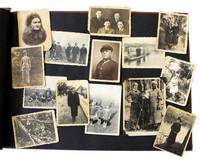
1939187411939. Polish Jewish family photographs created between 1934 and 1939 documenting Jewish life in Poland during the final years before the outbreak of World War II and the destruction of much of Eastern European Jewry. The photographs record members of a Polish Jewish family including men women and children during a period when Jewish communities remained deeply rooted throughout Poland but faced increasing political hostility and anti-Semitic agitation across Central Europe. Poland contained one of the largest Jewish populations in Europe during the inter war period with many families living in small Jewish communities often referred to as shutters as well as in larger towns and cities. The images capture everyday family and community life immediately before the German invasion of Poland in September 1939 a moment that would fundamentally transform the lives of Jewish communities across the region.<br /> <br /> Photo archive consisting of 21 silver gelatin photographs mounted in a photograph album together with 10 additional loose photographs. Images measure approximately 2.5 x 3.5 inches and depict family members in individual portraits group gatherings and scenes of school children assembled in large smiling groups. Several photographs carry handwritten inscriptions on the verso written in Polish and possibly Yiddish indicating personal exchanges between family members or relatives. Among the photographs are two portraits of a Polish Jewish man wearing Polish Army uniform one dated 1939 documenting Jewish participation in the Polish armed forces in the months immediately preceding the outbreak of war. The album pages preserve images of family gatherings and posed portraits reflecting domestic and social life within a Polish Jewish household during the final years of the inter war period.<br /> <br /> The photographs were created during a period of growing political instability in Europe that culminated in the German invasion of Poland on September 1 1939. That invasion followed the collapse of the German Polish non aggression agreement and the signing of the German Soviet pact that divided Poland between the two powers. German forces entered Poland with a large mechanized army supported by aircraft and armored divisions overwhelming the Polish military within weeks despite organized resistance. Jewish citizens served in the Polish armed forces and were present throughout the country's military and civilian life before the war. Album measuring approximately 15 x 11 inches containing 21 mounted photographs and accompanied by 10 loose photographs. Minor edge wear present with occasional cracks to several prints that do not affect the clarity of the images. Many photographs bear inscriptions and dates on the verso. Overall condition very good. unknown
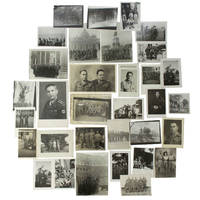
1944187231944. Polish Armed Forces soldiers serving with Allied forces during World War II documented in a group of photographs dating from 1945 to 1946 preserving visual evidence of the Polish II Corps and its role in the Italian Campaign. The Polish II Corps formed from Polish soldiers who had been released from Soviet imprisonment after the German invasion of the Soviet Union and were reorganized under Allied command receiving training in the Middle East before deployment to the Mediterranean theater. These troops participated in some of the most difficult operations of the Italian Campaign including the assault on German defensive positions at Monte Cassino in 1944 one of the decisive engagements that opened the road to Rome for Allied forces. The photographs record the presence of Polish soldiers in Italy during the final stages of the war and in the immediate aftermath of Allied victory.<br /> <br /> Photo archive consisting of 34 black and white silver gelatin photographs depicting members of the Polish Armed Forces serving with Allied units in Italy and surrounding regions during and immediately after the war. The photographs include individual portraits and group images of soldiers in uniform along with scenes of soldiers posed in front of prominent Roman landmarks such as St. Peter's Basilica the Colosseum and the Giuseppe Garibaldi monument. Several photographs show large groups of soldiers assembled near military vehicles and supply trucks while others depict soldiers aboard ships likely involved in transport within the Mediterranean theater. Many photographs carry inscriptions on the verso written in Polish including references to "Włochy" the Polish word for Italy confirming the location of the photographs. Some images show soldiers standing among palm trees suggesting photographs taken during the earlier phase of the corps' movement through the Middle East before deployment to Italy.<br /> <br /> By the end of the war the Polish forces serving alongside Allied armies had expanded significantly and the soldiers photographed here belonged to a formation that grew to more than 100000 personnel. After the war many Polish soldiers faced uncertain futures as their homeland fell within the Soviet sphere of influence following the war's conclusion. Photographs documenting Polish soldiers in the Italian theater therefore preserve visual records of a military force composed largely of displaced individuals who continued fighting under Allied command despite the political upheaval affecting their country. Thirty four silver gelatin photographs measuring approximately 2.5 x 3.5 inches to 5.5 x 3.5 inches. Minor edge wear present; overall condition very good. unknown
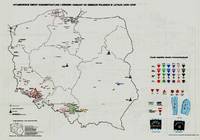
197941929Warszawa Warsaw: Pan´stw. Wydawn. Naukowe 1979. 1st Edition. Original black printed portfolio 8vo. Portfolio of seven large folding maps on on 4 sheets of heavy paper 3 are double sided 1 is singled sided. Primarily black and white with some color. Text in Polish. <br> Title translates to “Nazi camps in Poland 1939 - 1945. An Encyclopaedic Reference Book: Maps." Collection of 7 maps each 84 cm x 60 cm 33 x 24 inches produced by Jan Laskowski at the Main Commission for the Investigation of Nazi Crimes in Poland. The maps comprise Volume II of the work; Volume I is a heavily illustrated 676-page book of the same title which we offer separately. <br> The Seven maps all present are: <br> - Map 1 Single Sided: Hitlerowskie obozy na ziemiach polskich w latach 1939 - 1945. “Nazi camps in Poland in the years 1939 - 1945â€. Showing: concentration and extermination camps sub-camps of concentration camps extermination centers POW camps more important sub-camps working divisions commandos and temporary POW camps penal labor camps major labor camps prisons transit camps & ghettos. <br> - Map 2A: Getta na ziemiach polskich w okresie okupacji hitlerowskiej w latach 1939 - 1945 “Ghettos in Poland during the Nazi occupation in 1939 - 1945â€. <br> - Map 2B: Hitlerowskie obozy przejsciowe na ziemiach polskich w latach 1939 - 1945 “Nazi transit camps in Poland in 1939-1945â€. <br> - Map 3A: Hitlerowskie wiezienia i areszty na ziemiach polskich w latach 1939 - 1945 “Nazi prisons and arrests in Poland in 1939 - 1945â€. <br> - Map 3B: Hitlerowskie obozy pracy na ziemiach polskich w latach 1939 - 1945 “Nazi labor camps in Poland in the years 1939 - 1945â€. <br> - Map 4A: Hitlerowskie obozy jenieckie na ziemiach polskich w latach 1939 - 1945 “Nazi POW camps in Poland in 1939 - 1945â€. <br> - Map 4B: Hitlerowskie obozy koncentracyjne i osrodki zaglady na ziemiach polskich w latach 1939 - 1945 “Nazi concentration camps and extermination centers in Poland in 1939 - 1945â€. <br> Maps 2A & 2B have been described as a “Terrifying pair of maps showing the locations of German POW and internment camps in Poland during World War II highlighting the widespread locations of these establishments. In some parts of the map the information becomes so dense that three inset maps are shown. This map was designed by Jan Laskowski and printed in 1979 as part of a work on the Nazi extermination machine produced by PWN Warsaw a state-owned research-focused publishing house in Poland.<br> The map on the front is particularly interesting for its depiction of symbols used to classify internees in German camps. The uppermost of these depictions shows the combinations that can be made for different types of prisoners of different levels of importance. The armbands that would have been worn by these prisoners is shown as well as the prison uniforms. Other details are also shown. <br> The map lists hundreds of sites run by Nazi operators throughout the country. These include concentration camps death camps transitional camps and ghettos. The map is divided according to Poland's voivodeships with a key in the lower left. Names of cities too long to spell are also provided in the lower left. <br> This map was produced during a point in Poland's history during which it was actively revisiting the period during the Second World War. Leading social scientists devoted their time to trying to gather all the living as well as the recorded history of the events of the Holocaust and related atrocities before this information vanished. Leading these efforts particularly during the 1960s and 1970s was the Glówna Komisja Scigania Zbrodni przeciwko Narodowi Polskiemu known as the Chief Commission for the Prosecution of Crimes against the Polish Nation. They were active in publishing maps both for domestic educational purposes and for international remembrance and diplomatic efforts regarding the Holocaust. Jan Laskowski was a leading cartographer who produced a number of maps in this field. <br> These maps were produced as part of a series of maps that purported to combine to form an atlas of all of Hitler's crimes in Poland. Many of the large wall maps produced during this period could only show a fraction of the crimes or only the atrocities committed in one region. Thus a series of maps was needed to show all the points necessary which this present work contributes to. <br> Polish Reinterpretations of the Holocaust: Studying the effects of German occupation in Poland is a delicate subject. While it is certain that Poland suffered at least as badly as any other European nation during the Second World War reinterpretations of the Holocaust in the country have also been used to satisfy nationalistic tendencies. It has become evident to Western observers in the last several years that there is a strong nationalist movement in Poland that seeks to place blame for the Holocaust solely on the shoulders of non-Polish actors a movement originally fostered under Soviet rule. This movement has gone so far as to limit freedom of speech criminalizing with a three-year sentence the suggestion that Poland or its citizens in any form participated in the murders committed by Nazis. As such the term ‘Polish concentration camps’ has been deemed unacceptable with the government-approved term being ‘concentration camps on Polish territory.’ <br> All lines of evidence show that this map 2A & 2B was produced using the most accurate and impartial historical sources. The language on the map is simple naming only ‘Hitler's Atrocities’ and there is no evidence of a clear anti-German bias. However it is impossible to separate this map one of the most important productions of the remembrance movement during this period from the social situation in which it was produced. Maps like these can easily be converted into propaganda instruments and today's Polish leaders most of whom grew up during Soviet occupation will have formed their understanding of the Holocaust through maps like these. <br> Soviet Censorship: While the content of the map appears to have been produced free from bias the map still had to go through Soviet censorship. Mentioning prisoner of war camps in which primarily Soviet troops were interned would have been a prerequisite condition upon which the publication of the map rested. Further the lack of mention of any Soviet killings or camps requires no explanation….The map unlike many later maps makes no differentiation between the populations who suffered at the various camps. This represents the Soviet agenda that all nations suffered fought and won equally which sought to limit divisions in this post-identity state†Ruderman 2022. <br> SUBJECTS: World War 1939-1945 -- Prisoners and prisons German. -- Concentration camps -- Poland. Guerre mondiale 1939-1945 -- Prisonniers et prisons des Allemands. -- Camps d'internement -- Pologne. Obozy koncentracyjne -- Polska -- 1900-1945. OCLC: 830885973. <br> Light shelf wear to portfolio as expected. All maps in pristine condition with normal folds as issued. Very Good Condition. Complete and dramatic BR5 holo2-147-19-'cc. Warszawa (Warsaw): Pan´stw. Wydawn. Naukowe unknown
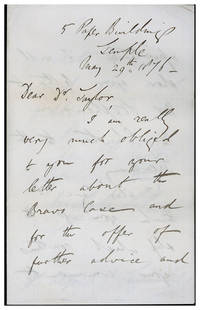
1876484621876. <p>Taylor Alfred Swaine 1806-80. Archive of material relating to the famous Charles Bravo poisoning case consisting of 1 Autograph letter signed to Taylor from Harry Bodkin Poland 1829-1928. Bifolium. 3pp. Temple London 29 May 1876. 205 x 127 mm. 2 3 autograph letters signed to Taylor from Augustus K. Stephenson 1827-1904. 15pp. total. London 3 June 1876 2 bifolia 8pp.; 5 June 1876 bifolium 4pp.; and 22 July 1876 bifolium 3pp. 184 x 114 mm. 3 Taylor. The Balham mystery. Galley proof corrected in Taylor's hand of the first portion of an unsigned article in The British Medical Journal 20 May 1876: 631-633. 578 x 148 mm. Together 4 letters and one printed proof. Some rodent damage to Stephenson's letters affecting several words mended in several places with clear tape. Small lacuna along one fold in the galley proof affecting a few words. Minor dampstaining but good to very good.</p> <p> From the library of Alfred Swaine Taylor founder of forensic toxicology an archive relating to the notorious and sensational Charles Bravo poisoning a case that is still unsolved. The Bravo mystery has inspired several works of fiction including Shirley Jackson's We Have Always Lived in the Castle 1962 and a three-part BBC serial titled The Poisoning of Charles Bravo 1975.</p> <p> Bravo 1845-76 a 33-year-old barrister died of tartar emetic antimony poisoning on 21 April 1876 less than five months after his marriage to a wealthy widow; the marriage was reportedly an unhappy one. The inquest on Bravo's death held on 25 and 28 April returned an open verdict but the circumstances of the case were so suspicious that Taylor offered his expert advice to Harry Bodkin Poland one of the attorneys for the Crown. Our archive includes the letter Poland sent thanking Taylor for "your letter about the Bravo Case and for the offer of further advice and assistance" and informing Taylor that he "will show your letter to Mr. Augustus K. Stephenson the Solicitor to the Treasury." Stephenson is represented in the archive by three letters asking for Taylor's expert opinion on the case: "You have read the account of the Post-mortem encl. by Dr. Payne . . . That being so does it enable you to form an opinion as to whether the antimony was taken in solid food . . . letter of 3 June. "Assuming small traces of antimony to have been found in the liver of a deceased person-Can you form any opinion as to length of time before death that the antimony was taken" letter of 5 June. "Can you tell me whether antimony in the form of tartar emetic wd. if taken in small doses at intervals during pregnancy induce a miscarriage letter of 22 July.</p> <p> The last item in our archive is a galley proof corrected in Taylor's hand of the first two-thirds of an article on the Bravo case published on 20 May in the British Medical Journal; although the article is unsigned it was most likely written by Taylor. Based on the medical evidence Taylor concluded that Bravo had ingested the fatal dose of antimony during his last meal. He severely criticized the investigators in the case for not testing the remains of the bottle of wine he had drunk with the meal-"the only article of food not shared in common with the three who sat at the dinner-table . . . If tartar emetic had been found in this wine much of the present mystery hanging about the case would be removed . . . In tracing the further history of this bottle we learn that no one now knows what became of it or its contents." </p> . unknown
1933173338New York: Edgar Weyhe 1933. Limited to 200 numbered copies. Paperback. VG with minor coiling to orange dustjacket covers otherwise almost like new except for some separation of spine at the very top. Orange printed dustjacket surrounding a white printed glued wrap-around stiff cover. 54 pp. Two color plates including a signed in pencil lithograph portrait of Shore by Jean Charlot 18 bw photographic reproductions after photographs of the artist's work by Edward Weston 5 smaller bw reproductions which may be lithographs at the head of the text articles. The first color plate may also be a color lithograph but it is not signed. One of Armitage's rarest works. A monograph on the art and career of California modernist painter Henrietta Shore.The portrait by Charlot is signed by the artist but hideous. Includes an article by Edward Weston who also photographed the original artworks by Shore. Includes articles by Merle Armitage Edward Weston and an Appraisal by Reginald Poland. Very rare. Forward colophon reads "Two hundred numbered copies of this book designed by Merle Armitage have been printed . by the Will A. Kistler Company . It is set in twelve point Rockwell type and the entire contents of the book is printed by the Artochrome Process. The photographs of the paintings pastels crayons and drawings in this book were made from the originals by Edward Weston. This is copy no. blank"--Colophon./ Descriptive letterpress on versos facing the plates." Edgar Weyhe paperback
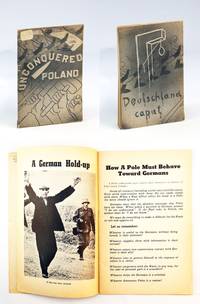
1943442j1479New York: Poland Fights - Polish Labor Group. Fair with no dust jacket. 1943. First Edition. Paperback. "As German boots marched and German tanks rumbled through the mined streets of Warsaw the workers buried their remaining arms drew closer to one another and silently disappeared to continue the fight with means other than rifles and bullets. Underground Poland was born! And this is its story." - page 2. Topics include: How a Pole Must Behave Toward Germans; List of 15 Strictly Forbidden Activities; Underground Poetry; Invisible Sabotage; Roads To Death; 1.5 Million Slave Laborers; Boycott; Recalcitrant Peasants; Avengers and Guerrillas; The Ghetto Strikes Back; Collective Responsibility of Monuments; Wawer Massacre; Hide It From The Germans!; Our Future. Stapled booklet with 44 glossy unnumbered pages in illustrated covers. Text in English. Profusely illustrated with black and white reproductions of photos document facsimiles illustrations and a map. No indication of any prior printings. Former library copy with related markings to front and back of front cover. Bound by a single staple which is pulling from the tender illustrated covers. One-inch opening at bottom of coverfold. A worthy example of this highly informative WWII-era artifact. Wiener Library Catalogue Series 7 1004. 8.5" x 5.5"; Front Cover; 8vo . Poland Fights - Polish Labor Group paperback
1918184801918. American Red Cross Poland photo album Warsaw Operations 1918-1920 documents U.S. humanitarian operations in Eastern Europe following World War I recording relief work conducted during the Polish-Soviet War and the broader reconstruction of Polish civil and medical infrastructure. The images identify personnel locations and operational units associated with American Red Cross efforts as they provided transport medical care and material aid in a region destabilized by the collapse of empires and the reestablishment of an independent Polish state in 1918. A caption referencing "the Polish-Russian front ARC 1920 Poland" situates the album within active conflict conditions while additional annotations tied to supply trains and field units establish the material as a contemporaneous record of organized international relief.<br /> <br /> Photo album measuring approximately 8 x 11.5 inches with 34 photographs mounted across 11 leaves each image approximately 3 x 5 inches. The photographs depict American Red Cross personnel aboard trains and railway platforms including a documented ARC supply train as well as automobile units in transit or undergoing roadside repair captioned "American Red Cross cars 1918 Poland." Several images include handwritten annotations identifying subjects locations and squadron designations. One photograph shows a group of workers assembled on a makeshift structure with a caption identifying "Van Wert in charge of one of the relief trains" indicating named personnel connected to field operations.<br /> <br /> Produced during the initial phase of internationally coordinated humanitarian intervention in postwar Poland the album aligns with the 1919 recognition of the Polish Red Cross by the International Committee of the Red Cross which facilitated the transfer of hospitals medical trains and logistical infrastructure into Polish administration. The photographs document the integration of American aid within these systems including rail-based medical transport and mobile support units critical to relief distribution in contested and newly reorganized territories. Some photographs detached from leaves and a tear to the front cover; images and structure otherwise intact. Overall very good condition. unknown
194595822Lodz: Centralna Zydowska Komisja Historyvzna w Polsce 1945. 1st edition. Good. oblong quarto. original chipped boards 38 104 32pp. b/w plates An amazing document drawn largely from "souvenir" photos taken by German soldiers and published immediately after the end of the war. Dual text POLISH RUSSIAN ENGLISH FRENCH & HEBREW. Heavy use inc. loose pages o/w a complete copy of a very scarce not to say rare volume suitable for restoration & rebinding Centralna Zydowska Komisja Historyvzna w Polsce hardcover
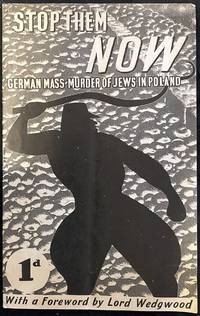
194243347Liberty Publications London 1942. Paperback. 1st edition. Original dramatically illustrated paper wrappers. 12mo 14 pages. Photographic illustrations. <br> With heart-breaking introduction: "It IS True" by the London-based Bundist leader Szmul Zygielbojm who within eight months of this publication committed suicide At the time of his suicide he stated: "By my death I wish to give expression to my most profound protest against the inaction in which the world watches and permits the destruction of the Jewish peopleâ€.<br> Zygielbojm was a “Member of the Polish National Council in London Member of the T.U.C. in Poland and of the Executive of the Jewish Socialist Party “Bund†in Poland.†<br> This dramatic publiction details the horrors against Jews specifically the Polish Jews using information from two documemts from the Polish government. Includes photographs of “a mass grave of massacred Jews in Central Poland†a man tallying the dead bodies and a man holding a starving baby. A copy sold for over USD 800 with commissions at auction in 2013. <br> SUBJECTS: Holocaust Jewish 1939-1945 -- Poland. World War 1939-1945 – Jews. Atrocities. Occupation. <br> OCLC: 22173530. <br> Very Good Condition. HOLO2-159-16-XX-ABLPIII-EBB-'ff. Liberty Publications, London paperback
1891276956O.R. Reisland Leipzig 1891. Hardcover mit Leinenrücken und -ecken 1891-1931. Jahrgänge 1112132526272829303132333839404142464748495051. Der 39. Jahrgang ist nicht gebunden. Zustand: Keine Beschädigungen ehem. Exemplare einer Klosterbibliothek mit Kennungen. Rücken Ecken Kanten sehr gut. O.R. Reisland, Leipzig, hardcover
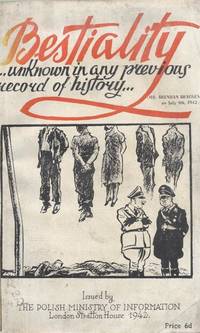
194239727London: Stratton House 1942. First edition. Original illustrated wraps. 12mo. 56 pages. 19 cm. ‘A Record of the German Barbarities in Poland in the First Six Months of 1942.’ <br> With two page map of concentration camps in Germany. <br> Extremely detailed early report concerning Nazi atrocities executions concentration camps the extermination of the Lublin ghetto etc. Contents include: Introduction; Documents from Poland; General Sikorski's protest speech; Resolution of the Polish National Council; Press conference at the Ministry of Information; and Justice will be done: official statements and declarations. <br> Included in in the “<br> Documents from Poland†section is a piece on the “Destruction of the Jewish Population.†<br> “As early as 1940 the Government Delegate alerted London about the persecution of Jews in Poland. Thereupon the Polish government-in-exile sent a note on this subject to allied governments May 3 1941. Also in 1941 the Polish Ministry of Information in London published a booklet on the persecution of Jews in Poland entitled ‘Bestiality Unknown in Any Previous Record of History’ and based on information received from occupied Poland. In January 1942 the Ministry issued another publication ‘The New German Order in Poland. ’ Both publications created a stir throughout the allied world which after 1941 could no longer plead ignorance of the persecution of Jews in Poland. †"The Polish Underground State: A Guide to the Underground 1939-1945" Stefan Korbonski. <br> The US Holocaust Museum keeps their copy in their Rare Book Room. Subjects: World War 1939-1945 - Poland. World War 1939-1945 - Atrocities. <br> OCLC: 8022841. <br> Staples show rust as generally found light rubbing to covers attractive and dramatic about Very Good Condition.B HOLO2-104-27C-MMACCBBE-I-'. London: Stratton House unknown