PAC (Michel Jean) & BOHUSZ (Ignacy).Livre Rare Book
4 167 résultats
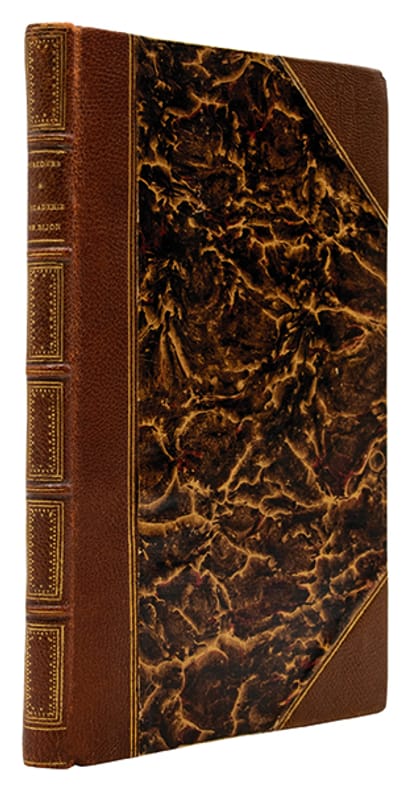
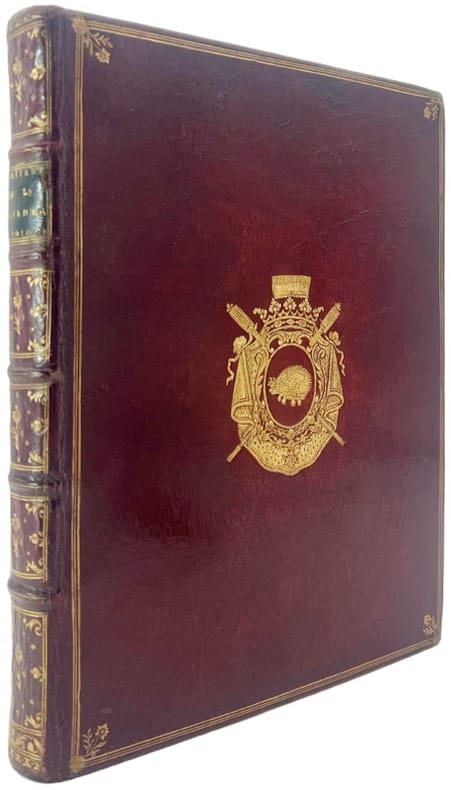
177044616, , 1770. In-4 de 141-(3)-293-(3) pp., maroquin rouge, dos orné à nerfs, triple filet doré en encadrement sur les plats, fleurons aux angles, gardes de papier décoré, armes frappées au centre des plats, dentelle intérieure, pièce de titre en maroquin noir, tranches dorées (reliure de l'époque).
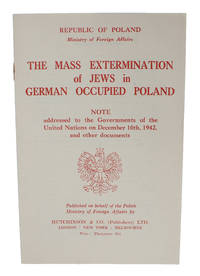
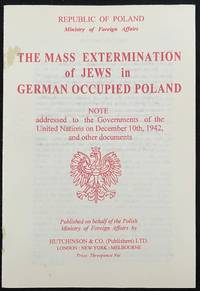
194360182London, New York, Melbourne (printed in Great Britain), Published on behalf of the Polish Ministry of Foreign Affairs, (1943). 8vo. Stapled as issued. Title-page printed in red. Stapels with rust, slightly affecting surrounding paper. A very fine, near mint, copy. 16 pp.
194360436London, New York, Melbourne (printed in Great Britain), Published on behalf of the Polish Ministry of Foreign Affairs, (1943). 8vo. Stapled as issued. Title-page printed in red. Stapels with rust, slightly affecting surrounding paper. A very fine, near mint, copy. 16 pp.
194360436London New York Melbourne printed in Great Britain Published on behalf of the Polish Ministry of Foreign Affairs 1943. 8vo. Stapled as issued. Title-page printed in red. Stapels with rust slightly affecting surrounding paper. A very fine near mint copy. 16 pp. <br/><br/><em>The scarce first printing of this hugely important publication which constitutes one of the very first official reports on Holocaust and one of the most accurate accounts that had been presented to the West changing their knowledge of what was actually going on. This seminal pamphlet consists of 1 Raczynski's account of the ongoing Holocaust based among other reports on the eye-witness-report by Jan Karski a Polish Government emissary in occupied Poland who bribed his way into a German concentration camp and witnessed the mass extermination of Jews 2 the seminal "Joint Declaration" by members of the United Nations in which "The above-mentioned Govenments and the French National Committee condemn in the strongest possible terms this bestial policy of cold-blooded extermination. They declare that such events can only strengthen the resolve of all free-loving peoples to overthrow the barbarous Hitlerite tyranny. They reaffirm their solems resolution to ensure that those responsible for these crimes shall not escape retribution and to press on with the necessary practical measures to this end." p. 12 3 an extract of Deputy Prime Minister Mikolajczy's statement on behalf of the Polish Government and 4 the text of Raczynski's broadcast of December 1942 in which pleaded for action wishing to make the public and the Allied nations "understand how real is the tragedy which is taking place not so very far from the shores of this island on the continet of Europe - on the soil of Poland. For more than three years the Germans have consistently done everything they could to hide from the eyes of the world the martyrdom of the Polish nation the like of which has never been known in the history of humanity. But "when we would keep silence the very stones will cry out"." p. 15.While the details were neither complete nor wholly accurate the Allies were aware of most of what the Germans had done to the Jews at a relatively early date. The mass murder of the Jews was of such dimensions however that at first they could not believe the reports that reached them. This quickly changed though.In February of 1942 Jacob Grojanowski an escaped prisoner of the Chelmno extermination camp provided the Oneg Shabbat group with detailed information about what went on at the Chelmno camp. His report became known as the Grojanowski Report. It was smuggled out of the Warsaw Ghetto via the Polish underground and reached London in June of 1942. It is not known exactly what happened to the report at that point but by February of 1942 the United States Office of War Information had decided not to release information about the extermination of Jews thinking that there was a risk of the public viewing the war as only being a Jewish problem. Thus the Grojanowski Report was not released. By at least October of 1942 British radio had broadcast news of the gassing of Jews to the Netherlands and in December 1942 the Western Allies released their Joint Declaration which is printed in the present publication describing and condemning in the strongest manner Hitler's violent attempts at exterminating the Jews of Europe. In 1942 Jan Karski 1914-2000 a Polish World War II resistance movement fighter and later professor at Georgetown University gave his first report to the Polish British and U.S. governments on what was going on in the German extermination camps in Poland.Karski reported to the Polish government in exile i.e. Raczynski who was the Ambassador and one of its most prominent leaders and the Western Allies on the situation in German-occupied Poland. Karski personally met with Franklin Roosevelt and British Foreign Secretary Anthony Eden to explain what went on in Poland and Raczynski wrote up the report. Eventually the American Government confirmed the reports to Jewish leaders in late November 1942 and shortly thereafter they were publicized i.e. in the present publication. Karski's report through Raczynski became one of the most important reports in the history of the Holocaust being a major factor in informing the West. It sparked one of the first official publications from the Allies on the mass extermination of Jews in Poland and resulted in the official reports and condemnations from the Allied countries i.e. the "Joint Declaration" also published here."The purpose of this publication is to make public the contents of the Note of December 10th 1942 addresses by the Polish Government to the Governments of the United Nations concerning the mass extermination of Jews in the Polish territories occupied by Germany and also other documents treating on the same subject. . In the hope that the civilized worlds will draw the appropriate conclusions the Polish Government desire to bring to the notice of the public by means of the present White Paper these renewed German efforts at mass extermination with the employment of fresh horrifying methods." From the Introductory Note p. 3."Most recent reports present a horrifying picture of the position to which the Jews in Poland have been reduced. The new methods of mass slaughter applied during the last few months confirm the fact that the German autorities aim with systematic deliberation at the total extermination of the Jewsih population of Poland and of the many thousands of Jews whom the German authorities have deported to Poland from Western and Central European countries and from the German Reich itself.The Polish Government consider it their duty to bring to the knowledge of the governments of all civilized countries the following fully authentical information received from Poland during recent weeks which indicates all too plainly the new methods of extermination adopted by the German authorities." p. 4. </em> unknown
194360182London New York Melbourne printed in Great Britain Published on behalf of the Polish Ministry of Foreign Affairs 1943. 8vo. Stapled as issued. Title-page printed in red. Stapels with rust slightly affecting surrounding paper. A very fine near mint copy. 16 pp. <br/><br/><em>The scarce first printing of this hugely important publication which constitutes one of the very first official reports on Holocaust and one of the most accurate accounts that had been presented to the West changing their knowledge of what was actually going on. This seminal pamphlet consists of 1 Raczynski's account of the ongoing Holocaust based among other reports on the eye-witness-report by Jan Karski a Polish Government emissary in occupied Poland who bribed his way into a German concentration camp and witnessed the mass extermination of Jews 2 the seminal "Joint Declaration" by members of the United Nations in which "The above-mentioned Govenments and the French National Committee condemn in the strongest possible terms this bestial policy of cold-blooded extermination. They declare that such events can only strengthen the resolve of all free-loving peoples to overthrow the barbarous Hitlerite tyranny. They reaffirm their solems resolution to ensure that those responsible for these crimes shall not escape retribution and to press on with the necessary practical measures to this end." p. 12 3 an extract of Deputy Prime Minister Mikolajczy's statement on behalf of the Polish Government and 4 the text of Raczynski's broadcast of December 1942 in which pleaded for action wishing to make the public and the Allied nations "understand how real is the tragedy which is taking place not so very far from the shores of this island on the continet of Europe - on the soil of Poland. For more than three years the Germans have consistently done everything they could to hide from the eyes of the world the martyrdom of the Polish nation the like of which has never been known in the history of humanity. But "when we would keep silence the very stones will cry out"." p. 15. While the details were neither complete nor wholly accurate the Allies were aware of most of what the Germans had done to the Jews at a relatively early date. The mass murder of the Jews was of such dimensions however that at first they could not believe the reports that reached them. This quickly changed though. In February of 1942 Jacob Grojanowski an escaped prisoner of the Chelmno extermination camp provided the Oneg Shabbat group with detailed information about what went on at the Chelmno camp. His report became known as the Grojanowski Report. It was smuggled out of the Warsaw Ghetto via the Polish underground and reached London in June of 1942. It is not known exactly what happened to the report at that point but by February of 1942 the United States Office of War Information had decided not to release information about the extermination of Jews thinking that there was a risk of the public viewing the war as only being a Jewish problem. Thus the Grojanowski Report was not released. By at least October of 1942 British radio had broadcast news of the gassing of Jews to the Netherlands and in December 1942 the Western Allies released their Joint Declaration which is printed in the present publication describing and condemning in the strongest manner Hitler's violent attempts at exterminating the Jews of Europe. In 1942 Jan Karski 1914-2000 a Polish World War II resistance movement fighter and later professor at Georgetown University gave his first report to the Polish British and U.S. governments on what was going on in the German extermination camps in Poland.Karski reported to the Polish government in exile i.e. Raczynski who was the Ambassador and one of its most prominent leaders and the Western Allies on the situation in German-occupied Poland. Karski personally met with Franklin Roosevelt and British Foreign Secretary Anthony Eden to explain what went on in Poland and Raczynski wrote up the report. Eventually the American Government confirmed the reports to Jewish leaders in late November 1942 and shortly thereafter they were publicized i.e. in the present publication. Karski's report through Raczynski became one of the most important reports in the history of the Holocaust being a major factor in informing the West. It sparked one of the first official publications from the Allies on the mass extermination of Jews in Poland and resulted in the official reports and condemnations from the Allied countries i.e. the "Joint Declaration" also published here. "The purpose of this publication is to make public the contents of the Note of December 10th 1942 addresses by the Polish Government to the Governments of the United Nations concerning the mass extermination of Jews in the Polish territories occupied by Germany and also other documents treating on the same subject. . In the hope that the civilized worlds will draw the appropriate conclusions the Polish Government desire to bring to the notice of the public by means of the present White Paper these renewed German efforts at mass extermination with the employment of fresh horrifying methods." From the Introductory Note p. 3. "Most recent reports present a horrifying picture of the position to which the Jews in Poland have been reduced. The new methods of mass slaughter applied during the last few months confirm the fact that the German autorities aim with systematic deliberation at the total extermination of the Jewsih population of Poland and of the many thousands of Jews whom the German authorities have deported to Poland from Western and Central European countries and from the German Reich itself.The Polish Government consider it their duty to bring to the knowledge of the governments of all civilized countries the following fully authentical information received from Poland during recent weeks which indicates all too plainly the new methods of extermination adopted by the German authorities." p. 4. </em> unknown
1943140946511London New York & Melbourne: Hutchinson & Co. Publishers Co 1943. First edition. First edition. 16 pp. Staple bound in publisher's self wraps. Near Fine with a little rusting to staples and staining along spine. A bright attractive copy of a momentous historical document. <p>For the first time this pamphlet publicly disclosed the ongoing Holocaust for an Allied audience in the midst of World War II with information provided by Polish diplomat-tuned-secret-agent Jan Karski. It focused on events in Poland including the Warsaw Ghetto rebellion and mentioned various concentration camps in Eastern Europe. It also contained the text of the Joint Declaration by Members of the United Nations of 17 December 1942 and an excerpt of a statement by Deputy Prime Minister Stanisław Mikołajczyk of 27 November 1942. Rare in commerce. Hutchinson & Co. (Publishers) Co unknown
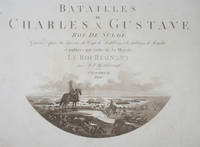
180645461Stockholm, 1806. Large folio oblong. (44 x 61 cm.). Contemp. hcalf, covers with marbled paper. Titlelabel in red and gilt pasted on frontcover. Wear to foot of spine, otherwise fine. Engraved titlepage (battle view), engraved plate depicting the Carl Gustav on horseback in front of a battle scene and 11 engraved plates showing battlescenes after Dahlberg's drawings. All engravings in beautiful toned sepia aquatint. A few marginal brownspots. A very fine copy.
180645461Stockholm 1806. Large folio oblong. 44 x 61 cm. Contemp. hcalf covers with marbled paper. Titlelabel in red and gilt pasted on frontcover. Wear to foot of spine otherwise fine. Engraved titlepage battle view engraved plate depicting the Carl Gustav on horseback in front of a battle scene and 11 engraved plates showing battlescenes after Dahlberg's drawings. All engravings in beautiful toned sepia aquatint. A few marginal brownspots. A very fine copy. <br/><br/><em>Very scarce first printing of this series of plates aiming at glorifying the Swedish victories showing battlescenes - Warsaw Carnova Columbi Guesne and the crossing of the Belt in Denmark - from the wars against Poland and Denmark 1655-58 in fine engravings by Skjöldebrand. </em> unknown
In-4°; pp. (12). 226. (2) Frontespizio allegorico e ritratto di Maria Casimira Sobieski incisi su rame da Hubert Vincent; nel testo stemma Barberini inciso su legno; alcuni quaderni solo leggermente bruniti, per il resto buon esemplare. Unica edizione di questo diario del viaggio che per nove mesi tra il 1698 e il 99 portò a Roma la regina di Polonia Maria Casimira, all’udienza con Innocenzo XII. Il cardinal Barberini, suo protettore a Roma, commissionò questo testo a Antonio Bassani, canonico di Padova, e lo stampò nella sua stamperia privata. Il viaggio della vedova di Giovanni Sobieski fu un vero e proprio pellegrinaggio reale ma anche il suo trasferimento a Roma. Di particolare interesse risultano le descrizioni dei banchetti, delle feste (a Venezia come a Bologna), della tappa alla Santa casa di Loreto, e in generale delle cerimonie e degli omaggi organizzati nelle varie città per l’ingresso della regina. Fumagalli 280.
17507546Très célèbres estampes d’après Rigaud, dans son cadre en bois doré d'époque. Belleudy n° 1. Extrêmement rare. C'est l'estampe qui a causé l'exil de Baléchou à Avignon … Paris 1750
194343453London New York; Published on Behalf of the Polish Ministry of Foreign Affairs by Hutchinson & Co 1943. 1st edition. Original illustrated red and white paper wrappers. 8vo. 16 pages. 22 cm. National Government Publication. Printed in red and black ink. Includes a note by Polish Foreign Minister Edward Raczynski and speeches by Deputy Prime Minister Stanislaw Mikolajczyk.<br> The official 16-page diplomatic publication from December 1942 by the Polish Government-in-Exile in London marking a turning point in international understanding of the Nazi destruction of the Jews of Europe. <br> Jan Karski a courier for the Polish Underground had smuggled microfilmed evidence and intelligence out of occupied Poland to London. This raw intelligence gathered from his time secretly inside the Warsaw Ghetto and the Izbica transit camp formed the core of the facts published in the booklet.<br> <br> "In October 1942 at the height of the destruction of Polish Jewry Jan Karski born Jan Kozielewski was ordered to clandestinely go to the West and deliver a report on the situation of occupied Poland to the Polish government-in-exile in London. The situation of the Jews in Poland was to be one section of that report. Since the government in exile was concerned with the internal politics of Poland's underground parties Karski held meetings with the different factions including the Jewish Zionist and the Jewish Socialist Bund movements. <br> Thus shortly before his departure Karski met with two Jewish leaders who asked him to inform the world's statesmen of the desperate plight of Polish Jewry and of the hopelessness of their situation. Their message was: 'Our entire people will be destroyed.'<br> The Jewish leaders' appeals touched Karski and he decided to see things with his own eyes in order to make his report. With great risk to his life he was smuggled into the Warsaw ghetto and into a camp in the Lublin area. The horrors he witnessed marked him deeply and propelled him to become not only the messenger of the Polish underground but to concentrate on giving voice to the suffering of the dying Jews.<br> In November 1942 Karski reached London delivered the report to the Polish government-in-exile and set out to meet Winston Churchill other politicians journalists and public figures. Upon completing his mission Karski went on to the United States where he met with President Roosevelt and other dignitaries and tried in vain to stir up public opinion against the massacre of the Jews. In 1944 while in the United States Karski wrote a book on the Polish Underground Story of a Secret State with a long chapter on the Jewish Holocaust in Poland.<br> After the war Karski stayed in the United States where he was later appointed Professor at Georgetown University Washington DC.<br> On 2 June 1982 Yad Vashem recognized Jan Karski as Righteous Among the Nations" Yad Vashem. <br> <br> Leading Holocaust scholar Lucy Dawidowicz cites the booklet in her now classic work "The Holocaust and the Historians" Harvard 1983 p. 167; the report could not be more explicit in its description of the horrors nor in its plea for help: <br> "The new methods of mass slaughter applied during the last few months confirm the fact that the German authorities aim with systematic deliberation at the total extermination of the Jewish population of Poland and of the many thousands of Jews whom the German authorities have departed to Poland from Western and Central European countries and from the German Reich itself. The Polish Government considers it their duty to bring to the knowledge of the Governments of all civilised countries the following fully authenticated information received from Poland during recent weeks which indicates all too plainly the new methods of extermination adopted by the German authorities." <br> The report elaborates: "The actual process of deportation was carried out with appalling brutality. At the appointed hour on each day the German police cordoned off a block of houses selected for clearance entered the back yard and fired their guns at random as a signal for all to leave their homes and assemble in the yard. Anyone attempting to escape or to hide was killed on the spot. No attempt was made by the Germans to keep families together. Wives were torn from their husbands and children from their parents. Those who appeared frail or infirm were carried straight to the Jewish cemetery to be killed and buried there. <br> On the average 50-100 people were disposed of in this way daily. After the contingent was assembled the people were packed forcibly into cattle trucks to the number of 120 in each truck which had room for forty. The trucks were then locked and sealed. The Jews were suffocating for lack of air. The floors of the trucks were covered with quicklime and chlorine. As far as is known the trains were dispatched to three localities - Treblinka Belzec and Sobibor to what the reports describe as 'Extermination camps.' <br> The very method of transport was deliberately calculated to cause the largest possible number of casualties among the condemned Jews. It is reported that on arrival in camp the survivors were stripped naked and killed by various means including poison gas and electrocution. The dead were interred in mass graves dug by machinery." <br> <br> Read more about the singular importance of this publication at <br> en.wikipedia.org/wiki/The_Mass_Extermination_of_Jews_in_German_Occupied_Poland# . <br> In 2020 Polish Postal authorities chose this very publication to illustrate their official first day cover honoring righteous Poles who had saved Jews during the Holocaust see illustration. <br> <br> Subjects: World War 1939-1945 - Jews - Poland. World War 1939-1945 - Poland - Atrocities. Holocaust Jewish 1939-1945 - Poland. Jews - Poland. OCLC: 234118765. <br> Touch of staining at staples without the rust almost always seen in other surviving copies. Very Good condition. A copy with rust stains sold in 2018 at auction for over £6000. Rare and very important. BHOLO2-97-48-MMXRLADFACC. London, New York; Published on Behalf of the Polish Ministry of Foreign Affairs by Hutchinson & Co unknown
c4661PIÈCE MANUSCRITE , de format in folio oblong, sur velin, de 12 pages, comportant environ 1000 signatures de FEMMES POLONAISES EXILÉES à MOSCOU.La première page est somptueusement illustrée d'un large encadrement peint et doré signé par K. Homolacs, avec le texte soigneusement calligraphié.Toutes les grandes familles polonaises sont représentées. Texte très touchant ( référence à la France “Seconde Patrie“, “Berceau des idées généreuses “, aux “Héros de Verdun “. Charles Richet fut Président de La Ligue pour le rétablissement de la Pologne, il était physiologiste, aviateur ,pacifiste et adepte des sciences occultes.Pièce d'un grand intérêt historique et remarquablement décorative.
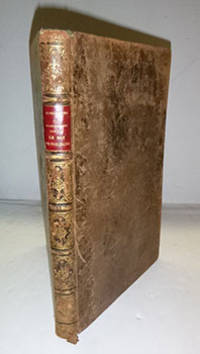
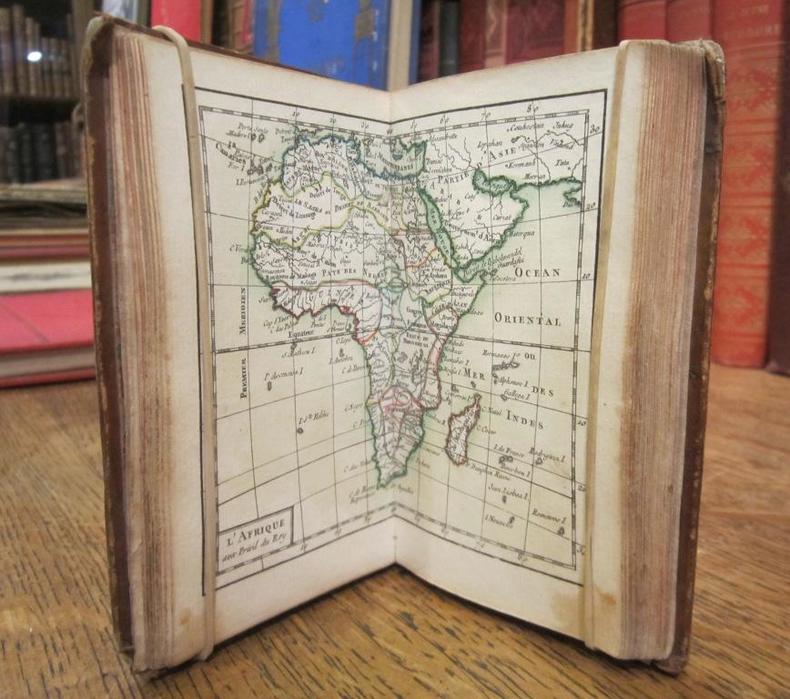
382653 ouvrages reliés en un volume in-8 (182 x 112 mm), demi-maroquin acajou à coins, dos à nerfs orné de compartiments garnis d'un décor d'encadrement doré, titre doré, tête dorée (rel. fin XIXe).
In 8, cm 18 x 24,5, pp. (4) + 222 + (2) con 5 ( su 6) tavole fuori testo incise all'acquaforte e un'insegna incisa posta all'ultima carta (Diversa per aequora). Manca gran parte della pianta di Mosca. Brunitura uniforme alle tavole. Piena pergamena coeva. Rara edizione italiana di questa traduzione tratta dai Viaggi di Moscovia di Adam Olschlager stampata nel 1646 e edizione originale della Relatione del Barberini, scritta nel 1565 e mai pubblicata. Olearius venne inviato nel 1633 da Federico III Duca di Hoeltein in Russia e in persia, al fine di stringere rapporti commerciali con questi paesi e contiene la descrizione dei paesi attraversati durante il viaggio, descrive la Livonia, Riga, Vvolmar, Dorp, Narva, Caporio, Notemburg, Novogordia ecc. Ampia descrizione di usi e costumi russi, delle udienze pubbliche con le quali furono ricevuti, i ricevimenti degli ambasciatori turchi e tartari ecc. La relazione del Barberini, poi, si presenta sotto forma di lettera al Conte di Nubarola il quale narra della Russia e dei paesi attraversati durante il viaggio. Importante testimonianza del rinato interesse per la Russia di questo periodo ribadito nell'Avvertimento al lettore, nel quale si danno delucidazioni sul paese e note relative all'etimologia di alcune parole. La relazione del Barberini risale al viaggio fatto da questi nel 1564 al fine di vendere allo Zar Ivan il terribile, il brevetto per l'estrazione del sale. Mazzitelli, Slavica biblioteconomica, p. 47 - 49. rhode, 1963, 141.
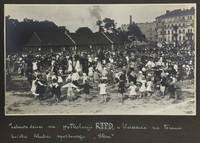
3728825<p>Poland c.1920s. 21ff. Album. 9½ x 13 inches. Beige cloth with colorful woven onlay; cord-bound. 23 captioned photographs mounted on black cardstock rectos approx. 4¾ x 8¾ inches tissue guards. Brief wear to head and tail of spine and corners; very good.</p> <p>Made by the Workers’ Society of Friends of Children in Warsaw and given to their Chicago branch this 1920s photograph album illustrates the strong link between Poles living in Warsaw and Chicago reflecting the wider story of the Polish diaspora at that time. The album documents that Polish immigrants in Chicago supported social projects back in Poland highlighting the cross-continental connections among Polish communities.</p> <p>The Workers’ Society of Friends of Children was established in 1919 to provide childcare and education centers for workers’ children and the children of the unemployed. The outreach included kindergartens schools summer camps meals and medical care. </p> <p>The album’s photographs show children’s homes and tents kindergarten-age children playing with blocks playtime camp scenes communal meals calisthenics sports clubs and a view of children on a beach along the Vistula River. Places seen include Warsaw the Helena Dłuska Children’s Home in Helenów Broszków Brok and Brest.</p> <p>The album is autographed inside by Tomasz Arciszewski 1877–1955 and Dr. Aleksander Landy 1881–1969 the Society’s founders in Poland. Arciszewski served as founding chairman of The Workers’ Society of Friends of Children Robotnicze Towarzystwo Przyjaciół Dzieci RTPD and along with Landy was an active member of the Polish Socialist Party PPS. Arciszewski served in the Socialist party and became Poland’s 31st Prime Minister. The album’s first image shows children at a Warsaw “Children’s Home†featuring Bolesław Limanowski 1835–1935 PPS co-founder among them.</p> <p>Clear evidence of how Polish immigrants in Chicago supported and engaged with social efforts back in Poland showing the strong international connections among Polish communities worldwide.</p> unknown
197119091971 Atelier Calevaert-Brun, Paris, (1971?). Petit in-folio, 40 xylographies, sous emboitage muet.
17846038Paris, Gueffier, 1784. 2 volumes in-8 de [4]-XVI-396p. ; [4]-474-[2]p., plein veau marbré, dos à nerfs ornés de filets et fleurons dorés, pièces de titre en maroquin rouge. Bel exemplaire en très jolie condition.
16-5052LuneÌville: Chez Claude-François Messuy 1761 and 1762. Folio. 24.5 x 40.2 cm. Contemporary calf with gilt spine; covers rubbed. 6-188-2-136-XII-2pp. The "compte général" lacks the plan de Nancy and 3 plates of ferronnerie.Cohen 250; OCLC Number: 939437546: While in exile in Lorraine between 1737 and 1766 the Polish King Stanislaw I was granted the title of Duke of Lorraine and Bar and used his position to endow a number of buildings and monuments in Nancy where he had his seat. The designs for the new buildings which included orphanages schools hospitals churches libraries and a new Hote de Ville for Nancy were drawn up by Emmanuel HeÌreÌ who published many of them in his Recueil des plans elevations et coupes tant geometrales qu'en perspective des chateaux jardins et dependances que le Roy de Pologne occupe en Lorraine . 2 vols Paris 1750-1752. In 1753 a supplementary volume was published as Plans et elevations de la Place Royale de Nancy . Paris; q.v. in the Supplement. While HeÌreÌ drew up the plans and oversaw the building work the administration and finances of the King's building programme were overseen by Nicolas LeÌopold Michel 'Controlleur de la Maison du Roi' see page 1 of part 2. The second part of the present work is explicitly said to be a public statement of the accounts kept by Michel. The first part has also been attributed to Michel by QueÌ€rard Rau and France-Lanord see below and by most library catalogues see the Avery Cat. Berlin Kat. and the BM. Gen. Cat although UCBA attributes both parts to HeÌreÌ. Although no firm evidence has been advanced for Michel's authorship of the first part of the text it is highly likely that he was involved. The text describes the buildings not in architectural terms but by detailing their planning and approval by official bodies the specifications for their construction the contracts and estimates drawn up and the administration of the actual building work. In many cases the specifications given to HeÌreÌ and to others are reprinted in full. Thus the first volume is to some extent a collection of official documents relating to the buildings edited together for public presentation and it can be presumed that many of the texts were drawn up under Michel's supervision. It could also be argued that primary responsibility for this part of the work lay with the King himself who had ordered and defined the limits of the works; indeed he is referred to as the 'Auteur' on page 8 of the 'Discourse PreÌliminaire' although this use of the word is more of a homage to Stanislaw's patronage than an actual statement of responsibility for the text. The 'Discourse PreÌliminaire' lavishes much praise on the King for his generosity and public spirit and notes that 'notre Ouvrage est un nouveau preÌsent que le Roi fait aÌ€ ses Peuples' p.5. The King paid for the publication which is also described as 'donneÌ lieu aÌ€ un suppleÌment' presumably supplementing HeÌreÌ's own very different work describing the buildings. HeÌreÌ's book contains 63 large-scale engraved plates and was no doubt expensive and the present publication may have been seen at least in part as a way of producing a rather cheaper and more generally accessible advertisement for Stanislaw's good works. For further details of the buildings involved see Julia Rau Emmanuel HeÌreÌ: premier Architecte von Stanislas Leszczynski in Lothringen 1705-1763 Berlin: Mann 1973; and Albert France-Lanord Emmanuel HeÌreÌ: architecte du roi Stanislas Nancy: Presses Universitaires de Nancy 1984. Both of these books reproduce many of the etched illustrations from the present work. Rau attributes both parts to Michel in a note on page 36 but in her bibliography describes them quite wrongly as the second edition of HeÌreÌ's Recueil p.303. In France-Lanord's bibliography both parts are attributed to Michel although they are listed both separately and together. L'auteur est Nicolas-Léopold Michel écuyercontrôleur général de la Maison de Stanislas trésorier des bâtiments de S. M. et premiersecrétaire de ses archives 27 janvier 1718-… Ouvrage qui comprend la construction d'unenouvelle place au milieu de laquelle est érigée la Statue de Louis XV et les Bâtiments que samajesté Polonoise a fait élever dans la Ville de Nancy pour son embellissement ; et le Comptegénéral de la Dépense des Edifices et Bâtiments que le Roi de Pologne Duc de Lorraine et deBara fait construire pour l'embellissement de la Ville de Nancy depuis 1751 jusqu'en 1759.Recueil contenant les arrêts la déclaration de Sa Majesté Très-Chrétienne les concessions.Précis des concessions de Terrains accordés par le Roi de Pologne. V. l'article de StéphaneGaber p. 72 dans le Pays Lorrain de 1985 N° 2. Illustré du plan général de Nancy levé en1758 dépliant ; façades de l'Hôtel de Ville de l'Hôtel des Fermes de l'Hôtel de Mr. Alliot duPavillon du Sr. Jacquet du Pavillon de la Comédie ; Vue des Fontaines et de la Face opposée à l'Hôtel de Ville ; façade de la Porte Royale ; élévations d'une des deux Grilles et Fontainesposées en tours creuses aux angles de la Place Royale de Nancy des Grilles des anglesd'entrée de la Place Royale de Nancy des gardes-corps du grand Balcon du milieu de laFaçade de l'hôtel de Ville dépliant ; statue de Louis XV ; Porte Saint-Stanislas ; Placed'Alliance ; vue perspective de la Carrière depuis l'intendance ; Intendance ; Pavillon pour lesOfficiers de la Garnison l'ensemble en gravure en taille-douceCe recueil est important pourl'histoire sociale française avec la liste détaillée des oeuvres charitables de ce temps et pourl'histoire urbaine avec la description de l'organisation des plans de construction pour une desplus importantes villes européennes au XVIIIe siècle Millard I 155. L'auteur contrôleur de lamaison du roi a soigneusement consigné et magnifiquement représenté le compte desdépenses effectuées par le roi Stanislas depuis 1751 jusqu'en avril 1759 pour l'embellissementde son siège royal nancéien. Le "recueil des fondations" comporte le nouveau supplément de 10ff paginé 188 à 206 qui manque dans certains exemplaires. Le "compte général" est incomplet du plan de Nancy et des 3 planches de ferronnerie. LuneÌville: Chez Claude-François Messuy , 1761 and 1762 unknown
18640001111MELROSE MASSACHUSETTS MASS MA. Good. 1864. Manuscript. On offer are two original manuscript diaries dated 1864 and 1865 by 'Doctor' James W. Poland of Melrose Massachusetts. James W. Poland was a long time Baptist minister in Goffstown New Hampshire when in an attempt to treat himself for some ailment he came up with the formula for a medicine he called Dr. Poland's White Pine Compound. The medicine was a huge success and Dr. Poland found himself in a new career as a proprietary medicine maker. Eventually he also produced Dr. Poland's Cedar Plaster White Mountain Bitters Diarrhea Elixer Hair Preserver Poland's Magic Powders etc. At the time these diaries were written Dr. Poland had moved to Melrose Mass. and was active making some of these medicines especially the Magic Powders. He was selling on his own and also working for Dr. George W. Swett of the New England Botanic Depot in Boston. In 1864 he transferred the rights to some of his medicines to Swett. Dr. Poland's diary entries are short with a note of the weather his or his family's health problems travel mainly to Boston gardening activities purchases sales of the medicines and church activities once in a while he preached in Melrose at the Baptist church. Usually there were no notes of outside events with the notable exceptions of Lincoln's election in 1864 Lincoln's inauguration on March 4 1865 Lee's surrender on April 10th and Lincoln's assassination on April 14th. Dr. Poland writes: "Pres. Lincoln shot by Booth an assassin - Lord Save Us!" He notes his own birthday 57 years old in 1865 and the death of his mother on Nov. 5th of the same year. Included are a number of ephemera items related to Dr. Poland's profession as a maker and seller of proprietary patent or "quack" medicines including: two receipts for pew rental at the First Baptist Society of Melrose; two newspaper clippings of testimonials for the use of Dr. Poland's White Pine Compound; a business license from the U.S. Internal Revenue dated June 1 1863 a tax to help pay for the war; and a page of handwritten advertising copy for Dr. Poland's Specific; a cure for costiveness constipation. Both diaries have written entries in pencil for every day of the year and are overall in G condition.; 16mo - over 5¾" - 6¾" tall; QUACK MEDICINE PHYSICIAN QUACKERY PATENT MEDICINE SNAKE OIL BAPTISTS MASSACHUSETTS MASS MA CIVIL WAR 19TH REGIMENT FORT COLUMBUS YORK HARBOR ANTIETAM FORT SENECA SOCIAL STUDIES GENDER STUDIES HANDWRITTEN MANUSCRIPT DOCUMENT LETTER AUTOGRAPH DIARY JOURNAL LOG KEEPSAKE WRITER HAND WRITTEN DOCUMENTS SIGNED LETTERS MANUSCRIPTS HISTORICAL HOLOGRAPH WRITERS DIARIES JOURNALS LOGS AUTOGRAPHS PERSONAL MEMOIR MEMORIAL PERSONAL HISTORY AMERICANA Als antiquité contrat vélin document manuscrit papier Antike Brief Pergament Dokument Manuskript Papier oggetto d'antiquariato atto velina documento manoscritto carta antigüedad hecho vitela documento manuscrito papel. . unknown
[Torun (Polonia), s.n., 1697-1698], manoscritto su carta, in-4, legatura settecentesca in mezza pelle con punte (spellature diffuse) cc. 221 totali, non numerate (specifica dei vari titoli: cc. [74] ultime 5 bianche - [34] - cc. [60], ultime 2 bianche - [8], ultime 2 bianche - [10] - [6], ultima bianca - [8] - [5] - [16]). Steso in chiara grafia, da una sola mano, in lingue latina (in gran parte) e polacca. Interno in condizioni più che buone. Dell'estensore del manoscritto, Giovanni Francesco Pagnini che studiava a Torun nel 1697, non sappiamo nulla, se non che apparteneva ad un ramo della famiglia Pagnini originaria di Prato, che ebbe ramificazioni a Volterra, Lucca e, appunto, in Polonia. Ben più ampie le notizie disponibili sul suo professore, Raczynski, nato a Podlasie nel 1664, e che negli anni 1697-1708 insegnò retorica a Torun, Lublino e Poznan. La sua opera maggiore è l'"Historia naturalis curiosa regni Poloniae, magni ducatus Lituaniae annexarunque provinciarum" edita nel 1721, che, nonostante sia, in buona parte, una raccolta di descrizioni da varie fonti, costituisce una delle maggiori opere di storia naturale polacche del XVIII secolo. Morì nel 1737 a Danzica. Nel volume da noi presentato segnaliamo il secondo titolo che affronta argomenti intorno alla convivialità e alla gastronomia.
1762001893Paris Lattré 1762
Varsha [i. E. Warsaw]: Di Welt, 1927-37. Paper Wrappers or Cloth, 4to (tabloid format) , 16 pages each issue. Partially Bound in Cloth. Many with photos or Socialist Realism illustrations on cover. This Yiddish Socialist bi-monthly newspaper for Young people ran from Dec. 1, 1922 until sometime in 1948, in various formats at different times. In addition to these issues from 1922-1937 out of Warsaw, the journal was later published instead in Lodz and Paris, and was edited, in succession, by L. Hechtman, J. Mendelsohn, J. Gutgold, & L. Blit. Issues present here are: 1927 [1(38) - 24(60) ]; 1928[1(61) - 24(84) ]; 1929 [ 2(86) -5(89) , 7(91) -10(94) , 12(96) , 13(97) , 16(100) , 18(102) , 19(103) , 21(105) , 22(106) , 25(109) ]; 1930 [2(111) -14(123) , 20(129) ]; 1934 [21(232) ]; 1931[7 (141) , 16(15) , 17(151) ]; 1937[6 (299) ]. SUBJECT(S) : Jewish socialists -- Poland -- Periodicals. Jewish youth -- Poland -- Periodicals. Jews -- Poland -- Periodicals. OCLC lists only 1 holding (NYPL) . Bound volume (1927-1928) has heavily worn boards. All are printed on newsprint, so paper is brown, sometimes fragile, sometimes not, generally not split at the binding but sometimes so. In any case, all wear is at the extreme margins, with, remarkably, no text loss whatsoever. (Y-28)
336 pages. "Shows how Slavic indolence has made him (the Polish Jew) the active agent in business and revolution." - from review headline in the New York Times, 19 January, 1907. Tight library binding. Olive-coloured boards with gilt lettering upon backstrip. Several tape repairs to pages. Map of Poland loose but present after title page. Page 95 loose but present. Usual library markings. Moderate wear. A generally sound copy. Book
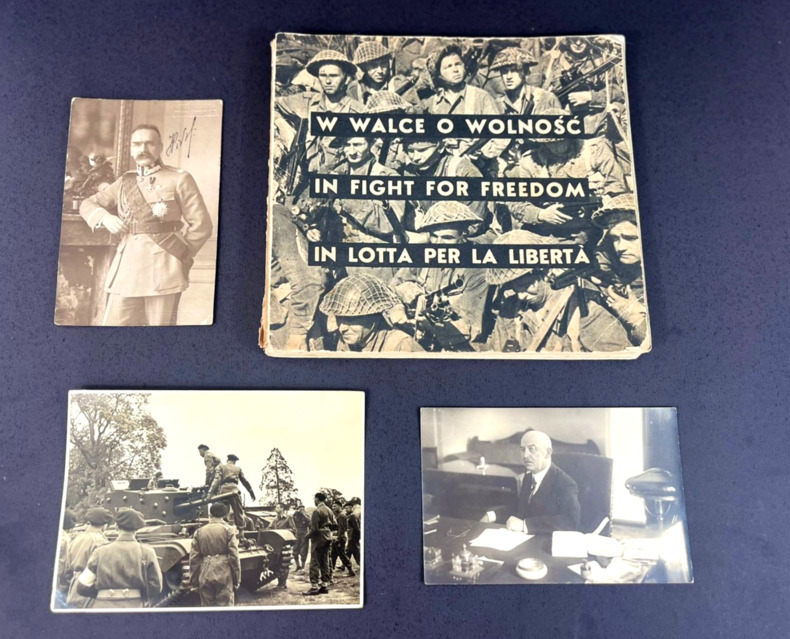
1945517This is a set which belonged to Janusz Gluchowski, a high-ranking Polish military officer at the time of the WW2. The set contains three original B&W pictures. First one: undated postcard showing Marshal Jozef Pilsudski, signed by himself in black ink, 8.5 x 13.5 cm, with two embossed mentions above and below. Second picture: undated postcard showing Poland President Gabriel Narutowicz, with a written mention on the back. Third picture: 11 x 15.5 cm photograph. General Tadeusz Bór-Komorowski inspecting a British Cromwell tank, accompanied by Polish officers of the 3rd Armored Regiment (3 puk pancerny). The image was captured during an official ceremony in the city of Kelso, Scotland, in the immediate post-war period, on June 15, 1945. The scene shows the General in an observation position, climbing onto the tank while surrounded by Polish soldiers. The tank corresponds to a British model widely used by Polish forces in exile during the Western European campaign. On the reverse, the following handwritten inscriptions appear: VI 1945, Kelso. N. Wódz gen. Bór-Komorowski dokonuje inspekcji 3 p. panc. N. Wódz w towarzystwie bryg. puku na czogu." / June 15, 1945, Kelso The book is an illustrated three-languages (Polish, English and Italian) set commemorating the struggles of the Polish II Corps. Edited by Wyda Rererat [Referat] Kultury i Prasy Kresowej Dywizji Piechoty in Rome, 1945. Oblong book of 21 x 19 cm, unpaginated (144 pp.). Cover detached. Endpapers and first page show Janusz Gluchowski's stamp. In publisher's photographically illustrated wrappers. Each page contains a photographic image or a photomontage accompanied with a short text in three languages. Front cover shows some wear and tear, the binding is a bit loose - we would advise having this book bound. The Polish II Corps was a major tactical and operational unit recruited from Polish deportees in the Soviet Gulags in 1943. First they fought in the Middle East, and in 1944 February they were transferred to Italy and as independent part of the British Army to fight in the Italian campaign, in the battles of Monte Cassino and Ancona and also the Battle of Bologna during the final offensive in Italy in 1945. The book goes through the story of Poland and the later established Polish II Corps, starting with the German and Soviet occupation in 1939. It shows the deportation of Poles to forced labour to the Gulag and, after the Polish-Russian Military Agreement in 1941, the establishment of the Polish Army on Soviet soil, also their military training and their fights in various battles. Janusz Julian Gluchowski was a Major General in the Polish Army during the Second Polish Republic. He was born on August 6, 1888, in Bukowa. He fought in the Polish Legions in World War I, the Polish-Ukrainian War, the Polish-Soviet War, and the invasion of Poland by Nazi Germany, Slovakia, and the Soviet Union in 1939, which culminated in the start of World War II. In his adolescence, he attended high school in Czstochowa. In 1905, he became a member of the Combat Organization of the Polish Socialist Party and was wounded in the hand during an attack near Czstochowa. To avoid arrest by the Russian authorities, he left for Belgium, where he studied at the University of Liège. He returned to divided Poland around 1910 and settled in Austrian Galicia. In 1912 he graduated from the Officers' School of the Riflemen's Association in Stroza, near Krakow. In the early hours of August 1914, he commanded a platoon in Oleandria and was Wadysaw Belina-Pramowski's representative during the legendary attack of the so-called Seven Lancers of Belina (Uaska siódemka). On August 6th, together with the First Cadre Company, he left Krakow and marched to Miechów. In October 1914 he was promoted to Lieutenant (Poruchik) and, in November 1916, to Rittmeister (Cavalry Master). Until 1917 he served in the First Uhlan Regiment of the Polish Legions. After the Oath Crisis (Kryzys przysigowy) he was interned first in Fort Beniaminów and later in Werl. Released in October 1918, he went to Lublin, where, in early November, he formed the Third Ulan Regiment (later renamed the Seventh Ulan Regiment of Lublin). Along with his unit, he fought in the Polish-Soviet War. On May 29, 1920, he was promoted to Polkovnik. He was transferred in July 1920 to Eastern Galicia, taking command of the First Cavalry Brigade, fighting against the Soviets in Galicia and Volhynia. After the war, he remained in this position until 1925, when he was transferred to the Fourth Cavalry Brigade. Promoted to Brigadier General on March 16, 1927. Appointed commander of the Center for Higher Military Studies on June 4, 1930, and three years later, after the death of General Stanislaw Tessaro, he was appointed commander of Military District X in Przemyl. In October 1935, he became Deputy Minister of Military Affairs. In the early days of the 1939 invasion of Poland, Gluchowski ordered General Walerian Czuma to prepare the defense of Warsaw. In mid-September 1939, he fled to Romania. After his escape, he managed to travel to the Middle East and, in January 1941, received orders to go to London. In October 1941, he was appointed Commander of the Training Brigade stationed in Scotland. On September 23, 1943, he was appointed commander of all Polish Army units stationed in Great Britain, except the First Independent Parachute Brigade, which remained under the authority of the Commander-in-Chief. He was promoted to Major General on June 1, 1945. He decided not to return to Soviet-occupied Poland and remained in Great Britain. He frequently criticized the Soviet regime and the Soviet occupation authorities in postwar Poland. Furthermore, he was one of the founders and president of the Jozef Pilsudski Institute in London. He was, therefore, an active member of the Polish community in Great Britain. He was president and honorary member of several Polish veterans' organizations. He died on June 11, 1964, in London, England.