PAC (Michel Jean) & BOHUSZ (Ignacy).Livre Rare Book
1 677 résultats
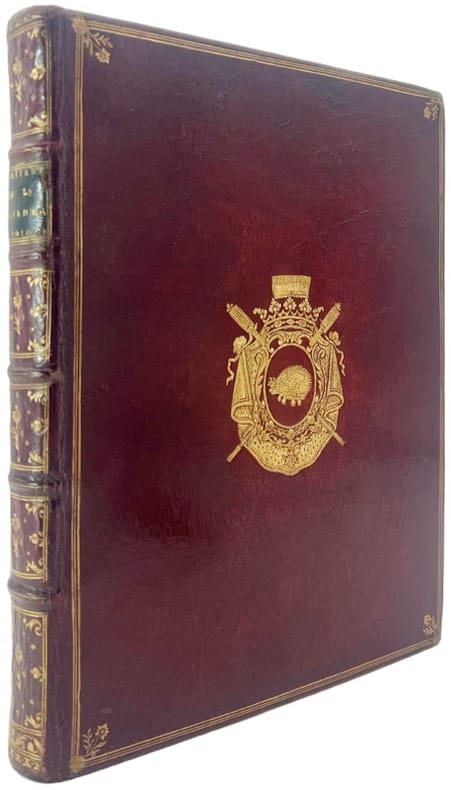
177044616, , 1770. In-4 de 141-(3)-293-(3) pp., maroquin rouge, dos orné à nerfs, triple filet doré en encadrement sur les plats, fleurons aux angles, gardes de papier décoré, armes frappées au centre des plats, dentelle intérieure, pièce de titre en maroquin noir, tranches dorées (reliure de l'époque).
194360182London, New York, Melbourne (printed in Great Britain), Published on behalf of the Polish Ministry of Foreign Affairs, (1943). 8vo. Stapled as issued. Title-page printed in red. Stapels with rust, slightly affecting surrounding paper. A very fine, near mint, copy. 16 pp.
194360436London, New York, Melbourne (printed in Great Britain), Published on behalf of the Polish Ministry of Foreign Affairs, (1943). 8vo. Stapled as issued. Title-page printed in red. Stapels with rust, slightly affecting surrounding paper. A very fine, near mint, copy. 16 pp.
180645461Stockholm, 1806. Large folio oblong. (44 x 61 cm.). Contemp. hcalf, covers with marbled paper. Titlelabel in red and gilt pasted on frontcover. Wear to foot of spine, otherwise fine. Engraved titlepage (battle view), engraved plate depicting the Carl Gustav on horseback in front of a battle scene and 11 engraved plates showing battlescenes after Dahlberg's drawings. All engravings in beautiful toned sepia aquatint. A few marginal brownspots. A very fine copy.
17507546Très célèbres estampes d’après Rigaud, dans son cadre en bois doré d'époque. Belleudy n° 1. Extrêmement rare. C'est l'estampe qui a causé l'exil de Baléchou à Avignon … Paris 1750
c4661PIÈCE MANUSCRITE , de format in folio oblong, sur velin, de 12 pages, comportant environ 1000 signatures de FEMMES POLONAISES EXILÉES à MOSCOU.La première page est somptueusement illustrée d'un large encadrement peint et doré signé par K. Homolacs, avec le texte soigneusement calligraphié.Toutes les grandes familles polonaises sont représentées. Texte très touchant ( référence à la France “Seconde Patrie“, “Berceau des idées généreuses “, aux “Héros de Verdun “. Charles Richet fut Président de La Ligue pour le rétablissement de la Pologne, il était physiologiste, aviateur ,pacifiste et adepte des sciences occultes.Pièce d'un grand intérêt historique et remarquablement décorative.
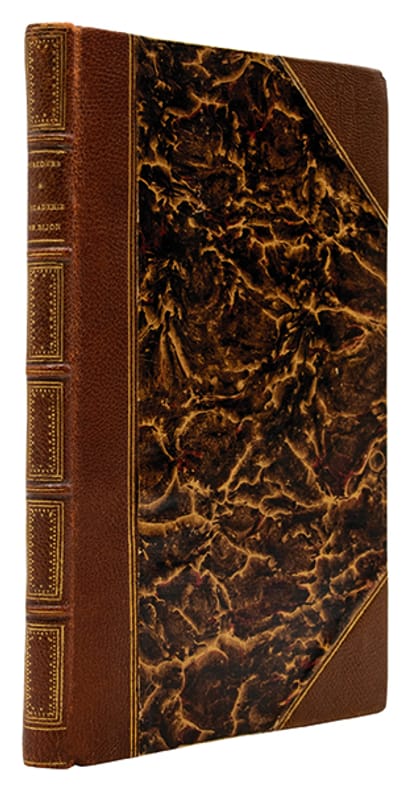
382653 ouvrages reliés en un volume in-8 (182 x 112 mm), demi-maroquin acajou à coins, dos à nerfs orné de compartiments garnis d'un décor d'encadrement doré, titre doré, tête dorée (rel. fin XIXe).
197119091971 Atelier Calevaert-Brun, Paris, (1971?). Petit in-folio, 40 xylographies, sous emboitage muet.
17846038Paris, Gueffier, 1784. 2 volumes in-8 de [4]-XVI-396p. ; [4]-474-[2]p., plein veau marbré, dos à nerfs ornés de filets et fleurons dorés, pièces de titre en maroquin rouge. Bel exemplaire en très jolie condition.
1762001893Paris Lattré 1762
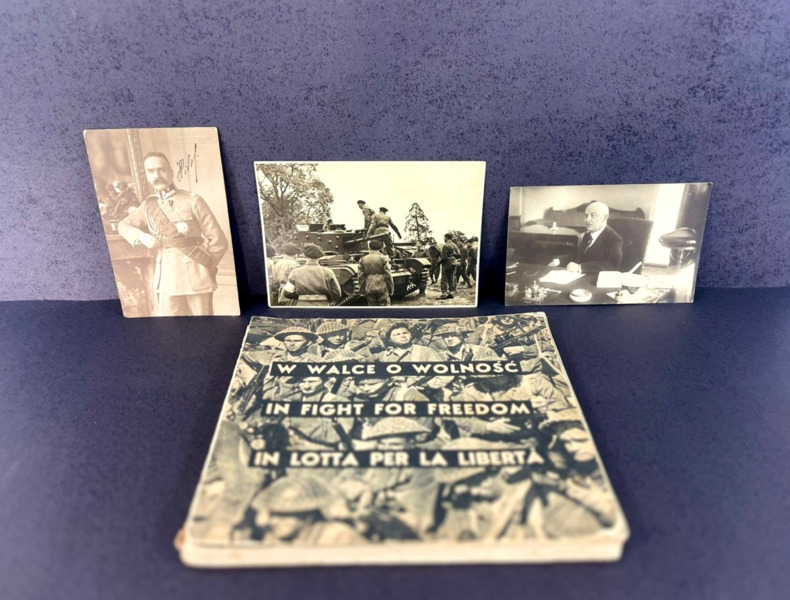
1945517This is a set which belonged to Janusz Gluchowski, a high-ranking Polish military officer at the time of the WW2. The set contains three original B&W pictures. First one: undated postcard showing Marshal Jozef Pilsudski, signed by himself in black ink, 8.5 x 13.5 cm, with two embossed mentions above and below. Second picture: undated postcard showing Poland President Gabriel Narutowicz, with a written mention on the back. Third picture: 11 x 15.5 cm photograph. General Tadeusz Bór-Komorowski inspecting a British Cromwell tank, accompanied by Polish officers of the 3rd Armored Regiment (3 puk pancerny). The image was captured during an official ceremony in the city of Kelso, Scotland, in the immediate post-war period, on June 15, 1945. The scene shows the General in an observation position, climbing onto the tank while surrounded by Polish soldiers. The tank corresponds to a British model widely used by Polish forces in exile during the Western European campaign. On the reverse, the following handwritten inscriptions appear: VI 1945, Kelso. N. Wódz gen. Bór-Komorowski dokonuje inspekcji 3 p. panc. N. Wódz w towarzystwie bryg. puku na czogu." / June 15, 1945, Kelso The book is an illustrated three-languages (Polish, English and Italian) set commemorating the struggles of the Polish II Corps. Edited by Wyda Rererat [Referat] Kultury i Prasy Kresowej Dywizji Piechoty in Rome, 1945. Oblong book of 21 x 19 cm, unpaginated (144 pp.). Cover detached. Endpapers and first page show Janusz Gluchowski's stamp. In publisher's photographically illustrated wrappers. Each page contains a photographic image or a photomontage accompanied with a short text in three languages. Front cover shows some wear and tear, the binding is a bit loose - we would advise having this book bound. The Polish II Corps was a major tactical and operational unit recruited from Polish deportees in the Soviet Gulags in 1943. First they fought in the Middle East, and in 1944 February they were transferred to Italy and as independent part of the British Army to fight in the Italian campaign, in the battles of Monte Cassino and Ancona and also the Battle of Bologna during the final offensive in Italy in 1945. The book goes through the story of Poland and the later established Polish II Corps, starting with the German and Soviet occupation in 1939. It shows the deportation of Poles to forced labour to the Gulag and, after the Polish-Russian Military Agreement in 1941, the establishment of the Polish Army on Soviet soil, also their military training and their fights in various battles. Janusz Julian Gluchowski was a Major General in the Polish Army during the Second Polish Republic. He was born on August 6, 1888, in Bukowa. He fought in the Polish Legions in World War I, the Polish-Ukrainian War, the Polish-Soviet War, and the invasion of Poland by Nazi Germany, Slovakia, and the Soviet Union in 1939, which culminated in the start of World War II. In his adolescence, he attended high school in Czstochowa. In 1905, he became a member of the Combat Organization of the Polish Socialist Party and was wounded in the hand during an attack near Czstochowa. To avoid arrest by the Russian authorities, he left for Belgium, where he studied at the University of Liège. He returned to divided Poland around 1910 and settled in Austrian Galicia. In 1912 he graduated from the Officers' School of the Riflemen's Association in Stroza, near Krakow. In the early hours of August 1914, he commanded a platoon in Oleandria and was Wadysaw Belina-Pramowski's representative during the legendary attack of the so-called Seven Lancers of Belina (Uaska siódemka). On August 6th, together with the First Cadre Company, he left Krakow and marched to Miechów. In October 1914 he was promoted to Lieutenant (Poruchik) and, in November 1916, to Rittmeister (Cavalry Master). Until 1917 he served in the First Uhlan Regiment of the Polish Legions. After the Oath Crisis (Kryzys przysigowy) he was interned first in Fort Beniaminów and later in Werl. Released in October 1918, he went to Lublin, where, in early November, he formed the Third Ulan Regiment (later renamed the Seventh Ulan Regiment of Lublin). Along with his unit, he fought in the Polish-Soviet War. On May 29, 1920, he was promoted to Polkovnik. He was transferred in July 1920 to Eastern Galicia, taking command of the First Cavalry Brigade, fighting against the Soviets in Galicia and Volhynia. After the war, he remained in this position until 1925, when he was transferred to the Fourth Cavalry Brigade. Promoted to Brigadier General on March 16, 1927. Appointed commander of the Center for Higher Military Studies on June 4, 1930, and three years later, after the death of General Stanislaw Tessaro, he was appointed commander of Military District X in Przemyl. In October 1935, he became Deputy Minister of Military Affairs. In the early days of the 1939 invasion of Poland, Gluchowski ordered General Walerian Czuma to prepare the defense of Warsaw. In mid-September 1939, he fled to Romania. After his escape, he managed to travel to the Middle East and, in January 1941, received orders to go to London. In October 1941, he was appointed Commander of the Training Brigade stationed in Scotland. On September 23, 1943, he was appointed commander of all Polish Army units stationed in Great Britain, except the First Independent Parachute Brigade, which remained under the authority of the Commander-in-Chief. He was promoted to Major General on June 1, 1945. He decided not to return to Soviet-occupied Poland and remained in Great Britain. He frequently criticized the Soviet regime and the Soviet occupation authorities in postwar Poland. Furthermore, he was one of the founders and president of the Jozef Pilsudski Institute in London. He was, therefore, an active member of the Polish community in Great Britain. He was president and honorary member of several Polish veterans' organizations. He died on June 11, 1964, in London, England.
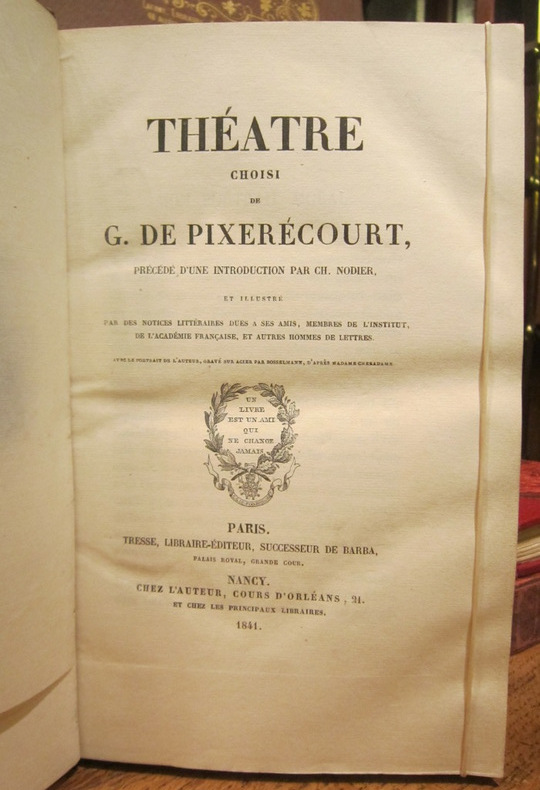
1841002830Paris et Nancy, Tresse, et Chez Lauteur, 1841
1657PHO-1458A Troyes, par Nicolas Oudot, et se vendent à Paris: Chez François Clousier, 1657. in-4; [6ff. (sur 7: feuillet de dédicace en fac-simile), dont titre, portrait légendé de La Boullaye, préface], 558p., [5ff. Table, fautes, privilège du 12 février 1657]; 33 illustrations sur bois dans le texte dont 16 à pleine page. Reliure d'époque en basane brune, dos à nerfs avec titre , coupes , coiffes et coins usés , frottements. un coin déchiré au titre sans atteinte au texte. Mouillure angulaire au premier portrait P. 73 déchirée avec manque de papier ,sans atteinte au texte. P. 165: manque en coin avec perte de qq mots; PP. 173 et 175: déchirures sans perte de texte; P. 234: manque de papier en pied avec perte de quelques mots; taches d'encre pp. 264 ; pp. 460 à 485: petites galeries de vers marginales en pied. Ex-libris manuscrit Dominium Antonium Biguet. Seconde édition
226917Varsovie, Thorn, 1807 in-4, 1 à 4 pp. chacune,
9542Paris, Galland, 1806. In 8, pleine basane racinée, dos lisse ornée CIV-215 pp. avec deux cartes dépliantes (Varsovie et Théâtre de la Guerre).
594174Kraków-Warszawa, Druk. W. L. Anczyca i Spolki, 1904. 3 vol. in-folio, rel. moderne demi-papier velours blanc à coins, dos lisse, titre & tomaison rouge et noir en long, tête dorée ; 308-XXXVII pp. en continu, texte sur 2 colonnes, qq. figures dans le texte, très nombr. planches de dessins, dont quelques-unes colorées.
139322aafDresden, Walther, 1791, gr. in-8vo, Titelbl. mit gest. Vign. u. Stempel (=III/IV) + V-XVIII (ohne Vortitelbl.) + S. 3 bis 309 + 1 S. leer + 2 Bl. , 3 Textkupferstiche + 1 gef. Kupfertafel u. 1 mehrfach gef. kolor. petrographische Kupferstichkarte sowie 1 gef. Tabelle. Auf Vorsatz hs. Vorbesitzer-Eintrag / exlibris Peter E. Obergfell, Original Halb-Lederband der Zeit mit Rsch. Rotschnitt.
242326Paris, Ambroise Dupont et Cie, 1828 in-8, [4]-270 pp., demi-chagrin rouge, dos à nerfs, couv. cons. (reliure moderne).
013852Marc Myron ou Miron (?-1608), médecin né à Tours, reçu docteur en 1558, médecin du duc d'Anjou en Pologne (futur Henri III), premier médecin du roi Henri III et son confident, docteur de la faculté de médecine de Paris en 1558. Il est le médecin qui a publié faussement qu'Henri III était malade pour favoriser son retour en France. P.S. avec note vraisemblablement autographe au dos, 15 (?) mai 1582, 1p in-4 oblong. Sur parchemin. Reçu pour le paiement des frais d'un voyage aux bains de Bourbon-Lancy. La note au dos : « pour servir de Reçu. » (3 lignes) Rare signature. [329-2]
GF28391Amsterdam - Henri Desbordes - 1732 - 2 volumes in8 de 410 -7 et 336 - 6 pages - Reliure pleine basane d'époque - Coiffes un peu usées - Mors légérement frottés - Un mors fendu sur 3 cm - dos cinq nerfs ornés -
1760340901760 Paris - Paris - La Compagnie des Libraires - 1742 - 4 volume in8 de 355; 501; 411; 432 pages - Reliures plein veau blond d'époque - coins un peu émoussés - toutes tranches dorées - Dos cinq nerfs - Mors un peu frottés - Triple filet doré d'encadrement et Chiffre couronné sur les plats - Taille de premier volume légérement inférieure à celle des autres -
1931223BBZürich, Leipzig, Orell Füssli Verlag, 1931. 8°. 8 S., (english), 7 S. (hebrew). Mit 65 Abb. nach Photos von M. Vorobeichic. Illustr. Orig.-Halbleinenband (berieben und bestossen). = "Schaubücher", Bd. 27.
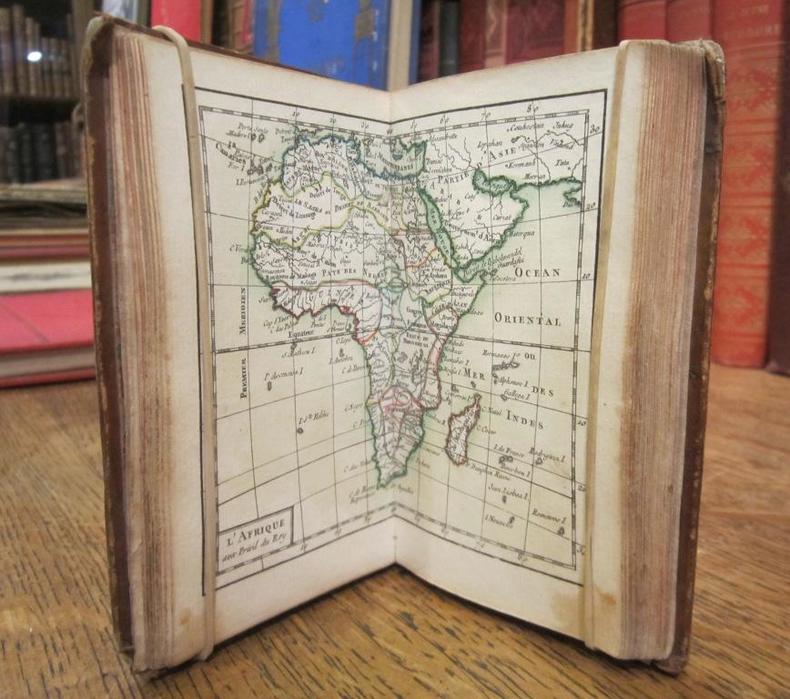
ORD-2643Traduit de l'anglais, enrichi de notes & des éclaircissemens nécessaires, & augmenté d'un Voyage en Norvège. Par M. P. H. MALLET. Ouvrage orné de Cartes géographiques, Portraits, Plans & Figures en taille-douce. Genève. Barde, Manget & Comp. Paris. Buisson. 1786. 4 volumes in-8 (128 x 198mm) plein moucheté de noir, dos à 5 nerfs ornés or, pièces de titre maroquin rouge, de tomaison maroquin noir, tranches rouges, XII, 380; 1f., 404; 1f., 393 et 1f., 303 pages. Bien complet des 19 planches hors texte. Ex-libris Duhamel. 2 coiffes supérieures habilement restaurées, petits accidents aux derniers plats des tomes 1 et 2 sinon très bel exemplaire.
1920145501920 br. format 30 x 24 cm, Paris s.d. (ca. 1920)
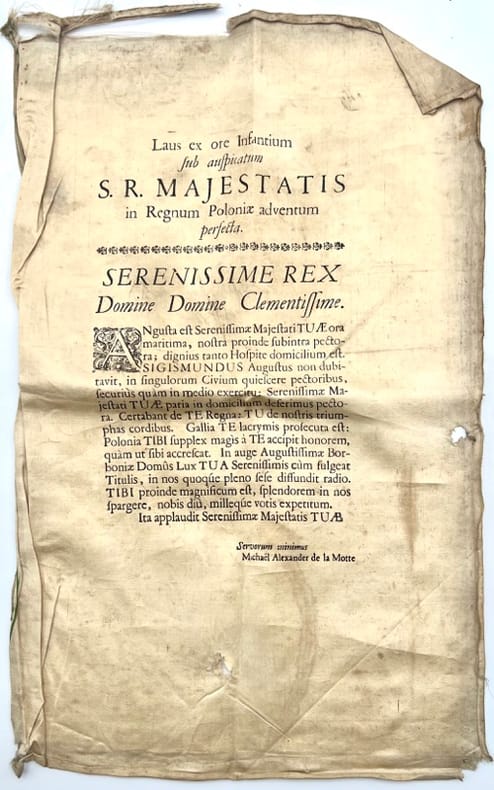
171444331S.l.n.d., , 1714-1734. Placard in-quarto sur soie (39 x 25 cm).