Poland, Guy & Aidan RafteryBiblio.com

4 198 résultats
21884807like new. unknown
21884807-nnew. unknown
2019__1905319436British Small Animal Veterinary 2019. Paperback. New. 1st edition. 368 pages. 11.50x8.25x0.75 inches. British Small Animal Veterinary paperback
96641aafBern, Dalp, 1876, in-8vo, VIII + 619 S., ill. + 12 Tafeln + Beil. mit 9 Tafeln, Original-Leinenband, reichlich goldgepr. Rücken, blindgepr. und goldgepr. Deckel, Rücken verschossen.
1st edition. 4to, Original Paper Wrappers, 8 pages each issue, 13 numbers in 12 separate issues, as published. In Yiddish. Title translates as Bulletin of the Bund. Complete run of this early post-Holocaust iteration the Bunds monthly newsletter (also serving Kindred Jewish Socilaist Organizations), reflecting the concerns of its membership of secular Polish Holocaust survivors as well as pre-war immigrants to the US. Full of interesting articles including: Reports and declarations from the World Bund Conference in Brussels, including declarations on Antisemitism the workers movement, etc; The 1947 Socialist conference in Zurich; Bund activity in postwar-Poland, Belgium, Italy, France, Brazil, and Argentina; Jewish Socialists in Rumania; Bund Resolutions on the Camps; German Socialists and the Jewish Question; Professor Hirsh and Palestine; Discussion in the Bun on the Status of Palestine; On the Bundist Youth Movement in Poland; Special Camps; The Bulletin of the Bund [ie this periodical] in the [DP] Camps; Five Years in the Warsaw Ghetto, by Bernard Goldshtein; Bundist Academy in the Gan Eden Camp in New York; A Memorial for the Bund at the Congress of the French Socialists; etc. The General Jewish Labour Bund in Lithuania, Poland and Russia (Yiddish: algemeyner yidisher arbeter-bund in lite, poyln un rusland), generally called The Bund or the Jewish Labour Bund, was a secular Jewish socialist party.... founded in Vilnius on October 7, 1897 ..In 1917 the Polish part of the Bund, which dated to the times when Poland was a Russian territory, seceded from the Russian Bund and created a new Polish General Labor Bund which continued to operate in Poland in the years between the two world wars .The Bund sought to unite all Jewish workers in the Russian Empire into a united socialist party, and also to ally itself with the wider Russian social democratic movement to achieve a democratic and socialist Russia. The Russian Empire then included Lithuania, Latvia, Belarus, Ukraine and most of present-day Poland, areas where the majority of the world's Jews then lived. They hoped to see the Jews achieve a legal minority status in Russia. Of all Jewish political parties of the time, the Bund was the most progressive regarding gender equality, with women making up more than one-third of all members. The Bund actively campaigned against anti-Semitism. It defended Jewish civil and cultural rights and rejected assimilation. However, the close promotion of Jewish sectional interests and support for the concept of Jewish national unity (klal yisrael) was prevented by the socialist universalism of the Bund. The Bund avoided any automatic solidarity with Jews of the middle and upper classes and generally rejected political cooperation with Jewish groups that held religious, Zionist or conservative views. Even the anthem of the Bund, known as "the oath" (di shvue in Yiddish), written in 1902 by Sh. An-ski, contained no explicit reference to Jews or Jewish suffering. At the heart of the vision of the future of the Bund was the idea that there is no contradiction between the national aspect on the one hand and the socialist aspect on the other. As a strictly secular organization, the Bund renounced the Holy Land and the sacred language (Hebrew) and chose to speak Yiddish .In its early years the Bund had remarkable success, gaining an estimated 30,000 members in 1903 and an estimated 40,000 supporters in 1906, making it the largest socialist group in the Russian Empire . the Bund was a founding collective member at the RSDLP's first congress in Minsk in March 1898. For the next 5 years, the Bund was recognized as the sole representative of the Jewish workers in the RSDLP, although many Russian socialists of Jewish descent, especially outside of the Pale of Settlement, joined the RSDLP directly .The Bund generally sided with the party's Menshevik faction led by Julius Martov and against the Bolshevik faction led by Vladimir Lenin during the factional struggles in the run-up to the Russian Revolution of 1917 .In the Polish areas of the [Russian] empire, the Bund was a leading force in the 1905 revolution. At that time the organization probably reached the height of its influence. It called for an improvement in living standards, a more democratic political system and the introduction of equal rights for Jews. At least in the early stages of the first Russian Revolution, the armed groups of the "Bund" were likely the strongest revolutionary force in Western Russia. During the following years, the Bund went into a period of decay .The Bund eventually came to strongly oppose Zionism, arguing that emigration to Palestine was a form of escapism. The Bund did not advocate separatism. Instead, it focused on culture, rather than a state or a place, as the glue of Jewish nationalism. . The Bund also promoted the use of Yiddish as a Jewish national language and to some extent opposed the Zionist project of reviving Hebrew. The Bund won converts mainly among Jewish artisans and workers, but also among the growing Jewish intelligentsia. It led a trade union movement of its own. It joined with the Poalei Zion (Labour Zionists) and other groups to form self-defense organisations to protect Jewish communities against pogroms and government troops. During the Russian Revolution of 1905 the Bund headed the revolutionary movement in the Jewish towns, particularly in Belarus and Ukraine ..In 1921, the Communist Bund [in the USSR] dissolved itself and its members sought admission to the Communist Party....Many former Bundists, like Mikhail Liber and David Petrovsky, perished during Stalin's purges in the 1930s. The Polish Bundists continued their activities until 1948. During the latter half of the 20th century the Bundist legacy was represented through the International Jewish Labor Bund, a federation of local Bundist groups around the world .Among the exiled Bundists who went on with Socialist politics in America was Baruch Charney Vladeck (18861938), elected to the New York Board of Aldermen as a Socialist in 1917 [and] 1937 [and] manager of The Jewish Daily Forward Moishe Lewis (18881950)....the father of David Lewis (19091981), a leader of the New Democratic Party in Canada .David Dubinsky (18921982), though never formally a member of the party, had joined the bakers' union, which was controlled by the Bund, and was elected assistant secretary within the union by 1906 ..He later became a member of the Socialist Party of America, helped found the American Labor Party in 1936 and was from 1932 till 1966 the leader of the International Ladies' Garment Workers' Union ..under the name Max Goldfarb, David Petrovsky (18861937) was a member of the Central Committee of the Jewish Socialist Federation of America, a member of the Socialist Party of America, and the labor editor of The Forward (Wikipedia). SUBJECT(S): Jews -- United States -- Periodicals. Jewish socialists -- New York (State). Jewish labor unions. OCLC: 234327189. OCLC: 234327189. OCLC-Worldcat lists 6 holdings worldwide (NYPL, NLI, YIVO, Harvard, Yale, USHMM), though some listings may be for partial runs. Light wear, Very Good Condition. Rare and important complete set. (Yid-33-51)
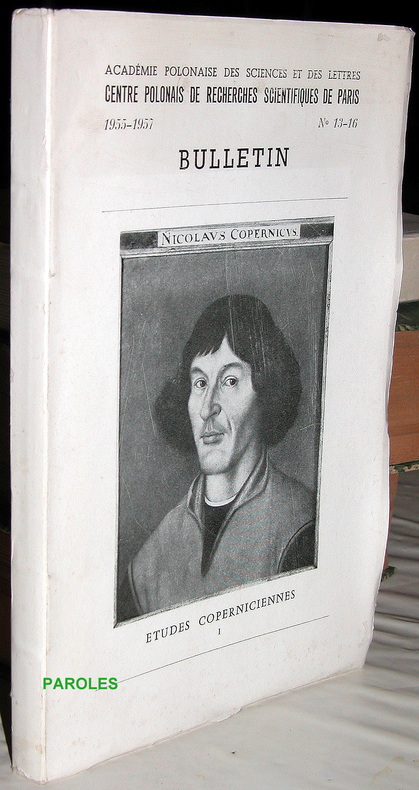
195815961Paris, Centre polonais de recherches scientifiques, 1958 1 volume 15,3 x 24cm Broché sous couverture au 1er plat orné d'un portrait. VII + 314p., 1feuillet. Bon état (couverture légèrement salie).
Au sommaire: "Copernic et la Pologne" par Stanislaw WEDKIEWICZ ("Sa fortune en Pologne", "Son culte parmi les émigrés polonais en France", "Les monuments de Copernic et ses effigies en Pologne", "Copernic dans les belles-lettres polonaises", biographie de Ludwik Antoni Birkenmajer); "Célébration de l'année Copernic 1953" ("Le Centenaire de 1943", "L'année 1953 en Pologne et à l'étranger", "La commémoration de Galilée"); choix de textes de savants polonais sur Copernic ("L'Université de Cracovie - Centre d'études astronomiques au tournant des XVè et XVIè siècles" par Aleksander BIRKENMAJER, "Le néo-platonisme de Copernic" par Henryk BARYCZ, "La pensée économique de Copernic" par Edward LIPINSKI, "Copernic juriste" par Wojciech HEJNOSZ, "La réforme astronomique de Copernic" par Jozef WITKOWSKI, "Buridan - Oresme - Copernic" par Roman ST. INGARDEN junior, "Rheticus, éditeur de Copernic" par Ryszard GANSINIEC, "Préface à une nouvelle édition du 1er Livre du "De Revolutionibus"" par Aleksander BIRKENMAJER, "La théorie de la relativité et le système de Copernic" (extraits des études d'Albert EINSTEIN, W.A. FOCK et Leopold INFELD); "Etudes coperniciennes" par Stanislaw WEDKIEWICZ ("La connaissance du XVIè siècle polonais en France", "Copernic et la découverte du Nouveau Monde", Problèmes biographiques, ""L'Uomo Universale" (Le philologue, l'économiste, le médecin, le géographe, le peintre, le technicien)", ""Ille sarmaticus astronomus...""; notes et documents (Le nom de Copernic - Le titre du chef-d'oeuvre - Lettre du chapitre de Warmie à Sigismond Ier, roi de Pologne - Le père Adam Kochanski S.J. - Le comte Louis de Tressan - Giacomo Leopardi - Erreurs et légendes - Sur la sphéricité de la Terre et les antipodes - L'expérience de la barque); addenda. Français
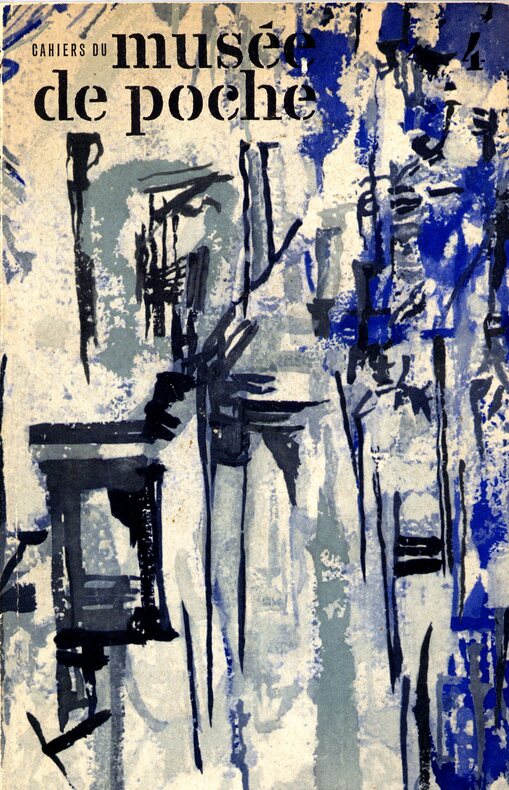
1971LFA-126741254Revue de 59 pages, format 135 x 210 mm, illustrée de cartes, brochée, bon état
1959LFA-126741344Revue de 56 pages, format 135 x 210 mm, brochée, bon état
In-8 (cm. 23.80), mz. pergamena, titolo manoscritto al dorso, pp. 37, (3), con illustrazioni nel testo. Ex libris al risguardo anteriore. In buono stato di conservazione (good copy).
593167e année - 18 - 15 septembre 1932 - Organe théorique du Parti Communiste Français (S.F.I.C) - Bureau d'Edition : 132, Faubourg Saint-Denis, Paris (10e) - bimensuel - in-8 broché Sommaire : Au seuil de la seconde année - Après le Congrès d'AmsterdamLes problèmes du front unique en Allemagne (W. Florin) - Le Congrès de la Fédération de l'Enseignement (P. Bouthonier) - Les nouvelles manoeuvres des réformistes anglais (Is) - La spéculation comme remède à la crise (M. Lévy)Mouvement communiste : Quelques aspects du travail du parti dans la région bordelaise (Ruffe) - Sur le travail d'Agit-prop en Pologne (Klem) - Expérience d'une école (J. R.)Encore sur le projet de thèses agraires (H. Desvaux) - L'U.F.E. doit rester ce qu'elle est (Maurney) - Pour un véritable travail révolutionnaire parmi les étudiants (H. Rolland) - Panorama de la quinzaine Notes de lectureBoîte aux lettres
6001916e année - N° 4 - avril 1939 - Revue mensuelle publiée par le C.C. du Parti Communiste Français (S.F.I.C) - 44, rue Peletier. Paris 9e - plusieurs hors-texte - in-8 broché Sommaire : Après les paroles, des actes (Jacques Duclos) - Contre la philosophie du suicide (J. Berlioz) - Contribution au programme de redressement du Parti Communiste Français (J. Solomon) - Le 18e Congrès du Parti Communiste (bolchévik) de l'Union Soviétique (E. Fajon) - En 1870-71, le Peuple de Paris sauvait l'honneur français et fondait la IIIe République (P. Bouthonnier) - Le retentissement de la Révolution française en Pologne (G. Merlin) - Les grandes dates de l'histoire de la Révolution française (P. B.) - Le matérialisme dialectique et le matérialisme historiqueLe Puy-de-Dôme : Son histoire, ses richesses, ses luttes (G. Perilhou) - Le Musée de l'Histoire à Montreuil (J. Bruhat) - ...
1960L1634Georges Fall, 1960, 120 p.
ria9783527348466_inpHardback. New. New Book; Fast Shipping from UK; Not signed; Not First Edition; N/A hardcover
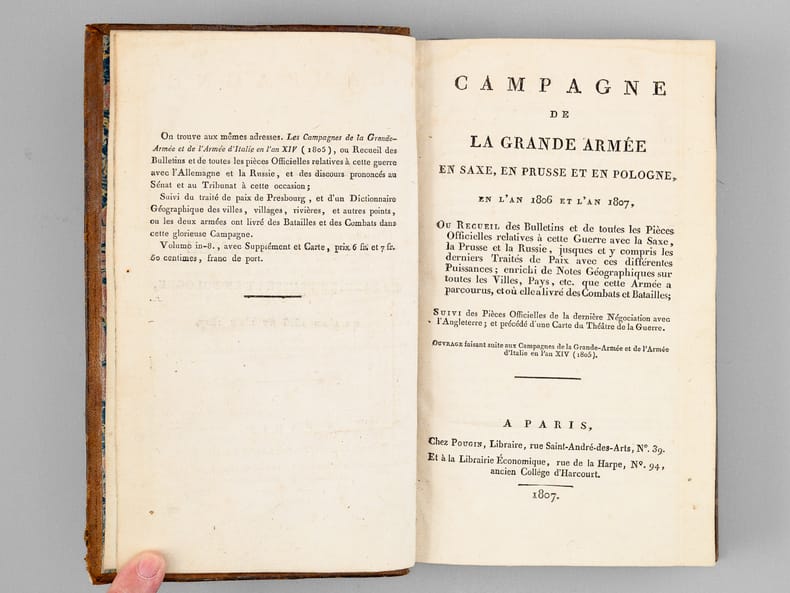
180768203Suivi des Pièces Officielles de la dernière Négociation avec l'Angleterre ; et précédé d'une Carte du Théâtre de la Guerre, Ouvrage faisant suite aux Campagnes de la Grande-Armée et de l'Armée d'Italie en l'An XIV (1805), 1 vol. in-8 reliure de l'époque pleine basane marbrée, dos lisse orné, toutes tranches marbrées, Chez Pougin, Libraire, et à la Librairie Economique, Paris, 1807, 3 ff., 477-81 pp. avec grande carte dépliante en couleurs
M17317Couverture souple Editions historiques Teissèdre, 2006, in8 broché, IX-543pp Tome 4 de la réédition Teissèdre en fac similé de l'édition Berger-Levrault de1882. Tiré à 200 exemplaires. Etat neuf Langue: Français
213137Paris, Berger-Levrault, 1882 2 vol. petit in-8, XIV-543 pp. et 473 pp., 2 cartes et 8 tableaux dépliants, demi-basane aubergine, dos à nerfs ornés de filets à froid (reliure postérieure). 2 cartes sont manquantes. Dos insolé. Qqs annotations au crayon dans les marges.
221945Paris, Berger-Levrault, 1882 2 vol. petit in-8, XIV-543 pp. et 473 pp., 2 cartes et 8 tableaux dépliants, demi-chagrin rouge, dos lisse, filets dorés (reliure de l'époque). 2 cartes sont manquantes. Traces d'étiquette au dos. Cachet (annulé).
233335Paris, Berger-Levrault, 1882 2 vol. in-12, XIV-543 pp. et 473 pp., 4 cartes et 8 tableaux dépliants, broché. Qqs rousseurs.
Broch?. 192 pages.
in-8, 186 p., 2 cartes, tabl., br., couv. ill. pla Bel exemplaire. [HI-5]
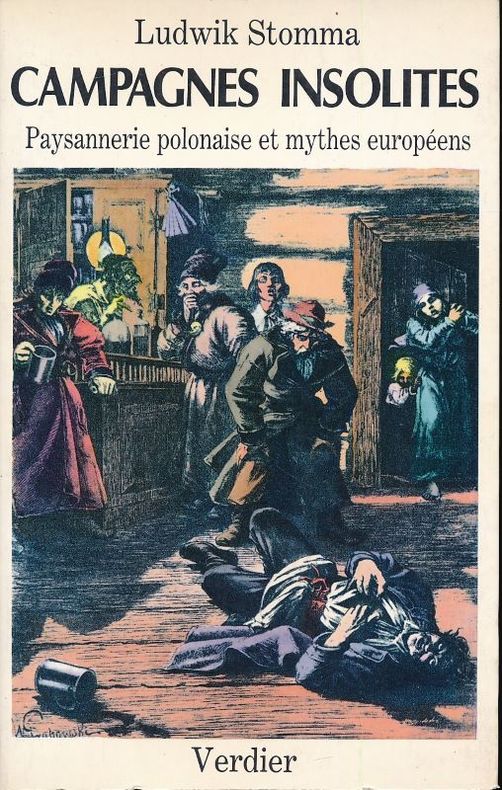
1986149548Verdier Verdier, 1986. In-8 broché, couverture à rabats de 186 pages. Très bon état
Verdier, 1986. In-8 broché, couverture à rabats de 186 pages. Très bon état
Al centro piega editoriale
197260588BBOttawa., National Gallery of Canada., 1972. 15 lose Blatt. OBroschur., 60588BB Erste Auflage. Umschlag insgesamt etwas gebrauchsspurig und mit handschriftlicher Notiz ("Venedig"), Papier teilweise altersbedingt etwas gedunkelt, sonst gutes Exemplar.