4 198 résultats
VG/VG (couple of small marks to front of clean bright dj, large stain on page 42 else all clean tight and bright) octavo 134pp. True account of how the author's young Polish stepson survived the horrors of exile in Siberia and forced labour camps during the second world war.
pp. [8], 240. "Utterly fascinating, in that what we come to know here is what has made the man who and how he is." - Kirkus Reviews. "The account of Prime Minister Begin's incarceration in a series of Soviet prisons, and his eventual release and arrival in Israel to become the leader of his country. His crime was belief in Zionism, and the time of testing he describes in this book vividly brings to life the formation of his own inner character and the sense of mission which he so evidently brings to his present awesome responsibilities." - dust jacket. "One of the greatest pieces of prison literature in the world." - The Times of London. Light soiling to top edge, otherwise book clean, bright and unmarked with light wear. Average wear to dust jacket now preserved in archival-grade Brodart. A quality copy. Book
19705712Flammarion, 1970, fort in-8°, 503 pp, 44 photos et 4 illustrations sur 24 pl. hors texte, 8 pl. de documents en fac-similé hors texte, pièces annexes, broché, couv. illustrée, bon état
199538301ABOhne Ort., Kerber Verlag / edition pro., 1995. 4°. 239 S. OLeinen mit OUmschlag., 38301AB 1. Auflage. KLeiner, sauber hinterlegter Einriss am Umschlagrand, sonst sehr gutes Exemplar.
ORD-5523Carte postale polonaise. Nakladca E. Schiller, Czerniowce. Série 39. Vers 1900. Carte postale (90 x 137mm), caricature.
1965rx1143Instytut Wydawniczy Nasza Ksiegarnia Warszawa Cartonné 1965 In-4 (24,3 x 23 cm), cartonné toilé, non paginé, texte en polonais, photographies en noir et blanc ; mouillures et quelques taches sur les plats, deux pages déchirées vers la fin de l'ouvrage, plusieurs ex-libris tamponnés à l'intérieur, en l'état. Livraison a domicile (La Poste) ou en Mondial Relay sur simple demande.
2026x-1009741128Cambridge University Press 2026. Hardcover. New. 242 pages. 6.00x0.56x9.00 inches. Cambridge University Press hardcover
51790749like new. unknown
51790749-nnew. unknown
Wear to extremities and spine; Towering over Krakow. Unpaginated photo section ; B&W Photographs; 8vo; 109+ pages
Illustrated souvenir book about Warsaw.18p.text+ 59p.of photographs Book
1914A111-111Wien, Kaiserlich-K?nigliches Milit?r-Geographisches Institut, 1914. Hochformat, ca. 34 x 55 cm, Ausgabe: mehrf?rbig; Zustand: gut +
1890A141-1195Wien, Kaiserlich-K?nigliches Milit?r-Geographisches Institut, 1890. Hochformat, ca. 34 x 55 cm, gefaltet zu 4 Segmenten, Ausgabe: mehrf?rbig; Zustand: gut +
Broché. 128 pages.
199225342Warszawa : Festina, 1992. [76] pp. : predom. ill. 4°. Orig. cardboard covers (cloth structure) with DJ.
200481275Warsaw Poland: Warsaw City Hall c2004. Presumed First Edition First printing. Wraps. Very good. 48 pages. Oversized 12 inches by 12 inches. Minor wear. Many color illustrations. Hand Signed by the Mayor of Warsaw Lech Kaczynski on page 1. Topics include the Anniversary of the Warsaw Uprising; Business; Cultural Life; Development; Education; Festivals; Gardens and parks; Hotels and restaurants; Investors; Jewish heritage; Key offices; Leisure activities; Museums and galleries; New and older architecture; Old Town; Powazki cemetery; Royal Route; Shopping; Transportation system; Vistula River; Warsaw Mermaid; Yesterday's Warsaw; Zoo; and Warsaw history. Warsaw is the capital and largest city of Poland. The metropolis stands on the Vistula River in east-central Poland and its population is officially estimated at 1.8 million residents within a greater metropolitan area of 3.1 million residents which makes Warsaw the 7th most-populous capital city in the European Union. The city limits cover 517.24 199.71 sq. mi. while the metropolitan area covers 2355.39 sq. mi. Warsaw is a major international tourist destination and a significant cultural political and economic hub. Its historical Old Town was designated a UNESCO World Heritage Site. The city rose to prominence in the late 16th century. The elegant architecture grandeur and extensive boulevards earned Warsaw the nickname Paris of the North. The city was largely destroyed by the Warsaw Ghetto Uprising in 1943 the general Warsaw Uprising in 1944 and the systematic razing by the Germans in advance of the Vistula-Oder Offensive. Warsaw gained the new title of Phoenix City because of its reconstruction after the war. Lech Aleksander Kaczy ski 18 June 1949 - 10 April 2010 was a Polish lawyer and politician who served as the Mayor of Warsaw from 2002 until 2005 and as the President of Poland from 2005 until his death in 2010. Before his tenure as president he previously served as President of the Supreme Audit Office from 1992 to 1995 and later Minister of Justice and Public Prosecutor General in Jerzy Buzek's cabinet from 2000 until July 2001. Born in Warsaw he starred in a 1962 Polish film The Two Who Stole the Moon with his identical twin brother Jaros aw. Kaczy ski was a graduate of law and administration of Warsaw University. In 1980 he was awarded his Ph.D. by Gda sk University. In 1990 he completed his requirements in labor and employment law. He later assumed professorial positions at Gda sk University and Cardinal Stefan Wyszy ski University in Warsaw. During the communist period Kaczy ski was an activist in the pro-democratic anti-communist movement in Poland the Workers' Defence Committee as well as the Independent Trade Union movement. In August 1980 he became an adviser to the Inter-Enterprise Strike Committee in the Gda sk Shipyard and the Solidarity movement. After the communists imposed martial law in December 1981 he was interned as an "anti-socialist element". After his release he returned to trade union activities becoming a member of the underground Solidarity. When Solidarity was legalized again in the late 1980s Kaczy ski was an active adviser to Lech Wa sa and his Solidarity Citizens' Committee in 1988. From February to April 1989 he participated in the Polish Round Table Talks along with his brother. After Solidarity's victory in the 1989 Polish legislative election Kaczy ski became a senator and vice-chairman of the movement. Then in the 1991 Polish parliamentary election he was elected into the Sejm as a non-party member. He was also the main adviser and supporter of Lech Wa sa when the latter was elected President of Poland in December 1990. In 2003 Kaczy ski co-founded the Law and Justice party after splitting from the Solidarity Electoral Action and the Christian National Union along with his brother. Kaczy ski was the party's presidential candidate during the 2005 Polish presidential election. In the first round of voting Kaczy ski received 33.1% of the valid votes. In the second round of voting Kaczy ski received 54.04% of the vote defeating Donald Tusk who received 45.96% of the vote. He was sworn in as President on 23 December 2005. In 10 July 2006 Kaczy ski appointed his brother as Prime Minister of Poland upon the resignation of Kazimierz Marcinkiewicz the brothers then became the first pair of brothers in the world to serve as President and Prime Minister of a country and the only twin brothers to achieve the feat. His brother was succeeded as prime minister by his former presidential rival Donald Tusk. On 10 April 2010 he was killed along with his wife in the crash of a Polish Air Force jet that occurred on a landing attempt at Smolensk North Airport in Russia. He was the first conservative president of Poland since 1922 and the second president to die in office since the assassination of Gabriel Narutowicz. Warsaw City Hall paperback
Fine English Paperback. 4to. (33 x 24 cm). In English. 462 p., color and b/w ills. This book is published on the occasion of the exhibition entitled "War and Peace: Ottoman - Polish relations in the 15th - 19th centuries" held at the Museums of Turkish and Islamic Arts in Istanbul between June 29 and September 20, 1999. Contents: M. Istemihan Talay: Preface / Kaya Turgut: Exhibitions of international scale and the role of sponsors / Nazan Olcer: Exhibition of two countries at war and peace / Dariusz Kolodziejczyk: A historical outline of Polish - Ottoman political and diplomatic relations / Dariusz Kolodziejczyk: Ottoman documents in the Polish collections / Andrzej Dziubinski: Polish - Turkish trade ih the 16th to 18th centuries / Tadeusz Majda: Ottoman art in thePolish collections / Magedalena Piwocka: Turkish tents in Poland / Beata Biedronska-Slota: The history of Turkish textile collections in Poland / Zdzislaw Zygulsky Jr: The kalkan - the shield of the orient / Kazimierz Dopierala: Poles in the Ottoman Empire / Kazimierz Dopierala: Adampol - Polonezkoy / Hieronim Kaczmarek: Sefer Pasha - Wladyslaw Koscielski / Zdzislaw Zygulsky Jr: Remarks on the weapons collection of Wladyslaw Koscielski - Alias Sefer Pasa / Catalogue: 15. century / 16. century / 17. century / 18. century / 19. century / Glossary / Bibliography.
1970869Warszawa, Sport i turystyka, 1970 in-8, 22 pp., 45 double photographies, table des illustrations dépliantes, cartonnage éditeur
1 vol. in-12 reliure de l'époque demi-basane verte, dos à 5 nerfs, couv. conservée, Editions Balzac, Paris, 1943, 334 pp. Bon état (dos passé, bon exemplaire par ailleurs) Français
1943597161 vol. in-12 reliure de l'époque demi-basane verte, dos à 5 nerfs, couv. conservée, Editions Balzac, Paris, 1943, 334 pp.
11701Album cartonne gris, dos toile, sous jaquette illustree, format in-4* a l'italienne, nombreuses photos, 1951.Bon etat, jaquette un peu fendue en 4*.
118160aafWadowice, Drukarnia i Wydawnictwo Grafikon, 2013, in-4to, 176 p., ill. d’env. 140 planches photographiques, cartonnage original ill.
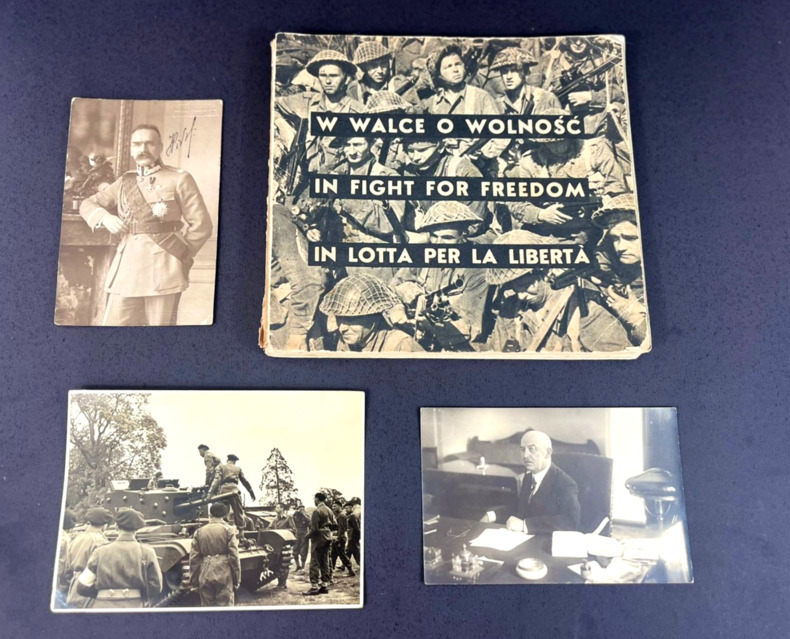
1945517This is a set which belonged to Janusz Gluchowski, a high-ranking Polish military officer at the time of the WW2. The set contains three original B&W pictures. First one: undated postcard showing Marshal Jozef Pilsudski, signed by himself in black ink, 8.5 x 13.5 cm, with two embossed mentions above and below. Second picture: undated postcard showing Poland President Gabriel Narutowicz, with a written mention on the back. Third picture: 11 x 15.5 cm photograph. General Tadeusz Bór-Komorowski inspecting a British Cromwell tank, accompanied by Polish officers of the 3rd Armored Regiment (3 puk pancerny). The image was captured during an official ceremony in the city of Kelso, Scotland, in the immediate post-war period, on June 15, 1945. The scene shows the General in an observation position, climbing onto the tank while surrounded by Polish soldiers. The tank corresponds to a British model widely used by Polish forces in exile during the Western European campaign. On the reverse, the following handwritten inscriptions appear: VI 1945, Kelso. N. Wódz gen. Bór-Komorowski dokonuje inspekcji 3 p. panc. N. Wódz w towarzystwie bryg. puku na czogu." / June 15, 1945, Kelso The book is an illustrated three-languages (Polish, English and Italian) set commemorating the struggles of the Polish II Corps. Edited by Wyda Rererat [Referat] Kultury i Prasy Kresowej Dywizji Piechoty in Rome, 1945. Oblong book of 21 x 19 cm, unpaginated (144 pp.). Cover detached. Endpapers and first page show Janusz Gluchowski's stamp. In publisher's photographically illustrated wrappers. Each page contains a photographic image or a photomontage accompanied with a short text in three languages. Front cover shows some wear and tear, the binding is a bit loose - we would advise having this book bound. The Polish II Corps was a major tactical and operational unit recruited from Polish deportees in the Soviet Gulags in 1943. First they fought in the Middle East, and in 1944 February they were transferred to Italy and as independent part of the British Army to fight in the Italian campaign, in the battles of Monte Cassino and Ancona and also the Battle of Bologna during the final offensive in Italy in 1945. The book goes through the story of Poland and the later established Polish II Corps, starting with the German and Soviet occupation in 1939. It shows the deportation of Poles to forced labour to the Gulag and, after the Polish-Russian Military Agreement in 1941, the establishment of the Polish Army on Soviet soil, also their military training and their fights in various battles. Janusz Julian Gluchowski was a Major General in the Polish Army during the Second Polish Republic. He was born on August 6, 1888, in Bukowa. He fought in the Polish Legions in World War I, the Polish-Ukrainian War, the Polish-Soviet War, and the invasion of Poland by Nazi Germany, Slovakia, and the Soviet Union in 1939, which culminated in the start of World War II. In his adolescence, he attended high school in Czstochowa. In 1905, he became a member of the Combat Organization of the Polish Socialist Party and was wounded in the hand during an attack near Czstochowa. To avoid arrest by the Russian authorities, he left for Belgium, where he studied at the University of Liège. He returned to divided Poland around 1910 and settled in Austrian Galicia. In 1912 he graduated from the Officers' School of the Riflemen's Association in Stroza, near Krakow. In the early hours of August 1914, he commanded a platoon in Oleandria and was Wadysaw Belina-Pramowski's representative during the legendary attack of the so-called Seven Lancers of Belina (Uaska siódemka). On August 6th, together with the First Cadre Company, he left Krakow and marched to Miechów. In October 1914 he was promoted to Lieutenant (Poruchik) and, in November 1916, to Rittmeister (Cavalry Master). Until 1917 he served in the First Uhlan Regiment of the Polish Legions. After the Oath Crisis (Kryzys przysigowy) he was interned first in Fort Beniaminów and later in Werl. Released in October 1918, he went to Lublin, where, in early November, he formed the Third Ulan Regiment (later renamed the Seventh Ulan Regiment of Lublin). Along with his unit, he fought in the Polish-Soviet War. On May 29, 1920, he was promoted to Polkovnik. He was transferred in July 1920 to Eastern Galicia, taking command of the First Cavalry Brigade, fighting against the Soviets in Galicia and Volhynia. After the war, he remained in this position until 1925, when he was transferred to the Fourth Cavalry Brigade. Promoted to Brigadier General on March 16, 1927. Appointed commander of the Center for Higher Military Studies on June 4, 1930, and three years later, after the death of General Stanislaw Tessaro, he was appointed commander of Military District X in Przemyl. In October 1935, he became Deputy Minister of Military Affairs. In the early days of the 1939 invasion of Poland, Gluchowski ordered General Walerian Czuma to prepare the defense of Warsaw. In mid-September 1939, he fled to Romania. After his escape, he managed to travel to the Middle East and, in January 1941, received orders to go to London. In October 1941, he was appointed Commander of the Training Brigade stationed in Scotland. On September 23, 1943, he was appointed commander of all Polish Army units stationed in Great Britain, except the First Independent Parachute Brigade, which remained under the authority of the Commander-in-Chief. He was promoted to Major General on June 1, 1945. He decided not to return to Soviet-occupied Poland and remained in Great Britain. He frequently criticized the Soviet regime and the Soviet occupation authorities in postwar Poland. Furthermore, he was one of the founders and president of the Jozef Pilsudski Institute in London. He was, therefore, an active member of the Polish community in Great Britain. He was president and honorary member of several Polish veterans' organizations. He died on June 11, 1964, in London, England.
23x24. 203p. Fotogr. Enc. tela ed. La sobrecubierta algo deslucida.