60 [Warsaw] Fuks, MarianBiblio.com
28 résultats
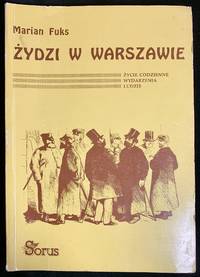
199243036Poznan/Daszewice: Sorus 1992. First edition. 8vo. Original illustrated paper wrappers 403 pages with 87 pages of illustrations. 24 cm. In Polish. Title translates to “Jews In Warsaw: Everyday Life Events People.â€<br> Book containing essays on the history of Jews in Warsaw. Includes bibliographical references pages 372-376 and index.<br> “Before World War II Warsaw was a major center of Jewish life and culture in Poland. Warsaw's prewar Jewish population of more than 350000 constituted about 30 percent of the city's total population. The Warsaw Jewish community was the largest in both Poland and Europe and was the second largest in the world second only to New York City…Following the German invasion of Poland on September 1 1939 Warsaw suffered heavy air attacks and artillery bombardment. German troops seized Warsaw on September 27 1939.†USHMM. SUBJECTS: Jews -- Poland -- Warsaw -- History. Ethnic relations. OCLC: 27969297.Very Good Condition. YIZ-23-43XX-CCLX–’e. Poznan/Daszewice: Sorus unknown
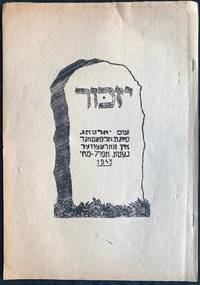
194443395Shvayts Switzerland: Undzer Vort Poale Tziyon Left 1944. May 1944. 1st edition. Original stapled printed paper cover 4to 2 25 pages. <br> In Yiddish. Title translates as "In Memoriam. On the Anniversary of the Uprising in the Warsaw Ghetto April-May 1943.<br> First Anniversary of the Warsaw Ghetto uprising published in Europe during the Holocaust by Jewish "Poale Tziyon Left" members in Switzerland. The organization's name which means "Workers of Zion" is sometimes also romanized as "Poale Zion" or "Poaley Syjon." <br> <br> The imprint "Undzer Vort" "Our Word" was a Left Poale Tziyon publisher in Switzerland which also published a mimeograph newspaper titled "Undzer Vort" OCLC: 232675203 during this same period. A fully underground version of the paper was also published in Nazi-Occupied Belgium see below.<br> <br> Indeed Poale Tsiyon Left was an important part of Jewish resistance throughout Europe most notably during the Warsaw Ghetto Uprising which this publication commemorates. <br> <br> "The Holocaust-era Jewish resistance group ZOB was formed from a coalition including Hashomer Hatzair Dror Bnei Akiva the Jewish Bund various Jewish Communist groups and both factions of Poale Zion. Poale Zion was also active in the Anti-Fascist Bloc.<br> Several notable Jewish resistance fighters during the Holocaust particularly those involved in the Warsaw Ghetto Uprising were members of Poale Zion. They include:<br> <br> Adolf Berman Warsaw ZOB fighter; Secretary of Zegota Poale Zion Left<br> Hersz Berlinski member of Warsaw ZOB Command Poale Zion Left<br> Yochanan Morgenstern member of Warsaw ZOB Command Poale Zion Right<br> Emanuel Ringelblum member of Warsaw ZOB; chronicler of the Warsaw Ghetto Poale Zion Left" Wikipedia.<br> <br> The booklet opens with the moving story of the start of the uprising:<br> <br> "It has been a year since the glorious uprising of the Jews in the Warsaw ghetto.<br> April 19 1943 - barely a few tens of thousands of Jews left in Warsaw after about half a million of their brothers and sisters were exterminated in the most gruesome way they rose up with organized resistance against the renewed attempts.that they too like the previous ones would be led out like sheep to the slaughter.<br> Forty thousand Jews weapons in hand opposed an enemy tenfold a hundred hundred times outnumbered.Women men and children the high class and the humble.<br> From the beginning they all knew without exception that they would be defeated that the outcome was not in doubt and that the enemy intended nothing but destruction for all of them.<br> But no Nazi expected to fall on such a battlefield.<br> And his was the biggest slap in the face which the proud Nazis.so hated when it was received from these these trampled down these unrefined these scorned these despised Jewish 'untermenchen'" Translated from the opening paragraphs on page 1.<br> <br> The publication later continues with a damnation of the "democracies" who did so little and a holding up of the comrades of Poale Tziyon who are doing so much fighting on all fronts:<br> <br> "The 'world democracies' didn't do anything.to save the Jewish victims and to stop the misery train they issued platonic statements about punishing the 'crimes' after the massacre. The warnings have so far helped little.<br> The.Sacrifices keep growing.The world that is fighting 'for justice' and that is busy with courts after the massacre has not found any means to rescue the few escaped heroes in the ghetto for a whole year.<br> This long eulogy is for dozens and hundreds of comrades who fell as loyal children of the nation and fighters for its working class on the fronts in the distant.north in the camps of France and Belgium. who went from one end of the world to the other - at their wounds and from hundreds of thousands of others - comrades of the Poale-Tziyon movement." page 24. <br> <br> Poale Zion.was a movement of Marxist-Zionist Jewish workers founded in various cities of Poland Europe and the Russian Empire at about the turn of the 20th century after the Bund rejected Zionism in 1901.<br> Poale Zion was torn between left-wing and right-wing factions in 1919-1920; the organization formally split at the Poale Zion fifth world congress in Vienna in 1920 following a similar division that occurred in the Second International.<br> The right wing was less Marxist and more nationalist and favoured a more moderate socialist program and supported the International Working Union of Socialist Parties to continue the work of the Second International essentially becoming a social democratic party. The left-wing faction did not consider the Second International radical enough and some accused its members of betraying Borochov's revolutionary principles although Borochov had begun to modify his ideology as early as 1914 and publicly identified as a social democrat the year before his death.<br> Poale Zion Left which supported the Bolshevik revolution continued to be sympathetic to Marxism and Communism and attended the second and third congresses of the Communist International in a consultative capacity. They lobbied for membership but their attempts were unsuccessful as the internationalist communist movement under Lenin and Trotsky was opposed to Zionist nationalism. The Comintern advised individual members of Left Poale Zion to join their national Communist parties as individuals; at their 1922 Danzig conference these terms were rejected by the party. The Comintern declared it an enemy of the workers' movement.<br> Poale Zion Left opposed the decision by Poale Zion to rejoin the World Zionist Organization viewing it as essentially bourgeois in character and viewed the Histadrut as reformist and non-socialist. Aside from differing attitudes towards Zionism and Stalinism the two wings of Poale Zion parted ways over Yiddish and Yiddish culture.<br> The Left was more supportive of the latter similar to the members of the Jewish Bund while the Right bloc identified strongly with the emerging modern Hebrew movement in the early 20th century.<br> In Poland for a brief period following World War I both factions of Poale Zion were reported as legal and functioning political parties. The Polish Left party was the largest Left Poale Zion party in the world. It worked closely with the Bund in developing Yiddish schools in Poland and supporting secular Yiddish culture although they had political differences e.g. the Bund was more supportive of the Polish Socialist Party than LPZ.<br> As part of the large-scale ban on Jewish political parties in post-World War II Poland by the Communist leadership both Poale Zion groups were disbanded in February 1950" Wikipedia.<br> <br> Interestingly the image on the front cover this distinctive gravestone with "Yizkor" in a specific heavy font was a frequent image for memorials to the victims of pogroms as well as the Shoah in particular for memorials to the Warsaw Ghetto Uprising. A few examples include:<br> • Hashin & Ben Gurion Yizkor tsum ondenken di gefalene vekhter un arbeiter in Erets Yisroel New York Poale Zion Palestine Committee 1917. Internal illustrated title page<br> • Hurbn Proskurov New York: Proskurover Relief Organization 1924. See image on JHU's online Yizkor Book Exhibit at www.library.jhu.edu/news/2025/06/yizkor-books-traveling-homelands-and-portable-memorials And from another memorial to the first anniversary of the Warsaw Ghetto Uprising:<br> • Tsum Yortog Funm Oyfshtand in Varshever Geto April-May 1943. Ramat Gan: Defus "liga" 1944. OCLC: 63647084. See Nr. 35 in our catalog 215 at danwymanbooks.cdn.bibliopolis.com/images/upload/catalog-215.pdf <br> <br> "Undzer Vort" also published similar underground Poale Tziyon Left newspapers and other materials in Nazi-occupied countries such as Belgium: <br> "'Linke Poale Zion' Left-wing Workers of Zion was a Zionist-Socialist party in Belgium and one of the initiators of the Jewish Defense Committee of Belgium. This committee managed to save about 3000 children and several thousand Jewish adults from the clutches of the Nazis.<br> With his party comrades Abusz Werber ensured the editing publication and distribution of 28 issues of a secret underground newspaper in Yiddish"Unzer Wort" Undzer Vort Our Word which appeared until the Liberation in September 1944 and even after" Werber The Word of Abusz Werber 2017. Note how the Yiddish documents on the cover of the book are similar to our Undzer Vort publication from Switzerland: https://m.media-/images/I/71sWHrhxgoL._SL1360_.jpg. <br> <br> SUBJECTS: Holocaust Jewish 1939-1945 -- Poland -- Warsaw -- Illustrations. <br> OCLC: 233365664. OCLC locates only 1 copy worldwide NLI.<br> <br> Final leaf in facsimile. Paper toning as expected but strong. About Very Good Condition thus. Rare and important. B Holo2-163-28-XX. Shvayts [Switzerland]: Undzer Vort [Poale Tziyon Left] unknown
1987AME_9780139623745PrenticHall 1987. 1st. Hardcover. New/New. PrenticHall hardcover
1987DBS-9780139623745Prentice Hall 1987. 1st. Hardcover. New. Prentice Hall hardcover
1987DBS-9780139623745Prentice Hall 1987. 1st. Hardcover. New. Prentice Hall hardcover
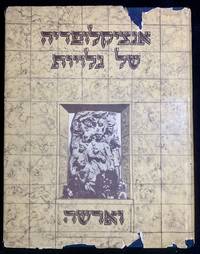
195343056Yerushalayim Jerusalem: Hevrat Entsiklopedyah shel galuyot 1953. First edition. Original boards with illustrated dust jacket 4to 816 columns 408 pages including illustrations and portraits. 31 cm. In Hebrew.<br> Encyclopedia on Jewish life in Warsaw published as part 1 of the Encyclopedia of the Diaspora series published in Jerusalem from the 1950s-1970s. Includes bibliographical references. Includes errata slip.<br> “Before World War II Warsaw was a major center of Jewish life and culture in Poland. Warsaw's prewar Jewish population of more than 350000 constituted about 30 percent of the city's total population. The Warsaw Jewish community was the largest in both Poland and Europe and was the second largest in the world second only to New York City…<br> Following the German invasion of Poland on September 1 1939 Warsaw suffered heavy air attacks and artillery bombardment. German troops seized Warsaw on September 27 1939.†USHMM.<br> SUBJECTS: Jews -- Poland -- Warsaw -- History. Holocaust Jewish 1939-1945 -- Poland -- Warsaw. Ethnic relations. Jews. OCLC: 34717605.<br> Dust jacket is lightly worn. Very Good condition in Good Dust Jacket. YIZ-23-66-. Yerushalayim [Jerusalem]: Hevrat Entsiklopedyah shel galuyot unknown
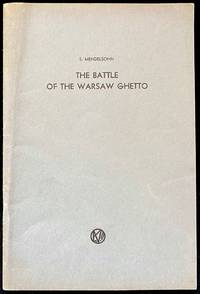
19444620<p>New York: Yiddish Scientific Institute 1944. Paperback. 1st separate edition. Original Paper Wrappers. 8vo. 28 pages. 23 cm. Wolff #I: 1441. Includes map in black red and white as the full-page center spread. <br />Early report on the uprising: "It is as yet impossible to give a complete picture of the resistance in the Warsaw Ghetto.The material is as yet too scarce. " <br />"This paper was read at the eighteenth annual conference of the Yiddish scientific institute on January 9 1944 .The paper was delivered in Yiddish and is published in the Yivo bleter Journal of the Yiddish scientific institute XXIII 1 January-February 1944." <br />Very good condition. B HOLO2-65-17.</p> Yiddish Scientific Institute paperback
198223277Washington DC: Defense Intelligence Agency 1982. fair to good. Quarto approx. 250 wraps profusely illus. appendices covers somewhat worn & soiled sm tears at spine lower corner fr cover & some pgs bent. This unclassified guide to Soviet Navy surface ships covers aircraft carriers principal surface combatants patrol combatants amphibious warfare ships mine warfare ships coastal patrol--river/roadstead craft amphibious warfare craft mine warfare craft underway replenishment ships material support ships fleet support ships and other auxiliaries. Defense Intelligence Agency paperback
197649668Washington DC: Defense Intelligence Agency 1976. good. Approx. 50 wraps illus. diagrams recommended reading. DDI-1100-128-76. This Intelligence Handbook supersedes Department of the Army Pamphlet No. 20-236 Historical Study Night Combat dated June 1953. The information in this Handbook has been obtained principally from Soviet open-source publications. It was written for the general orientation of members of the United States Armed Forces and for the training of troops both in the field and in the classroom in night combat operations. Defense Intelligence Agency paperback
1998Star-9783790811193Springer 1998. Hardcover. New. Springer hardcover
1998Star-9783790811193Springer 1998. Hardcover. New. Springer hardcover
19981303421PN. New. 1998. Soft Cover. Date is original print. This is a reprint edition . PN paperback
19884465Wiley Law 1988. First edition. Hardcover. Very Good. 4to348 pages red cloth <br/><br/>Trial Practice Library series. Edited by Warsaw who edited WOMEN TRIAL LAWYERS and formerly "Trial Diplomacy Journal". "That trial lawyering is an art rather than a science is acknowledged by nearly all who try to teach trial advocacy. . Those with advocacy teaching experience testify that trial tactics skills and techniques that lead to success . CAN be learned by deicated study and practice. . This is down-to-earth plain lawyering talk full of the kind of information that would pass from a senior partner to an associate during a coffee break conference in a top trial firm - Foreword." Contributors include Rudy Giuliani Philip Corboy Robert Habush Gerry Spence Leonard Ring Jill Wine-Banks etc. Wiley Law hardcover
19842080302106809414Sangyo tosho 1984. Soft Cover. Fine. Size: 23 x 18 cm 182 pages Volume: 1 volume Sangyo tosho paperback
19852092902141504274Sangyo tosho 1985. Soft Cover. Fine. Size: B5 size Sangyo tosho paperback
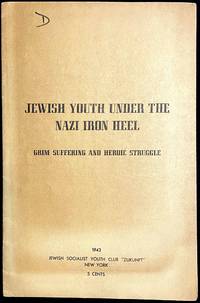
194243351New York: Jewish Socialist Youth Club 1942. Paper Wrappers. Illustrated by 2 Facimilie Illustrations. 1st edition Original Paper Wrappers 8vo 16 pages another variant we have seen has 15 pages. <br> From the year before the Warsaw Ghetto Uprising an early 1942 report by the American branch of the Bund on Jewish resistance by young people in Eastern Europe. <br> "Hand in hand with the underground organizations of the General Jewish Labor Union and in contact with the organization of the Polish socialists the Youth Union 'Zukunfst' conducts an untiring and ramified activity which is preparing the ground for the open struggle of tomorrow against Hitlerism" p. 13. <br> "Tsukunft or Cukunft or Zukunft Yiddish for future was the youth organization of the General Jewish Labor Union or Bund. It was founded in 1910 and in 1916 it was officially called Yugnt-Bund Tsukunft. Their newspaper was the Yugnt veker.<br> In 1922 the organization changed its name to Yugnt-bund "Tsukunft" in poyln 'Youth Bund "Tsukunft" in Poland'.At the time of the sixth Tsukunft conference in 1936 the last before the outbreak of the Second World War the organization counted with 184 local groups.<br> On the eve of the Second World War the organization had 15000 members. The Tsukunft took part in the Warsaw ghetto uprising as part of the Jewish Fighting Organization" Wikipedia.<br> SUBJECTS: Jewish youth -- Poland. Holocaust Jewish 1939-1945 -- Jewish resistance. World War 1939-1945 -- Atrocities. <br> OCLC: 6871875. <br> Covers toning with pen notation to cover otherwise Very Good Condition B Holo2-139-22A-XAECC-'l. Jewish Socialist Youth Club unknown
20001328296PN. New. 2000. Soft Cover. Date is original print. This is a reprint edition . PN paperback
19981310075PN. New. 1998. Soft Cover. Date is original print. This is a reprint edition . PN paperback
1953biblio434<p>Issued by Philip Warsaw Pincas Dov 1953. Presented by the Author to rabbi Alexander Alan Steinbach. Fine Hardcover darkbrown cloth. gilt lettering. Several marks on the page with contents. Otherwise Book looks perfect no wear clean unmarked free of inscriptions text. 9.2"x6.4"x1.2". be40695</p> Issued by Philip Warsaw (Pincas Dov) hardcover
1992259300PN. New. 1992. Soft Cover. Date is original print. This is a reprint edition . PN paperback
1964283435Warszawa: Panstwowe Wydawnictwo Naukowe 1964. First Edition. Hardcover. Good cloth copy in a good if somewhat edge-torn with some loss and dust-toned dust-wrapper now mylar-sleeved. Remains quite well-preserved overall; tight bright clean and strong. Physical description; xxvi 510 pages. Subjects; Polish History. Warsaw. Civil Defense. Warszawa: Panstwowe Wydawnictwo Naukowe hardcover
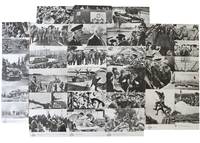
1955187431955. Photograph archive 1955 documenting the political leadership and military forces present at the establishment of the Warsaw Pact in Poland with direct relevance to the study of Cold War alliances Soviet influence in Eastern Europe and the organization of socialist military systems. Formed as a collective defense agreement among the Soviet Union Poland East Germany Czechoslovakia Hungary and Bulgaria the Warsaw Pact functioned as a counterpart to NATO and formalized military coordination within the Eastern Bloc. The photographs depict assembled leaders and officers alongside scenes of organized troops training exercises and public displays of military readiness reflecting the emphasis on unity and preparedness at the outset of the alliance. The archive captures the visual language of state power and coordination during a defining moment in early Cold War geopolitics.<br /> <br /> Archive of 28 black and white photographs each approximately 8 x 10 inches produced as professional press or official images with captions in Czech. The photographs include formal portraits and groupings of political and military leaders as well as images of soldiers in formation training exercises and urban assemblies associated with the founding events. The consistent format and captioning indicate coordinated production for documentation or dissemination within Eastern Bloc media or governmental contexts. Twenty-eight photographs with light wear consistent with handling; overall very good condition. A cohesive visual record of the formation and early presentation of the Warsaw Pact as a military and political alliance during the Cold War. The Warsaw Pact would persist until the end of the Cold War when it fractured as states throughout the Eastern Bloc broke with communism and no longer were programatically aligned. In very good condition overall. unknown
1986mon0000483629HarperCollins Publishers Ltd 03/11/1986 00:00:01. hardcover. Good. 5.5838 in x 23.0964 in x 15.4822 in. Ex-library book usual marking. Clean copy in good condition. HarperCollins Publishers Ltd hardcover
1997Q-1860463789Harvill Pr 1997-05-01. Paperback. New. In shrink wrap. Looks like an interesting title! Harvill Pr paperback
1969ZB445382Warsaw: 1969-2000. volumes 10-11 14-15 21 23-26 37-41 complete volumes in original softcovers well illustrated some library markings passim PRICE IS FOR THE LOT. - If you are reading this this item is actually physically in our stock and ready for shipment once ordered. We are not bookjackers. Buyer is responsible for any additional duties taxes or fees required by recipient's country. Photos available upon request. Warsaw: paperback