ALBERT I PARADIS, Catalina.MareMagnum

2 851 résultats
Madrid, Biblioteca Patria, s.a. (1907). 4to. menor; 108 pp., 1 h. Ilustraciones entre el texto. Cubiertas originales.
Barcelona, Imprenta Peninsular de Mariol y López, 1885. 4to. mayor; VIII pp., 254 pp., 3 hs. Con 21 láminas. Encuadernación en media piel de la época. El proceso de beatificación de Oriol tuvo una gran importancia en las relaciones hispanoromanas de finales del XVIII. Masdeu, residente por entonces en Roma, escribió la biografía en italiano y la publicó en 1806, año de la beatificación. Esta traducción, realizada por el mismo Masdeu, fue publicada con gran lujo por la Comunidad Parroquial de la barcelonesa Iglesia de Ntra. Sra. del Pino, de la que había sido beneficiado el Beato. Contiene como Apéndice todos los documentos públicos del proceso de beatificación.
Barcelona, por la Compañía de Jordi, Roca y Gaspar, 1807. 4to.; una lámina retrato grabada por Coromina, X pp., 1 h., 255 pp., 2 hs. Ejemplar carente de láminas. Encuadernación en pergamino de la época. El proceso de beatificación de Oriol tuvo una gran importancia en las relaciones hispanoromanas de finales del XVIII. Masdeu, residente por entonces en Roma, escribió la biografía en italiano y la publicó en 1806, año de la beatificación. Esta traducción, realizada por el mismo Masdeu, fue publicada con gran lujo por la Comunidad Parroquial de la barcelonesa Iglesia de Ntra. Sra. del Pino, de la que había sido beneficiado el Beato. Contiene como Apéndice todos los documentos públicos del proceso de beatificación.
Barcelona, por Juan Ignacio Jordi, Impresor y Librero, 1815. Dos tomos en un volúmen en 4to.; XVI-278 pp. + 233 pp., 2 hs. Encuadernación en piel marbreada, de la época.
Manresa, en la Imprenta de Martín Trullás, 1829. 4to.; VIII-352 pp., 2 hs. Ejemplar con taladros de polilla en el margen blanco exterior, sin afectar a texto, de cincuenta páginas. Encuadernación de la época, en pergamino.
Manresa, en la Imprenta de Martín Trullás, 1830. 4to.; VIII-352 pp., 2 hs. Encuadernación de la época, en pergamino.
Cádiz, Escélicer, s.a. (1943). 4to.; 104 pp. Cubiertas originales.
Barcelona, Editorial Barna, 1953. 4to.; 301 pp. y 8 láminas fotográficas fuera de texto. Encuadernación original en tela.
Zaragoza, IFC, 2020. 4to.; 341 pp. Ilustraciones. Encuadernación original.
Barcelona, Editorial Bruguera, 1966. 8vo.; 106 pp., 3 hs. Cubiertas originales.
Barcelona, Seix & Barral Hermanos, Editores, 1915. 4to.; 89 pp. y 12 láminas. Encuadernación original en cartoné impreso.
Barcelona, Editorial Aedos, 1952. 4to.; 3 hs., 404 pp. Con numerosas ilustraciones fotográficas en 32 láminas dobles, aparte. Encuadernación original en tela estampada.
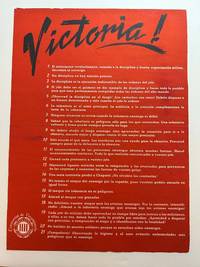
193711137Barcelona Spain: Comissariat de Propaganda Generalitat de Catalunya 1937. Near Fine. Propaganda poster listing 21 wartime rules of behavior to help the republican side achieve victory over the fascists during the Spanish Civil War. As follows: As with most of the Republican posters the colors of the anarchists and communists black and red figure prominently in the poster. Many of the prescriptions seem geared toward inexperienced soldiers. This feature of the prescriptions is no surprise since much of the soldiers fighting on the side of the Republicans were volunteers or militiamen who were not professionally trained soldiers.<br /> The prescriptions on the poster are as follows: "Revolutionary enthusiasm plus discipline and good military organization will defeat the enemy. Without discipline the army is not powerful. Discipline is the unquestioning execution of the commander's orders. The commander should be the first in giving an example of discipline and making everything possible so that all orders from above are accomplished perfectly. Observe discipline in the line of fire! Cartridges are expensive! You should fire at fixed targets and only when the commander orders it. The infantry is the principal weapon. The artillery and air force complement the work of the infantry. No situation is critical when the enemy's infantry is weak. Know that the cavalry is dangerous only for those that move back. A brave and firm infantry can always put it in flight. You should not avoid enemy fire but you should take advantage of the situation in order to go on the offensive to attack it better and to fire against it with greater precision. Only he who attacks triumphs. The trenches are aid for the offensive. Always try to pass from defense to offense. The reconnaissance of enemy positions will save many forces. Do continuous reconnaissance. Communicate all that you discover to your commander. Bring every prisoner to your commander. Keep a tight link between the rearguard and the advance forces in order to prevent surprises and increase the force of your blow. One bad sentry lost Chapaief. Do not forget the sentries! Do not fear the attack of the enemy from behind since you can attack them in the same way. The tank without infantry is not dangerous. Attack tanks with grenades. Do not debilitate your attack in the presence of enemy planes. On the contrary intensify it. Attack the enemy infantry that advances behind enemy planes. Every commander of militias should make the most of their free time to instruct militiamen and they on their time should do everything possible to study. Learn to shoot with precision to understand maps and to identify with a locality. Do not speak of military subjects because the hated enemies are listening. Countrymen! By practicing good hygiene and cleanliness you avoid diseases more dangerous than the enemy." SC&A UC San Diego OCLC. Near fine. Single sheet color lithograph mostly red and black 30 x 23 cm. In Spanish Catalonia. Comissariat de Propaganda, Generalitat de Catalunya unknown
B., Viuda de Luis Tasso, 1929, 13 x 20'5 cm., 11 hojas con ilustraciones intercaladas y un mapa.
Barcelona, Josep Maria Bosch, 1955. 4to.; 140 pp., 1 h. Cubiertas originales. El autor, destacado jurista y antiguo catedrático de la Universidad de Oñate, fue Director de la "Oficina d'Estudis Jurídics" de la Mancomunitat de Catalunya, así como Presidente del "Centre Excursionista de Catalunya" de 1927 a 1931. Fue miembro del Comité Asesor de las Minorías Nacionales en la Sociedad de Naciones y Presidente de la Delegación Catalana al Congreso de las Nacionalidades Minoritarias de Europa en 1931. Con posterioridad a la Guerra, desde la Presidencia de la "Societat Catalana d'Estudis Jurídics, Económics i Socials", filial del "Institut d'Estudis Catalans", fue firme partidario de la Unión Europea.
Madrid, 2005. 4to.; 177 pp. Ilustraciones fotográficas. Cubiertas originales.
Comillas, Universidad Pontificia, 1968. 4to.; 361 pp. Cubiertas originales.
Madrid, Escélicer, 1971. 8vo.; 96 pp. Cubiertas originales.
León, 1974 [Colección "Provincia" de Poesía]. 4to.; 63 pp., 2 hs. Cubiertas originales.
Barcelona-Madrid, Sociedad Editorial La Maravilla-Librería Española, 1864. Dos volúmenes en folio; 542 pp. + 488 pp. Con 31 láminas litográficas aparte (de 38). Encuadernación de la época en media piel. El tomo primero bastante fatigado.
B., 1949, 19’5 x 13 cm., 21 págs. incluso 3 láminas facsímiles en colores – 1 h. (Estudio sobre un códice del siglo XV de Jaime Marquilles sobre Comentarios de los "Usatges").
Barcelona, Industrias Gráficas Seix Barral Hermanos, 1949. 4to. menor; 21 pp., 1 h. Con tres reproducciones a toda plana, en color, de fragmentos de la miniatura. Cubiertas originales.
Barcelona, Editorial Bruguera, 1986. 4to. menor; 300 pp. Cubiertas originales.
Madrid, Imprenta Real, 1851. Dos volúmenes en 4to.; 2 hs., 333 pp. + 2 hs., 377 pp. Cubiertas mudas, de época, en papel azul.
Madrid, Imprenta de la Real Academia de la Historia, 1850. Dos tomos en 4to.; IX pp., 1 h., 334 pp. Ejemplar de salida, sin desbarbar ni abrir. Puntos marginales de polilla sin afectar al texto. Cubiertas mudas, de época, en papel azul.