2 759 résultats
Kisthinios, KristinaIn Pristine Condition. unknown
Boman, Monica ed. EnglishNot in perfect condition. unknown
Lindkvist, Lennart; transnot in perfect condition. unknown
Hans, RabenNot in Perfect Condition. unknown
Notini, AnjaNot in Perfect Condition. unknown
Jan, AnderIn Pristine Condition. unknown
Caldenby, Claes and WedebIn Pristine Condition. unknown
Widstrand, StaffanIn Pristine Condition. unknown
Danius, Sara; Johansson,In Pristine Condition. unknown
Nyström, BengtIn Pristine Condition. unknown
Strong, DanielIn Pristine Condition. unknown
Philips, CharlesIn Pristine Condition. unknown
Holmberg, John-Henri edIn Pristine Condition. unknown
Tsarouhas, DimitrisIn Pristine Condition. unknown
Makos, Christopher and SoIn Pristine Condition. unknown
8 fascicules de 25 ? 60 pages. L'ensemble.
19883443913Kopenhagen, Rigsarkivet, 1988. 363 S. OKart.
Very Good English Original 49 real photo postcards (with an original photograph). 9x14 cm. A very good collection. A real photo postcard collection of a Turkish soldier named Mustafa Baspak, including gelatin silver prints (one is hand-colored) of South Africa; attractive views of Cape Town (23 photos), Durban (24 photos), and Natal (2 photos). Some cards are posted to Turkey by military post. Mostly, these real photo postcards are published by Valentine's (SA) Ltd., a photographic/printing company established by Mr. James Valentine (1814-1879) in 1851. In 1963, the company became a subsidiary of John Waddington Ltd.
Very Good Swedish Original photograph album. Cloth. Oblong cr. 8vo. (13 x 19 cm). Descriptions in Swedish. Various sized 20 b/w photographs. Other pages blank. Photos: St. Lars ruin.; Humanistiska Laroverket.; Kyrkan.; MAria-Kyrkan, Interiör.; Vardshuset Draken.; Sigtunastiftelsen. Flygfoto.; Posthuset.; Utsikt fran Flickinternatet.; Flickinternatet Berga elevhem.; Sigtuna stiflelsen.; Kyrkan.; Radhusel.; Stadshotellets terrass.; Humanistika Laroverket.; S:t. Olofs ruin.; Lilla torget och Stora gatan.; Gamla Tullstugan.; Sigtunaskolan.; Sigtunastiftelsen, Rosengarden.; Prastgarden, S:t. Pers ruin och 'Pilgrimstugan'.
Very Good French Contemporary wrappers. Ex-libris "Lundsbergs Skola". A fine copy. Cr. 8vo. (19 x 12 cm). In French. 74 p. Scarce early French edition of this biographical tractate of "the military talents and the character of Charles XII, King of Sweden", with the indication of "de main de maitre", but without designation of place of printing or of bookseller, written by Frederic II, King of Prussia. First appeared 8 January 1760. The tractate was published in a small number of copies which the King intended for his brothers, his friends, and his most distinguished officers, as can be seen from the beginning of his letter to the Marquis d'Argens dated from Freyberg, January 1760. OCLC 719084932, 1154704830.
Very Good Turkish Original twenty-three gelatin silver detachable photos on eight "Leykam" blind-stamped papers. Papers' size: 32,5x25 cm, photos size mostly: 9x14 cm. Punch holes in the left margins. Otherwise a clean collection. A fine photograph collection of a scientific voyage to Central, East, and South Anatolia in 1953, by German and Turkish mineralogists, to collect and research natural materials, including shores of lakes and seas, soils of Anatolian land from Mt. Taurus, Lake Van, Hakkari and Mount Cilo.
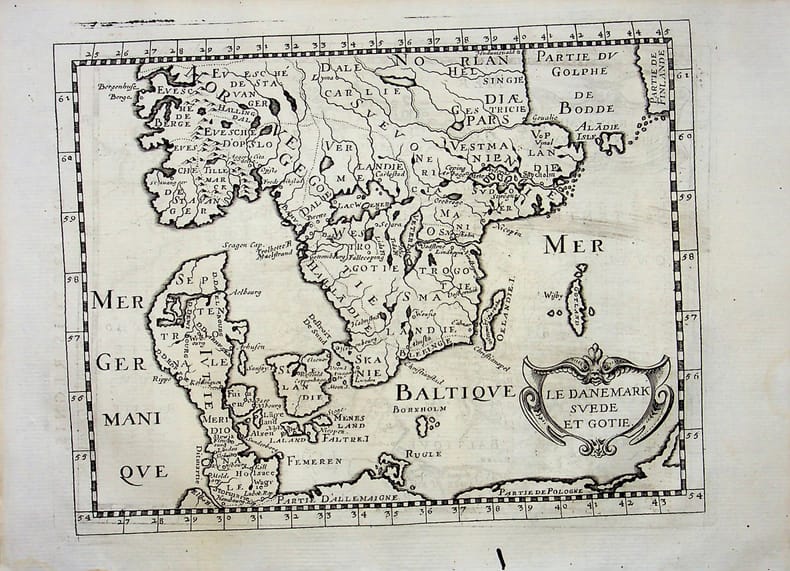
018778[Philippe Briet, Parallela geographiae veteris et novae] Danemark, Suède et Gotie. Gravure originale, 1649, environ 240*170mm. Gravure tirée de l'ouvrage du savant jésuite Philippe Briet (1601-1668) publié en 1648-1649. Texte au dos. [435]
Good Turkish, Ottoman (1500-1928) Contemporary non-aesthetic burgundy cloth bdg. Demy 8vo. (22 x 14,5 cm). In Ottoman script (Old Turkish with Arabic letters). 299, [6] p. Fading on cloth, minor repairs on some pages, otherwise a good copy. Lithographed edition. First and only Turkish edition of this uncommon and very scarce early book of the history of Russia under the rule of Peter the Great. This book was published during the Crimean War, which was a military conflict fought from October 1853 to February 1856 in which Russia lost to an alliance of the Ottoman Empire, France, the United Kingdom, and Piedmont-Sardinia. The first four chapters describe the general political and social history of Russia at the time of Peter the Great. The following chapters narrate important events like the new revolution in Sofia, the first diplomatic relations with China in the period and the first agreement between the Russian and Chinese Empires, The Siege of Azov Fortress, the agreement with the Saxony, Peter the Great's travels to Europe, rebuild of St. Petersburg, The Battle of Narva and the Siege of Narva, return of the Great Tsar to Russia from France, commerce in Russia in the period of the Peter the Great's rule, etc. Peter I, most commonly known as Peter the Great, was a monarch of Russia who modernized it and made it a European power. He ruled the Tsardom of Russia from 7 May [O.S. 27 April] 1682 to 1721 and subsequently the Russian Empire until his death in 1725, jointly ruling before 1696 with his elder half-brother, Ivan V. To improve his nation's position on the seas, Peter sought more maritime outlets. His only outlet at the time was the White Sea at Arkhangelsk. The Baltic Sea was at the time controlled by Sweden in the north, while the Black Sea and the Caspian Sea were controlled by the Ottoman Empire and Safavid Empire respectively in the south. Peter attempted to acquire control of the Black Sea, which would require expelling the Tatars from the surrounding areas. As part of an agreement with Poland that ceded Kyiv to Russia, Peter was forced to wage war against the Crimean Khan and against the Khan's overlord, the Ottoman Sultan. Peter's primary objective became the capture of the Ottoman fortress of Azov, near the Don River. In the summer of 1695, Peter organized the Azov campaigns to take the fortress, but his attempts ended in failure. Through a number of successful wars, he captured ports at Azov and the Baltic Sea, laying the groundwork for the Imperial Russian Navy, ending uncontested Swedish supremacy in the Baltic, and beginning the Tsardom's expansion into a much larger empire that became a major European power. He led a cultural revolution that replaced some of the traditionalist and medieval social and political systems with ones that were modern, scientific, Westernised, and based on the Enlightenment. Shuvalov was called the Maecenas of the Russian Enlightenment and the first Russian Minister of Education. Russia's first theatre, university, and Academy of Arts were instituted with his active participation. He was born in Moscow, the only son of Ivan Menshoi Shuvalov, an army captain who died when the boy was ten, and Tatiana Rodionovna. The Shuvalov family fortunes changed drastically in 1741 when Empress Elizaveta Petrovna ascended to the Russian throne with help from Ivan's powerful cousins - Peter Shuvalov and Alexander Shuvalov. The following year, they had the fourteen-year-old Ivan attached to the imperial court as a page. Complete title: "Büyük Petro'nun eyyâm-i hükümetinde Rusya'da cereyân eden ahvâl-i dahiliyye ve umûr-i hâriciyyeye ve husûsiyle nizâmât-i mevzûa-i cecdîdeye ve oralarda bulunan milel ve akvâm-i muhtelifenin ahlâk ve âdâb ve fünûn ve sanâyilerine dair Büyük Petro'nun kizi Elizabete'nin kurenâsindan Sovalef nâm zâtin bazi resâil-i mevsûka ve senedât-i sahîhadan vukûf ve ittilâi hâsil olan ahvâl ve keyfiyâti nakil ve hikâyeye mübâseret olunmustur." Özege 17170.
Very Good Turkish Paperback. 32mo. (9 x 6 cm). In Turkish. 25 original b/w gelatin silver photographs in 12 joined page plates. This extremely rare miniature souvenir album shows the stations, bridges and their constructions, the first moving trains, railways, opening celebrations and visits of the Turkish ministers, opening speech, etc. during the opening of the Irmak-Filyos railways on 12 November 1935 Irmak-Filyos line which was opened by Ali Çetinkaya (1878-1949), who was an Ottoman-born Turkish army officer and politician, who served eight terms in the Grand National Assembly of Turkey. Çetinkaya also can be seen in some photos of the album. "The Republic of Turkey, which tried to overcome the destructive effects of the war, took an important step toward reaching economic independence and transporting natural resources to the different regions of the country. The Grand National Assembly of Turkey approved the Law on the Ankara-Eregli Railway Line under the name 'The Railway Leading to Coal'. This important railway line, which the young Republic of Turkey wished to establish to face the future and move forward, was going to run between the coal city Zonguldak and Irmak station, near the capital Ankara. The construction of the railway started on 7th February 1927 and the 102-kilometer line, running between Irmak and Çankiri, became operative on the 23rd of April 1931. The railway between Irmak-Filyos, which had a total length of 391 kilometers, went into operation on 12th November 1935 with a ceremony held in Filyos. It comprised 27 stations, 1368 culverts, and bridges and 37 tunnels, and had a total length of 8800 kilometers.". (Source: Irmak Karabük Zonguldak Railway Line - UDHB). "Foto Birlik" was the most important photography studio in Zonguldak city which was an eyewitness in the early period of Republican Turkey. No copy in OCLC.; No copy in the Turkish National Library.