(PCUS) -MareMagnum

8 176 résultats
Roma, Ambasciata dell'URSS, 1977, 8vo punto metallico, pp. 58.
1937R68519Moscow: People's Commissariat of Justice of the U.S.S.R. 1937. 1st edition. Very Good. octavo. orig. boards vi 580pp. Heard before the Military Collegium of the Supreme Court of the U.S.S.R.Moscow January 23-30 1937. Verbatim Report People's Commissariat of Justice of the U.S.S.R. hardcover
1938R68520Moscow: People's Commissariat of Justice of the U.S.S.R. 1938. 1st edition. Very Good. octavo. orig. boards 799pp. Heard before the Military Collegium of the Supreme Court of the U.S.S.R.Moscow March 2-13 1938. Verbatim Report People's Commissariat of Justice of the U.S.S.R. hardcover
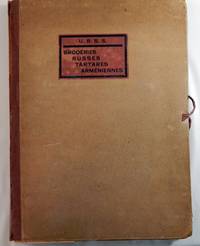
192521763Paris: Ernst Henri Editeur 1925. Loose plates. Good. Folio 11 by 15 inches. Portfolio of 40 loose plates. Paper over boards cloth spine printed paper label cloth tie. The plates are printed in full color and mounted to a gray card with a printed black border. Portfolio well worn and the spine repaired. The text pages are soiled and chipped. The mountings for the plates are sunned along the edges but the plates are fine. Overall a good copy.<br /> <p><br /> These embroideries and woven printed fabrics were exhibited at the U.S.S.R. pavilion at the International Exhibition of Decorative Arts at Paris in 1925. The samples were supplied by ethnographic museums and almost all of them were produced in the 19th century. A few are from the 17th and 18th century and plates 26 and 27 are from modern Ukraine.<br /> <p>. Ernst Henri, Editeur unknown
Original Orange printed paper wrappers, showing distinctive elements of both modern and traditional typeface. 8vo, 24 pages, 21 cm. In Yiddish. Rare 1940 Riga edition of the 1936 Soviet constitution, certainly one of the last Yiddish publications in Latvia; OCLC-Worldcat literally lists not a single Yiddish publication from Riga 1941-1987. Immediately after the establishment of German authority [in Latvia] in the beginning of July 1941, the elimination of the Jewish and Roma population began, with major mass killings taking place at Rumbula and elsewhere. The killings were committed by the Einsatzgruppe A, and the Wehrmacht. Latvian collaborators, including the 5001, 500 members of the Arajs Commando (which alone killed around 26, 000 Jews]) and other Latvian members of the SD, were also involved. 30, 000 Jews were shot in the autumn of 1941 with most of the remaining Jewish people being rounded up and put into ghettos. In November and December 1941 the Riga Ghetto became crowded and to make room for the imminent arrival of German Jews, who were being shipped out of the country, all the remaining 30, 000 Jews in Riga were taken from the ghetto to the nearby Rumbula Forest and shot (Wikipedia, 2016) . SUBJECT(S) : Soviet Union. Konstitutsiia (1936) -- Politics and government. OCLC lists only 1 copy anywhere (Harvard) . Only the lightest wear to wrappers, an amazingly well-preseverd copy of this exceedingly rare Yiddish imprint. (yid-26-6)
Very Good Condition No Jacket; 8vo; 261 +98 pages; In Yiddish, Hebrew, & English. Map endpapers, of the town. Very good condition. (YIZ-1-10A) xx
1st edition. Original dramatic constructivist paper covers 8vo, 135 pages ; 22 cm. In Yiddish. Title also in Russian on copyright page: Dlia stseny. SUBJECT (S) Yiddish literature. OCLC lists 3 copies worldwide (LOC, UMaryland, NLI) . Ex-library, but only with bookplate to later boards and faint blindstamp on non-illustarted title page. 1 inch closed tear to illustrated cover, one corner repaired, lacks spine. Paper browning with dampstaining throughout, but staining is not obtrusive on the illustrated cover. Lacks backstrip, otherwise Good Condition thus. (YID-26-10)
Original illustrated paper covers with constructivist font, 8vo, 66 pages. Includes text illustrations as well. In Yiddish. Young adult book. Title translates as In search of Food. OCLC lists only 2 copies worldwide (Columbia & Wayne State) . Cover stain and tears along spine; inside 1/2 inch of first and last leaves are stuck to covers at the gutter margin (from glue from later outer binding which is no longer present) . Attractive, rare Kultur-Lige imprint. (Yid-26-11)
Publishers cloth. 8vo. 445, [9], [12] pages. 22 cm. Edition. In Hebrew; one appendix in Russian; added t. P. And introductory matter in English. Folded map attached to lining paper. A history of the Jewish autonomous region of Birobidjan, with detailed sections on immigration and population figures, local and international funding and support for the colonization project, industry, agriculture, forestry, construction, handicrafts, medical services, literature, art, education and culture, Jewish life in the region, and the place of Yiddish. In the series: Sidrat "Galuyot" volume 2. Subjects: Birobidzhan (Russia) - History. Ex-library markings. Slight toning. Very minimal markings. Very good condition. (EE-5-43B)
1970R160187280SEUIL. 1970. In-8. Broché. Etat d'usage, Couv. convenable, Dos plié, Intérieur frais. 253 Pages. . . . Classification Dewey : 947-Europe de l'Est, URSS
Album cartonato di cm. 36 x 31 di dieci pagine con applicate 34 foto in nero, mediamente cm. 23 x 14 con didascalie in cirillico. Anni '40/'50, ma forse anche precedenti.
Mosca, Progress, 1977, 8vopunto metallico con copertina illustrata a colori, pp. 70.
Tre quotidiani Corriere della Sera del 28, 29 e 30/6/1941 di 5 pag.
Due Quotidiani LA STAMPA di 4 pag. del 29 e 30/6/1941
Roma, Editrice Cultura Proletaia di Antonio Vairo, 1945, 8vo brossura, pp. 32. Adesivi quà e là.
In 8° leg. edit. fig. pp.400 ben tenuto
Fine Turkmen Paperbak. Cr. 8vo. (20 x 14 cm). In Turkmen and Russian. 92 p. Turkmenistan SSR'nin metbugat letopisi. Turkmenistan SSR'nin Sovyet bibliyografiyasinin organi.= Letopis' pechati Turkmenskoi SSR. Organ gosudarstvennoi bibliografii Turkmenskoi SSR.
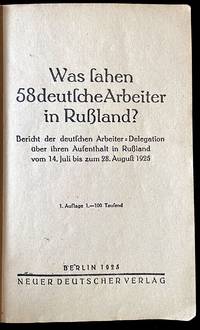
192542907Berlin Neuer Deutscher Verlag 1925. 1st edition. Original 3-color printed wrappers 12mo 176 pages. Foreword by the Dutch trade union official Edo Fimmen 1882-1942. <br> Fimmen was committed to a workers’ united front and was chairman of the The International Federation of Trade Unions also known as the Amsterdam International from 1919 to 1923. He was also a member of International Workers' Aid and through his friendship with Willi Münzenberg an important supporter of the International Red Aid and the League against Imperialism and Colonial Oppression. <br> Widely-read among Anti-fascists in Germany in the years leading up to Hitler's win in the Reichstag this work includes numerous photo plates with travel impressions and a list of the delegation members. <br> In her recent history of East Germany “Beyond the Wall†historian Katia Hoyer discusses the importance of this book in building a positive image of the newly founded Soviet Union among German Communists including Jews who would soon begin to flee to the USSR in large numbers as the Nazi noose tightened.<br> She notes that “a 1925 brochure called ‘What Did 58 German Workers See in Russia’ became instrumental in creating a paradisiacal image of the Soviet Union. It was inspired by the communist Hermann Remmele who had led a group of his comrades on a grand tour of sorts through Russia. <br> The pamphlet was based on their reports and boasted of 'female workers who proudly talked of their equal treatment' and of wages that were '33 per cent higher' if one takes into account that workers lived rent-free and had excellent healthcare. All of this must have made the Soviet Union seem like the promised land to the unemployed and the destitute as well as to idealist intellectuals. <br> Having experienced the First World War and its appalling consequences older German communists wanted to believe there was a better alternative and saw the Soviet Union as a beacon of hope especially after the waves of arrests in Berlin in 1933. For most German political refugees who fled to the USSR after Hitler took power their time in Moscow began as a great adventure†page 15.<br> She notes that later however “Hermann Remmele the leader of the group that penned the propaganda brochure ‘What Did 58 German Workers See in Russia’ was to endure a fate that would stand in for many German communists. Once a darling of the Soviet political elite Grigory Zinoviev had called him 'the best and most precious asset of the German party. the gold of the proletariat' he was arrested in Russia in May 1937 on charges of spying and sabotage. Two years later he was sentenced to death and shot on the same day 7 March 1939.<br> His son Helmuth died on his way to a gulag in Siberia and his wife Anna would succumb to health problems caused by a horrific spell in Moscow's Butyrka prison†page 19.<br> SUBJECTS: Labor and laboring classes -- Soviet Union. Economic history. Labor – Working class -- Economic conditions -- 1917-1945. URSS -- Conditions e´conomiques -- 1917-1945. OCLC: 5918896. Cover rubbed with tear loss to one letter chip at base of spine and small chip at lower margin of front cover. Internally very good condition Good- Condition overall. B Holo2-162-27-XX-. Berlin, Neuer Deutscher Verlag unknown
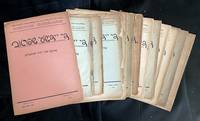
193042139Kiev: Katedr far Yidisher Kultur ba der Ukr. Visnshaftl. Akademye Filologishe Sektsye 1930. Paper Wrappers. 1st edition. Original printed publisher’s color paper wrappers 4to large ca 72-116 columns ca 36-58 pages per issue. 28 cm. In Yiddish. Title translates roughly as “The Yiddish Language.†Succeeded in 1931 by “Afn shprakhfront.â€Di Yidishe Shprakh was a “Yiddish linguistic journal published in Kiev from 1927 to 1930. A bimonthly journal Di yidishe shprakh The Yiddish Language was published by the cooperative publishing house Kultur-lige and was the main philological publication of the Kiev Yiddish academic center. Its editor was the veteran Yiddishist Nokhem Shtif a founder of YIVO who had returned to Kiev from Germany in 1926. The journal’s inaugural issue March–April 1927 was published under the auspices of the Central Yiddish Bureau of the Ukrainian Commissariat for Education. With the next issue Di yidishe shprakh was an organ of the Chair and from July to October 1929 it was an organ of the Institute for Jewish later Proletarian Jewish Culture at the Ukrainian Academy of Sciences. Initially defined as a 'journal for practical Yiddish linguistics' from May to June 1927 it appeared as simply a 'journal for Yiddish linguistics. 'Shtif distinguished three language registers: the vernacular of the old generation partly represented in the works of Sholem Aleichem and predecessors; the highbrow language of modern writers such as Dovid Bergelson; and the contemporary 'culture language' most notably of the press. Although Shtif sought to target speakers of the mass 'culture language' the journal’s circulation hovered around 500 copies read mainly by Yiddish teachers.Apart from Shtif who published articles on various language-planning problems the most active contributors to Di yidishe shprakh were Ber Slutski Ayzik Zaretski Elye Falkovitsh Lipe Reznik and Shimen Dobin. In early 1929 Moscow literary critic Aron Gurshteyn criticized the journal for its purist approach to language planning. In the July–October 1929 issue Shtif published his article 'Di sotsyale diferentsiatsye in yidish' The Social Differentiation in Yiddish heralding an intensification of Soviet linguists’ anti-Hebraist campaign. That issue of Di yidishe shprakh adopted completely reformed Soviet spelling omitting for example final consonant letters.Although the last—twenty-fifth—issue of the journal was dated November–December 1930 it included materials from the First All-Union Yiddish Language Conference convened in Kiev from 8 to 13 February 1931 that issue is present here. Published under the imprint of the Central Publishing House this issue also signaled the demise of the remaining vestiges of the Kiev Kultur-lige. Yoysef Liberberg’s article 'Far parteyishkayt in der yidisher visnshaft-arbet' For a Party Approach to Yiddish Linguistics marked a full break with YIVO scholars particularly with YIVO director Max Weinreich whom Liberberg ridiculed for presenting Yiddish as an emanation of the Ashkenazic Jews’ soul. The Yiddish Language Conference decided to change the name of the journal. Between 1931 and 1939 it appeared sporadically under the title Afn shprakhfront On the Language Front reflecting its new more aggressive and politically charged approach' Gennady Estraikh in YIVO Encyclopedia of Jews in Eastern Europe 2010. For more see David Shneer “Yiddish and the Creation of Soviet Jewish Culture 1918–1930†Cambridge and New York 2004. SUBJECTS: Yiddish language -- Periodicals. Title also listed on covers in Russian “Ievreis'ka Mova†and German “Jiddische Sprachâ€. OCLC: 22840298. Most holdings in OCLC appear to be fragmentary. Covers are browning and fragile as expected but are otherwise very well preserved with very little edgewear. Internal text pages are also toning but remain relatively strong as pulp paper. Very important journal scarce in this degree of completeness Note that Estraikh suggests a circulation of only 500!. B YID-43-5-E. Kiev: Katedr far Yidisher Kultur ba der Ukr. Visnshaftl. Akademye, Filologishe Sektsye unknown
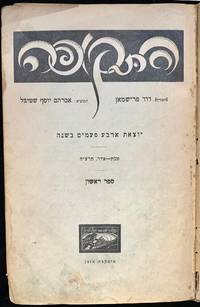
191843090Moskvah Moscow : A.Y. Shtibel 1918. First edition. Original boards 8vo 678 pages. 26 cm. In Hebrew. Title translates as “The Season.â€<br> Rare volume 1 published in the USSR of the quarterly literary magazine Ha-Tekufah. Includes essays by Simon Dubnow poetry short stories translations and articles.<br> Ha-Tekufah was a “Hebrew periodical devoted to literary scientific and social subjects which appeared first as a quarterly then as an annual intermittently between 1918 and 1950. Ha-Tekufah received the financial backing of Abraham Joseph Stybel a philanthropist who had placed David Frischmann in charge of launching Hebrew literary projects on an unprecedented large scale. Accordingly Frischmann established both the Stybel publishing house and launched Ha-Tekufah serving as the editor of both projects. The first volume of Ha-Tekufah appeared in Moscow early in 1918 before the Bolshevik regime had decided to suppress Hebrew literature. Frischmann published the works of the world's best authors and scholars. The literary standards of the periodical were high. Frischmann encouraged young authors for example Eliezer Steinman. In all respects and not least for its beautiful graphic work Ha-Tekufah was a rare phenomenon in Hebrew literature.†Jewish Virtual Library.<br> SUBJECTS: Hebrew literature Modern -- Periodicals. Hebrew literature Modern. OCLC: 25586768<br> Boards separated and pages edgeworn. Lacks backtrip spine covering. Good Condition internally. YID-46-7-’. Moskvah [Moscow] : A.Y. Shtibel unknown
1925164375?????????, ???. ???-??, 1925. 32 S., Original broschiert, kl.8°. Softcover Rücken eingerissen, Papier etwas gebräunt. ????????? ??????????
1931164422?????? ; ?????????, ????, 1931. 47 S., Original broschiert, kl.8°. Vordere Umschlagseite mit rot/schwarzer Typographie. Softcover Rücken mit kleiner Fehlstelle, Ecken bestossen, Besitzvermerk auf Titelseite. Papier gebräunt. ?? ??????? 5-?????
1968164410Ffm., ?????, 1968. 2 Bde., 317, 253 S., Original broschiert, kl.8°. Kleine Ausgabe, gedruckt in kleiner Schrift auf dünnem Papier, geeignet für den diskreten Vertrieb des in der Sowjetunion noch nicht erlaubten Romans. Softcover Ecken bestossen, handschriftliche Notizen auf den hintersten Seiten.
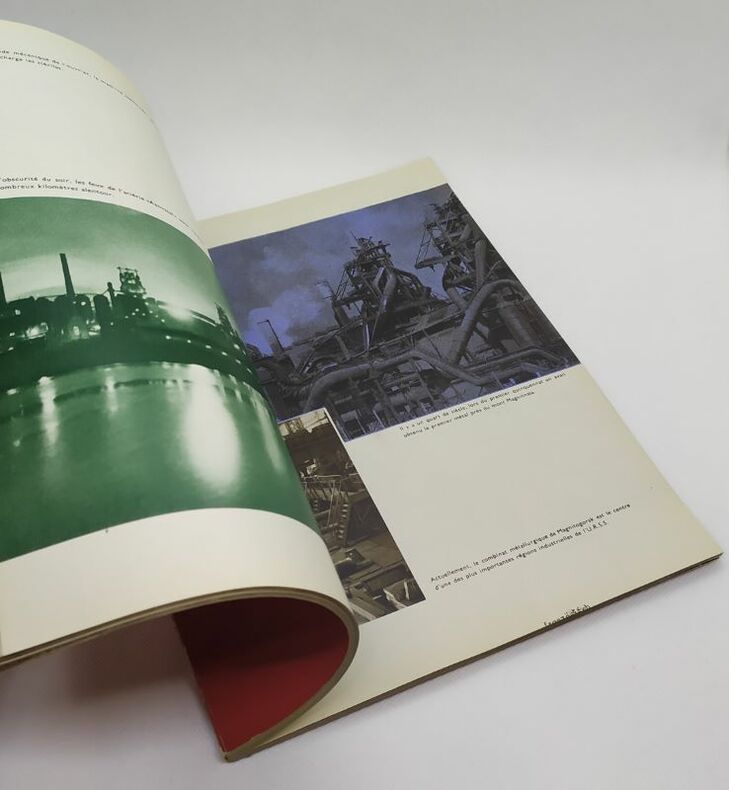
3092Sans mention d'éditeur. Version française. 1958. Couverture souple illustrée, dos droit collé. Illustré de nombreuses photographies reproduites en héliogravure et en couleurs. Dim: : 263 x 206 mm. Non paginé. Très bon état.
3092Sans mention d'éditeur. Version française. 1958. Couverture souple illustrée, dos droit collé. Illustré de nombreuses photographies reproduites en héliogravure et en couleurs. Dim: : 263 x 206 mm. Non paginé. Très bon état.