COLLECTIFLivre Rare Book

8 119 résultats
19356911935 - reliure - Sanjian Shuwu 三閒書屋 - Yinyu ji 引玉集 (« Recueil pour attirer le jade ») 木刻五十九幅 - Deuxième tirage, avril 1935 - In-8 (19,5 × 15,5 cm) reliure cartonnée de l'éditeur, dos noir, pièce de titre contrecollée sur le premier plat - 68 pages - 59 reproductions de gravures sur bois soviétiques imprimées au procédé collotype (珂羅版) d'après les tirages originaux fournis par les artistes - Comprend un texte de Chen Jie (陳節), traduction abrégée d'un essai de A. D. Chegodaev consacré à la gravure soviétique contemporaine - Tirage limité à 215 exemplaires, dont 15 exemplaires hors commerce - Diffusion assurée par la librairie Uchiyama (內山書店), Shanghai - Ouvrage en chinois - Avec des œuvres de Dmitri Isidorovich Mitrokhin, A. Kravchenko, N. Piskarev, Vladimir Andreevich Favorsky, P. Pavlinov, A. Goncharov, M. Pikov, Sergei Mikhalovich Mocharov, L. Khizhinsky, Nikolai Vasilievich Alekseev et Sergei Mikhailovich Pozharsky - A PROPOS : Rare anthologie consacrée à la gravure soviétique moderne, publiée à Shanghai par 三閒書屋 et diffusée par la librairie Uchiyama (內山書店). L'ouvrage réunit cinquante-neuf reproductions en collotype de gravures sur bois réalisées par plusieurs figures majeures de l'école russe et soviétique de la gravure des années 1920-1930, parmi lesquelles Vladimir Favorsky, Dmitri Mitrokhin, Alexei Kravchenko et Pavel Pavlinov. Accompagné d'une traduction abrégée par Chen Jie d'un essai de l'historien de l'art soviétique A. D. Chegodaev, ainsi que d'une préface, d'un catalogue des planches et d'une postface, le volume fut conçu comme une introduction à l'estampe contemporaine soviétique pour le public chinois. Témoignage remarquable des échanges artistiques sino-soviétiques dans le Shanghai républicain des années 1930, il s'inscrit dans le contexte du mouvement de la Nouvelle Gravure (新興木刻運動), alors en plein essor sous l'influence des milieux intellectuels de gauche et des réseaux culturels gravitant autour de la librairie Uchiyama et de la figure de Lu Xun. Les reproductions furent réunies à partir de documents et publications soviétiques découverts au début des années 1930, notamment par l'intermédiaire de la revue Graphika. /// ENGLISH: Sanjian Shuwu (三閒書屋) - Yinyu ji (引玉集, “Collection to Draw Forth Jade”): Fifty-Nine Woodcuts (木刻五十九幅) - Second printing, April 1935 - Octavo (19.5 × 15.5 cm), publisher's boards with black spine and mounted title label on upper cover - 68 pages - 59 collotype (珂羅版) reproductions of Soviet woodcuts printed from original impressions supplied by the artists - Includes a text by Chen Jie (陳節), an abridged translation of an essay by A. D. Chegodaev on contemporary Soviet printmaking - Limited edition of 215 copies, including 15 non-commercial presentation copies - Distributed by Uchiyama Bookstore (內山書店), Shanghai - Text in Chinese - Featuring works by Dmitri Isidorovich Mitrokhin, Alexei Kravchenko, Nikolai Piskarev, Vladimir Andreevich Favorsky, Pavel Pavlinov, Aleksandr Goncharov, Mikhail Pikov, Sergei Mikhailovich Mocharov, Leonid Khizhinsky, Nikolai Vasilievich Alekseev and Sergei Mikhailovich Pozharsky. ABOUT: Rare anthology devoted to modern Soviet wood engraving and printmaking, published in Shanghai by Sanjian Shuwu and distributed through Uchiyama Bookstore (內山書店). The volume gathers fifty-nine collotype reproductions of woodcuts by several leading figures of the Russian and Soviet printmaking revival of the 1920s and 1930s, including Vladimir Favorsky, Dmitri Mitrokhin, Alexei Kravchenko and Pavel Pavlinov. Accompanied by Chen Jie's abridged translation of an essay by Soviet art historian A. D. Chegodaev, as well as a preface, plate catalogue and postface, the work was conceived as an introduction to contemporary Soviet printmaking for Chinese readers. A remarkable testimony to Sino-Soviet artistic exchanges in Republican-era Shanghai, it belongs to the context of the New Woodcut Movement (新興木刻運動), then flourishing under the influence of left-wing intellectual circles and cultural networks associated with Uchiyama Bookstore and the figure of Lu Xun. The reproductions were assembled from Soviet books, periodicals and documentary sources discovered in the early 1930s, notably through the journal Graphika. /// 中文:三閒書屋出版 — 《引玉集:木刻五十九幅》 — 1935年4月再版 — 32開(19.5 × 15.5厘米)精裝本,黑色書脊,封面貼書名籤 — 68頁 — 收錄蘇聯木刻作品59幅,以珂羅版工藝依據藝術家提供之原拓本複製印製 — 附陳節摘譯 A. D. Chegodaev(契戈達耶夫)論蘇聯現代版畫藝術之文章 — 限印215部,其中15部為非賣贈送本 — 上海內山書店代售 — 中文版 — 收錄 Dmitri Isidorovich Mitrokhin、Alexei Kravchenko、Nikolai Piskarev、Vladimir Andreevich Favorsky、Pavel Pavlinov、Aleksandr Goncharov、Mikhail Pikov、Sergei Mikhailovich Mocharov、Leonid Khizhinsky、Nikolai Vasilievich Alekseev 及 Sergei Mikhailovich Pozharsky 等藝術家作品。關於本書:本書為三閒書屋於上海出版、由內山書店代售之珍稀蘇聯現代木刻版畫選集。全書收錄59幅以珂羅版精印之蘇聯木刻作品,作者均為1920至1930年代俄羅斯及蘇聯版畫復興運動的重要藝術家,其中包括弗拉基米爾·法沃爾斯基(Vladimir Favorsky)、德米特里·米特羅欣(Dmitri Mitrokhin)、阿列克謝·克拉夫琴科(Alexei Kravchenko)及帕維爾·帕夫利諾夫(Pavel Pavlinov)等人。書中除收錄陳節摘譯之蘇聯藝術史家 A. D. Chegodaev 論文外,尚附序言、圖版目錄及後記,旨在向中國讀者介紹蘇聯當代版畫藝術。本書不僅是研究俄蘇版畫的重要文獻,亦是1930年代上海中蘇藝術交流的珍貴見證。其出版背景與中國新興木刻運動(新興木刻運動)密切相關,反映了左翼知識界、內山書店文化網絡以及魯迅所倡導之版畫思想的深遠影響。書中圖版主要彙集自1930年代初傳入中國之蘇聯書籍、期刊及藝術資料,其中包括《Graphika》等重要出版物。
1965mon0000121503PROGRESS PUB. 1965-01-01. Hardcover. Good. 2.5000 in x 8.5000 in x 5.9000 in. No DJ. Mild shelf wear and fading to both volumes. Former owner's name on inside cover otherwise pages clean. Cup mark on volume one's cover. PROGRESS PUB. hardcover
Very Good Russian Original dark green cloth bdg. Oblong folio. (28 x 36 cm). Eight languages of the title on the colophon, the text is completely Russian. [6], [ii], 108 p., [36] maps in various sizes, some of folded: (62x47 cm, 52,5x45,5 cm, 49,5x27 cm [x3], 61x47 cm; other maps are 36x28 cm). Four unnumbered leaves with half-title and contents for each section. Two small millimetric cuttings on two text pages. Ex-owner's name is on the title page. Markings on the index. Otherwise a very good and clean copy. Rare complete and the first atlas including a fine collection of 36 attractive chromo-lithograph maps mostly with tissue papers of the Soviet Union, edited by the Central Executive Committee and Enukidze (1877-1937), who was a prominent Georgian "Old Bolshevik". One of 11000 copies. Being published only 10 years after the USSR was established, this is the earliest atlas of the country. It seems to have been published with a wider audience in mind, with a title page in various European languages. The borders of many areas -including not just administrative regions throughout the USSR, but also entire autonomous republics (especially in Central Asia)- were in a state of flux; as such, the borders in this Atlas (including the wax-paper overlays meant to update various maps with changes made between when they were drawn and when the Atlas was published) often don't look anything like the borders they were set at the end of the Soviet Union and have continued on to modern times. Since the boundaries were often ideologically- (sometimes ethnically-, less so economically-) motivated, this offers an interesting insight into the mindset of the administration that was making these changes. Map list: World map, General USSR, USSR in Europe, Asia and USSR, Karelian Autonomous Soviet Socialist Republic, Komi-Zyryan Autonomous Oblast, Avt, Votskaya Oblast, Maryinskaya, Cherepovetsky District, Vologda Oblast, Avt. Chuvashskaya SSR (Chuvashia), Avt. Tatarskaya SSR (Tatarstan), Avt. Bashkirskaya SSR (Bashkiria), ASSR Nemchev Povoljiya, Kalmykia (Kalmykia), Krimskaya SSR (Crimea), Adigeiskaya (Tscherkeskaya) Obl. (Cherkesia), Kabardino-Balkarskaya Avt. Obl. (Kabardino-Balkarian Rep.), Karachayskaya Avt. Obl. & Tscherkesskiy Nation. Okrug (Karachay-Cherkessia), Chechenskaya Avt. Obl. (Chechnya), Ingushetiya, Severo-Osetiya, Avt. Daghestanskaya SSR, Avt. Kazakskaya SSR, Kyrgyzkaya ASSR, Avt. Oiuratskaya Oblast, Burito - Mongolskaya SSR (Kazakhstan), Avt. Yakustkaya SSR (Yakutia), Beloruskaya SSR (Belarus), Ukrainskaya, SSR (Ukraine), Moldavskaya SSR (Moldovia), Zakavkazkaya SSR (Abkhazia), Azerbaijanskaya SSR (Azerbaijan), Arminskaya SSR (Armenia), SSR Gruzii (Georgia), Central Asian SSR (Karakalpakstan, Kyrgyzstan, Turkmenistan, Uzbekistan), Uzbekistan, Turkmenistan. OCLC shows copies in twenty-three libraries worldwide: 7852120, 968755133, and 822577467.
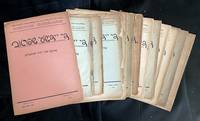
193042139Kiev: Katedr far Yidisher Kultur ba der Ukr. Visnshaftl. Akademye Filologishe Sektsye 1930. Paper Wrappers. 1st edition. Original printed publisher’s color paper wrappers 4to large ca 72-116 columns ca 36-58 pages per issue. 28 cm. In Yiddish. Title translates roughly as “The Yiddish Language.†Succeeded in 1931 by “Afn shprakhfront.â€Di Yidishe Shprakh was a “Yiddish linguistic journal published in Kiev from 1927 to 1930. A bimonthly journal Di yidishe shprakh The Yiddish Language was published by the cooperative publishing house Kultur-lige and was the main philological publication of the Kiev Yiddish academic center. Its editor was the veteran Yiddishist Nokhem Shtif a founder of YIVO who had returned to Kiev from Germany in 1926. The journal’s inaugural issue March–April 1927 was published under the auspices of the Central Yiddish Bureau of the Ukrainian Commissariat for Education. With the next issue Di yidishe shprakh was an organ of the Chair and from July to October 1929 it was an organ of the Institute for Jewish later Proletarian Jewish Culture at the Ukrainian Academy of Sciences. Initially defined as a 'journal for practical Yiddish linguistics' from May to June 1927 it appeared as simply a 'journal for Yiddish linguistics. 'Shtif distinguished three language registers: the vernacular of the old generation partly represented in the works of Sholem Aleichem and predecessors; the highbrow language of modern writers such as Dovid Bergelson; and the contemporary 'culture language' most notably of the press. Although Shtif sought to target speakers of the mass 'culture language' the journal’s circulation hovered around 500 copies read mainly by Yiddish teachers.Apart from Shtif who published articles on various language-planning problems the most active contributors to Di yidishe shprakh were Ber Slutski Ayzik Zaretski Elye Falkovitsh Lipe Reznik and Shimen Dobin. In early 1929 Moscow literary critic Aron Gurshteyn criticized the journal for its purist approach to language planning. In the July–October 1929 issue Shtif published his article 'Di sotsyale diferentsiatsye in yidish' The Social Differentiation in Yiddish heralding an intensification of Soviet linguists’ anti-Hebraist campaign. That issue of Di yidishe shprakh adopted completely reformed Soviet spelling omitting for example final consonant letters.Although the last—twenty-fifth—issue of the journal was dated November–December 1930 it included materials from the First All-Union Yiddish Language Conference convened in Kiev from 8 to 13 February 1931 that issue is present here. Published under the imprint of the Central Publishing House this issue also signaled the demise of the remaining vestiges of the Kiev Kultur-lige. Yoysef Liberberg’s article 'Far parteyishkayt in der yidisher visnshaft-arbet' For a Party Approach to Yiddish Linguistics marked a full break with YIVO scholars particularly with YIVO director Max Weinreich whom Liberberg ridiculed for presenting Yiddish as an emanation of the Ashkenazic Jews’ soul. The Yiddish Language Conference decided to change the name of the journal. Between 1931 and 1939 it appeared sporadically under the title Afn shprakhfront On the Language Front reflecting its new more aggressive and politically charged approach' Gennady Estraikh in YIVO Encyclopedia of Jews in Eastern Europe 2010. For more see David Shneer “Yiddish and the Creation of Soviet Jewish Culture 1918–1930†Cambridge and New York 2004. SUBJECTS: Yiddish language -- Periodicals. Title also listed on covers in Russian “Ievreis'ka Mova†and German “Jiddische Sprachâ€. OCLC: 22840298. Most holdings in OCLC appear to be fragmentary. Covers are browning and fragile as expected but are otherwise very well preserved with very little edgewear. Internal text pages are also toning but remain relatively strong as pulp paper. Very important journal scarce in this degree of completeness Note that Estraikh suggests a circulation of only 500!. B YID-43-5-E. Kiev: Katedr far Yidisher Kultur ba der Ukr. Visnshaftl. Akademye, Filologishe Sektsye unknown
FT) Original Stapled Wrappers. 8vo. 24; 56; 24; 15; 40; 12; 2; 6; 20; 47; 24; 32; 52; 16; 38 pages. In Russian. Title translates to English as, Diary of a Social Democrat. Menshevik journal edited by Plekhanov published sporadically from 1905-1911 containing open letters and polemics on various subjects. Issue no. 4 includes a letter directed To Comrade X, likely directed at Lenin, with whom he famously split a few years prior, and a direct response to Aleksandr Martinov. CONTENTS: Patriotizm I Sotsializm [Patriotism and Socialism] --- Nashe Polozhenie [Our Position] ---Esche o Nashem Polozhenii: Pismo k Tovarischu X [More on Our Position: A Letter to Comrade X] --- K Agrarnomu Voprosu v Rossii [On the Agrarian Issue in Russia] --- O Chrezvyshaynom Partiynom Sezde (Otkritoe Pismo k Tovarischam) [On the Emergency Party Congress (An Open Letter to the Comrades) ] --- O Vozobnovlenii Moego Dnevnik [On Resuming my Diary] --- Samoubiystvo ili Borba [Suicide or Struggle] --- Poslednee Plenarnoe Sobranie Nashego Tsentralnago Komiteta [The Last Plenary Meeting of our Central Committee] --- Legalnyya Rabochiya Organizatsii I Rossiyskaya Sotsial-Demokraticheskaya Rabochaya Partiya [Legal Labor Organizations and the Russian Social Democratic Labor Party] --- Polemicheskaya Bezpomoshnost (Otvet t. Martynovu) [Polemical Helplessness (A Response to c. Martinov) ] --- K Voprosu o Vozrozhdenii Nashey Partii [On the Issue of the Rebirth of our Party] --- Chrezvychaynyy Sezd Mezhdunarodnago Sotsialisticheskago Byuro [Emergency Congress of the International Socialist Bureau]. French title across top-margin: Le Journal dun Socialdemocrate. OCLC lists one copy (National Library of Israel) . Nos. 1 & 9 covers detached and worn at edges, but present. Supplement to No. 7 chipping at edges with minor loss of text. Remaining issues are nice and clean. Very Good Condition. (RUS-11-26A)
1st edition. Original dramatic constructivist paper covers 8vo, 135 pages ; 22 cm. In Yiddish. Title also in Russian on copyright page: Dlia stseny. SUBJECT (S) Yiddish literature. OCLC lists 3 copies worldwide (LOC, UMaryland, NLI) . Ex-library, but only with bookplate to later boards and faint blindstamp on non-illustarted title page. 1 inch closed tear to illustrated cover, one corner repaired, lacks spine. Paper browning with dampstaining throughout, but staining is not obtrusive on the illustrated cover. Lacks backstrip, otherwise Good Condition thus. (YID-26-10)
322 pages. Translated from the first Russian edition. Contents include: Jews in the land of Kiev Russia and the Moscow State; The first Jews in Russia; The further growth rate of Jews in Russia; Politics of the Russian Government with regard to the Jewish question; How Jewish capital was created in Russia; The social structure of Russian Jewry; Jewish participation and their role in the cultural life of Russia; Jews in Russian literature and criticism; Jews - Russian lawyers; Russian Jewry at the beginning of the twentieth century; The Balis Affair; The Jewish question from February to October 1917; Jews in USSR; Personal-national autonomy; Thirty-year total; The war years; The post-war period; The state of Israel and the problem of double citizenship; Supplements I and II. Apparently the author self-published a first English edition in New York in 1967. This copy may be a later reprint as a small Truth Seeker address label has been placed over original text on the copyright page. Regardless, this copy appears to be circa 1970s or prior. Brown stains to lower portion of back cover modestly affect last three pages - text unaffected. Binding intact. Unmarked. A sound copy. Book
(FT) Original Newspaper. Folio. Numbers 2-25 are between 8-12 pages. Numbers 33-58 are 2 pages each. In Russian. Title translates to English as, The Social Democrat. Subtitle: Tsentralnyy Organ Rossiyskoy Soctsialdemokraticheskoy Rabochey Partii [The Central Organ of the Russian Social Democratic Labour Party]. Contributing authors include Lenin, Trotsky and Martov. Includes supplements to numbers: 6, 19-20, 23, and 42. The Social-Democrat was an illegal Russian newspaper, Central Organ of the R. S. D. L. P. , published from February 1908 to January 1917. Altogether 58 issues appeared. The first issue was put out in Russia, but further publication was arranged abroad, first in Paris, then in Geneva The Editorial Board was made up of representatives of the Bolsheviks, the Mensheviks and the Polish Social-Democrats. The paper was largely run by Lenin, [who] fought for a consistent Bolshevik line on the Editorial Board. From December 1911 Sotsial-Demokrat was edited by Lenin Lenin's articles published in Sotsial-Demokrat during the war played an important part in helping to apply the strategy and tactics of the Bolshevik Party on the questions of war, peace and revolution, in denouncing social-chauvinists, and uniting the internationalist forces in the world labour movement (Encylopedia of Marxism) . CONTENTS INCLUDES: Tsel' Bor'by Proletariata v Nashey Revolyutsii [The purpose of the Struggle of the Proletariat in our Revolution] Rabochaya Gruppa na Zhenskom Syezd [The Worker's Group at The Women's Congress] Itogi Syezda Fabrichno-Zavodskikh Vrachey [The results of the congress of factory physicians] Kont-Revolyutsiya I Burzhuaziya [Counter-revolution and Bourgeois] Klassy I Partii v ikh Otnosheniy k Religii I Tserkvi [Classes and parties in their relations to religion and Church] Vopros' o Professional'nykh Soyuzakh v 3-oy Dume [Questions on trade unions in the Third Duma] O Fraktsii "Vperedovtsev" [About the Faction "Vpered"] Fraktsiya Trotskogo I Partiynoe Polozhenie [Trotsky's faction and party position] Mezhdunarodny Sotsialisticheskiy Syezd v Kopengagen [The International Socialist Congress in Copenhagen] Karl Marks I Lev Tolstoy [Karl Marx and Tolstoy] Stolypin I Revolyutsiya [Stolypin and the Revolution] Voyna I Rossiyskaya Sotsial-Demokratiya [War and the Russian Social-Democracy] Sotsialisticheskaya Partii Evropy vo Vremya Voyny [The Socialist Party of Europe during the War] Povorot Martova [Martovs Turn] Germanskaya Sotsial-Demokratiya I Buduschiy Internatsional' [German Social Democracy and the Future International] Patsifizm ili Marksizm (Zloklyucheniya Odnogo Lozunga) [Pacifism or Marxism (Misadventures of a slogan) ] Tsimmerval'd-Kintal': Vtoraya Tsimmerval'dskaya Konferentsiya [Zimmerwald-Kienthal: Second Zimmerwald Conference] Povorot' v Mirovoy Politike [Turn in world politics]. All original prints except No. 25 (facsimile) . Most pages darkened and somewhat fragile but still nice; several pages with chipping at edges, some with minor loss of text. Good+ condition. (RUS-11-1)
364 pages. Index. Three maps. Black and white photographic plates. "For the first time, a historian - Soviet defector Viktor Suvorov - shows that the USSR's part in starting WWII was much greater, and much more sinister, than has hitherto been assumed. A direct and often harrowing challenge to accepted history. Its achievement is to force us all to revise radically our ideas of - and the reasons for - the most destructive war mankind has ever experienced." - dust jacket. Clean and unmarked with light wear. Dust jacket now preserved in glossy new archival-grade Brodart. A quality copy. Book
Original Paper Wrappers. 4to. issues are 16-20 pages each. 28cm. In Russian. Title translates to English as, "The Banner of Struggle." Published sporadically, and eventually annually, from 1924-1930. CONTENTS: Budet Burya! [A Storm is Coming!] --- V Zaschitu Russkikh Revolyutsionerov [In Defense of Russian Revolutionaries] --- Sotsial-Bessarabtsy [The Social Bessarabians] --- Mezhdunarodnoe Revolyutsionnoe Dvizhenie [International Revolutionary Movement] --- Kultura i Revolyutsiya [Culture and Revolution] --- K Godovschine Iyul'skikh Dney [The Anniversary of the July Days] --- K Desyatiletniyu "Velikoy Voyny" [On the Decade of the "Great War"] --- Krovavyye Maski [Bloody Mask] --- V Godovschinu Dekabr'skoy Boyni 1923 goda [On the Anniversary of the December 1923 Massacre] --- O Veilkom Krizise v Marksizme, Sotsializme, Demokratizme i Rabochem Dvizhenii [The Great Criss in Marxism, Socialism, Democracy and the Labor Movement] --- Vashi Voprosy i Nashi Otvety [Your Questions and Our Answers] --- Golos Revolyutsionerov iz Rossiyskikh Tyurem [The Voice of Revolutionaries from Russian Prisons] --- O Natsional'nykh Men'shinstvakh na Ukraine [On the National Mensheviks in Ukraine] --- Manifest k Trudyaschimsya Goroda I Derevni [Manifest to the Workers of Cities and Villages] --- S'ezd Mezhdunarodnago Byuro Rev.-Sots. Partiy [Congress of the International Bureau of the Rev.-Soc. Party] --- Stalin, Trotskiy ili Revolyutsiya [Stalin, Trotsky or Revolution] --- Nelegal'nye Dokumenty RKP [Illegal Documents of the RCP (Russian Communist Party)] --- Desyat' Let Oktryabr'skoy Revolyutsii [Ten Years From the October Revolution] --- Na Poroge Dvenadtsatogo Goda [On the Eve of the Twelfth Year] --- Osnovnye Prichiny Krizisa Sotsializma [The Main Causes of the Crisis of Socialism] --- Na Poroge Trinadtsatogo Goda [On the Eve of the Thirteenth Year]. The "Union of Socialists-Revolutionaries Maximalists was a political party in the Russian Empire, a radical wing expelled from the Socialist-Revolutionary Party in 1906. The Union united agrarian terrorists, the 'Moscow Opposition' and other radical dissidents from the PSR in an independent party. The Maximalists officially split off from the PSR at its Second Congress in Imatra in 1906. Maximalists played a role in both the Revolution of 1905 and the Revolution of 1917. Many former SR Maximalists eventually joined the Russian Communist Party (Bolshevik) .Maximalists were so called because they demanded the full implementation of the 'maximum programme' in the expected revolution: full socialisation of the land, factories and all other means of production. The orthodox Socialist-Revolutionaries wanted to start with land reform but defer socialisation of other means of production. The Maximalists also rejected the PSR's version of a 'two-stage' revolution, a theory associated with V.M. Chernov. According to Chernov, the coming revolution in Russia would not be purely 'bourgeois-democratic' as the Social-Democrats claimed, but would include social and economic as well as political reforms. It would be a 'popular-democratic' revolution, and would transition into a full-blown 'labour-socialist' revolution later on. The Maximalists rejected this as Social-Democratic 'attentism' and argued that the coming Russian revolution would not be able to stop half-way; it was the two-stage theory, not Maximalism, that was unrealistic if it thought the toiling masses, once liberated, would content themselves with a bourgeois republic and gradual reforms." (Wikipedia, 2012) OCLC lists 9 copies. Publisher's typo on final page of No. 20/21: issue listed as "No. 20-25". Pages darkened but not fragile; some edgewear. Issue no. 24-26 worn with minor closed tears along gutter margin. Issue no. 8 outer wrappers detached but present. No 12/13 with small loss of paper and a few words. Overall, in Very Good Condition, a scarce complete run of this important journal. (RUS-11-37)
In-16 gr. (mm. 195x115), 2 volumi, p. pelle bazana coeva, fregi e titolo oro su tassello al dorso (piccola manc. alle cuffie), tagli rossi, pp. (6),VIII,280; (4),380,VI,(4); con 3 tavole incise in rame (più volte ripiegate) di cui 2 carte geografiche che raffigurano la "Route dans la presqu'isle de Kamtschatka - Route depuis Avatscha" e 1 bella tavola, incisa da Choffard, che illustra una carovana Kamtschadale. "Prima edizione". Cfr. Brunet,III,1016: "Ouvrage curieux, et dont les exemplaires ne sont pas communs" - Graesse,IV,178. “Jean-Baptiste Barthélemy, baron de Lesseps, diplomate français (1766-1834), accompagna La Pérouse dans une partie de son voyage (1784-1787) et ramena du Kamtchatka les documents de l'expédition, publiés en 1790”. Così “Grand Larousse”,VI,702. Esemplare ben conservato.
210120Paris, A. J. Kilian, Paris, Ch. Picquet, 1826 in-8, 10-XX-381 pp., fac-similé dépl., basane brune cailloutée, dos lisse orné, tranches marbrées (reliure de l'époque).
(FT) Original Newspaper. Folio. Each issue is 2-4 pages. In Russian. Title translates to English as, Life: A Politiical, Social and Literature Newspaper. Published daily (except Monday) March 12, 1915 June 4, 1915 and weekly thereafter until Jan. 2, 1916. ISSUES INCLUDED: 2-26, 28-61, 68 (6) , 69(7) , 72 (10) . CONTENTS INCLUDES: Bessilie Printsipov [The Impotence of Principles] -- Ideaologicheskiy Krizis [Ideological Crisis] -- Natsionalizm v Narodnom Khozyaystve [Nationalism in the People's Economy] -- Militarzatsiya Sotsializma [The Militarization of Socialism] ---Shtyk-Sotsialisty [Bayonet Socialism] -- Sotsialisticheskiy Shovinizm [Socialist Chauvinism] -- Internatsionalizm I Vospitanie Proletariata [Internationalism and the Education of the Proletariat] -- Manifest Levykh [Manifest of the Left] -- Hemetskaya Sotsial-Imperialiistskaya Ideologiya [German Social-Imperialist Ideology] -- Erve Protiv Libknekhta [Hervé Against Liebknecht] -- Eshche o Rossiyskoy Demokratiy [More About Russian Democracy] -- Sotsialdemokratiya I Zashchita Otechestva [Social Democracy and the Protection of the Fatherland] -- Pervaya Treschina v Internatsionalizme [The First Crack in Internationalism] -- V Sotsialisticheskom Mire: Posle Natsionalnago Soveta [In a Socialist Word: After the National Council]. All pages are tanned but not fragile; most with some minor chipping, closed tears at edges but only minor loss of text from some wear through to one issue (No. 7) . Good condition. (RUS-11-13)
(FT) Original Newspaper. Folio. First four issues are 12 pages each (36cm) ; remainder are 4-6 pages each (48cm) . In Russian. Issues 1-13, 15-25 with supplements for 17, 12 and 21 as well as a broadsheet on May Day (International Workers' Day) . Title translates to English as, "Truth: Labor Newspaper. " The original Pravda was founded in 1905 by Spilka, a breakaway party from the Revolutionary Ukrainian Party. In October 1908 Leon Trotsky was called in to edit the newspaper and pick it up from its insignificant and run down state. After several issues, the Spilka left the newspaper to Trotsky the subtitle "Organ Ukrainskago Soyuza 'Spilki' [Organ of the Ukrainian Union 'Spilka'] appears only on the first two issues who converted it into a Russian social democratic newspaper aimed at Russian workers. The editorial staff consisted of Trotsky and, at various times, Victor Kopp, Adolf Joffe and Matvey Skobelev, who tried to avoid the factional issues that divided Russian émigrés and concentrated on the issues of interest to Russian workers. The newspaper published its last issue on April 23, 1912. CONTENTS INCLUDES: Pora Prosnut'sya Sel'skim Rabochim [It's Time to Wake Up the Rural Worker] -- Ha Bor'bu s Bezrabotitsey I Golodom [The Fight Against Unemployment and Hunger] -- Balkanskiy Vopros [The Balkans Question] -- Zhizn' I Bor'ba Mirovogo Proletariata [Life and Struggle of the World Proletariat] -- Polozhenie "Pravdy" v Partii [The Position of Pravda in the Party] -- Nasha Partiya I Yeya Zadachi [Our Party and It's Problems] -- Zhelezo I Krov' [Iron and Blood] -- Karl Marks I Rossiya v 1909 g. [Karl Marx and Russia in 1909] -- Natsional'naya Bor'ba I Edinstvo Proletariata [National Struggle and Unity of the Proletariat] -- Kooperativy I Sotsializm [Cooperatives and Socialism] -- Russkie Rabochie I Evreyskoe Bezpravie [Russian Workers and the Jews Without Rights]. Non-archival tape to front of No. 1 with some damage to text. Some light wear and closed tears to edges of several issues, but no other loss of text. Very Good Condition. (RUS-11-12a)
1st edition. Bound in period boards cloth. Folio. Each issue is about 6 pages. In Russian. Vpered and Proletariy bound together. Vpered was the first Bolshevik weekly newspaper, published in Geneva from Dec. 22, 1904 (Jan. 4, 1905) to May 5 (18) , 1905, founded after the Mensheviks seized control of the central organ of the RSDLP, Iskra. The first issue alone contained The Autocracy and the Proletariat (an editorial) , On Good Demonstrations of Proletarians and Poor Arguments of Certain Intellectuals, Time to Call a Halt, and other articles by Lenin. The significance of Vpered in the history of the CPSU is defined by the fact that the paper was an ideological-political organ abroad that cooperated with the practical organ in Russiathe Bureau of Committees of the Majorityto give political and organizational shape to Bolshevism (The Great Soviet Encyclopedia, 3rd Edition. 1979) . Vpered articles include: Somneniya Dvuglavago Orla [Doubts About the Double-Headed Eagle] -- Politika Ustupok [Policy Concessions] -- Nachalo Revolyutsii v Rossii [The Beginning of the Revolution in Russia] -- Dolzhni-li My Organizovat Revolyutsiyu [Should We Organize a Revolution] -- Bankrotstvo Politseyskago Rezhima [Bankruptcy of a Police Regime] -- Bakinskiy Pogrom [Baku Pogrom] -- Marks ob Amerikanskom Chernom Peredele [Marx on American Black Redistribution] -- Vozrozhdenie Pravoslavnoy Tserkvi [The Rebirth of the Orthodox Church] -- Rol Organizatsiy v Narodnykh Dvizhenyakh [The Role of Organizations in the Peoples Movement]. Proletariy was published in Geneva from May 14 (27) until November 12 (25) , 1905, with a total of twenty-six issues during the heights of political and social unrest of the Revolution of 1905. Active in the work of the editorial board were V. Vorovsky A. Lunacharsky, and M. Olminsky. Proletariy continued the policy of the old, Leninist Iskra, and maintained full continuity with the Bolshevik newspaper Vpered. Proletariy articles include: Mezhdunarodnoe Znachenie Russkoy Revolyutsii [International Significance of the Russian Revolution] -- Demokraticheskiya Zadachi Revolyutsionnago Proletariata [Democratic Tasks of the Revolutionary Proletariat] -- Noviy Revolyutsionnyy Rabochiy Soyuz [New Revolutionary Workers Union] -- Rabochiy Klass I ego Vragi [The Working Class and Its Enemies] -- Russkiy Tsar Ischet Zaschity Svoego Naroda Y Turetskago Sultana [Russian Tsar Seeks Protection From His Own People With Turkish Sultan] -- Ocherki iz Revolyutsionnoy Borby Zapadno-Evropeyskago Proletariata [Sketched from the Revolutionary Fight of the Western European Proletariat] -- Edinenie Tsarya s Narodom I Naroda s Tsarem [Union of the Tsar and with the People and of the People with the Tsar] -- Pervaya Pobeda Revolyutsii [The First Victory of the Revolution]. Some pages are darkened, particularly at edges, but not fragile. Very Good condition. (RUS-11-10)
1958055782Cairo: The USSR Embassy Press Office in the United Arab Republic UAR 1958. 1st Edition . Hardcover. Very Good. 8vo - over 7¾ - 9¾" tall. Contemporary full green cloth in Egyptian style contemporary white endpapers gilt lettering of title on front board and gilt decorations on spine. Original pictorial cover saved inside. Roy. 8vo. 24 x 17 cm. In Arabic. 88 p. 12 b/w ills. including drawings and reproduced photographic plates. Extremely rare unrecorded first issue of this Soviet propaganda organ published in Cairo the centre of the UAR by the USSR Propaganda Press Office with a striking cover design depicting the Sputniks in space celebrating the third anniversary of the Kosmicheskaya programma SSSR. The content begins with a comparison between the Soviet and American satellites. A full-paged photograph shows the Muscovites reading newspapers about the launch of the third Soviet satellite into space. In the periodical many details such as the construction processes and technical specifications of the satellites are explained as well as a striking history of the Soviet Space Program. Relations between Russia and Egypt have a long history dating back to before the 16th century. In the 1950s Gamal Abdel Nasser's independent and anti-imperialist policy earned him enthusiastic support from the Communist government of the USSR. In 1955 Egypt made a major arm deal with the Soviet Union and from then teams of Egyptian officers were trained in Eastern Bloc countries. Czechoslovak instructors also came in 1956 to train Egyptian personnel in the use of Soviet weapons. When France attacked Egypt during the Suez Crisis the USSR threatened to use destructive weapons i.e. nuclear weapons for the defence of Egypt. The degree of the Soviet approval of the Egyptian leader's policies culminated rather controversially in the award of the highest Soviet decoration the star of the Hero of the Soviet Union with the Order of Lenin to Nasser during Nikita Khrushchev's visit to the country in 1964. Kosmicheskaya programma SSSR i.e. The Soviet Space Program was the national space program of the Union of Soviet Socialist Republics USSR active from 1955 until the dissolution of the Soviet Union in 1991. After WWII the Soviet and US space programs both utilized German technology in their early efforts. Eventually the program was managed under Sergei Korolev who led the program based on unique ideas derived by Konstantin Tsiolkovsky sometimes known as the father of theoretical astronautics. Contrary to its American European and Chinese competitors who had their programs run under a single coordinating agency the Soviet space program was divided and split among several internally competing design bureaus led by Korolev Kerimov Keldysh Yangel Glushko Chelomey Makeyev Chertok and Reshetnev. The Soviet space program served as an important marker of Soviet claims to its global superpower status. Wikipedia. As of May 2024 not in OCLC and KVK. <br/> <br/> The USSR Embassy Press Office in the United Arab Republic (UAR) hardcover
431 pages. Index. Bibliographical Notes. Enables readers to view world events from a Soviet perspective from the time of the Russian Revolution and moving forward. "The authors, who take the Stalinist treason trials and purges at face value, conclude that illusions about the Soviet Union were not shattered until she proved her strength during World War II". - Joel Seidman. Somewhat above-average external wear and soiling. Front hinge tender but intact. Prior owner's signature and small vintage bookseller tag upon front free endpaper. A worthy reference copy of this fascinating work. Kolarz [2] p.153, Seidman S22. Book
P5852Moscow: Ministerstvo elektrostantsii SSSR 1958. Oblong folio 24.5 × 36 cm. Original silver embossed blue cloth with blue printed dust wrapper in protective card case; 197 pp. Illustrated profusely from photographs in black and white with captions. Small closed tears to front and back dust wrapper; card case rubbed and lightly soiled; lacking titl leaf; else a very well preserved copy. This impressively illustrated album exhibited at the Soviet Pavilion during the Brussels World's fair in 1958 is filled with maps graphs drawings and photographs that tell the story of the electrical production of the Soviet Union. The album opens with a famous quotation from Lenin: "Communism is Soviet power plus the electrification of the whole country." The following pages contain graphs indicating rapid growth of electrical production maps that show the reach of electrical power and photographs of the enormous machines that service major urban centers like Moscow as well as entire regions like the Don Basin DONBAS. Typical for the Thaw and in contrast to similar albums form the heydays of the 'five year plans' all mentions of Stalin are conspicuously absent and the album is focused on images over text clearly trying to appeal to an international audience in keeping with new international policies of Nikita Khrushchev 1894-1971. Khrushchev came to power after the death of Stalin in 1953 and in his 1956 "secret speech" denounced Stalin's cult of personality and isolationist policies setting in motion the period known as the Thaw 1956-1968. Changing the international image of the Soviet Union was a major focus for Khrushchev and he saw international participation in cultural events as key. The Soviet presence at the Brussels World's fair in 1958 was a great success with the Soviet pavilion winning a grand prix and exhibiting among other technological innovations a facsimile of Sputnik a satellite that had gone into space in the previous year. Another grand prix went to the Volga Hydroelectric Station Volga GES images of which are richly represented in this album. unknown
FT) Original Newspaper. Folio. Issues are between 8-12 pages. In Russian. Title translates to English as, The Social Democrat. Subtitle: Tsentralnyy Organ Rossiyskoy Soctsialdemokraticheskoy Rabochey Partii [The Central Organ of the Russian Social Democratic Labour Party]. Contributing authors include Lenin, Trotsky and Martov. Includes supplement to number 19-20. The Social-Democrat was an illegal Russian newspaper, Central Organ of the R. S. D. L. P. , published from February 1908 to January 1917. Altogether 58 issues appeared. The first issue was put out in Russia, but further publication was arranged abroad, first in Paris, then in Geneva The Editorial Board was made up of representatives of the Bolsheviks, the Mensheviks and the Polish Social-Democrats. The paper was largely run by Lenin, [who] fought for a consistent Bolshevik line on the Editorial Board. From December 1911 Sotsial-Demokrat was edited by Lenin Lenin's articles published in Sotsial-Demokrat during the war played an important part in helping to apply the strategy and tactics of the Bolshevik Party on the questions of war, peace and revolution, in denouncing social-chauvinists, and uniting the internationalist forces in the world labour movement (Encylopedia of Marxism) . CONTENTS INCLUDES: Tsel' Bor'by Proletariata v Nashey Revolyutsii [The purpose of the Struggle of the Proletariat in our Revolution] Rabochaya Gruppa na Zhenskom Syezd [The Worker's Group at The Women's Congress] Itogi Syezda Fabrichno-Zavodskikh Vrachey [The results of the congress of factory physicians] Kont-Revolyutsiya I Burzhuaziya [Counter-revolution and Bourgeois] Klassy I Partii v ikh Otnosheniy k Religii I Tserkvi [Classes and parties in their relations to religion and Church] Vopros' o Professional'nykh Soyuzakh v 3-oy Dume [Questions on trade unions in the Third Duma] O Fraktsii "Vperedovtsev" [About the Faction "Vpered"] Fraktsiya Trotskogo I Partiynoe Polozhenie [Trotsky's faction and party position] Mezhdunarodny Sotsialisticheskiy Syezd v Kopengagen [The International Socialist Congress in Copenhagen] Krestyanskaya Reforma I Proletarski-Krestyanskaya Revolyutsiya [Peasant Reform and the Proletariat-Peasant Revolution]. Many pages darkened with rubbing and edgewear, creases throughout. Some markings in header and top margin, but all text is clear. Good Condition. (RUS-11-1a) xxxxxxxx
RO80102054IMPRIMERIE LEMERCIER. Non daté. In-Folio. Broché. Etat passable, Couv. défraîchie, Dos satisfaisant, Quelques rousseurs. 151 pages. Nombreuses photos en noir et blanc, dans le texte et hors-texte. Un portrait en héliogravure, avec serpente. Quelques planches de fac-similés. Dos usé. Déchirures sur la page de titre, et en marges sur quelques pages. Dos renforcé par de la toile, avec étiquette de code sur la coiffe en-tête. Tampons de bibliothèque sur la page de titre et dans quelques marges. 2nd plat de couverture non-original. Quelques traces d'humidité sur les 30 dernières, en marges n'altérant pas la lecture du texte.. . . . Classification Dewey : 947-Europe de l'Est, URSS
Edizione originale del primo omaggio della Rivoluzione bolscevica a Karl Marx. Un volume (18x26 cm) di (8)-187 pagine; ritratto in antiporta. In lingua russa (caratteri cirillici). Legatura coeva sovietica in mezza tela muta, piatti con carta marmorizzata. Ottime condizioni. Prima edizione di questa raccolta di articoli di capi del movimento comunista, Lenin, Rosa Luxembourg, Mehring, Kamenev. Nella prefazione Zinoviev racconta la genesi di questa opera, progettata nel 1908 per celebrare il 25esimo anniversario della morte di Marx, ma proibita dalla polizia zarista, e quindi pubblicata solo all'indomani della Rivoluzione d'Ottobre.
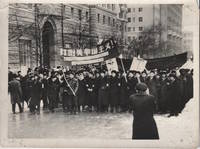
1965217848Beijing: No publication details. Circa1965. Complete set of 20 black and white photographs photographs 15 and 19 not numbered. 15 x 20.3cm. Explanatory slips of paper in simplified Chinese characters measuring 6.7 x 18.7cm are provided for 18 photographs lacking two slips for numbers 15 and 19. Pin-holes at corners of photographs corners little creased one corner chipped. An interesting collection of photographs in good condition. This collection of 20 black and white photographs shows a Chinese and international student demonstration against American imperialist aggression in Vietnam that took place in front of the American Embassy in Moscow in 1965. Photos 1-13 show an initially peaceful demonstration by Chinese and international students that turned ugly after Soviet troops cavalry vehicle-mounted guns and water sprayers were sent in with Russian generals personally taking charge. The chaos can be clearly felt in some of the blurred images where students were being beaten up and arrested. Photograph 14 shows an injured student Huang Zhaogeng being taken off a plane in Beijing on a stretcher. The photographs numbered 15 - 20 show demonstrations in Beijing in support of injured Chinese student demonstrators two leaders making speeches and medical care and support from friends. Text on the banners in photographs in Chinese and Russian. . No publication details. unknown
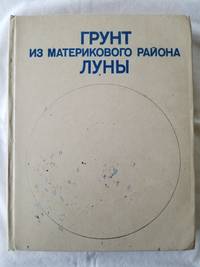
19791641Moscow: Nauka / Ðаука 1979. First edition. Hardcover. Good. Tan flexi-bound hardcover first edition. Text in Russian. A good only copy of this scarce publication from the USSR on lunar soil samples. Minor musty smell. Corners heavily bumped and soil to the front cover and the text block edges. Flexible binding is solid and pages are firmly bound in. Interior appears to be unmarked. Bumping to the lower corners of the pages. One miscut page is creased toward the final gathering of the book. Filled with charts graphs and some black and white photos. 708 pp. title page in English and Russian but the text is solely in Russian. Hard to find in any condition. <br /> Nauka / Ðаука hardcover
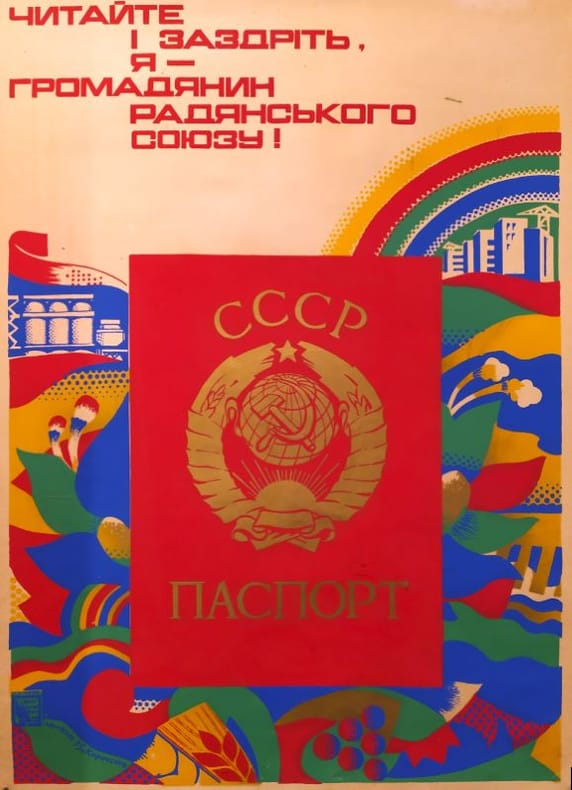
3146République Socialiste Soviétique d'Ukraine - Affiche de propagande. 1975. Impression en sérigraphie. Dim: 840 x 620 mm. Quelques petits défauts, très belle impression.
3146République Socialiste Soviétique d'Ukraine - Affiche de propagande. 1975. Impression en sérigraphie. Dim: 840 x 620 mm. Quelques petits défauts, très belle impression.