Thubron ColinLivre Rare Book

8 176 résultats
1991R300318199Payot. 1991. In-12. Broché. Bon état, Couv. convenable, Dos satisfaisant, Intérieur frais. 390 pages.. . . . Classification Dewey : 947-Europe de l'Est, URSS
8vo., First Edition, with endpaper maps; blue cloth, backstrip lettered in silver, a near fine copy in unclipped dustwrapper. SIGNED BY THE AUTHOR ON TITLE.
1988ROD0021828"Payot. 1988. In-8. Broché. Bon état, Couv. convenable, Dos satisfaisant, Intérieur frais. 391 pages. Illustration en couleurs sur la couv. Collection ""Voyageurs Payot"".. . . . Classification Dewey : 947-Europe de l'Est, URSS"
102.807Paris, Editions Payot, 1988. 14 x 21, 391 pp., broché, très bon état.
102.389Paris, Editions Payot, 1991. 12 x 19, 391 pp., broché, très bon état.
24111Paris, La Renaissance 1945, 1887x117mm, 226pages, broché.
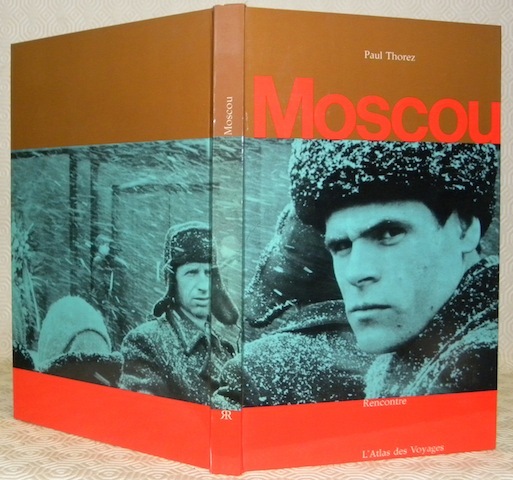
8235Lausanne, Editions Rencontre 1964, 270x170mm, 215pages, photos n/b, cartonnage de l’éditeur. Bel exemplaire.
1964R110116272RENCONTRE. 1964. In-4. Relié. Bon état, Couv. convenable, Dos satisfaisant, Intérieur frais. 215 pages. Nombreuses illustrations en couleurs et noir et blanc dans et hors texte.. . . . Classification Dewey : 947-Europe de l'Est, URSS
RENCONTRE. 1964. In-4 Carré. Relié. Bon état. Couv. convenable. Dos satisfaisant. Intérieur frais. 215 pages. Nombreuses illustrations en couleurs et noir et blanc dans et hors texte.
11284Paris, Lieu Commun, 1982 14 x 22, 198 pp., broché, bon état
15124Paris, Lieu Commun, 1985 14 x 22, 177 pp., broché, bon état.
1890RO80104230BERGER-LEVRAULT. 1890. In-12. Relié demi-cuir. Etat d'usage, Couv. défraîchie, Dos fané, Intérieur acceptable. 590 pages. Mors fendus. Etiquette de code sur la coiffe en-tête et tampons de bibliothèque sur la page de faux-titre et dans quelques marges.. . . . Classification Dewey : 947-Europe de l'Est, URSS
in-8°, 226 pp., broche, couverture illustree plast. Bel exemplaire (Qq. passages soulignes au crayon). [DV-14]
69590Paris, Hachette, 1989. 11 x 18, 282 pp., broché, très bon état.
2004121301L'harmattan 2004 In-8 broché 24,0 cm sur 16,0. 518 pages. Bon état d’occasion.
1824R320094858LECOINTE ET DUREY. 1824. In-18. Relié demi-cuir. Bon état, Couv. convenable, Dos satisfaisant, Intérieur frais. 358 pages - Plats, contre-plats et tanches jaspés - Signet conservé - Titre, fleurons, filets et roulettes dorés au dos.. . . . Classification Dewey : 947-Europe de l'Est, URSS
LECOINTE ET DUREY. 1824. In-18 Carré. Relié demi-cuir. Bon état. Couv. convenable. Dos satisfaisant. Intérieur frais. 358 pages - Plats, contre-plats et tanches jaspés - Signet conservé - Titre, fleurons, filets et roulettes dorés au dos. COLLECTION DE RESUMES
1986LFA-126724870Un ouvrage de 311 pages, format 155 x 240 mm, broché, publié en 1986, Bernard Grasset, bon état
Very Good Serbo-Croatian Original color lithographed print poster. Mounted on cardboard. Slight chip on the left corner, not loose. A good poster. 44x28 cm. In Serbo-Croatian. Artist signature: Kun, [Gleb?]. Red and black theme on the white surface. The peasant Serbian woman with her head and right hand raised to the sky is depicted. Antifastictika Fronta Zena [i.e. The Women's Antifascist Front] was a Yugoslav feminist and anti-fascist mass organization. The predecessor to several feminist front groups in the former Yugoslavia, and present-day organizations in the region, the "AFZ" was heavily involved in organizing and participating in the Partisans, the communist and multi-ethnic resistance to the Nazi occupation of Yugoslavia during World War II. It was formed by volunteers on 6 December 1942 in Bosanski Petrovac at the First National Conference of Women. In its early days, the organization was called the Antifascist Organization of Women (AOZ). In Croatia, the organization was named the Antifascist in front of women of Croatia. In Slovenia, there were a number of titles: Antifascist women association, Antifascist Front Women, Antifascist Front of Women. It was founded under the name of the Slovenian Antifascist Women Association. There was also a Slovenian Anti-Italian Women's Union. In Macedonia, it was called Antifascist front of women of Macedonia (Antifasisticki front na zenite na Makedonija). In Serbia, there was the Antifascist Front of Women of Serbia, including the Antifascist Front of Women of Vojvodina (based in Subotica). Before World War II, many women organizations advocated for peace, fighting against the different totalitarian forces that were growing across Europe. During the war, however, many women organized themselves within the antifascist movement and strengthened their position. This is confirmed by the first document of the Supreme Headquarters and the National Liberation Army volunteer Yugoslavia, which at that time was the supreme authority in the liberated territories. In various documents, it confirmed women's active and passive voting rights, which they already possessed prior to 1941, as outlined in the Constitution, but were not allowed to exercise. [.] Women began to massively involve the NOP as soldiers, medical staff, politicians, and MPs. Different female structures, which were established in 1941 under various names, have been associated in the wider areas, and as of 6 December 1942, held the first National Conference of Women. The conference was attended by 166 delegates from all over Yugoslavia, except for Macedonia, because they did not occur because of both distance and security concerns. Then the Conference founded the Antifascist Front of Women with the aim of mobilizing women for assisting new units, helping partisan government bodies, participation in armed and sabotage actions, and for the development of 'Brotherhood and Unity' among women. AFZ played an influential role in the Second World War, after the Invasion of Yugoslavia. The NLA attracted about two million women. In military units, there were 110 000 women. During the war, 2,000 women became officers. AFZ Committees were also responsible were collecting clothes for the NOV, caring about children, wounded soldiers, working as front-line nurses, and performing agricultural tasks. Of the 305,000 fallen soldiers between 1941-1945, 25000 were women, and of the 405,000 injured 40,000 were women. The issue of legal equality did not arise, because the women through their participation in the national liberation movement had arguably already achieved certain rights. All that after FOCA regulations on the principles of equality enshrined in the later constitutions "new" Yugoslavia, and various laws, the result of the struggle of women themselves in the feminist and anti-fascist women's organizations before the war, as well as their struggle during the war. [.].
1958055782Cairo: The USSR Embassy Press Office in the United Arab Republic UAR 1958. 1st Edition . Hardcover. Very Good. 8vo - over 7¾ - 9¾" tall. Contemporary full green cloth in Egyptian style contemporary white endpapers gilt lettering of title on front board and gilt decorations on spine. Original pictorial cover saved inside. Roy. 8vo. 24 x 17 cm. In Arabic. 88 p. 12 b/w ills. including drawings and reproduced photographic plates. Extremely rare unrecorded first issue of this Soviet propaganda organ published in Cairo the centre of the UAR by the USSR Propaganda Press Office with a striking cover design depicting the Sputniks in space celebrating the third anniversary of the Kosmicheskaya programma SSSR. The content begins with a comparison between the Soviet and American satellites. A full-paged photograph shows the Muscovites reading newspapers about the launch of the third Soviet satellite into space. In the periodical many details such as the construction processes and technical specifications of the satellites are explained as well as a striking history of the Soviet Space Program. Relations between Russia and Egypt have a long history dating back to before the 16th century. In the 1950s Gamal Abdel Nasser's independent and anti-imperialist policy earned him enthusiastic support from the Communist government of the USSR. In 1955 Egypt made a major arm deal with the Soviet Union and from then teams of Egyptian officers were trained in Eastern Bloc countries. Czechoslovak instructors also came in 1956 to train Egyptian personnel in the use of Soviet weapons. When France attacked Egypt during the Suez Crisis the USSR threatened to use destructive weapons i.e. nuclear weapons for the defence of Egypt. The degree of the Soviet approval of the Egyptian leader's policies culminated rather controversially in the award of the highest Soviet decoration the star of the Hero of the Soviet Union with the Order of Lenin to Nasser during Nikita Khrushchev's visit to the country in 1964. Kosmicheskaya programma SSSR i.e. The Soviet Space Program was the national space program of the Union of Soviet Socialist Republics USSR active from 1955 until the dissolution of the Soviet Union in 1991. After WWII the Soviet and US space programs both utilized German technology in their early efforts. Eventually the program was managed under Sergei Korolev who led the program based on unique ideas derived by Konstantin Tsiolkovsky sometimes known as the father of theoretical astronautics. Contrary to its American European and Chinese competitors who had their programs run under a single coordinating agency the Soviet space program was divided and split among several internally competing design bureaus led by Korolev Kerimov Keldysh Yangel Glushko Chelomey Makeyev Chertok and Reshetnev. The Soviet space program served as an important marker of Soviet claims to its global superpower status. Wikipedia. As of May 2024 not in OCLC and KVK. <br/> <br/> The USSR Embassy Press Office in the United Arab Republic (UAR) hardcover
194670752Leningrad: Paper-Journal & Book Pub. Good; Text in Russian. 1946. Hardback. 467 pages . Paper-Journal & Book Pub. hardcover
bross. edit., restauro al dorso e alla cop., piccole rotture alle unghiature
Some foxing throughout. No other marks or inscriptions. Faint creasing down whole booklet. A very clean very tight booklet with lightly foxed front cover, rusty staples and no bumping to corners. 20pp. Published by the Soviet government as (1) their reply to the notes of western nations about Berlin, (2) a Soviet military proclamation to the German population and (3) currency reform in the German Soviet Zone. .
Signed by JC Dumbreck on front end paper. No other marks or inscriptions. A very clean very tight copy with bright unmarked boards and minor bumping to corners. Dust jacket not price clipped or marked with chips/nicks and slight rubbing to upper and lower edges. 455pp. A collection of seventeen Soviet novelettes from writers including Gorky and Tolstoi and a range of lesser known authors. Undated ca 1960. From the Personal Library of the late John Dumbreck, Emeritus Professor of Russian Studies at the University of Manchester. We are also selling a large number of other books from Professor Dumbreck's Collection including some signed and authored works.
19842iEh0028bMoscow U.S.S.R. Russia: Finansy/Published by Statistika Publishers 1984. Book. Very Good. Mass Market Paperback. 12mo or 12° Duodecimo: 6¾" x 7¾" tall. 239 pp. A rare hard-to-find out-of-print true collectible gem! A wonderful copy! Solidly bound copy with minimal external wear crisp pages and clean text. Bottom right corner of front cover bent. Finansy/Published by Statistika Publishers Paperback