John Locke. Pierre Coste (traducteur).Livre Rare Book

603 résultats
1742AMO-3555Par M. Locke, traduit de l'anglais par M. Coste. Quatrième édition, revue, corrigée et augmentée de quelques additions importantes de l'auteur qui n'ont paru qu'après sa mort, et de plusieurs remarques du traducteur, dont quelques unes paraissent pour la première fois dans cette édition. A Amsterdam, chez Pierre Mortier, 1742 (i.e. 19 août 1741 - achevé d'imprimer) 1 volume in-4 (26,5 x 21 cm) de XLII-603-(17) pages. Portrait de l'auteur gravé à l'eau-forte en frontispice (dessiné par G. Kneller, 1697, gravé par E. Morellon de la Cave, 1734). Reliure hollandaise strictement de l'époque plein vélin, dos lisse à coutures apparentes, titre à l'encre au dos (époque). Vélin légèrement sali. Intérieur frais. Quelques rousseurs. Ensemble très bien conservé, relié à belles marges. Quatrième édition française. La première édition française a paru en 1700 à Amsterdam chez Henri Schelte (in-4), traduite par Pierre Coste. Pierre Coste a traduit la plupart des ouvrages de John Locke (1632-1704) mais également l'Optique de Newton (1722). On lui doit des écritions critiques des Essais de Montaigne ou encore La Bruyère. Coste était devenu membre de la Royal Society le 25 novembre 1742. L'Essai philosophique concernant l'entendement humain (An Essay Concerning Human Understanding) a paru à Londres pour la première fois en 1689 (bien que l'édition fut datée 1690). L'un des ouvrages majeurs fondateurs de l'empirisme qui fut l'un des courants majeurs de la théorie de la connaissance, dans lequel John Locke développe ses idées selon lesquelles l'expérience est à l'origine de nos idées. L'ouvrage se divise en 4 livre : Livre I : Des Notions Innées. Locke montre que dire qu’une idée est innée signifie que l’âme aperçoit naturellement cette idée : c’est là le sens de cette doctrine. Donc il ne peut pas y avoir d’idée innée inaperçue. En fait, la seule chose que Locke concède à l’innéisme, c’est le fait que la faculté de comprendre soit innée. Livre II : Des Idées. Locke distingue dans l'Essai sur l'entendement humain deux sortes d’idées : les idées simples et les idées composées. "rien n’est plus évident à un homme que la perception claire et distincte qu’il a de ces idées simples." Livre III : Des Mots. C’est le nom qui fonde et scelle dans les idées mixtes cette union de plusieurs idées qui n’a aucun fondement dans la nature. Les genres et les espèces n’ont donc pas une existence réelle dans les choses mêmes ou dans la nature mais sont un artifice de l’esprit pour exprimer plus aisément telle ou telle collection d’idées simples par un seul terme général. Livre IV : De La Connaissance. Locke cherche à identifier les limites de notre connaissance. Notre ignorance vient de notre manque d’idées, du manque de liens visibles entre nos idées, ou du manque d’examen de notre part de celles-ci. Bel exemplaire, très pur, de cet ouvrage fondamental pour l'histoire des "Lumières" naissantes.
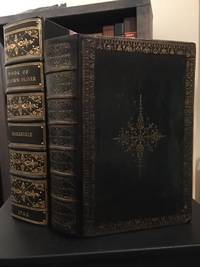
1760174<b>8vo 24.5 cm 9.6". 544 pp. contemporary full dark blue morocco rebacked with original spine panels laid down elaborately gilt-decorated spine and boards with armorial gilt centerpieces raised bands marbled endpapers all edges gilt. Second edition of Cambridge University printer John Baskerville's Book of Common Prayer including the Psalter the articles of religion and state prayers for George II. This impression printed in the same year as the first edition features decorative page borders; its title-page matches the description of Gaskell's Group 2 with the third line printed in roman and the price listed as "Seven Shillings and Six Pence unbound." Housed in a 1/4 morocco clamshell box with raised bands and gilt compartments by the Heritage bindery.</b> Printed by John Baskerville, Printer to the University; By whom they are sold, and by B. Dod, Bookseller, In Ave-Mary Lane, Lond hardcover
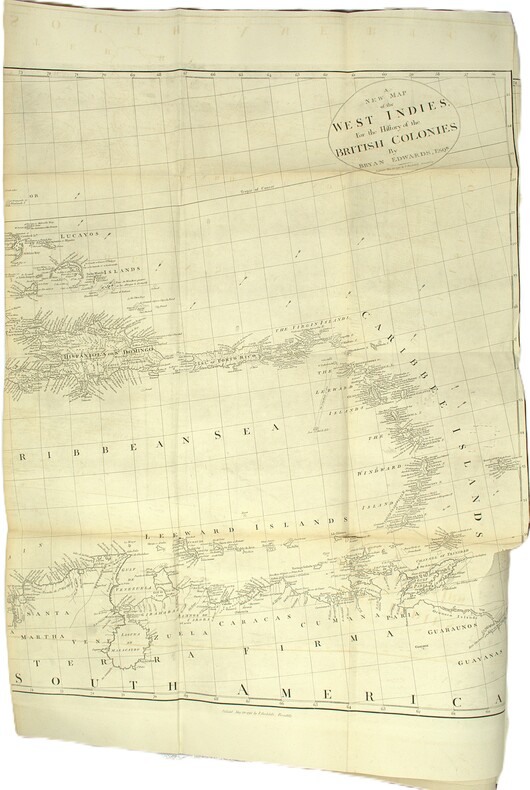
1794PHO-1886John Stockdale, Londres, 1794-1801, 3 volumes in-4 (275 X 225 mm), reliés plein veau marbré époque (restauration ancienne), pièce de titre rouge et de tomaison vert. Tome I, liv-494 pp., Tome II 520 pp, Tome III (1801) xix 443 pp., illustré de 3 frontispices, 11 cartes dont une en double feuille et dépliante (720 X 620) (cartes des Indes occidentales), 2 dépliantes Saint Domingo (250 X 225) et Jamaïque et 8 planches h.t., ex-libris en page de garde, déchirures aux pliures et brunissures en marge de la grande carte, frottements, griffures, pièces de titre et tomaison avec petits manques, quelques brunissures sur les titres et quelques feuillets.
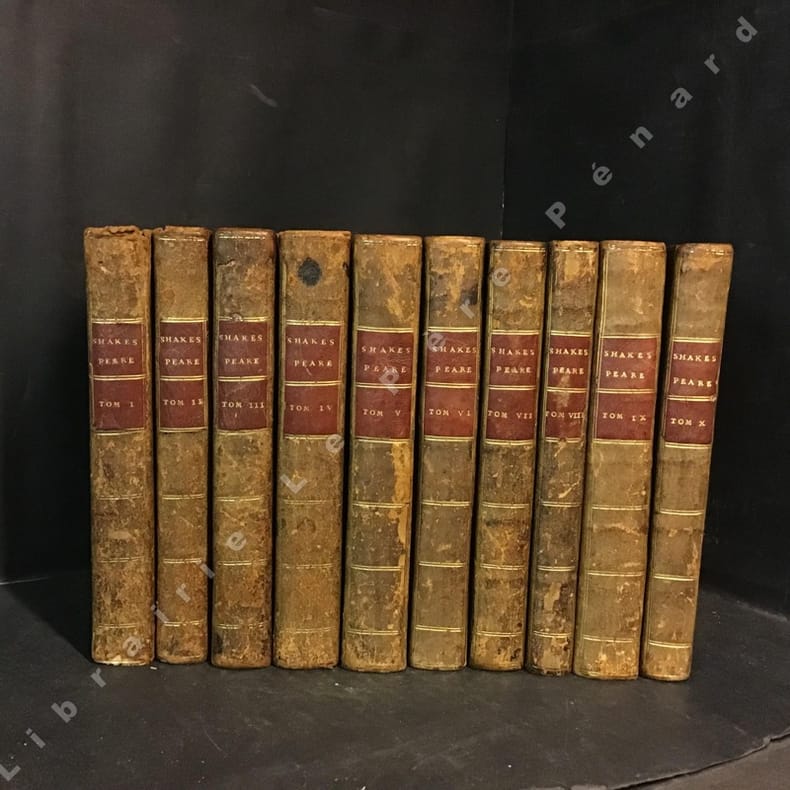
17761244161776-1782 Édition originale et complète de la première traduction en français par Pierre Le Tourneur. Les volumes I & II sont à l'adresse de plusieurs libraires : A Paris, chez La Veuve Duchesne, libraire, Musier Fils, Nyon, La Combe, Ruault, Le Jay, Clousier. Les volumes III à XX : A Paris, chez l'auteur et chez Mérigot, libraire - M. DCC. LXXVI - M. DCC. LXXXII (1776-1782) - 20 volumes, In-8, reliure pleine peau de l'époque, dos lisses avec pièces de tomaison en marocain rouge, caissons, auteur et tomaisons en doré, toutes tranches rouges, frise dorée sur les tranches, roulette dorée sur les contreplats, signets verts - 394 + 410 + 444 + 478 + 304 + 478 + 395 + 306 + 491+ 312 + 311 + 453 + 495 + 571 + 471 + 390 + 393 + 496 + 500 + 410 pages
1718SB-20193Leipzig, Moritz George Weidmann, 1718. 11 Bl., 1.240 S. Brauner Ganzlederband der Zeit auf vier Bünden mit braungeprägtem Rückentitel auf hellbraunem Rückenschild. .worinnen derselben Einwohner Ursprung, Sprache, Temperament, Genius, Religion, Sitten und Litteratur, nebst deren Monarchen, hohenm und niedrigen Adel, Geistlichkeit, Gesetzen, Regierungs-Art, geist- und weltlichen Gerichten u.s.w. ingleichen die Eintheilungen dieser grossen und berühmten Insuln, deren Macht, Interesse und Nachtheil bey Vergleichung anderrer Länder, die einheimischen Curiosa naturae & artis: ferner auch die vornehmsten Merckwürdigkeiten der ungemeinen grossen und volckreichen Hauptstadt London zusamt dem Staat der Engel- Schott- und Irrländischen Universitäten u. v. m. deutlich und weitläufftig entdecken werden. . Auch mit sehr vielen accuraten und saubern Kupffern ausgezieret. Erster, England betreffender Teil der umfassenden Landesbeschreibung Großbritanniens und Irlands des englischen Historikers und Lexikographen Guy Miège (ca. 1644 - 1718). Der in Lausanne geborene Miège ging 1616 nach London und war dort zunächst im diplomatischen Dienst tätig. In der Folgezeit trat er durch mehrere Veröffentlichungen zur britischen sowie zur europäischen Staatengeschichte hervor (A Complete History of the late Revolution, London 1691; The Present State of Denmark, London 1683). Bekanntheit erlangte er außerdem als Verfasser eines neu konzipierte französisch-englischen Wörterbuchs (New dictionary French and English, with another English and French, London 1677) sowie mehrerer Werke zur englischen Sprache. Bei Mièges Geschichte Englands handelt es sich eher um eine Landeskunde, die den englischen Staat des späten 17. bzw. frühen 18. Jahrhunderts in seiner politischen, gesellschaftlichen und ökonomischen Struktur und all seinen Facetten systematisch abbildet; einbezogen sind auch Fragen der Demographie, Gesetzgebung, Religionsausübung und Sittengeschichte. Inhalt in Stichworten: England als Teil Groß-Britanniens - Bevölkerung und Einkünfte - geographische Beschaffenheit - Grafschaften und Städte - Grafschaften im Einzelnen - Fürstenthum Wales - London - Sitten und Gewohnheiten - Postwesen - Orden und Stände: Hosenband-Orden; Niederer Adel; Klerus; Bischöfe und Prälaten - Liturgie, Kirchenordnungen, Religionsausübung - politische Fraktionen: Whigs und Torys - Militär - Gesetzgebung - Englische Krone - kurze Geschichte Englands, seiner Revolutionen, Monarchen usw. - Stellung des Königs, Verfaßtheit der Monarchie - Rechtsprechung und Strafen - Gewichte, Maße, Münzen. Enthalten sind 74 großenteils (teils mehrfach) ausfaltbare, teils handkolorierte Kupfertafeln (Landschafts- und Gebäude-Ansichten; Porträts) außerhalb der Paginierung sowie eine (nicht im Original enthaltene, aber stilgerecht rekonstruierte) mehrfach ausfaltbare Karte Großbritanniens (Des Isles Britanniques) im Format 33 x 29 cm.
1741bf2528Leak J. Reliure 1741 Très jolie reliure de plein maroquin roux moderne, fleurons et décorations sur les plats et le dos, belle édition (la 5e) de ce texte anglais chantant et vantant dans un érotisme léger le Merryland, ce pays des merveilles qu'est le corps féminin, il fut traduit en français sous le titre 'Description Topographique, Historique, Critique et Nouvelle du pays et des environs de la Forêt-Noire' ; très bel état. Livraison a domicile (La Poste) ou en Mondial Relay sur simple demande.
1707SB-21560Leiden, Pierre Vander, 1707. Vollständiges Werk in 8 Bänden (Band V aus zwei Teilen bestehend). Etwas spätere braune Ganzlederbände mit goldgeprägten Rückentiteln auf rotem und schwarzem Rückenschild, reicher goldgeprägter Ornamentik und Kopffarbschnitt; Seiten- und Fußschnitt mit rötlicher Marmorierung. Die Bände wurden, augenscheinlich im früheren 19. Jahrhundert, umfassend restauriert und erhielten dabei neue Buchrücken. Diese Arbeit wurde excellent ausgeführt - die Naht zwischen Buchrücken und Deckelbezügen ist kaum zu sehen - und hat unter anderem den Vorteil, daß die Gelenke der Bände jetzt stabil und belastbar sind. Oeuvre complète 8 tomes (le tome V se compose de deux parties). Un peu plus tard, des volumes en cuir marron complet avec des titres de dos en relief doré sur une étiquette de dos rouge et noire, une riche ornementation en relief en or et une coupe de couleur de tête; côté et pied coupés avec marbrures rougeâtres. Les volumes ont été largement restaurés, apparemment au début du XIXe siècle, et ont reçu de nouveaux dos dans le processus. Ce travail a été réalisé avec brio - la couture entre le dos du livre et la couverture est à peine visible - et a l'avantage, entre autres, que les joints des volumes sont maintenant stables et résistants. Titelfortsetzung: .où sont exactement décrites les Antiquitez, les Provinces, les Villes, les Bourgs, les Montagnes, les Rivières, les Ports de Mer, les Bains, les Forteresses, Abbayes, Eglises, Académies, Collèges, Bibliothèques, Palais, les principales Maisons de Campagne & autres Edifices des Familles Illustres, avec leurs Armoiries, &c. La Religion, les mours des habitans, leurs jeux, leurs divertissemens, & généralement tout ce qu'il y a de plus considérable à remarquer. Ebenso umfangreiche wie thematisch breit gefächerte Beschreibung Großbritanniens und Irlands um 1700, die alle wesentlichen Aspekte einer Landeskunde einschließt, so unter anderem die geographische Beschaffenheit, die Beschreibung der Städte und Seehäfen, das Kultur- und Hochschulleben, den Einfluß der führenden Adelsfamilien sowie die Alltagssitten und religiösen Gebräuche der Bevölkerung, ferner die Beschreibung der wichtigsten Burgen, Schlösser und Kirchen. Das Werk umfaßt mehr als 1.500 Textseiten und enthält 251 (!) doppelseitige Kupferstich-Ansichten (außerhalb der Paginierung), darunter 9 Frontispizes (v. 10, Frontispiz des ersten Teils des Bandes V fehlend), 2 mehrfach ausfaltbare Kostümtafeln und mehrere Landkarten und Stadtpläne.
1755002368Leipzig & Francfort Aux dépens de la Compagnie 1755
1710496London: Reprinted without any alteration 1710. Leather Bound. Very Good . 4 1/2 x 7 1/8 inches. 8vo. 168 unnumbered pages. Title page yellowed and chipped at bottom with no loss. First few pages age-toned other pages bright and clean. U2 and U3 with small losses to lower corners affecting 2 or 3 lines of text with text supplied in neat handwritten facsimile. ESTCN11904. See ESTCS108617 1546 edition. Half title excised and "reprinted without any alteration" removed from title page. Bound in later full brown calf with "King Henry VIII's Primer" in gilt to spine and light wear to corners and head and tail of spine. A very good copy of the 1710 reprint in 32 lines scarce in its own right of the 1546 edition by Grafton altered to give appearance of the even rarer 1546 edition. Reprinted without any alteration unknown
1777D17899Oxford: Wright and Gill sold by Crowder and Jackson 1777. Hardcover. Good. and A New Version of the Psalms of David Fitted to the Tunes Used in Churches London: Printed by Mary Harrison 1774; with forty-nine of the fifty-two engravings interspersed through the first two titles viz. engraved frontis portrait of George II engraved title plates numbered 2-51 with the omission of plates 10 26 and 27 all hand-colored contemporary or near-contemporary. Small 8vo. Contemporary full red sheep tooled in gilt spine worn and laid down; a.e.g. Two early women owner's signatures to front blank one dated 1813. Various manuscript notes in pencil to front leaves. This is an especially scarce suite of engravings not in ESTC. The engravings depict the usual religious subjects but end with plates depicting the Gunpowder Plot martyrdom of Charles I and restoration of Charles II; Book of Common Prayer ESTC T82211; Psalms ESTC N67336. <br/><br/> Wright and Gill, sold by Crowder and Jackson hardcover
17990075-17Monmouth, Printed and sold by him [i. e. C. Heath] 1799. kl.-4°. 4 Bll., 164 S.; 8 Bll. ("Mr, Kyrle's will; Walford"). HLdr. d. 19. Jhdts. Ecken bestoßen. [2 Warenabbildungen]
17921148021792 A Paris, Chez Defer de Maisonneuve, rue du Foin S. Jacques, n°11 - 1792 - 2 fort volumes in-folio, demi-basane gaufrée bordeaux; dos à 5 nerfs avec caissons estampés à froid et nom de l'auteur, titre, tomaison et fleurons en dorés et estampés à froid - 391 pp. + 377 p. - Ouvrage bien complet de ses 12 superbes planches hors texte - Ouvrage bilingue français / anglais
1777D17899Oxford: Wright and Gill sold by Crowder and Jackson 1777. Hardcover. Good. and A New Version of the Psalms of David Fitted to the Tunes Used in Churches London: Printed by Mary Harrison 1774; with forty-nine of the fifty-two engravings interspersed through the first two titles viz. engraved frontis portrait of George II engraved title plates numbered 2-51 with the omission of plates 10 26 and 27 all hand-colored contemporary or near-contemporary. Small 8vo. Contemporary full red sheep tooled in gilt spine worn and laid down; a.e.g. Two early women owner's signatures to front blank one dated 1813. Various manuscript notes in pencil to front leaves. This is an especially scarce suite of engravings not in ESTC. The engravings depict the usual religious subjects but end with plates depicting the Gunpowder Plot martyrdom of Charles I and restoration of Charles II; Book of Common Prayer ESTC T82211; Psalms ESTC N67336. <br/><br/> Wright and Gill, sold by Crowder and Jackson hardcover books
1800225275England 1800. Watercolor drawing. 31.8 x 45.7 cm. 12-1/2 x 18 inches. Framed and matted. Watercolor drawing. 31.8 x 45.7 cm. 12-1/2 x 18 inches. Superb hilltop view of the old port in this village in North Devon showing several large frigates anchored in the bay sloops moored in the harbor cattle grazing on the slopes sea and sky in the distance. unknown books
1775000855England 1775. On offer is an original LS by English King George III dated 3 January 1775 a mere six days before Parliament declared Massachusetts in a state of rebellion. On March 23 Patrick Henry gives the "Give me or give me Death" speech and on 19 April came the first shots on Lexington Green. King George III King of England 1760 - 1820 he supported the policy which led to war with and the loss of the American colonies sends his cousin to Princess Abbess at Gardersheim Germany his profuse best wishes for the New Year. Signed "George R" one page both sides 8 x 12.5 which reads in part: "You have our most sincere thanks for the pleasant mark that your dear Love has given us at this time of change to a New Year of your friendly disposition toward us. We reciprocate the same and would express the sincere wish that Your dear Love may have begun the New Year Pleasantly and may pass it in uninterrupted enjoyment of unalloyed prosperity.George R." In fine condition with remnants of previous matting to the lower corners. As King George's III grandfather George I came over directly from Germany George III spoke and wrote German in which this letter is written. Comes with a full translation. VG. Very Good. Folio - over 12" - 15" tall. Manuscript. unknown
172755069London: printed by John Baskett. and by the Assigns of Henry Hills decease'd 1727. Later edition. Hardcover. Very good. Three parts folio in fours 38 by 24 cm. 380 23 3 table pp; text in two columns. Additional engraved title page; main title in red and black; woodcut initials and ornaments. Contemporary two-tone paneled calf triple-ruled in gilt; spine with raised bands elaborately tooled in gilt morocco lettering piece; gilt inner dentelles; marbled endleaves; all edges gilt. Covers very lightly scuffed with mild traces of wear at extremities; upper joint just starting at top; occasional touches of mild mostly marginal foxing. A very good or better copy complete and handsomely bound.<br /> <br /> An uncommon and beautifully printed edition of the Book of Common Prayer "the first single manual of worship in a vernacular language directed to be used universally by and common to both priest and people" Carter and Muir. Despite early revisions and some major alterations following the Restoration the original simplicity of the language has been presevered the text remaining substantially unaltered since 1662. References: ESTC N67554 locates only 4 copies. Cf. Carter & Muir Printing and the Mind of Man 75 ed. 1549. Collation: pi1 a-c4 A-Aaa4 Bbb2 = 203 leaves. printed by John Baskett... and by the Assigns of Henry Hills, decease'd hardcover
172133322London: Printed for D. Browne J. Walthoe J. Knapton B. Knaplock et. al. 1721. 8 volumes. First Complete and Best Published Edition. With and engraved frontispiece of the author to Vol. I and Dedication to Richard Cromwell Lord Protector of the Common-wealth of England Scotland and Ireland and the Dominions and Territories thereunto belonging. Folio very handsomely bound in contemporary paneled calf the spines with raised bands separating the compartments panels within the compartments fully gilt with elaborate corner tooling and central ornamental devices two compartments with contrasting red and green morocco lettering labels the covers with double fillet rules at the borders surrounding a central panel tooled with fillet lines enclosing a roll tooled framework and a central panel of mottled calf original plain paper endleaves. Vol. I with index and subscribers list. Vol. II The Second Part Containing the Principal Matters Which Happened from the Dissolution of the Parliament.Until the Summoning of Another Parliament which met at Westminster April 13 1640. Vol. III The Second Volume of The Second Part Containing the Principal Matters Which happened From March 26 1639 until.April 13 1640. Vol. IV The Third Part.Containing the Principal Matters Which happened from the Meeting of the Parliament November the 3d 1640 To the End of the Year 1644 Wherein is a particular Account of the Rise and Progress of the Civil War to that Period.Vol. V The Second Volume of The Third.Vol. VI The Fourth and Last Part in Two Volumes. Volume the First. Containing the Principal Matters Which Happen'd From the Beginning of the Year 1645 to the Death of Kng Charles the First 1648. Wherein is a Particular Account of the Progress of the Civil War to that Period. Vol. VII The Fourth and Last Part. Vol. VIII The Tryal of Thomas Earl of Strafford. Lord Lieutenant of Ireland Upon an Impeachment of High Treason by The Commons then Assembled in Parliament in the Name of Themselves and of the All the Commons of Englan: Begun in Westminster-Hall the 22th of March 1640. And Continued.until the 10th May 1641. Shewing the Form of Parliamentary Proceedings in an Impeachment of Treeason To which is Added A shor Account of some other Matters of Fact.With some Special Arguments in Law. A very handsome set in remarkably preserved and original binding some hinges expertly refurbished three covers detached clean internally but for the usual browning to some leaves due to paper stock used in the printing a large wide margined copy of this important work. FIRST COMPLETE AND BEST EDITION. John Rushworth born c. 1612 died May 12 1690 was the English historian whose Historical Collections of Private Passages of State 7 vol. 1659–1701; 8 vol. 1721 covering the period from 1618 to 1649 continues to be a valuable source of information on events leading up to and during the English Civil Wars.<br> Rushworth studied law and in 1638 was made solicitor to the town of Berwick-upon-Tweed. He was enrolled at Lincoln’s Inn in 1640 and called to the bar in 1647. Rushworth was more interested in politics than in law and during the intermission of parliaments 1629–40 he attended and made shorthand notes of all important political and judicial proceedings heard before the Star Chamber the court of honour and the king and council. In 1640–42 he was assistant clerk to the House of Commons and after the outbreak of war he acted as a messenger between Parliament and its committees at Oxford and York. He himself published a number of the newssheets that preceded the establishment of regular newspapers—e.g. the daily London Post 1644–45; 1646–47 the Kingdomes Weekly Post 1643–1644—and also the parliamentary pamphlets opposed to the Royalist Mercurius Aulicus.<br> Following the execution of Charles I in 1649 Rushworth became personal secretary to Oliver Cromwell. He began drafting plans for the abolition of the monarchy and the House of Lords and the establishment of an English Republic under the leadership of Cromwell. As secretary 1645–50 to Sir Thomas Fairfax general of the New Model Army Rushworth had considerable importance and thereafter he was employed by the council of state and Parliament. When Cromwell became Lord Protector in 1653 Rushworth was promoted to Registrar of the Court of Admiralty. In 1657 he was elected Member of Parliament for Berwick in the Second Protectorate Parliament. As a member of the Cromwellian government he enjoyed the friendships of John Milton who served Cromwell as the official State Censor; John Owen; John Bunyan and many other well known people of that period. When Oliver Cromwell died on 3 September 1658 his son Richard Cromwell became Lord Protector.<br> At the Restoration Rushworth made peace with Charles II and although called to give information on the activities of the regicides was not himself implicated. In 1667 he became secretary to the lord keeper and later agent to the colony of Massachusetts. Despite his many emoluments and an inherited estate he fell into poverty and spent his last years in a lodging in the King’s Bench prison Southwark where he died.<br> Rushworth’s Historical Collections was compiled from his own notes and from printed material with the avowed intention of making it possible for a true history to be written of events that in pamphlets and news sheets dating from the period before the control of the press were liable to misrepresentation. It is most useful for its eyewitness accounts of the Earl of Strafford’s trial the Battle of Naseby and the parliamentary campaigns of 1644–45 and for its transmission of contemporary comment.<br> While Rushworth was remembered as a person his writings found favour in America where they served as a source of inspiration for Thomas Jefferson. Jefferson bought a copy of Rushworth's Historical Collections for use in his own library and he often quoted from them. Rushworth was a contemporary of John Lilburne whose writings had a profound impact on the history of the English Civil Wars of the 17th century. Although his senior he also shared much in common with Oliver Cromwell born 1599 because they were evangelical Christians who believed that the Church of England should undergo a total reformation contrary to the wishes of King Charles I. His views of Charles I as a king who had declared war on his own people were later echoed in words by Thomas Jefferson and others when writing about the reign of George III in the Declaration of Independence. Britannica. Wiki Printed for D. Browne, J. Walthoe, J. Knapton, B. Knaplock et. al.... hardcover
1717757London: John Sturt and John Baskett 1717. First edition first state. Leather Bound. Near Fine. John Sturt. 5 1/2 x 8 inches. 8vo. 22 166 pages. Front hinge and front endpaper expertly reattached by conservator with Japanese tissue. Marbled endpaper and following ffep contain inscription "The gift of Lady Parkyns to her Daughter Anne Parkyns May 7th 1740." Engraved armorial bookplate of Sir William Milman on front endpaper partially obscuring one of the inscriptions. Small area where a name was erased from marbled endpaper interrupting marbling. Each page beautifully engraved by John Sturt on silver plates. More than 130 engraved vignettes ranging in size from 41 mm x 55 mm to 84 mm x 55 mm numerous other smaller in-text vignettes initials head and tailpieces etc. Each page with elaborate engraved border. This edition also double red ruled. Volvelle present in original state on page V thus first state. Pages very clean with small occasional minor smudge. All page edges gilt with small "spot" loss of gilt at top. Griffiths 1717/1. Bound in contemporary dark green crushed calf with elaborate gilt borders and central lozenge. Elaborate gilt decoration to spine. Slight bleaching to spine and small losses to corners. Sturt's rare and beautifully silver-engraved Book of Common Prayer with volvelle in original state. John Sturt and John Baskett unknown
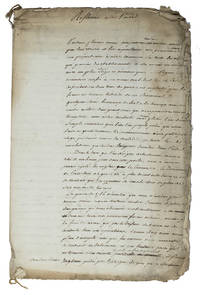
1778ABC_455321778. Sewn with two small chords in the left upper and bottom corner. Folio. First draft of an autograph manuscript in French with erasures and corrections probably written by a diplomat or strategist concerning the causes of Britains defeat of France in India during the Seven Years War 1756-1763 and analysing different ways to restore France to power on Indian soil by an alliance with the sultan Haider Ali Khan 1722-1782 who ruled Mysore and a large part of southern India and was one of the greatest enemies of the British East India Company. According to the unidentified diplomat who wrote this text Haider Ali Khan was the only one who was able to defeat the British or challenge their supremacy in India. In this manuscript he describes the best strategy not only to join Haider Ali Khan but also to negotiate with the British people on profitable Indian trade for both parties.Slightly worn and frayed around the edges first page slightly dust-soiled but still an interesting autograph manuscript in good condition. unknown
17500009001London England Britain UK. Good. 1750. Vellum. On offer is an exemplary and rare Latin copy of the Thirty-Nine Articles of Religion the defining statements of doctrines and practices of the Church of England and one of the most important religious documents of history. While the Articles themselves were formulated in the mid-1500s this particular book dates back to c.1700. The Articles were issued in both Latin and English. The entirety of this book is written in Latin. There is a vellum cover still fully intact though there are small tears at the ends and discoloration due to age. Written on the front cover and continued on the back are a table of contents for all 39 articles. They begin with I. De Fide in sacrosanctam Trinitatem. and ending with XXIX. De Christiani Juramento. The writing is still extremely clear. Smudging or discoloration of the text throughout the entire book is non-existent. The book is roughly 160 pages long. It has been sewed together using a 3-hole pamphlet stitching. There are also some anomalies throughout. Many pages contain tiny pieces of paper sewn in that have extra writing on them. One of them reads Christ a true sacrifice vide Eph: 20 which translates to Christs sacrifice see: Ephesians: 20. Another reads vide Art: XXI. Prop: V. These little notes seem to be addendums and cross-references that the owner most probably put in himself. While most pages are fully filled with text a few pages are mostly blank with some writing on the top De sexta propositione and a blank space under which the owner meant to continue writing but did not. History: When Henry VIII broke with the Roman Catholic Church and was excommunicated in 1538 he formed a new Church of England which would be headed by the monarch himself rather than the pope. The Thirty-nine Articles of Religion were initiated by the Convocation of 1563 under the direction of Matthew Parker the Archbishop of Canterbury. The articles pulled back from some of the more extreme Calvinist thinking and created the peculiar English reformed doctrine. Adherence to the Articles was made a legal requirement by the English Parliament in 1571 and incorporated into the Anglican Book of Common Prayer. Although not the end of the struggle between Catholic and Protestant monarchs and citizens the book helped to standardize the English language and was to have a lasting effect on religion in the United Kingdom and elsewhere through its wide use. ; Manuscript; 8vo - over 7¾" - 9¾" tall; KEYWORDS: HISTORY OF THIRTY-NINE ARTICLES OF RELIGION 39 ARTICLES XXXIX ARTICLES ANGLICAN CHURCH CHURCH OF ENGLAND LATIN BOOK HENRY VIII THOMAS CRANMER EXCOMMUNICATION NON VERNACULAR RELIGION RELIGIOUS DOCUMENT PROTESTANT REFORMATION UNITED . hardcover
1763BEL3269London, Robson, 1763. Seiten: Titel, 2-127, XVIII, (3),130-271, (dann falsch nummeriert: 262-3, 218-21), XX, zahlr. Kupferstiche, H 16 x 11 cm, marmor. Pappband der Zeit mit Rückenschild, Farbschnitt. - Einband leicht schadhaft (Ecken, Falze, Kapital, Fuss), innen wenige Flecken. Buchblock gebrochen. fest gebunden/ hardcover
175558878ABHalle, Francken, 1755-60. 4to. Mit gest. Frontispiz, 11 gest. Porträts, 2 gest. Faltkarten, 10 gest. Tabellen und 11 gest. Titelvignetten. Marmorierte Lederbände der Zeit mit rotem Rückenschild, reicher -vergoldung, Marmorpapiervorsätzen.
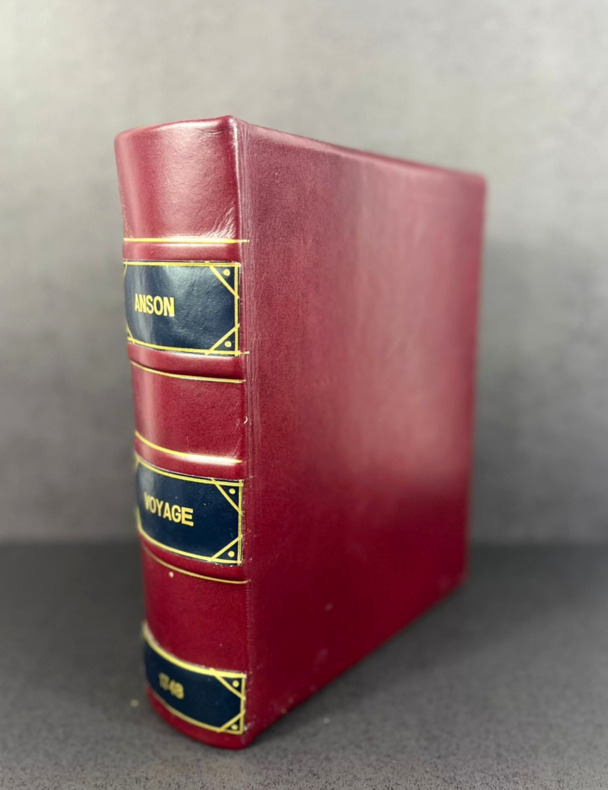
1748493London, John and Paul Knapton in Ludgate Street, 1748. This is a subscriber copy, so the real first edition of Anson's book. A brick of a book with 215 x 260 mm, 80 mm thick. 33 unpaginated pp. at the beginning, 417 (2) pp. Contemporary thick binding of a deep purple hue, four nerves on the spine, three black title pieces with author's name, book title and year in gold print characters. Includes the list of subscribers, p. 319 incorrectly designated as p. 219, two pages of instructions to the binder at the end of the book. With 42 copper plates: 14 maps and 28 engravings, all folding (38 having dimensions close to the book itself or to unfold horizontally and 3 being large folding maps). Comes with a sliding protective case. This is a copy of George Anson's account of his circumnavigation voyage. Complete with all the features which are often missing or signal a later edition. A lively tale of hardship, courage, curiosity, risk-taking and doing the impossible: overtaking Spain on the Peru coast, taking a Spanish galleon and completing the travel around the world with an awesome booty and an epic story to tell. The victory of Anson's Centurion launched the age of British dominance over the oceans and paved the way for a Victorian empire where "the sun never sets."
1737AMO-4509London, Printed for the Author ; and sold by W. Innys and R. Manby, 1737 3 parties reliées en 2 volumes in-8 (23,6 x 15 cm) de (13)-XXXII-431-(1 bl.) et (10)-352 pages, suivi de "An Appendix in Answer to a Book, etc." en pagination séparée de 85-(27) pages. Reliure strictement de l'époque plein maroquin noir, dos à nerfs richement ornés aux petits fers dorés, large dentelle dorée en encadrement des plats, armoiries dorées au centre des plats, roulette dorée sur les coupes et en encadremen intérieur des plats, doublures et gardes de papier peigne, tranches dorées. Légères marques aux reliures, sans gravité. Petits manques aux pièces de titre et sur un bord de coiffe (coiffe supérieure du premier volume), coins légèrement frottés ou usés, sans gravité, armoirires dorées sur le premier plat du premier volume légèrement frottées. Intérieur en bon état, imprimé sur beau papier fort à grandes marges (large paper).