[Milk Industry; England]Biblio.com
5 854 résultats
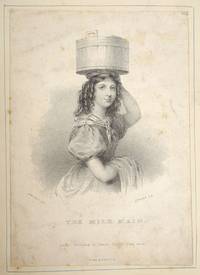
1888293631888. Print. Good overall. Over 100 sheets illustrating the English milk industry milk maids all things milk. 32 engravings 2 vinegar valentines 2 color illustrations 2 hand bills two small illustrations by "H. W. P." one printed on unusual silvered paper or silver of a man delivering milk in a town numbered "55" and a colored print of the same image unnumbered in colored woodblock. Over 20 pages of newspaper clippings carefully mounted on folio sheets 13 1/2 x 11 1/2" discussing milk adulteration milk famine etc. Newspapers clipped include the Daily Telegraph and Fun great name for a newspaper. Edges a little ruffled & musty. Overall a very interesting collection impossible to recreate. unknown
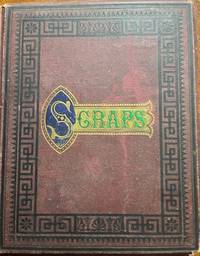
31082United Kingdom: n/a n.d. Scrapbook. Fair. Quarto. Approx. 11.25" x 9." Monogram Scrapbook. Maroon cloth hardcover with black stamped decorative borders and title in green blue and gilt on the front cover. Front hinge broken and front cover is loose but still attached. Cloth is split along the joints spine and corners. Light to moderate foxing to the sheets and tissue guards. 25 thick card leaves with numerous colored monograms. A few hand colored pages. No names or places identified in this collection. n/a unknown
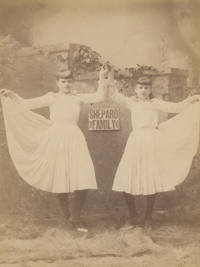
1890List1620Mostly New England: Various Photographers 1890. Cabinet cards measuring 6 ½ x 4 ¼ inches. Various settings showing the band members posed with their instruments including banjos violins trumpets drum and tubas. Varying wear but generally very good with some normal age-related fading. Very Good. Originally from Lawrenceville New York the Shepard Family Band toured throughout the Northeast in the 1880s and 1890s eventually settling in South Royalton Vermont. All members of the family were apparently musically inclined: “In addition to Minnie mother and matriarch Mary “Minnie†Shepard and her husband patriarch James Monroe Shepard all of the children were pressed into service. Daughter Laura Belle the ‘violiniste’ was getting better all the time under the instruction of a ‘competent master.’ Her fans “will be astonished at the improvement in style tone and expression.†It was said of little Lessie that ‘Among lady cornetists she has no equal.’ The darling little son of the family Master Burtie could not help but please for he was well-known to be ‘The youngest Tuba soloist in the world; only nine years of age; scarcely larger than the instrument he plays.’ He was also a ‘clever comedian singer and character artist.†The baby little Flossie “a sweet little miss of four summers’ was said to be a “wonderful mimic and impersonator…a veritable little fairy.’ Daughters Kittie and Georgia were also part of the troupe.†- Henry Sheldon Museum. A very nice collection. Various Photographers unknown
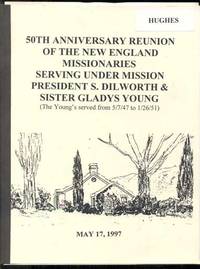
199745652New England States Mission 1997. 26 29pp. Quarto 28 cm Cream printed wrappers with binders tape over spine as issued. Fine. Self-published yearbook for a fifty year reunion of the missionaries who served in the New England Mission in the late 1940s and early 1950s. Contents include a brief overview of the news of 1947 and then continues with brief biographical sketches of the missionaries and "where are they now." Presumed miniscule print run. Laid in at the front is a stapled copy of a Dialogue article and laid into the rear is a biographical sketch of one of the missionaries likely a last minute addition. [New England States Mission] unknown
1268New-York: Printed for the Author 1812. . 2 volumes. 8vo contemporary sheep lacking top surface in places; spines darkened; internally lightly browned. Ownership signature on front free endpaper of first volume and on front cover of same volume; ownership labels on both spines Comprehensive manual outlining all duties and actions required of the various officers. Marvin p. 83 New-York: Printed for the Author, 1812. unknown
1978173481978. Very Good. 38" x 25" unframed print. A wonderful print of a Harvard Square aerial-style map surrounded by ivy-covered brick created by Hawaii's fine art cartographer and psychedelic artist Blaise Domino. A chance to revisit Elsie's Deli and other iconic Harvard Square hangout spots from the Seventies. Created for the tourist market this wonderful and scarce map makes a great gift for any Harvard University graduate or fan of the Harvard Square area. Color image of the piece can be provided. unknown
19205135Boston: Boston Architectural Club 1920. First printing. Beige Cloth over Boards. Very Good. Folio pp. nn ca 150 numerous b/w photographs and drawings of buildings lots of ads for building trades and others representing current architectural and related projects primarily by Boston area architects and designers. . Wonderful early Boston architectural and trade catalog. Scarce. Boston Architectural Club hardcover
AQ33628London: John Russell Smith 1849. 2 70pp. Bound after: HUNTER Joseph. Agincourt. A contribution towards an authentic list of the commanders of the english host in king henry' the fifth's expedition to france in the third year of his reign. London. John Russell Smith 1850. First edition. 2 56pp. Bound before: HUNTER Joseph. Milton. A sheaf of gleanings after his biographers and annotators. London. John Russell Smith 1850. First edition. 4 72pp. And: HUNTER Joseph. The great hero of the ancient minstrelsy of england "robin hood." His period real character etc. investigated and perhaps ascertained. London. John Russell Smith 1852. First edition. 2 62pp. And: HUNTER Joseph. Pope: his descent and family connections. Facts and conjectures. London. John Russell Smith 1857. First edition. 4 46pp 2. With a temrinal leaf of publisher's advertisements. 8vo. Contemporary blind-ruled brown half-morocco brown cloth boards lettered in gilt to spine T.E.G. A trifle rubbed. Marbled endpapers armorial bookplate of antiquary William Boyne 1814/15-1893 to FEP manuscript list of contents to front blank fly-leaf. A sammelband of five papers by antiquary Joseph Hunter 1783-1861 including his significant monograph concerning the Pilgrim Fathers and the early settlements in Massachusetts compiled from documents assessed whilst employed at the Public Record Office. Mr. Hunter answers more satisfactorily than it has been answered before the question "Who were the leaders of these pilgrims" and answers moreover for the first time the question "In what exact part of England had they previously resided" Gentleman's Magazine February 1850 p.185. . First edition. John Russell Smith hardcover
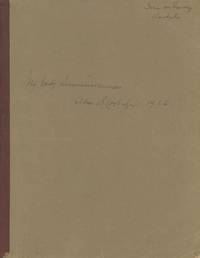
1926List3141Quincy Massachusetts: unpublished 1926. 201 pp cardstock wraps. Normal wear to wraps; overall Near Fine. Alice Brackett White Coolidge 1864–1927 was a Boston socialite of the prominent Richardson family; her grandfather was merchant and Massachusetts State Legislator Jeffrey Richardson. Coolidge was also the author of three children’s books: The Bunnies of Evergreen Village 1917 The Refugees in Evergreen Village 1918 and Evergreen Village to the Rescue 1922. Offered here is Coolidge’s unpublished memoir of her early life written in 1926 titled My Early Reminiscences.<br /> <br /> The memoir recalls Coolidge’s childhood and teen years spent mainly in Massachusetts New Hampshire and Maine. Her recollections typically involve extensive descriptions of the houses at which her family stayed the scenery around them and the various families they met and visited with. Given her position in society her acquaintances are sometimes quite influential people: Princeton president John Grier Hibben enjoys Coolidge’s fishcakes; Trinity Church rector Phillips Brooks gives her grandfather an “excellent pew†in the newly-finished church; pioneering doctor Alfred Worcester mistakes red pepper for mercury in a scientific demonstration at her school; and she recalls brief correspondences with John Greenleaf Whittier and William James.<br /> <br /> Coolidge also took dance lessons from Augustus Papanti whom she describes as “one of the thinnest men I ever saw†who was “very melancholy. I hardly remember his ever smilingâ€; and remembers Judge Charles Devens for “his great stature his charming face his courtliness of manner and his really boyish simplicity in entering into our evening games†including a game of “mind reading†which Devens played “with zest.â€<br /> <br /> One of her longtime friends was Rear Admiral John E. Pillsbury. She recalls:<br /> <br /> “Mr. Pillsbury as a young naval man a brother-in-law of my uncle Dr. Richardson used to take me out in the swan-boats on the Public Garden Pond. Later he went through all the ranks up to being retired as a Rear Admiral but time and circumstances never changed him. We always met at Thanksgiving and Christmas dinners and always talked at great length. . He was a wonderfully interesting lovable man and very modest and unassuming and shy. I always considered him one of my best friends though older by many years than I.â€<br /> <br /> Another interesting New England figure Coolidge encountered was Joseph Lee. She describes Lee’s hotel in Newton:<br /> <br /> “The house where we stayed was kept by a remarkable man named Joseph Lee. He was a mulatto much above many of his kind and his wife was a handsome woman partly Indian. They did the cooking and he waited on table with a colored maid to help him. In fact there were no white women in the house. The cooking was delicious.â€<br /> <br /> Lee was born enslaved in South Carolina freed in 1865 and went on to invent the automatic bread kneading and bread crumbing machines.<br /> <br /> Though nearly all of her childhood was spent in New England she also remembers being invited to visit Charles Joseph Bonaparte in Baltimore:<br /> <br /> “We had never been so far south except to Washington and I felt a curious feeling of being in a different atmosphere from any I had known. . We were met at the station by Mrs. Bonaparte in a large roomy covered vehicle with two horses. The coachman and footman were in the Bonaparte colors -- a deep wine color. The footman I well remember. He was a light-colored young negro very handsome and smiling and excited over having young ladies from the North. . All the servants were colored and lived in cabins near the house. . I never knew Mr. Bonaparte in public life so my memories of him are quite intimate and I fancy I saw much of his real self. . His mind was very active. He used to talk or listen as he walked and he moved his head in a curious way from one side to the other with a slightly rolling motion which was distinctly individual. . I never saw him irritated or excited and he was always very simple. In the group picture we had taken at the Maplewood he sat down cross-legged on the piazza floor like a boy. That was in about 1887. I suppose in public life or in law he was different but he was very equable and charming as we met him in his home and at the mountains. Most of all I admired his sweet tender ways with his flower-like wife.â€<br /> <br /> This was not too long after the end of Reconstruction and Coolidge remarks on the tense atmosphere:<br /> <br /> “Mrs. Bonaparte had warned me to be careful about questions regarding the North and South as the ‘feeling’ had not yet died away. I was so glad she had warned me. A gentleman slipped in and sat down beside me to watch a parade and whispered in my ear as the bands had been playing ‘Dixie’ how glad he was to meet a Northerner. I was glad to meet him too although I remember neither his name nor face but I felt I breathed freer in his sympathetic locality. . I had no idea that this feeling still remained as far North as Baltimore and of course I remembered how our Massachusetts troops had been fired upon in Baltimore at the outset of the war but I was admonished and very wise and only returned my unremembered neighbor’s greeting with a sympathetic word and look.â€<br /> <br /> Besides individuals Coolidge does cover a few historical events including the Great Boston Fire of 1872:<br /> <br /> “Oh! a horrible sight met our eyes. Back of the opposite houses in Park Square was a background of sheets of red flames and heavy black smoke rising high into the air. . On the Parade Ground all was in confusion and the sight was very sad and never-to-be-forgotten. It was literally covered with boxes and bales of furniture and sad forlorn desperate looking people crouching or sitting or standing amidst what they had saved from their homes . At night . the whole city was in darkness as there was no gas.â€<br /> <br /> The family also frequently stayed at hotels in the White Mountains of New Hampshire and Coolidge recalls the “overwhelmingly tragic†effects of the 1867 sale of this land to logging companies; she writes that looking out from the Flume House in Franconia “all about were brown scarred places marking the woodchoppers’ work which was cutting away our beautiful trees for lumberâ€.<br /> <br /> In this memoir Coolidge supplies detailed remembrances of the private personalities of influential figures of Gilded Age New England. We find two copies of My Early Reminiscences on OCLC. Of interest to historians of the era especially as told through the perspective of a young woman. unpublished unknown
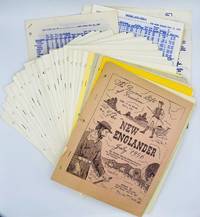
19588971Cambridge MA: New England Mission 1958. Vol. 19 / Nos.6-12. Vol. 20 / Nos.1-11. Vol.21 / 1-11. 28 issues. Quartos 28 cm Side stappled wrappers. Mimeographed contents. Issues very good or better. Newsletters from the New England Mission that contain news from the Mission comings and goings comics and other miscellany. Included with this collection are 90 pages of mimeographed 'Comparative Reports' covering the same time period for the Western and Northern Massachusetts districts. <br /> <br /> The New England Mission was organized in September 1937 from portions of the Eastern States Mission and the Canadian Mission. It was composed of the states of Massachusetts Connecticut Rhode Island Maine Vermont and New Hampshire. As well as the Canadian provinces Nova Scotia New Brunswick Prince Edward Island and Newfoundland. New England Mission unknown
1893138373Boston nd. 1893. Revised and Corrected. Hardcover. Fair. 543 4 p. 23 cm. Small illustrations. Half black leather with black cloth. Spine missing. No title page. Ink inscription from 1894 on front free endpaper. <br/><br/>A Descriptive List of all postage stamps ever issue by any government in the world giving their date of issue color and value. Illustated wth the Types of all Stamps prices used and unused at which they can be obtained of the publishers being a useful guide for arranging stamps in the International Postage Stamp Album. hardcover
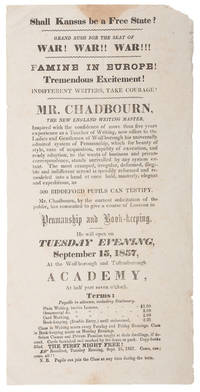
1857List317New Hampshire 1857. Broadside advertisement 5 ½ x 11 inches. Very Good. An unusual advertisement for a penmanship instructor a Mr. Chadbourn announcing the opening of his academy on September 15 1857 in Wolfborough New Hampshire. The broadside states “Inspired with the confidence of more than five years experience as a Teacher of Writing now offers to the Ladies and Gentlemen of Wolfborough his universally admired system of Penmanship which for beauty of style ease of acquisition rapidity of execution and ready adaptation to the wants of business and private correspondence stands unrivalled by any system extant.†An interesting relic from the middle of the Bleeding Kansas period which would serve as a harbinger for the bloodiness of the American Civil War. A very good example with a chip with loss to upper corner and some toning to head but attractive and well preserved. Unrecorded in OCLC. unknown
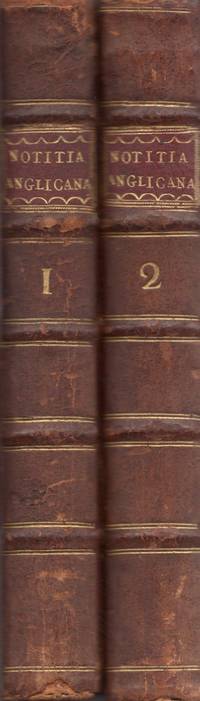
172435317London: Printed for A. Johnston 1724. Leather bound. Fair. 12mos. Two volumes. Volume I: 3 70 pages. Volume II: 3 pages 71-166 3 Spotted brown calf leather bindings. Raised bands and red leather title labels on the spines. The preliminary and rear end sheets removed in both volumes. Armorial book plate of Henry H. Ficken on the front paste downs. Illustrated with 190 coat of arms engravings. Outer joints are cracked volume 1. Front board detached volume 2. Edge wear to the boards and spines. Interior contents toned in places. <br /> <br /> Full title of this scarce two volume set is "Shewing I. The atchievements of all the English nobility complete i.e. their several quarterings or pretensions; being the arms of the most eminent families in Great Britain and Ireland: also their impalements &c. as well as their paternal coats crests supporters and mottos. II. Their several titles of honour whether hereditary or by great offices in the state: together with just and correct blasons of their said atchievements and reasons for many of their particular bearings &c. To which is added by way of introduction a concise essay upon the nature rise and intent of arms and armory. Shewing their progressive growth in the practice of both the ancients and moderns; together with sufficient rules and observations for attaining a perfect knowledge in that science." 10 copies of the printed version listed in OCLC 10/22. Printed for A. Johnston unknown
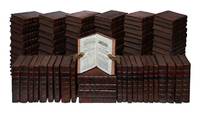
64760London 1760-1819. Folio approximately 275 x 185 mm. 93 volumes including 5190 Acts. Bound in contemporary virtually uniform calf with the arms of the City of Aberdeen to the upper covers of most volumes. Some age wear as reasonably expected generally the books are sound with some recent professional restorations to extremities joints heads and toes of spines etc. where it was necessary recently professionally cleaned and polished. Contents generally fresh and clean without any significant foxing or damp-staining exceptional set overall. Provenance: these Acts were compiled and bound for the Royal Burgh of Aberdeen bearing their arms on the front and back boards until 1792 and the town's motto of Bon Accord on the bottom of the backstrip thereafter. It is likely then that these were originally housed in the old Tollbooth from which Aberdeen was governed until the construction of the larger town house complex in the 19th century. This being the case it is also likely that the medieval library that these were to be stowed away in was not overly gifted with shelf space and the incidental removal of Acts deemed less interesting to a Scottish readership would have been an easy way of slimming the collection down so that it fitted into its designated place. A near full-run of the Acts passed under the reign of King George III a period that oversaw the American Revolutionary War changes in policy regarding slavery etc. In ninety-three volumes and including 5190 Acts this collection recalls the entirety of the reign of King George III undoubtedly one of the most significant for American history and in general amongst the most dynamic and rapidly changing periods of the modern era. These Acts bear witness to the birth and rebirth of nations the reorganization and regulation of the East India Company the gradual abolition of slavery the rapid onset of the Industrial Revolution the growth of an empire that touched every corner of the known world and the rising clatter of mechanization and industry. Almost every major Act of George III's reign is included. Sixty years of some of the most energetic social and political history are laid out kept in time to the marching beat of Parliamentary governance. This set is even more interesting for having been held together and bound with the arms of the City of Aberdeen to mist volumes. This collection is an invaluable primary source of unusual scale and completeness. American contents: The United States of America's rise from a string of far-western colonies to a sovereign state is mapped comprehensively. Tensions in the Americas arguably began with the Royal Proclamation of 1763 which barred American colonists from settling further west of a line closely circumscribing existing colonial boundaries. A year later the Sugar Act and Currency Act both vol. VI heightened unrest by hampering the already struggling economies of the Thirteen Colonies. In 1765 the Stamp Act vol. VII passed into law imposing a tax on printed goods and documents payable only in British currency. The response was enormous culminating in the Stamp Act Congress whose united voices issued the Declaration of Rights and Grievances. Parliament was petitioned and when it became clear that the Act was harming British mercantile interests in the Colonies it was repealed. Soon after however the Declaratory Act vol. VIII reasserted British authority in America. To Britain control over the Colonies was essential. A succession of failed harvests combined with large-scale grain exports had led to soaring corn prices and riots across Britain. In response Parliament abolished import duties on "Corn and Grain" from America vol. VIII followed by the removal of duties on wheat and wheat flour vol. IX and later on other American grains including rice and maize vol. X. America was simply too valuable for Britain to lose. The Townshend Acts of 1767 and 1768 introduced further measures to curb colonial dissent and extract greater profit from His Majesty's American possessions. The Revenue Act vol. IX placed taxes on several goods including tea and introduced Writs of Assistance allowing property searches in cases of suspected smuggling. Passed concurrently the Commissioners of Customs Act vol. IX sought to enforce compliance with British customs laws. The Indemnity Act vol. IX waived import duties on tea imported by the East India Company undercutting smuggled Dutch tea that threatened British revenue. The New York Restraining Act vol. IX suspended the New York Assembly's legislative authority until it complied with the Quartering Act of 1765 vol. VII. The last of the Townshend Acts the Vice Admiralty Court Act vol. X of 1768 replaced colonial courts with admiralty courts to more effectively punish and prevent smuggling. These Acts were later repealed except for the Indemnity Act which in 1773 was amended and continued as the Tea Act vol. XVII prompting the Boston Tea Party. Parliament retaliated with the Boston Port Act vol. XIX closing the harbour until the destroyed tea was paid for. This was the first of the five Intolerable Acts that directly precipitated the Declaration of Independence and the outbreak of war in 1776. Soon followed the Massachusetts Government Act and the Administration of Justice Act both vol. XIX. The former tightened royal control over Massachusetts while the latter permitted royal officials accused of offences in America to be tried elsewhere. The next Intolerable Act was the Quartering Act vol. XX which reiterated provisions from the earlier Act. Finally came the Quebec Act vol. XX expanding the province's boundaries into territory now part of the United States. These measures brought the Colonies to the brink of rebellion and when Parliament angered by New York's non-compliance with the Quartering Act passed the New England Restraining Act vol. XXI in 1775 banning trade with New England war finally broke out. Years of fighting followed as France Spain and the United Provinces of the Netherlands joined the conflict against Britain. In 1782 George III gave assent to the American Colonies Peace Act vol. XXXIV allowing negotiations that culminated in the Treaty of Paris of 1783. Later that year the Trade with America Act vol. XXXV was passed formally recognising the United States and reopening trade. In other spheres the British Empire continued to develop. Shown in these Acts is the amazing variety of luxury goods flowing into and through Britain from around the world. Sugar and Tobacco from the West Indies arrived in British ports to be warehoused alongside Teas and Silks from China. However stowed between tea chests and sugar barrels British merchants often found room for human cargo. The British slave trade and its abolition is also documented in these Acts. In this time African slaves passed as freely from port to port as any other exotic merchandise and it wasn't until the Slave Trade Act of 1788 that this trade was in any way regulated. This Act only temporarily limited the number of slaves that could be carried on board a trading vessel and whilst British slavers would face further regulations in the years following it was only in 1807 that the trade was truly abolished. However long after George III's death slaves were still working the plantations of the British Empire. Britain and Ireland also underwent great change. Physically the British Isles were transformed. By his death in 1820 George III's now united Kingdom was cut with snaking canals and bristled with groaning mills. Coal and cheap iron flowed into burning furnaces allowing British manufacturers to produce with great speed and quantity goods to be exported across the world. James Watt's steam engine its invention marked in an Act of the twenty-first volume of this collection greatly encouraged this growth of industry. Textiles were one of Britain's biggest exports and their manufacture was greatly increased by Watt's machine. Handloom weavers were very quickly driven out of work and in retaliation broke machines and burned mills. Parliament's response was a series of punitive Acts ensuring harsh and 'exemplary' punishment for these Luddites. The revolt was extinguished and with it an older slower world. This collection also contains fascinating details of the East India Company and the long process by which it was gradually subsumed by the British Crown. By 1773 the Company was failing. Smuggling in the Americas had severely reduced its income and the British Government eager to safeguard its future introduced the Regulating Act vol. XVIII overhauling its organisation and drawing it closer into British control. However this did little to abate concerns surrounding the Company's inefficiency in governing its Indian territories. In 1784 Prime Minister Pitt the Younger sought to remedy this with his India Act vol. XXXVII which more firmly subordinated the Company to the Crown by appointing six Privy Councillors to the newly created Board of Control. The final major reorganisation of the East India Company during George III's reign came in 1813 with the Charter Act vol. LXXX which renewed the Company's charter but restricted its monopoly to China and the trade in opium and tea. War with France had placed enormous financial pressure on Britain and merchants who were unable to trade with much of Europe demanded the destruction of the Company's monopoly in India. Once again the Company's authority was curtailed and brought further under direct British oversight. Another significant movement of George III's reign was the abolition of the slave trade. Abolitionism had been largely a fringe movement until David Hartley tabled a motion in the House of Commons in 1776 to end Britain's involvement in the movement of human chattel. Hartley's motion failed and it wasn't until over a decade later that any sort of regulation was placed on British slaving practices. The Zong massacre of 1781 in which the crew of a British slaving ship threw one hundred and thirty African slaves overboard provoked widespread outrage and strengthened the abolitionist cause. By 1788 sufficient pressure had built for Parliament to pass the first Slave Trade Act vol. XLI regulating the number of slaves permitted aboard trading vessels. Later that year the Society for Effecting the Abolition of the Slave Trade published its famous plan of the slave ship Brookes illustrating the continued horrors permitted under the new rules. Eleven more years of campaigning led to the second Slave Trade Act vol. LVIII in 1799 which required slaving vessels to be exclusively registered for that purpose and imposed stricter limits on the number of individuals transported. These regulations were to be enforced by Customs Officers. Seven years later the third Slave Trade Act vol. LXIX of 1807 abolished the trade altogether outlawing the sale and purchase of slaves and establishing penalties for violators. Parliament subsequently strengthened enforcement through numerous amendments and secured agreements with Spain Portugal and the Netherlands to end the trade in their own territories vols. XCI & XCII. In practice however these agreements varied in effectiveness and in Spain and Portugal the illegal trade persisted. In Britain slavery itself was only abolished in 1833. The Acts also detail the swift progress of the industrial revolution as well as evidence of the growing pains of a rapidly changing society. One of the earliest inventions mentioned in this collection is found in an Act encouraging John Harrison to make more available his invention of the marine chronometer vol. V. This was a crucial step in the British Government's mission to increase the ease and efficiency of ocean travel. A great number of Acts offering rewards for discoveries and the conducting of experiment in this vein were passed by Parliament the last being in 1818 vol. XCI. Another important invention that finds direct reference in the Acts is James Watt's steam engine vol. XXII. This machine was the centrepiece of the British industrial revolution allowing for the automation of many tasks previously found to be slow and laborious. Watt's invention allowed manufactured goods to be produced much faster and in much greater quantities. Textiles were one manufacture greatly improved by the advent of steam power however this was not the view of all. This set contains a number of punitive acts aimed to curb the Luddite movement that set about breaking machines and burning mills primarily in the North of England. The 1812 Frame Breaking Act vol. LXXVII declared the interfering with and destruction of mechanised looms a hangable offence. Shortly followed by two more dissuasive Acts the revolt was quelled and the handloom weavers and many other craftsmen of the old order were put out of work. Each regnal year is fully accounted for save the two months of George the III's final Parliament which actually became George IV's first in 1820. Occasionally Acts are missing and unaccounted for by the Table or list of contents that accompanies most years these omissions would have been made at the point of binding these volumes and often betray a Scottish interest in retaining acts relevant to Scotland whilst removing those that are not. Beyond these great narratives this collection is filled with thousands of Acts worthy of closer inspection. This list includes more famous acts such as the two Acts concerning Napoleon's confinement to the Island of St Helena vol. LXXXVII and the Regency Act vol. LXXVI in which the ailing King finally cedes power to his son the later George IV. However lowlier Acts such as those concerning parish organisation and land taxation are filled with fascinating tables charts oaths street-plans exemplar registers and lottery tickets. Every Act reveals something new of King George III's long reign and offers a vivid glimpse into the daily workings of government and society during a period of extraordinary change. This collection offers a panoramic view of King George III's sixty year reign. Reading through these Acts the scale and pace of the changing world of this early region of modernity is palpable revealing an empire continually reshaped by conflict commerce and the first stirrings of industrial power. A five hundred and seventy-four page list of the titles of each Act of Parliament contained in this collection is available upon request. London, 1760-1819. hardcover
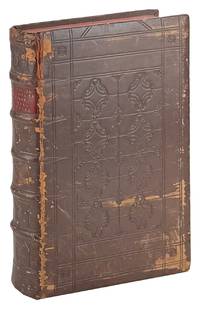
17131394685London: Printed by John Baskett 1713-1717. First Editions. Hardcover. Folio 61-174 2179-191 6 203-206 2 211-218 2 223-270 2 275-357 3 361-362 2 367-382 2 387-422 4. In Good minus condition. Bound in full contemporary calf with banded spine and tooling to boards. Boards show moderate wear to edges moderate plus wear and bumping to corners and several gouges to the front board. Cracking to leather along joint of front board. A clear lacquer appears to have been applied to the boards. Text block has light age toning to edges. Ex-Library institutional plate appears on front paste down. Ex libris of former owner appears on front pastedown. Several ink "doodles" in an 18th-century hand appear on the front paste down and front free end page. Square-inch tear to fore-edge of front free end page. Pages tightly trimmed by binder impacting some of the printed marginal annotations. BB Consignment. Shelved in Room A Oversized. Appears to contain two collections of public statutes passed in 1713 and 1714 but printed between 1713 and 1717 each with a closing contents page. The first collection contains Acts II - XVIII of 18 acts and the second contains Acts II - XXIII of 23 acts. The acts cover a range of topics including duties tariffs and taxes; the paying and management of military personnel and militias; and the management of churches. The most significant of the acts however is Act 15 of the second set of acts entitled "An Act for Providing a Publick Reward for such Person or Persons as shall Discover the Longitude at Sea". This formally established the Commissioners of the Longitude and the reward of £20000 for "the first Author or Authors Discoverer or Discoverers of any such method ." that to the satisfaction of the committee accurately determined a ship's longitude at sea accurate to within 20 geographical miles. This reward would not be claimed until 1765 when clockmaker John Harrison developed his "time-keeper" or marine chronometer. 1394685. Special Collections. Printed by John Baskett hardcover
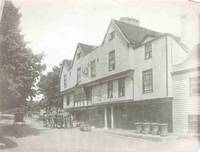
1880166521880. Very good condition. A collection of photographs of English cottages and half timbered buildings. 14 images paper prints. All labeled on verso; including King's Head Tavern where Dickens wrote Barnaby Rudge; the New Inn at Poole; Dodmore in Shropshire; Old Bank in Porlock; Old Cottage at Basket Gate Herefordshire; Allerton Cottage & Bridge; Cottage & Street Wolbley; Chimney & Gable detail illegible; Chiddingstone; Newton Village; Dodmore No. Ludlow; House of Seven Gables Orleton; Cottage at Newton; and Orleton Herefordshire. 8 x 6". Some captioned or numbered in white. unknown
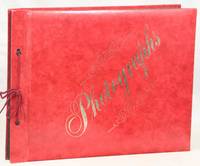
1959000014636n.p.: n.p. 1959. Photo Album. Near Fine. Oblong 8vo. 28 cm x 38 cm. The album cover is red faux leather with gold lettering and two gold flourishes on the front cover bound with a red tie. Photographs and postcards are mounted with four corner tabs each on black paper. Photographs measure 9 cm x 9 cm to 9 cm x 14.5 cm. There are 23 leaves 46 pages of content. Most of the photographs are in black and white but a handful are in color. With a few postcards pasted in all in color some measure 9 cm x 14 cm and some measure 15 cm x 10.5 cm. Almost every photograph and postcard is accompanied by a typewritten caption of what is depicted captions printed on white paper. The photographs depict landmarks like Stonehenge Tintagel Glastonbury the abbey the Roman Baths Canterbury Cathedral Winchester Cathedral Jane Austen's home Salisbury Cathedral York Minster the Isle of Skye Inverness Grasmere Lake Thomas Hardy's birthplace in Dorset landmarks from his novel Tess of the D'Urbervilles Westminster Abbey Samuel Johnson's home in London an orator speaking in Hyde Park Dickens' residence the Tower of London Kensington Gardens and the exterior of the British Museum. The album was put together by an English literature professor who took the trip and let his love of the subject inform his itinerary. The postcards at the end of the album depict the Brontë sisters Byron Wordsworth Dickens and others. Most of the photographs are of just the landmarks but there are a few photographs of people scattered throughout: the crowd listening to the speaker at Hyde Park a women playing with a shetland pony on the side of the highway a man standing in the circle at Stonehenge possibly the compiler of this album and women shopping at the Shambles in York. A visual smorgasbord of English and Scottish highlights. Very light wear to the leaves' bottom edges overall a sharp example. n.p. unknown
170547008London: s.i. 1705. Very Good. London: s.i. 1705. Pirated Edition per Case. Octavo; 19th century full blind-tooled calf by B.E. Bult spine in six compartments crimson gilt spine label all edges stained dark red red glazed endpapers; 165911pp. collated complete. Leather dried and a bit flaky along spine edges brief 19th century marginalia to a couple early leaves extensive contemporary notes to p. 592 blank pencil shelf number to rear free endpaper; Very Good and sound overall. This variant with catchword "The" on p. 564. <br /> <br /> Arsenic green binder's ticket and ownership ex libris of the British politician Edward Goulburn 1787-1868 to front pastedown. <br /> <br /> This edition described by A.E. Case's Bibliography of English Poetical Miscellanies 1521-1750 as a piracy of the first three volumes of "Poems on affairs of state."<br /> <br /> Case 237; ESTC N5917. s.i. unknown
18472345<p>Boston: Printed by S.N. Dickinson & Co. 1847.</p><p>A full-throated cry against slavery. The Quakers who had long opposed slavery wonder how a supposedly Christian nation could allow such evil to exist. "From the border slave states to the far south and southwest the vessels of the slave-trader regularly ply laden with youthful victims reared like cattle for the market" page 4. <br /><br />This pamphlet is scarce to the market.</p><p>PHYSICAL DETAILS: 12mo 7 1/4 x 4 5/8 inches; 183 x 119 mm 12 pages in original printed wrappers softcover.</p><p><br />CONDITION: Slight soiling and creasing to wrappers horizontal fold probably for mailing. Very Good or better.</p> Printed by S.N. Dickinson & Co. paperback
13665Without place or date1750s. 1p. landscape 12mo. On aged and lightly-creased laid paper 'PRO PATRIA' watermark with chipping to extremities. On reverse in another hand: 'At Northampton a Monument at the Inn'. The note reads: 'This ancent Mounement was Erected to perpetuate the memory of Queen Eleon sic Consort to Edward the First Who in an Expedition against the Scots was Shot with a Poison arrow the Queen Extracted the poisen from the wound By Sucking it out By which means she saved the Kings Life But Lost her own - This Being almost Come to Decay By age was Rebuilt and Beutified By the worshipfull the Justices of Peace for this County in that Memorable Year 1712 when the Arms of England was Crownd with Succes under the Conduct of Brave and Renownd John Duke of Malbrow'. The poison-sucking story popularised by William Camden has no basis in fact and the present document is an interesting example of how stories are distorted in folk memory. As perpetuated by Camden the incident is supposed to have occurred at Acre not in Scotland and the poisoning is supposed to have involved a dagger not an arrow; nor is Eleanor supposed to have died as a result of her intervention. Without place or date[1750s?]. unknown
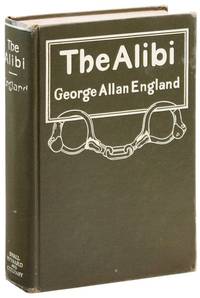
19168373New York: Small Maynard & Co 1916. First Edition. Green cloth boards stamped in white; 363pp; frontis. Light wear to tips of corners and spine ends; brief splits to front hinge internal; bit of offsetting to title page from color frontispiece. A solidly Very Good copy. HANNA 1096: ".young bank employee falsely convicted of embezzlement spends two years in Sing Sing before being cleared." Octavo. Small, Maynard & Co unknown
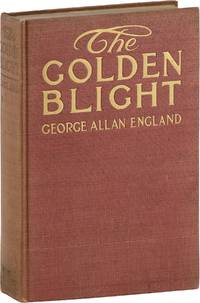
191688025New York: The H.K. Fly Company Publishers 1916. First Edition. First Printing. Octavo 19.5cm; mauve cloth with titles stamped in gilt on spine and front cover; 89-3502pp. Though the title page credits it to C.D. Williams the frontispiece and four black & white plates of illustrations are signed by John Sloan. Gentle sunning and some light dust-soil to spine neat early owner's ink name and tiny label at upper front pastedown with a small faint splash mark to upper corners; Very Good with the spine titling somewhat brighter than usual.<br /> <br /> "In The Golden Blight 1916 an early example of modern science fiction a physicist whose sympathies are with the proletariat in their opposition to World War I invents a machine which from any distance can reduce gold to ash. Despite the villainous attempts of the capitalists and their kept government to prevent him he eventually attacks even the gold in the United States Treasury Building in his effort to bring a stop to the war. When the financiers of the world gather in the Treasury's vaults to observe as one of them has predicted the reconstruction of the ash back into its original form the metal kills the financiers wrecks the Treasury Building and leaves for wiser posterity a Caesar's Column of gold bodies and masonry. Freed of their servitude to gold which as the physicist explains represents capitalism the people of the world immediately declare peace and vote in the Cöoperative Commonwealth" Rideout pp.59-60. REGINALD 04906. The H.K. Fly Company Publishers unknown
173835638London: Printed for J. Walthoe et. al 1738. The Fourth Edition Corrected. Leather bound. Poor. Folio. 4 xxiv 396 pages 1. Partially restored dark calf leather binding. Partial title label on the spine. Ex-institutional copy with hand written information on the front paste down "This Book belongs to the Library of Lyons Say-Brook 1743." More hand written notes from the same period written on the front paste down about the book and library. Leather binding patched on the spine joints and covers. First 4 leaves edge torn taped in the gutters and stained this volume suffered water damage. Purplish stains in the text gradually disappearing by page 300. No mold found inside. Browning to the gutters. Several page tears at bottom and top in the gutters. Remains of the half title page pasted down onto a sheet of white paper and bound in before the title page. Some old tape stains in the gutters of the title page and preliminary pages. Printed for J. Walthoe, et. al unknown
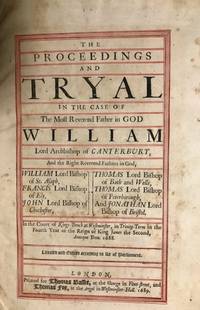
168935228London: Printed for Thomas Basset at the George in Fleet-Street and Thomas Fox at the Angel in Westminster-Hall 1689. First Edition. Full calf. Fair. Folio. 3 140 pages. MISSING THE ENGRAVED FRONTISPIECE Marbled calf leather binding with leather title label on the spine. Outer joints for both boards are cracked and the boards are loose but still attached. Text is outlined in red horizontal and vertical printed lines. Armorial bookplate of "Hans Sloane Stanley" located on the front paste down. Sir Jonathan Trelawny Bishop of Bristol William Lloyd Bishop of St. Asaph William Sancroft Bishop of Canterbury was three of the Bishops on trial for seditious libel under King James II. From wikipedia: <br /> <br /> Sir Jonathan Trelawny 3rd Baronet 24 March 1650 – 19 July 1721 was a British Bishop of Bristol Bishop of Exeter and Bishop of Winchester. Trelawny is best known for his role in the events leading up to the Glorious Revolution which are sometimes believed to be referenced in the Cornish anthem The Song of the Western Men. He was born at Trelawne in the parish of Pelynt Cornwall the eldest surviving son of Sir Jonathan Trelawny 2nd Baronet. He was educated at Westminster School and then went to Christ Church Oxford at the start of the Michaelmas term of 1668 where he distinguished himself as a scholar.<br /> A staunch royalist he was ordained in 1673 and became a beneficed clergyman. He was appointed rector of South Hill on 4 October and of St. Ives on 12 December 1677 becoming Bishop of Bristol in 1685. He was one of the Seven Bishops tried for seditious libel under James II. Trelawny and the other bishops petitioned against James II's Declaration of Indulgence in 1687 and 1688 granting religious tolerance to Catholics and as a result he was arrested and imprisoned in the Tower of London on charges of seditious libel. The bishops said that whilst they were loyal to King James II their consciences would not agree to allowing freedom of worship to Catholics even if it were to be within the privacy of their own homes as the Declaration proposed; thus they could not sign. Trelawny was held for three weeks before trial then tried and acquitted; this led to great celebrations with bells being rung in his home parish of Pelynt.1<br /> <br /> William Lloyd was born at Tilehurst in Berkshire in 1627 the son of Richard Lloyd then vicar1 who was the son of David Lloyd of Henblas Anglesey. By the age of eleven he had understanding in Greek and Latin and somewhat of Hebrew before attending Oriel and Jesus Colleges Oxford later becoming a Fellow of Jesus College.2 He graduated M.A. in 1646. In 1663 he was prebendary of Ripon in 1667 prebendary of Salisbury in 1668 archdeacon of Merioneth in 1672 dean of Bangor and prebendary of St Paul's London in 1680 bishop of St Asaph in 1689 lord-almoner in 1692 bishop of Lichfield and Coventry and in 1699 bishop of Worcester.3 As Bishop of Lichfield he rebuilt the diocesan residence at Eccleshall Castle which had been destroyed in the Civil War.4<br /> Lloyd was an indefatigable opponent of the Roman Catholic tendencies of James II of England and was one of the seven bishops who for refusing to have the Declaration of Indulgence read in his diocese was charged with publishing a seditious libel against the king.3 However he was acquitted in 1688 which was one of the events that lead to the fall of James II.citation needed<br /> He engaged Gilbert Burnet to write The History of the Reformation of the Church of England and provided him with much material. He was a good scholar and a keen student of biblical apocalyptic literature and himself "prophesied" to Anne Queen of Great Britain Robert Harley 1st Earl of Oxford and Mortimer William Whiston and John Evelyn the diarist. Lloyd was a staunch supporter of the Glorious Revolution.3<br /> He lived to the age of ninety-one and died at Hartlebury Castle on 30 August 1717. He was buried in the church of Fladbury near Evesham in Worcestershire of which his son was rector and where a monument is erected to his memory with a long inscription.5<br /> <br /> William Sancroft 30 January 1617 – 24 November 1693 was the 79th Archbishop of Canterbury2 and was one of the Seven Bishops imprisoned in 1688 for seditious libel against King James II over his opposition to the king's Declaration of Indulgence. Deprived of his office in 1690 for refusing to swear allegiance to William and Mary he later enabled and supported the consecration of new nonjuring bishops leading to the nonjuring schism. Printed for Thomas Basset, at the George in Fleet-Street, and Thomas Fox, at the Angel in Westminster-Hall unknown
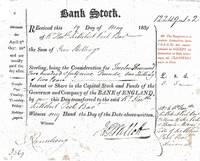
26618Bank of England 19 May 1831 His father politician and industrialist died in 1830. One page 27 x 16cm some damage to edge but no loss of text. Signed by "Willott" and another Armstrong - see Image. Text both printed and manuscript as follows: "Received this 19 Day of May 1831 of Rt Honble Sir Robert Peel Bart the Sum of Five Shillings Sterling being the Consideration for Twelve Thousand Two Hundred & forty nine PoundsOne Shilling & two pence Interest or Share in the Capital Stock and Funds of the Governor and Company of the BANK OF ENGLAND by me this day transferred to the said Rt Honble Sir Robert Peel Bart Witness my Hand the Day of the Date above-written Witness Willott and another." Manuscript note bottom right: " Att to Rt Honble Sir Robert Peel Bart Witness William Yates Peel & Thomas Robins Exers of Sir Robert Peel Bart deceased." [Bank of England] 19 May 1831 (His father, politician and industrialist, died in 1830) unknown