24 614 résultats
29p., port. Hardcover Ex-library, Very good condition
in-12, 189 pp, broché. Très bel exemplaire. [LP-2]
1995391277Bristol : Faculty of Art Media and Design University of the West of England 1995. 1st edition. Hardcover. Near fine cloth copy. Slightest suggestion only of dust-dulling to the spine bands and panel edges. Impressively illustrated with letterpress prints. Remains particularly well-preserved overall; tight bright clean and strong. Physical description; approximately 100 pp.: illustrations ; 40 x 57 cm. Subjects; Bestiaries. Pen drawing British. Animals Mythical in art. Bristol : Faculty of Art, Media and Design, University of the West of England hardcover
221 pages, page edges browned, light wear to covers. eng
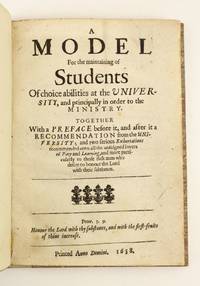
1658ST16442s.l.: s.n. Printed Anno Domini 1658. FIRST EDITION. 190 x 135 mm. 7 1/2 x 5 3/8". 3 p.l. 14 pp. complete. <br/> 20th century vellum-backed marbled boards flat spine with vertical titling. Front pastedown with bookplate of the Fox Pointe Collection. Wing P-2842B; ESTC R207754. ◆Text lightly washed and pressed but still crisp faint foxing to lower edge of title page otherwise a fine fresh copy in an unworn binding.<br/> <br/> Written by an opinionated English cleric this is an extraordinarily rare pamphlet proposing an unusual fund to support young 17th century scholars. According to DNB the scheme outlined in the present work was meant "to support the university studies of young men of promise seeking entry into the ministry." The plan "was approved by John Worthington and Anthony Tuckney and had the support also of John Arrowsmith DD Ralph Cudworth William Dillingham DD and Benjamin Whichcote. The fund raised about £900 and it appears that William Sherlock afterwards dean of St Paul's received assistance from this fund during his studies at Peterhouse Cambridge until 1660 when he graduated BA. Those entrusted with administering the fund sent Poole regular reports on students interviewed and the ratings they had received in philosophy logic and languages. The scheme was abandoned at the Restoration." Poole 1624 - 79 was the author of a number of controversialist pamphlets on subjects ranging from Unitarianism to preaching by lay persons before undertaking his major work: a synthesis of critical biblical commentaries "Synopsis criticorum aliorumque sacrae scripturae interpretum." This is one of his scarcest writings: ESTC lists seven copies two in North America while ABPC and RBH record just two copies at auction. s.n. Printed Anno Domini unknown
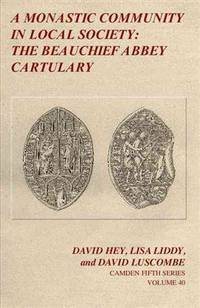
2011130467Cambridge U.K.: Cambridge University Press 2011. Hardcover. NF. Deep red cloth boards red and tan dust jacket with b/w illustration. 304 pp. Frontispiece. The first full edition of the medieval Beauchief Abbey Cartulary complete with full historical introduction. Cambridge University Press hardcover books
1741bf2528Leak J. Reliure 1741 Très jolie reliure de plein maroquin roux moderne, fleurons et décorations sur les plats et le dos, belle édition (la 5e) de ce texte anglais chantant et vantant dans un érotisme léger le Merryland, ce pays des merveilles qu'est le corps féminin, il fut traduit en français sous le titre 'Description Topographique, Historique, Critique et Nouvelle du pays et des environs de la Forêt-Noire' ; très bel état. Livraison a domicile (La Poste) ou en Mondial Relay sur simple demande.
209451Londres, Whittle et Laurie, 1er mars 1822 plan dépliant de 55 x 69 cm, en feuille, entoilée, dans emboîtage de papier vert marbré de l'éditeur, étiquette de titre sur le plat supérieur.
116644aafCambridge Univ. Press, 2000, in-8vo, cloth - jacket.
1871G58430Roehampton, Printed at Roehampton 1871 iv + 331pp., 1st edition, 22cm., cart.cover (leather spine), few foxing, good copy, scarce, [not found in De Backer-Sommervogel], G58430
390p. Inked ownership of Williams A. Stevenson, May, 1819, on title page. 8vo. Quarter green leather over marbled boards. Front board detached. Spine decorated in gold with raised bands. Leather spine labels chipped with loss. Head of spine worn with loss. Extremities worn; boards rubbed. Hardbound. Very good. Second edition. Scarce. **PRICE JUST REDUCED! JUN5 BOX 6
iv + 331pp., 1st edition, 22cm., cart.cover (leather spine), few foxing, good copy, scarce, [not found in De Backer-Sommervogel], G58430
152 p., illus. Hardcover Very good condition good
64760London 1760-1819. Folio approximately 275 x 185 mm. 93 volumes including 5190 Acts. Bound in contemporary virtually uniform calf with the arms of the City of Aberdeen to the upper covers of most volumes. Some age wear as reasonably expected generally the books are sound with some recent professional restorations to extremities joints heads and toes of spines etc. where it was necessary recently professionally cleaned and polished. Contents generally fresh and clean without any significant foxing or damp-staining exceptional set overall. Provenance: these Acts were compiled and bound for the Royal Burgh of Aberdeen bearing their arms on the front and back boards until 1792 and the town's motto of Bon Accord on the bottom of the backstrip thereafter. It is likely then that these were originally housed in the old Tollbooth from which Aberdeen was governed until the construction of the larger town house complex in the 19th century. This being the case it is also likely that the medieval library that these were to be stowed away in was not overly gifted with shelf space and the incidental removal of Acts deemed less interesting to a Scottish readership would have been an easy way of slimming the collection down so that it fitted into its designated place. A near full-run of the Acts passed under the reign of King George III a period that oversaw the American Revolutionary War changes in policy regarding slavery etc. In ninety-three volumes and including 5190 Acts this collection recalls the entirety of the reign of King George III undoubtedly one of the most significant for American history and in general amongst the most dynamic and rapidly changing periods of the modern era. These Acts bear witness to the birth and rebirth of nations the reorganization and regulation of the East India Company the gradual abolition of slavery the rapid onset of the Industrial Revolution the growth of an empire that touched every corner of the known world and the rising clatter of mechanization and industry. Almost every major Act of George III's reign is included. Sixty years of some of the most energetic social and political history are laid out kept in time to the marching beat of Parliamentary governance. This set is even more interesting for having been held together and bound with the arms of the City of Aberdeen to mist volumes. This collection is an invaluable primary source of unusual scale and completeness. American contents: The United States of America's rise from a string of far-western colonies to a sovereign state is mapped comprehensively. Tensions in the Americas arguably began with the Royal Proclamation of 1763 which barred American colonists from settling further west of a line closely circumscribing existing colonial boundaries. A year later the Sugar Act and Currency Act both vol. VI heightened unrest by hampering the already struggling economies of the Thirteen Colonies. In 1765 the Stamp Act vol. VII passed into law imposing a tax on printed goods and documents payable only in British currency. The response was enormous culminating in the Stamp Act Congress whose united voices issued the Declaration of Rights and Grievances. Parliament was petitioned and when it became clear that the Act was harming British mercantile interests in the Colonies it was repealed. Soon after however the Declaratory Act vol. VIII reasserted British authority in America. To Britain control over the Colonies was essential. A succession of failed harvests combined with large-scale grain exports had led to soaring corn prices and riots across Britain. In response Parliament abolished import duties on "Corn and Grain" from America vol. VIII followed by the removal of duties on wheat and wheat flour vol. IX and later on other American grains including rice and maize vol. X. America was simply too valuable for Britain to lose. The Townshend Acts of 1767 and 1768 introduced further measures to curb colonial dissent and extract greater profit from His Majesty's American possessions. The Revenue Act vol. IX placed taxes on several goods including tea and introduced Writs of Assistance allowing property searches in cases of suspected smuggling. Passed concurrently the Commissioners of Customs Act vol. IX sought to enforce compliance with British customs laws. The Indemnity Act vol. IX waived import duties on tea imported by the East India Company undercutting smuggled Dutch tea that threatened British revenue. The New York Restraining Act vol. IX suspended the New York Assembly's legislative authority until it complied with the Quartering Act of 1765 vol. VII. The last of the Townshend Acts the Vice Admiralty Court Act vol. X of 1768 replaced colonial courts with admiralty courts to more effectively punish and prevent smuggling. These Acts were later repealed except for the Indemnity Act which in 1773 was amended and continued as the Tea Act vol. XVII prompting the Boston Tea Party. Parliament retaliated with the Boston Port Act vol. XIX closing the harbour until the destroyed tea was paid for. This was the first of the five Intolerable Acts that directly precipitated the Declaration of Independence and the outbreak of war in 1776. Soon followed the Massachusetts Government Act and the Administration of Justice Act both vol. XIX. The former tightened royal control over Massachusetts while the latter permitted royal officials accused of offences in America to be tried elsewhere. The next Intolerable Act was the Quartering Act vol. XX which reiterated provisions from the earlier Act. Finally came the Quebec Act vol. XX expanding the province's boundaries into territory now part of the United States. These measures brought the Colonies to the brink of rebellion and when Parliament angered by New York's non-compliance with the Quartering Act passed the New England Restraining Act vol. XXI in 1775 banning trade with New England war finally broke out. Years of fighting followed as France Spain and the United Provinces of the Netherlands joined the conflict against Britain. In 1782 George III gave assent to the American Colonies Peace Act vol. XXXIV allowing negotiations that culminated in the Treaty of Paris of 1783. Later that year the Trade with America Act vol. XXXV was passed formally recognising the United States and reopening trade. In other spheres the British Empire continued to develop. Shown in these Acts is the amazing variety of luxury goods flowing into and through Britain from around the world. Sugar and Tobacco from the West Indies arrived in British ports to be warehoused alongside Teas and Silks from China. However stowed between tea chests and sugar barrels British merchants often found room for human cargo. The British slave trade and its abolition is also documented in these Acts. In this time African slaves passed as freely from port to port as any other exotic merchandise and it wasn't until the Slave Trade Act of 1788 that this trade was in any way regulated. This Act only temporarily limited the number of slaves that could be carried on board a trading vessel and whilst British slavers would face further regulations in the years following it was only in 1807 that the trade was truly abolished. However long after George III's death slaves were still working the plantations of the British Empire. Britain and Ireland also underwent great change. Physically the British Isles were transformed. By his death in 1820 George III's now united Kingdom was cut with snaking canals and bristled with groaning mills. Coal and cheap iron flowed into burning furnaces allowing British manufacturers to produce with great speed and quantity goods to be exported across the world. James Watt's steam engine its invention marked in an Act of the twenty-first volume of this collection greatly encouraged this growth of industry. Textiles were one of Britain's biggest exports and their manufacture was greatly increased by Watt's machine. Handloom weavers were very quickly driven out of work and in retaliation broke machines and burned mills. Parliament's response was a series of punitive Acts ensuring harsh and 'exemplary' punishment for these Luddites. The revolt was extinguished and with it an older slower world. This collection also contains fascinating details of the East India Company and the long process by which it was gradually subsumed by the British Crown. By 1773 the Company was failing. Smuggling in the Americas had severely reduced its income and the British Government eager to safeguard its future introduced the Regulating Act vol. XVIII overhauling its organisation and drawing it closer into British control. However this did little to abate concerns surrounding the Company's inefficiency in governing its Indian territories. In 1784 Prime Minister Pitt the Younger sought to remedy this with his India Act vol. XXXVII which more firmly subordinated the Company to the Crown by appointing six Privy Councillors to the newly created Board of Control. The final major reorganisation of the East India Company during George III's reign came in 1813 with the Charter Act vol. LXXX which renewed the Company's charter but restricted its monopoly to China and the trade in opium and tea. War with France had placed enormous financial pressure on Britain and merchants who were unable to trade with much of Europe demanded the destruction of the Company's monopoly in India. Once again the Company's authority was curtailed and brought further under direct British oversight. Another significant movement of George III's reign was the abolition of the slave trade. Abolitionism had been largely a fringe movement until David Hartley tabled a motion in the House of Commons in 1776 to end Britain's involvement in the movement of human chattel. Hartley's motion failed and it wasn't until over a decade later that any sort of regulation was placed on British slaving practices. The Zong massacre of 1781 in which the crew of a British slaving ship threw one hundred and thirty African slaves overboard provoked widespread outrage and strengthened the abolitionist cause. By 1788 sufficient pressure had built for Parliament to pass the first Slave Trade Act vol. XLI regulating the number of slaves permitted aboard trading vessels. Later that year the Society for Effecting the Abolition of the Slave Trade published its famous plan of the slave ship Brookes illustrating the continued horrors permitted under the new rules. Eleven more years of campaigning led to the second Slave Trade Act vol. LVIII in 1799 which required slaving vessels to be exclusively registered for that purpose and imposed stricter limits on the number of individuals transported. These regulations were to be enforced by Customs Officers. Seven years later the third Slave Trade Act vol. LXIX of 1807 abolished the trade altogether outlawing the sale and purchase of slaves and establishing penalties for violators. Parliament subsequently strengthened enforcement through numerous amendments and secured agreements with Spain Portugal and the Netherlands to end the trade in their own territories vols. XCI & XCII. In practice however these agreements varied in effectiveness and in Spain and Portugal the illegal trade persisted. In Britain slavery itself was only abolished in 1833. The Acts also detail the swift progress of the industrial revolution as well as evidence of the growing pains of a rapidly changing society. One of the earliest inventions mentioned in this collection is found in an Act encouraging John Harrison to make more available his invention of the marine chronometer vol. V. This was a crucial step in the British Government's mission to increase the ease and efficiency of ocean travel. A great number of Acts offering rewards for discoveries and the conducting of experiment in this vein were passed by Parliament the last being in 1818 vol. XCI. Another important invention that finds direct reference in the Acts is James Watt's steam engine vol. XXII. This machine was the centrepiece of the British industrial revolution allowing for the automation of many tasks previously found to be slow and laborious. Watt's invention allowed manufactured goods to be produced much faster and in much greater quantities. Textiles were one manufacture greatly improved by the advent of steam power however this was not the view of all. This set contains a number of punitive acts aimed to curb the Luddite movement that set about breaking machines and burning mills primarily in the North of England. The 1812 Frame Breaking Act vol. LXXVII declared the interfering with and destruction of mechanised looms a hangable offence. Shortly followed by two more dissuasive Acts the revolt was quelled and the handloom weavers and many other craftsmen of the old order were put out of work. Each regnal year is fully accounted for save the two months of George the III's final Parliament which actually became George IV's first in 1820. Occasionally Acts are missing and unaccounted for by the Table or list of contents that accompanies most years these omissions would have been made at the point of binding these volumes and often betray a Scottish interest in retaining acts relevant to Scotland whilst removing those that are not. Beyond these great narratives this collection is filled with thousands of Acts worthy of closer inspection. This list includes more famous acts such as the two Acts concerning Napoleon's confinement to the Island of St Helena vol. LXXXVII and the Regency Act vol. LXXVI in which the ailing King finally cedes power to his son the later George IV. However lowlier Acts such as those concerning parish organisation and land taxation are filled with fascinating tables charts oaths street-plans exemplar registers and lottery tickets. Every Act reveals something new of King George III's long reign and offers a vivid glimpse into the daily workings of government and society during a period of extraordinary change. This collection offers a panoramic view of King George III's sixty year reign. Reading through these Acts the scale and pace of the changing world of this early region of modernity is palpable revealing an empire continually reshaped by conflict commerce and the first stirrings of industrial power. A five hundred and seventy-four page list of the titles of each Act of Parliament contained in this collection is available upon request. London, 1760-1819. hardcover
0265861578.Ghardcover. Good. Access codes and supplements are not guaranteed with used items. May be an ex-library book. hardcover
London, printed by J. Worral and Co. A. Shuckburgh, T. Waller, P. Uriel, W. Owen, B. White, H. Woodfall, W. Strahan, J. Rivington, R. Baldwin, L. Hawes and Co. T. Longman, Z. Stuart, W. Johnston, B. Law, T. Caslon, T. Payne, and T. Cadell, 1768-1770, volumi 5, in-folio, legatura novecentesca in piena pelle con punte, i piatti in pelle antica, alcuni con motivi fitomorfi a secco, labbri dei piatti (antichi) decorati, dorso a 6 nervi con singoli ferri e filetti in oro, titolo e autore in oro su tassello in pelle rossa, pp. [20], 692 - [20], 687 - [22], 823 - [16], 698 - [14], 544, [10]. Una traccia di tarlo al vol. V ma ben lontana dal testo; qualche traccia di umidità, marginale, al vol. II; consunzioni alla pelle antica dei piatti. Nel complesso un bell'esemplare di questa terza edizione del celebre “Bacon's Abridgment”. Raro.
RGW13017Engraved map Title cartouche from Middleton's Complete System of Geography very good condition faint stain left border Thomas Bowen fl. 1767-1790 carried on the business of his father Emanuel. This is a detailed map showing counties towns and the chief roads. It has an attractive cartouche. unknown
Fifteen Volumes. Foxed. XLib stamp on title pages and elsewhere. Bookplate of Gettysburg Lutheran Seminary on front paste downs. No plates. 8vo. 215mm. Original full worn leather bindings. All volumes worn and rubbed with small loss at head and tail of spines. Volume I spine torn with loss at tail. Volume VIII loss at tail. Volume XIV and Volume XV top edge torn. Volume VI, Volume VIII, Volume XII and Volume XIII lack leather spine labels. The complete set of the original edition. Worthy of binding restoration. Please email us directly about postal charges on these sets. **PRICE JUST REDUCED! ENGSETS BX 2
170547008London: s.i. 1705. Very Good. London: s.i. 1705. Pirated Edition per Case. Octavo; 19th century full blind-tooled calf by B.E. Bult spine in six compartments crimson gilt spine label all edges stained dark red red glazed endpapers; 165911pp. collated complete. Leather dried and a bit flaky along spine edges brief 19th century marginalia to a couple early leaves extensive contemporary notes to p. 592 blank pencil shelf number to rear free endpaper; Very Good and sound overall. This variant with catchword "The" on p. 564. <br /> <br /> Arsenic green binder's ticket and ownership ex libris of the British politician Edward Goulburn 1787-1868 to front pastedown. <br /> <br /> This edition described by A.E. Case's Bibliography of English Poetical Miscellanies 1521-1750 as a piracy of the first three volumes of "Poems on affairs of state."<br /> <br /> Case 237; ESTC N5917. s.i. unknown
193872694Boston: The Boston Club of Printing House Craftsmen. Very Good. 1938. Hardcover. A NEW ENGLAND KEEPSAKE PRESENTED TO ALL THE CRAFTSMEN REGISTERED AT THE 19TH ANNUAL CONVENTION OF THE INTERNATIONAL ASSOCIATION OF PRINTING HOUSE CRAFTSMEN INCORPORATED AT THE HOTEL STATLER AUGUST 14-17 1938 BOSTON MASSACHUSETTS. The Boston Printing Club of Printing House Craftsmen 1938. Brown cloth covers with gilt printing. The spine and cover edges are lightly sunned. Bright and fresh internally. Illustrated throughtout. . The Boston Club of Printing House Craftsmen hardcover books
52 pages. Index. Black and white illustrations. Foldout map at back. Three pages of ads at front. Includes notes on the Museum, an account of the Battle of Lewes, and much more. Unmarked. Covers almost loose from textblock. A worthy vintage copy of this informative work. Book
1140928694.Gpaperback. Good. Access codes and supplements are not guaranteed with used items. May be an ex-library book. paperback
137954677X.Ghardcover. Good. Access codes and supplements are not guaranteed with used items. May be an ex-library book. hardcover
Two volumes. pp. (xx) 598; (16) 676 + Illustrations, including color frontis pieces and sixty-four monochrome plates. Foxed. Original blue cloth binding, worn and torn at hinges. Methodism in the Christian tradition, chronicling its growth (especially in the U.S.) from modest beginnings. PA 51.
190919809London, Hodder and Stoughton, 1909. XX, 598; XVI, 676 S. Mit 64 Tafeln. Gr.-8° (24,5 x 17 cm). Original-Leinwand.