24 519 résultats
64760London 1760-1819. Folio approximately 275 x 185 mm. 93 volumes including 5190 Acts. Bound in contemporary virtually uniform calf with the arms of the City of Aberdeen to the upper covers of most volumes. Some age wear as reasonably expected generally the books are sound with some recent professional restorations to extremities joints heads and toes of spines etc. where it was necessary recently professionally cleaned and polished. Contents generally fresh and clean without any significant foxing or damp-staining exceptional set overall. Provenance: these Acts were compiled and bound for the Royal Burgh of Aberdeen bearing their arms on the front and back boards until 1792 and the town's motto of Bon Accord on the bottom of the backstrip thereafter. It is likely then that these were originally housed in the old Tollbooth from which Aberdeen was governed until the construction of the larger town house complex in the 19th century. This being the case it is also likely that the medieval library that these were to be stowed away in was not overly gifted with shelf space and the incidental removal of Acts deemed less interesting to a Scottish readership would have been an easy way of slimming the collection down so that it fitted into its designated place. A near full-run of the Acts passed under the reign of King George III a period that oversaw the American Revolutionary War changes in policy regarding slavery etc. In ninety-three volumes and including 5190 Acts this collection recalls the entirety of the reign of King George III undoubtedly one of the most significant for American history and in general amongst the most dynamic and rapidly changing periods of the modern era. These Acts bear witness to the birth and rebirth of nations the reorganization and regulation of the East India Company the gradual abolition of slavery the rapid onset of the Industrial Revolution the growth of an empire that touched every corner of the known world and the rising clatter of mechanization and industry. Almost every major Act of George III's reign is included. Sixty years of some of the most energetic social and political history are laid out kept in time to the marching beat of Parliamentary governance. This set is even more interesting for having been held together and bound with the arms of the City of Aberdeen to mist volumes. This collection is an invaluable primary source of unusual scale and completeness. American contents: The United States of America's rise from a string of far-western colonies to a sovereign state is mapped comprehensively. Tensions in the Americas arguably began with the Royal Proclamation of 1763 which barred American colonists from settling further west of a line closely circumscribing existing colonial boundaries. A year later the Sugar Act and Currency Act both vol. VI heightened unrest by hampering the already struggling economies of the Thirteen Colonies. In 1765 the Stamp Act vol. VII passed into law imposing a tax on printed goods and documents payable only in British currency. The response was enormous culminating in the Stamp Act Congress whose united voices issued the Declaration of Rights and Grievances. Parliament was petitioned and when it became clear that the Act was harming British mercantile interests in the Colonies it was repealed. Soon after however the Declaratory Act vol. VIII reasserted British authority in America. To Britain control over the Colonies was essential. A succession of failed harvests combined with large-scale grain exports had led to soaring corn prices and riots across Britain. In response Parliament abolished import duties on "Corn and Grain" from America vol. VIII followed by the removal of duties on wheat and wheat flour vol. IX and later on other American grains including rice and maize vol. X. America was simply too valuable for Britain to lose. The Townshend Acts of 1767 and 1768 introduced further measures to curb colonial dissent and extract greater profit from His Majesty's American possessions. The Revenue Act vol. IX placed taxes on several goods including tea and introduced Writs of Assistance allowing property searches in cases of suspected smuggling. Passed concurrently the Commissioners of Customs Act vol. IX sought to enforce compliance with British customs laws. The Indemnity Act vol. IX waived import duties on tea imported by the East India Company undercutting smuggled Dutch tea that threatened British revenue. The New York Restraining Act vol. IX suspended the New York Assembly's legislative authority until it complied with the Quartering Act of 1765 vol. VII. The last of the Townshend Acts the Vice Admiralty Court Act vol. X of 1768 replaced colonial courts with admiralty courts to more effectively punish and prevent smuggling. These Acts were later repealed except for the Indemnity Act which in 1773 was amended and continued as the Tea Act vol. XVII prompting the Boston Tea Party. Parliament retaliated with the Boston Port Act vol. XIX closing the harbour until the destroyed tea was paid for. This was the first of the five Intolerable Acts that directly precipitated the Declaration of Independence and the outbreak of war in 1776. Soon followed the Massachusetts Government Act and the Administration of Justice Act both vol. XIX. The former tightened royal control over Massachusetts while the latter permitted royal officials accused of offences in America to be tried elsewhere. The next Intolerable Act was the Quartering Act vol. XX which reiterated provisions from the earlier Act. Finally came the Quebec Act vol. XX expanding the province's boundaries into territory now part of the United States. These measures brought the Colonies to the brink of rebellion and when Parliament angered by New York's non-compliance with the Quartering Act passed the New England Restraining Act vol. XXI in 1775 banning trade with New England war finally broke out. Years of fighting followed as France Spain and the United Provinces of the Netherlands joined the conflict against Britain. In 1782 George III gave assent to the American Colonies Peace Act vol. XXXIV allowing negotiations that culminated in the Treaty of Paris of 1783. Later that year the Trade with America Act vol. XXXV was passed formally recognising the United States and reopening trade. In other spheres the British Empire continued to develop. Shown in these Acts is the amazing variety of luxury goods flowing into and through Britain from around the world. Sugar and Tobacco from the West Indies arrived in British ports to be warehoused alongside Teas and Silks from China. However stowed between tea chests and sugar barrels British merchants often found room for human cargo. The British slave trade and its abolition is also documented in these Acts. In this time African slaves passed as freely from port to port as any other exotic merchandise and it wasn't until the Slave Trade Act of 1788 that this trade was in any way regulated. This Act only temporarily limited the number of slaves that could be carried on board a trading vessel and whilst British slavers would face further regulations in the years following it was only in 1807 that the trade was truly abolished. However long after George III's death slaves were still working the plantations of the British Empire. Britain and Ireland also underwent great change. Physically the British Isles were transformed. By his death in 1820 George III's now united Kingdom was cut with snaking canals and bristled with groaning mills. Coal and cheap iron flowed into burning furnaces allowing British manufacturers to produce with great speed and quantity goods to be exported across the world. James Watt's steam engine its invention marked in an Act of the twenty-first volume of this collection greatly encouraged this growth of industry. Textiles were one of Britain's biggest exports and their manufacture was greatly increased by Watt's machine. Handloom weavers were very quickly driven out of work and in retaliation broke machines and burned mills. Parliament's response was a series of punitive Acts ensuring harsh and 'exemplary' punishment for these Luddites. The revolt was extinguished and with it an older slower world. This collection also contains fascinating details of the East India Company and the long process by which it was gradually subsumed by the British Crown. By 1773 the Company was failing. Smuggling in the Americas had severely reduced its income and the British Government eager to safeguard its future introduced the Regulating Act vol. XVIII overhauling its organisation and drawing it closer into British control. However this did little to abate concerns surrounding the Company's inefficiency in governing its Indian territories. In 1784 Prime Minister Pitt the Younger sought to remedy this with his India Act vol. XXXVII which more firmly subordinated the Company to the Crown by appointing six Privy Councillors to the newly created Board of Control. The final major reorganisation of the East India Company during George III's reign came in 1813 with the Charter Act vol. LXXX which renewed the Company's charter but restricted its monopoly to China and the trade in opium and tea. War with France had placed enormous financial pressure on Britain and merchants who were unable to trade with much of Europe demanded the destruction of the Company's monopoly in India. Once again the Company's authority was curtailed and brought further under direct British oversight. Another significant movement of George III's reign was the abolition of the slave trade. Abolitionism had been largely a fringe movement until David Hartley tabled a motion in the House of Commons in 1776 to end Britain's involvement in the movement of human chattel. Hartley's motion failed and it wasn't until over a decade later that any sort of regulation was placed on British slaving practices. The Zong massacre of 1781 in which the crew of a British slaving ship threw one hundred and thirty African slaves overboard provoked widespread outrage and strengthened the abolitionist cause. By 1788 sufficient pressure had built for Parliament to pass the first Slave Trade Act vol. XLI regulating the number of slaves permitted aboard trading vessels. Later that year the Society for Effecting the Abolition of the Slave Trade published its famous plan of the slave ship Brookes illustrating the continued horrors permitted under the new rules. Eleven more years of campaigning led to the second Slave Trade Act vol. LVIII in 1799 which required slaving vessels to be exclusively registered for that purpose and imposed stricter limits on the number of individuals transported. These regulations were to be enforced by Customs Officers. Seven years later the third Slave Trade Act vol. LXIX of 1807 abolished the trade altogether outlawing the sale and purchase of slaves and establishing penalties for violators. Parliament subsequently strengthened enforcement through numerous amendments and secured agreements with Spain Portugal and the Netherlands to end the trade in their own territories vols. XCI & XCII. In practice however these agreements varied in effectiveness and in Spain and Portugal the illegal trade persisted. In Britain slavery itself was only abolished in 1833. The Acts also detail the swift progress of the industrial revolution as well as evidence of the growing pains of a rapidly changing society. One of the earliest inventions mentioned in this collection is found in an Act encouraging John Harrison to make more available his invention of the marine chronometer vol. V. This was a crucial step in the British Government's mission to increase the ease and efficiency of ocean travel. A great number of Acts offering rewards for discoveries and the conducting of experiment in this vein were passed by Parliament the last being in 1818 vol. XCI. Another important invention that finds direct reference in the Acts is James Watt's steam engine vol. XXII. This machine was the centrepiece of the British industrial revolution allowing for the automation of many tasks previously found to be slow and laborious. Watt's invention allowed manufactured goods to be produced much faster and in much greater quantities. Textiles were one manufacture greatly improved by the advent of steam power however this was not the view of all. This set contains a number of punitive acts aimed to curb the Luddite movement that set about breaking machines and burning mills primarily in the North of England. The 1812 Frame Breaking Act vol. LXXVII declared the interfering with and destruction of mechanised looms a hangable offence. Shortly followed by two more dissuasive Acts the revolt was quelled and the handloom weavers and many other craftsmen of the old order were put out of work. Each regnal year is fully accounted for save the two months of George the III's final Parliament which actually became George IV's first in 1820. Occasionally Acts are missing and unaccounted for by the Table or list of contents that accompanies most years these omissions would have been made at the point of binding these volumes and often betray a Scottish interest in retaining acts relevant to Scotland whilst removing those that are not. Beyond these great narratives this collection is filled with thousands of Acts worthy of closer inspection. This list includes more famous acts such as the two Acts concerning Napoleon's confinement to the Island of St Helena vol. LXXXVII and the Regency Act vol. LXXVI in which the ailing King finally cedes power to his son the later George IV. However lowlier Acts such as those concerning parish organisation and land taxation are filled with fascinating tables charts oaths street-plans exemplar registers and lottery tickets. Every Act reveals something new of King George III's long reign and offers a vivid glimpse into the daily workings of government and society during a period of extraordinary change. This collection offers a panoramic view of King George III's sixty year reign. Reading through these Acts the scale and pace of the changing world of this early region of modernity is palpable revealing an empire continually reshaped by conflict commerce and the first stirrings of industrial power. A five hundred and seventy-four page list of the titles of each Act of Parliament contained in this collection is available upon request. London, 1760-1819. hardcover
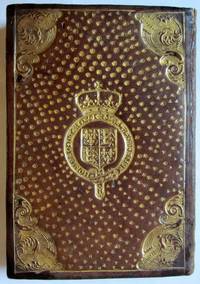
15683182London: William Seres 1568. 4to 216 x 147 mm. 8 118 leaves. Roman italic and greek types; printed shoulder notes. 8-line historiated woodcut initial opening the dedication 4-line initial opening the text. Title a bit soiled and ink-speckled some old crease marks to corners dampstaining in lower portion of last 30 or so leaves a few small stains including early inkstains in some lower margins.Contemporary London binding of ca. 1570 by the "Macdurnan Gospels Binder" of brown calf over pasteboard both covers gold-blocked and -tooled to a center- and corner-piece design with large cornucopia corner tools Foot K1 and K2 at center the gold-blocked arms of Elizabeth I within the Garter and surmounted by a coronet Oldfield British Armorial Bindings stamp 1 a semis of small gilt trefoils smooth spine gilt with small tools and intersecting fillets evidence of two fore-edge ties edges gilt the gilding largely faded; a few small gouges old restorations to corners obscuring the corner edges of five of the eight cornerpieces and to upper board edges joints and extremities of spine; modern folding case.Provenance: Elizabeth I of England supra-libros the binding probably commissioned and presented to her by the dedicatee Peter Osborne; Richard Latewar 1560-1601 preacher and Neolatin poet neat inscription on title consisting of two lines of Latin verse praising this posthumous work Bernardus niveos moriens imitates olores / Edidit hos dulces in sua busta sonos signed with his Latin name Richardus a Sero Bello a correction f. 98r and five marginal notes apparently in the same hand ff. 4v of the dedication 27v 31r 48r 65r 83v; Latin motto or quotationat end in a different early hand; John Wright purchase inscription on title stating that he paid 12 pence for the book in 1613 Johannes Wryght p. 12 d / 1613 a few marginalia probably in the same hand some marginal notation symbols and light underlines; with Bernard Quaritch catalogue 166 January 1897 Examples of the Art of Bookbinding no. 21 the text of the catalogue on a typed sheet mounted inside front cover. First Edition of a devotional treatise by a reformist Yorkshire preacher bound for presentation to the Queen.This was John Bernard's only published work. The manuscript was found in Bernard's study after his death by his brother Thomas who had it published dedicating the volume to Peter Osborne the lord treasurer's remembrancer of the exchequer. "According to Thomas Bernard his brother wrote the Oratio pia early in Mary's reign when the persecution of protestants was beginning. Supported by much classical and patristic learning John Bernard pursues the question of 'where the true tranquillitie of the minde may be founde' English translation of 1570 The Tranquillitie of the Minde 35. His standpoint is firmly evangelical. Proclaiming a scripture-based religion he rejects clerical celibacy and the doctrine of purgatory and asserts that if no morally worthy priest is available to comfort those troubled in conscience the latter should go instead to 'the lay man which is indued with the same giftes that are in a godly Minister'" Oxford DNB. The work was printed by the noted Protestant printer William Sere who had received letters patent for the printing of psalters primers and prayer-books in 1554; he lost this privilege under Queen Mary and regained it upon the accession of Elizabeth I in 1558.The "MacDurnan Gospels Binder" a shop or binder active from the 1560s to the early 17th century after about 1580 the shop's material is associated with the binder John Bateman derives its name from the 9th-century Gospels of Maelbright MacDurnan Abbot of Armagh d. 927 now in the Library of Lambeth Palace which was bound in this London shop for Archbishop Matthew Parker the bindery's main patron. "Besides binding manuscripts for Parker and presentation copies of books in whose production he was concerned this bindery bound presentation copies of books produced by most of the leading members of the London book trade between 1567 and 1577" Nixon Five Centuries. Nixon and Miriam Foot recorded nine bindings from the shop originally owned by Queen Elizabeth not including this one which appears neither in Nixon's 1970 census of 34 books bound in the shop nor in Foot's 70-item addendum to his census. Others were owned by King James I Henry Prince of Wales Robert Dudley Earl of Leicester William Cecil Lord Burghley and other luminaries.This binding is decorated with a pair of the distinctive cornerpiece blocks that characterize the shop's work; they are reproduced by Miriam Foot in The Henry Davis Gift volume I plate facing p. 40 as nos. K1 and K2. She reproduces two bindings decorated with these blocks dated by her to ca. 1567 and 1570 cf. vol. 1 no. 3 = vol. 2 no. 48 and vol. 2 49. Another binding with the same cornerpiece blocks though with modern overpainting is held by the Folger Shakespeare Library and reproduced in their Bindings Image Collection STC 17518. The present binding may have been commissioned for presentation to the Queen by Peter Osborne Officer of the Exchequer to whom the work is dedicated. The inscription by the poet and divine Richard Latewar who died in 1601 appears to indicate that the volume passed out of Queen Elizabeth's hands before that date.STC 1924. Cf. Howard M. Nixon Five Centuries of English Bookbinding 21; Nixon "Elizabethan Gold-tooled Bindings" Essays in honour of Victor Scholderer Mainz 1970 census pp. 254-262; Miriam Foot Henry Davis Gift I:35-49; Paul Needham Twelve Centuries of Bookbindings no. 87. William Seres unknown books
152168857London: Richard Pynson 1521. Full Description:<br> <br> HENRY VIII King of England. Assertio Septem Sacramentorum Aduersus Martin. Lutheru. Aedita ab Invictissimo Angliae et Franciae Rege et do. Hyberniae Henrico Eius Nominis Octavo. London: Richard Pynson 1521.<br> <br> First edition. Small quarto 8 1/4 x 6 1/8 inches; 210 x 155 mm. 80 leaves. With the final two blank leaves. Final leaf of text is errata and colophon. Large woodcut initials. Title-page within a allegorical woodcut boarder signed HH for Hans Holbein. "The woodcut border on the title-page which depicts the story of C. Mucius Scaevola and King Porsenna McKerrow & Ferguson 8 was adapted from a design by Hans Holbein for the De immortalitate animae by Aeneas Gazaeus printed by Froben in Basel in 1516." Sotheby's.<br> <br> Probably remboitage binding of 17th-century vellum rebacked. The arms of Pope Urban VIII in gilt as central devices on front and back board. Boards double ruled in gilt and with gilt bees as corner devices. All edges gilt. Leaves very clean. Binding with staining and repairs to corners. Old ink manuscript on front board. Final blank leaf professionally repaired. Overall a very good copy.<br> <br> It was perhaps as early as 1516 that Cardinal Wolsey anxious to distract him from more worldly preoccupations first encouraged Henry VIlI to embark on a serious rejoinder to Luther 49. In so doing Wolsey wrought his own downfall and this was perhaps the least of the consequences of 'The Assertion of the Seven Sacraments' one of the most fateful books in the history of western civilisation. Despite his unfeigned zeal to extirpate heresy it was not until Henry began to take a serious interest in foreign affairs that he realised the practical value which such a work might have if dedicated to the Pope. It is difficult to estimate the spiritual influence of the papacy at a time when the vast majority of Christendom saw It as a not specially powerful temporal state; but it was none the less felt. How much Henry's anxiety to complete the book between May and July 1521 was activated real if romantic desire to become the champion of the papacy it is hard to say. This point of view may be supported by Henry's statement to a startled and incredulous Thomas More 47 that 'from that See we received our crown imperial. More could see the dangers of so firm commitment to the temporal if not to the spiritual power of the papacy and his misgivings were soon to be justified a hundredfold. Henry gained the recognition he sought from Leo X the title of Fidei Defensor. But had he not made so absolute an admission of papal authority it is unlikely that he would have felt so personally slighted by the Pope's refusal to give him his way in his 'great matter' the divorce from Catherine of Aragon; unlikely that he would have turned with such vehemence on almost all the advisers. More among them who had made his reign so successful hitherto; unlikely that he would have claimed the royal supremacy in the Church; unlikely- but there speculation must stop. Suffice it to say that the publication of the Assertio must be considered to mark a critical moment in the history of the English Reformation." PMM 50.<br> <br> ESTC S123359. PMM 50. STC 13078.<br> <br> HBS 68857.<br> <br> $27500. Richard Pynson unknown
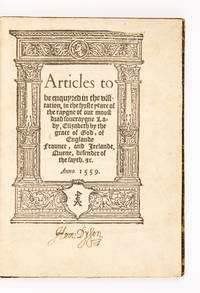
15592653London: : Imprinted… in Povles Churcheyarde by Richard Iugge and Iohn Cavvood Printers to the Quenes Maiestie 1559. FIRST EDITION of the first visitation articles of Elizabeth’s reign. . Quarto:. 18 x 13 cm. 14 pp. Collation: A-B4 lacking blank leaf B4 Bound in 19th c. marbled boards. A fine wide-margined copy. The title is set within an architectural woodcut border McKerrow & Ferguson 83 with Cawood’s monogram in the shield. A large woodcut initial of Arcas and Callisto appears on leaf A2. With the signature of the 16th c. book collector Humphrey Dyson 1582-1633 at the foot of the title page. The bookplate of Albert Ehrman with his motto “Pro Viribus Summis Contendo†is affixed to the front pastedown. This was lot 270 in the 1978 sale of Ehrman’s library. Very rare. ESTC locates 4 copies in the U.S.: Folger Huntington Harvard Yale. First edition of the first visitation articles established for the reformed church after Elizabeth’s accession. The visitation articles are a series of 56 questions that were to be asked by church commissioners as they visited each parish within the kingdom. They include inquiries into the number of people imprisoned starved or burned at the stake during Mary’s reign; the number of known drunkards adulterers brawlers sorcerers book burners possessors of unlawful books and minstrels or others who “do use to synge or saye anye songes or dytties that be vyle or uncleane and especially in derision of anye godly ordre nowe sette forth and established†in a given parish. “On 19 July 1559 Elizabeth issued a royal proclamation publishing her fifty-three ‘Injunctions’ which set forth to the clergy the form and substance of the Elizabethan Church established by the 1559 Act of Uniformity. Besides calling ‘all ecclesiastical persons’ to observe all the laws that restored to the Crown the ancient jurisdiction over the ‘state ecclesiastical’ the Injunctions specified that educated and licensed preachers should preach the Word of God or lacking such preachers that homilies should be read; that accessories for Catholic worship should be removed from churches and that Bibles should replace them… They called upon the Queen’s subjects to live in charity and to avoid religious epithets like ‘papist’ or ‘schismatic’ as words of reproach. Among the Injunctions one called for press licensing to deter printed books against the religious settlement… Besides those statutes that established Elizabeth’s succession and Church settlement among the earliest acts of Elizaneth I’s first Parliament were those that extended the Marian treason statutes. The first of these included in the definition of high treason writing or printing anything saying that the Queen was not entitled to rule or that someone else was. The second act extended the Marian statute that criminalized false slanderous and seditious news about the Queen.†Clegg Censorship and the Press 1580-1720 pp. 9-10 That the re-implementation of Protestant reforms was of paramount importance for Elizabeth is reflected in the second and third articles: The second article inquires “Whether in theyr Churches and chapels al ymages shrynes al tables Candelstickes Trindelles or rolles of Mare Pictures Payntynges and al other monuments of fayned and false myracles Pylgrymages ydolatrye and superstition be removed abolished and destroyed.†While the third asks whether the vicars… “openly playnley and distinctlye recite to theyr paryshners in the Pulpit the Lordes prayer the Belief and the tenne commaundements in Englyshe.†Further each parishioner is to be “admonished… that they ought not to presume to receive the sacrament of the body & bloud of Christ before they can perfectly recite the Lordes prayer the articles of the faith and the x. commaundementes in Englyshe.â€Article 12 And of course the old rite is to be suppressed. In article 9 the Commissioners are asked to discover whether any of the vicars curates or ministers declare “anyte thynge to the extollynge or settynge forth of vayne and superstitious religion pylgrimages reliques or ymages or lyghtyngge of candelles kyssinge knelynge eckynge of the same ymages.†The question regarding sorcery seems to encompass the work of midwives: “Whether you knowe any that doe use charmes sorcerye enchauntmentes invocations circles witchcrafts southsayinge or any lyke craftes or ymagniationes invented by the Devyll and specyallye in the tyme of womens travayle.†As regards books the 46th article asks “What bokes of goddess scripture you have delivered to be burnte or otherwise distroied ad to whom ye have delivered the same.†And the 52nd concerns “makers bringers biers sellers kepers or conveyers of anye unlawfull books whiche might styre or provoke seditionâ€. Provenance: Humphrey Dyson 1582-1633 a scrivener and notary was a noteworthy English book collector with possible ties to Shakespeare's circle. “Humfrey Dyson d. 1633 book collector was probably the son of Christopher Dyson d. 1609 wax chandler of the parish of St Alban Wood Street London and his wife Mary. He was practising as a notary public by 1609 when he witnessed Christopher's will and continued to do so until shortly before his death drawing up wills and other documents. He was a citizen of London as a member of the Wax Chandlers' Company from 1603 and married Elizabeth daughter of Thomas Speght d. 1621 the editor of Geoffrey Chaucer and John Lydgate. “Dyson is notable chiefly for the enormous library he amassed. No catalogue of the library is known apart from six notebooks All Souls College Oxford MS 117 listing in order of date of publication those books ‘touching as well the State Ecclesiasticall as Temporall of the Realme of England’: in 1631 these alone totalled nearly 1100. He also owned a large number of works of Elizabethan and Jacobean literature; in some instances his is now the unique surviving copy. Nearly all the extant printed proclamations of Queen Elizabeth I's reign belong to the seven sets each of which he collected together bound and provided with its own specially printed title-page 1618. Dyson printed nothing else but he collaborated in the 1633 revision of John Stow's Survey of London—an edition that included many copies of acts of parliament and of the common council of London. “Dyson died between 7 January 1633 when he made his will as a parishioner of St Olave Jewry London and 28 February 1633 when it was proved. In it he made monetary bequests to his four daughters and two sons allowed the use of his professional papers to his apprentices and gave a two-volume book of statutes to ‘my noble friend Sir William Paddy … to be by him put and given to the library of St John's College in Oxford’. He directed simply that his other books be sold by William Jumper; a great many of them were acquired by Richard Smith d. 1675 and were dispersed when his library was sold in 1682. Thomas Baker wrote: ‘There are Books chiefly in old English almost in every Library that have belong'd to H. Dyson with his Name upon them’ Hearne 7.369.â€Nigel Ramsay ODNB STC 10118 Imprinted… in Povles Churcheyarde by Richard Iugge and Iohn Cavvood, Printers to the Quenes Maiestie, unknown books
188155698London 1881. Very good. Twelve monthly parts quarto 22 by 17.5 cm. 379 leaves 8 final blank. Original manuscript penned in several neat hands including 40 original illustrations mostly tipped-in on heavier paper. Title pages for vol. 1 January-June and vol. 2 July-December; index for vol. 1. Recent foliation in pencil; 75 pages with contemporary numeration in ink. Navy blue polished calf lettered and tooled in gilt marbled endleaves. Covers lightly chafed at extremities; occasional mild smudging else text about fine.<br /> <br /> Privately circulated magazine comprising essays often on historical subjects travel accounts short stories poetry riddles and puzzles along with some letters to the editor. This particular collection affords a unique perspective on a Victorian-era co-ed literary project born of youthful enthusiasm. Many of the pieces unfold serially across several issues. Floral themes depictions of girls and landscapes abound among the watercolor and ink illustrations most of which are on heavier paper and have been tipped-in. All but the last issue contain an opening illustration invoking the month. The illustrations and written pieces are pseudonymously signed by no fewer than sixteen contributors many of whom are women: Ad Lucem; Amicus; Beth; Constancy; Daphne; Elaine; Gh; Granta; Hope; Iris; Ivy; Mezereon a species of Daphne; M'one; M:zone; One of the Mob; Sinon the cousin of Odysseus who persuaded the Trojans to open the gate for the Trojan Horse; Viola. The editor's introduction and subsequent addresses attest to the ephemeral nature of the project including financial pressures. In the address to the members which appears at the opening of the second volume the editor raises the issue of increasing the subscription rate for 2 to 5 shillings per annum. <br /> <br /> "At a meeting of a few friends it was suggested that a publication of a Magazine to be circulated among the members only should be undertaken. Two members undertook to draw up a code of rules and issue a circular inviting members to join the Society the magazine of which was to be called 'The Folia Peripatetica.' The encouragement which the proposal received was quite equal to the anticipation of the promoters and many hailed with joy the advent of the Folia as a pastime and an occupation for the long winter evenings and sunny days of summer. All the contributors it is needless to say were born authors and though perhaps some were comparatively young in years yet their light was no longer to remain dimly burning under the bushel. Poets Musicians Novelists Historians all found here the medium they had long wished for. Joy joy unspeakable joy reigned supreme in the Editors office and for a season all went on as 'merry as a cricket.' But alas! vain are the hopes of man. Time was when lo a change came oer the spirit of my dream. Members finding they were after all condemned to 'blush unseen' and waste their fragrance on the limited circle of the Folia's members began to find that other and more important duties claimed their time. Some retired into distant parts of the country others went abroad or got married. In vain fresh nurses were called in and a change of Doctors -- I mean Editors -- effected Hope for a short while revived but this soon gave place to despondency. A change to Sidmouth and Plymouth only accelerated the malady. But the Folia was not to perish in this obscure way. Fate had ordained a fairer destiny. The two volumes now handsomely bound will remain for many a long year to come a fitting monument to the memory of the 'Folia Peripatetica'" editor's preface. vol. 1. <br /> <br /> "Granta" contributes several notable pieces: "University Degree Day" an eye-witness account of the 1877 ceremony where Charles Darwin received an honorary degree at Cambridge; "Jesuit Schools" prompted by the "advent of a colony of Jesuits in our secluded valley;" and "Capital Punishment" in which the author argues against "a practice entirely barbarous horrible in its details and brutalising in its effects." A piece on "Women's Rights" written under the pseudonym "Ad Lucem" is illustrated with pen drawings of butterflies. An account of Autumn maneuvers with the 20th Yorkshire Amateur Carabineers written by a participant is provided by Gh. "Hope" writes about "Shakespeare's Heroines" and "Viola" explores the lives of "Some of Our King's Wives." "One of the Mob" offers an account of "two bachelors of limited incomes" visiting Paris on the cheap. An anonymous writer compares "the translations of the old and revised versions of the New Testament" that appear in the Gospel of Matthew. "Music in Worship" by "Amicus" includes a score entitled "Augusta." An ultra-miniature 30 cm text penned within a circle and requiring magnification to read includes The Lord's Prayer a Creed and the Ten Commandments the final line noting "St. John's College Cambridge 1881."<br /> <br /> Provenance: Editorial note at close of first monthly issue noting that subscriptions for the current half year are now due and should be forwarded to No. 43 Oakley Street Chelsea.<br /> <br /> Binding: ticket of Macmichael. Stationer to the Queen. 207 Kings Road. Chelsea<br /> <br /> Watermark: Jordan Superfine. unknown
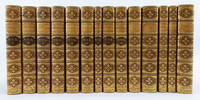
1809ST19496London and Hafod 1809-11. 300 x 240 mm. 11 3/4 x 9 1/2". 14 volumes. Froissart translated by John Bouchier Lord Berners. Monstrelet translated by Thomas Johnes. Rastell edited by Thomas F. Dibdin. <br/> HANDSOME CONTEMPORARY SPRINKLED CALF GILT covers with French fillet border corners with floral spray topped by a coronet raised bands spine compartments with central floral sprig surrounded by small tools acorn and oak leaf cornerpieces one tan and one brown morocco label marbled endpapers all edges gilt. Monstrelet with 51 plates one double page; Rastell with numerous woodcuts in the text and 18 full-page portraits of English kings. Lowndes III 1586; Cave "Private Press" pp. 43-44 Monstrelet; Cox III 380; Lowndes II 924 Grafton; Cox III 375; Lowndes II 843 Froissart; Cox III 378; Lowndes II 984 Hall; Cox III 374; Lowndes I 72 Arnold; Cox III 377; Lowndes IV 2051 Rastell; Cox III 375; Lowndes II 773-774 Fabyan; Cox III 378; Lowndes II 994 Hardyng. Spines lightly sunned top label more affected a dozen boards with small patches of lost patina from insect activity light rubbing to extremities other insignificant defects but the bindings lustrous with very little wear and making an imposing presence on the shelf. Illustrations lightly foxed occasional minor foxing or browning to text more prominent on a dozen or so openings but never severe other isolated negligible imperfections but a fine set inside and out the amply-margined text clean bright and fresh.<br/> <br/> Tall uniformly bound and a striking ornament to any library these volumes contain important histories first published in the 15th and 16th centuries covering events in England France and western Europe from the first century A.D. through the mid-1500s. The famed "Chronicles" of Jean Froissart ca. 1337 – ca. 1405 are a key resource for the Hundred Years' War and for the chivalric culture of the 14th century. Monstrelet ca. 1400 – 1453 picked up where Froissart left off reporting on the years 1400-44. The works by Robert Fabyan d. ca. 1512 and John Hardyng 1378–1465 look at English history from the first century Roman occupation through the Plantagenet and Tudor dynasties ending in the 15th and 16th centuries respectively. Printer John Rastell d. 1536 compiled and published "Pastime" which looks at England from 1066-1485. The "Chronicle" by Edward Hall 1497-1547 covering the years 1399-1547 was a key source for Shakespeare's history plays and according to A. W. Rosenbach's 1938 catalogue was "the second book printed in English and written by an Englishman referring to America as well as the first English historical work mentioning a voyage to America." King's printer to Henry VIII and Edward VI Richard Grafton ca. 1506/7 or 1511 – 1573 produced an abridgement of earlier Chronicles and a continuation of Hall's work notable according to DNB for "his description of the accession of Queen Elizabeth her welcome in London and the pageants held along the route—from the Tower to Westminster—which Grafton helped to oversee." "Customs of London" attributed to Richard Arnold d. ca. 1521 lists mayors sheriffs and bailiffs of that city from the time of Richard I to that of Henry VI and contains its articles charters and ordinances. It is easy to picture the present set on the shelves of a stately home---which given their "country house" condition is quite possibly where they resided for many years. unknown
1505rx1297Michel le Noir Relié 1505 Ensemble complet des 4 livres de Froissart, en trois volumes reliés plein vélin sur ais de bois, dos ornés de fers qui sont plus probablement du XVIII° siècle ainsi que les pièces de titre, la peau a-t-elle été changée, c'est difficile à dire, mais sa patine nous permet de la dater d'au moins du XVII°, peut-être du XVI°, il semblerait que les gardes aient été refaites également, sans doute au XVIII lors de la pose des pièces de titre. Le Premier volume de Froissart Des croniques de France : dangleterre, descoce ; Despaigne : de bretaigne : de gascongne : de flandres. Et lieux circonvoisins. A la fin : Cy finist le premier volume… Imprime a paris par Michel le noir libraire demourant au bout du pont nostre dame devant saint denis de la chartre a lymage nostre Dame. Lan mil cinq cens et cinq le xxviii. Iour de mars. Petit in-folio de 8 feuillets, CCLXXI, complet de tout ses feuillets Au verso du 271è feuillet, la marque de Michel le Noir. Dans ce premier volume, des travaux de vers sans gravité, une mouillure marginale sur les 64 dernières pages. Second volume de Froissart, des croniques de France, dangleterre, descoce, despaigne, debretaigne, de gascogne, de Fralndres et lieux circonvoisins. A la fin : Cy finit le second volume des croniques de messire Jehan Froissart sur les guerres de France, dangleterre, escoce, espaigne, Bretaigne, Flandres et autres lieux voisins. Imprimé à Paris pour françois regnault libraire demourant en la rue saint-jacques à lenseigne sainct Claude. Dans ce volume les cahiers sont quaternes excepté F qui est quinterne et A et G qui sont ternes. CCLVVIV feuillets, colationné complet, volume non daté, mais comme nous le verrons notre troisième volume étant daté de 1518 on peut supposer qu'il fait parti du même tirage. Le tiers volume de Froissart, des cronicques de France, dangleterre, descoce, despaigne, de Bretaigne, de Gascongne, de Flandres et lieux circonvoisins. Dans ce dernier volume le cahier A est terne. Le tiers volume contient CCXXXI feuillet il et est bien complet. A la fin : Cy finist le tiers volume de messire Jehan Froissart sur les croniques de france, dagleterre, escoce, spaigne, Bretaigne et flandres et lieux voisins. Imprime à Paris po François regnault libraire demourant en la Rue Saint jacques a lenseigne sainct claude. Le quart volume de Froissart, des cronicques de France, dangleterre, descoce, despaigne, de Bretaigne, de gascogne, de Flandres et lieux circonvoisins. Ce dernier volume contient deux feuillets non numéroté, puis CXI feuillets complet. A la fin : Cy finit le quart volume de messire jehan froissart sur les croniques de France, dagleterre, escoce, espaigne, Bretaigne, Flandres, Navarre, Arragon, Naples, Hongrie lieux circonvoisins imprime à Paris l'an de grace mil cinq cens et dixhuyt, le vii° jour doctobre pour françois regnault libraire demourant en la rue sainct Jacques à lenseigne sainct claude ; nous avons ici un ensemble composite un volume de 1505 pour Michel Le Noir, puis le second, le tiers et le quart volume dans une édition plus tardive de 1518, le tout avec une reliure sur ais de bois, très probablement plus tardive, bien que les ais de bois ne soient plus que très rarement utilisé après le seizième. Nous sommes donc en face d'une reliure qui peut être une reliure à l'antique réalisé à la fin du XVII° ou au XVIII°, ou face à une reliure modifié au cours du temps. On ne présente plus Froissart qui couvrit la partie de la guerre de cent ans de 1326 à 1400. Froissart meurt en 1410 sans, très probablement, finir son ouvrage. Il existe plus de cent manuscrits copiés lors du XV° siècles. La première édition imprimée est donnée par Antoine Verard vers 1495. Celle de 1505 est la troisième, celle de 1518 est la 10°. Les ensembles homogènes sont très rares. Notre exemplaire est frais malgré les travaux de vers des deux premiers volumes (fréquents dans le premier volume, rares dans le second). Les reliures sont fatiguées (surtout les dos, voir photos, les plats sont propres) mais leur patine est agréable. Un bel exemplaire bien complet, collationné. Livraison a domicile (La Poste) ou en Mondial Relay sur simple demande.
181815391ABEngland and Scotland, 1818 - 1838. 28,5 : 38,5 cm. 20 mounted original watercolours, mezzotints and drawings Full contemporary calf, richly gilt ornamented on spine and boards, edges gilt.
1767QQ0322Printed by Mark Baskett and by the assigns of Robert Baskett 1767. Original full black morocco elaborate gilt borders to boards built up with single gilt fillet geometric roll and small tools rococo floral motifs. Geometric gilt decor to board edges; floral gilt decor to turn-ins. Raised bands to spine and elaborate gilt decor in small tools flowers stars fronds etc. Some rubbing to board and spine edges and to raised bands on spine. Board corners slightly pushed in. Mild uniform sunning to boards and spine. Minor abrasion c. 1.5cm to centre rear board. All edges gilt. Thick 4to 33 x 26.5 x 10.5cm. Hinges sound. Original marbled endpapers; front endpapers cracked at gutter. With loose slip of paper with pen inscription: 'This Bible was donated to the Community of Our Lady and St John at Alton Abbey by HRM Roundell Esq . whose late wife Louise was a member of the Corrie family. February 2005'. There is indeed the signature 'Edgar Corrie' to t.p. and 6pp. inscriptions largely genealogical records of the Corrie family to front of vol. inc. blank verso to front free endpaper and t.p. in a variety of old hands some interspersed with annotations to birth or baptismal records giving dates of death. First blank front endpage has some loss at top and bottom gutter. Dates recorded range from 1748 the birth of Edgar Corrie clearly recorded after the fact to 1894 Fanny Amos the 'loving and dearly loved friend and nurse' to a succession of Corries born in the mid-nineteenth century; possibly the only individual recorded who was not a member of the Corrie family by birth or marriage. The first page of inscriptions is not a genealogical record but a selection of biblical passages and an unattributed quotation from the 17th-century Anglo-Welsh historian James Howell 'in the conduct of human affairs it is a rule that a good conscience hath always within doors enough to reward itself' see Epistolae Ho-Elianae: The Familiar Letters of James Howell 1907 Vol. III p. 3. The collected inscriptions are signed 'E.C. 14th March 1799'; Corrie concludes at the bottom of the page 'I earnestly recommend the serious consideration of all the above texts & truths to each & to all of my Children' the second page of inscriptions records ten children to Corrie and his wife Ann Falkner. Edgar Corrie 1748-1819 prominent Scottish merchant in Liverpool business partner with John Gladstone father of the prime minister from 1787-1801. Corrie was a clandestine abolitionist: he wrote to Lord Hawkesbury in February 1788 with 'a long attack on the conduct of the slave trade in Liverpool' but asked that his name should be concealed from all except the Prime Minister William Pitt as it would 'cause him "irreparable prejudice" in the town if his letter became known' F. E. Sanderson “The Liverpool Abolitionists” in R. Anstey and P. E. H. Hair eds. Liverpool the African Slave Trade and Abolition 1989 pp. 215-16. No pagination. Decorated initials. Text printed in double columns. Separate dated t.p. for NT. Index to rear. The Apocrypha is listed in contents but it was issued without. Lacking the additional engraved title page mentioned by Darlow & Moule as are many other copies in ESTC & OCLC. Large paper copy considerably larger than the 24.1 x 18.8 size mentioned in Darlow & Moule. An imposing Baskett bible in handsome original binding with interesting provenance. Darlow & Moule 1180; ESTC T93100. Robust packaging. Tracking can be added to overseas orders on request. Used books are exempt from USA tariffs. Very Good/Fine. c. 3000pp. 33 x 27 x 10 cm. Printed by Mark Baskett and by the assigns of Robert Baskett Hardcover
17131394685London: Printed by John Baskett 1713-1717. First Editions. Hardcover. Folio 61-174 2179-191 6 203-206 2 211-218 2 223-270 2 275-357 3 361-362 2 367-382 2 387-422 4. In Good minus condition. Bound in full contemporary calf with banded spine and tooling to boards. Boards show moderate wear to edges moderate plus wear and bumping to corners and several gouges to the front board. Cracking to leather along joint of front board. A clear lacquer appears to have been applied to the boards. Text block has light age toning to edges. Ex-Library institutional plate appears on front paste down. Ex libris of former owner appears on front pastedown. Several ink "doodles" in an 18th-century hand appear on the front paste down and front free end page. Square-inch tear to fore-edge of front free end page. Pages tightly trimmed by binder impacting some of the printed marginal annotations. BB Consignment. Shelved in Room A Oversized. Appears to contain two collections of public statutes passed in 1713 and 1714 but printed between 1713 and 1717 each with a closing contents page. The first collection contains Acts II - XVIII of 18 acts and the second contains Acts II - XXIII of 23 acts. The acts cover a range of topics including duties tariffs and taxes; the paying and management of military personnel and militias; and the management of churches. The most significant of the acts however is Act 15 of the second set of acts entitled "An Act for Providing a Publick Reward for such Person or Persons as shall Discover the Longitude at Sea". This formally established the Commissioners of the Longitude and the reward of £20000 for "the first Author or Authors Discoverer or Discoverers of any such method ." that to the satisfaction of the committee accurately determined a ship's longitude at sea accurate to within 20 geographical miles. This reward would not be claimed until 1765 when clockmaker John Harrison developed his "time-keeper" or marine chronometer. 1394685. Special Collections. Printed by John Baskett hardcover
16113462Latin manuscript on vellum with large 6 in diameter suspended black wax seal of James I of England and autograph of Anne of Denmark dated July 23 1610 granting title to Corrodownan Manor in County Cavan Ulster to one John Browne Gent. of Gorgiemill near Edinburgh and his descendants during the Plantation i.e. colonization of Ulster under James I beginning in 1609. The colonists were settled on land confiscated from the Irish inhabitants following the conquest of Ulster 1594-1603 under James's predecessor Elizabeth I. The Plantation was intended to consolidate royal control of Ulster and repress rebellion by importing a substantial Protestant population. Like John Browne and indeed James himself many of the new colonists were Scottish. Some of these families went on to form the backbone of the Protestant Ascendancy in the province. John Browne and his heirs however were not among them. Sir George Carew sent by the king in 1611 to report on the progress of the Plantation noted that "he Browne . sent an agent who took possession set the lands to the Irish returned to Scotland and . performed nothing." The land was sold in 1613 to another Scottish colonist Archibald Acheson. Acheson's descendants were raised to the peerage of Ireland in 1806 as Earls of Gosford and still owned the property in the late nineteenth century. The first nineteen lines of the document grant the Scottish Browne the rights and privileges of James's English and Irish citizens. Especially notable are the requirement that the grantee maintain an adequate supply of arms for defense against the king's enemies lines 77-80 the attempt to encourage the growth of towns 74-76 and the ban on sale of the property to "mere Irish" or to anyone who failed to acknowledge the sovereign as head of the church thus excluding all Catholics by swearing the Oath of Supremacy 114-121. See Rev. George Hill The Conquest of Ireland. An Historical Account of the Plantation of Ulster at the Commencement of the Seventeenth Century 1608-1620 Belfast 1877 308; idem Plantation Papers. Containing a Summary Sketch of the Great Ulster Plantation in the Year 1610 Belfast 1889 188-190; F.J. McCaughey Arvagh. Sources for a Local History Arvagh 1998 16.; Moiré chemise lined with exact recess for seal housed in handsome ruled red morocco clamshell case with gilt title to front cover and raised bands gilt particulars and decoration to spine; gilt rolled edges. Two leaves 65 x 81 cm; the first illuminated with a portrait of the king. Stain to upper left see image.; 65 x 81 cm; 1 pages; Signed by Notable Personage Related; All shipments through USPS insured Priority Mail. . hardcover books
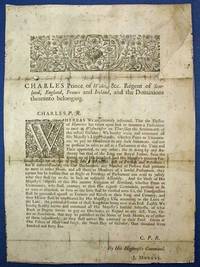
174536894Edinburgh 1745. 1st printing ESTC T30512. Broadside printed recto only. Complete printed text supplied on request. On an old mount broadside previously folded and repaired with slight loss of a few letters not affecting sense or legibility. A triangular section to the upper right blank margin lost & supplied no text affected. Some expected age-toning & soiling. A Good copy. Large headpiece 4.3 cm x 15 cm. Large initial capital letter 'W'. 30.3 cm x 22 cm. <br/><br/>Charles best known today as the instigator/leader of the unsuccessful Jacobite uprising of 1745 in his effort to restore an absolute monarchy to the United Kingdom which culminated in defeat at the Battle of Culloden essentially signaling the end of the Jacobite cause. This broadside issued at the apex of the rebellion highlights the extent of Charles' belief in his claim to the throne for in it he declares the parliament at London to lack legitimacy; next he brands traitor & rebel all who attend said parliament; and finally he declares the "pretended union of these Kingdoms now at an End." A very rare survivor of this tumultous time of British history this broadside is known in only 6 copies per ESTC none on this side of the pond. unknown books
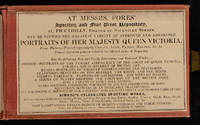
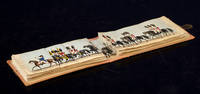
05481London: Messrs. Fores 1838. Queen Victoria's Coronation Procession in Scarce Panorama<br /> One of the Earliest Examples of Royal Memorabilia<br /> An Exceptional Example<br /> <br /> PANORAMA. VICTORIA Queen of England 1819-1901. Fores' Correct Representation of the State Procession on the Occasion of the August Ceremony of Her Majesty's Coronation June 28th 1838. Sixty Feet Long. Price £1. 11s. 6d Coloured 16s Plain. Also Accurate Views of the Interior of the Abbey During the Ceremony. London: Published by Messrs. Fores at their Sporting & Fine Print Repository and Frame Manufactory August 20 1838. <br /> <br /> First and only edition and issue. Small oblong quarto cover size: 4 13/16 x 7 7/8 inches; 122 x 200 mm. Thirty-three hand-colored sections in a continuous strip 4 x 675 inches; 103 x 17145 mm. of the full procession scene in aquatint. <br /> <br /> Publishers pink ribbed cloth covers bordered in blind front cover decoratively stamped and lettered in gilt with a border of crowns and flowers smooth spine decoratively tooled in blind. Small booksellers ticket of "R. Ackermann Junr." and small label wit "PP 2/ 1952" on front paste-down. Complete with the original brass clasp and catch. The spine very slightly faded still an exceptional example - apparently rarely handled.<br /> <br /> On June 20 1837 King William IV died and his niece Princess Victoria became Queen at the age of 18. Her coronation was held at Westminster Abbey a year later on June 28 1838; this panorama illustrates her procession to Westminster. The coronation was a huge occasion for celebration and four hundred thousand visitors descended upon London to see the new Queen being crowned. <br /> <br /> In her diary the nineteen-year-old Victoria set down an account of this the greatest day in her young life:<br /> <br /> "I was awoke at four o'clock by the guns in the Park and could not get much sleep afterwards on account of the noise of the people bands etc. etc. Got up at seven feeling strong and well; the Park presented a curious spectacle crowds of people up to Constitution Hill soldiers bands etc. I dressed having taken a little breakfast before I dressed and a little after. At half-past nine I went into the next room dressed exactly in my House of Lords costume."<br /> <br /> "At 10 I got into the State Coach with the Duchess of Sutherland and Lord Albemarle and we began our progress. It was a fine day and the crowds of people exceeded what I have ever seen; Their good humour and excessive loyalty was beyond everything and I really cannot say how proud I feel to be the Queen of such a nation.<br /> <br /> ". After the ceremony At about half-past four I re-entered my carriage the Crown on my head and the Sceptre and Orb in my hands and we proceeded the same way as we came-the crowds if possible having increased. The enthusiasm affection and loyalty were really touching and I shall ever remember this day as the PROUDEST of my life! I came home a little after six really not feeling tired. At eight we dined."<br /> <br /> "On the day of Queen Victoria's coronation four hundred thousand visitors descended on London to see the new queen. Fores publishing house had been established in the 1780s by Samuel William Fore 1761-1838 with his shop in Piccadilly London. It specialized in caricature and memorabilia and was at one time reputed to have the largest collection of caricatures." Bobins.<br /> <br /> Abbey Life 539; Bobins IV 1303. London: Messrs. Fores, 1838 unknown
04810London: Messrs. Fores 1838. Queen Victoria's Coronation Procession in Scarce Panorama<br/>One of the Earliest Examples of Royal Memorabilia<br/>A Near Fine Example<br/><br/>PANORAMA. VICTORIA Queen of England 1819-1901. Fores' Correct Representation of the State Procession on the Occasion of the August Ceremony of Her Majesty's Coronation June 28th 1838. Sixty Feet Long. Price £1. 11s. 6d Colored 16s Plain. Also Accurate Views of the Interior of the Abbey During the Ceremony. London: Published by Messrs. Fores at their Sporting & Fine Print Repository and Frame Manufactory August 20 1838. <br/><br/>First and only edition and issue. Small oblong quarto cover size: 4 7/8 x 8 inches; 123 x 203 mm. Thirty-three hand-colored sections in a continuous strip 4 x 675 inches; 103 x 17145 mm; of full procession scene in aquatint. An exceptional example with just a few of the folding illustrations expertly strengthened on verso at crease.<br/><br/>Publishers pink ribbed cloth covers bordered in blind front cover decoratively stamped and lettered in gilt with a border of crowns and flowers. expertly rebacked to style complete with the original brass clasp and catch. An excellent example.<br/><br/>Only one other copy in 1997 of this scarce and splendid keepsake panorama has come to auction since 1970.<br/><br/>On June 20 1837 King William IV died and his niece Princess Victoria became Queen at the age of 18. Her coronation was held at Westminster Abbey a year later on June 28 1838; this panorama illustrates her procession to Westminster. The coronation was a huge occasion for celebration and four hundred thousand visitors descended upon London to see the new Queen being crowned. <br/><br/>In her diary the nineteen-year-old Victoria set down an account of this the greatest day in her young life:<br/><br/>"I was awoke at four o'clock by the guns in the Park and could not get much sleep afterwards on account of the noise of the people bands etc. etc. Got up at seven feeling strong and well; the Park presented a curious spectacle crowds of people up to Constitution Hill soldiers bands etc. I dressed having taken a little breakfast before I dressed and a little after. At half-past nine I went into the next room dressed exactly in my House of Lords costume."<br/><br/>"At 10 I got into the State Coach with the Duchess of Sutherland and Lord Albemarle and we began our progress. It was a fine day and the crowds of people exceeded what I have ever seen; Their good humour and excessive loyalty was beyond everything and I really cannot say how proud I feel to be the Queen of such a nation.<br/><br/>". After the ceremony At about half-past four I re-entered my carriage the Crown on my head and the Sceptre and Orb in my hands and we proceeded the same way as we came-the crowds if possible having increased. The enthusiasm affection and loyalty were really touching and I shall ever remember this day as the PROUDEST of my life! I came home a little after six really not feeling tired. At eight we dined."<br/><br/>"On the day of Queen Victoria's coronation four hundred thousand visitors descended on London to see the new queen. Fores publishing house had been established in the 1780s by Samuel William Fore 1761-1838 with his shop in Piccadilly London. It specialized in caricature and memorabilia and was at one time reputed to have the largest collection of caricatures." Bobins.<br/><br/>Abbey Life 539; Bobins IV 1303. London: Messrs. Fores, 1838 unknown books
1737AMO-4509London, Printed for the Author ; and sold by W. Innys and R. Manby, 1737 3 parties reliées en 2 volumes in-8 (23,6 x 15 cm) de (13)-XXXII-431-(1 bl.) et (10)-352 pages, suivi de "An Appendix in Answer to a Book, etc." en pagination séparée de 85-(27) pages. Reliure strictement de l'époque plein maroquin noir, dos à nerfs richement ornés aux petits fers dorés, large dentelle dorée en encadrement des plats, armoiries dorées au centre des plats, roulette dorée sur les coupes et en encadremen intérieur des plats, doublures et gardes de papier peigne, tranches dorées. Légères marques aux reliures, sans gravité. Petits manques aux pièces de titre et sur un bord de coiffe (coiffe supérieure du premier volume), coins légèrement frottés ou usés, sans gravité, armoirires dorées sur le premier plat du premier volume légèrement frottées. Intérieur en bon état, imprimé sur beau papier fort à grandes marges (large paper).
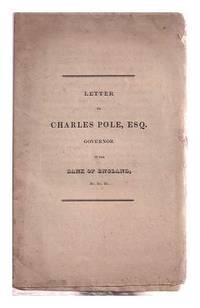
1820342776Publisher; Unknown 1820. First edition. Softcover. Specimen color/red plates 1 5 & 10 pound notes printed on single and double sides loosely inserted. Good copy; edges slightly nicked and dust-dulled as with age. An unread example with unopened pages. Remains particularly well-preserved overall; bright and clean. Additional scans and bibliographic detail on request. Date of publication is suggested. Physical description; 14 pp. Dis-bound as issued. Subjects; Bank of England.1800-1850. Bank notes - original currency samples -Great Britain. Banks and banking Central Great Britain. Currency - counterfeit and fraudulent - currency - forgery - nineteenth century. Currency printing - authentic registers. Pole served as Bank governor from 1820-1822 only. Publisher; Unknown paperback
51-6269Roma: Nella Stamperia di Generoso Salomoni 1762; Veneunt apud Auctorem aedibus Comitis Thomati via Felice prope templum SS. Trinitatis in Monte Pincio; . Folio. 40 x 52.7cm. Half 19th Century polished calf with marbled boards.Wilton-Ely D.IV nos. 553-558. The large folding plate "Senatus Populusque Romanus Monumenta. The Senate and People of Rome Wilton-Ely 558 is now in a sleeve bound-in for ease of removal and display. Engraved title engraved dedication large folding engraved plate with fabric repair to verso and a couple of small tears or wear-through holes at folds engraved vignettes light staining to half-title initial ff. and plates with small damp-stain to fore-edge margin 1762. very light scattered marginal spots or soiling book-plate to front pastedown "Collegii Sancti Cuthberti" c.f. Brunet IV 672. Roma: Nella Stamperia di Generoso Salomoni, 1762; Veneunt apud Auctorem aedibus Comitis Thomati via Felice prope templum SS. Tri hardcover
1823STLE0027London, Thomas Davison 1819-21 (Cantos I-V) u. John Hunt 1823-24 (Cantos VI-XVI). 8° (21,5 x 12,5 cm). (6 Tle. in 3 Bdn.). Tit., 227(1) S. (Cantos I & II); Tit., 218(2) S. (Cantos III, IV & V); VII(2) S., 181(1) S. (Cantos VI, VII & VIII); 151(1) S. (Cantos IX, X & XI); 168 S. (Cantos XII, XIII & XIV) u. 129(1) S. (Cantos XV & XVI). Dekorative Halblederbände der Zeit m. reicher goldgepr. Rückenverzierung, 2 Rüschildchen. Einbände leicht berieben, Ecken bestoßen, an den ob. Kapitalen etw. lädiert, Band 1 mit unterlegtem Eckabriss (Titelbl.) u. Namenszug v. alter Hd. auf Nebentitel, nur vereinzelt braunfleckig, im Text sehr sauberes Exemplar. STLE0027 EUR 5800 Bd. 1 (Cantos I u. II) erste Ausgabe im Oktavformat, die übrigen Bde. (Cantos III-XVI) in Erstausgaben. Der erste Band im Jahr der Erstausgabe in verkleinertem Format. Der Verleger Thomas Davison ließ den ersten Band im Quart-Format drucken. Doch die Verkaufszahlen der Auflage von 1500 Exemplaren waren enttäuschend, noch im selben Jahr erfolgte als 'New Edition' eine Ausgabe im kleineren Oktav-Format. 1823 übernahm Hunt den Druck der weiteren Bände und behielt das Oktavformat bei. - Das - unvollendet gebliebene - satirische Gedicht 'Don Juan' erschien anonym von 1819-24 in Fortsetzungen (16 Gesänge). Blackwood's Magazine nannte es 'a filthy and impious poem' und Wordsworth schrieb 1820 dazu: "I am convinced that Don Juan will do more harm to the English character, than anything of our time". Bd. 1 (Cantos I u. II) erste Ausgabe im Oktavformat, die übrigen Bde. (Cantos III-XVI) in EA. - Der erste Band im Jahr der Erstausgabe in verkleinertem Format (Oktav statt Quart). Der Verleger Thomas Davison ließ den ersten Band im Quart-Format drucken. Doch die Verkaufszahlen der Auflage von 1500 Exemplaren waren enttäuschend, noch im selben Jahr erfolgte als 'New Edition' eine Ausgabe in kleinerem Oktav-Format. 1823 übernahm Hunt den Druck der weiteren Bände und behielt das Oktavformat bei. - Das - unvollendet gebliebene - satirische Gedicht 'Don Juan' erschien anonym von 1819-24 in Forsetzungen (16 Gesängen). Im Blackwood's Magazine nannte es 'a filthy and impious poem' und Wordsworth schrieb 1820 dazu: ?I am convinced that Don Juan will do more harm to the English character, than anything of our time??. - Differenzbesteuert
162516043JLondon: Whitehall May 28 1625. CHARLES I King of England. Original Document Signed "Charles R". Bifolium with affixed wafer seal on the second sheet address verso text written in brown ink in a legible courthand signed at the head of the first leaf recto approximately 28 lines dated Whitehall 28th of May 1625. Some minor foxing minor wear to folds. Framed with an engraved portrait of the King. The document is addressed to a group of Scots peers including Sir William Oliphant. "Having understoode that a submission was sent to our late dear father from diverse gentlemen and others neighboring within the . of Glenalmond the right and title that they pretended thereto." Whitehall unknown books
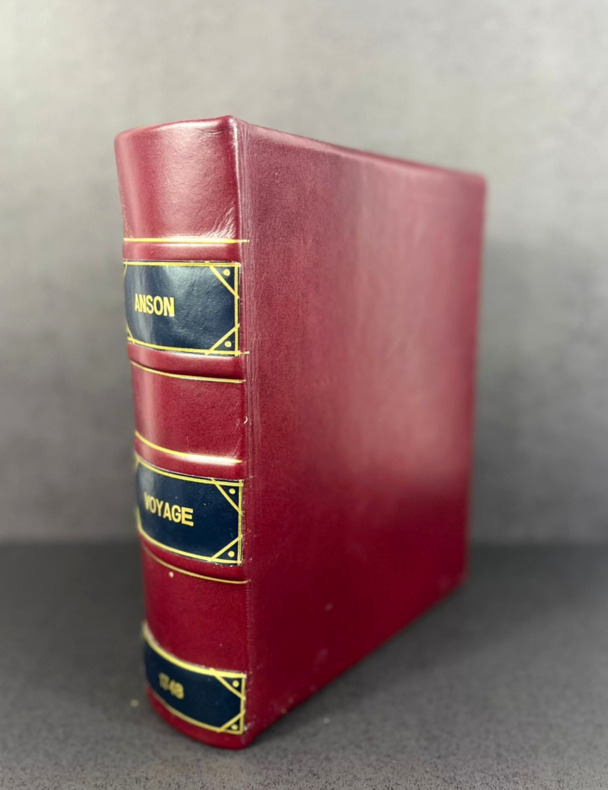
1748493London, John and Paul Knapton in Ludgate Street, 1748. This is a subscriber copy, so the real first edition of Anson's book. A brick of a book with 215 x 260 mm, 80 mm thick. 33 unpaginated pp. at the beginning, 417 (2) pp. Contemporary thick binding of a deep purple hue, four nerves on the spine, three black title pieces with author's name, book title and year in gold print characters. Includes the list of subscribers, p. 319 incorrectly designated as p. 219, two pages of instructions to the binder at the end of the book. With 42 copper plates: 14 maps and 28 engravings, all folding (38 having dimensions close to the book itself or to unfold horizontally and 3 being large folding maps). Comes with a sliding protective case. This is a copy of George Anson's account of his circumnavigation voyage. Complete with all the features which are often missing or signal a later edition. A lively tale of hardship, courage, curiosity, risk-taking and doing the impossible: overtaking Spain on the Peru coast, taking a Spanish galleon and completing the travel around the world with an awesome booty and an epic story to tell. The victory of Anson's Centurion launched the age of British dominance over the oceans and paved the way for a Victorian empire where "the sun never sets."
18299273Paris, Firmin-Didot, 1829 - 1833 ; 2 tomes reliés en 3 volumes in-folio atlantique (53 x 35,3 cm) ; demi-chagrin maroquiné à coins grenat, dos à nerfs soulignés de filets fins à froid, titre doré en lettres majuscules, filets à froid sur les plats, armes poussées à froid sur le premier plat de chaque volume, ex-libris Belton House (Grande-Bretagne), tête dorée, tranches juste ébarbées (reliure de l’époque) ; [4], 4, 9, [1 bl.], 50 pp. ; [4], pp.51-143, [1 bl.] pp.; [4], 143, [1bl.] pp. et en tout 254 lithographies hors-texte tirées sur Chine contrecollé sur vélin fort (quelques unes le sont directement sur la feuille), par Taylor, Fragonard, Eugène Isabey (17), Jorand, Deroy, Bourgeois, Sabatier, Bouton, Jaime, Athalin, Adam, J.D. Harding, Dauzats, Daguerre, Regnier, Brascassat, Ciceri, Bichebois, Tirpenne, Goré, Nouveaux, Villeneuve, Hubert, Monthelier, Alcaux, etc... ; 15 dessins in-texte lithographiés, 3 grandes lettrines de style celtique.
1666ALDR0371London, Printed for J. Starkey 1666. Kl.4°. 96 S. [Frontispiz fehlt]. - Angebunden: STUBBE, Henry. The Miraculous Conformist: Or An account of severall Marvailous Cures, performed by the stroaking oft the Hands of Mr Valentini Greatarick (sic!); With A Physicall Discourse thereupon, In a Letter to...Robert Boyle Esq;...By Henry Stubbe, Physician at Stratford upon Avon (etc.) - Oxford, Printed by H. (Henry) Hall Printer to the University, for Ric. (Richard) Davis 1666. Kl.4°. 2 unbedr. Bl., Titelbl., 2 nn. Bll., 44 (= 40) S. (Ss. 35 bis 38 überspr.) - Angebunden: LLOYD, David. Wonders No Miracles; Or, Mr. Valentine Greatrates (sic!) Gift of Healing Examindet, Upon occasion of a Sad Effect of his Stroaking, (etc.) - London, Printed for Sam. (Samuel Speed) 1666. Titelbl., 46 S. Lederband d. Zeit, Einbandrücken restauriert, Reste des früheren Rückenbezugs mit (abgeriebener) Goldprägung und des von alter Hand beschriebenen Rückenschildchens aufgeklebt, Einbanddeckel mit Zierrahmen in Goldprägung, mit dreiseitiger, grossteils abgeriebener Stehkantenverzierung, Buchschnitt rotgefärbt, Vorsatz erneuert. Wenig gebräunt, nur schwach stockfleckig. Mit ausführlichen bibliographischen und biographischen Anmerkungen von alten Händen auf den unbedruckten Blättern (This Book is very Curious & very Scarce), eine Anmerkung betreffend die falsche Seitenzählung am zweiten und eine Autorenangabe (by David Bryde) am dritten Titelblatt. NUC 216,238. 574,340 u. 336,191 - Sammelband mit drei selbständig erschienenen Schriften in Erstausgaben (bzw. im Jahr der Erstausgabe erschienen) von bzw. über den zu seiner Zeit berühmten und umstrittenen - auch noch später immer wieder in Publikationen erwähnten - Wunderheiler - Valentine Greatrakes (1628-1682). Der aus Irland stammende 'Geistheiler', wirkte in Irland und England und hatte neben Erfolgen auch Misserfolge zu verzeichnen. Der Sammelband enthält eine Schrift des Naturwissenschaftlers und anerkannten Altphilologen H. Stubbe (auch Stubbes; 1632-1676), die Greatrakes Heilungen durch Handauflegen ins Bereich des Wunderbaren und Mysteriösen verweisen, sowie eine Schrift, die heute dem Biographen David Lloyd (1635-1692) - nicht David Bryce, wie auf dem Titelblatt vermerkt - zugeschrieben wird, in welcher er gegen Greatrakes Stellung nimmt. Als Reaktion darauf verfasste Greatrakes den vorliegenden 'Brief Account' in Form eines Briefes an den bekannten Naturforscher Robert Boyle. Der aus Irland stammende Boyle (1627-1692) gilt als Mitbegründer der modernen Naturwissenschaften. Diese drei zeitgenössischen, noch zu Greatrakes Lebzeiten erschienenen, Schriften sind überaus selten. - Das fehlende Frontispiz liegt in Kopie bei. - Differenzbesteuert
166044488London: Printed for James Davis and are to be sold at the Grey-hound in St. Pauls Church-yard 1660. 1st Edition Abbott 1043; Wing G351. Later binding by Riviere & Son full red morocco triple gilt border rule to boards. AEG. Spine with elaborate gilt tooling five raised bands. Gilt stamped title to spine. Gilt dentelles. Very minor binding wear. Age-toning to eps & text paper. A handsome & pleasing VG - Nr Fine volume. 8 131 13 pp. A6 blank. 12 pages of bookseller offerings conclude volume. Engraved frontispiece restored lower corner. 12mo; A6 B - G12 A1 = Frontis. 5-1/2" x 3-1/4" 14 cm x 8.3 cm. <br/><br/> Printed for James Davis, and are to be sold at the Grey-hound in St. Pauls Church-yard hardcover books
2025__0323957021Academic Pr 2025. Hardcover. New. 3rd edition. 4740 pages. 10.87x8.50x1.14 inches. Academic Pr hardcover
Madrid, Bernardo de Villa-Diego, 1680, 20 x 15 cm., pergamino de época, 8 hojas incluso portada a dos tintas + 70 págs. (Obra extremadamente rara que narra una conspiración ficticia perpetrada en Inglaterra en 1678, atribuida a miembros de la Iglesia católica con el fin de desacreditarlos en un escándalo público y basada en un supuesto complot papista que pretendía asesinar al rey Carlos II de Inglaterra y reemplazarlo por Jacobo II, su hermano de confesión católica). (Extremely rare. This Manifesto dated London, 3 January 1679 (p.39) and translated into Castilian by July of the same year, appeared at the height of the panic about the popish plot. Commissioned by a man of importance ("un gran sujeto"), the translation aimed to publicize the facts about the persecution of Catholics. The work provides detailed biographies of the principal inventor of the plot - Titus Oates, and of other key witnesses -- William Bedloe and his brother, Miles Prance and Stephen Dugdale. The details of the supposed conspiracy to assassinate the King are examined and the claims of the witnesses challenged. Particular attention is paid to the activities of Oates and the Bedloes in Spain, and their characters and conduct are discredited. The assertions of the Manifesto are supported by the evidence provided in five "Instruments": sworn testimonies by various Spaniards, English Merchants in Bilbao, a letter by Oates himself relating to the Bedloes and a letter of the Rector of the Irish College in Salamanca).