41 695 résultats
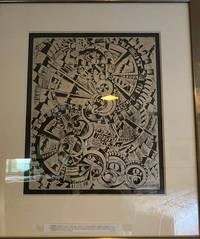
1919340Woodcut. 1919-1920. From the suite of 4 prints title M.E.Z. Signed dated and titled in red ink lower right. Grohn 28c Sprengel Museum 28c. Woodcut printed in silver on black paper. A small ed. of unknown size. 15 7/8 x 19 ¼ with full one inch margins all around. books
1919340<p>Woodcut. 1919-1920. From the suite of 4 prints title M.E.Z. Signed dated and titled in red ink lower right. Grohn 28c Sprengel Museum 28c. Woodcut printed in silver on black paper. A small ed. of unknown size. 15 7/8 x 19 ¼ with full one inch margins all around.</p>
19801014FBRoma., Galleria Pieroni., 1980. 23,6 x 17,1 cm. 12 unpaginierte S. OKarton, der vordere Deckel mit grauem Lack handgesprüht., 1014F Einband verso etwas stockig, sonst sehr gutes Exemplar.
19741013FBMönchengladbach., Städtisches Museum Mönchengladbach., 1974. 21 x 17 cm. 12 S. Leporello, 4 S. OPapp-Kassette., 1013F Tadellos frisches Exemplar.
198365596Stuttgart, Edition Schurr (Dr. Ursula Schurr), 1982/1983. Gr.-Fol. (67 x 52 cm). 1 Bl. (Titel u. Inhaltsverzeichnis) u. 13 num., sign. u. tlw. dat. Orig.-Grafiken, lose in OLwd.-Kassette.
19106040812Berlin, Reimer [de Gruyter] 1910 ff. 8°. Original Halbleder. Schwarze Kalbsledervariante, mit goldgeprägtem Rückentitel. Sehr hochwertige und saubere Ausführung. Druckfrisch.
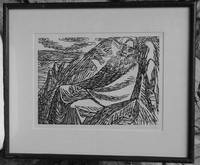
19223171922. Woodcut #7 from the suite: The Metamorphosis of God Die Wardlungen Gottes. Edition of 110. Schult 171. Signed in pencil. Image: 10¼ x 14¼. Margins: 17 x 13. Die Wandlungen Gotes: Sieben Holzschnitte . Artworks within this Set The cathedrals The divine beggar Dance of death 2 The god "Paunch" The rocks The seventh day The first day books
19223171922. Woodcut #7 from the suite: The Metamorphosis of God Die Wardlungen Gottes. Edition of 110. Schult 171. Signed in pencil. Image: 10¼ x 14¼. Margins: 17 x 13. Die Wandlungen Gotes: Sieben Holzschnitte . Artworks within this Set The cathedrals The divine beggar Dance of death 2 The god "Paunch" The rocks The seventh day The first day
19711015FBBerlin., Edition Rene Block., 1971. 1 Blatt., 1015F Tadelloses Exemplar.
198867515ABDüsseldorf., Takako Saito., 1988. 67515AB 1 Schachstäbchen mit ausgebesserter Bruchstelle. Sonst sehr gutes Exemplar.
1927613396Berlin, Mittler, 1927/32. OHlwd/OKart.
191378875ABBerlin, Vlg. Reimer, 1913. 32x27 cm. XXVIII, 387 S. mit vielen Figuren (Textband) und LXXX Tafeln in Lichtdruck, 1 Bl. (Tafelband). OLn. Text u. Tafelband in 2 Bänden.
197166348ABStuttgart. Köln. London. Reykjavik., Seimannsverlag - Vormals Edition Hansjörg Mayer., 1971. 23 x 17 cm. 2 Blatt, 114 Karton-Tafeln, 2 Blatt. OKarton in leinenbespanntem, lackierten Papp-Umschlag mit montierten, eingefärbtem Gebäck., 66348AB Auflage 1000 Exemplare. Einband am Rücken etwas gebräunt und gering fleckig, leicht angestaubt. Beide Hörnchen mit reichlich Wurmgängen, ein Hörnchen mit etwas Substanzverlust in der linken Hälfte, teils etwas bröselig aber insgesamt noch gut erhalten. Gesammelte Werke Band 6.
197166618ABDüsseldorf., Hartmut Kaminski., 1971. 66618AB Gutes bis sehr gutes Exemplar.
19691000FBStuttgart. Köln. London. Reykjavik., Edition Hansjörg Mayer., 1969 - 1987. 23,2 x 17,2 / 23,2 x 23,6 / 26,7 x 23,6. OKarton mit illustriertem OUmschlag / OPapp-Box., 58038AB 20 Bände. 1. Auflage. Drei Bände auf dem Kopfschnitt etwas stockfleckig, teils geringe Bereibungen an den Umschlägen, sonst sehr gutes Exemplar.
1995156FBParis., Yvon Lambert., 1995. 156F Sehr gutes Exemplar.
1981658FBKassel., Orangerie., 1981. 658F Sehr gutes Exemplar.
194737284US Zone: Office of Military Government for Germany U.S. 1947. First and only edition. Hardcover. g. Folio. 2 51 leafs 2pp. index of names 7 leafs exhibit list and certification of reproduction with facsimile signature of Charles E. Bancroft 293 leafs with facsimile reproductions of 137 exhibits. Original half black binder tape over paper covered boards with title pasted on spine and front cover. This rare document is based on a great number of important records which became accessible at the Deutsche Bank's Hamburg branch only after the end of WWII. For the first time information is revealed on some rather unusual transactions which tend to incriminate the bank even further for its participation in spoliation and aryanization from 1933 to 1945. Of particular interest is the description of the manner in which the Deutsche Bank following the Munich agreement of 1938 grasped control of two outstanding Czech banking institutions: the Boehmische Unionbank and the Deutsche Agrar- und Industriebank. This work recounts the Deutsche Bank's participation in the "aryanization" of the German economy from 1932 to 1940 drawing on internal Deutsche Bank records as well as material seized by Allied troops after World War II. It shows how as the Nazis began to rise to power the bank reluctantly purged itself of Jewish directors followed by Jewish employees in response to state pressure. Later the regime enlisted the bank employees' professional skills domestic and foreign relationships and financial muscle to eliminate Jewish control and ownership of German companies. The expropriation was conducted gradually since many hastily seized companies proved worthless without the management of their Jewish former owners and also because this method muted foreign criticism and preserved a veneer of legality. This stands in stark contrast to the brutally simple methods used by the Nazis in occupied countries and after 1941 in Germany as well. The numerous incriminating documents retrieved at the end of the hostilities are reproduced in facsimile. The index of names includes institutions as well as names of high level Nazis and their supporters. Rare! No listing in KVK. Sporadic and minor damp-staining on covers and at upper margin of pages not affecting text. Text in English documents in German. Binding and interior in overall good condition. "After Adolf Hitler came to power instituting the Third Reich Deutsche Bank dismissed its three Jewish board members in 1933. In subsequent years Deutsche Bank took part in the aryanization of Jewish-owned businesses; according to its own historians the bank was involved in 363 such confiscations by November 1938. During the war Deutsche Bank incorporated other banks that fell into German hands during the occupation of Eastern Europe. Deutsche provided banking facilities for the Gestapo and loaned the funds used to build the Auschwitz camp and the nearby IG Farben facilities. Deutsche Bank revealed its involvement in Auschwitz in February 1999. In December 1999 Deutsche Bank along with other major German companies contributed to a US$5.2 billion compensation fund following lawsuits brought by Holocaust survivors.2526 The history of Deutsche Bank during the Second World War has been documented by independent historians commissioned by the Bank. During World War II Deutsche Bank became responsible for managing the Bohemian Union Bank in Prague with branches in the Protectorate and in Slovakia the Bankverein in Yugoslavia which has now been divided into two financial corporations one in Serbia and one in Croatia the Albert de Barry Bank in Amsterdam the National Bank of Greece in Athens the Creditanstalt-Bankverein in Austria and Hungary the Deutsch-Bulgarische Kreditbank in Bulgaria and Banca Commercial Romana in Bucharest. It also maintained a branch in Istanbul Turkey" from Wikipedia. Office of Military Government for Germany (U.S.) hardcover
197062503ABStuttgart. London. Reykjavik., Edition Hansjörg Mayer., 1970. 23 x 17 cm. [256] S. OKarton mit verleimter Papp-Manschette mit Montagen., 62503AB Auflage 1000 Exemplare. Buch am Rücken berieben, am oberen Kapital 1 cm Abrieb des Bezugspapier. Sonst sehr gutes Exemmplar. Gesammelte Werke Band 11.
19300002-23Berlin, Bauwelt-Verlag Ullstein-Haus (1930). quadr.-4°. 64 S. Mit zahlr. tlw. farb. Taf. auf schwarzem Papier. OKart. m. farb. Einbandill. Einbd. staubfl., berieb., Ecke geknickt. Fehlstellen am Rü. restaur. - (Der wirtschaftliche Baubetrieb III) EA.
197366417ABReykjavik., Dieter Roth., 1973. 47 x 33 cm. Ca. 1200 S. OKarton mit Gazeverleimten Rücken., 66417AB Auflage 150 Exemplare. Sehr gutes Exemplar. [Tränen 2].
198269452AB1982. 61 x 69,8 cm., 69452A Keilrahmen leicht verzogen, Leinwand minimal gelockert, sonst noch guter Zustand, wie vom Künstler intendiert.
1919009981München, Kurt Wolff 1919-1921, 1919. VIII, 319; 332; 356 S. Großformatiger Orig.-Halbpergamentband (Jg. 1) sowie 2 großformatige Orig.-Leinenbände. Von der repräsentativen Kunstzeitschrift des Expressionismus erschienen insgesamt drei Jahrgänge, die hier vollständig gebunden mit allen16 ganzseitigen Original-Graphiken vorliegen: 1919/1: Karl Schmidt-Rottluff: Kopf (Original-Holzschnitt); Karl Caspar: Johannes auf Patmos (Original-Lithographie); Richard Seewald: Der Hirte (kolorierter Original-Holzschnitt): 1919/2: Franz Marc: Aus der Tierlegende (Original-Holzschnitt); Heinrich Nauen: Mutter und Kind (Original-Radierung); Ignaz Epper: Mädchenkopf (Original-Lithographie); 1920/1: Erich Heckel: Mädchenkopf (Original-Holzschnitt); Georg Ehrlich: Tröstung (Original-Lithographie); Frans Masereel: Business-man (Original-Holzschnitt); 1920/2: Max Kaus: Kopf (Original-Holzschnitt); André Rouveyre: Kopf (Original-Holzschnitt); 1921/1: Edwin Scharff: Die Brüder (Original-Lithographie); Alexander Archipenko: Figürliche Komposition (Original-Lithographie); Carl Hofer: Das Nest (Original-Lithographie); 1921/2: K. Schmidt-Rottluff: Lesender Mann (Original-Holzschnitt); Alexander Kanoldt: Klausen (Original-Lithographie). Mit dichterischen, philosophischen und literaturkritischen Erstdrucken u. a. von J. R. Becher, Ernst Bloch, Max Brod, E. R. Curtius, Alfred Döblin, Hermann Hesse, Georg Heym, Kurt Hiller, Franz Kafka ("Erstes Leid", Dietz 61), Kurt Pinthus, René Schickele, Ernst Weiß, Alfred Wolfenstein. Jentsch: Illustrierte Bücher des deutschen Expressionismus, Nr. 72; Söhn: HDO 12001-1 bis 12006-2. Die Bände 2 und 3 jeweils mit kleinem, zeitgenössischem Besitzvermerk in Tinte, sonst handelt es sich jedoch um ein schönes, wohlerhaltenes Exemplar in Originaleinbänden mit sämtlichen Originalgraphiken und nur leichten Gebrauchsspuren.
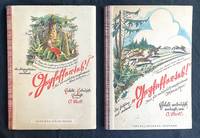
194143392Neudamm & Berlin: Munz & Co Försterbuben; and J. Neumann Frühling 1941. No Date 1940-1941 Both 1st edition. Original color illustrated boards 4to 70 68 pages. Filled with color illustrations over 20 of them stereotyped Antsemitic cartoon images. 25 cm. In German in Sütterlin script. The titles translate loosely as "The Spring and Other 'Spicy' Stories-- Only for People Sensitive to Nature" and "The Forest Boys and Other 'Spicy' Stories-- Only for People Sensitive to Nature." Text printed in red and black.<br> Both volumes were printed in Neudamm by Neumann but interestingly Försterbuben the first volume shows an overlay of the new publisher/distributer "Munz & Co. Verlag Berlin" on the front cover and title page. Complicated issues around distribution of Försterbuben may be reflected in its present scarcity OCLC locates only two copies worldwide. <br> OCLC suggests consecutive dates of 1940 and 1941 for both titles which makes sense given the use of Sütterlin script see below and the presence of the date 1938 or 1939 under the artist's printed signature in several of the drawings.<br> <br> Most scholars of Nazi-era Antisemitic imagery are familiar with the horribly Antisemitic children' s books Der Giftpilz The Poison Mushroom and Trau keinem Fuchs auf grüner Heid und keinem Jud auf seinem Eid! Don't Trust a Fox in a Green Pasture Or a Jew Upon His Oath! published by Julius Streicher's Stürmer Verlag. These Nazi propaganda books were intended for young people and were published in large printing runs in Nazi Germany.<br> Lesser known but at least as offensive are these illustrated Nazi-era book for adults by Otto Stoll. Printed and distributed by a far smaller publisher than the Stürmer Verlag they received smaller press run and appeared in only one edition. Indeed OCLC locates only 2 holdings worldwide for the first volume Die Försterbuben.<br> H. Heyne illustrated both works with colorful comic illustrations which are distributed throughout the text rendered in with what appear to be the highest quality printing techniques of the day. <br> Each book includes eight hunting or outdoors stories in verse two of them in Der Frühling the second volume extremely Antisemitic. Intended as humorous they contain typically ribald German hunting humor with immediately recognizable tropes from German culture. <br> <br> Interestingly these stories were published just in the final two years of official use of period Sütterlin cursive script which was popular during the early Nazi period and was used for example in Der Giftpilz and Trau keinem Fuchs. Indeed "In 1935 the Sütterlin style officially became the only German script taught in schools."<br> Then however "In 1941 the probable year of publication of the second work the Nazi Party banned all 'broken' fraktur 'blackletter' typefaces including Sütterlin and replaced them with Italian-style lettering such as the Antiqua typeface class. From the academic year 1941/42 onwards only the so-called Normalschrift 'normal script' which had hitherto been taught alongside Sütterlin under the name of 'Latin script' was allowed to be used and taught" Wikipedia.<br> Der Frühling. includes first the virulently Antisemitic illustrated tale of Max Isidor Veilchenblau the last name means the color violet in German implying strangeness and perhaps effeminacy a wealthy Jewish businessman who wanted to be a hunter. Max Isidor owns a big house on the edge of a forest where he lives with his wife Rosalinda. <br> <br> Under Heyne's colorful drawing of a synagogue with big flashy sports cars coming and going and stereotyped Jewish men greeting each other we are told that Veilchenblau has told his wife that he has hunting plans but he instead takes a beautiful blond Aryan girl out to dinner. A romantic encounter in a secluded cabin in the forest after dinner does not turn out as Max Isidor had planned and he has to flee stark naked into the woods where is found by his wife and a policeman. <br> According to the moral of the rhyming text Jews can never be hunters with a German hunter's soul a mythical German masculine ideal and no amount of money can make them hunters as their Jewish race just doesn't have "hunters' blood."<br> <br> Then the second illustrated antisemitic story tells of "War-Profiteer Meyer in Crisis" the tale of a Jew who grew wealthy during World War I another well-worn Nazi Antisemitic trope and then has difficulties on a hunting outing with his neighbor a count and the count's lovely blond escort.<br> Both these tales play on an imagined sexual threat of Jewish men to naive but pure Aryan maidens and also reinforce Jewish stereotypes of greed gluttony ugliness and cosmopolitanism.<br> The wider variety of stories in the books have titles such as: Spring; Hunter Latin; Quiet Retreat; and Hunter Hans and his Dog Kosimar. All are are accompanied by cartoon-like color illustrations of animals romantic encounters in the woods hunters in trouble with the tax authorities and of course hunters who are drinking experiencing hunting mishaps encountering misdeeds with chimneys and fireplaces getting in trouble while hunting farting etc. <br> Since these are otherwise low-brow humorous stories they illustrate how ethnic stereotyping and insinuations of racialized moral and physical inferiority-in this case Antisemitic-can be so easily integrated into the standard literature of a culture. The centering of the Jewish characters into two of these stories turns them into the kinds of standard racist jokes that teach and reinforce important racial ideas and hierarchies in the society. <br> At the rear is advertising for other humorous books published by Neumann Publishing company.<br> <br> OCLC listings match the author with an Otto Stoll who was a Swiss ethnographer and Mayanist who died in 1922 20 years before this book was first published which we find unlikely. <br> A copy of Der Frühling by itself sold at auction in 2018 for over $900 with the description noting "The very high production standard of this book belies its vile content." The US Holocaust Memorial Museum keeps their copy in their Rare Book Collection. The much rarer Die Försterbuben has never appeared at any major book auction. <br> SUBJECTS: German wit and humor. Jews -- Germany -- Caricatures and cartoons. Humour allemand. Juifs -- Allemagne -- Caricatures et dessins humoristiques. Anti-Jewish propaganda.<br> <br> Der Frühling. is OCLC: 843226193/72649783/250322204 with OCLC locating only 9 copies worldwide the majority in Germany none at NLI and only 3 in North America UFlorida USHMM UUtah none at any Ivy League institution. <br> Die Försterbuben. is OCLC 700497520 with OCLC locating only 2 copies anywhere worldwide Sachsische Landesbibliothek & LBI. It is extremely rare.<br> <br> Both volumes show only very slight wear an excellent set of this rare and important example of Nazi-era German mass-culture Antisemitism. B holo2-163-26A-XX. Neudamm & Berlin: Munz & Co [Försterbuben]; and J. Neumann [Frühling] unknown
1925054372Mittler. nice set; volumes 1-14 plus vol. 14 Beilagen plus two-volume Kriegsrustung und Kriegswirtschaft Total 17 volumes; does not include Das deutsche Feldeisenbahnwesen volume . Very Good. Hardcover. 1925. Mittler hardcover