Mendelssohn Bartholdy, Felix,Livre Rare Book
35 résultats
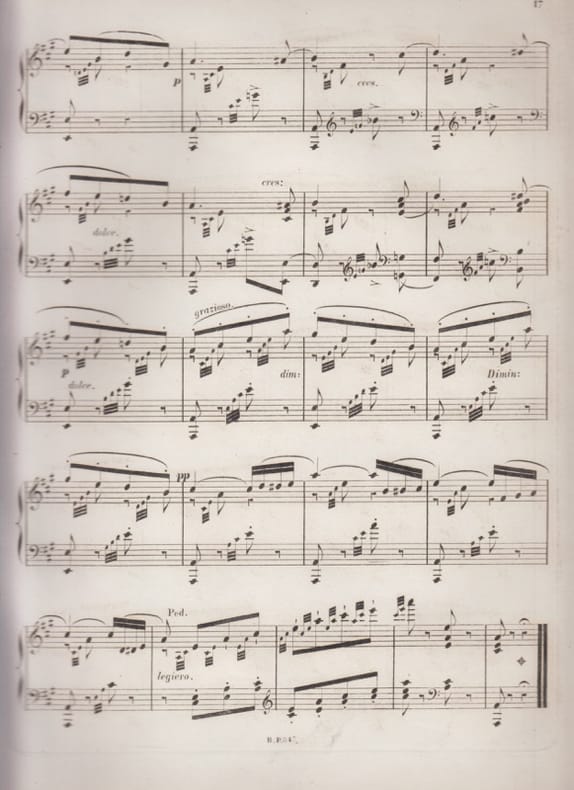
1781271351781 P. Grus - Lyon BENACCI sd (milieu XIXe s.) in-folio broché,tiré d'un recueil factice,(17 pp)- cotage B.P. 817
17771310905Leipzig, Dyck, 1775 - 1777. 2 Bl., 187, (1) S. Spät. Hlwdbd. Leicht berieben. Gebräunt u. braunfl.
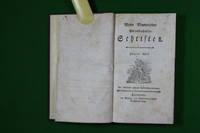
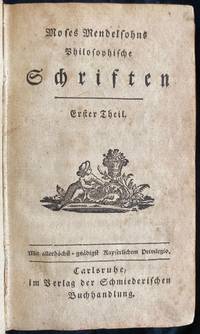
1780010808Carlsruhe: Im Verlag der Schmiederischen Buchhandlung 1780 Book. Fair. Hardcover. iv 283 1 pages. Vol 2 only - with a series title page - Sammlung der besten deutschen prosaischen Schriftsteller und Dichter Neun und neunzigster Theil - Mendelssohns philosophische Schriften. Undated circa 1780. Pages spotted throughout. In more recent cloth binding which is mottled with damp to the boards. Bookplate removed form the front pastedown. Ink number to the upper outer corner of the title page. Vol 2 only. Im Verlag der Schmiederischen Buchhandlung hardcover
1776000046Frankfurt Und Leipzig: 1776 1776 224pp.original cover wrapped.1 illustration at the beginning.foxed. Frankfurt Und Leipzig: , 1776 hardcover
178041625Karlsruhe, Schmiederische Buchhandlung (Schmieder), o. J. (um 1780). 8°. 5 Bll., 52; 224 S., Ppbd. d. Zt. m. handschriftl. Rückentitel.
180011012B1800. In 2 Vol. Parma: Dalla Reale Tipografia Parmense. 1800. CXVI264; 239 p. Later half vellum some rubbing. 1 page with outer corner torn away but no loss of text. Title page slight staining apart from this stainfree. An attractive wide-margined copy on laid paper. hardcover
1776190450Frankfurt & Leipzig. : No publisher. 1776. Publisher’s plain wraps paper spine label with handwritten title. . . Very good untrimmed in the wraps. 8vo. 19.5x12 cm. . German text. Mendelssohn’s musing on the immortality of the soul. weight: 0.4 lb. Engraved frontis. No publisher. paperback books
1776190450Frankfurt & Leipzig.: No publisher. 1776. Publisher’s plain wraps paper spine label with handwritten title. . Very good untrimmed in the wraps. 8vo. 19.5x12 cm. German text. Mendelssohn’s musing on the immortality of the soul. weight: 0.4 lb. Engraved frontis. No publisher. paperback
177235627BBParis, Saillant 1772. 8°: 2 n.n. Bl., XXIV S., 342 S., 1 Bl. Privileg. Mit gestochenem Frontispiz. Interimsbroschur der Zeit mit Marmorpapierbezügen.
179347688Berlin:: In der Vossischen Buchhandlung 1793. Second edition. contemporary paper-covered boards. Old private ownership stamp and signature on title page which is slightly stained; front joint and corners rubbed; but tight and sound. . 12mo. In der Vossischen Buchhandlung, hardcover
1785PNDilMEN56Troppau: Joseph Georg Trassler 1785. 1785. 2 Volumes. 8vo. pp. 268; 167 1. contemporary bds. some scattered foxing. cfRand I 369. Troppau: Joseph Georg Trassler, 1785. unknown
1791PNDädMEN98Carlsruhe: Schmiederischen Buchhandlung 1791. 1791. 8vo. pp. 5 p.l. 52 224. woodcut title vignette. later marbled bds. rubbed front joint & extremities bit chipped light dampstaining throughout. Mendelssohn's dialogue on immortality in imitation of Plato's Phaedo was first published in 1767. Leben und Charakter des Socrates which occupies pp. 52 at the beginning is chiefly based on the Life of Socrates by J.C.Cooper. cfRand I 369. Carlsruhe: Schmiederischen Buchhandlung, 1791. unknown
17876593Bern: in der Hallerschen Buchandlung 1787. Soft cover. Good. 8vo 152 x 95mm. 60pp. Modern wrappers margins trimmed close occasional spots lightly browned; front wrap loose but present. A satire on the Berlin academy written jointly by Lessing and Moses Mendelssohn criticizing the philosophical system of Alexander Popeís Essay on Man 1733-1734. Lessing German writer critic and dramatist was one of the most outstanding representatives of the Enlightenment era. His plays and theoretical writings often witty and ironic substantially influenced the development of German literature. In 1755 the collaborative work of Lessing and his friend philosopher Moses Mendelssohn anonymously appeared in the form of this provocative treatise Pope ein Metaphysiker! Pope as a Metaphysician. The controversial treatise dissected the subject of a contest at the Prussian Royal Academy. The two friends wrote it to confirm that there cannot be a true comparison between a poetic and a philosophic conception. <br/><br/> Bern: in der Hallerschen Buchandlung paperback books
17876593Bern: in der Hallerschen Buchandlung 1787. Soft cover. Good. 8vo 152 x 95mm. 60pp. Modern wrappers margins trimmed close occasional spots lightly browned; front wrap loose but present. A satire on the Berlin academy written jointly by Lessing and Moses Mendelssohn criticizing the philosophical system of Alexander Popeís Essay on Man 1733-1734. Lessing German writer critic and dramatist was one of the most outstanding representatives of the Enlightenment era. His plays and theoretical writings often witty and ironic substantially influenced the development of German literature. In 1755 the collaborative work of Lessing and his friend philosopher Moses Mendelssohn anonymously appeared in the form of this provocative treatise Pope ein Metaphysiker! Pope as a Metaphysician. The controversial treatise dissected the subject of a contest at the Prussian Royal Academy. The two friends wrote it to confirm that there cannot be a true comparison between a poetic and a philosophic conception. <br/><br/> Bern: in der Hallerschen Buchandlung paperback
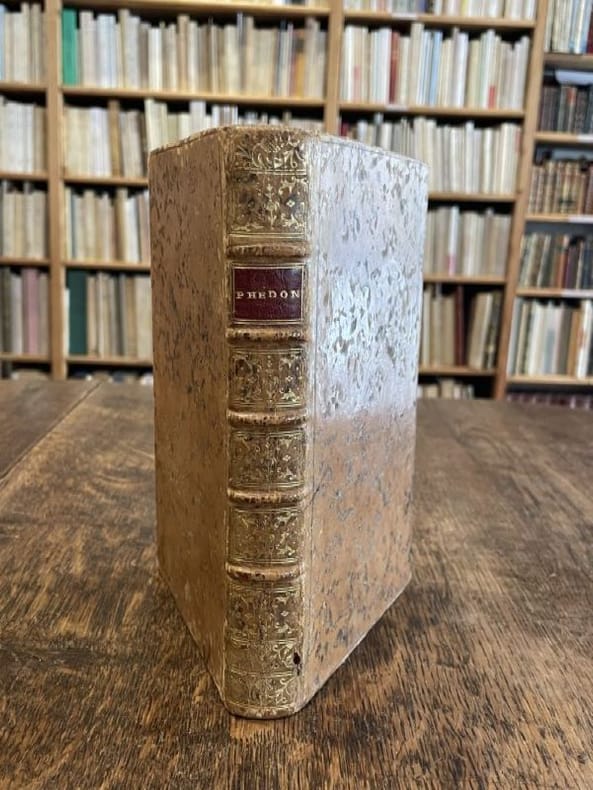
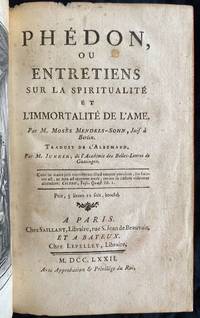
177254813Paris et Bayeux Saillant et Lepelley 1772 1 vol. Relié in-8, veau fauve écaille, dos à nerfs, pièce de titre de maroquin rouge, caissons ornés de fleurons et dentelle dorés avec double filet en encadrement, coupes filetées, coiffes guillochées, tranches rouges, XXIV + 342 + (2) pp. Edition originale française ornée d'un beau frontispice d'après Monet, gravé par Ménil. Précédé d'une vie de Socrate, cet essai est composé en trois dialogues, à la manière du "Phédon" de Platon, à partir de la correspondance de Mendelssohn avec son ami Thomas Abbt. Infime galerie de ver au dos en pied, sinon très bon exemplaire en reliure d'époque avec ex-libris gravé Cazenove.
177254813Paris et Bayeux Saillant et Lepelley 1772 1 vol. Relié in-8, veau fauve écaille, dos à nerfs, pièce de titre de maroquin rouge, caissons ornés de fleurons et dentelle dorés avec double filet en encadrement, coupes filetées, coiffes guillochées, tranches rouges, XXIV + 342 + (2) pp. Edition originale française ornée d'un beau frontispice d'après Monet, gravé par Ménil. Précédé d'une vie de Socrate, cet essai est composé en trois dialogues, à la manière du "Phédon" de Platon, à partir de la correspondance de Mendelssohn avec son ami Thomas Abbt. Infime galerie de ver au dos en pied, sinon très bon exemplaire en reliure d'époque avec ex-libris gravé Cazenove.
177214851A Paris Saillant 1772. Cont. full mottled calf. Back worn as the golddecoration is nearly gone. Engraved frontisp. XXIV3422 pp. A few lvs. slightly browned otherwise internally fine. <br/><br/><em>Scarce first French edition. </em> unknown
177214851A Paris, Saillant, 1772. Cont. full mottled calf. Back worn as the golddecoration is nearly gone. Engraved frontisp. XXIV,342,(2) pp. A few lvs. slightly browned, otherwise internally fine.
1785SZEPEBKS007095IWien: Sebastian Hartl 1785. First . Soft cover. Very Good/No Jacket. 16mo. 17x10.5 cm. - 79 pp. - Near fine in contemporary strong grey wrappers. - Small ownership stamp on title-page. <br/> <br/> Sebastian Hartl paperback
178043258Carlsruhe: im Verlag der Schmiederischen Buchhandlung 1780. No Date 1780s. Period laquered boards with leather spine label. 12mo. XXIV 278; 283 pages. In German. Title translates as “Writings.†Includes 2 different title vignettes 1 on each title page.<br> <br> Goedeke IV 1 488 6. Meyer 108; Dorn 105-107; Holzmann/Bohatta Deutsches Anomymen-Lexikon IV no. 1559. <br> <br> Early printing of Mendelssohn’s second work in which he "began his formulation of a new psychological theory that stressed the autonomy of aesthetics logic and ethics relative to each other." Merriam-Webster's Encyclopedia of World Religions p. 710. <br> <br> Contents:<br> <br> Vol. 1. Vorrede. <br> I. Ueber die Empfindungen.<br> II. Gespräche; <br> <br> Vol. 2. I. Rhapsodie oder Zusätze zu den Briefen über die Empfindungen. <br> II. Ueber die Hauptgrundsätze der schönen Künste und Wissenschaften. <br> III. Ueber das Erhabene und Naive in den schönen Wissenschaften. <br> IV. Ueber die Wahrscheinlichkeit. <br> <br> Also includes bibliographical references.<br> <br> Included within these is a series of writings on aesthetics which influenced Lessing and Schiller with Lessing noting“We have to thank him Mendelssohn for the true theory of mixed sensations.â€<br> <br> Moses Mendelssohn Moses of Dessau; 1729–1786 was a philosopher of the German Enlightenment in the pre-Kantian period early Maskil and a renowned Jewish figure in the 18th century. Mendelssohn was fluent in German and Hebrew and learned Latin Greek English French and Italian. His early teachers were young broadly educated Jews and he met the writer and dramatist G.E. Lessing 1754 and a deep and lifelong friendship developed between them. Throughout his life he worked as a merchant while carrying out his literary activities and widespread correspondence in his free time. In 1754 Mendelssohn began to publish – at first with the assistance of Lessing – philosophical writings and later also literary reviews. <br> He also started a few literary projects for example the short-lived periodical Kohelet Musar in order to enrich and change Jewish culture and took part in the early Haskalah. In 1763 he was awarded the first prize of the Prussian Royal Academy of Sciences for his work Abhandlung über die Evidenz in metaphysischen Wissenschaften "Treatise on Evidence in Metaphysical Knowledge". However when the academy elected him as a member in 1771 King Frederick II refused to ratify its decision. <br> <br> In 1769 he became embroiled in a dispute on the Jewish religion and from then on he confined most of his literary activity to the sphere of Judaism. His most notable and enduring works in this area included the translation into German and commentary on the Pentateuch Sefer Netivot ha-Shalom "Book of the Paths of Peace" 1780–83 and his Jerusalem: oder Ueber religiöse Macht und Judenthum "Jerusalem or On Religious Power and Judaism" 1783 this work the first polemical defense of Judaism in the German language and one of the pioneering works of modern Jewish philosophy. <br> <br> An active intermediary on behalf of his own people in difficult times and a participant in their struggle for equal rights he was at the same time a forceful defender of the Enlightenment against the opposition to it which gained strength toward the end of his life. In the midst of a literary battle against one of the leading figures of the counter-Enlightenment he died in 1786 EJ. <br> <br> SUBJECTS: Philosophy -- Early works to 1800. Philosophie -- Ouvrages avant 1800. Philosophy. OCLC: 1352546328. <br> <br> Light wear to original boards more so at spine but solid and attractive light spotting as expected About Very Good- Condition an attractive 18th Century copy. B KH-10-31. Carlsruhe: im Verlag der Schmiederischen Buchhandlung unknown
176752885Amsterdam 1767. Vermehret mit den zweifeln und dem Orakel über die Bestimmung des Menschen von eben diesem Verfasser Frühe Besitzereinträge auf Vorsatzbl. Neue Ausgabe Kl.-8°. Pbd. d. Zt. Philosophie unknown
177243257Paris et Bayeux chez Saillant et Lepelley 1772. 1st French-language edition. Period full leather binding with gilt spine and red edges with original marbled endpapers 8vo. Includes frontis copperplate etching. XXIV 342 1 pages. “Traduit de l’Allemand par M. Junker de l’Académie des Belles-Lettres de Goettingen.â€<br> This first French edition appeared 5 years after the first German edition of 1767<br> <br> "Phaedon or On the Immortality of the Soul" Phaedon Oder Ueber Die Unsterblichkeit Der Seele In Drey Gespraechen is one of Mendelssohn's 1729-1786 most famous publications establishing his reputation as the "German Socrates of Berlin." It is a philosophical interpretation of the Platonic dialogue "Phaedo" and is preceded by a biography on "The Life and Character of Socrates." The important German-Jewish philosopher was one of the most important representatives of the Enlightenment in Prussia and throughout Germany.<br> <br> Mendelssohn's Phaedon is a “classic of rational psychology on the immortality of the human soul a defining work by this leading enlightenment philosopher who launched the Jewish thinking of the modern age" with his tribute to Socrates modeled on Plato's dialogue the Phaedo.<br> Mendelssohn used Plato's famous dialogue the Phaedo as a model to publish Phädon oder über die Unsterblichkeit der Seele. With this seminal work "he reached the heights of fame" Wigoder Dictionary of Jewish Biography 342. <br> The work unites Mendelssohn's "paean to Socrates with an elaboration of the dreadful personal moral and political implications if a person's life is her 'highest good'… <br> This 'classic of rational psychology' as Dilthey put it also contains an argument for the simplicity and immortality of the human soul explicitly singled out for criticism by Kant in the 2nd edition of the Critique of Pure Reason. Mendelssohn supports the notion that the soul is simple and thus indestructible by noting that certain features of the soul namely the unifying character of consciousness and the identity of self-consciousness cannot be derived from anything composite whether those composite parts be capable or not of thinking… <br> As for the human soul's fate after death Mendelssohn appeals to divine goodness and providence which perhaps explains why following the publication of the Phaedo he finds himself needing to revisit the proofs for God's existence" Stanford Encyclopedia.<br> According to Mendelssohn’s modern biographer Alexander Altmann “The work that would establish Mendelssohn's world-wide renown and win him the title 'the German Socrates' was the dialogue Phaedon which was published in 1767. In this work he presented Socratic wisdom from the mouth of the ancient philosopher but in the language of the Enlightenment that is in his own words as a modern philosopher. <br> The work drew both praise and criticism but was on the whole popular in intellectual circles. It demonstrates Mendelssohn's unique ability as a Jew to be comfortable in the realm of both classical and enlightened philosophy not to mention languages. David Sorkin remarks ‘What is ironic is that Mendelssohn was known and revered as much for the quality of his prose as for his thought.†<br> Mendelssohn was himself often referred to as the German Plato or the German Socrates. <br> And “As a Jew living in Germany Moses Mendelssohn 1729-1786 stands at a pivotal point in the history of Jewish emancipation in Europe. There were Jews before him who had access to the corridors of power in Germany and elsewhere in Europe but Mendelssohn represents the first to be socially accepted to a significant extent within enlightened German culture without converting. <br> He not only conformed to the culture of the German Enlightenment in many ways but also helped shape the culture through his philosophical contributions. At the same time Mendelssohn refused to turn away from traditional Judaism. He attempted to become a full- fledged member of society during the emergence of modern Europe while remaining a proponent of Judaism as a revealed religion. Moreover he sought to use his place of influence to encourage Jewish acculturation in Germany and to speak on behalf of the emancipation of Jewish people…. <br> The traditional mentality of the European Jews prior to Mendelssohn's time included a kind of resignation to the incompatibility of Jewish learning and 'worldly' philosophy. This resignation contributed to Jewish cultural isolation. Alfred Jospe describes the conundrum in which a Jew found himself if he wished to enter the culture of the non-Jewish world: The Jew could gain access to the culture of the world only by rebelling against the traditional repudiation of all mundane wisdom. <br> It is just at this point that Mendelssohn broke the mold. He not only acquired modern German culture but did so by means of his understanding of and contributions to the philosophy that shaped that culture. In his monumental biographical study Alexander Altmann focuses as much on Mendelssohn's philosophy and his answers to contemporary critics as he does on the details of the events and influences of his life. Altmann states with appropriate admiration that “Considering the state of degradation in which the Jewish population lived in eighteenth-century Germany. Mendelssohn's rise to fame and his acceptance into the republic of letters was an amazing feat of personal achievement.†<br> The amazing feature of Mendelssohn's achievement is that he accomplished it as an avowedly traditional Jew. Mendelssohn has been rightly described as a rabbinic scholar but he made his reputation in non-Jewish intellectual circles as a literary critic and philosopher….with the help of both Gotthold Lessing and the Berlin publisher Friedrich Nicolai he was accepted into the inner circle of the Berlin Aufklärung. <br> His essays reviews and translations earned him tremendous status among German intellectuals. <br> The favorable comparison made by Lessing between the quintessential German poet Goethe and Mendelssohn is a mark of the esteem in which he was held. ‘Lessing told Friedrich Heinrich Jacobi that once Goethe regained his reason he would be hardly more than an ordinary man. At the very same time he said of Mendelssohn that he was the most lucid thinker the most excellent philosopher and the best literary critic of the century’" Clark 2005. P. 57-58. <br> OCLC: 19939219. <br> Very light edgewear to front endpapers touch of spotting a gorgeous copy in the original leather binding with tooled gilt spine with raised bands and leather label. Beautiful and scarce. B KH-10-30-RLB-’e. Paris et Bayeux, chez Saillant et Lepelley unknown
17872948München [d.i. Frankfurt a. M., Esslinger], 1787. 8°. Gest. Frontispiz, 116 S. Kartonage d. Zt., Rücken überklebt.
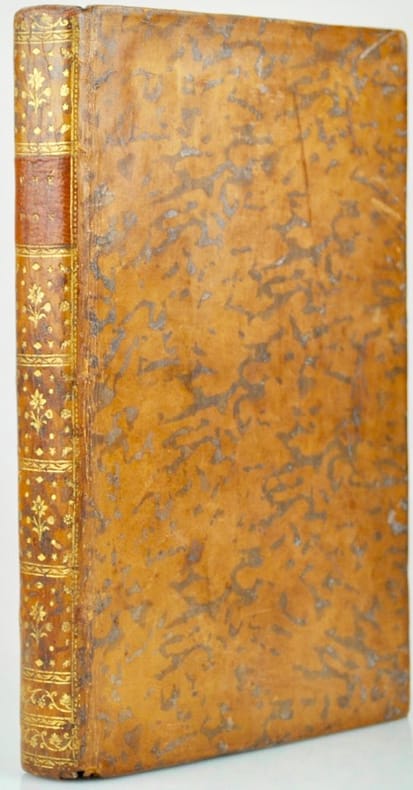
177242123A Paris, chez Saillant et à Bayeux, chez Lepelley, 1772. In-8 de 1 frontispice gravé, (4)-XXIV-342-(2) pp., veau marbré glacé, dos lisse orné, pièce de titre en maroquin rouge (reliure de l'époque).
178928250Berlin: bei Friedrich Vieweg dem álteren 1789.- 3 h. 250 p.; 8º 17 x 11 cm.; buena impresión en letra gótica sobre excelente papel verjurado; Plena Piel valenciana en tonos marrones lomo dorado con filetes y bandas sobre los nervios estuche. Salvo una pequeña marca de humedad en el margen superior de unas 8 hojas que no toca texto su estado es excelente. FILOSOFÃA E HISTORIA DE LA CULTURA Buch auf deutsch bei Friedrich Vieweg, dem álteren hardcover