79 résultats
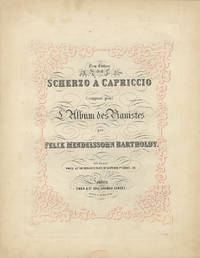
185236198Leipzig: Breitkopf & Härtel PN 7867 1852. Folio. Disbound. 1 title 2-7 i publisher's catalogue. Title and music engraved. With secondary pagination.<br/><br/>Small oval embossed stamp to upper margin of title with small oval publisher's handstamp to lower margin.<br/><br/>Spine and leaves reinforced with clear plastic tape; slightly worn and foxed; trimmed at inner margin. "One of the most gifted and versatile prodigies Mendelssohn stood at the forefront of German music during the 1830s and 40s as conductor pianist organist and above all composer. His musical style fully developed before he was 20 drew upon a variety of influences including the complex chromatic counterpoint of Bach the formal clarity and gracefulness of Mozart and the dramatic power of Beethoven and Weber.<br/><br/>Mendelssohn's emergence into the first rank of 19th-century German composers coincided with efforts by music historiographers to develop the concept of a Classic-Romantic dialectic in 18th and 19th-century music. To a large degree his music reflects a fundamental tension between Classicism and Romanticism in the generation of German composers after Beethoven." R. Larry Todd in Grove Music Online. Breitkopf & Härtel [PN 7867] unknown books
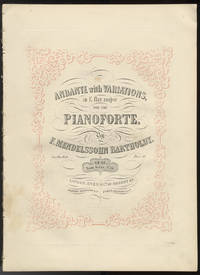
185236190London: Ewer & Co 1852. Folio. Disbound. 1 title within decorative border printed in red 2 blank 3-11 i publisher's catalogue pp. Engraved throughout. MWV U113.<br/><br/>"One of the most gifted and versatile prodigies Mendelssohn stood at the forefront of German music during the 1830s and 40s as conductor pianist organist and above all composer. His musical style fully developed before he was 20 drew upon a variety of influences including the complex chromatic counterpoint of Bach the formal clarity and gracefulness of Mozart and the dramatic power of Beethoven and Weber.<br/><br/>Mendelssohn's emergence into the first rank of 19th-century German composers coincided with efforts by music historiographers to develop the concept of a Classic-Romantic dialectic in 18th and 19th-century music. To a large degree his music reflects a fundamental tension between Classicism and Romanticism in the generation of German composers after Beethoven." R. Larry Todd in Grove Music Online. Ewer & Co unknown books
34870Paperback. Good. - Der unbekannte junge Mendelssohn. Basel: Der Internationalen Felix-Mendelssohn-Gesellschaft 1960. Octavo. Original green publisher's wrappers. 25 pp. With tipped-in frontispiece of Mendelssohn at the age of 12. Wrappers slightly worn and foxed.<br/><br/>- Unger Max. Von Mendelssohn-Bartholdys Beziehungen zu England. Fünf englische Briefe des Meisters mitgeteilt ins Deutsche übersetzt und besprochen . Musikalisches Magazin Heft 30. Langensalza: Hermann Beyer & Söhne 1910. Octavo. Light gray wrappers. Worn and browned.<br/><br/>- Schneider Max F. Die Wach'sche Mendelssohn-Sammlung auf dem Ried in Wilderswil bei Interlaken: Ein Beitrag zur Geschichte des Nachlasses von Felix Mendelssohn Bartholdy. Folio. 24 pp. 2 pp. "Stammtafel" all printed on one side of the leaf only. Typescript. Browned; spine reinforced with clear tape.<br/><br/>- Auction catalogue: Highly Important Musical Manuscripts formerly in the Archives of Novello & Co. Phillips London 14 June 1989. 35 pp. 2 copies.<br/><br/>- Publisher's catalogue: Felix Mendelssohn Bartholdy 1809-1847 zum Gedenkjahr. Das geistliche Vokalwerk Gesamtausgabe / Sacred choral music Complete edition. Carus 1997. 31 pp. <br/><br/>- Felix-Mendelssohn-Bartholdy-Preis Stiftung Preussischer Kulturbesitz Dokumentation anlässlich der 25. Vergabe des Preises im January 1987. Berlin. With contributions by Werner Knopp Johann-Georg Schaarschmidt Richard Jakoby Rudolf Elvers and Philipp Mohler.<br/><br/>- Program: Mendelssohn August 16 25 1991. The Bard Music Festival. Leon Botstein and Sarah Rothenberg Artistic directors.<br/><br/>- Pamphlet: Der Mendelssohn-Zimmer im Alten Rathaus zu Leipizig admission ticket and 7 related postal cards. paperback books
185536211Leipzig: Breitkopf & Härtel PNs 5668 5668a 1855. Folio. 1 title 2-31 i publisher's catalogue pp. Music engraved. <br/><br/>Disbound. Slightly worn soiled creased and stained; outer leaves detached. MWV SD11.<br/><br/>"One of the most gifted and versatile prodigies Mendelssohn stood at the forefront of German music during the 1830s and 40s as conductor pianist organist and above all composer. His musical style fully developed before he was 20 drew upon a variety of influences including the complex chromatic counterpoint of Bach the formal clarity and gracefulness of Mozart and the dramatic power of Beethoven and Weber.<br/><br/>Mendelssohn's emergence into the first rank of 19th-century German composers coincided with efforts by music historiographers to develop the concept of a Classic-Romantic dialectic in 18th and 19th-century music. To a large degree his music reflects a fundamental tension between Classicism and Romanticism in the generation of German composers after Beethoven." R. Larry Todd in Grove Music Online. Breitkopf & Härtel [PNs 5668, 5668a] unknown books
186635286Vienne: C.A. Spina PN P.M. No. 3604 1866. Small folio. 1f. recto title verso blank 3-15 i blank pp. Engraved.<br/><br/>Small oval handstamp of Beer & Schirmer New York to blank foot of title; small circular embossed stamp of Essex Institute to upper outer corner of first several leaves.<br/><br/>Disbound. Somewhat worn browned and foxed; plates quite worn resulting in poor impression; upper inner corners dampstained; first leaf detached; tears to title repaired with old tape. Spina re-issue from first edition plates. MWV U 156 p. 343. Krause 230. Not in Ward Jones. Hoboken 10 223 first edition.<br/><br/>One of the most gifted and versatile prodigies Mendelssohn stood at the forefront of German music during the 1830s and 40s as conductor pianist organist and above all composer. His musical style fully developed before he was 20 drew upon a variety of influences including the complex chromatic counterpoint of Bach the formal clarity and gracefulness of Mozart and the dramatic power of Beethoven and Weber.<br/><br/>Mendelssohn's emergence into the first rank of 19th-century German composers coincided with efforts by music historiographers to develop the concept of a Classic-Romantic dialectic in 18th and 19th-century music. To a large degree his music reflects a fundamental tension between Classicism and Romanticism in the generation of German composers after Beethoven." R. Larry Todd in Grove Music Online. C.A. Spina [PN P.M. No. 3604] unknown books
184035290Vienne: Pietro Mechetti qm Carlo PN P.M. No. 2133 1840. Small folio. Disbound. 1f. recto title verso blank 3-11 pp. Engraved.<br/><br/>Disbound. Slightly worn and soiled; browning to edges; light scattered foxing. Second German edition. MWV U 67 p. 312. Published before the "Neue rechtmässige Original-Ausgabe" published in 1854 Krause 212. Ward Jones III 381. <br/><br/>One of the most gifted and versatile prodigies Mendelssohn stood at the forefront of German music during the 1830s and 40s as conductor pianist organist and above all composer. His musical style fully developed before he was 20 drew upon a variety of influences including the complex chromatic counterpoint of Bach the formal clarity and gracefulness of Mozart and the dramatic power of Beethoven and Weber.<br/><br/>Mendelssohn's emergence into the first rank of 19th-century German composers coincided with efforts by music historiographers to develop the concept of a Classic-Romantic dialectic in 18th and 19th-century music. To a large degree his music reflects a fundamental tension between Classicism and Romanticism in the generation of German composers after Beethoven." R. Larry Todd in Grove Music Online. Pietro Mechetti qm Carlo [PN P.M. No. 2133] unknown books
187635158Leipzig: Breitkopf & Härtel PN M.B.114 Kl.A 1876. RIETZ Julius 1812-1877 ed. Folio. Modern mid-blue cloth-backed marbled boards with original publisher's light blue printed upper wrapper with titling within decorative border laid down to upper board titling to spine in black. 1f. title 62 pp. Engraved. Text in German.<br/><br/>In the series "Felix Mendelssohn Bartholdy's Werke. Kritisch durchgesehene Ausgabe von Julius Reitz. Mit Genehmigung der Originalverleger Serie 15. Grössere weltiche Gesangwerke. Klavier-Auszug." From the Breitkopf edition of Mendelssohn's Complete Works No. 114.<br/><br/>With small oval handstamp of Viennese musicseller Ludwig Doblinger and very small publisher's handstamp to foot of title.<br/><br/>Binding very slightly worn rubbed and bumped. Occasional light wear and foxing; gutter of title reinforced with narrow strip of paper tape. Wehner MWV M 12 p. 207.<br/><br/>Antigone was staged for the court at Potsdam in Berlin on 28 October 1841.<br/><br/>"One of the most gifted and versatile prodigies Mendelssohn stood at the forefront of German music during the 1830s and 40s as conductor pianist organist and above all composer. His musical style fully developed before he was 20 drew upon a variety of influences including the complex chromatic counterpoint of Bach the formal clarity and gracefulness of Mozart and the dramatic power of Beethoven and Weber.<br/><br/>Mendelssohn's emergence into the first rank of 19th-century German composers coincided with efforts by music historiographers to develop the concept of a Classic-Romantic dialectic in 18th and 19th-century music. To a large degree his music reflects a fundamental tension between Classicism and Romanticism in the generation of German composers after Beethoven." R. Larry Todd in Grove Music Online. Breitkopf & Härtel [PN M.B.114 Kl.A] unknown books
1867124196London England: Longmans Green and Co 1867. Hardcover. Good Boards have pulled away from page; Binding intact; Some light foxing. Dark brown cloth; 437 pp.; BW frontispiece. Includes a catalogue of Mendelssohn's musical compilations compiled by Dr. Julius Rietz. Longmans, Green, and Co hardcover books
185035288London: Ewer & Co 1850. Folio. Disbound. 1f. recto title within decorative borderprinted in light red verso blank 13 i blank pp. Engraved.<br/><br/>Small embossed stamp of English musicseller Etherington to foot of title.<br/><br/>Minor offsetting. First English edition. MWV U 158 p. 344. Not in Krause or Hoboken. Ward Jones III 771.<br/><br/>One of the most gifted and versatile prodigies Mendelssohn stood at the forefront of German music during the 1830s and 40s as conductor pianist organist and above all composer. His musical style fully developed before he was 20 drew upon a variety of influences including the complex chromatic counterpoint of Bach the formal clarity and gracefulness of Mozart and the dramatic power of Beethoven and Weber.<br/><br/>Mendelssohn's emergence into the first rank of 19th-century German composers coincided with efforts by music historiographers to develop the concept of a Classic-Romantic dialectic in 18th and 19th-century music. To a large degree his music reflects a fundamental tension between Classicism and Romanticism in the generation of German composers after Beethoven." R. Larry Todd in Grove Music Online. Ewer & Co unknown books
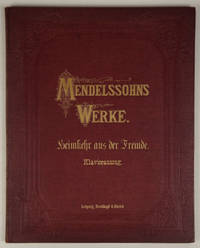
187735155Leipzig: Breitkopf & Härtel PN M.B.122 Kl.A 1877. RIETZ Julius 1812-1877 ed. Folio. Original publisher's full dark red cloth with titling gilt to upper within decorative blindstamped border titling gilt to spine; dark ivory endpapers. 1 title 2-83. i blank pp. Engraved. Text in German. With "Breitkopf & Härtels Musikbücher Nr. 181" to head of upper wrapper. <br/><br/>With Hungarian translation in ink along with marked cuts to No. 6. Terzett "O wie verschweig' ich."<br/><br/>In the series "Felix Mendelssohn Bartholdy's Werke. Kritisch durchgesehene Ausgabe von Julius Reitz. Mit Genehmigung der Originalverleger Serie 15. Grössere weltiche Gesangwerke. Klavier-Auszug." From the Breitkopf edition of Mendelssohn's Complete Works No. 122. <br/><br/>Together with:<br/>An invitation to the 1931 production of the opera from the Budapest Choral and Orchestra Association Ének- és Zenekaregyesűlet partially laid down to front free endpaper signed by István Eisler for the commissioning group and with his name in ink along with a date of December 1930 to upper outer corner and handstamp of Hungarian publisher/musicseller Rózsavölgyi és társa dated December 12 1930 to lower outer corner of endpaper.<br/><br/>Together with: <br/>Heimkehr aus dem Fremde. Leipzig: Breitkopf & Härtel 1885. Libretto. 16mo. Original publisher's light gray printed wrappers. 1f. recto title verso blank 12 2 pp. publisher's catalogue of piano-vocal scores and libretti with additional publisher's catalogue to verso of upper and recto and verso of lower wrapper. Later printing. Wehner MWV L 6 p. 196.<br/><br/>Heimkehr aus der Fremde a Liederspiel in 1 act to a libretto by Karl Klingemann was given a private premiere in Berlin on 26 December 1829. The first public performance took place in Leipzig on 10 April 1851. <br/><br/>"Mendelssohn's deft command of orchestral colour is evident throughout the work and his ability to create charming effects with the simplest of means is impressive." Clive Brown in Grove Dictionary of Opera<br/><br/>"One of the most gifted and versatile prodigies Mendelssohn stood at the forefront of German music during the 1830s and 40s as conductor pianist organist and above all composer. His musical style fully developed before he was 20 drew upon a variety of influences including the complex chromatic counterpoint of Bach the formal clarity and gracefulness of Mozart and the dramatic power of Beethoven and Weber.<br/><br/>Mendelssohn's emergence into the first rank of 19th-century German composers coincided with efforts by music historiographers to develop the concept of a Classic-Romantic dialectic in 18th and 19th-century music. To a large degree his music reflects a fundamental tension between Classicism and Romanticism in the generation of German composers after Beethoven." R. Larry Todd in Grove Music Online. Breitkopf & Härtel [PN M.B.122 Kl.A] unknown books
18623978London: Longman Green Longman and Roberts 1862. viii358pp. Nicely bound circa 1920 in polished red calf spine faded to brown over cloth. T.e.g. Inked ownership signature at top of title. Bookplate on front pastedown. Longman, Green, Longman, and Roberts hardcover books
1776190450Frankfurt & Leipzig. : No publisher. 1776. Publisher’s plain wraps paper spine label with handwritten title. . . Very good untrimmed in the wraps. 8vo. 19.5x12 cm. . German text. Mendelssohn’s musing on the immortality of the soul. weight: 0.4 lb. Engraved frontis. No publisher. paperback books
199359250Cambridge Massachusetts: Maurizio Martino-Publisher 1993. Hardcover. Near Fine. With a Descriptive Introduction by I.D. Colvin F.R.C.I. Two volumes. Tith twenty-six full-page illustrations reproducing valuable and rare engravings &c. Cambridge Massachusetts: Maurizio Martino-Publisher 1993. Facsimile reprint of the 1910 first edition limited to 175 copies. Octavo. Original burgundy cloth bindings with black and gilt titles. Issued without dust jackets. A near fine set. Maurizio Martino-Publisher hardcover books
1899551Leipzig 1899. Hardcover. Very Good. 7th ed. In 2 parts one vol. Index. Marbled foredge. Cover slightly rubbed. Illus. with gilt cover & spine. Original binding. <br/><br/> hardcover books
187835280Leipzig: Breitkopf & Härtel PN M.B. 85 1878. RIETZ Julius 1812-1877 ed. Folio. Original publisher's gray wrappers with titling within decorative border. 1f. recto title verso blank 1f. contents 328 pp. Engraved. Text in German.<br/><br/>In the series: "Felix Mendelssohn Bartholdy's Werke. Kritisch durchgesehene Ausgabe von Julius Reitz. Mit Genehmigung der Originalverleger. Serie 13. Oratorien. Partitur." From the Breitkopf edition of Mendelssohn's Complete Works No. 85. <br/><br/>From the library of composer Horace Middleton 1879-1961 with his small handstamp to upper wrapper and title. Small oval handstamp of Novello to upper wrapper and blank foot of title.<br/><br/>Wrappers rather worn; corner of upper lacking; lower detached. Occasional light foxing heavier to some leaves; edges somewhat soiled; some signatures split. Wehner MWV A 14 p. 19. <br/><br/>Paulus an oratorio to a libretto by Julius Schubring after Acts was first performed as part of the Niederrheinische Musikfest in Düsseldorf on 22 May 1836. Simrock printed the first edition of the piano-vocal score in December 1836 and the full score the following spring. <br/><br/>Mendelssohn distinguished himself in many fields and his contributions to sacred choral music are no exception. He was the most prominent advocate for the music of J.S. Bach reviving the St. Matthew Passion in 1829 and helped to reestablish the oratorio by providing two superb examples: St. Paul 1836 and Elijah 1846.<br/><br/>"From Bach's Passions and Handel's oratorios Mendelssohn borrowed the use of the traditional narrator to relate in recitatives the dramatic action of the work. Conspicuously Bachian are the chorales interspersed throughout the oratorio to demarcate the principal structural divisions diffusing according to Carl Klingemann 'a calmness through the whole'. On the other hand a debt to Handel is revealed in the rich variety of the choruses which include several that directly engage in the dramatic action and several cast in a variety of fugal styles. Prefacing the oratorio is an overture that evokes Paul's struggle for spiritual awakening by means of the chorale Wachet auf and a dissonant fugue with its subject derived from the first strain of the chorale." R. Larry Todd in Grove Music Online.<br/><br/>Horace Middleton was a British-born musician who served on the faculty of Bennett College from 1919 to the mid-1930s. He was best known for the music he composed for the Greek plays performed at the college. See obituary Millbrook Round Table November 23 1961. Breitkopf & Härtel [PN M.B. 85] unknown books
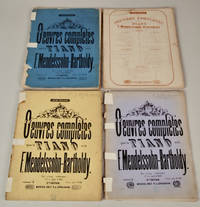
187536204Moscou: P.J. Jürgenson 1875. Folio. Original publisher's mid-blue decorative printed wrappers. <br/><br/>Vol. I: 125 pp. 3rd edition<br/>Vol. II: 126-262 pp. 2nd edition<br/>Vol. IV: 263-399 pp. 2nd edition<br/>Vol. V: 536-608 pp. 2nd edition<br/><br/>Each volume includes a collective title and index.<br/><br/>With the signature of the American composer and pianist Edward Julius Biedermann 1849-1933 to upper wrappers of three volumes inscribed "To my old friend Chas. B. Hughes."<br/><br/>Partially disbound; wrappers torn or lacking. 4 of 5 volumes lacking Vol. III. Some minor wear browning and staining. "One of the most gifted and versatile prodigies Mendelssohn stood at the forefront of German music during the 1830s and 40s as conductor pianist organist and above all composer. His musical style fully developed before he was 20 drew upon a variety of influences including the complex chromatic counterpoint of Bach the formal clarity and gracefulness of Mozart and the dramatic power of Beethoven and Weber.<br/><br/>Mendelssohn's emergence into the first rank of 19th-century German composers coincided with efforts by music historiographers to develop the concept of a Classic-Romantic dialectic in 18th and 19th-century music. To a large degree his music reflects a fundamental tension between Classicism and Romanticism in the generation of German composers after Beethoven." R. Larry Todd in Grove Music Online. P.J. Jürgenson unknown books
1847012322NY: Mason Brothers 1847. 1st Edition. Hardcover. Near Fine. Oblong 8v0. green pebbled cloth blind stamp rule and garland surround to titles in gilt 128 pp. Uncommon 19thC American song book in uncommonly un- or little-used condiution. No ownership markings. Musical scores set by A. P. Kendrick music typographer 20 Devonshire St Boston. Mason Brothers hardcover books
185035152Leipzig: Breitkopf & Härtel PN 5543 1850. Octavo. Dark ivory cloth-backed marbled boards with titling gilt to spine. 1f. recto title verso blank 52 pp. Engraved.<br/><br/>With small publisher's and Theune Amsterdam to foot of title. <br/><br/>Binding slightly worn. Minor internal wear browning soiling and foxing; contemporary signature illegible to blank upper margin of title. First Edition later issue. Wehner MWV P 7 p. 244; SD 10 pp. 472-3. Krause 141. Ward Jones III 401. Hoboken 10 167 first issue. <br/><br/>Mendelssohn began work on the Hebrides overture in August 1829 while on the west coast of Scotland. There he visited the famous Fingal's Cave in the Inner Hebrides named after the mythological Gaelic hero Fingal largely a creation of Scottish poet James Macpherson. Mendelssohn revised portions of the overture numerous times including the title. It was first performed as The Isles of Fingal by the Philharmonic Society in London 14 May 1832. Although Mendelssohn finally settled on Die Hebriden as the title the first editions were published as Fingals-Höhle.<br/><br/>One of the most gifted and versatile prodigies Mendelssohn stood at the forefront of German music during the 1830s and 40s as conductor pianist organist and above all composer. His musical style fully developed before he was 20 drew upon a variety of influences including the complex chromatic counterpoint of Bach the formal clarity and gracefulness of Mozart and the dramatic power of Beethoven and Weber.<br/><br/>Mendelssohn's emergence into the first rank of 19th-century German composers coincided with efforts by music historiographers to develop the concept of a Classic-Romantic dialectic in 18th and 19th-century music. To a large degree his music reflects a fundamental tension between Classicism and Romanticism in the generation of German composers after Beethoven." R. Larry Todd in Grove Music Online. Breitkopf & Härtel [PN 5543] unknown books
183835281Bonn: N. Simrock PN 3441 1838. Folio. 21 pp. 4 parts of 4 pp. each title and price to Soprano I part. Engraved. Text in Latin and German. <br/><br/>SSAA with organ.<br/><br/>From the library of composer E.J. Biedermann 1849-1933 with his signature in pencil to head of score and each part; small oval handstamp of G. Schirmer to foot of title and each part.<br/><br/>Split at spine; minor creasing; edges slightly worn and cockled. First Edition later issue. Wehner MWV B 23 p. 51. Not in Krause. Ward Jones III 488 490. Hoboken 10 193.<br/><br/>One of the most gifted and versatile prodigies Mendelssohn stood at the forefront of German music during the 1830s and 40s as conductor pianist organist and above all composer. His musical style fully developed before he was 20 drew upon a variety of influences including the complex chromatic counterpoint of Bach the formal clarity and gracefulness of Mozart and the dramatic power of Beethoven and Weber.<br/><br/>Mendelssohn's emergence into the first rank of 19th-century German composers coincided with efforts by music historiographers to develop the concept of a Classic-Romantic dialectic in 18th and 19th-century music. To a large degree his music reflects a fundamental tension between Classicism and Romanticism in the generation of German composers after Beethoven." R. Larry Todd in Grove Music Online. N. Simrock [PN 3441] unknown books
184418508Bonn: N. Simrock PN 4343 1844. Folio. Disbound. 19 pp. Engraved. <br/>Lithographic title with decorative blue background and border. <br/><br/>Moderate foxing and browning. First Edition later issue. Fuld p. 525. Krause 231. Hoboken 10 237. Mendelssohn Papers III 444. <br/><br/>This volume of the Songs Without Words contains Mendelssohn's "Spring Song. N. Simrock [PN 4343] unknown books
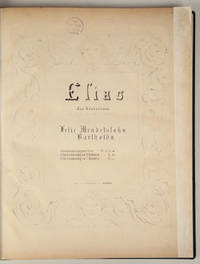
188035203Berlin: N. Simrock PN 4648 1880. Folio. Full black cloth with original publisher's light green printed wrapper with titling within decorative border laid down to upper board. 1f. recto title verso blank 3-207 i blank pp. Text in German.<br/><br/>Small circular handstamp of the Musik-schulen Kaiser Wien to wrapper title and several pages throughout.<br/><br/>Binding slightly worn rubbed and bumped; wrapper slightly trimmed and lightly foxed with several minor chips and abrasions to margins. Impression to title slightly light; title and final leaf reinforced with paper tape to gutter and outer edge. Light scattered foxing throughout. First German Edition later issue. Wehner MWV A 25 p. 35. Not in Krause. Ward Jones III 361 earlier issue. Hoboken 10 251 first issue.<br/><br/>Elias an oratorio to a libretto by Julius Schubring after Kings was first performed in Birmingham on 26 August 1846. Mendelssohn made major revisions to the work following this performance introducing the new and final version in London on 16 April 1847.<br/><br/>Mendelssohn distinguished himself in many fields and his contributions to sacred choral music are no exception. He was the most prominent advocate for the music of J.S. Bach reviving the St. Matthew Passion in 1829 and helped to reestablish the oratorio by providing two superb examples: St. Paul 1836 and Elijah 1846.<br/><br/>"Based largely on the account in 1 Kings Elijah relates the chief events in the prophet's life: the curse of the Lord and the seven-year drought Elijah's miraculous revival of the widow's son his confrontation with the Baal worshippers and the lifting of the drought his confrontation with Ahab and Jezebel his flight to the wilderness and encounter with the Lord and his journey to Mt Horeb and ascension to heaven in a flaming chariot. As in St Paul Mendelssohn employed chorales and relied heavily upon choral numbers; noteworthy is the sheer diversity of choruses . In contrast to St Paul Mendelssohn dispensed with the narrator allowing the characters themselves to deliver the dramatic action. Elijah diverges from St Paul too in its broadly conceived musical cohesiveness; in no other work did Mendelssohn concern himself with musical structure on such a large scale." R. Larry Todd in Grove Music Online. N. Simrock [PN 4648] unknown books
1987185682Stuyvesant NY: Pendragon Press 1987. Hardcover. VG- Ex-library with stamps and labels on spine inside front and rear covers ffep and block. Burgundy cloth boards with silver lettering; lvii 687 pp; bw illustrated frontispiece; illustrations portraits music facsimiles. Prefatory matter in English; letters in German with English translation. Collected edited and translated with introductory essays and notes by Marcia J. Citron. Includes bibliographical references pages ix-xviii. Pendragon Press hardcover books
185036199Leipzig: Breitkopf & Härtel PN 4980 1850. Folio. Unbound as issued. 1 title 2 blank 3-13 i publisher's catalogue; 9 i blank; 10; 8 pp. Engraved.<br/><br/>The first page of the first violin part page 3 contains the song "Ist es Wahr" for voice and piano; the violin part begins on page 4.<br/><br/>Wrappers slightly worn. Minor stain to title. Re-issue of the first edition of 1830. MWV R22. Wehner p. 276. Not in Hoboken. Krause 177.<br/><br/>"One of the most gifted and versatile prodigies Mendelssohn stood at the forefront of German music during the 1830s and 40s as conductor pianist organist and above all composer. His musical style fully developed before he was 20 drew upon a variety of influences including the complex chromatic counterpoint of Bach the formal clarity and gracefulness of Mozart and the dramatic power of Beethoven and Weber . <br/><br/>. Between 1827 and 1847 he composed six string quartets and had begun work on a seventh at the end of his life. The first two op. 13 in A minor 1827 and op. 12 in Eb 1829 show a rapprochement with the late quartets of Beethoven. To the Swedish musician Adolf Lindblad Mendelssohn explained his concern for the organic relationship of the various movements to the whole . In op. 13 the quintessential thematic material is drawn from the lied Frage op. 9 no. 1 with explicit quotations from the song in the outer and more hidden references in the inner movements of the quartet." R. Larry Todd in Grove Music Online. Breitkopf & Härtel [PN 4980] unknown books
184936217London: J. Alfred Novello . 69 Dean Strt. Soho & 24 Poultry PN 550 1849. Folio. Unbound. 1f. recto title verso blank 41 i publisher's catalogue pp. Engraved throughout. With "Novello's Edition of the Works of Felix Mendelssohn Bartholdy Op. 42" printed to head of title.<br/><br/>Publisher's blindstamp to title dated "20 9 49" 20 September 1849.<br/><br/>Slightly worn; small edge tears; minor soiling to outer leaves; abrasion to final leaf with small hole; significant tear to pp. 5/6 with no loss. Scarce early edition. MWV A15.<br/><br/>"One of the most gifted and versatile prodigies Mendelssohn stood at the forefront of German music during the 1830s and 40s as conductor pianist organist and above all composer. His musical style fully developed before he was 20 drew upon a variety of influences including the complex chromatic counterpoint of Bach the formal clarity and gracefulness of Mozart and the dramatic power of Beethoven and Weber.<br/><br/>Mendelssohn's emergence into the first rank of 19th-century German composers coincided with efforts by music historiographers to develop the concept of a Classic-Romantic dialectic in 18th and 19th-century music. To a large degree his music reflects a fundamental tension between Classicism and Romanticism in the generation of German composers after Beethoven." R. Larry Todd in Grove Music Online. J. Alfred Novello ... 69, Dean Strt. Soho, & 24, Poultry [PN 550] unknown books
184429801London: J.J. Ewer & Co 1844. Folio. Quarter dark blue leather with marbled boards paper label with titling in manuscript to upper. 1f. recto title verso blank 1 blank 2-88 pp. Engraved. With additional pagination to numbers 4/5 7 and 9. Text in English.<br/><br/>Binding quite worn; spine lacking; upper detached. Uniformly browned; title soiled torn and repaired. First Edition of this arrangement the overture is not included. Wehner M13 p. 210. Ward Jones: Catalogue of the Mendelssohn Papers in the Bodleian Library Oxford Vol. III 668. Not in Krause. J.J. Ewer & Co unknown books