Mendelssohn, MosesBiblio.com

983 résultats
24753Modern old style binding half calf leather. Else a good copy with an ownership mark on the titlepage ‘Joseph Basler or Basbe’. With an engraved frontispiece showing three scenes from jewish life and a small engraving on the titlepage by I.M. Eben. 8°: A-Z 8 pag.: 368. The filosopher Moses Mendelssohn 1729-1786 was the spiritual leader of the German Jewry during the Enlightenment. He wrote many philosophical treatises and is considered the father of the Jewish Enlightenment. Thus he became the symbol of progressive Judaism to the Christian world. At the height of his career in 1769 Mendelssohn was publicly challenged by a Christian apologist a Zurich pastor named John Lavater to defend the superiority of Judaism over Christianity. The letters forming his reply - published in German in 1770 and translated for the present rare French edition - neither attacked Christianity nor defended Judaism; they maintained instead that such polemics were inconsistent with Judaism and unbecoming of Jews. The controversy which disturbed Mendelssohn greatly forced him to recognize that his Judaism created a barrier between himself and his enlightened colleagues. Mendelssohn wanted to take the Jews out of a ghetto lifestyle and into secular society. He tried to improve the relationship between Jews and Christians as he argued for tolerance and humanity. B0109. hardcover
195950340Amsterdam/ny: North Holland Publishing Company / Interscience Publishers Inc. As New. 1959. Hardcover. FREE UPGRADE to Courier/Priority Shipping Upon Request IN STOCK AND IMMEDIATELY AVAILABLE FOR SHIPMENT - Text block pristine pages tight to spine - 192 pages. -- with a bonus offer-- . North Holland Publishing Company / Interscience Publishers, Inc. hardcover
106310C. F. Peters / G. Schirmer. As New. N.D. Hardcover. FREE UPGRADE to Courier/Priority Shipping Upon Request - IN STOCK AND IMMEDIATELY AVAILABLE FOR SHIPMENT - PRISTINE & UNMARKED TIGHT TO THE SPINE - - - No date circa 1890. -- with a bonus offer-- . C. F. Peters / G. Schirmer hardcover
200491632Thoemmes Continuum. New. 2004. Hardcover. 1843711079 . FREE UPGRADE to Courier/Priority Shipping Upon Request - IN STOCK AND IMMEDIATELY AVAILABLE FOR SHIPMENT - Flawless copy brand new pristine never opened -- 290 pages. Description: "Moses Mendelssohn 1729-86 is considered the father of the Jewish Enlightenment and the last great Leibnizian in the German philosophical tradition. One of his most successful works was this dialogue on the immortality of the soul modelled on Plato's 'Phaedo'. Mendelssohn sought to recast Plato's proofs of the soul's immortality by adding 'such arguments as are supplied by modern philosophy'. Like its ancient ancestor Mendelssohn's dialogue includes an account of the death of Socrates - an important figure in 18th-century Europe. ' "Ph don": or "The Death of Socrates" ' originally published in German in 1767 and translated by Charles Cullen in 1789 has never been rendered into modern English. Cullen's translation is thus the only recourse for present-day scholars who cannot read German. It is long out of print and difficult to find even in the largest academic libraries. Now that the English-speaking philosophical world is delving ever more deeply into the history of German philosophy this facsimile of the 1789 edition - newly introduced by Curtis Bowman - should be widely welcomed. " -- with a bonus offer-- . Thoemmes Continuum hardcover
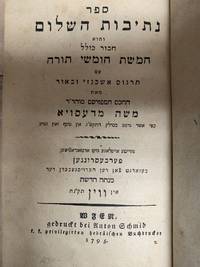
1795RB007Vienna: Anton Schmid 1795. Second. Good. 1795 rare copy of Netivot Ha-shalom The Paths of Peace. A German translation in the Hebrew alphabet of the book of Genesis by Moses Mendelssohn 1729-1786. It includes the Hebrew text of the Bible and a commentary by Mendelssohn. The last 200 pages of the book is the Aramaic text of Onkelos commentary of Rashi and the Haftaroth. This book is a former synagogue copy and in great shape for a book 230 years old. Binding still tight. Although there is wear on the pages it is very readable. Inside front and back covers are 3 off-white blank rectangular stickers one has been torn off leaving residue Markings on both sides of the page preceding the title page. Purple synagogue stamp at top of page prior to the text. That page has a 1-inch tear at the top middle edge. There is another stamp on the bottom right corner of pages 81b and 88b. Light penciled lines about one inch long on 5 pages of the introduction at least one other page of the book has similar marks. About 20 pages with the reverse page's text legible but still readable. Lh Anton Schmid unknown
81390Berlin Christian Friedrich Voss beides 1755. Kl.8° 1 Bl. Titelvignette 108 S.; Titelvignette 210 S. Paginierungssprung von Seite 143 auf 145 3 Bl. HPerg. d. Zeit Berieben mit handschriftlichem verblasstem Schild a. Rücken. Auf Vorsatz Bibliothekskleber Bibliotheksstempel Bibliothek des Rabbiner-Seminars Berlin a. Titelblatt verso. Etwas angeschmutzt u. fingerfleckig min. wasserrändig u. stockfleckig. Der Band umfasst die ersten beiden Schriften des jüdisch-deutschen Philosophen. «Philosophische Gespräche» Goed. IV/1 488 6. Meyer Mendelssohn 112; «Ueber die Empfindungen» Goed. IV/1 487 1. Meyer Mendelssohn 79Auf dem Vorsatz zwei hübsche Marginalien von alter Hand: «Der Verfasser Herr Moses solle ein gelehrter Jude und Buchhalter bey einem jüdischen Kaufmann in Berlin seyn.»Und von anderer Hand: «Zustehende Bücher sind von Herrn Moses Mendelssohn.»«Ueber die Empfindungen» Erste Ausgabe der zweiten Veröffentlichung Mendelssohns ein theoretisches Hauptwerk zur Ästhetik der Aufklärungsepoche. Bekannt geworden ist vor allem die ausführliche Diskussion des Selbstmordes und die Problematik seiner theatralischen Inszenierung auf der "Schaubühne". - Moses Mendelssohn 1729 in Dessau; gestorben 1786 in Berlin deutscher Philosoph der Aufklärung und gilt als Wegbereiter der jüdischen Aufklärung - Haskala. 010 Berlin, Christian Friedrich Voss, beides 1755 unknown
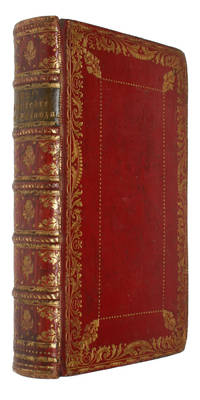
178945724Breslau Gottl. Löwe 1789 8vo. Very beautiful contemporary red full calf binding with five raised bands and gilt green leather title-label to richly gilt spine. elaborate gilt borders to boards inside which a "frame" made up of gilt dots with giltcorner-ornamentations. Edges of boards gilt and inner gilt dentelles. All edges gilt. Minor light brownspotting. Marginal staining to the last leaves. Engraved frontispiece-portrait of Spinoza engraved title-vignette double-portrait of Lessing and Mendelssohn engraved end-vignette portrait of Jacobi. Frontispiece title-page LI 1 -errata 440 pp. Magnificent copy. <br/><br/><em>First edition thus being the seminal second edition the "neue vermehrte Auflage" new and expanded edition which has the hugely important 180 pp. of "Beylage" for the first time which include the first translation into any language of any part of Giordano Bruno's "de Uno et Causa." pp. 261-306 as well as several other pieces of great importance to the "Pantheismusstreit" and to the interpretation of the philosophy of Spinoza and Leibniz here for the first time in print. The present translation of Bruno seems to be the earliest translation of any of Bruno's works into German and one of the earliest translations of Bruno at all - as far as we can establish the second only preceded by an 18th century translation into English of "Spaccio della bestia trionfante". It is with the present edition of Jacobi's work that the interest in Bruno is founded and with which Bruno is properly introduced to the modern world. Jacobi not only provides what is supposedly the second earliest translation of any of Bruno's works ever to appear he also establishes the great influence that Bruno had on two of our greatest thinkers Spinoza and Leibnitz. It is now generally accepted that Spinoza founds his ethical thought upon Bruno and that Lebnitz has taken his concept of the "Monads" from him. It is Jacobi who with the second edition of his "Letters on Spinoza." for the first time ever puts Bruno where he belongs and establishes his position as one of the key figures of modern philosophy and thought. Bruno's works the first editions of which are all of the utmost scarcity were not reprinted in their time and new editions of them did not begin appearing until the 19th century. For three centuries his works had been hidden away in libraries where only few people had access to them. Thus as important as his teachings were thinkers of the ages to come were largely reliant on more or less reliable renderings and reproductions of his thoughts. As Jacobi states in the preface to the second edition of his "Letters on Spinoza." "There appears in this new edition under the title of Appendices "Beylage" different essays of which I will here first give an account. The first Appendix is an excerpt from the extremely rare book "De la causa principio et Uno" by Jordan Bruno. This strange man was born one knows not in which year in Nola in the Kingdom of Naples; and died on February 17th 1600 in Rome on the stake. With great diligence Brucker has been gathering information on him but in spite of that has only been able to deliver fragments not in translation. For a long time his works were partly neglected due to their obscurity partly not respected due to the prejudice against the new opinions and thoughts expressed in them and partly loathed and suppressed due to the dangerous teachings they could contain. On these grounds the current scarcity of his works is easily understood. Brucker could only get to see the work "De Minimo" La Croce only had the book "De Immenso et Innumerabilibus" in front of him or at least he only provides excerpts from this also not in translation as Heumann does only from the "Physical Theorems" also small fragments not in translation; also Bayle had of Bruno's metaphysical works himself also merely read this work of which I here provide an excerpt." Vorrede pp. VII-VIII - own translation from the German. Jacobi continues by stating that although everyone complains about the obscurity of Bruno's teachings and thoughts some of the greatest thinkers such as Gassendi Descartes "and our own Leibnitz" p. IX have taken important parts of their theorems and teachings from him. "I will not discuss this further and will merely state as to the great obscurity "grossen Dunkelheit" of which people accuse Bruno that I have found this in neither his book "de la Causa" nor in "De l'Infinito Universo et Mondi" of which I will speak implicitly on another occasion. As to the first book my readers will be able to judge for themselves from the sample "Probe" that I here present. My excerpt can have become a bit more comprehensible due to the fact that I have only presented the System of Bruno himself the "Philosophia Nolana" which he himself calls it in its continuity. My main purpose with this excerpt is by uniting Bruno with Spinoza at the same time to show and explain the "Summa of Philosophy" "Summa der Philosophie" of "En kai Pan" in Greek characters - meaning "One and All". . It is very difficult to outline "Pantheism" in its broader sense more purely and more beautifully than Bruno has done." Vorrede pp. IX-XI - own translation from the German. So not only does Jacobi here provide this groundbreaking piece of Bruno's philosophy in the first translation ever and not only does he provide one of the most important interpretations of Spinoza's philosophy and establishes the importance of Bruno to much of modern thought he also presents Bruno as the primary exponent of "pantheism" thereby using Bruno to change the trajectory of modern thought and influencing all philosophy of the decades to come. After the second edition of Jacobi's "Ueber die Lehre des Spinoza" no self-respecting thinker could neglect the teachings of Bruno; he could no longer be written off as having "obscure" and insignificant teachings and one could no longer read Spinoza nor Leibnitz without thinking of Bruno. It is with this edition that the world rediscovers Bruno never to forget him again.WITH THE FIRST EDITION OF "UEBER DIE LEHRE DES SPINOZA" 1785 JACOBI BEGINS THE FAMOUS "PATHEISMUSSTREIT" which focused attention on the apparent conflict between human freedom and any systematic philosophical interpretation of reality. In 1780 Jacobi 1743-1819 famous for coining the term nihilism advocating "belief" and "revelation" instead of speculative reason thereby anticipating much of present-day literature and for his critique of the Sturm-und-Drang-era had a conversation with Lessing in which Lessing stated that the only true philosophy was Spinozism. This led Jacobi to a protracted and serious study of Spinoza's works. After Lessing's death in 1783 Jacobi began a lengthy letter-correspondende with Mendelssohn a close friend of Lessing on the philosophy of Spinoza. These letters with commentaries by Jacobi are what constitute the first edition of "Ueber die lehre des Spinoza" as well as the first part of the second edition. The second edition is of much greater importance however due to greatly influential Appendices. The work caused great furor and the enmity of the Enlightenment thinkers. Jacobi was ridiculed by his contemporaries for attempting to reintroduce into philosophy belief instead of reason was seen as an enemy of reason and Enlightenment as a pietist and as a Jesuit. But the publication of the work not only caused great furor in wider philosophical circles there was also a personal side to the scandal which has made it one of the most debated books of the period: "Mendelssohn enjoyed as noted at the outset a lifelong friendship with G. E. Lessing. Along with Mendelssohn Lessing embraced the idea of a purely rational religion and would endorse Mendelssohn's declaration: "My religion recognizes no obligation to resolve doubt other than through rational means; and it commands no mere faith in eternal truths" Gesammelte Schriften Volume 3/2 p. 205. To pietists of the day such declarations were scandalous subterfuges of an Enlightenment project of assimilating religion to natural reason. While Mendelssohn skillfully avoided that confrontation he found himself reluctantly unable to remain silent when after Lessing's death F. H. Jacobi contended that Lessing embraced Spinoza's pantheism and thus exemplified the Enlightenment's supposedly inevitable descent into irreligion.Following private correspondence with Jacobi on the issue and an extended period when Jacobi in personal straits at the time did not respond to his objections Mendelssohn attempted to set the record straight about Lessing's Spinozism in "Morning Hours". Learning of Mendelssohn's plans incensed Jacobi who expected to be consulted first and who accordingly responded by publishing without Mendelssohn's consent their correspondence - "On the Teaching of Spinoza in Letters to Mr. Moses Mendelssohn" - a month before the publication of "Morning Hours". Distressed on personal as well as intellectual levels by the controversy over his departed friend's pantheism Mendelssohn countered with a hastily composed piece "To the Friends of Lessing: an Appendix to Mr. Jacobi's Correspondence on the Teaching of Spinoza". According to legend so anxious was Mendelssohn to get the manuscript to the publisher that forgetting his overcoat on a bitterly cold New Year's eve he delivered the manuscript on foot to the publisher. That night he came down with a cold from which he died four days later prompting his friends to charge Jacobi with responsibility for Mendelssohn's death.The sensationalist character of the controversy should not obscure the substance and importance of Mendelssohn's debate with Jacobi. Jacobi had contended that Spinozism is the only consistent position for a metaphysics based upon reason alone and that the only solution to this metaphysics so detrimental to religion and morality is a leap of faith that salto mortale that poor Lessing famously refused to make. Mendelssohn counters Jacobi's first contention by attempting to demonstrate the metaphysical inconsistency of Spinozism. He takes aim at Jacobi's second contention by demonstrating how the "purified Spinozism" or "refined pantheism" embraced by Lessing is in the end only nominally different from theism and thus a threat neither to religion nor to morality." SEP.The Beylagen which are not included in the 1785 first edition and only appear with the 1789 second edition include: I. Auszug aus Jordan Bruno von Nola. Von der Ursache dem Princip und dem Einen p. 261-306 II. Diokles an Diotime über den Atheismus p. 307-327 translation of Lettre . sur l'Athéisme by F. Hemsterhuis. </em> hardcover
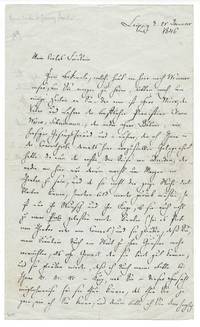
1911Two pages autograph letter bifolio. Signed as Felix Mendelssohn Bartholdy. Dated in Leipzig on 25 January 1846. A few nicks a tiny tear at folding with no effect on text traces of mount on integral blank. Otherwise in fine condition. Two pages autograph letter bifolio. Signed as Felix Mendelssohn Bartholdy. Dated in Leipzig on 25 January 1846. <p><br /> Mendelssohn’s signed autograph letter to Jenny Lind the Swedish Nightingale.<br /> <p><p><br /> In this signed letter to the renowned Swedish soprano Jenny Lind Mendelssohn introduces two acquaintances—Friedrich Wieck Clara Schumann’s father and Mr. Böhm a singing teacher from Leipzig—who were coming to Weimar to hear Lind sing. Both sought her assistance to attend a rehearsal and a concert believing that a word from her could make this possible.<br /> <p><p><br /> Mendelssohn expresses regret at missing Lind during her recent visit to Leipzig and hopes she might extend her stay there writing that it would be “the most delightful thing … that you could do for us.†This letter does not appear in Memoir of Jenny Lind-Goldschmidt London; New York 1891.<br /> <p><p><br /> Felix Mendelssohn 1809–1847 and Jenny Lind 1820–1887 met in October 1844 and collaborated until his early death. Mendelssohn began an opera Lorelei for Lind and tailored the aria “Hear Ye Israel†in Elijah for her although she did not perform it until after his death.<br /> <p><p><br /> Mendelssohn one of the early Romantic era’s greatest musical prodigies admired Lind who was known as the “Swedish Nightingale†and held in high esteem by composers like Hector Berlioz and Robert Schumann.<br /> <p>. unknown