Mendelssohn, MosesBiblio.com
983 résultats
117764066X.Gpaperback. Good. Access codes and supplements are not guaranteed with used items. May be an ex-library book. paperback
1974N2016Stuttgart: Friedrich Frommann 1974. Original Cloth. Very Good. 8vo. CLXXXIII516pp. German text.Gesammelte Werke Band 7. A very good and clean copy. <br/> <br/> Friedrich Frommann hardcover
0666796912.Ghardcover. Good. Access codes and supplements are not guaranteed with used items. May be an ex-library book. hardcover
ria9783743430259_inpPaperback. New. New Book; Fast Shipping from UK; Not signed; Not First Edition; N/A paperback
61053Leipzig 1880 Hardback. 2 Vols. Librtary Stamp. Good Condition Leipzig, 1880 hardcover
0500011524.Ghardcover. Good. Access codes and supplements are not guaranteed with used items. May be an ex-library book. hardcover
0266938558.Ghardcover. Good. Access codes and supplements are not guaranteed with used items. May be an ex-library book. hardcover
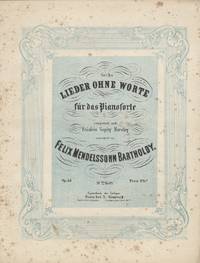
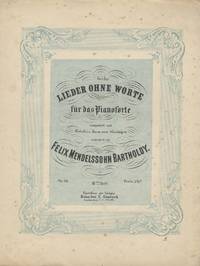
184140964Bonn . Paris . London: bei N. Simrock . Chez Lemoine . Chez Ewer & Co. PN 3935 1841. Folio. Disbound. Contemporary dark blue paper wrappers with decorative cut paper label titled in manuscript to upper. 1f. recto title verso blank 3-21 i blank pp. Lithographed.<br /> <br /> Wrappers worn and detached. Moderate foxing to first and last leaves. Early German edition. MWV SD23 p. 478. Krause 227. Hoboken 10 222.<br /> <br /> "One of the most gifted and versatile prodigies Mendelssohn stood at the forefront of German music during the 1830s and 40s as conductor pianist organist and above all composer. His musical style fully developed before he was 20 drew upon a variety of influences including the complex chromatic counterpoint of Bach the formal clarity and gracefulness of Mozart and the dramatic power of Beethoven and Weber.<br /> Mendelssohn's emergence into the first rank of 19th-century German composers coincided with efforts by music historiographers to develop the concept of a Classic-Romantic dialectic in 18th and 19th-century music. To a large degree his music reflects a fundamental tension between Classicism and Romanticism in the generation of German composers after Beethoven . <br /> <br /> . The origins of the Lieder ohne Worte of which Mendelssohn published 36 pieces in six volumes between 1832 and 1845 two more volumes followed posthumously remain couched in mystery. Among his earliest piano lieder was one in E♭ written for Fanny's birthday in 1828 Fanny herself composed numerous examples of the genre; the idea of creating songlike piano pieces may have originated in a game Fanny and Felix played in which they apparently added texts to piano pieces. Then too the critical thought of A.B. Marx who explored in his writings of the 1820s the expressive potential and 'definiteness' of instrumental music was not without impact. Most of the lieder fall into three groups pianistic parallels to the vocal categories of solo songs duets and partsongs. The meaning of the new genre perplexed Mendelssohn's contemporaries. Schumann suggested that the composer had produced texted lieder but then suppressed the texts; when the composer's cousin Marc-André Souchay offered to give some of the lieder fanciful titles Mendelssohn replied that he had intended each lied 'just as it stands'. Only a small number of the lieder bear titles from Mendelssohn e.g. the three called Venetianisches Gondellied or his circle e.g. the 'Frühlingslied'; nevertheless later in the 19th century a host of insipid titles accrued to the lieder contributing to the view of Mendelssohn as a composer of overtly sentimental piano music for the parlour." R. Larry Todd in Grove Music Online. bei N. Simrock ... Chez Lemoine ... Chez Ewer & Co. [PN 3935] unknown
185140963Bonn . London: bei N. Simrock . bei J. A. Novello PN 3383 1851. Folio. Disbound. Contemporary dark blue paper wrappers with manuscript title label to upper. 1f. recto title verso blank 3-19 i blank pp.<br /> <br /> Wrappers worn and detached. Moderate foxing throughout heavier to margins. First German edition later issue. MWV SD 23 p. 478. Krause 227. Hoboken 10 222.<br /> <br /> "One of the most gifted and versatile prodigies Mendelssohn stood at the forefront of German music during the 1830s and 40s as conductor pianist organist and above all composer. His musical style fully developed before he was 20 drew upon a variety of influences including the complex chromatic counterpoint of Bach the formal clarity and gracefulness of Mozart and the dramatic power of Beethoven and Weber.<br /> Mendelssohn's emergence into the first rank of 19th-century German composers coincided with efforts by music historiographers to develop the concept of a Classic-Romantic dialectic in 18th and 19th-century music. To a large degree his music reflects a fundamental tension between Classicism and Romanticism in the generation of German composers after Beethoven . <br /> <br /> . The origins of the Lieder ohne Worte of which Mendelssohn published 36 pieces in six volumes between 1832 and 1845 two more volumes followed posthumously remain couched in mystery. Among his earliest piano lieder was one in E♭ written for Fanny's birthday in 1828 Fanny herself composed numerous examples of the genre; the idea of creating songlike piano pieces may have originated in a game Fanny and Felix played in which they apparently added texts to piano pieces. Then too the critical thought of A.B. Marx who explored in his writings of the 1820s the expressive potential and 'definiteness' of instrumental music was not without impact. Most of the lieder fall into three groups pianistic parallels to the vocal categories of solo songs duets and partsongs. The meaning of the new genre perplexed Mendelssohn's contemporaries. Schumann suggested that the composer had produced texted lieder but then suppressed the texts; when the composer's cousin Marc-André Souchay offered to give some of the lieder fanciful titles Mendelssohn replied that he had intended each lied 'just as it stands'. Only a small number of the lieder bear titles from Mendelssohn e.g. the three called Venetianisches Gondellied or his circle e.g. the 'Frühlingslied'; nevertheless later in the 19th century a host of insipid titles accrued to the lieder contributing to the view of Mendelssohn as a composer of overtly sentimental piano music for the parlour." R. Larry Todd in Grove Music Online. bei N. Simrock ... bei J. A. Novello [PN 3383] unknown
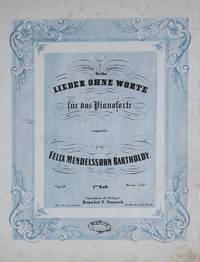
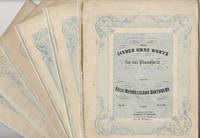
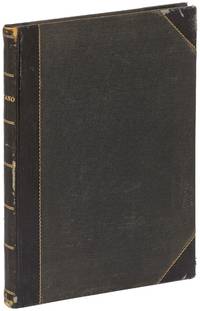
185140954Bonn . Paris . London: bei N. Simrock . bei M. Schlesinger . chez J. A. Novello PN 3041 1851. 1f. recto title verso blank 3-17 i blank pp. First German edition later issue "chez" rather than "bei" J. A. Novello. MWV SD5 p. 470. Krause 216. Hoboken 10 150.<br /> <br /> Bound with:<br /> Sechs Lieder Ohne Worte Componirt und Fräulein Elise von Woringen zugeeignet . Op. 30. IItes. Heft . Eigenthum der Verleger . Pr. 3 Frs. Bonn . London . Paris: bei N. Simrock . chez N. Mori . chez Schönenberger PN 3204 ca. 1851. 1f. recto title verso blank 3-19 i blank pp. First German edition later issue. MWV SD9 p. 472. Krause 220. Hoboken 10 177.<br /> <br /> Bound with:<br /> Sechs Lieder Ohne Worte für das Pianoforte . componirt und Fräulein Rosa von Woringen zugeeignet . Op. 38. IIItes. Heft . Preis 3 Frs. Bonn . London: bei N. Simrock . bei J. A. Novello PN 3383 ca. 1851. 1f. recto title verso blank 3-19 i blank pp. First German edition later issue. MWV SD9 p. 472. Krause 220. Hoboken 10 177.<br /> <br /> Bound with:<br /> Sechs Lieder Ohne Worte für das Pianoforte . componirt und Fräulein Sophÿ Horsleÿ zugeeignet . Op. 53 . IVtes. Heft . Preis 4 Frs. Bonn . London . Paris: bei N. Simrock . Chez Ewer & Co. . Chez Lemoine PN 3935 1841. 1f. recto title verso blank 3-25 i blank pp. First German edition later issue. MWV SD23 p. 478. Krause 227. Hoboken 10 222.<br /> <br /> Bound with:<br /> Sechs Lieder Ohne Worte für das Pianoforte . componirt und Frau Dr. Clara Schumann geb. Wieck zugeeignet . Op. 62. . Vtes. Heft . Preis 3 Frs 50c. Bonn . Lyon . Mailand . London: bei N. Simrock . bei Benacci & Peschier . bei J. Lucca . bei Ewer & Co. PN 4343 ca. 1860. 1f. recto title verso blank i blank 4-19 i blank pp. First Edition early issue. MWV SD29 p. 481. Krause 231. Hoboken 10 237.<br /> <br /> Bound with:<br /> Sechs Lieder Ohne Worte für das Pianoforte . componirt und Fräulein Sophie Rosen zugeeignet . Op. 67. . VItes. Heft . Preis 3 Frs 50c. Bonn . Mailand . Paris . London: bei N. Simrock . bei J. Ricordi . bei M. Schlesinger . bei Ewer & Co. PN 4478 1845. 1f. recto title verso blank i blank 4-21 i blank pp. First Edition early issue. MWV SD32 p. 482. Krause 236. Hoboken 10 245. <br /> <br /> 6 volumes. Folio. Contemporary black cloth-backed dark blue boards with titling in manuscript to upper. Titles lithographed on blue ground within decorative blue border music engraved. <br /> <br /> Provenance<br /> Heinrich Dorn 1800-1892 noted conductor composer music critic and teacher of the Schumanns with "H. Dorn" in manuscript to upper outer corner of upper board with his small oval handstamp "H. Dorn Coeln" and handstamp "M. Schloss in Coeln" to foot of titles. <br /> <br /> Binding slightly worn and soiled with small stains to upper. Some minor foxing soiling small stains and showthrough heavier to some leaves; small dampstain to blank lower margin of final half of volume; inner margins occasionally reinforced; some minor paper repairs. "One of the most gifted and versatile prodigies Mendelssohn stood at the forefront of German music during the 1830s and 40s as conductor pianist organist and above all composer. His musical style fully developed before he was 20 drew upon a variety of influences including the complex chromatic counterpoint of Bach the formal clarity and gracefulness of Mozart and the dramatic power of Beethoven and Weber.<br /> <br /> Mendelssohn's emergence into the first rank of 19th-century German composers coincided with efforts by music historiographers to develop the concept of a Classic-Romantic dialectic in 18th and 19th-century music. To a large degree his music reflects a fundamental tension between Classicism and Romanticism in the generation of German composers after Beethoven. .<br /> <br /> The origins of the Lieder ohne Worte of which Mendelssohn published 36 pieces in six volumes between 1832 and 1845 two more volumes followed posthumously remain couched in mystery. Among his earliest piano lieder was one in E♭ written for Fanny's birthday in 1828 Fanny herself composed numerous examples of the genre; the idea of creating songlike piano pieces may have originated in a game Fanny and Felix played in which they apparently added texts to piano pieces. Then too the critical thought of A.B. Marx who explored in his writings of the 1820s the expressive potential and 'definiteness' of instrumental music was not without impact. Most of the lieder fall into three groups pianistic parallels to the vocal categories of solo songs duets and partsongs. The meaning of the new genre perplexed Mendelssohn's contemporaries. Schumann suggested that the composer had produced texted lieder but then suppressed the texts; when the composer's cousin Marc-André Souchay offered to give some of the lieder fanciful titles Mendelssohn replied that he had intended each lied 'just as it stands'. Only a small number of the lieder bear titles from Mendelssohn e.g. the three called Venetianisches Gondellied or his circle e.g. the 'Frühlingslied'; nevertheless later in the 19th century a host of insipid titles accrued to the lieder contributing to the view of Mendelssohn as a composer of overtly sentimental piano music for the parlour." R. Larry Todd in Grove Music Online<br /> <br /> Dorn "studied the piano singing and composition in Königsberg made several long journeys throughout Germany during which he met Weber in Dresden and completed his studies with Ludwig Berger Bernhard Klein and Zelter in Berlin where his first opera Rolands Knappen was produced successfully in 1826. At the same time he became a co-editor of the Berliner allgemeine Muzikzeitung for which he wrote a spirited defence of the beleaguered Gaspare Spontini. Over the next two decades he built a solid reputation as a conductor of opera holding theatre posts at Königsberg 1828 Leipzig 1829-32 where he taught counterpoint to the young Schumann Hamburg 1832 Riga 1834-43 and Cologne 1844-8. He organized the first music festival of the Russian Baltic provinces in Riga 1836 and directed the Lower Rhine music festivals 1844-7. His most prestigious appointment in 1849 after Nicolai's death was as co-conductor with Wilhelm Taubert of the Berlin Hofoper. After his retirement from that post in 1869 he remained active in Berlin for many years as a teacher and writer." Adelyn Peck Leverett revised by Christopher Fifield in Grove Music Online. bei N. Simrock ... bei M. Schlesinger ... chez J. A. Novello [PN 3041] unknown
185036216Bonn . Londres . Paris: N. Simrock . J.J Novello . M. Schlesinger PN 3041 1850. 1 title 2 blank 3-17 i blank pp. Lithographed. First German edition later variant issue.<br /> <br /> With:<br /> - Op. 30. Sechs Lieder . componirt und Fräulein Elise von Woringen zugeeignet . Op. 30. IItes. Heft Pr. 3 Frs - 24 Sgr. Bonn . London . Paris: N. Simrock . N. Mori . M. Schlesinger PN 3205 ca. 1845. 1 title 2-3 blank 4-17 i blank pp. Engraved. First Edition later issue. Hoboken 10 177. <br /> <br /> - Op 38. Sechs Lieder . componirt Fräulein Rosa von Woringen zugeeignet . Op. 38. IIItes. Heft Preis 3 Frs. - 24 Sgr. Bonn: N. Simrock PN 3383 ca. 1850-60. 1 title 2 blank 3-19 i blank pp. Later edition. <br /> <br /> - Op. 53. Sechs Lieder . componirt und Fräulein Sophÿ Horsleÿ zugeeignet . Op. 53. IVtes. Heft Preis 4 Frs. Bonn: N. Simrock PN 3935 ca. 1860. 1 title 2 blank 3-21 i blank pp. <br /> <br /> - Op. 62. Sechs Lieder . componirt und Frau Dr. Clara Schumann geb. Wieck zugeeignet . Op. 62. Vtes. Heft Preis 3 Frs 50c. Bonn: N. Simrock PN 4343 ca. 1850. 1 title 2-3 blank 4-19 i blank pp. Engraved. <br /> <br /> - Op. 67. Sechs Lieder . componirt und Fräulein Sophie Rosen zugeeignet . Op. 67. VItes. Heft Preis 3 Frs 50c. Bonn: N. Simrock PN 4478 ca. 1860. <br /> <br /> 6 volumes. Folio. Titles printed on blue ground within decorative blue border. <br /> <br /> Handstamp of 19th century New York musicseller Scharfenberg to foot of titles of all but one volume. <br /> <br /> Disbound; spines reinforced with tape. Slightly worn; moderate browning and foxing throughout. "One of the most gifted and versatile prodigies Mendelssohn stood at the forefront of German music during the 1830s and 40s as conductor pianist organist and above all composer. His musical style fully developed before he was 20 drew upon a variety of influences including the complex chromatic counterpoint of Bach the formal clarity and gracefulness of Mozart and the dramatic power of Beethoven and Weber.<br /> <br /> Mendelssohn's emergence into the first rank of 19th-century German composers coincided with efforts by music historiographers to develop the concept of a Classic-Romantic dialectic in 18th and 19th-century music. To a large degree his music reflects a fundamental tension between Classicism and Romanticism in the generation of German composers after Beethoven." R. Larry Todd in Grove Music Online. N. Simrock ... J.J Novello ... M. Schlesinger [PN 3041] unknown
184418508Bonn: N. Simrock PN 4343 1844. Folio. Disbound. 19 pp. Engraved. Lithographic title with decorative blue background and border. <br /> <br /> Moderate foxing and browning. First Edition later issue. Fuld p. 525. Krause 231. Hoboken 10 237. Catalogue of the Mendelssohn Papers in the Bodleian Library III 444. <br /> <br /> This volume of the Songs Without Words contains Mendelssohn's "Spring Song. N. Simrock [PN 4343] unknown
51328777like new. unknown
102519456X.Ghardcover. Good. Access codes and supplements are not guaranteed with used items. May be an ex-library book. hardcover
1025199103.Gpaperback. Good. Access codes and supplements are not guaranteed with used items. May be an ex-library book. paperback
1371134227.Ghardcover. Good. Access codes and supplements are not guaranteed with used items. May be an ex-library book. hardcover
1371134219.Gpaperback. Good. Access codes and supplements are not guaranteed with used items. May be an ex-library book. paperback
1019570407.Ghardcover. Good. Access codes and supplements are not guaranteed with used items. May be an ex-library book. hardcover
1331430461.Gpaperback. Good. Access codes and supplements are not guaranteed with used items. May be an ex-library book. paperback
47029722like new. unknown
46346581-nnew. unknown
0483585629.Ghardcover. Good. Access codes and supplements are not guaranteed with used items. May be an ex-library book. hardcover
1999C2827Denon Records 1999-02-23. Audio CD. Very Good. 2 CDs case and liner all in very nice condition. Denon Records unknown
1879126381Leipzig & Berlin: C.F. Peters 1879. Hardcover. Very Good. Sheet music. Four volumes bound together each volume with its own front cover and pagination. Quarto. 54; 50; 60; 62pp. Half black calf black cloth boards with gilt trim along the calf gilt bands along the spine creating six compartments with "piano" stamped in gilt in the second compartment from the top. Boards and spine worn the front cover of the first volume is detached and laid in each volume with a music shop stamp on the front cover very good with the music clean. Instrumental pieces for piano.<br /> <br /> 1 Liszt: Chapelle Sixtine; Bülow: Op. 19 – Tarantella; Tausig: Transcription von Rich. Wagner’s Kaisermarsch; Rubinstein: Op. 23 No. 2 Concert-Etude<br /> <br /> 2 Raff Op. 93 – Dans la nacelle; Raff Op. 105 No. 3 – Troisieme Eglogue; Raff Op. 105 No. 4. - Quatrieme Eglogue; Raff Op. 105 No. 5 – Cinquieme Eglogue; Raff Op. 92 – Capriccio; Raff Op. 79 – Cachoucha Caprice<br /> <br /> 3 Transcriptionen von Alfred Jaell: No. 1: Nicolai – Lustigen Weiber von Windsor; No. 2: Mendelssohn – Hochzeitsmarsch; No. 3: Wagner – Lohengrin und Tannhäuser; No. 4: Bellini - Norma<br /> <br /> 4 Transcriptionen von Alfred Jaell: No. 1: Gounod – Faust-Walzer; No. 2: Meyerbeer – Afrikanerin Romance der Ines; No. 3: Meyerbeer – Afrikanerin Chor der Bischöfe; No. 4: Meyerbeer – Afrikanerin Arie des Nelusko; No. 5 Gounod – Romeo und Julie. C.F. Peters hardcover
126466Germany: Henry Litolff’s Verlag / C.F. Peters no date. Hardcover. Very Good. Bound sheet music album. Quarto. 11; 81pp. Half black calf black cloth boards with gilt trim along the calf gilt bands along the spine creating five compartments with the title stamped in gilt in the second compartment from the top. Boards and spine worn front hinge cracked page 11 of Christus is detached and laid in overall still very good with the music clean. Instrumental pieces for piano. The full titles for each piece are as follows: Recitative und Chore Aus Dem Unvollendeten Oratorium Christus: Clavierauszug zu 2 Handen arranged by Louis Kohler and Paulus: Oratorium Nach den Worten der Heiligen Schrift Op. 36. Henry Litolff’s Verlag / C.F. Peters hardcover